- Product Description Description
- Table of Contents TOC
- List of Table & Figure LOT
- Get Free Sample PDF Sample PDF
Market Size, 2025
$16.26 BnMarket Estimate, 2026
$18.1 BnMarket Forecast, 2034
$42.62CAGR, 2026–2034
11.3%Executive Summary: Global K-Beauty Products Market
- Market Scope: Global market analysis covering product types, distribution channels, end-user demographics, and regional landscapes.
- Market Valuation: Valued at USD 16.26 billion (2025), estimated at USD 18.10 billion (2026), and projected to reach USD 42.62 billion by 2034, growing at a strong CAGR of 11.30% (2026–2034).
- Primary Growth Drivers: Continuous skincare innovation, strong Korean cultural influence (Hallyu), rise of cross-border e-commerce, clean beauty trends, and high consumer demand for multifunctional products providing hydration, anti-aging, and UV protection.
Key Market Segment Metrics (2026–2034)
| Category | Leading Segment (2025 Position) | Fastest-Growing Segment |
|---|---|---|
| By Product Type | Moisturizers (34.5% revenue share) | Cleansers |
| By Distribution Channel | Online Retailers (52.5% share via cross-border e-commerce & D2C) | Specialty & Monobrand Stores |
| By End User | Women (largest consumer group) | Male Segment (driven by shifting grooming and skincare attitudes) |
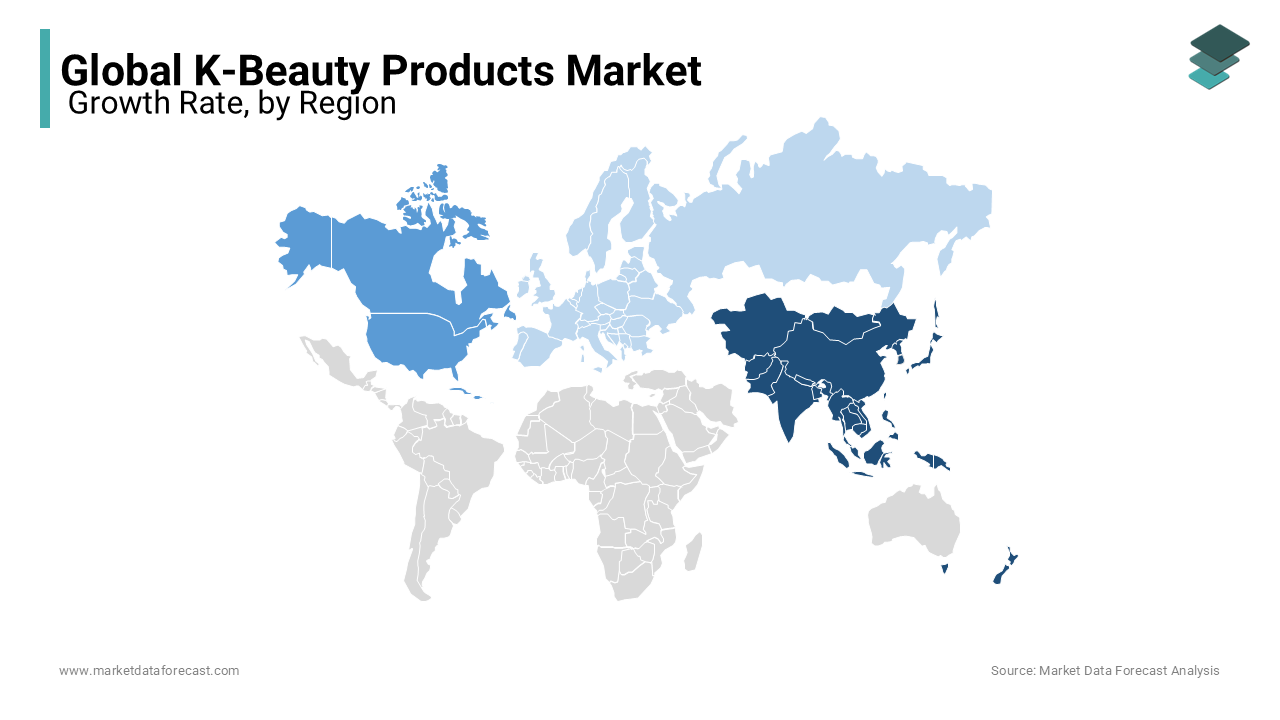
| By Region | Asia-Pacific (46.6% revenue share; anchored by South Korea's innovation hub) | — |
Major Market Players & Market Structure
Market Structure: Highly agile landscape driven by rapid product iteration, scientific validation, cultural influence, and social commerce. Industry participants heavily invest in sustainable sourcing, transparent labeling, clean beauty formulations, gender-inclusive lines, and microbiome-focused skincare.
Key Companies: ABLE C&C CO. Ltd., Adwin Korea Corp, Annie's Way International Co. Ltd., The Beauty Factory Ltd., Bluehug Inc., BNH Cosmetics, Ceragem Health and Beauty Co. Ltd., CK Beauty Enterprise Inc., LG Household & Health Care, and Amorepacific Corporation.
Global K-Beauty Products Market Size
The Global K-beauty products market was valued at USD 16.26 billion in 2025. The global market size is expected to grow at a CAGR of 11.3% from 2026 to 2034 and be worth USD 42.62 billion by 2034 from USD 18.1 billion in 2026.
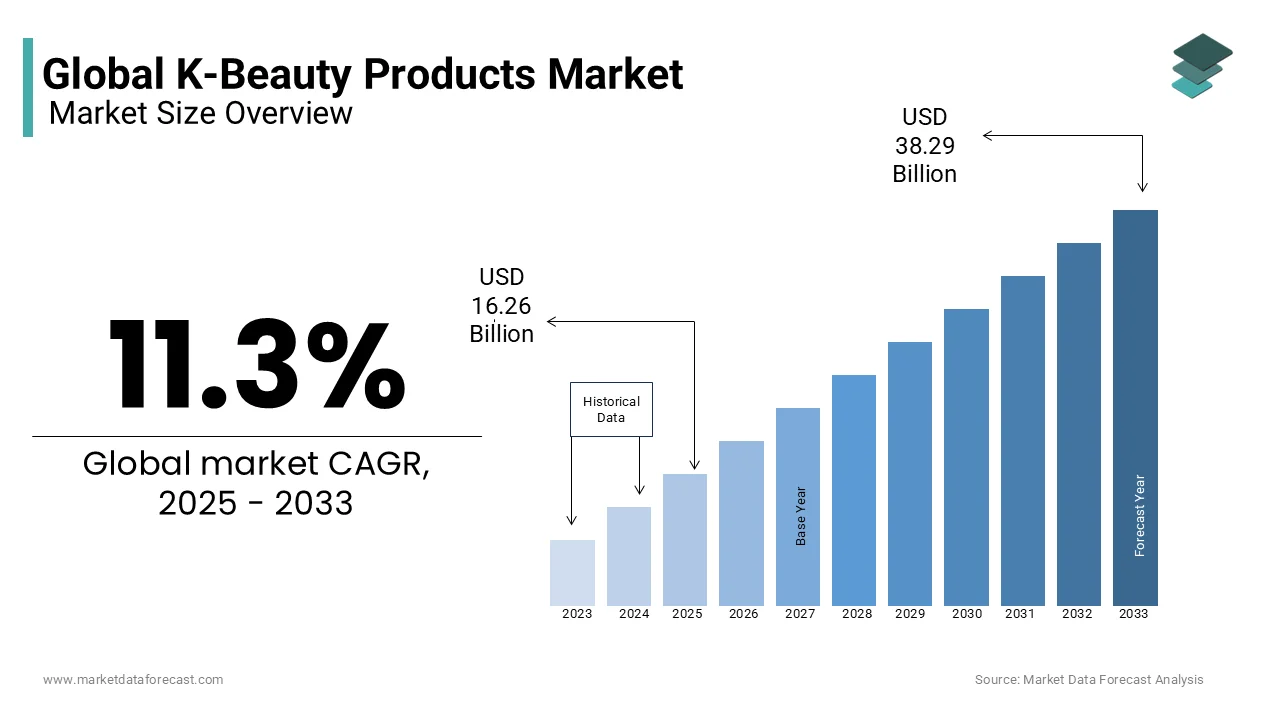
K-Beauty Products are skincare, cosmetics, and personal care items originating from South Korea, characterized by innovative formulations, multi-step regimens, and a strong emphasis on preventive care, hydration, and aesthetic refinement. Unlike conventional beauty paradigms, K-Beauty integrates scientific research with cultural aesthetics, prioritizing glass skin, minimal pore visibility, and natural enhancement over heavy coverage. The industry is anchored in South Korea’s advanced dermatological research, rigorous safety testing, and rapid product iteration cycles, often influenced by consumer feedback loops and digital engagementThis fusion of technological rigor, cultural influence, and consumer-centric innovation defines the structural uniqueness of the K-Beauty market, distinguishing it from Western and traditional beauty frameworks.
 MARKET DRIVERS
Rising Global Influence of Korean Pop Culture (Hallyu Wave)
The global proliferation of Korean pop culture, commonly referred to as the Hallyu wave, has emerged as a pivotal catalyst in the international ascent of K-Beauty products. South Korean dramas, music, and celebrity endorsements serve as de facto marketing vehicles, embedding skincare rituals and product usage into mainstream consumer consciousness. According to UNESCO, K-content consumption has surged across Southeast Asia, the Middle East, and Latin America, with Netflix listing Korean productions among its top-viewed non-English content in 94 countries during 2023. This cultural penetration directly influences beauty standards. Celebrities such as BTS and Blackpink have not only endorsed brands like Innisfree and Laneige but have also inspired limited-edition product lines that sell out within minutes. Moreover, K-pop idols are often perceived as embodying "flawless" skin, prompting fans to replicate their regimens. This symbiosis between entertainment and aesthetics has transformed cultural soft power into tangible market demand, positioning K-Beauty as a lifestyle aspiration rather than a mere cosmetic choice.
Innovation in Formulation and Product Efficacy
Its relentless focus on scientific innovation and functional efficacy, distinguishing it from conventional cosmetic offerings, is a defining driver of K-Beauty’s global appeal. South Korean brands invest heavily in dermatological research, leveraging advanced ingredients such as snail mucin, niacinamide, fermented actives, and polyglutamic acid, which have demonstrated measurable improvements in skin texture and hydration. Also, the Korean FDA mandates substantiation for functional claims such as "whitening" or "wrinkle improvement," requiring brands to submit clinical data before market entry. This emphasis on evidence-based skincare has cultivated consumer trust, particularly among millennials and Gen Z, who prioritize transparency and results. This scientific rigor, combined with rapid product iteration cycles, enables K-Beauty to stay ahead of global trends and maintain a competitive edge in the premium skincare segment.
MARKET RESTRAINTS
Stringent Regulatory Barriers in Target Markets
The complex and divergent regulatory landscape across international markets, which impedes seamless market entry and scalability, is one of the most significant restraints facing K-Beauty brands. While South Korea maintains a standardized approval process through the Ministry of Food and Drug Safety, importing countries often impose conflicting ingredient restrictions and labeling requirements. The U.S. Food and Drug Administration does not pre-approve cosmetics, but the lack of federal oversight creates liability risks. Additionally, Japan’s Pharmaceutical and Medical Devices Agency requires foreign manufacturers to appoint a local Responsible Person, increasing operational complexity. These fragmented frameworks not only increase time-to-market but also elevate compliance costs, discouraging smaller brands from international expansion and limiting the sector’s full global penetration.
Counterfeit and Grey Market Proliferation
The widespread circulation of counterfeit and grey market K-Beauty products poses a critical threat to brand integrity, consumer safety, and revenue sustainability. As global demand surges, unauthorized sellers exploit supply chain gaps by distributing imitation or expired goods through unofficial e-commerce channels. Platforms like third-party marketplaces on Amazon and social media resellers frequently offer "authentic" Korean skincare at drastically reduced prices, often sourced from parallel imports or falsified batches. Moreover, grey market goods legitimate products diverted from domestic distribution undermine pricing strategies and brand control. High-profile cases underscore the scale of the issue. These illicit practices not only damage brand equity but also expose consumers to health risks, compelling legitimate manufacturers to invest heavily in anti-counterfeiting technologies and legal enforcement, diverting resources from innovation and expansion.
MARKET OPPORTUNITIES
Expansion into Emerging Markets with Rising Disposable Incomes
Penetrating emerging economies where rising middle-class populations are increasingly investing in personal care and aesthetic enhancement is a transformative opportunity for K-Beauty brands. Countries across Southeast Asia, Latin America, and the Middle East are witnessing a cultural shift toward skincare as a form of self-care and social identity, creating fertile ground for K-Beauty adoption. Brazilian consumers are increasingly seeking lightweight, hydrating formulas suited to tropical climates aligning perfectly with K-Beauty’s signature gel-based and essence-driven products. Furthermore, governments in countries like India and Thailand are easing import regulations for cosmetics, facilitating market access. By tailoring product lines to regional skin concerns and climatic conditions, K-Beauty players can establish deep consumer resonance and capture long-term market share in high-growth economies.
Integration of Sustainable and Clean Beauty Practices
The global shift toward sustainability and clean beauty presents a strategic opportunity for K-Beauty brands to reposition themselves as ethical and environmentally responsible leaders. Consumers, particularly in North America and Europe, are demanding transparency in sourcing, reduced plastic usage, and non-toxic formulations. In addition, Korean brands are reformulating products to exclude parabens, sulfates, and synthetic fragrances, while increasing the use of biodegradable ingredients. Besides, refillable skincare systems and waterless formats, such as sheet masks made from upcycled fibers are gaining traction. In Europe, where the Green Claims Directive mandates substantiated environmental assertions, Korean brands with verified eco-practices gain competitive advantage. By aligning with global sustainability standards and leveraging Korea’s reputation for innovation, K-Beauty can transcend aesthetic appeal and become a leader in responsible beauty, capturing the loyalty of environmentally conscious consumers.
MARKET CHALLENGES
Intensifying Competition from Localized and Niche Beauty Brands
The rise of localized and niche beauty players that offer culturally resonant, hyper-targeted alternatives with greater agility and authenticity, is a growing challenge for K-Beauty brands. As consumers become more discerning, they are shifting toward brands that reflect regional skin types, traditions, and values, undermining the universal appeal of Korean formulations. Like, in France, clean beauty brands like Typology and Avène have gained market share by emphasizing dermatological testing and minimalist regimens tailored to European skin concerns. In the U.S., Black-owned brands such as Fenty Skin and Topicals are addressing underrepresented skin conditions like hyperpigmentation and acne, fostering deep community trust. Also, local e-commerce platforms in Southeast Asia, such as Tokopedia and Shopee, are promoting homegrown brands through algorithmic favoritism and subsidized logistics, limiting K-Beauty visibility. This fragmentation of consumer loyalty forces K-Beauty companies to invest in localization strategies, including regional R&D centers and culturally adapted marketing, to remain competitive in an increasingly decentralized beauty landscape.
Dependence on Digital Platforms and Algorithmic Volatility
K-Beauty’s global expansion has been heavily reliant on digital platforms such as Instagram, TikTok, and YouTube, making it vulnerable to algorithmic shifts, platform policy changes, and digital saturation. While social media has enabled rapid brand awareness and viral product launches, the unpredictability of online visibility poses a structural risk. Additionally, the reliance on third-party e-commerce marketplaces like Amazon and YesStyle exposes brands to inventory control issues and margin compression. In China, where Xiaohongshu and Taobao dominate beauty discovery, sudden content de-monetization or account suspensions can erase months of marketing progress. Overdependence on a few digital channels increases systemic fragility, especially as younger consumers migrate to emerging platforms. This digital dependency also limits brand control over messaging, with user-generated reviews and unregulated endorsements shaping perceptions more than official campaigns. To mitigate this, K-Beauty firms must diversify their digital presence, invest in owned media, and strengthen direct-to-consumer ecosystems to reduce exposure to external platform volatility.
REPORT COVERAGE
| REPORT METRIC | DETAILS |
| Market Size Available | 2025 to 2034 |
| Base Year | 2025 |
| Forecast Period | 202 to 2034 |
| Segments Covered | Based on Product Type, Distribution Channel, End-User, and Region |
| Various Analyses Covered | Global, Regional, and Country Level Analysis, Segment-Level Analysis, DROC, PESTLE Analysis, Porter’s Five Forces Analysis, Competitive Landscape, Analyst Overview of Investment Opportunities |
| Regions Covered | North America, Europe, Asia Pacific, Latin America, Middle East & Africa |
| Key Market Players | ABLE C&C CO., Ltd., Adwin Korea Corp, Annie's Way International Co., Ltd., The Beauty Factory, Ltd., Bluehug, Inc., BNH Cosmetics, Ceragem Health and Beauty Co, Ltd., CK Beauty Enterprise Inc., LG Household & Health Care, and Amorepacific Corporation. |
SEGMENTAL ANALYSIS
By Product Type Insights
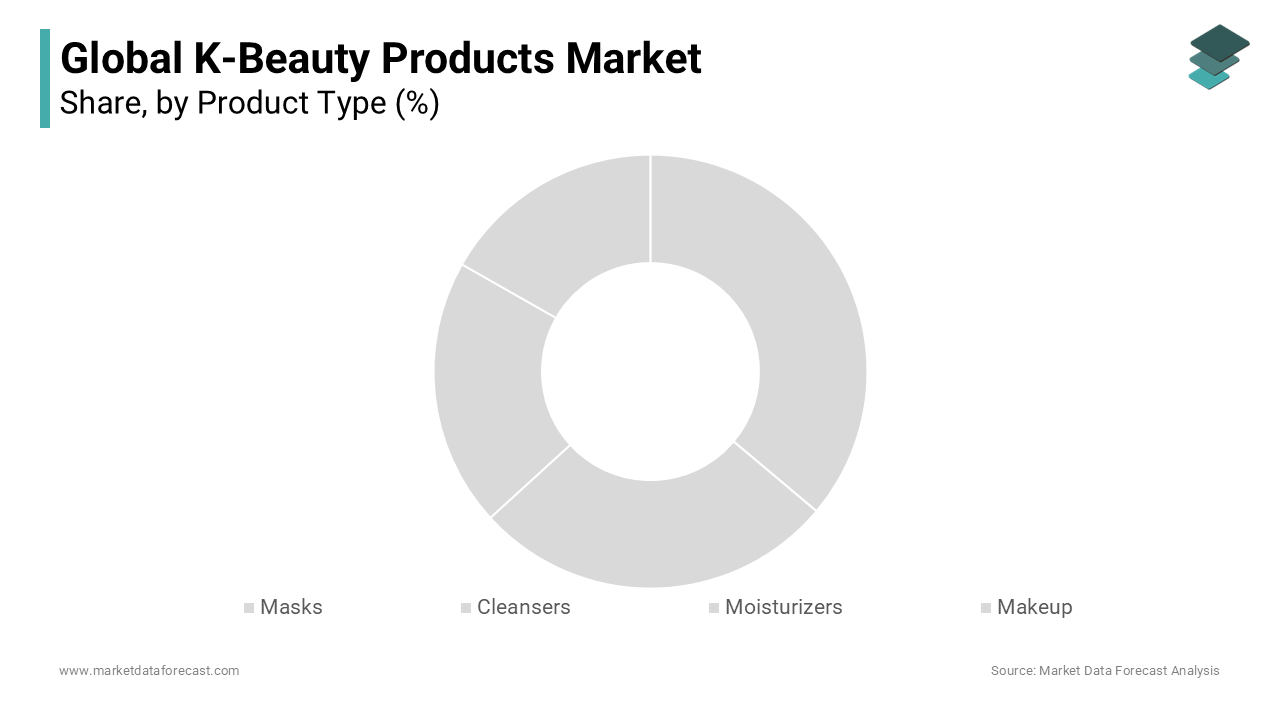
The moisturizers segment represented the largest product type in the global K-Beauty products market by capturing a 34.5% of total revenue in 2025. This dominance is rooted in the foundational role of hydration within Korean skincare philosophy, where maintaining a strong skin barrier and achieving "glass skin" are central aesthetic goals. Unlike Western regimens that often prioritize treatment over prevention, K-Beauty emphasizes continuous moisture retention through lightweight essences, emulsions, and gel-cream formulations. The popularity of ingredients such as hyaluronic acid, ceramides, and beta-glucan integral to most K-Beauty moisturizers has been clinically validated. With climate-induced dryness and pollution driving global demand for protective hydration, the centrality of moisturizers in K-Beauty regimens ensures their sustained market leadership.
The cleansers segment is emerging as the fastest-growing in the K-Beauty market and is projected to expand at a CAGR of 12.7% from 2025 to 2033. This surge is fueled by the rising adoption of double cleansing, a two-step process involving an oil-based cleanser followed by a water-based one, which has become a cornerstone of K-Beauty routines worldwide. The practice, originally popularized in South Korea to remove sunscreen and makeup without stripping natural oils, is now widely embraced in Western markets for its gentleness and efficacy. Korean brands like Banila Co and Heimish have led this trend. Additionally, the shift toward sulfate-free, pH-balanced, and microbiome-friendly formulas aligns with global clean beauty movements. With consumers increasingly recognizing cleansing as a critical step in skin health rather than mere hygiene, the segment is poised for sustained acceleration.
By Distribution Channel Insights
The online retailers segment dominated the K-Beauty distribution landscape by accounting for 52.5% of total share in 2025. This preeminence is due to the digital-native nature of K-Beauty’s global expansion, where social media influence, cross-border e-commerce, and direct-to-consumer models have bypassed traditional retail gatekeepers. Platforms such as YesStyle, Soko Glam, and Amazon have become primary access points for international consumers seeking authentic Korean formulations. The integration of video content and influencer reviews on sites like TikTok and YouTube has transformed product discovery. Additionally, subscription models and personalized skincare quizzes offered by online retailers enhance customer engagement and retention. With logistics improvements enabling faster delivery and reliable cold-chain shipping for sensitive products, online retail has become the most efficient and scalable channel for K-Beauty penetration, particularly in markets lacking physical specialty stores.
The specialty and monobrand stores segment is experiencing the fastest growth within the distribution channel segment and is expanding at a CAGR of 11.3% from 2025 to 2033. This growth is driven by the strategic retail expansion of major K-Beauty conglomerates seeking immersive brand experiences and direct consumer engagement. Companies like Amorepacific, LG Household & Health Care, and Innisfree have invested heavily in flagship stores that blend retail with education, offering skin consultations, product trials, and cultural storytelling. These stores are designed to reflect Korean aesthetics, minimalist, nature-inspired, and tech-integrated, enhancing brand perception. The emphasis on sustainability, such as refill stations and recyclable packaging, is particularly effective in attracting environmentally conscious millennials. As brands seek to differentiate in a crowded digital space, physical specialty stores offer a tactile, trust-building interface that strengthens loyalty and justifies premium positioning.
By End-User Insights
The women segment constituted the dominant end-user in the K-Beauty market by representing substantial portion of total consumption in 2025. This overwhelming share is driven by deeply embedded cultural norms in South Korea and across Asia, where skincare is considered an essential aspect of femininity, self-care, and social presentation. From adolescence, women are socialized into multi-step regimens, often beginning with early exposure to beauty routines in schools and family settings. K-Beauty marketing is predominantly tailored to female consumers, emphasizing concerns such as brightening, anti-aging, and pore refinement issues frequently highlighted in K-dramas and women’s magazines. Moreover, social platforms like Instagram and Xiaohongshu are dominated by female beauty influencers who shape purchasing trends. With product lines, packaging, and advertising consistently centered on female identity and beauty ideals, the segment remains the core engine of K-Beauty demand, supported by both cultural tradition and commercial strategy.
The male end-user segment is growing at the fastest rate in the K-Beauty market, with a CAGR of 14.2% between 2025 and 2033. This acceleration is driven by shifting societal attitudes toward male grooming and the normalization of skincare among younger generations. In South Korea, the concept of "male beauty" has gained mainstream acceptance, with male celebrities and K-pop idols openly endorsing serums, BB creams, and sheet masks. Brands like Tony Moly and The Face Shop have launched gender-neutral or men-specific lines featuring lightweight textures and minimalist packaging to appeal to male consumers. Western markets are also witnessing a cultural shift. With social media dismantling traditional gender norms and brands embracing inclusivity, the male segment is transforming from a niche to a high-potential growth frontier in the K-Beauty ecosystem.
REGIONAL ANALYSIS
Asia Pacific K-Beauty Products Market Analysis
Asia-Pacific held the most influential position in the global K-Beauty market by commanding 46.6% of total revenue in 2025. The region’s dominance is anchored in South Korea’s role as both originator and innovator, supported by neighboring markets that have rapidly adopted and localized K-Beauty trends. The popularity of Korean skincare is amplified by cultural proximity and media influence. Japan, despite its strong domestic beauty industry, has seen an increase in K-Beauty sales, driven by demand for novel ingredients and lightweight textures. Southeast Asia is a high-growth subregion. India’s e-commerce platforms like Nykaa and Flipkart have dedicated K-Beauty sections, reflecting growing consumer interest. The ASEAN Cosmetics Directive has also streamlined regulatory alignment, facilitating market access. With regional consumers sharing similar skin concerns melanin sensitivity, humidity-related oiliness, and pollution exposure K-Beauty formulations resonate deeply. Government-backed initiatives like Korea’s "K-Beauty Globalization Project" further strengthen export infrastructure, ensuring Asia-Pacific remains the epicenter of K-Beauty consumption and innovation.
North America K-Beauty Products Market Analysis
North America is another major market for K-Beauty products. The region’s significance lies in its high consumer receptivity to innovation, premiumization, and holistic skincare philosophies. The United States, in particular, has embraced K-Beauty as a disruptive alternative to traditional Western regimens, with major retailers like Sephora and Ulta dedicating entire sections to Korean brands. A key driver is the influence of digital communities. The rise of dermatologist-endorsed routines has further legitimized K-Beauty in clinical circles. Canada has followed a similar trajectory. The preference for non-comedogenic, fragrance-free, and cruelty-free formulations aligns with North American clean beauty trends. With brands like Glow Recipe and Cosrx achieving cult status, and K-pop fandoms driving viral launches, North America has become a critical growth engine for K-Beauty’s premium and mass-market segments alike.
Europe K-Beauty Products Market Analysis
Europe holds significant position in the K-Beauty market. The region’s market is characterized by selective adoption, with strong penetration in Western and Northern Europe, where consumers prioritize efficacy, sustainability, and scientific validation. The United Kingdom leads European demand, with K-Beauty sales increasing in 2023. French consumers, known for their preference for dermatological skincare, are increasingly drawn to K-Beauty’s evidence-based formulations. In Russia, despite geopolitical challenges, K-Beauty maintains a loyal following. With sustainability directives like the EU Green Claims Regulation reshaping marketing norms, K-Beauty brands that integrate clean ingredients and transparent sourcing are gaining competitive advantage. Although adoption is slower in Southern Europe, digital platforms and influencer collaborations are gradually expanding reach, positioning Europe as a maturing, quality-driven market.
Latin America K-Beauty Products Market Analysis
Latin America represents an emerging segment in the K-Beauty market. The region’s growth is concentrated in urban centers of Brazil, Mexico, and Colombia, where rising disposable incomes and digital connectivity are fueling interest in advanced skincare. Brazil is the largest market, with K-Beauty imports increasing in 2023. The appeal lies in lightweight, non-greasy formulations suited to tropical climates. Chile and Argentina are also witnessing growth, driven by e-commerce platforms. However, high import tariffs and regulatory fragmentation across countries pose challenges. Despite these hurdles, the cultural affinity for beauty and grooming, combined with increasing exposure to global trends, positions Latin America as a high-potential frontier for K-Beauty expansion.
Middle East and Africa K-Beauty Products Market Analysis
The Middle East and Africa collectively representing a nascent yet strategically significant region. The Gulf Cooperation Council countries, particularly the UAE and Saudi Arabia, are the primary entry points, where affluent consumers seek premium skincare solutions. Like, demand for hyperpigmentation treatments and brightening serums has surged, aligning with K-Beauty’s focus on luminous, even-toned skin. In Saudi Arabia, Vision 2030 includes initiatives to expand the personal care sector. South Africa is the leading market in Africa. However, challenges persist. In Egypt and Nigeria, counterfeit goods remain prevalent, limiting trust in authentic K-Beauty. Nevertheless, digital platforms like Namshi and Jumia are improving access, while brands like Laneige have opened counters in Dubai Mall to build credibility. With rising beauty consciousness and government support for wellness economies, the region is gradually opening to K-Beauty’s preventive, science-led approach.
KEY MARKET PLAYERS AND COMPETITIVE LANDSCAPE
Some of the notable companies operating in the global K-beauty products market analyzed in this report include ABLE C&C CO., Ltd., Adwin Korea Corp, Annie's Way International Co., Ltd., The Beauty Factory, Ltd., Bluehug, Inc., BNH Cosmetics, Ceragem Health and Beauty Co, Ltd., CK Beauty Enterprise Inc., LG Household & Health Care and Amorepacific Corporation.
The competitive dynamics of the K-Beauty products market are defined by a convergence of innovation, cultural influence, and digital agility, where differentiation hinges on brand authenticity, scientific rigor, and consumer engagement. While South Korean conglomerates dominate through scale and heritage, a new wave of independent and digitally native brands is challenging the status quo with niche positioning and rapid product iteration. The market is no longer solely about replicating the 10-step routine but revolves around tailored solutions for specific concerns such as barrier repair, sensitivity, and environmental protection. Competitors are increasingly investing in clinical validation, sustainable sourcing, and transparent labeling to meet the demands of informed consumers. The rise of clean beauty, gender inclusivity, and microbiome-focused formulations has intensified product differentiation, compelling established players to evolve beyond traditional aesthetics. Regional brands in China, India, and France are gaining traction by offering culturally resonant alternatives, forcing K-Beauty firms to localize rather than globalize uniformly. At the same time, the reliance on social commerce and influencer ecosystems has created a fast-paced environment where viral trends can make or break a product overnight. Success in this arena requires more than formulation excellence it demands narrative mastery, ethical integrity, and the ability to anticipate shifting consumer values in real time.
TOP PLAYERS IN THE MARKET
Amorepacific
Amorepacific stands as a cornerstone of the global K-Beauty movement, renowned for its fusion of traditional Korean herbal wisdom with cutting-edge scientific research. The company operates a diverse portfolio of brands, including Sulwhasoo, Laneige, IOPE, and Mamonde, each tailored to distinct consumer needs while maintaining a unified commitment to innovation and efficacy. Amorepacific has played a pivotal role in elevating K-Beauty from a regional trend to a global standard by establishing flagship stores in major international cities and pioneering clinical validation for skincare claims. Its investment in R&D, sustainability, and cultural storytelling has set benchmarks for quality and brand authenticity. By integrating digital diagnostics, eco-conscious packaging, and dermatological collaboration, Amorepacific has redefined premium skincare expectations, making it a leader in both heritage-driven and modern K-Beauty experiences.
LG Household & Health Care (LG H&H)
LG Household & Health Care has emerged as a dominant force in the K-Beauty landscape through its scientifically advanced brand portfolio, particularly The History of Whoo and SU:M37°, which blend luxury, fermentation technology, and royal-inspired aesthetics. The company distinguishes itself through rigorous product development, leveraging in-house dermatology research and biotechnology to deliver high-performance formulations. LG H&H has successfully positioned its brands in premium retail spaces across Asia and the West, emphasizing exclusivity and efficacy. Its global expansion strategy integrates cultural sophistication with clinical credibility, appealing to consumers seeking both indulgence and results. By prioritizing ingredient innovation, sustainable manufacturing, and immersive retail experiences, LG H&H has solidified its reputation as a purveyor of elite K-Beauty, bridging tradition with modern science to captivate discerning skincare enthusiasts worldwide.
Innisfree
Innisfree has become a global symbol of clean, nature-inspired K-Beauty, distinguished by its commitment to sourcing ingredients from Jeju Island and promoting eco-friendly practices. As a pioneer in sustainable beauty, the brand emphasizes transparency, minimal processing, and recyclable packaging, resonating with environmentally conscious consumers. Innisfree’s philosophy of “naturalism” extends beyond products to store design, customer experience, and community engagement, creating a holistic brand identity. Its global presence, marked by flagship stores in New York, Shanghai, and Dubai, reflects a strategic blend of authenticity and accessibility. By combining volcanic clay, green tea, and tangerine extracts with modern dermatological insights, Innisfree delivers effective, sensorial skincare that appeals to a broad demographic. Its success lies in harmonizing ethical values with aesthetic innovation, making it a trailblazer in the convergence of nature and science within the K-Beauty realm.
TOP STRATEGIES USED BY KEY PLAYERS
One of the most impactful strategies employed by leading K-Beauty players is the creation of immersive brand experiences through experiential retail and cultural storytelling. Companies are designing flagship stores that reflect Korean aesthetics minimalist, nature-integrated, and technology-enhanced to foster emotional connections with consumers. These spaces often feature skin diagnostics, product customization, and interactive displays that elevate shopping into a personalized journey, reinforcing brand loyalty beyond transactional relationships.
Another key approach is the strategic localization of formulations and marketing to align with regional skin concerns, cultural preferences, and regulatory environments. Brands are adapting ingredient profiles, textures, and fragrance levels to suit diverse climates and consumer expectations, such as lighter textures for humid regions or enhanced sun protection for high-UV zones. This regional customization ensures relevance and efficacy, increasing consumer trust and adoption.
Digital engagement and influencer collaboration remain central to market penetration. K-Beauty companies leverage social media platforms, virtual try-ons, and AI-powered skincare advisors to drive discovery and education. By partnering with dermatologists, beauty editors, and micro-influencers, they amplify credibility and create authentic narratives that resonate across global audiences, ensuring sustained visibility in a highly competitive digital landscape.
RECENT HAPPENINGS IN THE MARKET
- In February 2024, Amorepacific launched a global AI-powered skin diagnostic platform integrated into its e-commerce sites and flagship stores. This innovation allows customers to receive personalized skincare regimens based on real-time analysis of skin conditions, enhancing customer engagement and product relevance across international markets.
- In March 2024, LG Household & Health Care opened a new R&D center in Shanghai dedicated to developing region-specific formulations for Chinese consumers. This facility focuses on addressing hyperpigmentation and urban pollution damage, reinforcing LG H&H’s commitment to localized innovation and regulatory alignment.
- In January 2024, Innisfree introduced a refillable skincare system in all its European stores, utilizing biodegradable containers and Jeju-sourced ingredients. This initiative supports its global sustainability pledge and strengthens brand loyalty among eco-conscious consumers in the region.
- In April 2024, Sulwhasoo, a luxury brand under Amorepacific, collaborated with the National Museum of Korea to release a limited-edition packaging collection inspired by Joseon-era art. This cultural partnership elevated brand prestige and deepened emotional resonance with heritage-conscious consumers.
- In May 2024, Laneige expanded its presence in the Middle East by opening a flagship store at Dubai Mall, featuring augmented reality mirrors and on-site dermatologist consultations. This move reinforces its premium positioning and enhances accessibility for high-end skincare consumers in the GCC region.
MARKET SEGMENTATION
This research report on the global K-beauty products market has been segmented and sub-segmented into the following categories.
By Product Type
- Masks
- Cleansers
- Moisturizers
- Makeup
- Others
By Distribution Channel
- Online Retailers
- Supermarkets\Hypermarkets
- Specialty\Monobrand Stores
- Others
By End-User
- Men
- Women
By Region
- North America
- Europe
- Asia-Pacific
- Latin America
- Middle East and Africa