- Product Description Description
- Table of Contents TOC
- List of Table & Figure LOT
- Get Free Sample PDF Sample PDF
Market Size, 2025
$2.07 BnMarket Estimate, 2026
$2.33 BnMarket Forecast, 2034
$5.93 BnCAGR, 2026–2034
12.40%Executive Summary: Global Handheld Imaging Devices Market
- Market Scope: Comprehensive global analysis of the handheld imaging devices sector, covering product types (ultrasound, X-ray, optical imaging, OCT, NIR), hardware components and accessories, clinical end-users, and regional adoption.
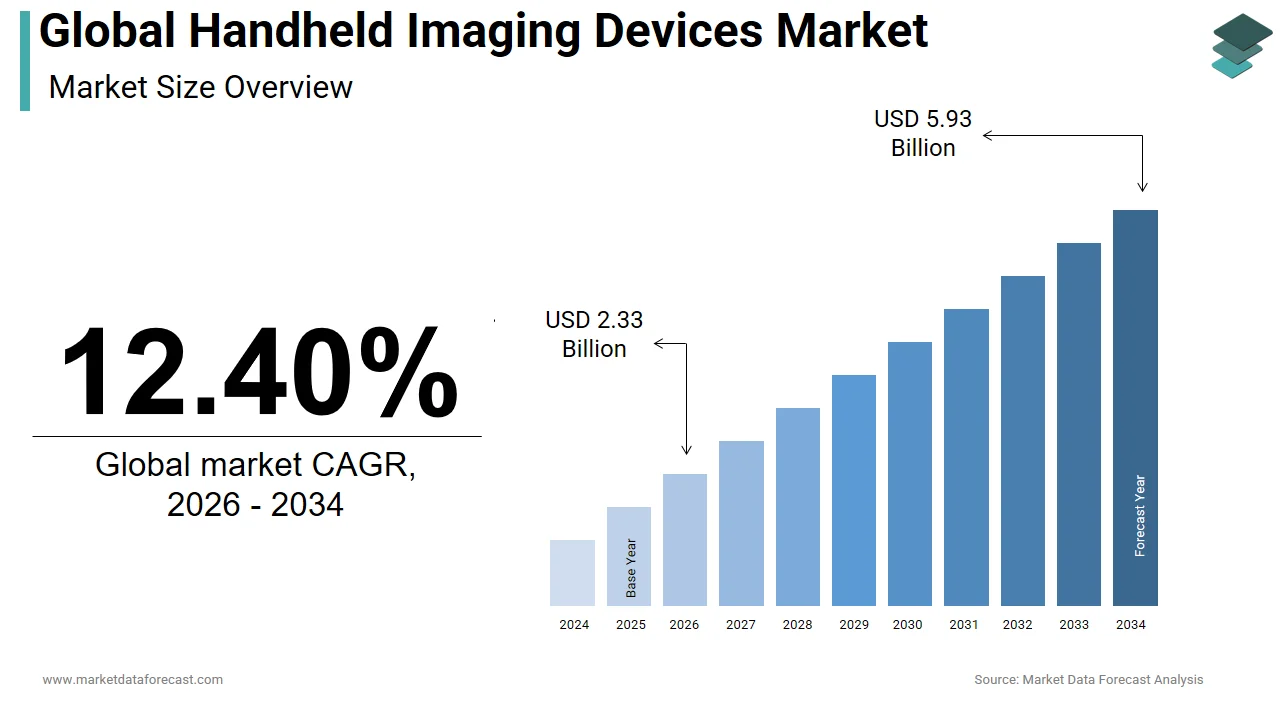
- Market Valuation: Valued at USD 2.07 billion in 2025, reaching USD 2.33 billion in 2026, and projected to expand to USD 5.93 billion by 2034, growing at a robust CAGR of 12.40% from 2026 to 2034.
- Primary Growth Drivers: Rapid technological miniaturization of components and AI/ML-driven analytical algorithms, rising global prevalence of cancer and chronic orthopedic disorders, and increasing demand for rapid point-of-care diagnostics.
Key Market Segment Metrics
| Category | Leading Segment (Base Position) | Fastest-Growing / High-Growth Segment |
|---|---|---|
| By Product Type | Ultrasound Scanners (held significant market share, driven by point-of-care portability and real-time critical care imaging) | Optical Imaging Devices (high-growth segment supporting chronic disease monitoring and advanced diagnostic screening) |
| By Component | Devices (captured the major market share, backed by surging demand for portable point-of-care imaging hardware) | Accessories (fastest-growing segment supporting expanded device utilization across cardiology, gynecology, and dermatology) |
| By End-User | Hospitals (held the leading market position, driven by critical care room needs and emergency room triage requirements) | Diagnostic Centers (fastest-growing end-user segment expanding via high-volume outpatient disease monitoring and screening) |
| By Region | North America (market leader holding 52.7% share in 2022, backed by advanced healthcare tech adoption and favorable reimbursement) | Europe (fastest-growing regional market driven by cost-effective portable healthcare delivery and supportive government initiatives) |
Major Market Players & Industry Landscape
Market Structure: Competitive global medical device ecosystem featuring established healthcare giants and agile innovators developing compact, AI-integrated handheld ultrasound and optical imaging systems.
Key Companies: General Electric Company, Smith & Nephew, Inc., Healcerion, Inc., Micro C, LLC, Hunan Ramzed Medical Imaging Technology Co., Ltd., Siemens, Koninklijke Philips N.V., Butterfly Network, Inc., BLZ Technology Inc., and Kent Imaging Inc.
 Download Free Sample Report
Global Handheld Imaging Devices Market Size
The global handheld imaging devices market was valued at USD 2.07 billion in 2025, is estimated to reach USD 2.33 billion in 2026, and is projected to reach USD 5.93 billion by 2034, growing at a CAGR of 12.40% from 2026 to 2034.
MARKET DRIVERS
One of the major key factors propelling the growth of the market is the technological advancement in the handheld imaging devices market. The advancement in the material allowed the miniaturization of imaging components, which makes handheld devices more compact and portable, this has expanded the potential use of handheld imaging devices across the healthcare sector. Technological advancement has led to the development of high-resolution sensors, and advanced algorithms, which enhance color accuracy, and clarity in the devices making medical diagnosis more easy, the adoption of artificial intelligence and machine learning capabilities has transformed handheld imaging devices into powerful analytical tools, thus this advancement majorly fuel the growth of the handheld imaging devices market.
The second major factor fueling the growth of the market is the rising prevalence of cancer and orthopedic diseases. Globally there was around 10 million death caused by cancer in 2022, these diseases need accurate and timely imaging for diagnosis, treatment, and also monitoring of the disease progress. Handheld imaging devices are more convenient and accessible for detecting and diagnosing cancer and orthopedic diseases at early stages which help healthcare professionals to perform quick point-of-care imaging and enable timely intervention. The portability and easy handling ability of these devices are valuable for screening a large population for cancer and orthopedic condition, thus this factor is also expected to fuel the market growth in the upcoming years.
Another major factor favoring the growth of the market is the changing lifestyle and aging population. As the aging population rises globally and due to continuous lifestyle changes there is more demand for these devices. As more people daily rely on junk food, also due to hectic workloads many people are mentally disturbed also more people now are health-conscious, thus there is an emerging need for regular health monitoring, thus handheld imaging devices enable individuals to monitor their health parameters such as blood pressure, glucose level and heart rate from the comfort of their homes. The aging population led to the rise in the prevalence of chronic and cardiovascular diseases, thus handheld imaging devices led to the management of these diseases and help healthcare providers to monitor disease progression and to make treatment plans thus this factor majorly propelled the growth of the market.
The other key factor propelling the growth of the market include technological advancement, rising research and development activity, advancement in handheld imaging devices, the convenience of use, the diagnosis of cancer and cardiovascular diseases, changing lifestyles, and the aging population fueling the growth of the market.
MARKET RESTRAINTS
There are many factors rapidly driving the growth of the handheld imaging devices market but there are some factors that negatively hamper the overall growth of the global market. The major challenges associated with the image artifact such as technical error, reduced image quality, and clinical difficulties majorly hampering the growth of the market. Another major factor hindering the growth is the high cost associated with handheld imaging devices majorly limits the growth of the market. Technological advancement, innovation, and rising research and development activity majorly raise the production and development expenses, the higher price limits the affordability of the devices due to limited budget and the financial crisis occur due to the global pandemic crisis which negatively impacted the adoption of the devices in many healthcare authorities. The regulatory approval process and reimbursement policies are costly and time-consuming which delays the availability of this equipment in the market, thus all factors hampering the growth of the market.
REPORT COVERAGE
| REPORT METRIC | DETAILS |
| Market Size Available | 2025 to 2034 |
| Base Year | 2025 |
| Forecast Period | 2026 to 2034 |
| Segments Covered | By Patient Position, Application, End-use, and Region. |
| Various Analyses Covered | Global, Regional, and Country-Level Analysis, Segment-Level Analysis, Drivers, Restraints, Opportunities, Challenges; PESTLE Analysis; Porter’s Five Forces Analysis, Competitive Landscape, Analyst Overview of Investment Opportunities |
| Regions Covered | North America, Europe, Asia Pacific, Latin America, Middle East & Africa |
| Market Leaders Profiled | General Electric Company, Smith & Nephew, Inc., Healcerion, Inc., Micro C, LLC, Hunan Ramzed Medical Imaging Technology Co., Ltd., Siemens, Koninklijke Philips N.V., Butterfly Network, Inc., BLZ Technology Inc., and Kent Imaging INC. |
SEGMENT ANALYSIS
By Product Type Insights
Based on product type, the ultrasound scanner segment accounted for a significant market share in the worldwide market during the forecast period. the factors such as emerging demand for portable and point-of-care ultrasound devices, rapid adoption of the devices in gynecology, the rising number of advancements in the technologies, the surging need for real-time imaging, and rapid diagnosis in critical care fuel the growth of the segment in the global market.
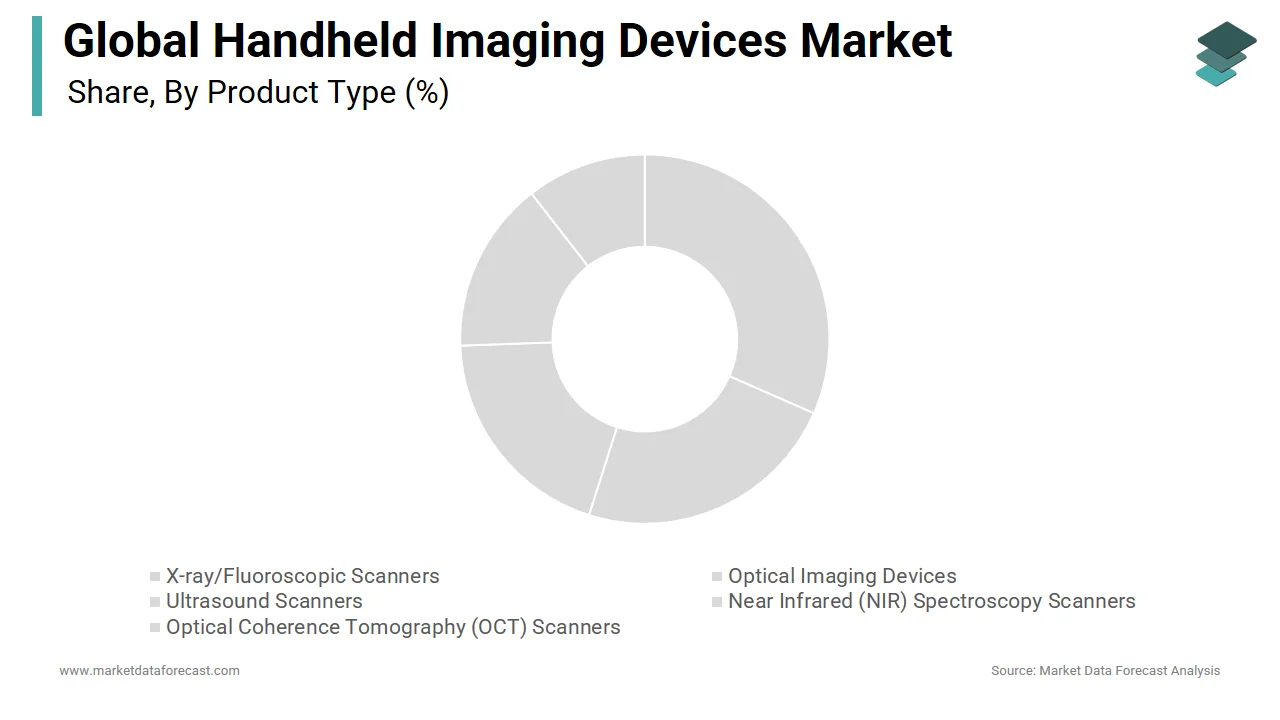
Optical imaging devices are another segment that accounted for a considerable share of the worldwide handheld imaging devices market. The rising prevalence of chronic diseases is a major factor that drives the growth of the optical imaging devices segment and helps to boost the growth of the market.
By Component Insights
Based on the component, the devices segment is anticipated to hold the major market share in the worldwide market. The emerging demand for portable and handheld imaging devices for point-of-care diagnostics, technological advancement, the rising adoption of the devices in the dermatology, gynecology, and cardiology sector, growing prevalence of chronic disease, all factors propel the growth of the segment and fuel the growth of the market.
The accessories segment is also anticipated to dominate the market and hold a substantial market share in the worldwide handheld imaging devices market.
By End-user Insights
Based on End-user, the hospital segment is anticipated to hold the leading market share during the projected period. The emerging demand for portable imaging devices to enhance patient care and treatment outcome in the hospital boost the growth. The increasing emphasis on the point of care imaging for rapid diagnosis and immediate treatment decisions, the advancement in the devices, and the necessities of these devices in the emergency room and critical room fuel the growth of this segment and propel the market growth.
The diagnostic center segment is also expected to grow at the highest CAGR during the projected period. The emerging demand for handheld devices in the diagnostic center for imaging and monitoring disease condition majorly boost the growth of the segment and favors the market growth.
REGIONAL ANALYSIS
North America is the leading region in the global market holding the largest market revenue of 52.7% in 2022. This region is anticipated to continue to dominate the market during the forecast period. The rising adoption of advanced handheld imaging devices in various medical fields, the rising prevalence of the chronic condition, and the surge of point-of-care imaging solutions, also the technological advancement and innovation in handheld imaging devices, favorable reimbursement policies contributed to the overall growth of the market in this region. This region has the presence of a prominent market player which majorly focuses on product development, and rising healthcare expenditure this all factor drives the growth of the market in this region.
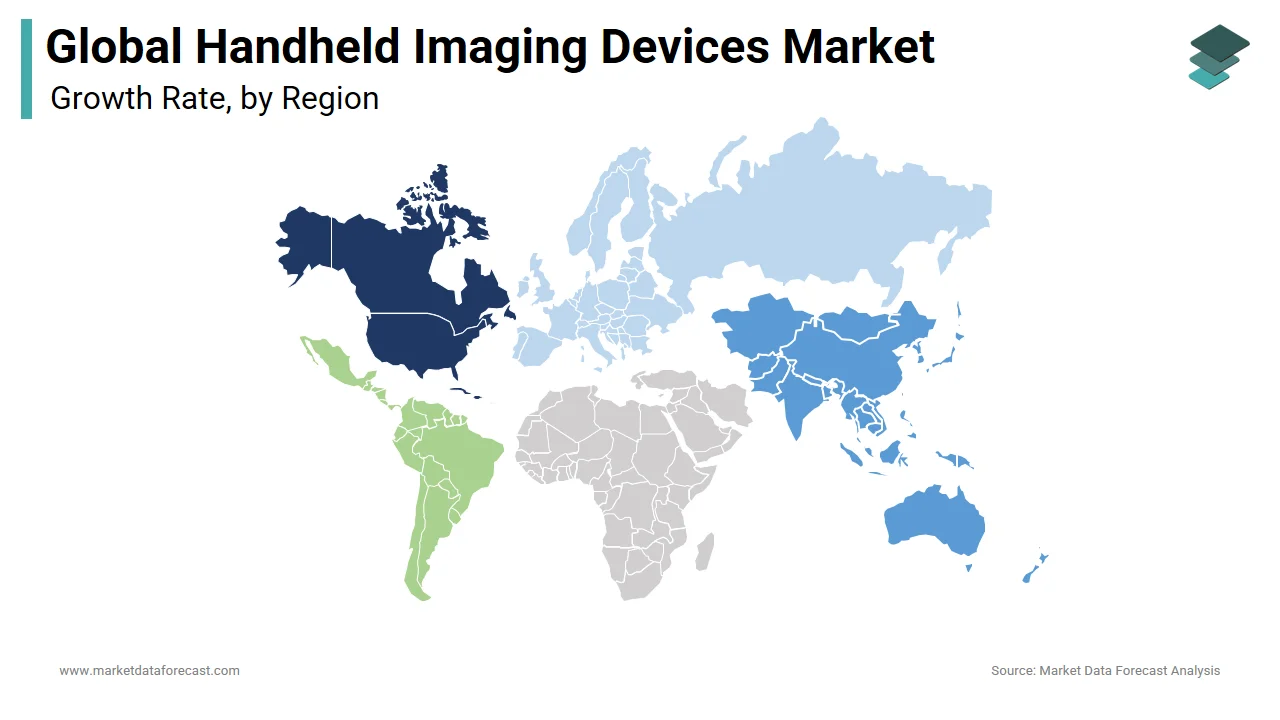
Europe is the second-largest region anticipated to grow at the fastest CAGR during the projected period. The major factor boosting the growth of the market in this region include growing healthcare expenditure, rising medical imaging procedures, demand for portable and handheld imaging devices for cost-effective healthcare delivery, growing prevalence of chronic disease and the necessities for timely diagnosis and monitoring, supportive government initiative this all factor fueling the growth of the market in this region.
The Asia-Pacific region is expected to show lucrative growth in this region and is anticipated to dominate the market at the longest CAGR during the projected period. Factors such as technological advancement and developing healthcare facilities, the growing awareness about the benefits of early diagnosis, and advanced medical technologies favor the growth of the market in this region.
The Latin America and Middle East and Africa region is expected to grow at significant CAGR and earn more market revenue in the upcoming years.
KEY MARKET PLAYERS
The prominent key player in the global handheld imaging devices market are
- General Electric Company
- Smith & Nephew, Inc.
- Healcerion, Inc.
- Micro C, LLC
- Hunan Ramzed Medical Imaging Technology Co., Ltd.
- Siemens
- Koninklijke Philips N.V.
- Butterfly Network, Inc.
- BLZ Technology Inc.
- Kent Imaging Inc.
MARKET SEGMENTATION
This research report on the global handheld imaging devices market has been segmented and sub-segmented based on the product, component, end-user, and region.
By Product Type
- X-ray/Fluoroscopic Scanners
- Optical Imaging Devices
- Ultrasound Scanners
- Near Infrared (NIR) Spectroscopy Scanners
- Optical Coherence Tomography (OCT) Scanners
By Component
- Devices
- Accessories
By End-user
- Hospitals
- Diagnostic Centers
- Point of Care
By Region
- North America
- Latin America
- Europe
- Asia-Pacific
- Middle East and Africa