- Product Description Description
- Table of Contents TOC
- List of Table & Figure LOT
- Get Free Sample PDF Sample PDF
Market Size, 2025
$62.52 BnMarket Estimate, 2026
$67.52 BnMarket Forecast, 2034
$124.98 BnCAGR, 2026–2034
8%Global Home Security System Market Size
The global home security system market was valued at USD 62.52 billion in 2025. The global market is predicted to reach USD 67.52 billion in 2026 and USD 124.98 billion by 2034, growing at a CAGR of 8% during the forecast period.
A home security system consists of a combination of software and hardware devices designed to detect intrusions or unauthorized intrusions when a security area is breached. It can work even during power outages and warns of environmental hazards such as carbon monoxide emissions, fires, floods, etc. Today's home security systems are microprocessor-based, perform a variety of functions, and are easy to use. The Home Security Solutions market size is expected to experience growth opportunities that are in line with the forecast schedule due to rising crime rates and immoral practices in residential areas. Modernized and effective security systems, such as remote monitoring services, drive the market by increasing consumer interest in home security solutions. Home security systems and solutions include facilities ranging from alarm systems, motion detectors, and camera systems to access control. These systems are built into homes for several reasons, including protection against burglary, fire accidents, and other aspects related to occupant safety.
MARKET DRIVERS
The global demand for home security systems is increasing due to the need to ensure optimal security in residential spaces.
Home security systems have emerged as an integral part of the modern home system. The residential sector has seen rapid growth over the past decade and this factor has played a significant role in driving demand in the global home security systems market. Home security systems include a variety of products that can help protect your residential space from intrusive elements. The increasing incidence of crime and accidents in residential complexes has taken the demand for home security systems to a new level.
The global market for home security systems is supposed to bring huge benefits in the future. Also, global home security system market vendors are likely to introduce key business strategies in the coming years. The market demand for home security systems has reached a new level in the last decade. Residential complexes and societies are equipped with the latest security technologies that have driven the growth of the global market. Besides, the global market for home security systems will expand due to government regulations on home security. The demand for home security systems will be driven by the increased adoption of smart homes, where smart security systems are an integral part. The introduction of the smart home is made possible by advancements in future technologies such as IoT. In addition, the growing adoption of the Internet, tablets, and smartphones is paving the way for the introduction of IoT in home security through smart applications. IoT has improved the quality of products and the consistency of automation systems. The successful integration of IoT networks, which facilitates remote, real-time, and automated monitoring of the home environment, has helped develop smart homes.
Therefore, security systems based on wireless technology are one of the main advancements in the field of home security solutions, and the IoT is widely favored by owners to ensure effective protection.
The rise of mobile monitoring devices, attractive protection plans, increased use of smartphones and tablets, and increased customer awareness will expand the market for home security solutions. In addition, the intensification of competition between distributors and suppliers to provide a variety of services due to the demand for home appliances will have a positive impact on the industry. The technological advancement of the home security solutions market has gradually evolved over the years. Video surveillance technology is one of the trends in the global home security solutions market, as videos collected from surveillance can now be shared or streamed to computers and mobile devices, making them accessible anytime, anywhere. Additionally, solution providers and resellers should strive to incorporate a high-tech approach to retain existing customers and acquire new ones. The increasing demand for these products will provide opportunities for market growth. The rising need for wireless technology and ease of installation has provided many opportunities for the growth of the home security solutions market around the world.
MARKET RESTRAINTS
The high cost of the installation and maintenance of home security systems is hampering the market growth. Customers are increasingly aware of the benefits of home security systems. Another main problem vendors face in the Home Security Systems market is the lack of "human contact" with these systems, making it difficult for vendors to convince customers that the devices installed in their systems are authentic.
REPORT COVERAGE
| REPORT METRIC | DETAILS |
| Market Size Available | 2025 to 2034 |
| Base Year | 2025 |
| Forecast Period | 2026 to 2034 |
| CAGR | 8% |
| Segments Covered | By Type, Type Of Housing, and Region. |
|
Various Analyses Covered | Global, Regional & Country Level Analysis, Segment-Level Analysis, DROC, PESTLE Analysis, Porter’s Five Forces Analysis, Competitive Landscape, Analyst Overview on Investment Opportunities |
| Regions Covered | North America, Europe, APAC, Latin America, Middle East & Africa |
|
Market Leaders Profiled | Alarm.com, Allegion PLC, Bosch Security Systems, ASSA ABLOY, Godrej & Boyce Manufacturing Company Limited, Control Corporation, Ingersoll-Rand Solutions, Honeywell International, Inc., Tyco, Nortek Security & Control LLC and UTC Fire & Security and Others. |
REGIONAL ANALYSIS
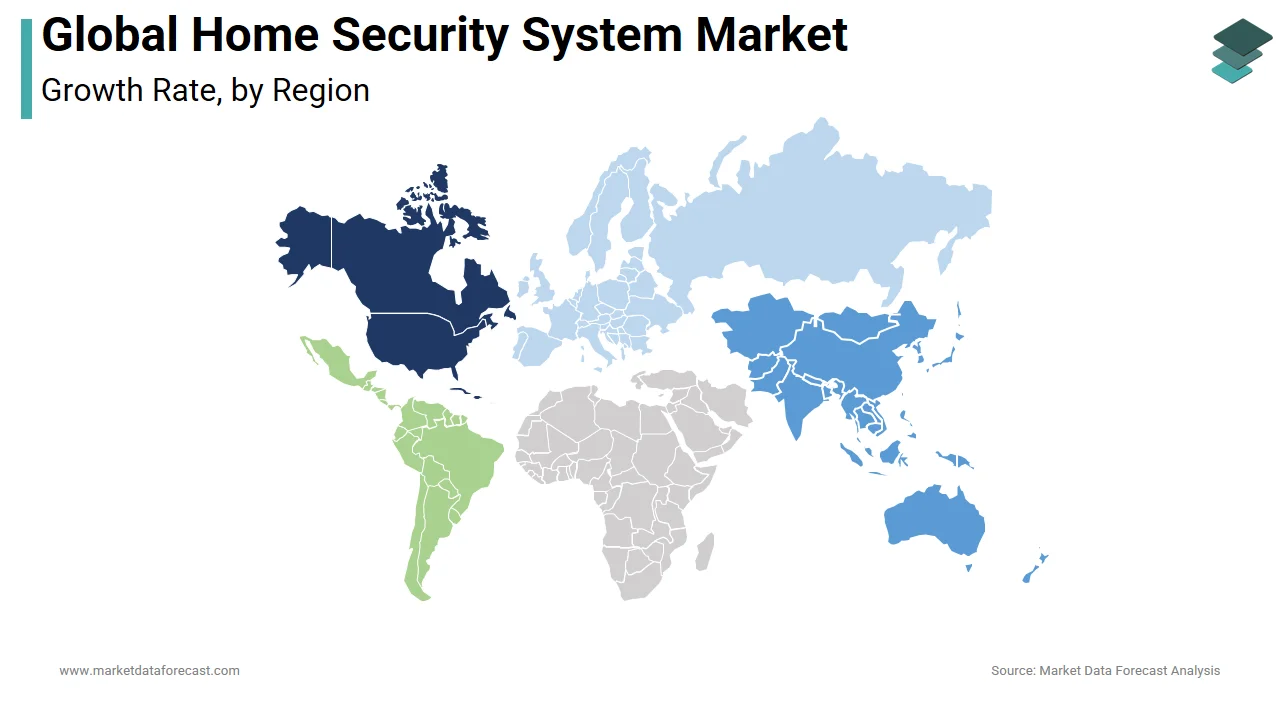
North America is estimated to have a significant share of the global home security solutions market due to the presence of many companies offering these solutions. In the United States, approximately 15 million American households are expected to invest in and install new home security solutions over the next several years. A growing list of smart home solution providers and services in the United States are using home security to introduce home automation services. In the US market, the market for home security solutions is experiencing significant growth due to an increase in fire and smoke injuries and deaths. The Asia Pacific industry is characterized by the use of Internet Protocol (IP). The Japanese industry is one of the fastest-growing sectors for IP camera surveillance systems. These solutions are being adopted in nursing homes, chain retail stores, homeowners, small factories, and warehouses.
KEY MARKET PLAYERS
Some of the key companies playing a dominant role in the global home security system market profiled in this report are Allegion PLC, Bosch Security Systems, ASSA ABLOY, Godrej & Boyce Manufacturing Company Limited, Control Corporation, Ingersoll-Rand Solutions, Honeywell International Inc., Tyco, Nortek Security & Control LLC, and UTC Fire & Security.
RECENT MARKET HAPPENINGS
-
In August 2020, Hero Electronix introduced its 'Qubo Shield', a home security solution that offers complete security for households. It protects against external threats like theft or security threats like fire and gas leaks.
-
In March 2020, Vivint Smart Home introduced an AI-powered Doorbell Camera Pro (180-degree vertical and horizontal viewing angle) with a 1-1 aspect ratio that can intelligently detect packages and protect against theft and other potential threats.
MARKET SEGMENTATION
This research report on the global home security system market has been segmented and sub-segmented based on the type, type of housing, and region.
By Type
- Electronic and Smart Locks
- Security Solutions Security Cameras
- Alarms
- Sensors and Detectors
- DIY Home Security
By Residence Type
- Condominiums
- Independent Homes
- Apartments
By Region
- Asia Pacific
- Europe
- Middle East and Africa
- North America
- Latin America