- Product Description Description
- Table of Contents TOC
- List of Table & Figure LOT
- Get Free Sample PDF Sample PDF
Market Size, 2025
$132.85 BnMarket Estimate, 2026
$140.85 BnMarket Forecast, 2034
$224.83 BnCAGR, 2026–2034
6.02%Global Home Textile Market Size, Growth, Trends & Forecast (2026–2034)
The global home textile market size was valued at USD 132.85 billion in 2025, is estimated to reach USD 140.85 billion in 2026, and is projected to reach USD 224.83 billion by 2034, registering a compound annual growth rate (CAGR) of 6.02% during the forecast period from 2026 to 2034. Driven by global urbanization, housing development, and an escalating consumer emphasis on health, wellness, and sleep quality, the industry continues to experience steady structural growth.
Key Executive Metrics (At-a-Glance)
- 2025 Base Valuation: USD 132.85 Billion
- 2026 Current Valuation: USD 140.85 Billion
- 2034 Forecast Valuation: USD 224.83 Billion
- Compound Annual Growth Rate (CAGR): 6.02% (2026–2034)
- Leading Product Segment: Bedroom Linen (37.8% share in 2025)
- Leading Material Segment: Polyester (52.6% share in 2025)
- Leading Regional Market: Asia Pacific (45.6% share in 2025)
Core Market Drivers
- Urbanization & Housing Expansion: Massive residential infrastructure growth and affordable housing projects in emerging economies fueling direct outfitting demands.
- Wellness & Sleep Quality Focus: Rising demand for hypoallergenic, temperature-regulating, and eco-friendly performance bedding.
Primary Market Restraints & Challenges
- Raw Material Volatility: Climatic disruptions affecting cotton output and geopolitical conflicts impacting petrochemical-based synthetic supply chains.
- Strict Environmental Regulations: Stringent compliance mandates like the EU’s Strategy for Sustainable and Circular Textiles regarding durability, recycling, and chemical use.
Global Home Textile Market Segmentation Breakdown
| Segment Category | Largest / Dominant Segment | Fastest-Growing Segment |
|---|---|---|
| By Product | Bedroom Linen (37.8% Share in 2025) | Bathroom Linen (7.8% CAGR) |
| By Material | Polyester (52.6% Share in 2025) | Cotton (6.9% CAGR) |
| By Region | Asia Pacific (45.6% Share) | Latin America (9.5% CAGR) |
Major Industry Players Profiled
Key market participants shaping the global home textile landscape include Welspun Group, Springs Global, New Sega Home Textiles, Ralph Lauren Corporation, Shenzhen Fuanna, Trident Group, Marvic Textiles, Shanghai Hometex, Honsun, Hunan Mendale Hometextile Company Ltd., IKEA, and Fenwick & Co.
Global Home Textile Market Size
The global home textile market size was valued at USD 132.85 billion in 2025 and is expected to reach USD 224.83 billion by 2034 from USD 140.85 billion in 2026. The market is projected to grow at a CAGR of 6.02%.

Home textile are fabric-based household products, including bed linens, bath towels, kitchen textiles, and decorative furnishings such as curtains and cushions. These products serve both functional and aesthetic purposes which are deeply embedded in daily domestic life and interior design trends. As per the U.S. Census Bureau, the total number of new housing units authorized in 2022 was 1,680,368, directly stimulating demand for home furnishing goods. Additionally, a study indicates that global e-commerce penetration in furniture and home furnishings increased in recent years which reflectes a structural shift in consumer purchasing behavior.
MAREKT DRIVERS
The global surge in urbanization and housing development in emerging economies is driving the growth of home textile market. According to the United Nations, over half of the world’s population resided in urban areas in 2022-2023, a figure expected to rise by 2030, necessitating massive residential infrastructure expansion. In India, it saw the construction of significant number of affordable housing units under the Pradhan Mantri Awas Yojana, each requiring full textile outfitting. This scale of housing delivery directly fuels demand for bed sheets, towels, and kitchen textiles. Furthermore, as urban middle-class households grow, so does disposable income allocation toward home comfort and aesthetics.
The escalating consumer emphasis on wellness and sleep quality, which has redefined bedding product expectations, is propelling the growth of home textile market. The global rise in sleep disorders has prompted a behavioral shift toward investing in sleep-enhancing environments. As per the study, a portion of adults in developed nations report chronic sleep disturbances, driving demand for hypoallergenic, moisture-wicking, and temperature-regulating bedding. This has led to the proliferation of performance-driven fabrics such as bamboo-derived viscose and TENCEL, with global sales of eco-friendly textile fibers reaching significant metric tons, according to research. Brands have capitalized on this trend and reported a year-on-year increase in premium bedding sales.
MARKET RESTRAINTS
Volatility of raw material supply chains, particularly cotton and synthetic fibers, is restraining the growth of home textile market. Cotton production is highly susceptible to climatic disruptions, with a decline in global cotton output in 2022 due to droughts in key producing regions. Simultaneously, the war in Ukraine disrupted global supply chains for polyester which relies on petrochemical feedstocks. These fluctuations directly impact manufacturing costs and lead times which forces producers to either absorb losses or pass costs to consumers, dampening pHome textile-sensitive demand. Moreover, the lack of diversified sourcing infrastructure in developing textile hubs exacerbates dependency on unstable supply networks.
Growing regulatory pressure on environmental compliance in textile manufacturing is restraining the growth of home textile market. The European Union’s Strategy for Sustainable and Circular Textiles require that by 2030, textiles placed on the EU market must be durable, recyclable, and produced with minimal environmental impact. The textile industry is responsible for a portion of the EU’s total greenhouse gas emissions and landfill waste, which is prompting stringent regulations on chemical usage and waste discharge.
MARKET OPPORTUNITIES
The digitization of design and customization platforms is subatntially creating new opportunities for the growth of home textile market. Advances in digital printing technology allow for on-demand, low-volume production of bespoke patterns without significant cost premiums. According to research, the global digital textile printing market is projected to grow in the coming years, driven by consumer demand for unique, personalized home décor. Companies like Spoonflower and Fabric on Demand have leveraged this trend by offering customers the ability to upload designs for custom-printed curtains or bedding. Apart from these, generative AI tools are being integrated into design interfaces. This shift not only reduces inventory waste but also enhances consumer engagement, creating a competitive edge for agile, tech-integrated brands.
The integration of home textiles into the circular economy through rental and resale models is additionally to promote the growth of home textile market. However, subscription-based models for premium bedding and towel sets are gaining momentum, particularly in urban Europe. Similarly, as per study, the secondhand home goods segment grew annually between, outpacing overall retail growth. This shift shows the evolving consumer values toward sustainability and access over ownership by presenting scalable business models for forward-thinking textile enterprises.
MARKET CHALLENGES
Persistent issue of labor exploitation and ethical sourcing in the global textile supply chain is challenging the growth of home textile market. As per the research, significant number of children were engaged in child labor, with a significant proportion working in agriculture, including cotton farming in countries. Apart from these, the 2023 Global Slavery Index estimates that approximately 27.6 million people are trapped in forced labor worldwide, with textile manufacturing being a high-risk sector. In Bangladesh, the world’s second-largest apparel exporter, the research says that a portion of garment and home textile workers did not receive a living wage. These issues attract regulatory scrutiny and consumer backlash which affects brand reputations and increases compliance risks for international retailers seeking ethical certification.
Rapid pace of technological obsolescence in smart textile innovation is another factor declining the growth of home textile market. While intelligent fabrics, such as those with embedded sensors for monitoring sleep or temperature, are gaining interest, their commercial viability remains limited by high production costs and short product life cycles. According to study, the average development-to-market timeline for smart textiles is severval years, significantly longer than conventional textile cycles, leading to mismatched innovation timing. Moreover, a study found that a portion of smart textile prototypes failed durability tests after 50 wash cycles, raising concerns about long-term usability. Consumer skepticism remains high.
REPORT COVERAGE
| REPORT METRIC | DETAILS |
| Market Size Available | 2025 to 2034 |
| Base Year | 2025 |
| Forecast Period | 2026 to 2034 |
| Segments Covered | By Product, Material, Distribution Channel, and Region |
| Various Analyses Covered | Global, Regional, & Country Level Analysis; Segment-Level Analysis; DROC; PESTLE Analysis; Porter’s Five Forces Analysis; Competitive Landscape; Analyst Overview of Investment Opportunities |
| Regions Covered | North America, Europe, APAC, Latin America, Middle East & Africa |
| Market Leaders Profiled | Welspun Group, Springs Global, New Sega Home Textiles, Ralph Lauren Corporation, Shenzhen Fuanna, Trident Group, Marvic Textiles, Shanghai Hometex, Honsun, Hunan Mendale Hometextile Company Ltd., LLC Honsun Home Textile, and others |
SEGMENTAL ANALYSIS
By Product Insights
The bedroom linen segment dominated the home textile market by accounting for 37.8% share in 2025. The growth of the segment is driven by the universal necessity of bedding items such as sheets, pillowcases, and comforters which are replaced more frequently than other textile categories due to wear, hygiene requirements, and seasonal changes. The average household replaces bed linens every several months, according to the study, creating a consistent replacement cycle. Apart from these, rising consumer interest in sleep wellness has amplified demand for premium bedding.
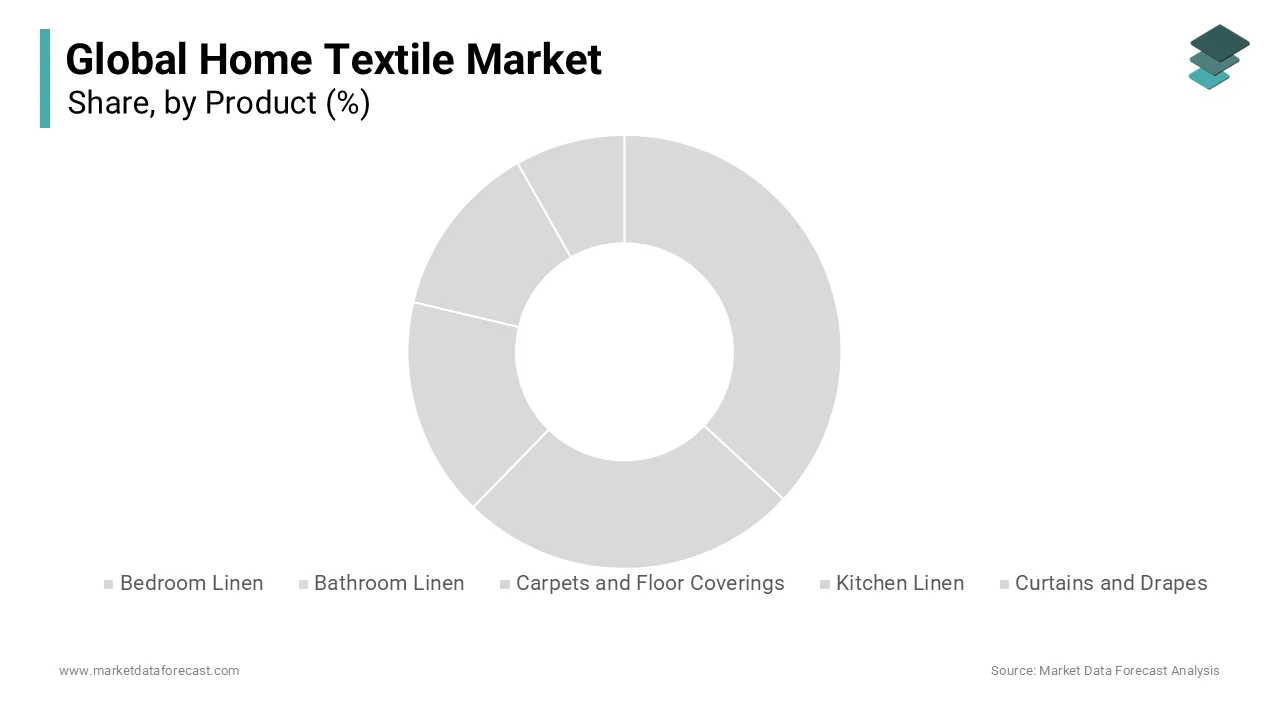
The bathroom linen segment is anticipated to witness a CAGR of 7.8% from 2025 to 2033 with the increasing personal hygiene awareness and the expansion of the premium hospitality sector. The World Tourism Organization recorded over 1.3 billion international tourist arrivals in 2023, an increase from the previous year, directly boosting demand for high-quality towels and bathrobes in hotels and short-term rentals. Moreover, consumer preference for luxury at home has intensified. Like, according to research, global retail sales of premium bath textiles grew annually. The adoption of Turkish and Egyptian cotton towels, which is known for superior absorbency and softness, has become a status symbol in urban households.
By Material Insights
The polyester segment was accounted in holding 52.6% of home textile market share in 2025 with the cost efficiency and durability which makes it the preferred choice for mass-market bedding, curtains, and kitchen textiles. This cost advantage enables manufacturers to produce affordable, wrinkle-resistant, and quick-drying products, particularly crucial in pHome textile-sensitive markets across Asia and Africa. Furthermore, polyester’s compatibility with digital printing technologies has enhanced its appeal in decorative textiles. According to study, a portion of digitally printed home textiles use polyester substrates due to superior color retention.
The cotton segment is anticipated to grow at a CAGR of 6.9% over the forecast period owing to a resurgence in consumer preference for natural, breathable fibers amid growing health and environmental consciousness. The number of farmers in several countries were trained in sustainable cotton farming practices, which is covering a portion of global cotton production. Apart from these, cotton’s dominance in bedroom and bathroom linens, where skin contact is frequent, has strengthen its appeal. Innovations such as compact-spun cotton and enzyme-treated finishes have also enhanced durability and softness by reducing the performance gap with synthetics and reinvigorating demand.
REGIONAL ANALYSIS
Asia Pacific Home Textile Market Insights
Asia Pacific was the top performer in the global home textile market in 2025 and accounted for 45.6% of the global market share in 2025 with its dual role as the world’s manufacturing epicenter and a rapidly expanding consumer base. China and India alone contribute majorly to global cotton spinning capacity, as per the study. Simultaneously, rising urbanization and a burgeoning middle class are transforming domestic demand. According to research, millions of people in Southeast Asia entered the middle-income bracket, fueling purchases of home furnishings. E-commerce has further accelerated access, with data showing a year-on-year increase in home textile sales on its platforms. Government initiatives, such as India’s “Make in India” and China’s “Dual Circulation” strategy, are also strengthening regional self-sufficiency and export competitiveness.
Europe Home Textile Market Insights
Europe home textile market was positioned by holding a significant share in 2025 due to its emphasis on sustainability, design excellence, and regulatory dominance. According to study, a portion of home textile brands in Germany, France, and Scandinavia incorporate circular design principles, such as recyclable fibers and modular construction. Apart from these, the EU’s Ecodesign for Sustainable Products Regulation is compelling manufacturers to disclose environmental footprints, accelerating green innovation. Consumer behavior aligns with these policies. Premium brands like FennWick (UK) and LinenMe (Lithuania) have capitalized on the demand for organic and traceable materials. Moreover, the region’s strong rental and refurbishment sectors support recurring demand, particularly in urban centers.
North America Home Textile Market Insights
North America home textile market is anticipated to grow steadily during the forecast period with the high per-capita spending, brand loyalty, and integration with smart home ecosystems. The average American household spends notable amount annually on home textiles, as per the study. Demand is further amplified by a robust housing sector. The rise of direct-to-consumer (DTC) brands like Parachute and Buffy has disrupted traditional retail by offering premium, digitally marketed bedding with transparent sourcing. These brands report customer acquisition rates higher than conventional retailers, as per research.
Latin America Home Textile Market Insights
Latin America home textile market is predicted to grow at an anticipated CAGR of 9.5% during the forecast period owing to the urbanization and increasing access to formal retail channels are majorly propelling the home textile growth in worldwide. Brazil and Mexico account for a notable share of regional demand, driven by expanding middle-class populations. According to research, a portion of Latin Americans reside in urban areas, with household expenditure on home furnishings rising annually since 2020.
Middle East and Africa Home Textile Market Insights
Middle East and Africa home textile market is likely to grow steadily in the coming years. The MEA market is driven by a blend of traditional craftsmanship and luxury import consumption. In the Gulf Cooperation Council (GCC) countries, high disposable incomes drive demand for premium and imported textiles.
COMPETITIVE LANDSCAPE
The home textile market exhibits a fragmented yet dynamic competitive landscape, characterized by the coexistence of global conglomerates, regional manufacturers, and digitally native brands. Incumbents leverage scale and supply chain maturity, while emerging players disrupt through innovation and agility. Competition is intensifying as brands differentiate via sustainability credentials, smart textile integration, and hyper-personalization. PHome textile sensitivity remains a challenge in emerging economies, whereas premiumization dominates in developed regions. Private-label expansion by major retailers adds pressure on branded players, prompting increased investment in R&D and brand storytelling. The rise of direct-to-consumer models has diminished reliance on traditional distribution, enabling faster feedback loops and reduced time-to-market.
KEY MARKET PLAYERS
- Welspun Group
- Springs Global
- New Sega Home Textiles
- Ralph Lauren Corporation
- Shenzhen Fuanna
- Trident Group
- Marvic Textiles
- Shanghai Hometex
- Honsun
- Hunan Mendale Hometextile Company Ltd.
- LLC Honsun Home Textile
TOP PLAYERS IN THE MARKET
IKEA
IKEA has established a formidable presence in the Asia-Pacific home textile market by combining affordable design with scalable supply chain integration. The company sources a significant portion of its textile products from India and Vietnam by leveraging local manufacturing expertise and cost efficiencies. In recent years, IKEA has intensified its focus on sustainability by launching collections made from organic cotton and recycled polyester across its APAC stores. The company has also expanded its e-commerce footprint, launching dedicated online platforms in China, Japan, and South Korea.
Fenwick & Co.
Fenwick & Co., a UK-origin premium home textile brand with deep penetration across Southeast Asia and Australia, has distinguished itself through a curated approach to quality and wellness-centric product development. The company has invested heavily in R&D to introduce temperature-regulating bedding using natural TENCEL and bamboo-derived fibers, now central to its offerings in humid climates such as Singapore and Thailand. This direct-to-consumer innovation has improved customer retention and reduced reliance on third-party retailers by enabling agile responses to shifting regional preferences.
Shanghai Metersbonwe Home
Shanghai Metersbonwe Home, a subsidiary of China’s Metersbonwe Group, has emerged as a key regional player by fusing fast-fashion principles with home textiles. The company targets young urban consumers through trendy, affordable collections available in both physical stores and on Alibaba’s Tmall platform. It has capitalized on China’s “guochao” (national trend) movement by incorporating traditional motifs into modern bedding and curtain designs, resonating with patriotic consumer sentiment.
TOP STRATEGIES USED BY THE KEY MARKET PLAYERS
Key players in the home textile market are deploying vertical integration, digital transformation, sustainability alignment, product differentiation, and strategic regional expansion to consolidate their positions. Vertical integration enables control over sourcing and production, reducing lead times and ensuring ethical compliance. Digital transformation, including AI-powered design tools and e-commerce optimization, enhances customer engagement and personalization. Sustainability alignment involves adopting certified raw materials and circular business models to meet regulatory and consumer demands. Product differentiation through functional textiles, such as antimicrobial or thermoregulatory fabrics, caters to health-conscious consumers.
MARKET SEGMENTATION
This research report on the global home textile market has been segmented and sub-segmented based on product, material, distribution channel, and region.
By Product
- Bedroom Linen
- Bathroom Linen
- Carpets and Floor Coverings
- Kitchen Linen
- Curtains and Drapes
By Material
- Polyester
- Cotton
- Silk
- Wool
- Others
By Distribution Channel
- Offline
- Supermarket/Hypermarket
- Specialty Stores
- Others
- Online
By Region
- North America
- Europe
- Asia-Pacific
- Latin America
- Middle East and Africa