- Product Description Description
- Table of Contents TOC
- List of Table & Figure LOT
- Get Free Sample PDF Sample PDF
Market Size, 2025
$831.8 BnMarket Estimate, 2026
$888.36 BnMarket Forecast, 2034
$1503.7 BnCAGR, 2026–2034
6.8%Executive Summary: Global Home Decor Market
- Market Scope: Comprehensive global analysis of the home decor industry assessing product types, income groups, price points, distribution channels, and regional market trends.
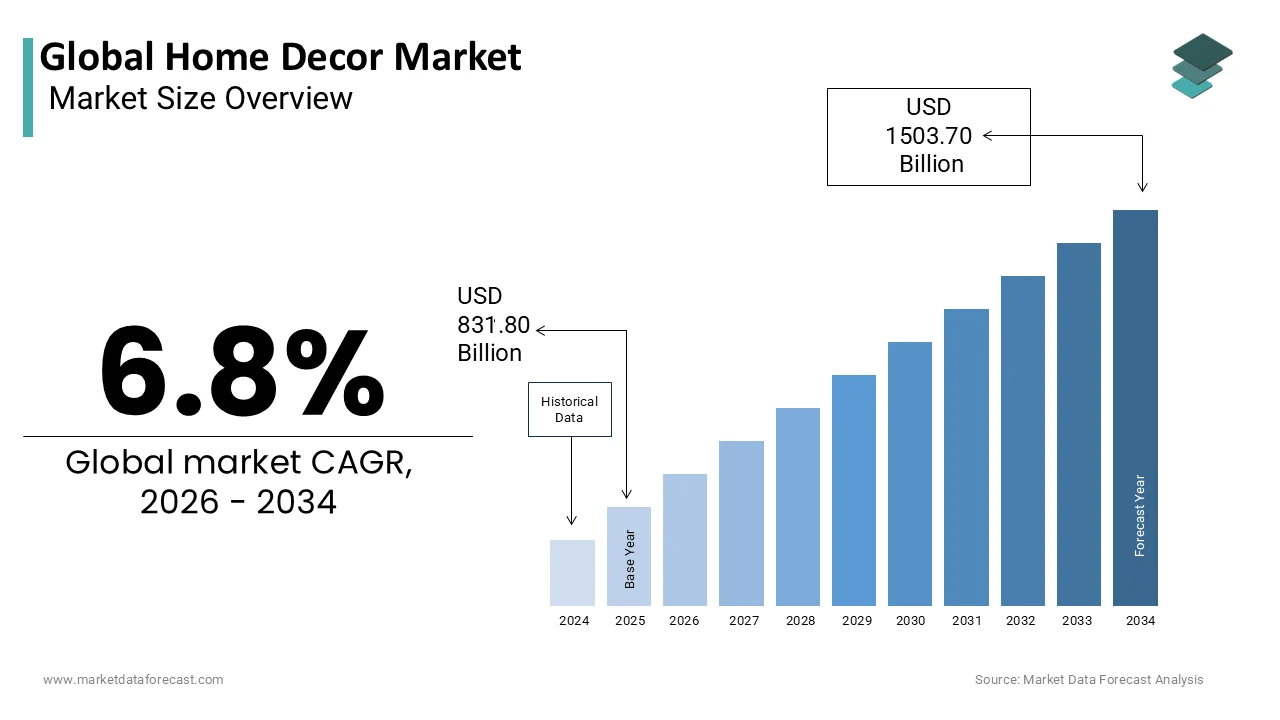
- Market Valuation: Valued at USD 831.80 billion in 2025, reaching USD 888.36 billion in 2026, and projected to expand to USD 1503.70 billion by 2034, registering a solid CAGR of 6.8% from 2026 to 2034.
- Primary Growth Drivers: Proliferation of remote and hybrid work models driving the domestication of professional spaces; influence of digital platforms and visual social media on consumer aesthetics; and urbanization increasing focus on indoor well-being and lifestyle environments.
Key Market Segment Metrics (2026–2034)
| Category | Leading Segment / Core Focus | Fastest-Growing / Key Segments |
|---|---|---|
| By Product Type | Furniture (held the highest market share of 46.4% in 2025 due to essential structural roles, long replacement cycles, and remote work adjustments) | Home Textiles & Floor Coverings (estimated to record the highest CAGR of 10.4% driven by sensory comfort and flexible updates) |
| By Income Group | Upper-Middle-Income Segment (largest consumer group occupying 41.4% share in 2025, driven by economic mobility in emerging markets) | High-Income Segment (growing at the fastest CAGR of 9.2% due to investments in bespoke, sustainable, and tech-integrated interiors) |
| By Price Point | Mass Price Segment (held 60.5% of the global share in 2025, supported by affordable, functional, and compact living solutions) | Premium Price Segment (anticipated to record a CAGR of 10.4% driven by demands for authenticity, craftsmanship, and luxury aesthetics) |
| By Distribution Channel | E-Commerce Channel (accounted for the leading share of 41.6% in 2025, powered by digitization, AR visualization, and fast delivery) | Specialty Stores (fastest-growing channel at a CAGR of 8.2% due to curated experiential retail, expert curation, and tactile engagement) |
| By Region | North America (dominated in 2025 with 34.6% global share, backed by high disposable income, homeownership culture, and robust renovation cycles) | Europe & Asia Pacific (steady expansion anchored by circular economy models, urbanization, and growing middle classes) |
Major Market Players & Market Structure
Market Structure: Highly competitive landscape comprising global furniture retailers, mass-market home furnishers, specialized design boutiques, and technology-driven interior platforms.
Key Companies: Inter IKEA Systems B.V., Kimball International Inc., Herman Miller, Inc., home24, Hanssem Corporation, Koninklijke Philips N.V., Conair Corporation, Suofeiya Home Collection Co., Ltd., Springs Window Fashions LLC, and Siemens AG.
Global Home Decor Market Size
The global home decor market size was worth USD 831.80 billion in 2025, and the market is anticipated to reach USD 1503.70 billion by 2034 from USD 888.36billion in 2026, registering a CAGR of 6.8% from 2026 to 2034.
Home decor includes a broad spectrum of products designed to enhance the aesthetic, functional, and emotional quality of residential interiors, including furniture, lighting, textiles, wall art, and decorative accessories. Unlike mere furnishing, home decor reflects personal identity, cultural influences, and evolving lifestyle philosophies, positioning it as a dynamic intersection of design, psychology, and consumer behavior. The sector has undergone a paradigm shift in recent years, driven by changing living patterns, digital inspiration platforms, and a growing emphasis on well-being within personal spaces. As urbanization accelerates and housing models evolve, the psychological significance of interior environments has intensified. According to the World Health Organization, individuals in urban centers spend approximately 90% of their time indoors, amplifying the impact of interior design on mental health and daily functionality. This behavioral insight has elevated home decor from a discretionary expenditure to a core component of holistic living. Furthermore, the proliferation of digital design tools and virtual staging applications has democratized access to professional aesthetics, enabling even budget-conscious consumers to curate visually cohesive environments. According to UNESCO’s 2023 report on urban well-being, 57% of city dwellers in emerging economies associate improved mental resilience with intentional home styling, underscoring the emotional resonance of decor choices. With remote work normalizing domestic spaces as multifunctional zones blending office, leisure, and social functions, the demand for adaptable, expressive, and ergonomically sound decor solutions has surged, redefining the market’s scope beyond traditional retail boundaries.
MARKET DRIVERS
Rise of Remote Work and the Domestication of Professional Spaces
The permanent integration of remote and hybrid work models that has fundamentally altered the functional demands placed on residential interiors is one of the key factors propelling the growth of the home decor market. The transformation of living rooms, bedrooms, and unused corners into home offices has necessitated a re-evaluation of spatial design, ergonomics, and aesthetic coherence. According to the International Labour Organization, 34% of employed professionals in advanced economies continued to work remotely at least part-time in 2023, a figure nearly four times higher than pre-pandemic levels. This shift has spurred demand for dual-purpose furniture such as modular desks, space-saving shelving, and acoustically insulated room dividers that harmonize with domestic aesthetics while supporting productivity. In parallel, consumers are investing in ambient enhancements like task lighting, noise-reducing textiles, and biophilic elements such as indoor plants and natural materials to create psychologically supportive work environments. According to a 2023 study by the Global Well-Being Institute, 68% of remote workers reported improved focus and reduced stress when their workspace incorporated intentional decor, including warm lighting and personalized artwork. According to the U.S. General Services Administration’s post-occupancy evaluations, employees in well-designed home offices took 27% fewer sick days, reinforcing the health-performance link. As remote work becomes institutionalized, particularly in tech, education, and creative sectors, the home office is no longer a temporary setup but a permanent fixture, driving sustained demand for decor that balances professionalism with comfort and individuality.
Influence of Digital Platforms and Visual Social Media on Consumer Aesthetics
The transformative role of digital platforms, particularly image-centric social networks, in shaping consumer tastes and accelerating decor trend cycles, is further contributing to the expansion of the global home decor market. Instagram, Pinterest, TikTok, and YouTube have evolved into virtual design studios, where curated interiors, DIY tutorials, and influencer-led styling guides dictate aesthetic preferences across demographics and geographies. According to the Pew Research Center, 46% of adults aged 25 to 40 in North America and Europe use Pinterest or Instagram for home inspiration, with the average user saving over 15 decor ideas monthly. This constant exposure to aspirational content has compressed trend adoption timelines, which was once a seasonal shift and now occurs in weeks. According to the Global Design Forecasting Network, the average lifespan of a dominant interior trend, such as "Scandinavian minimalism" or "dark academia," has decreased from 18 months in 2018 to just 6.4 months in 2023. Moreover, short-form video content on TikTok has popularized accessible, budget-friendly styling hacks, encouraging consumers to refresh their spaces without major renovations. According to a 2022 survey by the Royal Institute of British Architects, 54% of homeowners under 35 had replicated a look seen online, often using affordable decor items from mass retailers. Platforms have also enabled niche aesthetics such as Japandi, Grandmillennial, or desert modernism to gain global followings, fostering demand for specific textures, color palettes, and artisanal pieces. As digital inspiration becomes the primary catalyst for purchasing decisions, the home decor market is increasingly responsive to algorithmic trends, making visual appeal and shareability key determinants of product success.
MARKET RESTRAINTS
Supply Chain Volatility and Raw Material Scarcity
The ongoing instability in global supply chains, particularly concerning the availability and pricing of essential raw materials such as timber, glass, and specialty metals, is primarily hampering the expansion of the home decor market worldwide. The sector is highly dependent on geographically concentrated sources, such as Scandinavian birch, Italian marble, or South American hardwoods, many of which face logistical disruptions, export restrictions, or environmental regulations. According to the Food and Agriculture Organization, global wood production declined by 2.3% in 2022 due to deforestation controls and extreme weather events, leading to a 31% increase in wholesale plywood prices, as reported by the International Council of Forest and Paper Associations. This scarcity disproportionately affects mid-tier and artisanal manufacturers who lack the purchasing power to secure long-term contracts. Additionally, geopolitical tensions have disrupted shipping lanes. According to the United Nations Conference on Trade and Development, Red Sea rerouting in early 2024 extended delivery times for European decor shipments by an average of 18 days. These delays cascade into production bottlenecks, forcing retailers to maintain inconsistent inventory or pass costs onto consumers. According to a 2023 audit by the European Furniture Industries Federation, 47% of SMEs in the sector experienced at least one material shortage that halted production for over two weeks. With climate policies tightening and resource nationalism rising, the reliance on finite, location-specific inputs poses a structural vulnerability, constraining scalability and innovation in a market increasingly defined by customization and craftsmanship.
Environmental Impact and Regulatory Pressure on Manufacturing Practices
The rising environmental scrutiny and tightening regulations on the ecological footprint of home decor production are further hampering the global market growth. The global home decor market is a significant contributor to deforestation, chemical pollution, and waste generation, particularly through the use of non-recyclable laminates, solvent-based finishes, and single-use packaging. According to the United Nations Environment Programme, the global furniture and decor sector generates over 100 million tons of waste annually, with less than 15% being recycled. In response, governments are enacting stricter compliance mandates. According to the European Union’s 2023 Eco-Design for Sustainable Products Regulation, full lifecycle assessments and recyclability declarations are now required for all imported decor items. Similarly, California’s Proposition 65 enforces stringent labeling for products containing carcinogenic substances, affecting dyes, adhesives, and treated woods. These regulations increase compliance costs, especially for small and medium enterprises that lack in-house sustainability teams. According to a 2024 report by the International Council of Chemicals Associations, 63% of decor manufacturers in Southeast Asia were not compliant with REACH standards, risking market exclusion. Furthermore, consumer backlash against "greenwashing" has made authenticity in sustainability claims essential. According to the Global Consumer Trust Index, 59% of buyers verify environmental certifications before purchasing high-ticket decor, with 41% abandoning transactions upon detecting misleading claims. As regulatory and reputational risks intensify, companies face a costly transition toward circular production models, slowing innovation and market entry for conventional players.
MARKET OPPORTUNITIES
Integration of Smart Home Technology with Decorative Elements
The convergence of smart home systems and aesthetic design,n where functionality and visual appeal are seamlessly integrated, ed is a promising opportunity for the home decor market. Consumers are no longer satisfied with technology that disrupts interior harmony; instead, they demand devices that blend into the decor while enhancing comfort and efficiency. This has given rise to "invisible tech" lighting controls embedded in mirrors, speakers disguised as sculptures, and climate sensors housed in artisanal ceramics. According to the Consumer Technology Association, 68% of smart home adopters in 2023 prioritized design compatibility when selecting devices, signaling a shift from utility to elegance. Companies like Flos and Philips have launched lighting collections that double as IoT hubs, while startups such as Mui Lab offer minimalist wooden interfaces for home automation. The trend is particularly strong among high-income urbanites. According to a 2023 survey by the Architectural Digest Intelligence Unit, 74% of luxury homeowners in New York, London, and Tokyo preferred tech-hidden solutions over visible gadgets. Additionally, modular smart furniture tables with wireless charging, sofas with integrated climate control, and roll are gaining traction in compact urban dwellings. According to the International Federation of Interior Architects/Designers, 52% of new residential projects now include tech-integrated decor in initial design phases. As artificial intelligence enables predictive environmental adjustments, the role of decor as both a sensor and a statement piece is expanding, creating a new category of intelligent, adaptive interiors that respond to user behavior without compromising aesthetic integrity.
Growth of the Rental Economy and Demand for Non-Permanent Decor Solutions
The rise of the rental housing sector and the accompanying demand for non-invasive, portable, and reversible decor solutions is another significant opportunity for the global home decor market. With urbanization and housing affordability crises pushing more individuals into long-term rentals, tenants are seeking ways to personalize spaces without violating lease agreements or damaging property. According to the World Bank, rental occupancy rates in major cities like Berlin, Sydney, and Toronto exceeded 40% in 2023, up from 32% a decade earlier. This demographic shift has fueled interest in peel-and-stick wallpapers, freestanding room dividers, magnetic panel systems, and adhesive-free lighting installations. According to the Global Tenants’ Rights Observatory, 61% of renters in 2023 avoided permanent modifications due to deposit concerns, creating a niche for temporary yet stylish alternatives. Brands like NuWallpaper and Room Copenhagen have capitalized on this, offering high-design, damage-free products that mimic permanent finishes. Moreover, the portability of such items aligns with nomadic lifestyles and frequent relocations common among digital nomads and young professionals. According to a 2024 study by the Urban Land Institute, 53% of renters under 35 viewed their decor as mobile assets, often relocating them across cities. This mindset shift reframes home decor not as a fixed investment but as a transferable expression, opening avenues for subscription models, rental decor services, and modular design systems. As rental living becomes the norm rather than the exception, the market for flexible, reversible, and reusable decor is poised for structural expansion.
MARKET CHALLENGES
Counterfeit Products and Brand Dilution in Mass Retail Channels
The proliferation of counterfeit and imitation products that erode brand equity and consumer trust is primarily challenging the growth of the global home decor market. High-design aesthetics, particularly from Scandinavian, Japanese, and Italian design houses, are frequently replicated by mass manufacturers who produce low-cost versions with inferior materials and craftsmanship. According to the International AntiCounterfeiting Coalition, over 38% of online decor purchases in 2023 involved products falsely marketed as authentic designer items, with platforms like Amazon, AliExpress, and Facebook Marketplace being primary distribution channels. This misrepresentation not only undermines the financial returns of original creators but also misleads consumers about quality expectations. According to a 2023 investigation by the European Intellectual Property Office, 29% of customers who purchased "designer-inspired" lighting fixtures reported structural failures within six months. The issue is exacerbated by ambiguous labeling and the use of terms like "in the style of" to circumvent legal action. Furthermore, the rise of AI-generated product images makes it harder for buyers to distinguish authentic pieces from replicas. According to the Royal Society of Arts, 44% of consumers could not visually identify counterfeit furniture without expert guidance. This erosion of authenticity discourages investment in premium brands and stifles innovation, as designers face diminished returns on creativity. As the line between inspiration and imitation blurs, the market risks descending into a race to the bottom, where aesthetics are copied but craftsmanship is compromised.
Labor Shortages and Decline in Skilled Artisan Craftsmanship
The dwindling availability of skilled artisans and craftspeople capable of producing high-quality and handcrafted decor items is further challenging the expansion of the global home decor market. Traditional techniques in woodworking, ceramics, metalwork, and textile weaving require years of training, yet younger generations are increasingly disengaged from these vocations due to low perceived economic returns and lack of institutional support. According to UNESCO’s 2023 Atlas of Endangered Crafts, over 120 artisanal disciplines related to interior decor are at risk of extinction, with fewer than 20 master practitioners remaining in fields such as hand-blown glass and hand-carved marquetry. This scarcity drives up production costs and limits scalability for brands emphasizing authenticity and heritage. According to the National Association of Craft Enterprises, Italy reported a 40% decline in apprenticeships in furniture craftsmanship between 2015 and 2023. Similarly, according to the Central Handicrafts Council, India noted that only 18% of weavers under 30 continue the trade, preferring urban service-sector jobs. The consequences are twofold: luxury brands face extended lead times and inconsistent supply, while consumers encounter inflated prices for genuine handmade goods. Automation has not fully compensated, as many decorative elements, such as hand-painted tiles or custom inlays, resist mechanization. According to the International Labour Organization, without targeted vocational programs and cultural valorization, the loss of artisanal expertise will permanently degrade the quality and diversity of the global decor landscape, reducing it to a homogenized, industrially produced commodity.
REPORT COVERAGE
| REPORT METRIC | DETAILS |
| Market Size Available | 2025 to 2034 |
| Base Year | 2025 |
| Forecast Period | 2026 to 2034 |
| Segments Covered | By Product Type, Income group, Price Point, and Region |
| Various Analyses Covered | Global, Regional & Country Level Analysis, Segment-Level Analysis, DROC, PESTLE Analysis, Porter’s Five Forces Analysis, Competitive Landscape, Analyst Overview on Investment Opportunities |
| Regions Covered | North America, Europe, Asia Pacific, Latin America, the Middle East, and Africa |
| Market Leaders Profiled | Inter IKEA Systems B.V., Kimball International Inc., Herman Miller, Inc., home24, Hanssem Corporation, Koninklijke Philips N.V., Conair Corporation, Suofeiya Home Collection Co., Ltd., Springs Window Fashions LLC, and Siemens AG. |
SEGMENTAL ANALYSIS
By Product Type Insights
The furniture segment dominated the market by holding the highest share of 46.4% of the global market in 2025. The dominance of the furniture segment in the global market is primarily attributed to the furniture’s essential role as a structural and functional component of interior spaces, with long replacement cycles and high per-unit spending. One primary driver of its market leadership is the global rise in residential construction and renovation activity, particularly in urban centers undergoing demographic shifts. According to the United Nations Housing Authority, over 130 million new housing units were completed worldwide between 2020 and 2023, with a significant portion requiring full furnishing packages. In emerging economies such as India and Indonesia, government-backed affordable housing initiatives have spurred demand for durable, space-efficient furniture, especially multifunctional pieces like sofa beds and modular storage units. According to the International Labour Organization, 68% of households in newly constructed urban apartments in Southeast Asia purchased at least one major furniture item within six months of occupancy. Additionally, the normalization of remote work has increased demand for ergonomic home office furniture, desks, task chairs, and filing systems,s further reinforcing the segment’s centrality. According to a 2023 survey by the Global Workspace Innovation Network, 57% of remote workers invested in new furniture to improve productivity and comfort, with average spending exceeding $800 per household. As furniture remains indispensable to habitability and lifestyle adaptation, its market primacy is structurally reinforced.
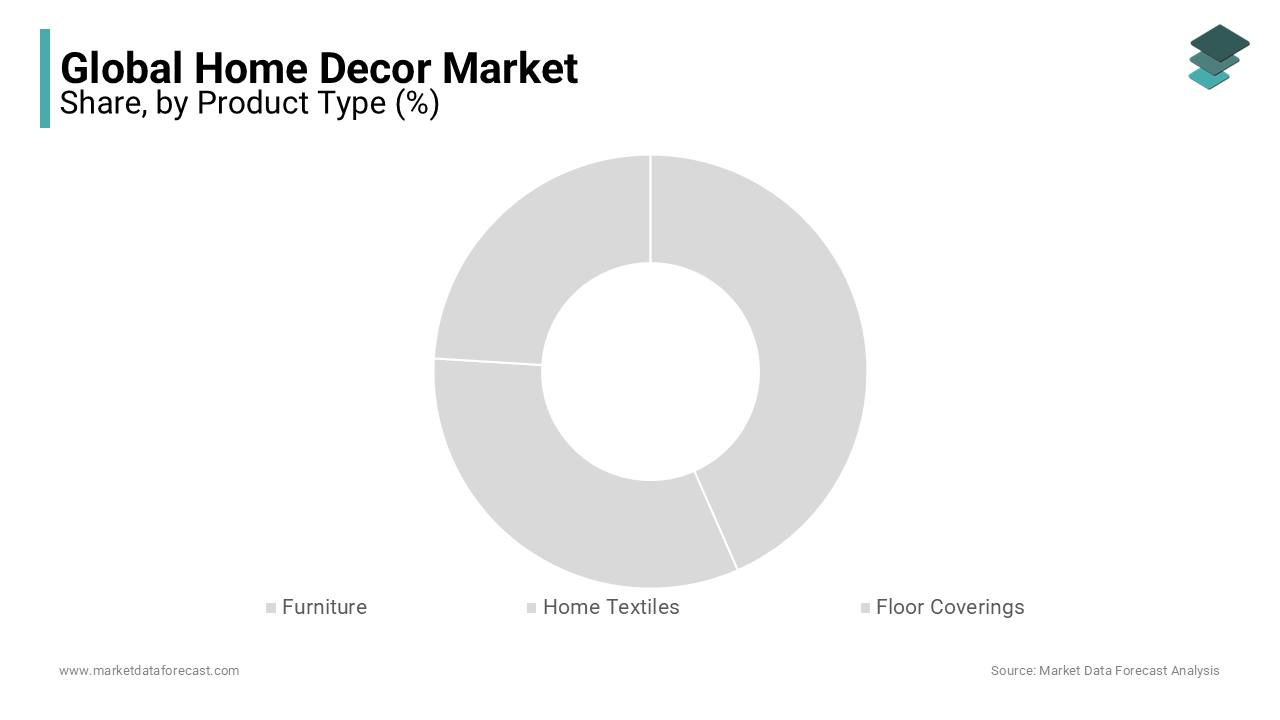
On the other side, the home textiles and floor coverings segment is the fastest-growing category and is estimated to record a CAGR of 10.4% during the forecast period, od owing to the shifting consumer preferences toward sensory comfort, aesthetic flexibility, and frequent style updates. Unlike furniture, textiles such as curtains, bedding, rugs, and decorative throws offer an accessible and reversible way to refresh interiors without structural changes. A key driver is the increasing emphasis on tactile and emotional well-being in domestic environments. According to the Global Well-Being Research Consortium, 63% of consumers in 2023 associated improved mood and relaxation with high-quality textiles, particularly natural fibers like cotton, linen, and wool. The trend is amplified by seasonal and trend-driven consumption platforms like Pinter, which report that searches for “cozy bedroom ideas” and “fall home refresh” peak twice annually, driving recurring purchases. Additionally, advancements in performance fabrics, stain-resistant, hypoallergenic, and temperature-regulating,g have enhanced the functional appeal of home textiles. According to the European Chemicals Agency, over 40% of premium bedding launched in 2023 incorporated smart textile technologies. Moreover, floor coverings are gaining traction in rental markets, where removable rugs and modular carpet tiles allow personalization without permanent alterations. As consumers prioritize comfort, sustainability, and visual variety, the segment’s agility and emotional resonance position it for sustained expansion.
By Income Group Insights
The upper-middle-income segment was the largest consumer segment in the global home decor market and occupied 41.4% of the global market share in 2025. This demographic, typically defined as households earning between $25,000 and $75,000 annually, exerts disproportionate influence due to its size, geographic concentration in urbanizing regions, and aspirational spending behavior. A primary driver of its market dominance is the rapid expansion of this income bracket in emerging economies, where economic mobility has enabled millions to transition from basic shelter to lifestyle-oriented living. According to the Asian Development Bank, over 350 million individuals in Asia entered the upper middle-income tier between 2015 and 2023, fueling demand for quality furnishings and design coherence. These consumers prioritize value-for-money, favoring brands that offer premium aesthetics at accessible prices, a niche occupied by retailers like IKEA, HomeCentre, and West Elm. According to a 2023 study by the Emerging Markets Consumer Institute, 71% ofupper-middle-incomee households in Mexico, South Africa, and Indonesia allocated at least 8% of disposable income to home improvement annually. Additionally, this group is highly responsive to digital marketing and social media trends, often replicating high-end looks through curated, budget-conscious purchases. According to the United Nations Department of Economic and Social Affairs, 58% of home styling inspiration among this cohort originates from online platforms, reinforcing the link between digital exposure and spending. With strong purchasing power and high engagement in aesthetic consumption, the upper middle-income segment anchors the market’s volume and growth trajectory.
On the other side, the high-income segment is growing at the fastest and is estimated to witness a CAGR of 9.2% during the forecast period, owing to the increasing investment in bespoke, sustainable, and technologically integrated interiors among affluent consumers. A key factor is the rising emphasis on residential spaces as extensions of personal identity and status, particularly in global cities where real estate serves as both home and asset. According to the Knight Frank Wealth Report, ultra-high-net-worth individuals spent an average of $1.2 million on interior design and decor in 2023, with many commissioning custom furniture, artisanal finishes, and smart home integrations. Another driver is the convergence of art, design, and wellness. High-income homeowners are increasingly commissioning pieces from recognized designers, installing biophilic elements, and incorporating mental health-focused layouts. According to the Royal Institute of British Architects, 66% of luxury residential projects in London and New York included dedicated wellness zones with curated lighting, acoustics, and materials. Additionally, sustainability has become a hallmark of elite consumption. According to the International Council of Designers, 79% of high-income buyers now require proof of ethical sourcing and carbon footprint transparency before purchasing high-ticket decor. With disposable income rising faster than inflation in key markets and a cultural shift toward experiential luxury, the high-income segment is redefining the upper boundary of home decor spending.
By Price Point Insights
The mass price segment had 60.5% of the global market share in 2025. This leadership is sustained by the sheer scale of middle- and lower-income consumers who prioritize affordability, functionality, and accessibility over exclusivity. The segment’s strength lies in its alignment with urbanization trends and the proliferation of compact living spaces that require cost-effective, modular solutions. According to the United Nations Human Settlements Programme, over 1.6 billion people lived in urban housing units under 50 square meters in 2023, creating demand for space-saving, ready-to-assemble furniture and standardized decor items. Retail giants such as IKEA, Target, and Daiso have optimized supply chains to deliver stylish, durable products at low price points, often leveraging economies of scale and flat-pack logistics. According to the International Trade Centre, mass-market decor brands achieve up to 35% lower distribution costs through centralized warehousing and automated fulfillment. Additionally, the rise of fast decor short-cycle, trend-responsive products mirrors fast fashion, enabling consumers to frequently refresh interiors without financial strain. According to a 2023 survey by the Consumer Innovation Observatory, 64% of shoppers in Brazil, Turkey, and Thailand preferred replacing decor items every 12 to 18 months rather than investing in long-term pieces. With e-commerce platforms amplifying reach and discount models gaining traction, the mass segment remains the backbone of global home decor consumption, particularly in price-sensitive and rapidly urbanizing regions.
However, the premium price segment is anticipated to record a CAGR of 10.4% during the forecast period in the global market, owing to the rising consumer demand for authenticity, craftsmanship, and differentiated design in an increasingly homogenized retail landscape. Affluent buyers are shifting away from mass-produced items toward limited-edition pieces, heritage brands, and custom commissions that reflect personal taste and cultural values. A key driver is the growing appreciation for artisanal production. According to UNESCO’s 2023 Cultural Heritage Index, 72% of premium decor purchases involved products with documented craftsmanship origins, such as hand-carved wood or handwoven textiles. Additionally, the integration of sustainability and ethical sourcing has elevated the appeal of premium brands. According to the Global Fashion and Design Alliance, 68% of high-end consumers are willing to pay a 30% premium for decor items with full supply chain transparency. Another factor is the blurring of residential and hospitality aesthetics. Many homeowners now seek “hotel-luxury” finishes, including marble surfaces, designer lighting, and curated art collections. According to the American Society of Interior Designers, 54% of luxury home renovations in 2023 included at least one six-figure decor element. As consumers seek meaning, durability, and uniqueness in their purchases, the premium segment is redefining value beyond price, anchoring its growth in emotional and cultural capital.
By Distribution Channel Insights
The e-commerce channel segment accounted for the leading share of 41.6% of the global market in 2025. This dominance is driven by the sector’s increasing digitization, consumer reliance on visual platforms for inspiration, and improvements in logistics for bulky goods. Online marketplaces such as Amazon, Wayfair, and Houzz have transformed how consumers discover, compare, and purchase decor, offering vast catalogs, customer reviews, and augmented reality tools that simulate product placement in real spaces. According to the International Postal Corporation, home decor was the second-fastest-growing category in cross-border e-commerce in 2023, with a 33% increase in parcel volume. A critical enabler is the advancement in last-mile delivery, and white-glove services companies like FedEx and DHL now offer room-of-choice delivery and assembly for large items, reducing purchase hesitation. According to the World Economic Forum, 59% of consumers who previously avoided buying furniture online cited improved delivery options as the reason for changing their behavior. Additionally, social commerce has blurred the line between content and transaction. According to a 2023 Digital Consumer Insights study, Instagram and TikTok shoppable posts now account for 28% of decor purchases among users under 35. With AI-driven personalization, virtual room planners, and seamless payment integration, e-commerce has become the primary discovery and transaction engine for modern home styling, reshaping traditional retail hierarchies.
On the other side, the specialty stores segment is the fastest-growing distribution channel and is predicted to register a CAGR of 8.2% during the forecast period, due to the broader retail decline narrative, as curated, experiential retail spaces regain relevance among discerning consumers. Unlike mass retailers, specialty stores such as Design Within Reach, The Conran Shop, and local design boutiques offer expert curation, exclusive product lines, and immersive environments that foster emotional connection. A key driver is the desire for authenticity and tactile engagement. According to the Royal Society for the Encouragement of Arts, 67% of high-income shoppers preferred purchasing decor in person to assess material quality and craftsmanship. Additionally, these stores increasingly function as advisory hubs, offering interior design consultations, custom ordering, and after-sales services that enhance customer loyalty. According to the American Institute of Architects, 48% of architects now collaborate directly with specialty retailers to source materials for client projects. Another factor is the localization of desi,gn many specialty stores feature regionally inspired pieces, supporting local artisans and resonating with cultural identity. According to the European Craft Council, 53% of specialty decor sales in 2023 involved domestically produced items. As consumers seek differentiation and meaningful engagement, specialty stores are repositioning themselves not as retail outlets but as cultural and design destinations.
REGIONAL ANALYSIS
North America Home Décor Market Analysis
North America dominated the market in 2025 with 34.6% of the global market share and is expected to witness strong growth over the next few years and continue leading the market through sustained investments in residential improvements. The region’s leadership is underpinned by high disposable income, a strong culture of homeownership, and a mature interior design ecosystem. The United States, in particular, drives demand through a combination of residential renovation cycles, remote work adaptations, and a deeply ingrained consumer interest in home improvement. According to the Joint Center for Housing Studies at Harvard University, American homeowners spent $430 billion on renovations in 2023, with a significant portion allocated to decor and furnishings. The DIY ethos, amplified by platforms like HGTV and YouTube, encourages frequent styling updates and personalization. Canada complements this trend with steady urbanization and a growing preference for Scandinavian and minimalist aesthetics. Additionally, the presence of major retailers such as Williams-Sonoma, Crate & Barrel, and Wayfair ensures wide product availability and innovation. According to the Environmental Protection Agency, 41% of new home decor purchases in the U.S. now include sustainability claims, reflecting a shift toward eco-conscious consumption. With robust logistics, digital adoption, and a design-literate population, North America remains the most influential and dynamic market for home decor.
Europe Home Décor Market Analysis
Europe is poised to experience consistent development over the next few years due to its ongoing commitment to circular economic models and premium design trends. The region’s position is defined by its rich design heritage, regulatory emphasis on sustainability, and high urban living standards. Countries like Italy, Sweden, and Germany are globally recognized for their contributions to furniture and interior innovation, with brands such as IKEA, Flos, and B&B Italia setting international trends. According to the European Environment Agency, over 60% of home decor products sold in the EU must comply with circular economy principles by 2025, driving investment in recyclable materials and modular design. Consumer behavior is highly influenced by seasonal changes and cultucultural traditions Germany’s “Gemütlichkeit” and Scandinavia’s “hygge” fuel recurring demand for warm textiles.
Asia Pacific Home Decor Market Insights
Asia Pacific home decor market growth is growing lucratively with a significant CAGR during the forecast periodd with the rapid urbanization, a burgeoning middle class, and digital adoption. China, India, and Southeast Asian nations are witnessing unprecedented demand for modern, compact living solutions, particularly in high-density cities. E-commerce platforms like Alibaba, Flipkart, and Lazada have democratized access, while homegrown brands such as Muji and KOKUYO emphasize minimalism and functionality. The Japan External Trade Organization notes that Japanese and Korean design aesthetics are increasingly influencing global trends in smart and modular decor. Additionally, government initiatives in India and Indonesia promoting “housing for all” are accelerating the demand for furnishing.
Latin America Home Decor Market Insights
Latin America's home décor market growth is expected to have significant opportunities in the coming years. Local design movements, such as Brazilian tropical modernism and Mexican artisanal revival, are gaining commercial traction, supported by e-commerce and social media. Retail chains like Casas Bahia and Elektra offer installment plans, making decor accessible to middle-income consumers. However, logistical challenges and import tariffs constrain premium product availability.
COMPETITIVE LANDSCAPE
Competition in the home decor market is less defined by price wars and more by differentiation in design philosophy, brand authenticity, and experiential engagement. The sector operates as a hybrid ecosystem where global retailers, independent designers, and digital platforms coexist, each vying for consumer attention in an environment saturated with visual inspiration. Dominant players leverage scale, brand equity, and integrated logistics, while niche brands compete through craftsmanship, cultural specificity, and sustainability credentials. The rise of social media has democratized influence, enabling small studios and artisan collectives to gain visibility without traditional retail access. At the same time, mass-market retailers face pressure to innovate beyond affordability, incorporating ethical sourcing and smart functionality to retain relevance. The convergence of technology and design has intensified competition, with consumers expecting not only aesthetic appeal but also personalization, durability, and environmental responsibility. Retailers are increasingly judged not just by product offerings but by their values,, how they treat artisans, manage waste, and support communities. As the home becomes a canvas for identity, wellness, and resilience, the competitive edge lies in storytelling, emotional intelligence, and the ability to deliver both beauty and meaning. The market rewards agility, authenticity, and a deep understanding of evolving domestic rituals in a world where living spaces are more scrutinized and valued than ever before.
KEY MARKET PLAYERS
Some of the companies that are playing a dominating role in the Global Home Décor Market include
- IKEA Systems B.V.
- Kimball International, Inc.
- Herman Miller, Inc.
- home24 SE
- Hanssem Corporation
- Koninklijke Philips N.V.
- Conair Corporation
- Suofeiya Home Collection Co., Ltd.
- Springs Window Fashions LLC
- Siemens AG
TOP LEADING PLAYERS IN THE MARKET
- IKEA stands as a transformative force in the global home decor market, redefining accessibility, functionality, and democratic design. By integrating flat-pack engineering with Scandinavian minimalism, IKEA has made stylish, well-considered interiors attainable for millions across income brackets and geographies. The company’s vertically integrated mod,el from in-house design to global logist,ics ensures consistency, affordability, and scalability. Beyond retail, IKEA influences consumer behavior through catalog storytelling, digital planning tools, and sustainability initiatives that promote circular living. Its emphasis on modular, space-efficient solutions resonates in urban environments, while its cultural adaptability allows localization without compromising brand identity. Through continuous innovation in materials, such as plant-based textiles and recycled wood composites, IKEA has positioned itself not only as a furniture retailer but as a global arbiter of modern domestic living.
- Williams-Sonoma, Inc. has shaped the premium home decor landscape by curating distinct lifestyle brands that blend craftsmanship, heritage, and aspirational aesthetics. Through its portf,olio including Pottery Barn, West Elm, and Mark and Graham, the company offers differentiated design narratives that cater to diverse consumer identities, from coastal traditionalism to urban industrialism. Its strength lies in creating immersive experiences, both online and in physical stores, where product, storytelling, and service converge. The company has championed sustainable sourcing, artisan partnerships, and socially responsible production, reinforcing trust among affluent and values-driven consumers. By investing in digital visualization tools and personalized curation, Williams-Sonoma has elevated home decor from transactional purchasing to emotional investment, setting benchmarks for brand depth and customer loyalty in the luxury and upper-mass segments.
- Muji has redefined minimalism in home decor by championing anti-brand aesthetics, functional simplicity, and material honesty. Originating in Japan, Muji’s philosophy of “no-brand quality goods” emphasizes neutrality, longevity, and environmental mindfulness, appealing to consumers seeking respite from visual clutter and consumer excess. Its product design prioritizes usability, natural textures, and quiet elegance, influencing global trends in residential minimalism and mindful living. Muji integrates architecture, retail space design, and product development into a cohesive lifestyle ecosystem, where decor is not merely decorative but integral to daily well-being. By avoiding overt branding and focusing on sensory experience, Muji has cultivated a cult following and inspired a generation of designers and retailers to embrace restraint, sustainability, and human-centered design in the domestic sphere.
TOP STRATEGIES USED BY KEY MARKET PARTICIPANTS
- One major strategy employed by leading players is lifestyle branding, where companies position their products as components of a holistic, aspirational way of living rather than standalone decor items. By crafting cohesive narratives around wellness, sustainability, or urban sophistication, brands create emotional resonance that fosters long-term loyalty. This approach transforms shopping into an identity-building experience, encouraging repeat engagement and cross-category purchases.
- Another critical strategy is vertical integration of design and supply chains, enabling control over product quality, cost efficiency, and sustainability standards. Companies that manage in-house design, material sourcing, and manufacturing can respond swiftly to trends, ensure ethical production, and maintain aesthetic consistency across collections. This integration also supports innovation in eco-friendly materials and circular business models.
- A third pivotal approach is the fusion of digital and physical retail experiences, where augmented reality, virtual room planners, and in-store digital kiosks bridge the gap between tactile evaluation and online convenience. Brands are transforming stores into experiential hubs while enhancing e-commerce with immersive tools, allowing customers to visualize products in their own spaces, thus reducing purchase hesitation and increasing conversion rates.
RECENT HAPPENINGS IN THE MARKET
- In March 2023, IKEA launched a global take-back program for used furniture and home decor, allowing customers to return items for resale or recycling, which is reinforcing its commitment to circular design and sustainable consumption.
- In June 2023, Williams-Sonoma, Inc. introduced a digital room-planning tool powered by AI across its brand platforms by enabling customers to visualize curated decor collections in their own spaces using smartphone imagery.
- In October 2023, Muji opened a new flagship store in Paris that integrates a co-living prototype apartment by showcasing how its products function in real-life minimalist urban environments.
- In January 2024, West Elm, a subsidiary of Williams-Sonoma, expanded its artisan partnership program to include weavers and ceramicists in Guatemala and Tunisia, which is broadening its global craft network.
- In May 2024, IKEA collaborated with a Swedish biotech firm to launch a home textile line made from mycelium-based leather, marking a significant step toward biofabricated materials in mass-market decor.
MARKET SEGMENTATION
This research report on the global home decor market has been segmented and sub-segmented based on product type, income group, price point, and region.
By Product Type
- Furniture
- Home Textiles
- Floor Coverings
By Distribution Channel
- Supermarkets and Hypermarkets
- Specialized Stores
- E-Commerce
- Others
By Income Group
- Lower Middle Income
- Upper Middle Income
- High Income
By Price Point
- Mass
- Premium
By Distribution Channel
- Specialty Stores
- Supermarket/Hypermarket
- E-Commerce
- Others
By Region
- North America
- Europe
- Asia Pacific
- Latin America
- Middle East and Africa