- Product Description Description
- Table of Contents TOC
- List of Table & Figure LOT
- Get Free Sample PDF Sample PDF
Market Size, 2025
$8.39 BnMarket Estimate, 2026
$8.71 BnMarket Forecast, 2034
$11.7 BnCAGR, 2026–2034
3.75%Executive Summary: Global Christmas Lights & Decoration Market
- Market Scope: In-depth global analysis of festive ornaments, lighting systems (LEDs), and visual displays for residential and commercial spaces, accounting for cultural shifts and economic spending trends.
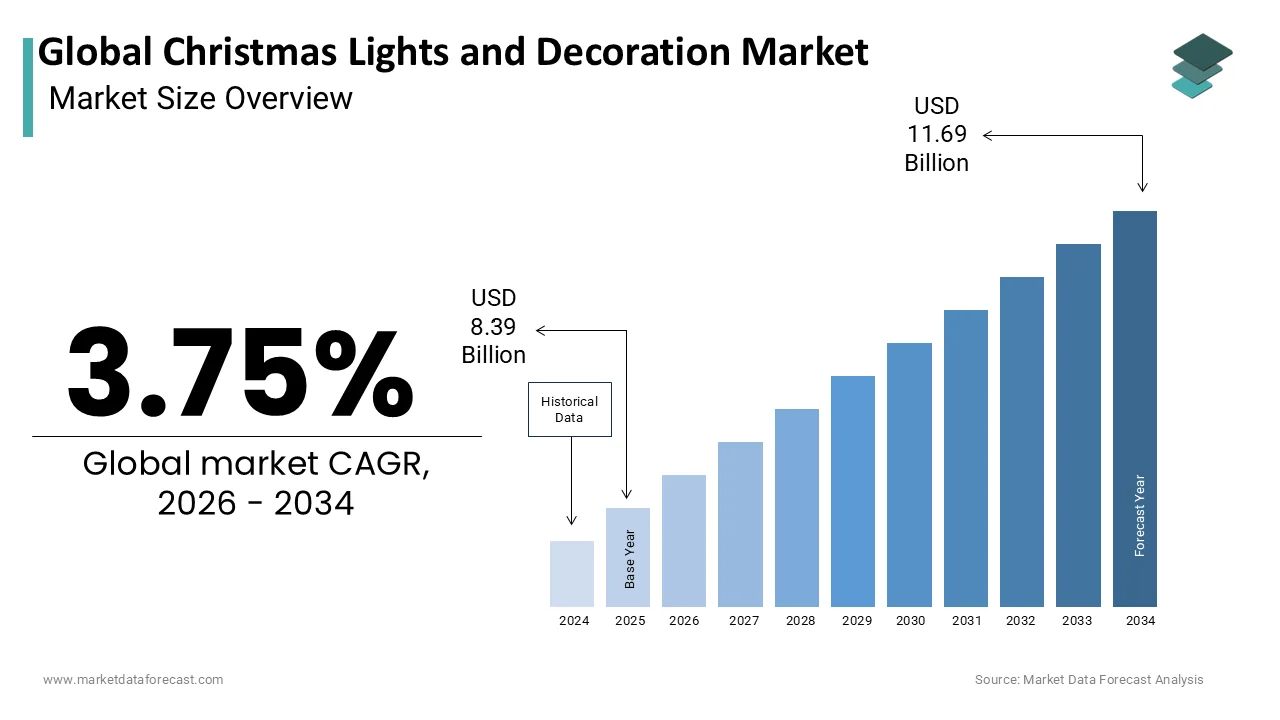
- Market Valuation: Valued at USD 8.39 billion in 2025, estimated at USD 8.71 billion in 2026, and projected to reach USD 11.69 billion by 2034, registering a CAGR of 3.75% from 2026 to 2034.
- Primary Growth Drivers: Resurgence of post-pandemic social gatherings, dominance of energy-efficient LED technology, and the viral influence of social media trends (Instagram/TikTok) on consumer aesthetic preferences.
- Market Restraints & Challenges: Rising environmental concerns regarding plastic/electronic waste, economic volatility/inflation impacting discretionary spending, and extreme supply chain seasonality.
Key Market Segment Metrics (2026–2034)
| Category | Leading Segment | Fastest-Growing Segment |
|---|---|---|
| By Type | Christmas Lighting (35.1% share) | Artificial Christmas Trees (6.2% CAGR) |
| By Application | Residential (65.5% share) | Commercial (7.1% CAGR) |
| By Distribution Channel | Supermarkets & Hypermarkets (40.3% share) | Online Retail (8.5% CAGR) |
Regional Dynamics
North America leads the global market due to high per capita holiday spending, strong suburban traditions, and tech-savvy adoption of smart lighting. Europe follows, emphasizing traditional craftsmanship, artisanal markets, and sustainability. Asia-Pacific is the fastest-evolving market, driven by westernization, urbanization, and a growing culture of spectacular public light festivals.
Major Market Players
SmartRay Inc., Cooper Decorations Co. Inc., Balsam Hill, Tree Classics, Barcana, Roman, Kingtree, Crystal Valley, Bulbman, Festive Productions Ltd, Crystal Valley Decorating Inc., Hilltop, BLACHERE ILLUMINATIO, and Focus Technology Co. Ltd.
Global Christmas Lights and Decoration Market Size
The global Christmas lights and decorations market was valued at USD 8.39 billion in 2025, is expected to have a 3.75% CAGR from 2026 to 2034, and be worth USD 11.69 billion by 2034 from USD 8.71 billion in 2026.
Christmas lights and decorations refer to the festive ornaments, lighting setups, and visual displays used to adorn homes, trees, and public spaces during the holiday season. This market is a significant cultural and economic phenomenon driven by deep-rooted traditions of home adornment and community celebration across various global regions. The market extends beyond residential use to include commercial applications such as shopping malls, hotels,s and public spaces that utilize elaborate installations to attract visitors and stimulate seasonal spending. According to the National Retail Federation, approximately 92% of U.S. adults plan to celebrate winter holidays such as Christmas, Hanukkah, or Kwanzaa, with consumers budgeting a significant portion of their seasonal expenses toward gifts, food, and holiday decorations. In Europe, the tradition is equally strong, with countries like Germany and the United Kingdom hosting extensive Christmas markets that drive demand for both indoor and outdoor decor items. The shift toward energy-efficient lighting technologies has transformed the industry, with light-emitting diode technology now dominating due to its longevity and lower power consumption. According to data from the International Energy Agency, the rapid global adoption of LED lighting has stabilized electricity demand in the buildings sector despite a 20% increase in global floor area over the last decade. For decorative and holiday purposes, the U.S. Department of Energy states that residential LEDs use at least 75% less energy than traditional incandescent ornamental lighting. Urbanization trends have led to smaller living spaces, influencing product design toward compact and versatile decorations. Social media platforms further amplify demand as individuals seek visually appealing setups for digital sharing,g creating a cycle of trend-driven consumption. The market operates on a highly seasonal basis, requiring efficient supply chain management to meet peak demand within a narrow window while minimizing inventory risks during off-peak periods.
MARKET DRIVERS
Resurgence of Post-Pandemic Social Gatherings and Community Events Drives Demand
The revival of large-scale social gatherings and community festivals following global health restrictions has significantly boosted the growth of the Christmas lights and decoration market. This trend has surged the demand for elaborate Christmas decorations and lighting installations. Communities are increasingly investing in public displays to foster social cohesion and celebrate collective joy after periods of isolation. According to VisitBritain's tourism data, seasonal events like illuminated light trails significantly bolster off-season travel, with individual historic UK estates reporting that holiday light displays successfully transform typically slow winter months by attracting hundreds of thousands of festive visitors. Municipalities and business improvement districts allocate substantial budgets for street decorations and illuminated trails to attract tourists and support local economies. The psychological need for normalcy and celebration drives households to invest more heavily in exterior lighting and yard displays to participate in neighborhood traditions. Commercial entities such as theme parks and retail centers compete to create immersive experiences, leading to higher spending on professional-grade decorations. As per the International Council of Shopping Centers (ICSC), experiential retail activations, pop-ups, and holiday displays are primary drivers of seasonal performance, serving to maximize visitor engagement and lengthen shopper dwell time. This trend encourages businesses to extend decoration periods starting earlier in November to maximize exposure. The visual spectacle of synchronized light shows and themed installations has become a key tourist attraction in many cities, generating revenue through ticket sales and associated hospitality services. This renewed focus on shared experiences ensures sustained growth in the commercial and public sectors of the decoration market.
Influence of Social Media and Digital Trends on Consumer Aesthetics
Social media platforms play a pivotal role in shaping consumer preferences and driving demand for visually striking Christmas decorations that are shareable online, thereby accelerating the expansion of the Christmas lights and decoration market. Platforms such as Instagram, Pinterest, st and TikTok feature millions of posts tagged with holiday decor inspiration, ion creating a continuous cycle of trend adoption and innovation. According to Sprout Social consumer pulse surveys, social media is an essential hub for seasonal inspiration, with nearly half of consumers explicitly relying on social platforms for product discovery, gift ideas, and holiday trend tracking. Influencers and lifestyle bloggers showcase elaborate setups featuring coordinated color schemes, smart lighting systems, and unique ornaments, which followers strive to replicate. This digital peer pressure accelerates the replacement cycle of decorations as consumers seek to stay current with evolving styles such as minimalist Scandinavian designs or maximalist vintage themes. The rise of short-form video content emphasizes dynamic elements like animated lights and moving figures, encouraging purchases of interactive products. Retailers leverage these trends by launching collections inspired by viral moments,thuss ensuring relevance and immediate appeal. User-generated content serves as free marketing for brands as customers post their own displays, tagging manufacturers and retailers. The desire for digital validation transforms decoration from a private tradition into a public performance, driving higher expenditure on premium and novel items. This digital influence expands the market reach globally as trends cross borders rapidly through online networks.
MARKET RESTRAINTS
Environmental Concerns and Waste Management Issues Limit Consumption
Growing environmental awareness regarding plastic waste and non-biodegradable materials is a major constraint on the Christmas lights and decoration market. Traditional decorations often consist of synthetic polymer,s metals, and electronic components that are difficult to recycle and frequently end up in landfills. According to the Environmental Protection Agency, household waste increases by 25 percent between Thanksgiving and New Year in the United States,s with a substantial portion attributed to packaging and discarded decor items. Consumers are increasingly scrutinizing the sustainability credentials of products, ts leading to hesitation in purchasing single-use or low-quality items. Regulatory pressures in regions like the European Union impose stricter guidelines on hazardous substances in electronics and plastics, affecting production costs and material choices. The carbon footprint associated with manufacturing and transporting bulky artificial trees and heavy lighting rigs also draws criticism from eco-conscious groups. Many municipalities have banned certain types of non-recyclable confetti and glitter-based decorations, further limiting product options. The perception of decorations as disposable contributes to a culture of overconsumption that conflicts with modern sustainability values. Brands face challenges in balancing affordability with eco-friendly materials, which often carry higher price points. This tension restricts market growth among environmentally aware demographics who may opt for minimalism or DIY natural alternatives instead of buying new commercial products each year.
Economic Volatility and Inflationary Pressures Reduce Discretionary Spending
Economic instability and rising inflation rates significantly impact consumer willingness to spend on non-essential items, which further hampers the expansion of the Christmas lights and decoration market. As household budgets tighten due to increased costs of living, energy, and food priorities take precedence over festive adornments. According to the U.S. Bureau of Labor Statistics (BLS), the Consumer Price Index reached multi-year highs in recent years, significantly inflating the cost of core consumer goods and causing a measurable tightening in household discretionary spending budgets. As per organizations like the National Retail Federation, microeconomic pressures and financial uncertainty frequently alter seasonal spending behavior, causing budget-conscious consumers to prioritize practical gift-giving and promotional discounts over purely discretionary goods like premium decorations. High interest rates further discourage borrowing for large purchases, including premium outdoor lighting systems or artificial trees. Price-sensitive consumers may delay replacements of existing items, extending the lifecycle of older decorations rather than buying new ones. The volatility of raw material costs, such as copper for wiring and plastics for oornamentss squeezes manufacturers' margins, ns leading to higher retail prices that dampen demand. Small businesses and municipalities also face budget constraints,nts reducing investment in public displays and commercial installations. This economic pressure creates a downward spiral where reduced sales volumes lead to less innovation and fewer promotional offers. The market becomes increasingly polarized, with growth only in ultra-low cost segments or ultra-premium niche products, while the middle market shrinks.
MARKET OPPORTUNITIES
Adoption of Smart Home Technology and Automated Lighting Systems
The integration of smart home technology into Christmas lighting paves the way for manufacturers to offer connected and automated decoration solutions, which are anticipated to drive the growth of the Christmas lights and decoration market. Consumers are increasingly seeking convenience and customization, allowing them to control their col,ors patterns, and schedules via smartphone apps or voice assistants. Smart LED strips and bulbs enable users to synchronize displays with music or other smart devices, creating immersive experiences without complex wiring. These systems appeal to tech-savvy demographics who value ease of use and energy efficiency through precise control features. Manufacturers can partner with major smart home ecosystems such as Amazon Alexa, Google Home,e and Apple HomeKit to ensure compatibility and broaden market access. The ability to program intricate light shows remotely enhances the appeal for competitive decorators and event organizers. Subscription-based software services offering pre-designed lighting templates provide recurring revenue streams for companies. The durability and programmability of smart lights justify higher price points, attracting premium buyers. As Internet of Things connectivity becomes standard in households, the demand for interoperable decorative lighting will rise. This technological shift allows for personalized expressions of holiday spirit while reducing manual effort,t opening new avenues for product innovation and market expansion.
Expansion of Sustainable and Eco-Friendly Product Lines
Developing sustainable and eco-friendly decoration lines offers a significant opportunity to capture the growing segment of environmentally conscious consumers, which is expected to propel the Christmas lights and decoration market. Products made from recycled materials, bamboo wood, and biodegradable plastics appeal to buyers seeking to reduce their ecological footprint. Companies can introduce take-back programs for old lights and decorations, promoting circular economy principles and building brand loyalty. Solar-powered outdoor lights eliminate electricity costs and appeal to energy-conscious households, particularly in regions with high utility rates. Natural fiber wreaths and organic cotton stockings provide alternatives to synthetic textiles,s aligning with the trend toward natural living. Certification labels, such as the Forest Stewardship Council for wood products, enhance credibility and trust among discerning shoppers. Collaborations with environmental organizations can boost brand image and differentiate products in a crowded market. Educational campaigns highlighting the longevity and recyclability of sustainable decorations help justify premium pricing. The shift toward minimalism and quality over quantity supports the sale of durable, heirloom-quality items rather than disposable goods. Manufacturers who lead in sustainability can future-proof their businesses against changing regulations and shifting consumer values. Ultimately, this ensures their long-term relevance and continuous growth.
MARKET CHALLENGES
Supply Chain Disruptions and Raw Material Scarcity
Supply chain vulnerabilities are a persistent hurdle for the Christmas lights and decorations market. This is due to its reliance on global manufacturing hubs and seasonal timing. Most decorations are produced in Asia, requiring long lead times for shipping to Western markets,s where demand peaks in November and December. According to the World Bank,nk global supply chain pressures have caused significant delays and increased freight costs, impacting inventory availability. Shortages of critical components such as semiconductor chips for smart lights and copper for wiring disrupt production schedules and limit output. Geopolitical tensions and trade tariffs further complicate sourcing strategies, increasing costs and uncertainty for importers. The just-in-time inventory model leaves little room for error, meaning any disruption can result in stockouts during the critical sales window. Manufacturers struggle to balance production capacity with fluctuating demand forecasts, leading to either excess inventory or missed sales opportunities. Port congestion and labor shortages in logistics sectors exacerbate delivery delays, affecting retailer readiness. The perishable nature of trends means that late arrivals may miss the peak consumer interest window,w resulting in deep discounting and margin erosion. Building resilient supply chains requires diversification of suppliers and nearshoring initiatives, es which involve significant capital investment and operational restructuring. These logistical hurdles constrain market stability and profitability.
Intense Seasonality and Inventory Management Risks
Extreme seasonality heavily limits the expansion of the Christmas lights and decoration market. As a result, retailers and manufacturers struggle with inventory management and cash flow planning. Sales are concentrated within a six to eight-week period, leaving months of idle capacity and storage costs for unsold goods. According to the National Retail Federation, holiday sales account for nearly 20 percent of annual retail revenue,e making accurate forecasting critical yet difficult. Overestimating demand leads to excessive leftover stock that must be stored for a year or sold at steep discounts, damaging brand value. Underestimating demand results in lost sales opportunities and dissatisfied customers who turn to competitors. The rapid evolution of design trends makes it risky to hold inventory for multiple seasons,s as styles may become obsolete. Warehousing costs for bulky items like artificial trees and large light sets are substantial, al eating into profit margins. Retailers must negotiate favorable return policies with suppliers to mitigate risk, but this shifts pressure upstream to manufacturers. The short-selling window limits the ability to react to mid-season trends or adjust pricing strategies dynamically. Cash flow constraints during off-peak months require careful financial management to fund production for the next cycle. This cyclical nature demands precise coordination across the entire value chain to optimize efficiency and minimize financial exposure.
REPORT COVERAGE
| REPORT METRIC | DETAILS |
| Market Size Available | 2025 to 2034 |
| Base Year | 2025 |
| Forecast Period | 2026 to 2034 |
| Segments Covered | By Type, Application, Distribution Channel, and Region |
| Various Analyses Covered | Global, Regional & Country Level Analysis, Segment-Level Analysis, Drivers, Restraints, Opportunities, Challenges, PESTLE Analysis, Porter’s Five Forces Analysis, Competitive Landscape, Analyst Overview on Investment Opportunities |
| Regions Covered | North America, Europe, Asia Pacific, Latin America, the Middle East, and Africa |
| Market Leaders Profiled | SmartRay Inc., Cooper Decorations Co. Inc., Balsam Hill, Tree Classics, Barcana, Roman, Kingtree, Crystal Valley, Bulbman, Festive Productions Ltd, Crystal Valley Decorating Inc., Hilltop, BLACHERE ILLUMINATIO, and Focus Technology Co. Ltd. |
SEGMENTAL ANALYSIS
By Type Insights
The Christmas lighting segment dominated the global market and accounted for a 35.1% share in 2025. This dominance of the segment was driven by the universal adoption of illumination for both indoor and outdoor festive displays. Moreover, the main driver is the global shift toward light-emitting diode technology, which offers superior energy efficiency and longevity compared to traditional incandescent bulbs. According to data evaluated by the U.S. Department of Energy, energy-efficient holiday LED light strands consume 75% to 80% less electricity than conventional incandescent light strings, allowing households and businesses to dramatically lower operational costs during the peak holiday season. This cost-saving encourages consumers to install more extensive lighting arrays without fear of excessive utility costs. Municipalities and commercial entities are mandated in many regions to use energy-efficient lighting for public decorations, further boosting bulk procurement. The versatility of LED strings allows for creative applications such as icicle lights, string lights, HTS, and net lights that cater to diverse architectural styles. Manufacturers continuously innovate with smart connectivity features enabling color changing and synchronization with music, which appeals to tech-savvy consumers. The durability of LED bulbs reduces replacement frequency, making them a preferred long-term investment. Seasonal promotions and bundle deals in retail outlets further stimulate volume sales. The visual impact of illuminated displays remains central to holiday traditions, ensuring consistent demand across all demographic segments globally.
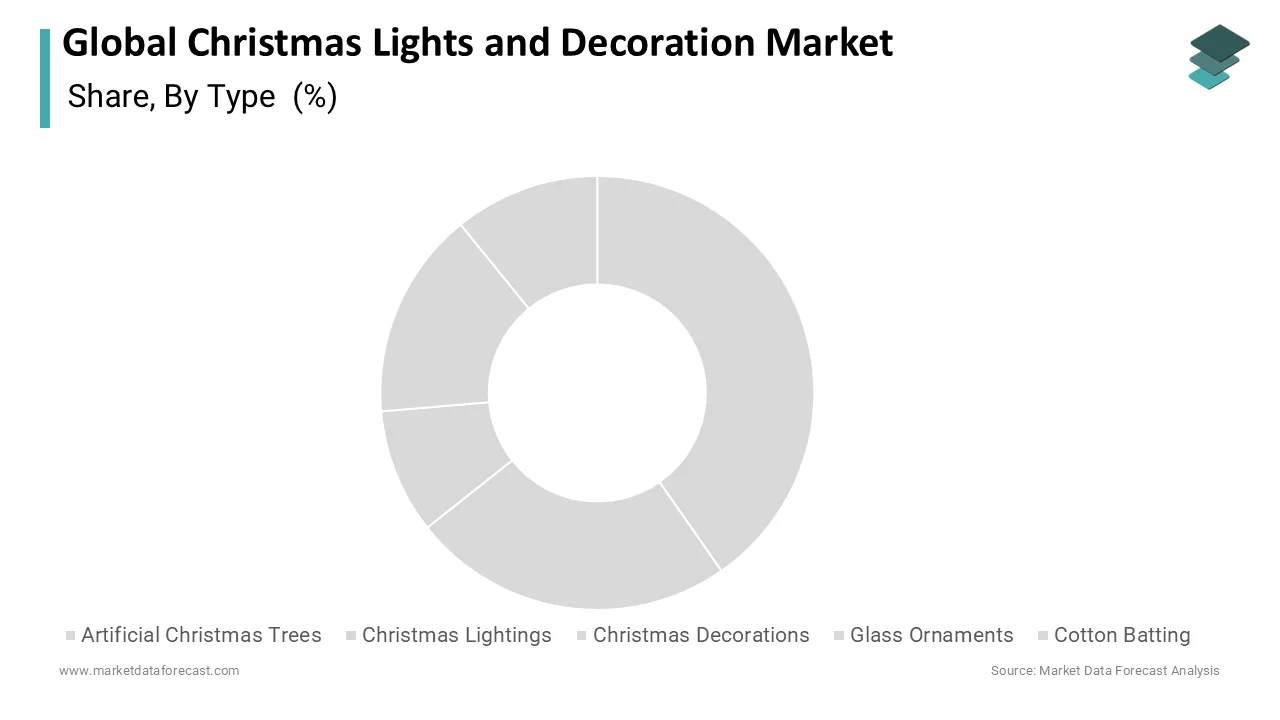
On the contrary, the artificial Christmas trees segment is on the rise and is expected to be the fastest-growing segment in the market by witnessing a CAGR of 6.2% during the forecast period due to convenience, reusability, and technological advancements. Consumers increasingly prefer artificial trees due to their low maintenance requirements and elimination of needle drop issues associated with real trees. According to the American Christmas Tree Association, over 80 percent of Christmas trees displayed in American homes are now artificial,l reflecting a decisive shift in consumer preference. Modern artificial trees feature realistic branch structures and pre-lit options that simplify setup and enhance aesthetic appeal. The ability to reuse these trees for multiple years offers significant cost savings over time, justifying the higher initial purchase price. Urbanization trends contribute to this growth as apartment dwellers with limited space opt for compact, small, indoor tabletop artificial varieties that fit smaller living areas. Advances in manufacturing materials such as polyethylene provide lifelike textures and colors that closely mimic natural foliage, addressing previous quality concerns. Environmental considerations also play a role as some consumers view reusable artificial trees as a sustainable alternative to cutting down fresh trees annually, although this debate continues. Retailers offer a wide range of sizes and styles from traditional green to white or black, catering to diverse interior design themes. The convenience of storage and assembly drives repeated purchases and upgrades among existing users.
By Application Insights
The residential application segment led the Christmas lights and decoration market and captured a 65.5% share in 2025. This leading position of the segment was attributed to deep-rooted cultural traditions and personal expression. Homeowners view holiday decorating as an essential annual ritual that fosters family bonding and community spirit. According to the National Retail Federation, holiday decorations remain a primary spending tier for seasonal shoppers, with the vast majority of celebrating consumers allocating a dedicated portion of their holiday budget toward seasonal home improvements, greenery, and lighting. This widespread participation creates a massive baseline demand for diverse product categories ranging from basic string lights to elaborate inflatables. The rise of social media platforms has intensified competition among neighbors to create visually stunning displays,s leading to increased spending on premium and unique items. Suburban neighborhoods often organize informal contests, ts encouraging residents to invest heavily in exterior decorations. The trend toward staycations and home-centric lifestyles following global health events has further amplified focus on home aesthetics. DIY culture promotes the purchase of modular components that allow for customization and creativity. Retailers respond by offering extensive assortments of themed decorations, such as rustic modern or vintage styles, to match individual tastes. The emotional value attached to creating a festive atmosphere ensures resilient demand even during economic downturns as consumers prioritize small luxuries. Government incentives for energy-efficient residential lighting also support the adoption of advanced LED systems in home settings.
However, the commercial application segment is expected to exhibit a noteworthy CAGR of 7.1% from 2026 to 2034, owing to the strategic use of decorations to attract customers and enhance brand visibility. Retailer,s shopping mal, ls hot, els and theme parks invest heavily in elaborate installations to create immersive holiday experiences that drive foot traffic and sales. According to the International Council of Shopping Centers (ICSC), visual merchandising, seasonal displays, and physical retail activations are essential mechanisms utilized by developers to heighten customer engagement and increase shopper dwell times during the year-end shopping rush. Businesses recognize that festive ambiance influences consumer mood and spending behavior, making decoration a critical marketing tool. Corporate offices also participate by decorating lobbies and common areas to boost employee morale and celebrate company culture. Public-private partnerships enable cities to fund large-scale light festivals and tree lighting ceremonies that attract tourists and generate local economic activity. The competition among commercial entities leads to innovation in display technologies such as projection mapping and interactive light shows. Hospitality sectors extend decoration periods to cover both Thanksgiving and New Year, maximizing return on investment. Professional installation services grow in tandem as businesses seek hassle-free solutions for complex setups. The visual spectacle serves as free advertising through social media shares, amplifying reach beyond physical visitors. This strategic imperative ensures sustained investment in commercial-grade decorations annually.
By Distribution Channel Insights
In 2025, the supermarkets and hypermarkets segment held the majority share of 40.3% of the Christmas lights and decoration market because of its widespread presence and one-stop shopping convenience. These retail giants leverage their extensive floor space to create dedicated seasonal aisles featuring comprehensive assortments of lights, trees, and ornaments at competitive prices. The ability to purchase decorations alongside weekly groceries appeals to time-constrained consumers seeking efficiency. Private label brands offered by these retailers provide affordable alternatives that attract budget-conscious shoppers. Promotional strategies such as buy one get one free offers and loyalty point multipliers drive impulse purchases and bulk buying. The physical tactile experience allows customers to inspect quality, color, and size before purchasing,g reducing return rates. Strategic placement near entrances and checkout zones maximizes visibility and exposure to high traffic flows. Established supply chains ensure consistent stock availability during peak demand periods, ds minimizing out-of-stock situations. The trust consumers place in familiar retail brands encourages repeat purchases year after year. This channel benefits from economies of scale, allowing for aggressive pricing that undercuts specialized stores.
On the contrary, the online distribution segment is predicted to witness the highest CAGR of 8.5% over the forecast period. This rapid expansion of the segment is fuelled by the convenience of home delivery,y extensive product variety, ty and competitive pricing. E-commerce platforms enable consumers to browse thousands of options, compare reviews,ws and find specific items that may not be available in local stores. The ability to shop at any time eliminates the stress of crowded stores and long queues during the busy holiday season. Direct-to-consumer brands utilize social media marketing to showcase unique and trendy items, reaching niche audiences effectively. Detailed product descriptions and customer images help buyers make informed decisions despite the lack of physical inspection. Free shipping thresholds and easy return policies reduce perceived risk, encouraging trial of new vendors. Subscription boxes for holiday decor offer curated selections that simplify decision-making for busy individuals. Mobile apps facilitate quick reordering of favorite items from previous years. The global reach of online marketplaces allows consumers to access international designs and innovations. Digital payment security and reliable logistics networks have built consumer confidence, making online shopping a preferred method for many demographics,s especially younger generations.
COUNTRY LEVEL ANALYSIS
North America Christmas Lights And Decoration Market Analysis
North America was the top performer in the global Christmas Lights and Decoration Market and accounted for a substantial share in 2025. This dominance of the North American market was driven by high per capita spending and elaborate decoration traditions. The United States and Canada exhibit strong cultural emphasis on holiday celebrations, ns with households investing significantly in both indoor and outdoor displays. According to the winter outlook data by the National Retail Federation (NRF), the average planned holiday spending per individual consumer hovered at $890.49. This money is distributed across gifts, seasonal food, and home decorations. The prevalence of single-family homes with yards facilitates extensive outdoor lighting projects, driving demand for weather-resistant and high-brightness products. Early adoption of smart home technologies integrates seamlessly with decorative lighting systems, appealing to tech-savvy consumers. Major retail events such as Black Friday and Cyber Monday kick off the shopping season with deep discounts, stimulating early purchases. The influence of television shows and movies depicting idealized Christmas settings reinforces societal expectations for festive adornment. Community associations often enforce guidelines that encourage uniform or impressive displays, fostering neighborhood competition. The robust e-commerce infrastructure supports rapid delivery of seasonal goods, ensuring a timely setup. Energy efficiency regulations promote the transition to LED lighting, reducing operational costs for large displays. This mature market values quality innovation and convenience,e sustaining steady growth despite saturation levels.
Europe Christmas Lights And Decoration Market Analysis
Europe was the next prominent region in the Christmas lights and decoration market in 2025. It places a strong emphasis on traditional craftsmanship and sustainable decoration practices. Countries like Germany, France, and the United Kingdom have deep historical roots in Christmas markets and festive traditions that drive demand for authentic and high-quality items. According to sources, household final consumption expenditure on recreation, sport, and culture saw a 3.0% increase following broader economic stabilization, following historical drops to record lows during preceding macroeconomic downturns. European consumers prefer durable heirloom-quality ornaments made from glass, wood,d and natural materials over disposable plastic alternatives. Environmental regulations strictly limit the use of hazardous substances in decoration, ns promoting eco-friendly production methods. The popularity of Christmas markets provides a platform for artisanal producers to sell unique handcrafted items directly to consumers. Urban living conditions in many European cities favor compact indoor decorations and balcony lighting over large outdoor displays. Government initiatives support energy conservation, encouraging the use of low-power LED lights for public and private installations. The region values aesthetic subtlety and elegance, influencing design trends toward minimalist and classic stystyless-border trade within the European Union facilitates access to diverse regional specialties, enhancing product variety. Sustainability certifications play a crucial role in purchasing decisions,s reflecting the environmentally conscious mindset of European shoppers.
Asia-Pacific Christmas Lights And Decoration Market Analysis
The Asia Pacific region is experiencing rapid growth in the Christmas Lights and Decoration Market due to increasing westernization and rising disposable incomes in emerging economies. While Christmas is not a traditional religious holiday in many Asian countries,e,s it is widely celebrated as a secular festival of joy and commerce,ce particularly in urban centers. Shopping malls and hotels invest heavily in elaborate displays to attract customers and create festive atmospheres that boost retail sales. Japan and South Korea have established vibrant illumination cultures with cities hosting spectacular light festivals that draw millions of tourists. The demand for decorative lights extends beyond Christmas to include New Year and other winter festivals, also expanding the selling season. E-commerce platforms facilitate access to international decoration trends,nds enabling young consumers to experiment with diverse styles. Manufacturing hubs in China supply a significant portion of global decoration, ns benefiting from local cost advantages and export capabilities. Urbanization leads to smaller living spaces, favoring compact and versatile decoration options. The influence of K-pop and J-pop culture spreads festive aesthetics across the region through media and entertainment channels.
Latin America Christmas Lights And Decoration Market Analysis
Latin America is a key player in the global market, owing to strong family-oriented traditions and vibrant cultural expressions. Countries such as Brazil, Mexico,o and Argentina place high importance on holiday gatherings where home decoration plays a central role in creating a welcoming environment. The tradition of setting up nativity scenes alongside Christmas trees blends religious significance with festive cheer,eer driving demand for diverse ornament types. Warm climate conditions influence decoration choices with lighter materials and outdoor patio setups being popular. Local artisans contribute unique handmade items such as woven ornaments and ceramic figures that reflect regional heritage. Economic volatility sometimes constrains spending, but the cultural imperative to celebrate ensures baseline demand remains resilient. Social media influence is growing rapidly among younger demographics, encouraging the adoption of global trends like synchronized light displays. Retailers expand seasonal offerings in supermarkets and department stores to capture increasing consumer interest. Importing dependencies for certain high-tech lighting products creates opportunities for local manufacturers to fill gaps with affordable alternatives. Community festivals and church events further stimulate demand for bulk decorations and public lighting installations.
Middle East and Africa Christmas Lights And Decoration Market Analysis
The Middle East and Africa region is likely to expand notably in the global market during the forecast period due to diverse cultural norms and expatriate populations. In Gulf Cooperation Council countries, large expatriate communities from Europe and Asia drive demand for Christmas decorations in residential compounds and international schools. Shopping malls compete to create extravagant festive displays to attract shoppers during the winter tourism seseason. In African nationss Christmas is widely celebrated with strong religious undertones,leading to demand for traditional ornaments and church decorations. Economic constraints in Sub-Saharan countries limit spending to essential items; however, local markets offer affordable handmade alternatives. Urban centers in South Africa and Kenya show growing adoption of modern lighting technologies for home and commercial use. Import reliance for most decorative products exposes the market to currency fluctuations and supply chain delays. Regional stability improvements in certain areas are encouraging foreign investment in retail infrastructure,e expanding access to varied decoration options. Cultural sensitivity requires marketers to tailor messaging and product designs to respect local traditions while celebrating universal themes of joy and light.
COMPETITIVE LANDSCAPE
The competition in the Christmas Lights and Decoration Market is highly fragmented, ed with a mix of established multinational brands and numerous small specialized manufacturers vying for consumer attention. Price sensitivity remains a critical factor as many buyers view decorations as seasonal disposable items, ems leading to intense rivalry in the low-cost segment. However, premium segments compete on quality innovation and design exclusivity,ity attracting discerning customers willing to pay more for durability and aesthetics. The rise of smart technology has introduced new competitive dynamics where connectivity and app functionality differentiate products beyond mere illumination. Retailers play a significant role in shaping competition through private label offerings that undercut branded prices while maintaining acceptable quality standards. The seasonal nature of demand forces companies to optimize supply chains and inventory management to avoid overstock issues. Digital marketing and social media presence are increasingly vital for brand visibility and customer engagement during the short selling window. Innovation in sustainable materials and energy efficiency serves as a key differentiator as regulatory pressures and consumer preferences shift toward eco-friendly options. This landscape requires agility and strategic positioning to succeed.
KEY MARKET PLAYERS
Some of the companies that are playing a dominating role in the Global Christmas Decorations Market include
- SmartRay Inc.
- Cooper Decorations Co. Inc.
- Balsam Hill
- Tree Classics
- Barcana, Inc.
- Roman, Inc.
- Kingtree
- Crystal Valley Decorating, Inc.
- Bulbman, Inc.
- Festive Productions Ltd.
- Hilltop Christmas Tree Farms
- Blachere Illumination
- Focus Technology Co., Ltd.
TOP LEADING PLAYERS IN THE MARKET
- Philips Lighting significantly contributes to the global market through its advanced LED lighting solutions that combine energy efficiency with smart home connectivity. The company recently expanded its Hue range to include specialized outdoor holiday lighting strips that sync with music and other smart devices. This innovation allows consumers to create dynamic and personalized festive displays via smartphone applications. Philips focuses on sustainability by ensuring all new products meet strict environmental standards and reduce energy consumption. Their partnerships with major smart home platforms enhance user experience and drive adoption among tech-savvy demographics. The brand leverages its strong reputation for quality to command premium pricing while offering durable, long-lasting products. Recent marketing campaigns emphasize the emotional value of light in creating holiday memories and strengthening brand loyalty. These actions position Philips as a leader in the modernization of traditional holiday decorations.
- General Electric Company maintains a robust presence in the market with its extensive portfolio of traditional and LED Christmas lights, known for reliability and brightness. The company recently launched a new line of vintage-style Edison bulbs that appeal to consumers seeking nostalgic aesthetics for their holiday decor. GE focuses on expanding distribution channels by partnering with online retailers and home improvement stores to increase product accessibility. Their commitment to innovation includes developing shatter-resistant bulbs and weather-proof designs suitable for harsh winter conditions. The brand leverages its trusted heritage to attract customers who prioritize durability and performance in outdoor lighting. Recent initiatives involve collaborating with interior designers to create curated decoration collections that simplify consumer choices. GE also emphasizes energy-efficient options to align with growing environmental consciousness among buyers. These strategies reinforce its position as a staple choice for holiday lighting needs globally.
- Seasonal Visions Inc specializes in high-end commercial and residential Christmas decorations, offering bespoke design services and premium products. The company recently expanded its manufacturing capabilities to produce larger-scale installations for shopping malls and theme parks worldwide. Their focus on customization allows clients to create unique thematic experiences that drive foot traffic and engagement. Seasonal Visions invests heavily in research and development to introduce innovative materials and lighting technologies that enhance visual impact. The brand collaborates with event planners and architects to integrate decorations seamlessly into existing structures. Recent actions include launching a rental service for expensive decor items, providing cost-effective solutions for temporary displays. Their expertise in project management ensures timely installation and removal, reducing client burden. Seasonal Visions distinguishes itself from mass-market competitors by targeting the lucrative commercial sector and offering superior service quality. This strategic approach ultimately strengthens the company's global reputation.
TOP STRATEGIES USED BY KEY MARKET PARTICIPANTS
Key players in the Christmas Lights and Decoration Market primarily employ product innovation strategies to develop smart connected lighting systems that offer customization and energy efficiency. Companies focus on expanding their e-commerce presence to reach broader audiences and provide convenient shopping experiences during the peak season. Strategic partnerships with smart home ecosystems enable seamless integration of decorative lights with existing household devices, enhancing user appeal. Sustainability initiatives involve using recycled materials and promoting reusable products to address environmental concerns, and attracteco-consciouss consumers. Diversification into commercial sectors allows manufacturers to secure large contracts for public displays and retail installations, ensuring stable revenue streams. Marketing campaigns leverage social media influencers and user-generated content to inspire trends and drive viral demand for specific styles. Offering bundled packages and subscription services creates added value and encourages repeat purchases. These combined approaches help participants navigate seasonal fluctuations and maintain competitive advantages in a dynamic market environment.
MARKET SEGMENTATION
This research report on the global Christmas lights and decoration market has been segmented and sub-segmented based on type, application, distribution channel, and region.
By Type
- Artificial Christmas Trees
- Christmas Lightings
- Christmas Decorations
- Glass Ornaments
- Cotton Batting
By Application
- Residential
- Commercial
By Distribution Channel
- Supermarkets
- Hypermarkets
- Departmental stores
- Convenience stores
- Online
By Region
- North America
- Europe
- Asia Pacific
- Latin America
- Middle East and Africa