- Product Description Description
- Table of Contents TOC
- List of Table & Figure LOT
- Get Free Sample PDF Sample PDF
Market Size, 2025
$65.92 BnMarket Estimate, 2026
$69.98 BnMarket Forecast, 2034
$108.57 BnCAGR, 2026–2034
5.7%Global Carpet and Upholstery Cleaning Services Market Summary
Market Size & Growth
- The global carpet and upholstery cleaning services market was valued at USD 65.92 billion in 2025.
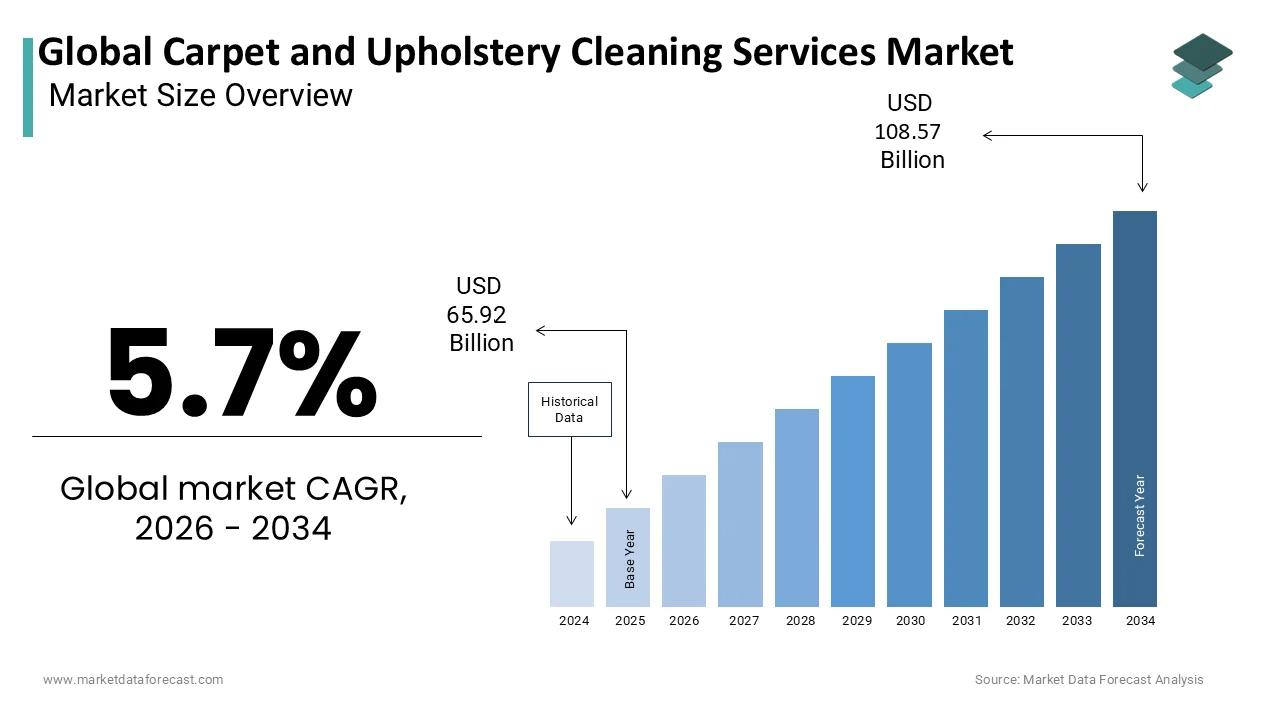
- The market is estimated to reach USD 69.98 billion in 2026 and USD 108.57 billion by 2034.
- The market is projected to grow at a CAGR of 5.7% from 2026 to 2034.
- North America held the largest regional share at 38.5% of the global market in 2025.
- Asia Pacific is the fastest-growing region, driven by urbanization and rising middle-class incomes.
Key Market Segments
- By Type: Carpet Cleaning (64.6% share in 2025), Upholstery Cleaning (fastest-growing at CAGR of 9.2%, 2026–2034).
- By Application: Commercial (56.5% share in 2025), Residential (fastest-growing at CAGR of 8.4%, 2026–2034).
- By Region: North America leads; Asia Pacific records the highest growth rate.
Key Drivers
- Rising health consciousness and allergen management requirements over 25 million people in the United States suffer from asthma, with indoor allergens as a major trigger, driving demand for professional deep cleaning.
- Expansion of the global hospitality and commercial real estate sectors the travel and tourism sector equaled 9.8% of global GDP in 2025, generating continuous demand for textile maintenance.
- Growing consumer preference for eco-friendly and sustainable cleaning practices 73% of millennials are willing to pay more for sustainable services, per the Nielsen Global Corporate Sustainability Report.
Key Players
ABM Industries Incorporated, Aramark Corporation, Chem-Dry, Jani-King International Inc., Sodexo S.A., COIT Cleaning and Restoration Services, The ServiceMaster Company LLC, CleanNet USA Inc., Pritchard Industries Inc., Analog Cleaning Systems.
Global Carpet and Upholstery Cleaning Services Market Size
The global carpet and upholstery cleaning services market size was valued at USD 65.92 billion in 2025 and is estimated to reach from USD 69.98 billion in 2026 to USD 108.57 billion by 2034, growing at a CAGR of 5.7% from 2026 to 2034.
Carpet and upholstery cleaning services include professional maintenance solutions designed to restore hygiene, aesthetics, and longevity of textile-based floor coverings and furniture. This sector operates at the intersection of facility management, residential care, and commercial sanitation, providing specialized extraction, steam cleaning, and chemical treatment services. As urbanization accelerates and living standards rise, the demand for professional cleaning has transitioned from a luxury to a necessity, driven by health consciousness and property preservation mandates. The industry serves diverse segments i, including hospitality, healthcare, education, and residential complexes, where regular deep cleaning is critical for compliance with health regulations. According to the World Health Organization, indoor air quality significantly impacts human health, with carpets acting as reservoirs for allergens, dust mites, and particulate matter if not maintained properly. As per the Environmental Protection Agency, Americans spend approximately 90% of their time indoors, making the cleanliness of interior surfaces a paramount concern for public health. The shift toward sustainable cleaning practices has also reshaped service offerings, with clients increasingly demanding eco-friendly solvents and water-efficient technologies. This market is characterized by a fragmented landscape comprising multinational corporations, regional specialists, and local independent operators who compete on service quality, technological adoption, and customer retention strategies. The integration of digital booking platforms and automated scheduling has further modernized service delivery, enhancing accessibility and operational efficiency across global markets.
MARKET DRIVERS
Rising Health Consciousness and Allergen Management Requirements
Health awareness among consumers and regulatory bodies is primarily fuelling the adoption of professional carpet and upholstery cleaning services, which is a key market driver. Carpets and upholstered furniture act as significant sinks for indoor pollutants, including dust mites, pet dander, pollen, and mold spores, which can exacerbate respiratory conditions such as asthma and allergies. According to the Asthma and Allergy Foundation of America, more than 25 million people in the United States suffer from asthma, with indoor allergens being a major trigger for attacks. Professional cleaning services utilize high-efficiency particulate air filtration systems and hot water extraction methods that remove up to 95% of embedded contaminants, which standard vacuuming cannot achieve. According to the Centers for Disease Control and Prevention, regular deep cleaning of soft surfaces reduces the biological load in indoor environments, thereby lowering the risk of disease transmission. In commercial settings, such as hospitals and schools, the imperative for hygienic interiors is even more pronounced. According to the Healthcare Facility Management Association, facilities implementing rigorous textile cleaning protocols report a 30% reduction in indoor-related health complaints. Additionally, the growing prevalence of autoimmune disorders and sensitivities has prompted households to seek certified cleaning services that use hypoallergenic and non-toxic solutions. This shift is not merely cosmetic but rooted in medical necessity, driving consistent, recurring revenue for service providers who can demonstrate tangible health benefits through certified cleaning standards and visible improvement in indoor air quality metrics.
Expansion of the Hospitality and Commercial Real Estate Sectors
The robust growth of the global hospitality industry and commercial real estate development is further boosting the expansion of the global carpet and upholstery cleaning services market. Hotels, resorts, and office spaces rely heavily on immaculate textiles to maintain brand reputation and meet guest expectations. According to the World Travel and Tourism Council, the travel and tourism sector equaled 9.8% of the global economy in 2025, indicating a vast infrastructure requiring continuous maintenance. High foot traffic in these establishments leads to rapid soiling of carpets and upholstery, necessitating frequent professional intervention to preserve asset value. According to the International Hotel and Restaurant Association, guest satisfaction scores are directly correlated with perceived cleanliness, with 85% of travelers citing room hygiene as a critical factor in their booking decisions. Furthermore, the expansion of co-working spaces and corporate offices has increased the density of upholstered furniture in commercial environments. According to the Global Workplace Analytics firm, modern offices allocate nearly 40% of their interior design budget to soft furnishings, which require specialized care to withstand daily wear. Property managers and facility operators are increasingly outsourcing cleaning tasks to specialized firms to ensure compliance with insurance requirements and lease agreements. This trend is particularly evident in emerging economies where urbanization is driving the construction of new commercial complexes. The need to extend the lifecycle of expensive textile assets while maintaining aesthetic appeal ensures a steady demand for professional cleaning services across the commercial sector globally.
MARKET RESTRAINTS
High Operational Costs and Labor Intensity Constraints
The carpet and upholstery cleaning market faces significant restraint due to high operational costs and the labor-intensive nature of the services. Professional cleaning requires specialized equipment, such as truck-mounted extractors, rotary scrubbers, and industrial dryers, which involve substantial capital expenditure and ongoing maintenance costs. According to the Bureau of Labor Statistics, the average annual wage for cleaning service workers has increased by 15% over the past five years, reflecting rising labor costs and a shortage of skilled personnel. The industry struggles with high employee turnover rates, which further escalates recruitment and training expenses. According to the International Cleaning Association, small to medium-sized cleaning businesses spend approximately 25% of their revenue on labor alone, limiting their profit margins and scalability. Additionally, the cost of eco-friendly cleaning agents, which are increasingly mandated by environmental regulations, is higher than that of traditional chemical solvents. These agents often require longer dwell times and specific application techniques, increasing the time required per job. The fluctuating prices of energy and water also impact operational efficiency, particularly for services relying on hot water extraction methods. In regions with strict wastewater disposal regulations, companies must invest in additional filtration systems to comply with environmental standards, adding to the financial burden. These cumulative costs make it challenging for smaller operators to compete with larger firms that benefit from economies of scale. Consequently, many potential customers opt for DIY cleaning solutions or less thorough, informal services due to price sensitivity, thereby restricting market penetration for professional providers who cannot lower prices without compromising service quality or sustainability standards.
Environmental Regulations and Chemical Usage Restrictions
Stringent environmental regulations governing the use of cleaning chemicals are further hampering the global market expansion. Governments worldwide are implementing stricter guidelines on volatile organic compounds and hazardous substances used in cleaning formulations to protect water sources and human health. According to the European Chemicals Agency, the Registration, Evaluation, Authorisation and Restriction of Chemicals (REACH) regulation has banned or restricted hundreds of substances commonly used in industrial cleaning applications. Compliance with these regulations requires service providers to reformulate their cleaning processes and invest in alternative technologies, which can be costly and technically challenging. According to the United States Environmental Protection Agency, standards for wastewater discharge from commercial cleaning operations have been tightened, requiring firms to install advanced treatment systems to remove contaminants before releasing water into municipal sewage systems. These compliance measures increase operational complexity and capital expenditure, particularly for small and medium enterprises that lack the resources for rapid adaptation. Furthermore, consumer skepticism regarding the efficacy of green cleaning products persists despite advancements in technology. According to a survey conducted by the Green Business Network, 40% of consumers doubt the cleaning power of eco-friendly solutions compared to traditional chemicals, leading to hesitation in adopting sustainable services. This perception gap forces providers to invest heavily in consumer education and demonstration efforts to prove effectiveness. The regulatory landscape continues to evolve, with new restrictions anticipated in emerging markets as they adopt international environmental standards. This dynamic creates uncertainty for long-term planning and investment in the sector, limiting the speed of market expansion and innovation in certain geographic regions.
MARKET OPPORTUNITIES
Integration of Smart Technology and IoT-Enabled Cleaning Solutions
The integration of smart technology and Internet of Things (IoT) enabled devices presents a significant opportunity for the global carpet and upholstery cleaning services market. Smart sensors and connected devices allow for predictive maintenance and real-time monitoring of soil levels, enabling service providers to optimize cleaning schedules and resource allocation. According to the International Data Corporation, global spending on Internet of Things solutions in facility management is projected to reach 15 billion dollars by 2027, driven by the need for data-driven operational insights. Cleaning companies can deploy sensors in high-traffic areas of hotels, offices, and public spaces to detect the accumulation of dirt and allergens, triggering automatic service requests. This proactive approach enhances customer satisfaction by ensuring cleanliness before visible soiling occurs, and it reduces unnecessary cleaning cycles, saving water and energy. Furthermore, mobile applications and artificial intelligence-powered platforms streamline booking, payment, and customer feedback processes, creating a seamless user experience. According to the Global Mobile App Analytics firm, businesses using automated scheduling software see a 20% increase in customer retention due to improved convenience and reliability. Robotics and autonomous cleaning machines are also gaining traction for large commercial spaces, offering consistent performance and reducing reliance on manual labor. These technologies enable the precise application of cleaning agents, minimizing waste and environmental impact. Service providers who adopt these innovations can differentiate themselves in a crowded market by offering superior efficiency, transparency, and sustainability. The data collected from smart devices also provides valuable insights into usage patterns, helping businesses tailor their services to specific client needs and identify new revenue streams through customized maintenance packages.
Growing Demand for Eco-Friendly and Sustainable Cleaning Practices
The escalating consumer preference for eco-friendly and sustainable cleaning practices offers a substantial opportunity for market growth. Modern consumers are increasingly aware of the environmental and health impacts of traditional cleaning chemicals, driving demand for green certification and biodegradable solutions. According to the Nielsen Global Corporate Sustainability Report, 73% of millennials are willing to pay more for sustainable goods and services, including home and facility maintenance. This shift prompts cleaning service providers to adopt plant-based enzymes, organic solvents, and water-efficient technologies that minimize ecological footprints. Certifications such as Green Seal and EcoLogo serve as trust markers for environmentally conscious clients, influencing purchasing decisions in both residential and commercial sectors. According to the Sustainable Cleaning Alliance, companies offering certified green services experience a 25% higher customer acquisition rate compared to those using conventional methods. Additionally, corporate social responsibility initiatives among large enterprises mandate the use of sustainable vendors for facility management, creating a B2B demand surge. Hotels and office buildings seeking LEED certification must adhere to strict environmental criteria, including the use of low-impact cleaning products and practices. This regulatory and consumer-driven demand encourages innovation in bio-based cleaning formulations and closed-loop water recycling systems. Service providers who pioneer these sustainable solutions can command premium pricing and build long-term loyalty among environmentally aware clients. The trend extends beyond product choice to include ethical labor practices and carbon-neutral operations, further enhancing brand value. As sustainability becomes a core business imperative rather than a niche preference, the opportunity for green cleaning services expands across all geographic markets and customer segments.
MARKET CHALLENGES
Shortage of Skilled Labor and Training Deficiencies
The global carpet and upholstery cleaning services market faces a persistent challenge due to the shortage of skilled labor and inadequate training infrastructure. Professional cleaning requires technical expertise in handling diverse fabric types, stain removal chemistry, and equipment operation, which cannot be mastered through informal learning. According to the National Association of Home Builders, the construction and maintenance sector experiences an annual labor shortage of approximately 500,000 workers, impacting service delivery capacity. The cleaning industry specifically struggles with attracting younger demographics, who often perceive the work as low status despite its technical complexity. According to the International Labour Organization, vocational training programs for facility maintenance are underfunded in many regions, leading to a skills gap that compromises service quality. Untrained workers may cause damage to expensive carpets and upholstery through improper chemical use or excessive moisture application, resulting in liability claims and customer dissatisfaction. According to the Insurance Information Institute, property damage claims related to cleaning errors have increased by 12% in recent years, underscoring the need for certified professionals. Furthermore, the aging workforce in developed nations exacerbates the shortage as experienced technicians retire without adequate replacement pipelines. Companies invest significant resources in on-the-job training, but high turnover rates mean these investments often yield limited long-term returns. The lack of standardized certification frameworks across different countries further complicates labor mobility and quality assurance. Addressing this challenge requires industry-wide collaboration to establish recognized training credentials and improve the professional image of the sector. Without a stable supply of competent technicians, service providers face operational bottlenecks, increased costs, and reputational risks that hinder market expansion and customer trust.
Inconsistency in Service Quality and Standardization Issues
Inconsistency in service quality and the lack of universal standardization present a major challenge for the global carpet and upholstery cleaning services market. The industry is highly fragmented, with numerous small operators varying widely in methodology, equipment, and chemical usage, leading to unpredictable outcomes for consumers. According to the Consumer Federation of America, complaints related to cleaning services rank among the top ten categories for household service disputes, with inconsistent results being the primary grievance. The absence of globally accepted standards for cleaning efficacy means that one provider may deliver exceptional results while another causes discoloration or fiber damage using similar advertised techniques. The Institute of Inspection, Cleaning and Restoration Certification (IICRC) attempts to address this by offering guidelines, but adoption remains voluntary and uneven across regions. This variability erodes consumer confidence and makes it difficult for reputable firms to justify premium pricing when competitors offer lower rates with inferior methods. In commercial contracts, this inconsistency poses significant risks as facility managers struggle to enforce uniform cleanliness standards across multiple locations serviced by different vendors. The American Society for Testing and Materials has developed some testing protocols for textile cleaning, but these are primarily used in laboratory settings rather than field applications. Customers often lack the technical knowledge to evaluate service quality objectively, relying instead on visual cues that may not reflect underlying hygiene or fabric integrity. This information asymmetry allows substandard providers to survive in the market, undermining overall industry credibility. Establishing mandatory certification requirements and transparent performance metrics could mitigate this challenge, but regulatory fragmentation across countries impedes global harmonization. Until standardization improves, the market will continue to suffer from trust deficits and price-based competition that prioritizes cost over quality.
REPORT COVERAGE
| REPORT METRIC | DETAILS |
| Market Size Available | 2025 to 2034 |
| Base Year | 2025 |
| Forecast Period | 2026 to 2034 |
| Segments Covered | By Type, Application, and Region |
| Various Analyses Covered | Global, Regional & Country Level Analysis, Segment-Level Analysis, DROC, PESTLE Analysis, Porter’s Five Forces Analysis, Competitive Landscape, Analyst Overview of Investment Opportunities |
| Regions Covered | North America, Europe, Asia Pacific, Latin America, Middle East & Africa |
| Market Leaders Profiled | ABM Industries Inc., Analog Cleaning Systems, Aramark Corporation, Chem-Dry, Cleannet, Jani-King International Inc., Pritchard Industries Inc., Sodexo, Coit Cleaning and Restoration Services, a nd The Servicemaster Company, LLC. |
SEGMENTAL ANALYSIS
By Type Insights
The carpet cleaning segment dominated the market by holding 64.6% of the global market share in 2025. The overwhelming dominance of the carpet cleaning segment is primarily propelled by the extensive installation of wall-to-wall carpets in commercial environments across the globe. Office buildings, retail spaces, and educational institutions heavily utilize carpeted flooring due to its acoustic-damping properties and aesthetic versatility. According to the World Floor Covering Association, commercial sectors account for nearly 60% of all broadloom carpet installations globally. This massive footprint necessitates rigorous and scheduled maintenance to preserve the structural integrity and visual appeal of the flooring. Professional cleaning services are indispensable in these settings because standard vacuuming cannot extract the deep-seated dirt and particulate matter that accumulate in high-traffic zones. According to the Institute of Inspection, Cleaning, and Restoration Certification, guidelines mandate that commercial carpets undergo professional hot water extraction at least every 12 to 18 months to maintain their warranty and performance standards. Consequently, facility management companies allocate substantial portions of their annual maintenance budgets to specialized carpet cleaning contracts. This recurring revenue model ensures the segment maintains its leading position, as businesses recognize that neglecting carpet maintenance leads to premature replacement costs, which are significantly higher than the cumulative expense of professional cleaning services over the lifespan of the flooring material.
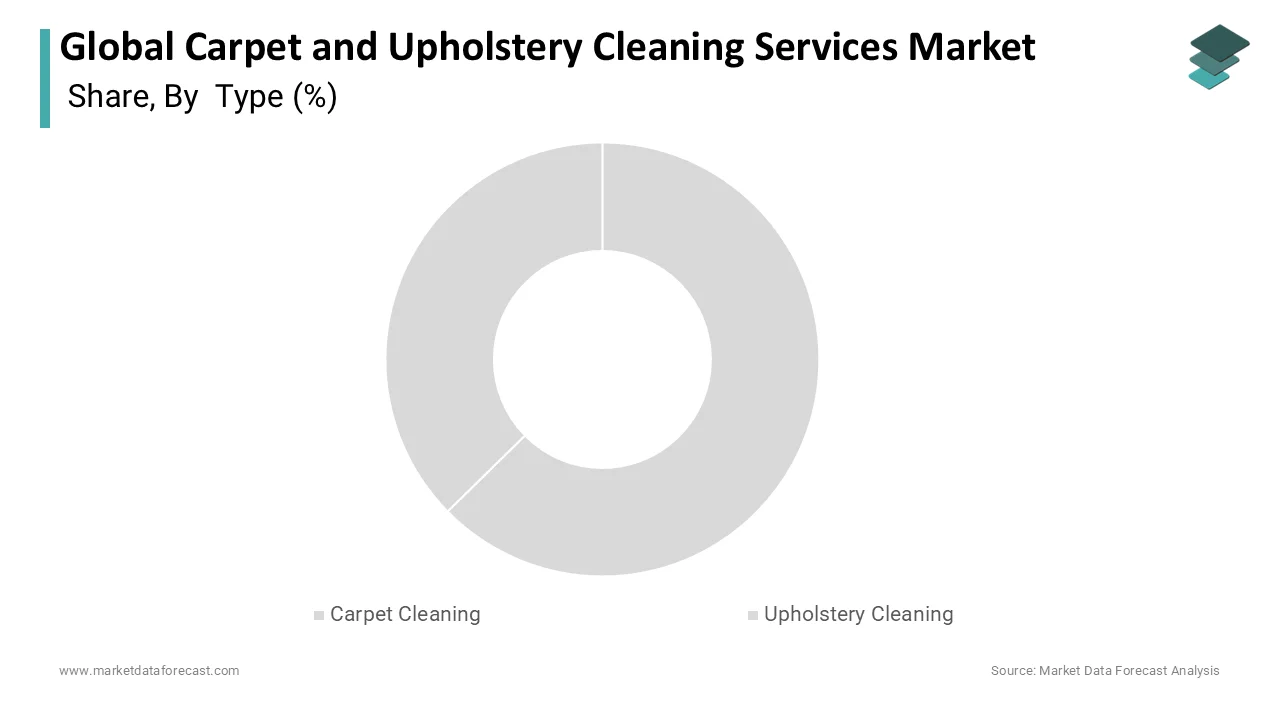
On the other side, the upholstery cleaning segment is the fastest-growing category and is estimated to record a CAGR of 9.2% during the forecast period, owing to a significant surge in consumer investments in premium and custom furniture pieces. As disposable incomes rise and remote work becomes permanently integrated into daily life, individuals are spending more on high-quality sofas, sectionals, and dining chairs to enhance their living environments. According to the American Home Furnishings Alliance, the average household expenditure on upholstered furniture has increased by 22% over the last five years. These premium pieces often feature delicate fabrics, intricate weaves, and specialized foam constructions that require highly specialized cleaning techniques to avoid damage. Consumers are increasingly unwilling to risk ruining expensive investments with over-the-counter sprays or improper DIY methods. Consequently, they are turning to certified upholstery cleaning professionals who utilize advanced, solvent-based cleaning systems and low-moisture extraction technologies. According to the Furniture Today industry analysis, 40% of luxury furniture buyers now schedule professional upholstery cleaning immediately upon purchase to apply fabric protectors and establish a maintenance routine. This shift in consumer behavior from viewing upholstery cleaning as a reactive measure for stain removal to a proactive preservation strategy is accelerating the growth rate of this specific segment well beyond the broader market average.
By Application Insights
The commercial segment led the market with 56.5% of the global market share in 2025. The commercial application segment commands the leading market share primarily due to stringent corporate hygiene mandates and the widespread outsourcing of facility management operations. Modern corporate environments are heavily regulated regarding indoor environmental quality and workplace safety, requiring documented cleaning protocols to protect employee health and ensure regulatory compliance. According to the International Facility Management Association, over 75% of large enterprises now outsource their specialized textile cleaning to certified third-party providers to guarantee adherence to industry standards. Commercial spaces, such as corporate headquarters, call centers, and government buildings, experience continuous foot traffic,c which rapidly degrades the appearance and hygiene of carpets and upholstered conference chairs. Facility managers utilize comprehensive maintenance contracts that include scheduled deep cleaning to mitigate the spread of airborne pathogens and maintain a professional corporate image. According to the Occupational Safety and Health Administration guidelines, emphasis is placed on the importance of maintaining clean indoor environments to reduce absenteeism caused by respiratory illnesses. By outsourcing these critical tasks, commercial entities can leverage the advanced equipment and trained personnel of professional cleaning firms without incurring the capital expenditure of purchasing industrial extractors. This operational efficiency, combined with the legal and health imperatives of maintaining pristine commercial interiors, ensures that the corporate sector remains the largest and most stable revenue generator for the global market.
However, the residential segment is anticipated to grow at a CAGR of 8.4% during the forecast period in the global market, et owing to the proliferation of dual-income households and the resulting phenomenon of time poverty among modern consumers. As both partners in a household participate in the full-time workforce, the availability of leisure time and weekends for strenuous household chores has diminished significantly. According to the United States Bureau of Labor Statistics, the number of households where both spouses work full-time has grown to represent over 50% of all married-couple families. This demographic shift has created a strong preference for outsourcing domestic tasks, including deep cleaning of carpets and upholstery, to professional services. Consumers are increasingly willing to pay a premium to reclaim their free time and avoid the physical labor and technical complexities associated with renting equipment and performing the work themselves. According to the Joint Center for Housing Studies, residential spending on home maintenance services has increased by 18% in the last three years, largely attributed to time-constrained professionals. Professional cleaning companies cater to this demographic by offering highly convenient online booking, flexible scheduling, and rapid service execution. This fundamental change in household dynamics and the valuation of time over money is accelerating the adoption of professional residential cleaning services at an unprecedented pace across developed and developing economies alike.
COUNTRY LEVEL ANALYSIS
North America Carpet And Upholstery Cleaning Services Analysis
North America held a preeminent position in the global market by commanding a substantial market share of 38.5% of the global market in 2025 due to the advanced infrastructure and high consumer spending levels. The region benefits from a highly developed facility management industry and a strong culture of professional home maintenance practices. According to the United States Census Bureau, the residential housing market continues to expand, with over 1.5 million new privately owned housing units completed annually, creating a massive base for cleaning services. Furthermore, the commercial sector in the region is characterized by stringent health and safety regulations enforced by federal and state agencies, which mandate regular textile maintenance in public and private buildings. The presence of major industry players and a highly fragmented network of local franchise operators ensures widespread service availability and intense competition that drives innovation. Consumers in this region exhibit a high willingness to pay for premium, eco-friendly cleaning solutions and advanced technological integrations, such as mobile scheduling and automated billing. The robust economic environment, combined with a strong emphasis on property value preservation and indoor health standards, ensures that North America remains the most lucrative and mature market for professional carpet and upholstery cleaning services worldwide today overall.
Europe Carpet And Upholstery Cleaning Services Analysis
European countries are projected to register stable progress in the coming years as local businesses align operations with regional green directives and rigid workspace sanitization frameworks. Europe maintains a strong and highly regulated presence in the global market,t characterized by a strong preference for sustainable practices. The region is at the forefront of the green cleaning movement, with stringent environmental directives from the European Union dictating the types of chemicals and wastewater disposal methods that service providers can utilize. According to Eurostat, the commercial real estate sector in Europe encompasses over 10 billion square meters of office and retail space, requiring continuous professional maintenance to comply with workplace health directives. European consumers are highly educated regarding the health impacts of volatile organic compounds, driving a massive shift toward plant-based and biodegradable cleaning agents. According to the European Cleaning and Facility Services industry association, over 60% of commercial contracts in the region now explicitly require the use of certified ecological cleaning products. Furthermore, the region's rich architectural heritage and high concentration of luxury hospitality venues demand specialized, delicate fabric care and restoration services. Despite facing economic fluctuations, the enduring commitment to environmental sustainability and rigorous facility hygiene standards ensures that Europe remains a critical and highly sophisticated hub for advanced carpet and upholstery cleaning services.
Asia Pacific Carpet And Upholstery Cleaning Services Analysis
The Asia Pacific region is rapidly emerging as a dynamic growth engine in the global market, fueled by rapid urbanization and a booming middle class. The unprecedented expansion of commercial infrastructure and residential high-rises in countries like China and India is creating massive new demand for professional facility maintenance. According to the Asian Development Bank, urban populations in the region are projected to add over 1.2 billion new residents by 2050, drastically increasing the density of indoor living and working spaces. This demographic shift is accompanied by a rising disposable income that allows consumers to transition from do-it-yourself cleaning to hiring professional services for convenience and superior results. The proliferation of international hotel chains and modern shopping malls across the region has also introduced global hygiene standards that necessitate regular professional textile care. Furthermore, the growing awareness of indoor air pollution and its impact on respiratory health in densely populated megacities is prompting both residential and commercial clients to seek deep cleaning solutions. This potent combination of economic growth, infrastructure development, and increasing health consciousness is propelling the Asia Pacific region to record growth rates.
Brazil Carpet And Upholstery Cleaning Services Analysis
Key regional hubs like Brazil and Mexico are forecasted to show incremental growth as corporate facilities increasingly modernize and transition from informal labor to structured, outsourced cleaning models. Latin America represents a developing yet increasingly vital segment of the global market as economic stabilization and urban expansion take root. The region is experiencing a gradual but steady shift toward professionalized facility management, particularly in major metropolitan hubs like São Paulo and Mexico City, ty where corporate headquarters and luxury residential complexes are concentrated. According to the Economic Commission for Latin America and the Caribbean, the services sector contributes to over 60% of the regional gross domestic product, highlighting the growing importance of specialized business services. Historically reliant on informal labor, the market is now seeing a formalization trend as international cleaning franchises enter the region, bringing standardized training and advanced equipment. The expanding tourism industry in countries like Brazil and Costa Rica is also driving demand, as hotels and resorts upgrade their facilities to meet international guest expectations for cleanliness. Additionally, a growing middle class with dual-income households is beginning to value the time-saving benefits of professional home cleaning. While price sensitivity remains a challenge, the ongoing professionalization of the sector and increasing awareness of hygiene standards are laying a solid foundation for sustained future growth in Latin America.
Middle East and Africa Carpet And Upholstery Cleaning Services Analysis
The Gulf Cooperation Council nations are poised for remarkable growth in the upcoming period, supported by luxury infrastructure pipelines and specialized, climate-induced maintenance mandates. The Middle East and Africa region holds a specialized and highly lucrative position in the global landscape, driven by extreme climate conditions and luxury developments. The harsh desert environment in the Middle East results in high levels of fine dust and sand infiltration, which rapidly abrades and soils carpets and upholstery, making frequent professional cleaning an absolute necessity rather than a luxury. According to the African Development Bank, rapid urbanization and massive infrastructure investments across the continent are modernizing the commercial real estate sector and creating new demand for facility management services. In the Gulf Cooperation Council countries, the presence of ultra-luxury hotels, mega shopping malls, and premium residential villas requires specialized, high-end cleaning services that utilize advanced restoration techniques. The hospitality sector, in particular, enforces rigorous cleanliness standards to maintain its world-class ranking.
COMPETITIVE LANDSCAPE
The global carpet and upholstery cleaning services market features a fragmented and competitive landscape characterized by the coexistence of multinational corporations and countless independent local operators. This fragmentation creates a dynamic environment where competition is driven not just by pricing but heavily by service quality, ty technological adoption, and brand reputation. Large franchise networks leverage their extensive geographic reach, each standardized training protocol, tools, and significant marketing budgets to capture substantial residential and commercial contracts. Conv,ersely local independent providers compete aggressively by offering highly personalized customer service, flexible scheduling,g and deep community relationships. The barrier to entry for small operators remains relatively low due to the affordable cost of basic cleaning equipment, which perpetuates market fragmentation and fuels intense price competition at the lower end of the spectrum. However, the increasing consumer demand for certified eco-friendly solutions, advanced allergen removal, and digital booking convenience is forcing smaller players to either invest heavily in upgrades or risk obsolescence. Consequently, the market is witnessing a consolidation trend where larger entities acquire successful regional operators to expand their territorial dominance. Ultimately, sustained competitive advantage in this sector requires a delicate balance of operational efficiency, continuous technological innovation, and an unwavering commitment to delivering exceptional hygienic outcomes.
KEY MARKET PLAYERS
Some of the companies that are playing a dominating role in the Global Carpet and Upholstery Cleaning Services Market include
- ABM Industries Incorporated
- Analog Cleaning Systems
- Aramark Corporation
- Chem-Dry
- CleanNet USA, Inc.
- Jani-King International, Inc.
- Pritchard Industries, Inc.
- Sodexo S.A.
- COIT Cleaning and Restoration Services
- The ServiceMaster Company, LLC
TOP LEADING PLAYERS IN THE MARKET
- ServiceMaster Clean operates as a premier global provider of comprehensive facility maintenance and restoration solutions with a profound impact on the professional cleaning landscape. The company leverages a vast franchise network to deliver specialized carpet and upholstery cleaning services to both residential and commercial clients. Recently,tly the organization has focused heavily on digital transformation by launching advanced mobile applications that allow customers to schedule services, obtain instant quotes, and track technician arrivals in real time. Furthermore,rthermore they have integrated PECO-friendly cleaning formulations into their standard operating procedures to meet the growing consumer demand for sustainable, non-toxic indoor environments. This continuous investment in technological convenience and green chemistry significantly strengthens their operational footprint and enhances overall customer satisfaction across diverse global markets.
- Stanley Steemer stands as a highly recognized industry leader, rerenowned forts patented hot water extraction method and extensive residential service capabilities. The company has deeply embedded itself in the global market by maintaining rigorous quality control standards and comprehensive training programs for its vast network of technicians. To strengthen its competitive position, the company recently expanded its service portfolio to include advanced textile protection treatments and specialized allergen reduction protocols. They have also heavily invested in fleet modernization, utilizing fuel-efficient vehicles equipped with state-of-the-art water reclamation systems to minimize environmental impact. By consistently upgrading its equipment and emphasizing health-focused cleaning outcomes, Stanley Steemer continues to build immense brand loyalty and drive recurring revenue from a highly satisfied customer base.
- Chem Dry distinguishes itself in the global market through its proprietary carbonated cleaning solution, which utilizes millions of microscopic bubbles to lift dirt and stains from deep within textile fibers. This innovative approach requires significantly less water than traditional steam cleaning, ng allowing carpets and upholstery to dry rapidly and reducing the risk of mold growth. The company actively strengthens its market position by aggressively expanding its international franchise footprint, particularly in emerging markets across Asia and Europe. Recently,y they introduced new specialized upholstery cleaning kits and enhanced their digital booking platforms to streamline the customer experience. By championing a unique low-moisture cleaning technology and prioritizing rapid global expansion, Chem Dry effectively captures a distinct segment of environmentally conscious and convenience-driven consumers worldwide.
TOP STRATEGIES USED BY KEY MARKET PARTICIPANTS
Key players in the global carpet and upholstery cleaning services market primarily rely on strategic franchise expansion, technological integration, and service diversification to solidify their competitive positions. Franchising allows companies to rapidly scale their geographic footprint with minimal capital expenditure while leveraging local entrepreneurial expertise. Technological integration is another critical strategy,y with firms investing heavily in mobile applications, ns automated scheduling, and Internet of Things-enabled soil sensors to enhance operational efficiency and customer convenience. Furthermore, companies are increasingly diversifying their service portfolios to include specialized offerings such as allergen reduction protocol,s textile protection treatments, and eco-friendly green cleaning certifications. By adopting these comprehensive strategies, market participants can effectively differentiate their brands, command premium pricing, and build long-term customer loyalty in an otherwise highly fragmented and competitive industry landscape.
GLOBAL CARPET AND UPHOLSTERY CLEANING SERVICES MARKET NEWS
- ABM, a facility solutions provider, said that it has achieved a definitive deal to buy Able Services, a San Francisco-based facilities services company.
MARKET SEGMENTATION
This research report on the global carpet and upholstery cleaning services market has been segmented and sub-segmented into the following categories.
By Type
- Carpet Cleaning
- Upholstery Cleaning
By Application
- Residential
- Commercial
By Region
- North America
- Europe
- Asia Pacific
- Latin America
- The Middle East and Africa