- Product Description Description
- Table of Contents TOC
- List of Table & Figure LOT
- Get Free Sample PDF Sample PDF
Market Size, 2025
$282.63 BnMarket Estimate, 2026
$304.73 BnMarket Forecast, 2034
$556.56 BnCAGR, 2026–2034
7.82%Global Hydrogen Market Size, Growth, Trends & Forecast (2026–2034)
The global hydrogen market was valued at USD 282.63 billion in 2025, is estimated to reach USD 304.73 billion in 2026, and is projected to scale up to USD 556.56 billion by 2034, growing at a compound annual growth rate (CAGR) of 7.82% from 2026 to 2034. Driven by national decarbonization strategies, industrial transition in hard-to-abate sectors, and aggressive investments in clean green hydrogen production, the market continues to expand worldwide.
Key Executive Metrics (At-a-Glance)
- 2025 Base Valuation: USD 282.63 Billion
- 2026 Current Valuation: USD 304.73 Billion
- 2034 Forecast Valuation: USD 556.56 Billion
- Compound Annual Growth Rate (CAGR): 7.82% (2026–2034)
- Top Performing Region: Europe (Holds the leading regional market share in 2025 at 38.2%, backed by robust regulatory frameworks and clean energy funding).
Core Market Drivers
- Government Policy Frameworks: National hydrogen strategies, funding allocations (e.g., U.S. Bipartisan Infrastructure Law, Japan's Hydrogen Strategy), and tax incentives de-risking investments.
- Heavy Industry Decarbonization: Surging adoption of hydrogen in steelmaking, chemicals, and refining to meet strict climate targets.
Primary Market Restraints & Challenges
- High Production Costs: Elevation in capital expenditure and operational costs associated with green hydrogen via electrolysis compared to conventional grey hydrogen.
- Infrastructure Bottlenecks: Underdeveloped storage facilities, specialized transport networks, and limited refueling stations worldwide.
Global Hydrogen Market Segmentation Highlights
| Segment Category | Largest Segment | Fastest-Growing / Key Segment |
|---|---|---|
| By Generation | Gray Hydrogen | Green Hydrogen (58.3% CAGR) |
| By Storage | Physical Storage (Gaseous & Cryogenic) | Material-Based Storage (14.6% CAGR) |
| By Application | Chemical & Refinery | Mobility & Heavy Transport (32.4% CAGR) |
| By Region | Europe | Asia-Pacific & Middle East |
Major Industry Players Profiled
Key global market leaders dominating the hydrogen sector include Linde plc, Air Products & Chemicals, Inc., Air Liquide, ITM Power plc, Nel ASA, Plug Power, Inc., Shell (Hydrogen divisions), Siemens Energy, Chevron Corporation, and TOTAL / TotalEnergies.
Global Hydrogen Market Size
The global hydrogen market was valued at USD 282.63 billion in 2025, is estimated to reach USD 304.73 billion in 2026, and is projected to reach USD 556.56 billion by 2034, growing at a CAGR of 7.82% from 2026 to 2034.
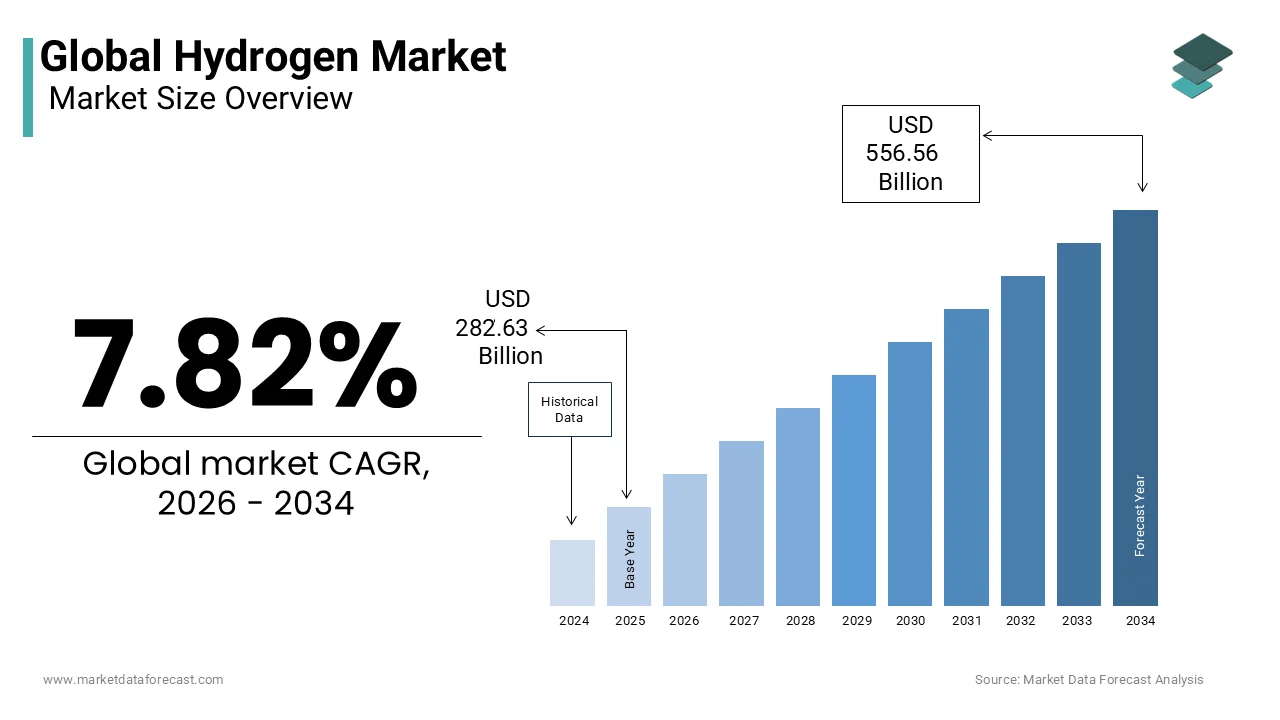
The hydrogen is playing a pivotal role in global decarbonization strategies. Hydrogen emits only water when used in fuel cells, which makes it a key enabler for clean energy in hard-to-abate sectors such as heavy industry, long-haul transport, and power generation. According to the International Energy Agency, hydrogen currently accounts for less than 2% of global final energy consumption, but its potential is expanding rapidly under climate imperatives.
MARKET DRIVERS
National Hydrogen Strategies and Government-Led Decarbonization Initiatives
A surge in national hydrogen strategies is a primary driver for the growth of the hydrogen market, with governments establishing roadmaps to scale low-carbon hydrogen production and usage. In the United States, the Bipartisan Infrastructure Law allocates $9.5 billion for hydrogen hubs, electrolyzer manufacturing, and R&D, which aims to establish four to ten regional clean hydrogen hubs. Japan’s Basic Hydrogen Strategy mandates that hydrogen meet 10% of the nation’s primary energy supply by 2050, with investments in ammonia co-firing and fuel cell vehicles. These policy frameworks provide long-term visibility, de-risk investments, and stimulate public-private partnerships, which are accelerating the commercialization of green and blue hydrogen across industrial, transport, and energy sectors.
Industrial Decarbonization in Hard-to-Abate Sectors
Heavy industries such as steel, cement, chemicals, and refining are under increasing pressure to reduce emissions, which will additionally fuel the growth of the hydrogen market. In steelmaking, hydrogen can replace coking coal in direct reduction processes, cutting CO₂ emissions by up to 95%. Sweden’s HYBRIT project, led by SSAB, LKAB, and Vattenfall, successfully produced the world’s first fossil-free steel in 2023 using green hydrogen, with plans to commercialize by 2026. In refining, the U.S. Energy Information Administration reports that hydrogen demand in U.S. refineries exceeds 2 million metric tons annually, primarily for desulfurization.
MARKET RESTRAINTS
High Production Cost of Green Hydrogen
The elevated cost of green hydrogen is restricting the growth of the hydrogen market. Producing hydrogen via electrolysis powered by renewable electricity currently costs $4–$6 per kilogram, compared to $1–$2 per kilogram for grey hydrogen from natural gas, as reported by the International Renewable Energy Agency (IRENA) in 2023. The high capital expenditure for electrolyzers and intermittent renewable supply contributes to this gap. According to BloombergNEF, electrolyzer system costs must fall by 60% to reach $1/kg by 2030, requiring substantial technological improvement and economies of scale. Additionally, the limited availability of low-cost renewable power in industrial zones increases logistics and transmission costs.
Underdeveloped Infrastructure for Storage and Distribution
The lack of dedicated infrastructure for hydrogen storage, transportation, and refueling is severely degrading the growth of the hydrogen market. Hydrogen has a low volumetric energy density, requiring compression to 700 bar for vehicle use or liquefaction at -253°C for long-distance transport, both of which are energy-intensive and costly. In the U.S., the Department of Energy reports that there are just 64 public hydrogen stations, mostly in California. Pipeline networks are also limited; while Europe has over 2,000 km of dedicated hydrogen pipelines, primarily in Germany and France, this is a fraction of what is needed for large-scale deployment. Retrofitting natural gas pipelines for hydrogen blending faces material compatibility and safety concerns. According to the European Commission, a pan-European hydrogen backbone of 53,000 km will be required by 2040.
MARKET OPPORTUNITIES
Integration of Hydrogen in Renewable Energy Storage and Grid Balancing
Long-duration energy storage is addressing the intermittency of solar and wind power, which is creating new opportunities for the growth of the hydrogen market. Excess renewable electricity can be used to produce green hydrogen via electrolysis, which can then be stored for weeks or months and reconverted to power via fuel cells or turbines. According to the National Renewable Energy Laboratory, hydrogen storage can provide 10–100 times more energy duration than lithium-ion batteries, making it ideal for seasonal balancing. In Germany, the H2Giga project aims to mass-produce electrolyzers by 2025 to support grid-scale storage. Australia’s Asian Renewable Energy Hub plans to generate 26 GW of wind and solar power to produce green hydrogen for domestic and export use.
Expansion of Hydrogen in Heavy-Duty and Long-Haul Transport
The Hydrogen fuel cell vehicles (FCEVs) are gaining traction in heavy-duty transport, where battery electrification faces limitations in range, weight, and refueling time, which is solely escalating the growth of the hydrogen market. In California, the Fuel Cell Electric Truck Collaborative has deployed over 100 Class 8 hydrogen trucks, with plans for 1,000 by 2027. The European Union’s Alternative Fuels Infrastructure Regulation (AFIR) mandates hydrogen refueling stations every 200 km on core TEN-T routes by 2030. Companies like Hyundai and Daimler are scaling production of hydrogen trucks, with Hyundai delivering over 100 XCIENT fuel cell trucks to Switzerland and Germany.
MARKET CHALLENGES
Scaling Electrolyzer Manufacturing and Securing Materials
The rapid deployment of green hydrogen hinges on the ability to scale electrolyzer production while securing access to raw materials such as iridium, platinum, and nickel, which is challenging the growth of the hydrogen market. However, current production capacity is insufficient, with only a few gigawatt-scale factories operational. Additionally, geopolitical concentration of materials in South Africa and Russia creates supply chain risks. Scaling manufacturing while reducing material intensity and improving recycling is now a technical and industrial challenge for the hydrogen economy.
Lack of Harmonized Standards and Certification Frameworks
The absence of globally harmonized standards for hydrogen production, quality, and carbon accounting is impeding the growth of the hydrogen market. Different countries apply varying definitions of “green” or “low-carbon” hydrogen based on emission thresholds, grid emission factors, and temporal matching of renewable electricity. The European Union’s Renewable Energy Directive II sets a threshold of 30 gCO₂e/MJ for renewable hydrogen, while California’s Low Carbon Fuel Standard uses time- and location-based accounting.
REPORT COVERAGE
| REPORT METRIC | DETAILS |
| Market Size Available | 2025 to 2034 |
| Base Year | 2025 |
| Forecast Period | 2026 to 2034 |
| Segments Covered | By Generation, Storage Application, and Region. |
| Various Analyses Covered | Global, Regional, and Country-Level Analysis, Segment-Level Analysis, Drivers, Restraints, Opportunities, Challenges; PESTLE Analysis; Porter’s Five Forces Analysis, Competitive Landscape, Analyst Overview of Investment Opportunities |
| Countries Covered | Europe Asia Pacific North America Latin America Middle East & Africa |
| Market Leaders Profiled | Linde plc Air Products & Chemicals, Inc. Air Liquide ITM Power plc Nel ASA Plug Power, Inc. Shell (Hydrogen divisions) Siemens Energy Chevron Corporation TOTAL / TotalEnergies |
SEGMENTAL ANALYSIS
By Generation Insights
The gray segment was the largest and held a prominent share of the global hydrogen market in 2025, with its cost-effectiveness and established infrastructure, as it is produced through steam methane reforming (SMR) of natural gas, a process that has been industrialized for decades. Globally, more than 70 million metric tons of hydrogen are produced annually, with the vast majority being gray, as noted by the IEA. The petrochemical and refining sectors, which consume hydrogen for desulfurization and ammonia synthesis, rely heavily on this low-cost feedstock.
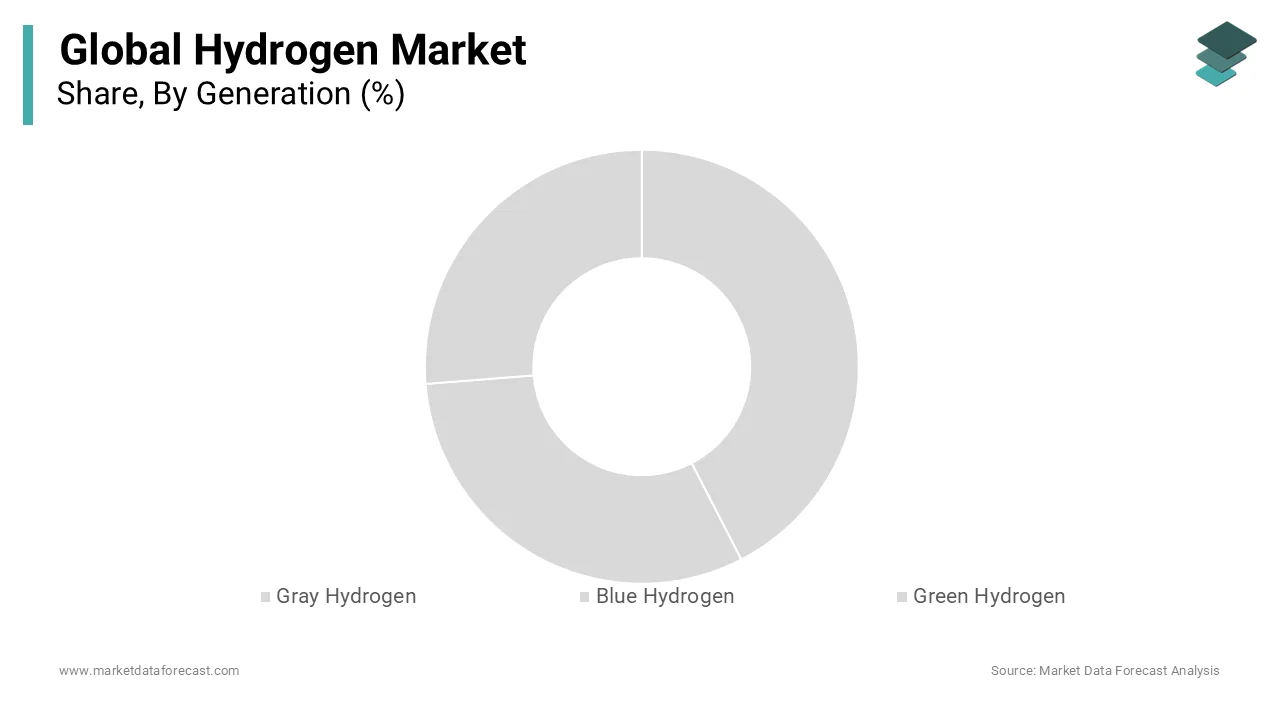
The green hydrogen segment is growing lucratively with an expected CAGR of 58.3% during the forecast period, with the plummeting renewable energy costs and aggressive decarbonization policies. Produced via electrolysis powered by wind, solar, or hydroelectricity, green hydrogen emits no CO₂ during production. The levelized cost of solar and onshore wind has fallen by over 80% since 2010, as reported by the International Renewable Energy Agency (IRENA), making electrolysis increasingly viable. Additionally, Saudi Arabia’s NEOM Green Hydrogen Company is constructing the world’s largest facility, set to produce 600 tons per day of green hydrogen by 2026, as confirmed by the project developers.
By Storage Insights
The physical storage segment was the largest by occupying a significant share of the global hydrogen market in 2025 due to its technological maturity and scalability. This includes high-pressure gaseous storage (350–700 bar) in steel or composite tanks and cryogenic liquid hydrogen stored at -253°C. Underground storage in salt caverns, depleted oil and gas fields, and aquifers is also a key component, particularly for grid balancing and industrial supply. According to the European Commission, Germany and the UK have over 40 operational salt caverns capable of storing up to 1.5 million tons of hydrogen, providing long-duration energy security.
The material-based segment is likely to grow at a CAGR of 14.6% during the forecast period, with the advancements in solid-state storage technologies for mobility and portable applications. This includes metal hydrides, chemical hydrides, and adsorbent materials like MOFs (metal-organic frameworks) that bind hydrogen at lower pressures and temperatures than gaseous systems. In Japan, Toyota and Honda are integrating magnesium-based hydrides into next-gen fuel cell cars to increase driving range. The German Aerospace Center (DLR) reports that ammonia borane and liquid organic hydrogen carriers (LOHCs) can achieve volumetric densities comparable to gasoline by enabling long-haul transport.
By Application Insights
The chemical and refinery sector accounted for a dominant share of the global hydrogen market in 2025, with its essential role in producing ammonia, refining crude oil, and synthesizing methanol. Refineries use hydrogen to remove sulfur from diesel and jet fuel, with the U.S. Energy Information Administration noting that hydrogen consumption in U.S. refineries exceeds 2 million metric tons per year. Methanol production, used in plastics and fuels, also consumes significant hydrogen, particularly in China, which produces over 70% of the world’s methanol, as per the Methanol Institute.
The mobility application segment is expected to grow with an expected CAGR of 32.4% from 2025 to 2033, with the adoption of hydrogen fuel cell electric vehicles (FCEVs) in heavy-duty transport. China leads in hydrogen buses, with more than 7,000 FCEVs in operation as of 2023, concentrated in Beijing and Guangdong, as reported by the China Association of Automobile Manufacturers. The European Union mandates hydrogen refueling stations every 200 km on core transport corridors by 2030 under the Alternative Fuels Infrastructure Regulation (AFIR). Companies like Hyundai and Daimler are scaling production, with Hyundai delivering over 200 XCIENT trucks to Europe and Switzerland.
REGIONAL ANALYSIS
Europe Hydrogen Market Analysis
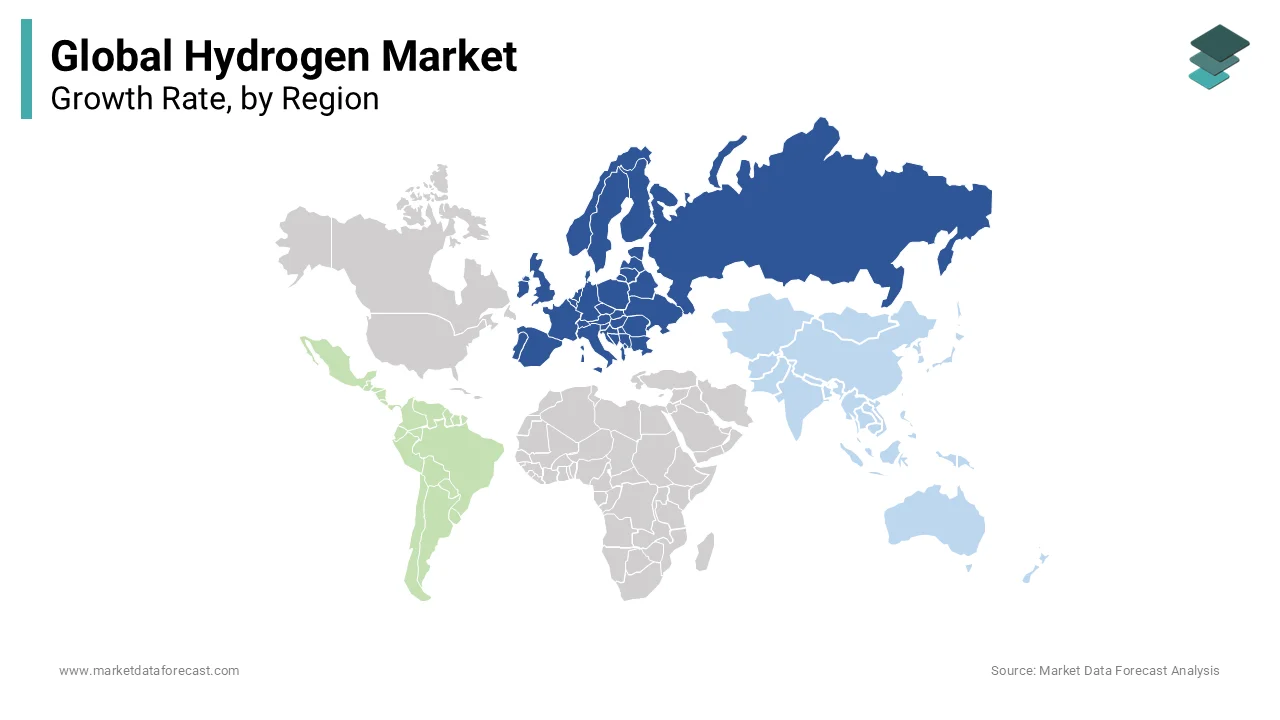
Europe was the top performer of the global hydrogen market with 38.2% the share in 2025, with a regulatory and strategic leader in clean hydrogen development. Germany was the largest contributor with a €900 million two-way auction platform to stimulate green hydrogen imports from North Africa and the Middle East. According to the European Clean Hydrogen Alliance, over 1,000 hydrogen projects have been proposed across the EU, with €470 billion in potential investment.
Asia Pacific Hydrogen Market Analysis
Asia Pacific market held 23.1% of the share in 2025, with China, Japan, and South Korea leading in demand, while Australia and India emerged as production hubs. India’s National Green Hydrogen Mission allocates ₹19,744 crore ($2.3 billion) to achieve 5 million tons of annual production by 2030. With diverse strategies spanning industrial use, mobility, and export, the Asia Pacific is a dynamic, multi-polar market shaping the hydrogen economy’s future.
North America Hydrogen Market Analysis
North America's market growth is likely to grow with the United States’ aggressive investment in clean hydrogen infrastructure and innovation. Texas and Louisiana are leveraging existing petrochemical infrastructure for blue hydrogen with carbon capture, while California focuses on green hydrogen for mobility. According to the Hydrogen Fuel Cell Partnership, over 13,000 fuel cell vehicles are on California roads, supported by 64 public refueling stations.
Middle East & Africa Hydrogen Market Analysis
The Middle East & Africa market growth is likely to grow, with Saudi Arabia, the UAE, and Egypt emerging as green hydrogen export leaders. Saudi Arabia’s NEOM project is constructing the world’s largest green hydrogen plant, powered by 4 GW of solar and wind, set to produce 600 tons per day by 2026, as confirmed by NEOM Green Hydrogen Company. The UAE’s Masdar is developing a $1 billion green hydrogen facility in Egypt, targeting European and Asian markets.
Latin America Hydrogen Market Analysis
Latin America market growth is anticipated to have significant growth opportunities in the coming years. Chile has the world’s best solar irradiation in the Atacama Desert, enabling some of the lowest green hydrogen production costs as low as $1.8/kg by 2030, as projected by the Chilean Ministry of Energy. Argentina’s Patagonia region offers world-class wind resources, with YPF developing an $8.5 billion green hydrogen hub in Rio Negro. However, infrastructure gaps and regulatory uncertainty remain barriers. According to the Inter-American Development Bank, $120 billion in investment is needed by 2050 to realize the region’s hydrogen potential.
COMPETITIVE LANDSCAPE
The hydrogen market is highly competitive, driven by technological innovation and global decarbonization goals. Key players compete on production efficiency, cost reduction, and scalability of green hydrogen solutions. Competition is intensifying in the Asia Pacific region, where governments are investing heavily in hydrogen infrastructure and clean energy transitions. Companies differentiate themselves through integrated offerings, including production, storage, and end-use applications. Strategic collaborations and pilot projects are common as firms seek to establish early dominance. Incumbent industrial gas providers face challenges from new entrants focused solely on renewable hydrogen.
KEY MARKET PLAYERS
Some of the prominent companies in the hydrogen hubs space are:
- Linde plc
- Air Products & Chemicals, Inc.
- Air Liquide
- ITM Power plc
- Nel ASA
- Plug Power, Inc.
- Shell (Hydrogen divisions)
- Siemens Energy
- Chevron Corporation
- TOTAL / TotalEnergies
TOP LEADING PLAYERS IN THE MARKET
- Linde is a global leader in industrial gases and a pioneer in hydrogen production, distribution, and technology development. In the Asia Pacific region, Linde has established a strong footprint through strategic investments in hydrogen refueling infrastructure and large-scale production facilities. The company operates advanced steam methane reforming and electrolysis units in China and Australia, supporting clean hydrogen supply for industrial and transportation sectors. Linde collaborates with governments and energy firms to advance hydrogen mobility, including fueling stations in Japan and South Korea. Recently, Linde launched a green hydrogen project in Australia with renewable energy partners, aiming to supply export markets in Asia.
- Air Products is a major force in the global hydrogen industry, delivering hydrogen solutions for refining, petrochemicals, and clean energy. In the Asia Pacific market, the company has expanded through joint ventures and large-scale investments in hydrogen production and fueling infrastructure. It operates hydrogen plants in China, India, and Southeast Asia, supporting industrial decarbonization. Air Products is actively involved in green hydrogen initiatives, including a major project in northeastern China powered by wind energy.
- Mitsubishi Heavy Industries plays an important role in shaping the Asia Pacific hydrogen market through technology innovation and integrated energy solutions. MHI develops advanced gas turbines capable of burning hydrogen blends and promotes hydrogen-based power generation, as a key player in hydrogen production, storage, and utilization. The company is involved in Japan’s hydrogen supply chain projects, including the import of liquid hydrogen from Australia. MHI collaborates with domestic and international partners to commercialize hydrogen-ready infrastructure.
TOP STRATEGIES USED BY THE KEY MARKET PARTICIPANTS
Key players in the hydrogen market employ strategic partnerships, technological innovation, and vertical integration to strengthen their positions. Companies form alliances with governments, energy firms, and research institutions to co-develop hydrogen infrastructure and secure funding. Investment in R&D drives advancements in electrolysis, fuel cells, and hydrogen storage solutions. Many firms pursue green hydrogen projects powered by renewable energy to meet sustainability goals. Expansion into new markets in the Asia Pacific is achieved through localized production facilities and refueling networks. Asset acquisition and joint ventures enable faster market entry and technology access.
MARKET SEGMENTATION
This research report on the global hydrogen market is segmented and sub-segmented into the following categories.
By Generation
- Gray Hydrogen
- Blue Hydrogen
- Green Hydrogen
- Others
By Storage
- Physical Storage
- Material-Based Storage
- Others
By Application
- Chemical & Refinery
- Power Generation
- Mobility (Fuel Cell Vehicles, Heavy Transport)
- Industrial Applications
- Others
By Region
- Europe
- Asia Pacific
- North America
- Latin America
- Middle East & Africa