- Product Description Description
- Table of Contents TOC
- List of Table & Figure LOT
- Get Free Sample PDF Sample PDF
Market Size, 2025
$11.74 BnMarket Estimate, 2026
$13.57 BnMarket Forecast, 2034
$43.28 BnCAGR, 2026–2034
15.60%Executive Summary: Identity Verification Market
- Market Scope: Comprehensive global identity verification market analysis covering component structures, deployment models, industry vertical adoption, regional leadership frameworks, and security integration metrics.
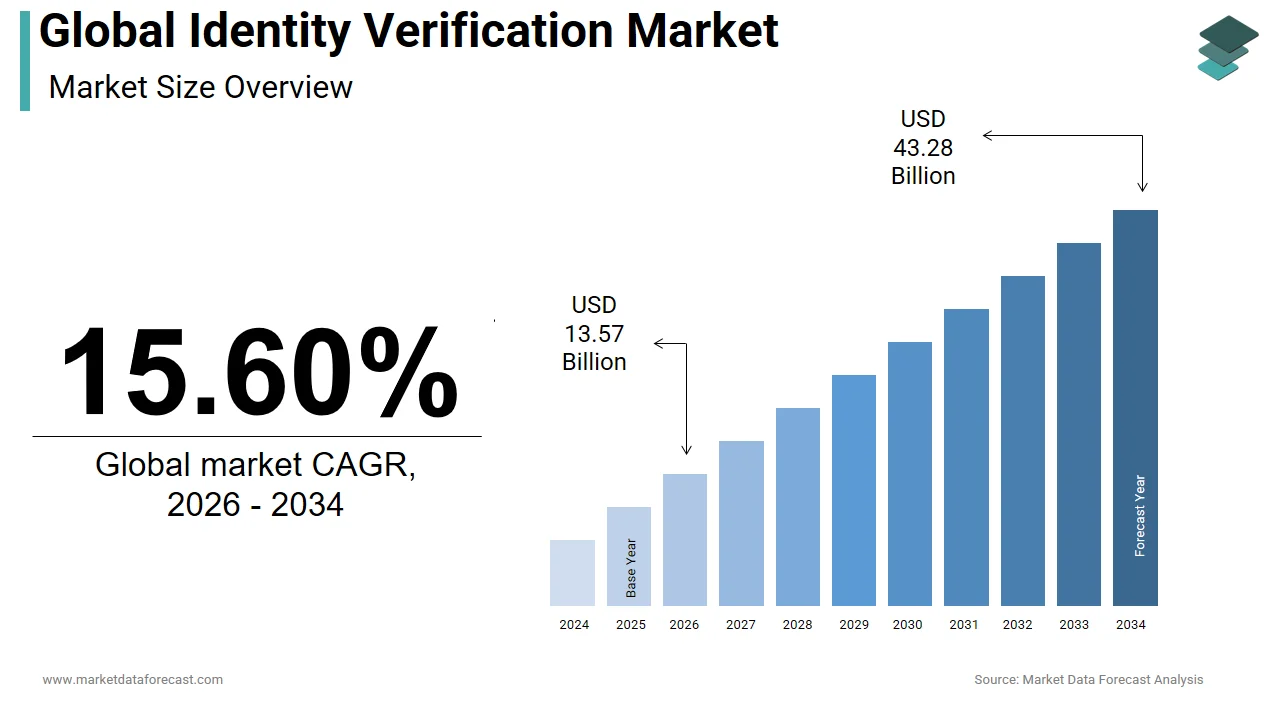
- Market Valuation: Valued at USD 11.74 billion (2025), estimated at USD 13.57 billion (2026), and projected to reach USD 43.28 billion by 2034, registering a robust CAGR of 15.60% (2026–2034).
- Primary Growth Drivers: Rising digitization initiatives, increasing fraud and identity theft, expanding digital identity use cases, and growing cybersecurity requirements. Key macro developments include government adoption of electronic ID cards, facial-recognition border controls, smart airports, digital identity-based driver’s licenses, and smart infrastructure, alongside AI and machine learning advancements improving verification accuracy, efficiency, and real-time fraud detection.
Key Market Segment Metrics (2026–2034)
| Category | Leading Segment (2025 Position) | Fastest-Growing Segment |
|---|---|---|
| By Component & Deployment | Professional Services & On-Premises Solutions (capturing foundational data security and enterprise control share) | Managed Cloud-Based Solutions & IDaaS Platforms |
| By Industry Vertical | Banking, Financial Services, & Insurance (BFSI) and Government Sectors | Healthcare, Retail, & E-commerce Digital Onboarding Sectors |
| By Technology | Document Verification & Biometric Identification Systems | AI/ML-Driven Passive Liveness Detection & Behavioral Biometrics |
| By Region / Country | North America (expected to account for the highest revenue share during the forecast period) | Asia-Pacific (fastest-growing region with highest CAGR, driven by eKYC and cloud adoption) |
Major Market Players & Market Structure
Market Structure: Highly competitive global digital security and compliance landscape featuring established credit bureaus, identity specialists, and tech innovators competing intensely on secure digital onboarding, data verification, fraud detection, identity authentication, eKYC, cloud-based verification, AI/ML capabilities, omnichannel verification, blockchain-enabled decentralized identity, and Identity Verification as a Service (IDaaS).
Key Companies: LexisNexis, Experian PLC, Mitek Systems, Equifax Inc., Onfido, IDEMIA, Gemalto, Acuant, Trulioo, and Jumio.
Global Identity Verification Market Size
The global identity verification market was worth USD 11.74 billion in 2025. The global market is predicted to reach USD 13.57 billion in 2026 and USD 43.28 billion by 2034, growing at a CAGR of 15.6% during the forecast period.
Identity verification solutions and services are used by various companies to ensure that the information provided by users or customers is related to the identity of a real person. Identity verification solutions ensure high security with detailed customer attributes, including personal credentials, nationality and immigration status, identity verification, employment, and business registration. Identity Verification is a comprehensive solution that ensures a secure customer registration process by providing a seamless, real-time onboarding experience and minimizing the risk of identity fraud. The identity verification process is an essential requirement for most online and offline processes and procedures. Identity verification is an essential requirement where a verified identity is essential, such as border control or access to digital services. Identity verification facilities are used to demonstrate that information provided by customers or users is related to the identity of a real entity. Identity verification services verify using detailed consumer attributes that include components such as credentials, company or employment record, and nationality. It is a comprehensive process to authenticate the consumer's secure record and minimize the likelihood of identity fraud.
MARKET DRIVERS
The rapid growth in identity verification in recent years is largely due to the increase in cyberattacks.
Digital transformation around the world has uncovered a host of identity fraud, and businesses have been forced to take quick and complex steps to protect it. Key drivers of the identity verification market are the rise in digitization initiatives, the rise in fraud and identity theft over the past decade, and the surge in digital identity use cases across industries. An increasing number of government initiatives in various countries, including electronic ID cards, border controls that use facial recognition for identification and verification processes, smart airports, and cities that use lice detection for identification and verification, can ensure online security through strong identities. As digitization progresses, identifying people and public facilities has become a necessity that requires verified identification. In the future, the rapid modernization of security solutions is estimated to increase the ability to rapidly analyze large amounts of data with the help of disruptive technologies such as artificial intelligence. The ability of artificial intelligence to provide rapid mathematical calculations to bolster the core capabilities of human intelligence is likely to create the greatest growth opportunities for the global identity verification market in the near future.
With the increasing use of AIDC (Automatic Identification and Data Capture) technology in the retail industry and e-commerce, the market for identity verification software is expected to expand.
The identity verification software market is supposed to be revitalized by the adoption of identity verification software by governments in developed and developing countries to identify customer information on ID cards, driving licenses, or government-issued passports. With an unprecedented increase in the number of cybersecurity incidents, the demand for robust security solutions has increased across the enterprise. The growing popularity of digitization and automation in industries ranging from BFSI to healthcare is foreseen to drive the identity verification market during the conjecture period. All these benefits and features that identity verification provides provide long-term benefits for businesses. These various advantages are estimated to drive the growth of the global identity verification market. As the sophistication of the security information platform and IT security tools and solutions become increasingly sophisticated, it is estimated to have a significant impact on the overall management of the enterprise security ecosystem. The market demand for identity verification solutions has gained considerable traction in recent years due to the various features of these systems, such as data verification, fraud detection, identity verification, and more.
MARKET RESTRAINTS
The main obstacles to market growth are resource constraints and a lack of understanding and awareness of the potential benefits of digital development. The high costs associated with identity verification solutions are supposed to restrict this business growth.
REPORT COVERAGE
| REPORT METRIC | DETAILS |
| Market Size Available | 2025 to 2034 |
| Base Year | 2025 |
| Forecast Period | 2026 to 2034 |
| CAGR | 15.6% |
| Segments Covered | By Component, Deployment Mode, Industry, and Region. |
|
Various Analyses Covered | Global, Regional & Country Level Analysis, Segment-Level Analysis, DROC, PESTLE Analysis, Porter’s Five Forces Analysis, Competitive Landscape, Analyst Overview on Investment Opportunities |
| Regions Covered | North America, Europe, APAC, Latin America, Middle East & Africa |
|
Market Leaders Profiled | LexisNexis, Experian PLC, Mitek Systems, Equifax Inc, Onfido, IDEMIA, Gemalto, Acuant, Trulioo, and Jumio and Others. |
REGIONAL ANALYSIS
North America is expected to project the highest market share in terms of revenue during the conjecture period. Factors such as the development of government initiatives such as smart cities, smart infrastructure, driver's licenses based on digital identity and a growing integration of various technologies. As Asia Pacific is technically equipped with early adoption of new technologies, it is estimated to contribute to the fastest growing regions with the highest CAGR during the forecast period. Governments are taking initiatives as factors in addressing identity fraud, especially strengthening eKYC for identity verification, such as nationally initiated compliance regulations, the growing demand for cloud-based identity verification, and growing attacks. cyber-related identity.

KEY MARKET PLAYERS
Key players in the market include LexisNexis, Experian PLC, Mitek Systems, Equifax Inc, Onfido, IDEMIA, Gemalto, Acuant, Trulioo, and Jumio.
RECENT HAPPENINGS IN THE MARKET
-
In April 2020, IBM announced it would resell Okta Identity Cloud through a recent strategic partnership with an identity management solutions provider.
-
In June 2020, GBG partnered with CredoLab, which used GBG's AI-based / digital risk management to assess the creditworthiness of Indonesian individuals, including CredoLab banks and banking, easily and reliably.
MARKET SEGMENTATION
This research report on the global identity verification market has been segmented and sub-segmented based on the component, deployment mode, industry, and region.
By Component
- Managed Services
- Consulting Services
- Training and Education
- Support and Maintenance
- Professional Services
By Deployment Mode
- On-Premises
- Cloud-Based.
By Industry
- Manufacturing
- Retail
- BFSI
- Healthcare
- Education
- Government and Public Sectors
- Others
By Region
- North America
- Europe
- Asia-Pacific
- Latin America
- The Middle East and Africa