- Product Description Description
- Table of Contents TOC
- List of Table & Figure LOT
- Get Free Sample PDF Sample PDF
Market Size, 2025
$8.12 BnMarket Estimate, 2026
$11.49 BnMarket Forecast, 2034
$184.66 BnCAGR, 2026–2034
41.50%Global Integration Platform as a Service (iPaaS) Market Report: Size, Share, Trends & Forecast (2026–2034)
- Market Scope: Comprehensive global evaluation of the integration platform as a service market spanning components, deployment modes (cloud, on-premises), organization sizes, application use cases, and industry verticals.
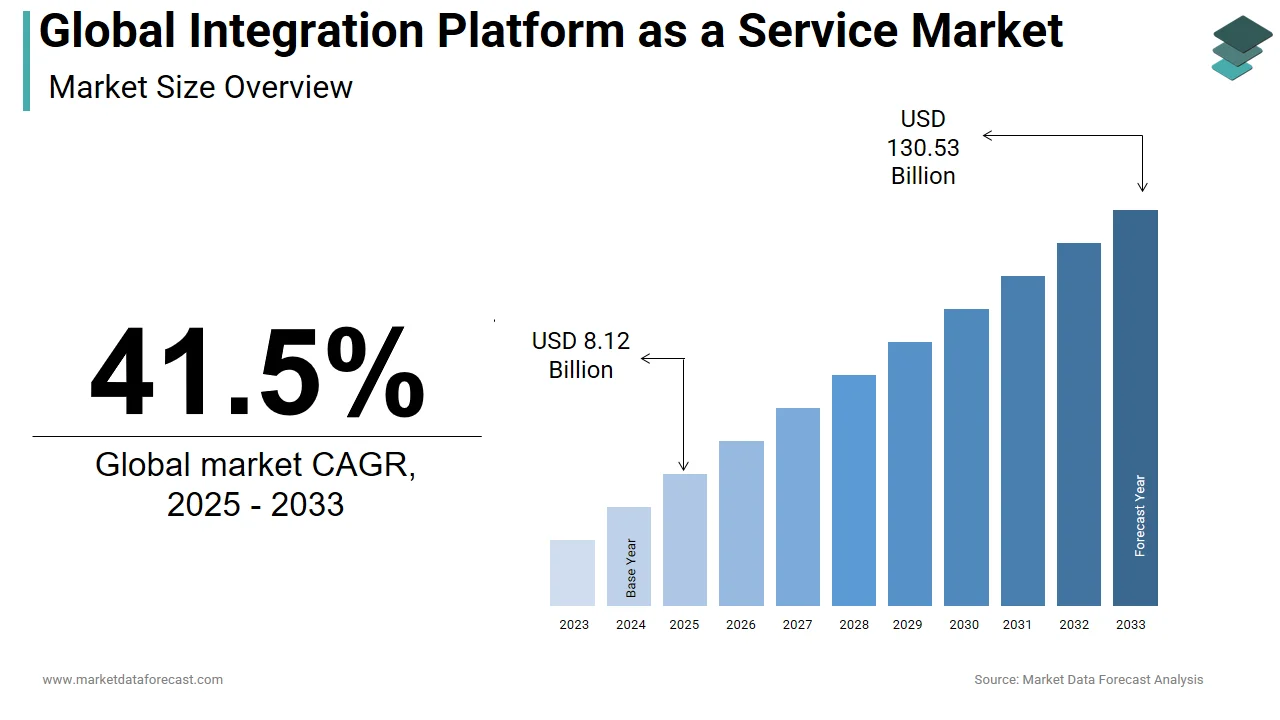
- Market Valuation: Valued at USD 8.12 billion in 2025, estimated at USD 11.49 billion in 2026, and projected to reach USD 184.66 billion by 2034, growing at a rapid CAGR of 41.5% during the forecast period from 2026 to 2034.
- Primary Growth Drivers: Escalating adoption among small and medium-sized enterprises (SMEs) to reduce total cost of ownership, surge in e-commerce and real-time data synchronization needs, and demand for unified cloud application connectivity.
Key Global iPaaS Market Segment Metrics (2026–2034)
| Category | Leading Segment / Position | Fastest-Growing / Prominent Trend |
|---|---|---|
| By Component | Platform — forms the core architectural infrastructure for software hosting and application deployment | Managed & Professional Services — expanding to support complex enterprise hybrid transitions |
| By Deployment Mode | Cloud Deployment — captures majority share through flexible multi-tenant and public cloud infrastructures | Hybrid Deployment — growing steadily to bridge legacy on-premises systems with modern cloud databases |
| By Organization Size | Large Enterprises — dominate overall revenue contribution driven by complex, high-volume data architectures | Small & Medium Enterprises (SMEs) — fast-growing adopter base seeking low-cost ownership solutions |
| By Region | North America — leads the global market backed by dense technology player presence and fast cloud migration | Asia-Pacific — high-growth market fueled by rapid enterprise digital transformations and e-commerce scaling |
Major Global iPaaS Companies & Competitive Landscape
Market Structure: A highly competitive enterprise software market featuring major cloud data leaders and technology giants continuously enhancing their platforms with event-driven architecture (EDA), AI-driven automation, and pre-built connectors.
Key Companies: Dell Boomi, Inc., Informatica Corporation, MuleSoft, Inc., IBM Corporation, Oracle Corporation, SAP SE, SnapLogic, Inc., Celigo, Inc., Jitterbit, Inc., Scribe Software Corporation, DBSync, and Flowgear.
Global Integration Platform as a Service Market Size
The global integration platform as a service (iPaaS) market was worth USD 8.12 billion in 2025. The global market is predicted to reach USD 11.49 billion in 2026 and USD 184.66 billion by 2034, growing at a compound annual growth rate (CAGR) of 41.5% during the forecast period.
Integration as a service platform (iPaaS) is a managed solution mainly employed to host, generate, and integrate data and applications in the cloud environment. An iPaaS provides solutions for infrastructure and data warehousing, application design, and DevOps environments. These iPaaS solutions can greatly simplify the integration of data, applications, security, and business compliance.
Market players have continuously worked to improve their platforms, including API management, data centers, b2b integration, and workflow automation, among others, which are considered integration technologies. Currently, iPaaS providers aim to position themselves in the architecture of enterprise applications. Additionally, with increasing considerations for crucial elements like e-commerce, real-time synchronization, and mobility, there is a bigger addition to cloud-based integration. In addition, data-centric and IoT integrations have also reached leading positions on the integration platform to meet the challenges of Big Data.
Today's businesses are increasingly using CRM systems to integrate their customer service systems. However, there is still a gap in the integration of these CRM systems with ERP and BI Analytics. IPaaS solutions allow companies to have a 360-degree view of their customers, help them access confidential information, and automate their business processes.
MARKET TRENDS
The rapid growth of electronic commerce on the b2b and b2c platforms has forced companies to manage several areas, such as online sales, orders, and inventory management. IPaaS solutions can provide a perfect e-commerce integration solution primarily for merging core processes, ERP systems, and the website. In addition, these integration tools also allow the free flow of data across front-end and back-end systems while significantly reducing IT expenses.
In addition, these innovative integration tools have also enabled retailers to navigate their online marketplace to connect with their ERP solutions to their web and mobile sales portals without using traditional integration tools. For e-commerce organizations, there is a growing need to improve their internal data channels, or even if it is first established, IPaaS technology can be an extremely powerful asset.
The e-commerce industry has intensified during this coronavirus epidemic, mainly because millions of people around the world have adopted platforms like Amazon to buy food, essential items, and medical supplies. This upward trend is expected to continue, stimulating the market during the outlook period.
MARKET DRIVERS
The increasing adoption of iPaaS platforms by small and medium-sized enterprises for integration is the main factor driving the adoption of iPaaS.
IPaaS solutions help reduce the cost of ownership, making it easier for companies to adopt these solutions. Additionally, these platforms allow IT or consultants to write custom connectors and exploit the packaged solutions available with the platform or in their different markets to use standard integration with popular services like Salesforce, Oracle, Akamai, and others.
MARKET RESTRAINTS
The main challenge in the iPaaS market is the lack of data security solutions. Security in the cloud continues to be a challenge faced by many companies due to the reduced number of security solutions available and the increase in organized threats. Many solution providers offer cloud security solutions, but these solutions do not offer complete security because there is always a risk of data breaches.
REPORT COVERAGE
| REPORT METRIC | DETAILS |
| Market Size Available | 2025 to 2034 |
| Base Year | 2025 |
| Forecast Period | 2026 to 2034 |
| CAGR | 41.5% |
| Segments Covered | By Component, Deployment Mode, Organization Size, Application / Use Case, Industry Vertical, and Region |
|
Various Analyses Covered | Global, Regional & Country Level Analysis, Segment-Level Analysis, DROC, PESTLE Analysis, Porter’s Five Forces Analysis, Competitive Landscape, Analyst Overview on Investment Opportunities |
| Regions Covered | North America, Europe, APAC, Latin America, Middle East & Africa |
|
Market Leaders Profiled | Dell Boomi, Inc. (United States), Informatica Corporation (United States), MuleSoft, Inc. (United States), IBM Corporation (United States), Oracle Corporation (United States), SAP SE (Germany), SnapLogic, Inc. (United States), Celigo, Inc. (United States), Jitterbit, Inc. (United States), Scribe Software Corporation (United States), DBSync (United States States), and Flowgear (South Africa) Others. |
REGIONAL ANALYSIS
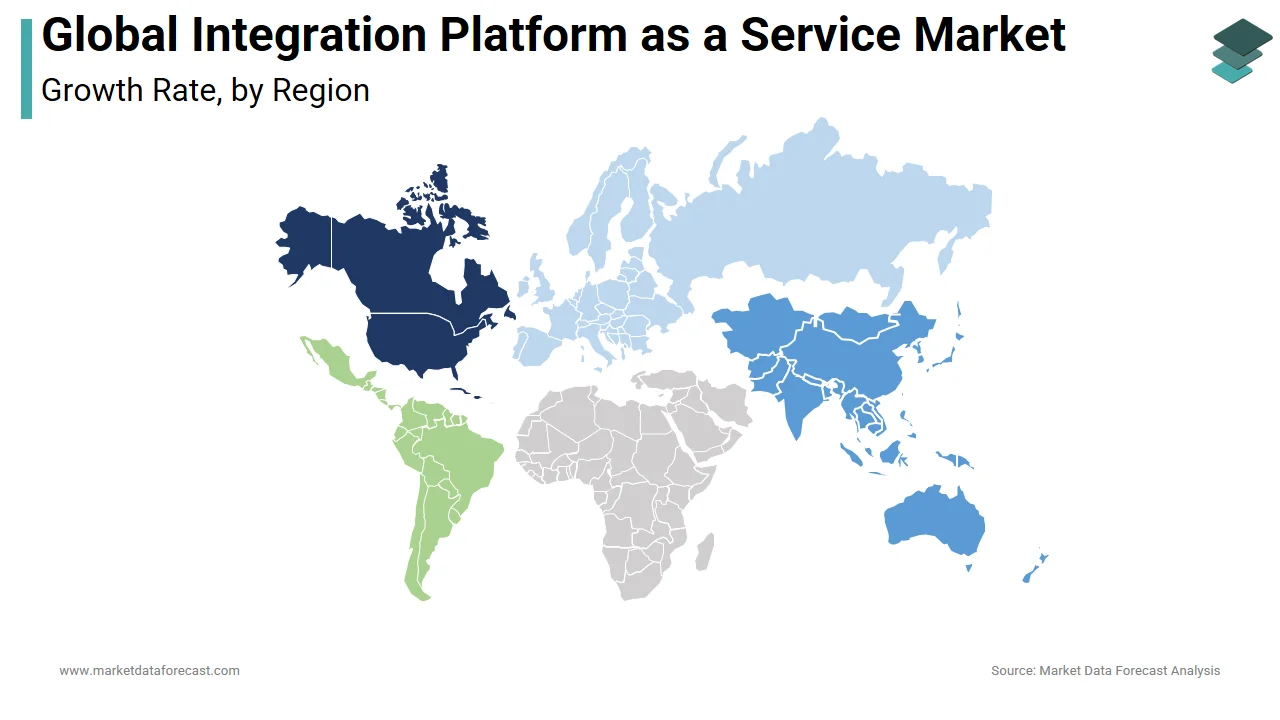
The North American Integration Platform as a service market is expected to experience significant growth during the foreseen period, primarily due to the presence of various industry players, along with the rapid implementation of cloud-based services in several end-user verticals in the area. In addition, the rising call for advanced integration services and the augmented workload transfer in the cloud platform are also foreseen to fuel the demand for IPaaS solutions across the globe.
KEY MARKET PLAYERS
Some of the main players in the global integration platform as a service market are Dell Boomi, Inc. (United States), Informatica Corporation (United States), MuleSoft, Inc. (United States), IBM Corporation (United States), Oracle Corporation (United States), SAP SE (Germany), SnapLogic, Inc. (United States), Celigo, Inc. (United States), Jitterbit, Inc. (United States), Scribe Software Corporation (United States), DBSync (United States States), and Flowgear (South Africa).
RECENT MARKET HAPPENINGS
- In May 2020, Boomi, a Dell Technologies company, announced integration with Amazon EventBridge and the company's platform, expanding its support for event architecture (EDA). Amazon Event Bridge is a serverless event bus that makes it easy to connect application data, integrate software applications as a service, and Amazon Web Services (AWS).
- In June 2020, Informatica, the provider of enterprise cloud data management solutions, presented its new intelligence and automation capabilities to its native cloud data management solution. The solutions are powered by the CLAIRE AI engine powered by the company. These capabilities will primarily allow businesses to see a faster return on investments in cloud data warehouses, investments in data lakes and Lakehouse.
MARKET SEGMENTATION
This research report on the global integration platform as a service market has been segmented and sub-segmented based on the component, deployment mode, organization size, application / use case, industry vertical, and region.
By Component
-
Platform
-
Services
-
Professional Services
-
Managed Services
-
By Deployment Mode
- Cloud
- On-Premises
By Organization Size
- Small & Medium Enterprises (SMEs)
- Large Enterprises
By Application / Use Case
- Data Integration
- Application Integration
- Business Process Integration
- B2B Integration
- Others (API Management, Cloud Integration)
By Industry Vertical
- BFSI (Banking, Financial Services, and Insurance)
- IT & Telecom
- Healthcare & Life Sciences
- Retail & E-commerce
- Manufacturing
- Government & Public Sector
- Media & Entertainment
- Transportation & Logistics
- Energy & Utilities
- Others
By Region
- North America
- Europe
- Asia-Pacific
- Latin America
- The Middle East and Africa