- Product Description Description
- Table of Contents TOC
- List of Table & Figure LOT
- Get Free Sample PDF Sample PDF
Market Size, 2025
$118.3 BnMarket Estimate, 2026
$129.2 BnMarket Forecast, 2034
$261.6 BnCAGR, 2026–2034
9.21%Executive Summary: Italy Food Service Market
- Market Scope: Comprehensive Italy food service market analysis covering place types, end-user settings, regional and national leadership frameworks, culinary tourism metrics, and digital adoption trends.
- Market Valuation: Valued at USD 118.38 billion (2025), estimated at USD 129.28 billion (2026), and projected to reach USD 261.60 billion by 2034, registering a robust CAGR of 9.21% (2026–2034).
- Primary Growth Drivers: High industry operational volumes (supporting over 330,000 food-service businesses and 1.4 million direct jobs, with more than 60% of Italian consumers dining out weekly). Key demand and operational trends include culinary tourism (with 73% of Italians prioritizing traditional recipes and food experiences influencing 68% of foreign visitors), cloud-based POS digitalization (>50% of restaurants), protection of over 800 PDO and PGI products, and 25,000+ agritourism businesses.
Key Market Segment Metrics (2026–2034)
| Category | Leading Segment (2025 Position) | Fastest-Growing Segment |
|---|---|---|
| By Place Type | Full-service restaurants (dominated with a 41.4% market share in 2025) | Quick-service restaurants (projected to grow at a 7.4% CAGR) |
| By End User | Commercial and office premises (captured 36.2% of the market in 2025) | Hospitals and nursing homes (forecast to expand at an 8.4% CAGR) |
| By Region / Setting | Northern and Central Italy urban centers (led commercial traffic, driven by high tourism density and corporate hubs) | Agritourism and rural hospitality sectors (projected to record high expansion backed by authentic culinary experiences) |
Major Market Players & Market Structure
Market Structure: Highly competitive Italian food service landscape blending independent restaurants, institutional operators, and international franchises, with differentiation increasingly centered on culinary authenticity, sustainable sourcing, digital ordering, AI-enabled demand forecasting, plant-based menus, delivery, food-waste reduction, and experiential dining.
Key Companies: McDonald’s, Pizza Hut, Gruppo Sebeto, Lagardère Food Services SRL, and CAMST.
Italy Food Service Market Size
Italy's Food Service Market size was calculated to be USD 118.38 billion in 2025 and is anticipated to be worth USD 261.60 billion by 2034, from USD 129.28 billion in 2026, growing at a CAGR of 9.21% during the forecast period.
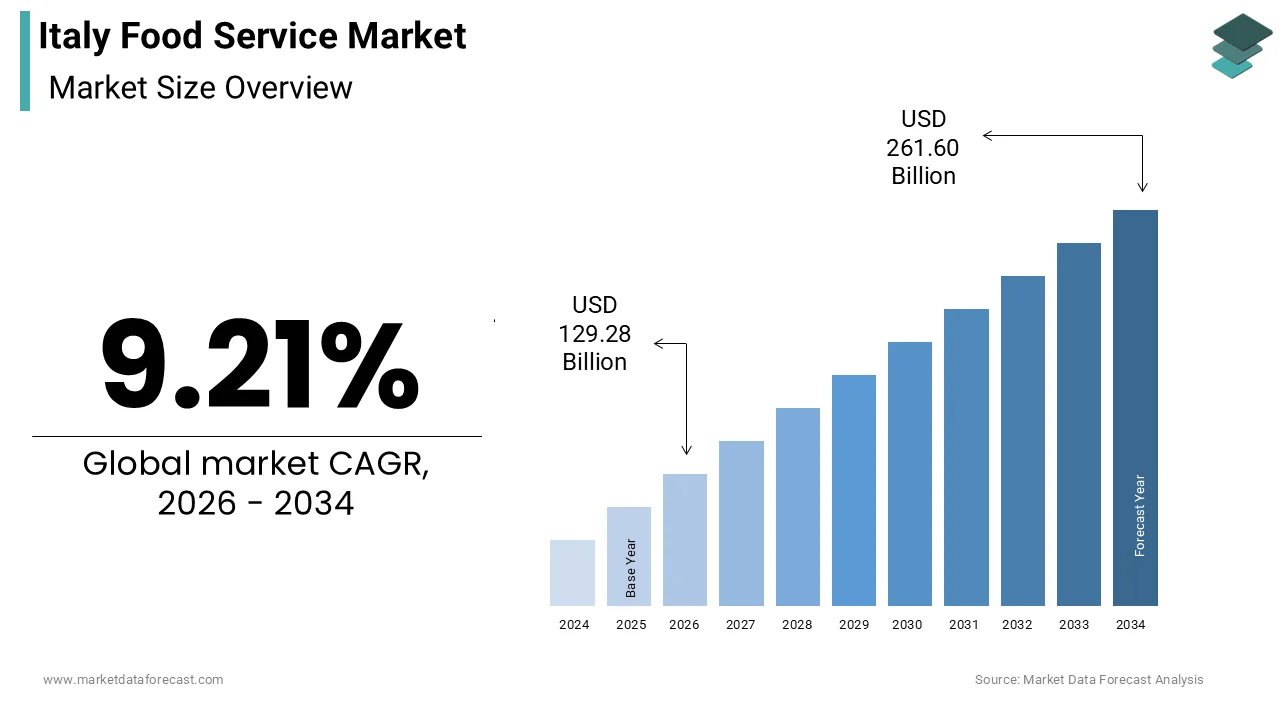
Rooted deeply in Italy’s cultural identity, food service extends beyond mere sustenance, reflecting regional culinary traditions, artisanal craftsmanship, and social rituals. As of 2023, the sector supports over 330,000 food service businesses across the country, according to the Italian Federation of Public Establishments (FIPE), with more than 1.4 million people employed directly in the industry. Italy’s gastronomic heritage, recognized by UNESCO as an intangible cultural asset, continues to influence both domestic consumption and international perceptions. Furthermore, as per the FIPE Ristorazione Report, over 60% of Italian consumers dine out at least once a week, underscoring the embeddedness of food service in daily life. This cultural centrality, combined with evolving consumer behaviors and urban mobility patterns, shapes the structural dynamics of the market.
MARKET DRIVERS
Revival of Domestic Tourism and Regional Culinary Tourism
The resurgence of domestic and regional tourism that has reinvigorated demand for authentic and location-specific dining experiences is one of the major factors propelling the expansion of the Italian food service market. Following the easing of pandemic-related restrictions, Italy recorded over 851 million domestic tourist stays in 2023, according to ISTAT, which is marking a significant increase from previous years. Travelers increasingly prioritize gastronomic experiences, with 58% of Italian tourists stating they choose destinations based on local food offerings, as reported by the Roberta Garibaldi Food and Wine Tourism Report. Regions such as Emilia-Romagna, Tuscany, and Sicily have capitalized on their culinary reputations, such as Parmigiano Reggiano, Chianina beef, and cannoli, by promoting food trails and agritourism. These initiatives integrate restaurants, trattorias, and farm-to-table venues into broader tourism circuits, increasing footfall and average spending. Additionally, the European Union’s support for rural development has funded thousands of food-based tourism projects, further embedding food service into regional economic strategies.
Changing Urban Lifestyles and Demand for Convenience Dining
The transformation of urban living patterns, particularly in major metropolitan areas like Milan, Rome, and Naples, where time scarcity and dual-income households are reshaping eating behaviors, is further boosting the Italian food service market growth. As per ISTAT, over 65% of working adults in Italian cities consume at least one meal outside the home during the workweek, with lunch being the most commonly outsourced. The rise of co-working spaces and extended service hours has led to increased demand for fast-casual formats, delivery, and grab-and-go options. According to a 2023 study by Nomisma, 44% of urban consumers prefer restaurants offering digital ordering and table reservations, highlighting the integration of technology into dining habits. Moreover, the number of single-person households in Italy reached 9 million in 2023, which is a significant increase over the last decade, according to ISTAT, and further amplifying demand for convenient, portion-controlled, and ready-to-eat meals.
MARKET RESTRAINTS
Labor Shortages and Rising Wage Pressures
The persistent shortage of skilled kitchen and service staff, exacerbated by demographic decline and youth migration, is hampering the expansion of the Italian food service market. According to FIPE, the hospitality sector faced a shortage of approximately 300,000 workers in 2023, while the aging workforce in independent restaurants continues to pose operational challenges. This aging workforce, coupled with low vocational training uptake, has created operational bottlenecks. Additionally, as per the National Collective Labor Agreement (CCNL), wage adjustments and rising inflation increased labor costs for small eateries, straining profit margins. Many restaurants, particularly in rural areas, remain understaffed, with many reporting closures or reduced hours due to hiring difficulties, according to industry surveys. These constraints limit scalability and service consistency, undermining customer satisfaction and long-term viability.
Stringent Regulatory and Tax Compliance Burdens
The complex regulatory environment governing food safety, labor, and taxation that disproportionately affects small and medium-sized food service operators is another significant impediment to the Italian food service market. Italy ranks among the most administratively burdensome countries in the EU for small businesses, according to the European Commission, with restaurateurs spending a significant amount of time annually on compliance. The introduction of electronic invoicing and real-time sales reporting has increased digital compliance loads, particularly for traditional family-run establishments. Moreover, as per the Italian Revenue Agency, the total tax wedge for businesses remains high, including VAT, IRAP, and local business taxes. These financial and bureaucratic pressures discourage innovation and investment, with many owners stating they avoid expansion due to regulatory complexity, according to recent industry reports.
MARKET OPPORTUNITIES
Expansion of Sustainable and Plant-Based Dining Concepts
The rising consumer preference for sustainable, plant-forward, and ethically sourced food offerings is a promising opportunity for the Italian food service market. As per the Eurispes Italy Report 2024, approximately 7.2% of Italians now identify as vegetarian or vegan, while a much larger portion is reducing meat consumption for health and environmental reasons. This shift has spurred the emergence of vegan pizzerias, zero-waste trattorias, and carbon-labeled menus in cities like Bologna and Turin. The Ministry of Environment reports that thousands of restaurants have joined various sustainability certification programs, committing to reduced food waste, local sourcing, and eco-friendly packaging. Additionally, the European Green Deal has allocated significant funding for sustainable food systems in Italy, supporting innovation in plant-based proteins and circular economy models. With younger consumers driving this trend, as 68% of Gen Z respondents in recent surveys prioritize sustainability, forward-thinking operators are redefining traditional Italian cuisine through eco-conscious lenses.
Digital Transformation and Integration of AI-Driven Solutions
The growing adoption of digital platforms and artificial intelligence to optimize operations and enhance customer engagement is another prominent opportunity in the Italian food service market. As per recent digital adoption data, over 50% of restaurants now use cloud-based POS systems, while many have implemented AI-powered demand forecasting tools. These technologies improve inventory management, reduce spoilage, and personalize marketing. Delivery aggregators like Just Eat Takeaway and Glovo have expanded their reach into secondary cities, enabling even small pizzerias to access broader markets. A study found that restaurants using dynamic pricing algorithms and loyalty apps saw a 22% increase in repeat visits. Furthermore, voice-activated ordering and AI chatbots are being tested in high-traffic urban locations, signaling a shift toward frictionless dining. As digital infrastructure improves nationwide, especially with 5G rollout, the integration of smart systems presents a scalable growth vector.
MARKET CHALLENGES
Preservation of Authenticity amid Commercialization Pressures
One of the primary challenges in the Italian food service market is maintaining culinary authenticity while adapting to commercial and tourist demands. The proliferation of standardized menus, frozen ingredients, and tourist-targeted restaurants in historic centers has raised concerns about the dilution of regional gastronomy. As per urban studies on heritage, residents in cities like Venice and Florence perceive a decline in food quality due to mass tourism, with many traditional recipes replaced by simplified versions. Small operators face pressure to cut costs and increase turnover, often compromising on ingredient quality. The Coldiretti agricultural association reports that a significant portion of food products served in central districts may not meet authentic certification standards, despite menu claims. Balancing economic survival with cultural integrity remains a critical tension for the sector.
Vulnerability to Global Supply Chain Disruptions and Ingredient Cost Volatility
The sector’s exposure to international supply chain instability and fluctuating input costs is further challenging the growth of the Italian food service market. Italy imports a significant portion of its cooking oils, wheat for specialty breads, and quantities of coffee, cocoa, and spices, according to agricultural reports. The war in Ukraine disrupted sunflower oil and grain flows, causing prices to spike significantly in 2022, as reported by Ismea. Similarly, global climate events affected coffee bean supplies, increasing wholesale costs by 32% in 2023. These fluctuations directly impact menu pricing and profit margins, particularly for independent restaurants with limited purchasing power. A 2024 survey revealed that 51% of restaurant owners revised their menus within the past year due to ingredient unavailability or cost, indicating a growing strain on operational resilience.
REPORT COVERAGE
| REPORT METRIC | DETAILS |
| Market Size Available | 2025 to 2034 |
| Base Year | 2025 |
| Forecast Period | 2026 to 2034 |
| CAGR | 9.21% |
| Segments Covered | By Place Type, End User, And Region |
| Various Analyses Covered | Global, Regional & Country Level Analysis; Segment-Level Analysis; DROC, PESTLE Analysis; Porter’s Five Forces Analysis; Competitive Landscape; Analyst Overview of Investment Opportunities |
| Regions Covered | Aosta Valley, Piedmont, Lombardy, Liguria, Trentino-Alto Adige/Südtirol, Veneto, Friuli Venezia Giulia, Emilia-Romagna, Tuscany, Umbria, Marche, Lazio, Abruzzo, Molise, Campania, Apulia, Basilicata, Calabria, Sicily, Sardinia |
| Market Leaders Profiled | McDonald’s, Pizza Hut, Gruppo Sebeto, Lagardère Food Services SRL, and CAMST. |
SEGMENTAL ANALYSIS
By Place Type Insights
The full-service restaurants (FSRs) segment dominated the market by holding 41.4% of the Italian market share in 2025. This dominance is anchored in Italy’s deep-rooted gastronomic culture, where multi-course meals, regional specialties, and sit-down dining remain central to social and familial life. According to industry data, hundreds of thousands of full-service establishments operate across the country, ranging from family-run trattorias to Michelin-recognized fine dining venues. The sector benefits from strong consumer preference for authenticity and culinary craftsmanship, with 73% of Italians stating they prioritize traditional recipes when dining out, as reported by the Eurispes Italy Report 2024. Additionally, FSRs are primary beneficiaries of domestic and international tourism, as the Ministry of Tourism confirms that food experiences influence 68% of travel decisions among foreign visitors, with Italy welcoming over 134 million tourist arrivals in 2023. The institutional support for heritage-based cuisine and geographical indications is further contributing to the growth of the FSR segment in the Italian market. According to the Ministry of Agriculture, Food and Forestry Policies, Italy protects over 800 PDO (Protected Designation of Origin) and PGI (Protected Geographical Indication) food products, many of which are integral to restaurant menus. This certification framework enhances consumer trust and allows restaurants to differentiate their offerings. Furthermore, the rise of agritourism has expanded the FSR footprint into rural areas, with over 25,000 certified agritourism businesses as per ISTAT. These venues combine regional cuisine with experiential tourism, increasing average spending per visit. As per a Nomisma study, diners at certified traditional restaurants spend 32% more than at generic eateries, reinforcing the economic viability of this segment.
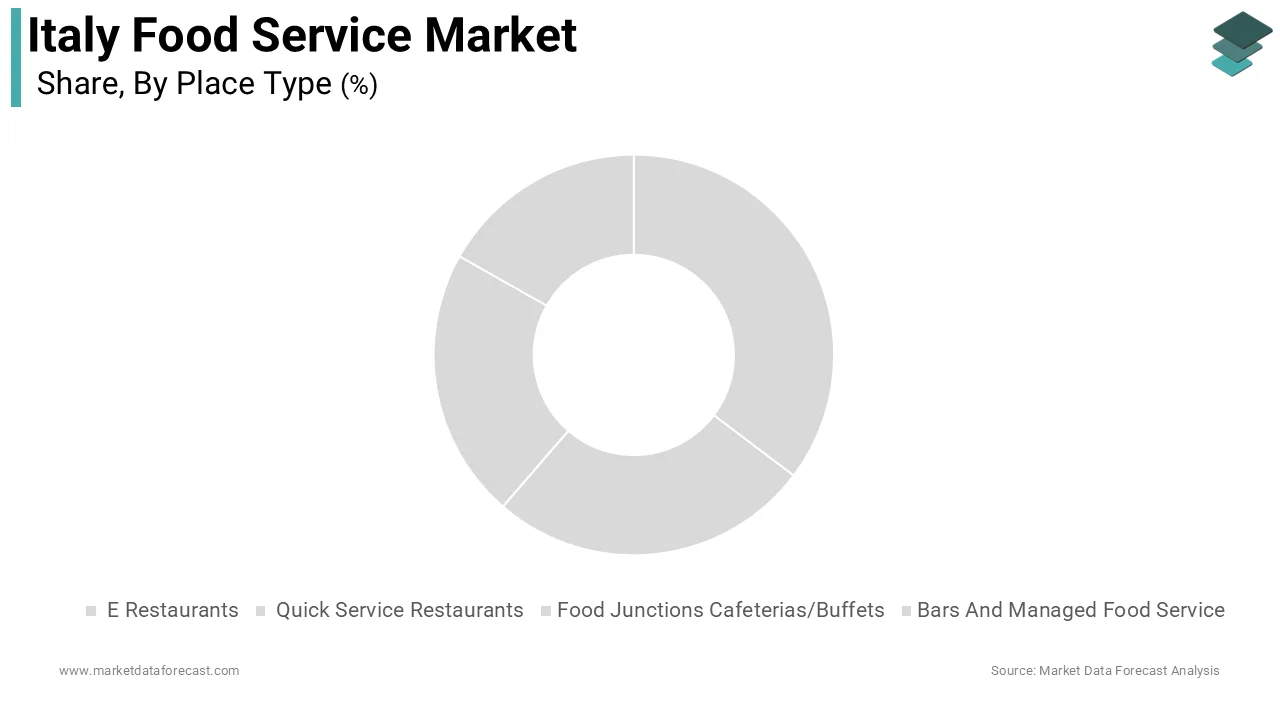
On the other hand, the quick service restaurants (QSRs) segment is the fastest-growing segment and is predicted to register a CAGR of 7.4% over the forecast period, owing to the shifting urban consumption patterns and the rising demand for speed, affordability, and digital convenience. As per ISTAT, over 60% of working professionals in major Italian cities consume lunch outside their homes, with time constraints favoring fast-casual formats. The number of QSR outlets in Italy continues to grow, reflecting both international brand expansion and homegrown innovation. Domestic chains like Panini & Company and Fratelli La Bufala have successfully adapted Italian flavors, such as buffalo mozzarella and slow-cooked ragù, into scalable, rapid-service models, appealing to younger demographics. The integration of digital platforms is another pivotal growth catalyst. According to a study by Politecnico di Milano, a large majority of QSR transactions in Italy now involve digital channels, including app-based ordering, delivery aggregators, and contactless payments. Just Eat Takeaway reports a 41% increase in QSR order volume in Italy between 2022 and 2023, with Milan, Rome, and Naples leading adoption. Additionally, the rise of ghost kitchens has lowered entry barriers and enabled rapid scaling. According to a Doxa survey, 54% of Gen Z consumers prefer ordering from digital-first brands, highlighting a generational shift in dining behavior. These factors collectively position QSRs as the most dynamic and adaptable segment in the evolving food service landscape.
By End-User Insights
The commercial and office premises segment led the market by capturing 36.2% of the Italian market share in 2025 due to the concentration of white-collar employment in urban centers and the institutionalization of workplace dining as a component of employee welfare. According to ISTAT, millions of Italians are employed in office-based roles, with a large percentage relying on workplace cafeterias or nearby food outlets for daily meals. Corporate campuses and business districts in Milan, Rome, and Turin feature integrated food courts, subsidized meal programs, and premium catering services, often managed by large operators like Sodexo and Elior Italia. The Italian Employers’ Confederation reports that a majority of medium-to-large companies offer structured meal solutions, reflecting the strategic role of food in productivity and employee retention. The expansion of hybrid work models has further refined demand, which is prompting employers to enhance on-site food quality and variety to incentivize office attendance and is further contributing to the expansion of the commercial and office premises segment in the Italian market. As per a Censis survey, 61% of employees consider cafeteria quality when evaluating workplace satisfaction. In response, many firms have partnered with local chefs and organic suppliers to elevate menu standards. Additionally, the European Union’s Workplace Health Initiative has encouraged investments in nutritionally balanced meals, with many corporate food programs now offering low-sodium, plant-rich, or allergen-free options. These developments have transformed office food service from a basic utility into a value-added benefit, solidifying its dominance in the institutional food service sector.
However, the hospital & nursing homes segment is the fastest-growing end-user segment and is predicted to record a CAGR of 8.4% over the forecast period, owing to the rapidly aging population and the increasing medicalization of dietary care. ISTAT projects that a significant portion of Italy’s population will be over 65 by 2030, necessitating expanded long-term care infrastructure. As of 2023, Italy operates thousands of nursing homes and hospitals, all of which require structured food service systems compliant with clinical nutrition standards. The Ministry of Health mandates that patients and residents receive personalized meal plans based on conditions such as diabetes, dysphagia, or renal impairment, increasing the complexity and value of food provision. The shift toward in-house, professionally managed nutrition services to improve patient outcomes is also contributing to the segmental expansion in the Italian market. As per a study published in the European Journal of Clinical Nutrition, hospitals with dedicated dietitians and customized menus reported a 28% reduction in malnutrition-related complications. In response, regional health authorities in Lombardy and Emilia-Romagna have outsourced food management to specialized providers using centralized kitchens and automated portioning systems. Additionally, EU funding has allocated significant resources to modernize healthcare food services in Italy, supporting digital menu planning and allergen tracking. These advancements are transforming institutional food from a logistical function into a critical component of therapeutic care.
COMPETITION OVERVIEW
The competition in the Italy Food Service Market is characterized by a fragmented yet dynamic landscape, where traditional family-run establishments coexist with large institutional operators and global franchises. While independent restaurants dominate in number, corporate players are gaining influence through scale, technology, and standardized quality control. Differentiation increasingly hinges on authenticity, sustainability, and digital convenience rather than price alone. Urban centers witness intense rivalry among quick-service and fast-casual brands, while rural areas rely on agritourism and heritage-driven dining. The rise of delivery platforms and ghost kitchens has lowered entry barriers, intensifying competition. At the same time, regulatory pressures and labor shortages favor well-resourced operators capable of compliance and innovation. As consumer expectations evolve, the market is shifting toward experiential, health-conscious, and ethically sourced food service, redefining competitive advantage across segments.
KEY MARKET PLAYERS
A few major players of the Italian food service market include
- McDonald’s
- Pizza Hut
- Gruppo Sebeto
- Lagardère Food Services SRL
- CAMST
Top Strategies Used by the Key Market Participants
Key players in the Italy Food Service Market are deploying strategic initiatives centered on digital integration, sustainability, and culinary authenticity to strengthen their competitive edge. Companies are investing in cloud-based POS systems, mobile apps, and AI-driven demand forecasting to enhance operational efficiency and customer engagement. Menu innovation focused on plant-based, gluten-free, and regionally sourced options is aligning with evolving consumer health and environmental preferences. Strategic partnerships with local producers and certification bodies are reinforcing transparency and authenticity. Expansion into high-growth segments such as healthcare and corporate wellness is broadening revenue streams. Additionally, operators are adopting circular economy principles, reducing food waste, and eliminating non-recyclable packaging. International knowledge transfer and brand localization are enabling Italian firms to influence global food service standards while maintaining cultural integrity.
Leading Players in the Italian Food Service Market
- Autogrill, a leading operator in travel-oriented food service, maintains a dominant footprint across Italy’s highways, airports, and railway stations. The company operates under multiple brands, including Burger King, Starbucks, and its proprietary Eat & Go and Traveler’s Café concepts, delivering standardized yet regionally adapted menus to millions of commuters annually. In recent years, Autogrill has prioritized digital transformation, launching mobile ordering and cashless payment systems across 80% of its Italian outlets by 2023. It has also intensified sustainability efforts, committing to eliminating single-use plastics in its operations by 2025, in alignment with EU Green Deal objectives. In the Asia Pacific region, Autogrill has extended its expertise through management contracts with airport operators in India and Thailand, providing operational frameworks for high-traffic food courts. These collaborations focus on integrating Italian culinary elements into localized menus, enhancing brand visibility while adapting to regional consumption patterns.
- Sodexo’s presence in the Italy Food Service Market is anchored in its leadership in managed services for corporate, healthcare, and educational institutions. The company tailors nutritionally balanced, culturally appropriate meal programs for clients ranging from multinational offices to public hospitals. In 2023, Sodexo Italy launched a digital wellness platform integrating AI-driven dietary recommendations with its meal delivery systems, enhancing personalization in workplace and healthcare settings. It has also strengthened partnerships with local farmers to ensure 60% of produce in its northern Italy facilities is sourced within 100 kilometers. In the Asia Pacific, Sodexo leverages its Italian operational model to serve expatriate communities and multinational campuses, particularly in Singapore and Japan. Its Italy-based R&D team has contributed to developing Mediterranean-inspired menu lines that meet nutritional standards in corporate and hospital contracts across the region, promoting cross-market innovation.
- Elior Italia, a subsidiary of the French Elior Group, is a major force in institutional and premium food service across Italy, operating in hospitals, universities, and high-end corporate environments. The company emphasizes culinary excellence and sustainability, employing certified chefs and implementing zero-waste kitchen protocols in over 400 facilities. In 2023, Elior Italia introduced a blockchain-based traceability system for meat and dairy, ensuring compliance with Italian food safety regulations and enhancing consumer trust. It has also expanded its “Cucina Italiana” program, which highlights regional dishes and seasonal ingredients, reinforcing cultural authenticity. In the Asia Pacific, Elior’s Italian division has supported the group’s contracts in Australia and India by providing menu design expertise and training for Italian cuisine preparation. These contributions have enabled Elior to differentiate its offerings in competitive urban markets where demand for authentic European dining experiences is rising.
MARKET SEGMENTATION
This research report on the Italian food service market has been segmented and sub-segmented based on place type, end user & region.
By Place Type
- E Restaurants
- Quick Service Restaurants
- Food Junctions Cafeterias/Buffets
- Bars And Managed Food Service
By End-User
- Industrial Premises
- Commercial and Office Premises
- Hospital & Nursing Homes
- Educational Premises (Colleges, Universities, Schools)
- In-transit Food Service (Airlines, Trains)
- Sports Centers/Malls)
By Region
- Aosta Valley
- Piedmont
- Lombardy
- Liguria
- Trentino-Alto Adige/Südtirol
- Veneto
- Friuli Venezia Giulia
- Emilia-Romagna
- Tuscany
- Umbria
- Marche
- Lazio
- Abruzzo
- Molise
- Campania
- Apulia
- Basilicata
- Calabria
- Sicily
- Sardinia