- Product Description Description
- Table of Contents TOC
- List of Table & Figure LOT
- Get Free Sample PDF Sample PDF
Market Size, 2025
$18.53 BnMarket Estimate, 2026
$21.63 BnMarket Forecast, 2034
$74.56 BnCAGR, 2026–2034
16.73%Executive Summary: Latin America Healthcare IT Market
- Market Scope: Comprehensive regional market analysis covering healthcare IT types (EHR, RIS, PACS, Telehealth, Analytics), components (Services, Software, Hardware), end-user segments, and country-level adoption frameworks across Latin America.
- Market Valuation: Valued at USD 18.53 billion (2025), estimated at USD 21.63 billion (2026), and projected to reach USD 74.56 billion by 2034, registering a strong CAGR of 16.73% (2026–2034).
- Primary Growth Drivers: Rapid rise in health and fitness initiatives, integration of smart devices and wearable sensors, increasing prevalence of chronic conditions, and expanding healthcare infrastructure modernization across key Latin American nations.
Key Market Segment Metrics (2026–2034)
| Category | Leading Segment (2025 Position) | Fastest-Growing Segment |
|---|---|---|
| By Type | Electronic Health Records (EHR) & Telehealth Solutions (anchored digital transformation across hospitals and clinics) | Healthcare Analytics & Interoperability Systems (accelerating due to demand for centralized health data pooling) |
| By Component | Software Solutions (dominated deployment frameworks for clinical and administrative record-keeping) | Services (scaling rapidly as healthcare facilities seek professional consultation, integration, and maintenance support) |
| By End-User | Healthcare Providers (hospitals, clinics, and diagnostic centers held the largest share of IT deployment) | Healthcare Providers (expanding alongside rising demands for precision diagnoses and remote patient monitoring) |
| By Country | Brazil (led the regional market with the largest overall market share driven by high healthcare expenditure) | Mexico (projected to grow rapidly at the highest CAGR, supported by emerging health analytics frameworks) |
Major Market Players & Market Structure
Market Structure: Competitive regional landscape featuring global healthcare technology giants and specialized enterprise software providers competing on interoperability, cloud integration, clinical workflow efficiency, and compliance.
Key Companies: Cerner Corporation (Oracle), McKesson Corporation, Philips Healthcare, Novarad Corporation, GE Healthcare, Carestream Health, eClinicalWorks, Epic Systems Corporation, Siemens Healthcare (Siemens AG), Athenahealth Inc., and Allscripts Healthcare Solutions Inc.
 Download Free Sample Report
Latin America Healthcare IT Market Size
The Latin America healthcare IT market was valued at USD 18.53 billion in 2025. This market is expected to grow at a CAGR of 16.73% from 2026 to 2034 and be worth USD 74.56 billion by 2034, up from USD 21.63 billion in 2026.
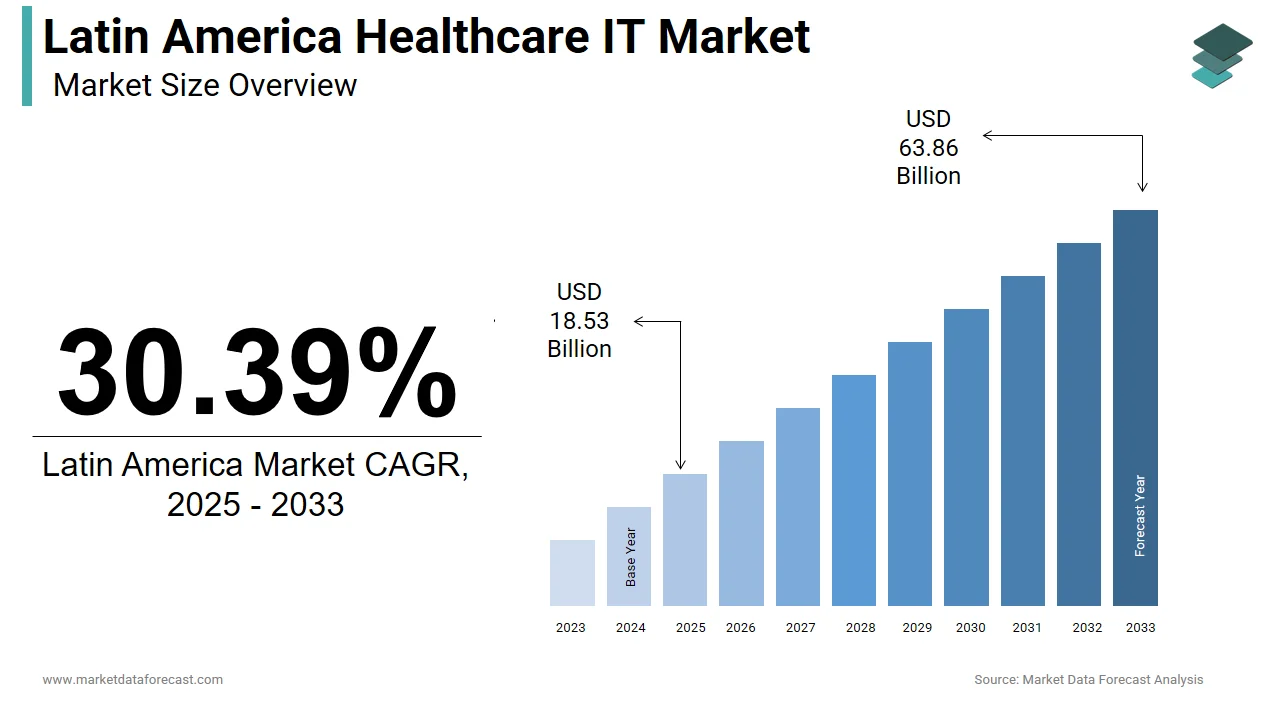
Healthcare IT is a medical infrastructure driven by the urgent need to modernize fragmented healthcare delivery systems. This sector encompasses electronic health records, telemedicine platforms, and data analytics tools designed to enhance patient outcomes and operational efficiency. As per the World Bank, chronic diseases account for over 70% of deaths in Latin America, necessitating robust data management solutions for long-term disease monitoring and prevention. These demographic and structural realities directly fuel the demand for advanced health information technologies capable of handling complex patient histories. Governments across Brazil, Mexico, and Colombia are increasingly prioritizing digital health initiatives to reduce public spending waste and improve access in remote areas. The integration of mobile health applications further extends reach to underserved populations where physical infrastructure remains limited.
MARKET DRIVERS
Government Mandates for Digital Health Infrastructure
The aggressive legislative frameworks enacted by national governments to standardize and digitize healthcare records across public and private sectors is fuelling the growth of the Latin America healthcare IT market. Countries like Brazil and Mexico have implemented strict regulations requiring hospitals and clinics to adopt electronic health record systems to qualify for public funding and insurance reimbursements. According to the Ministry of Health in Brazil, the national e-SUS strategy aims to integrate over 50000 primary care units into a unified digital network by 2025, ensuring seamless data exchange. This mandate creates a guaranteed baseline demand for healthcare IT vendors who provide compliant software solutions. Such efficiency gains validate government investments and encourage further policy support. Public-private partnerships are increasingly common as governments leverage private sector expertise to meet ambitious digitalization targets. The legal requirement for interoperability forces legacy systems to upgrade or replace their infrastructure, driving consistent revenue streams for IT providers. Compliance with data privacy laws such as those modeled after GDPR also necessitates sophisticated security features embedded in healthcare IT platforms. This regulatory pressure ensures that healthcare IT adoption is not optional but mandatory for operational continuity.
Rising Prevalence of Chronic Diseases and Aging Population
The demographic shift toward an aging population and the increasing burden of non-communicable diseases requiring continuous monitoring are also promoting the growth of the Latin America healthcare IT market. Latin America is experiencing a rapid epidemiological transition where lifestyle-related conditions such as diabetes and hypertension are becoming predominant health challenges. As per the International Diabetes Federation, the number of adults with diabetes in South and Central America is projected to reach 46 million by 2030, requiring extensive data tracking and management. Healthcare IT solutions enable remote patient monitoring and predictive analytics that help manage these chronic conditions more effectively than traditional episodic care models. These systems allow physicians to access real-time patient data, facilitating timely interventions and reducing hospital readmissions. The economic burden of chronic care drives insurers and providers to adopt IT tools that optimize resource allocation and prevent complications. Telehealth platforms supported by robust IT infrastructure extend specialist care to rural areas where chronic disease management is often neglected. The urgency to control rising healthcare costs associated with chronic illnesses makes IT investment a strategic priority.
MARKET RESTRAINTS
Limited Internet Connectivity in Rural Areas
The limited internet connectivity in rural areas is degrading the growth of the Latin America healthcare IT market. Many remote regions lack the high-speed broadband infrastructure necessary to support cloud-based healthcare IT applications and real-time data transmission. This disparity limits the effectiveness of telemedicine and remote monitoring solutions, which are critical for extending healthcare access to underserved populations. Healthcare providers in rural clinics often struggle to upload large medical files or access centralized electronic health records due to unstable connections. The Economic Commission for Latin America and the Caribbean notes that inadequate digital infrastructure increases the cost of deploying IT solutions in remote areas, requiring expensive satellite or dedicated line installations. This financial barrier discourages small rural practices from adopting advanced IT systems, perpetuating a cycle of inefficient care. The lack of reliable connectivity also hinders the implementation of artificial intelligence tools that require constant data flow for accurate diagnostics.
Shortage of Skilled Healthcare IT Professionals
The acute scarcity of professionals who possess both clinical knowledge and technical expertise in health informatics is also degrading the growth of the Latin American healthcare IT market. Implementing and maintaining complex healthcare IT systems requires specialized training that is currently insufficient in most Latin American educational institutions. This talent shortage leads to prolonged implementation timelines and increased reliance on expensive foreign consultants. Hospitals often face resistance from staff who lack the digital literacy to effectively use new software systems, resulting in underutilization of purchased technologies. The World Health Organization highlights that inadequate training programs contribute to high error rates in data entry, compromising the quality of electronic health records. The lack of standardized certification programs for health informatics further complicates workforce development, leaving organizations without clear hiring criteria. Small and medium-sized healthcare providers are particularly affected as they cannot compete with larger institutions for limited skilled talent. This human capital constraint slows down the pace of innovation and reduces the return on investment for IT projects.
MARKET OPPORTUNITIES
Expansion of Telemedicine and Remote Patient Monitoring
The post-pandemic era has normalized virtual care, creating sustained demand for integrated telehealth platforms that is one of the major opportunities for the growth of the Latin America healthcare IT market. Patients and providers now expect seamless digital interactions, making telemedicine a permanent fixture in healthcare delivery models across Latin America. This shift creates opportunities for IT vendors to offer comprehensive suites that combine video conferencing, electronic prescriptions, and remote monitoring devices. The ability to monitor patients with chronic conditions from home reduces hospital congestion and lowers overall healthcare costs. Insurance companies are increasingly covering telehealth services, encouraging providers to invest in compatible IT infrastructure. The expansion of 5G networks in major cities will further enhance the quality of remote diagnostics, enabling high-resolution image transmission and real-time data analysis. Startups focusing on niche telehealth applications for mental health and dermatology are attracting significant venture capital.
Integration of Artificial Intelligence in Diagnostic Processes
The healthcare providers' efforts to leverage artificial intelligence to improve diagnostic accuracy and operational efficiency are another factor to elevate the growth of the Latin America healthcare IT market. AI algorithms can analyze vast amounts of medical data to identify patterns and predict outcomes faster than human clinicians. According to The Lancet Digital Health, AI-assisted diagnostic tools have shown a 20% improvement in early detection rates for certain cancers in pilot studies conducted in Brazil and Argentina. This capability offers a significant advantage in regions with a shortage of specialized radiologists and pathologists. Healthcare IT vendors are integrating AI modules into existing platforms, providing value-added services that justify premium pricing. Hospitals use AI-driven analytics to optimize bed management, staff scheduling, and supply chain logistics, reducing operational waste. The growing availability of structured digital health data provides the fuel necessary for training robust AI models. Government initiatives promoting digital innovation are beginning to include incentives for AI adoption in public health systems.
MARKET CHALLENGES
Data Privacy and Security Concerns
The increasing sophistication of cyber threats targeting sensitive patient data stored in digital health systems is one of the key challenges for the growth of the Latin America healthcare IT market. Healthcare organizations in Latin America are becoming prime targets for ransomware attacks due to perceived weaknesses in cybersecurity defenses. The fear of data breaches makes healthcare providers hesitant to fully migrate to cloud-based IT solutions despite their efficiency benefits. Compliance with evolving data protection laws requires continuous investment in security infrastructure, which strains limited budgets. The lack of standardized cybersecurity protocols across different countries creates confusion for multinational IT vendors attempting to deploy uniform solutions. Patients are becoming more aware of privacy rights, leading to greater scrutiny of how their data is collected and used. Any high-profile security incident can damage trust in digital health platforms, slowing down adoption rates. Healthcare IT vendors must prioritize robust encryption and access control mechanisms to mitigate these risks.
Fragmented Regulatory Landscape Across Countries
The lack of harmonized regulations governing healthcare IT standards and data interoperability is also hindering the growth of the Latin America healthcare IT market. Each country has its own unique legal framework for data privacy, electronic prescribing, and medical device certification, creating barriers for regional expansion. As per the research, the absence of common technical standards prevents seamless data exchange between healthcare systems in neighboring countries, hindering cross-border care. IT vendors must customize their solutions for each market, increasing development costs and time to market. Inconsistent enforcement of digital health policies creates uncertainty for investors and technology providers. The lack of mutual recognition agreements for digital health credentials complicates the deployment of telemedicine services across borders. Healthcare providers struggle to integrate systems from different vendors due to incompatible data formats and protocols. This regulatory disjointedness slows down the overall pace of digital transformation in the region. Efforts to create regional standards are ongoing, but progress remains slow due to political and economic differences.
REPORT COVERAGE
| REPORT METRIC | DETAILS |
| Market Size Available | 2025 to 2034 |
| Base Year | 2025 |
| Forecast Period | 2026 to 2034 |
| Segments Covered | By Type, Component, End-user, and Country. |
| Various Analyses Covered | Global, Regional and Country-Level Analysis, Segment-Level Analysis, Drivers, Restraints, Opportunities, Challenges; PESTLE Analysis; Porter’s Five Forces Analysis, Competitive Landscape, Analyst Overview of Investment Opportunities |
| Countries Covered | India, China, Japan, South Korea, Australia, New Zealand, Thailand, Malaysia, Vietnam, Philippines, Indonesia, Singapore, Rest of APAC |
| Market Leaders Profiled | Cerner Corporation, Oracle Corporation, McKesson Corporation, Philips Healthcare, Novarad Corporation, Philips, GE Healthcare, Carestream Health, eClinicalworks, EPIC Systems Corporation, Siemens Healthcare (Siemens AG), Athenahealth Inc. and Allscripts Healthcare Solutions, Inc. |
SEGMENTAL ANALYSIS
By Type Insights
The electronic health record segment was the largest, accounting for 34.2% of the Latin America healthcare IT market share in 2025, with its foundational role in digitizing patient data and enabling seamless information exchange across healthcare facilities. Governments and private institutions prioritize EHR adoption as the first step toward modernizing legacy paper-based systems that hinder operational efficiency. This widespread adoption creates a stable revenue base for IT vendors providing core infrastructure solutions. Such tangible benefits justify the initial investment costs for healthcare providers facing budget constraints. EHR systems also serve as the central hub for other applications such as billing and analytics, making them indispensable for comprehensive hospital management. Regulatory requirements for data standardization further compel providers to upgrade to compliant EHR platforms. The need for interoperability between public and private sectors accelerates the replacement of fragmented standalone systems. As healthcare networks expand their reach into rural areas, cloud-based EHR solutions offer scalable options without heavy infrastructure costs.
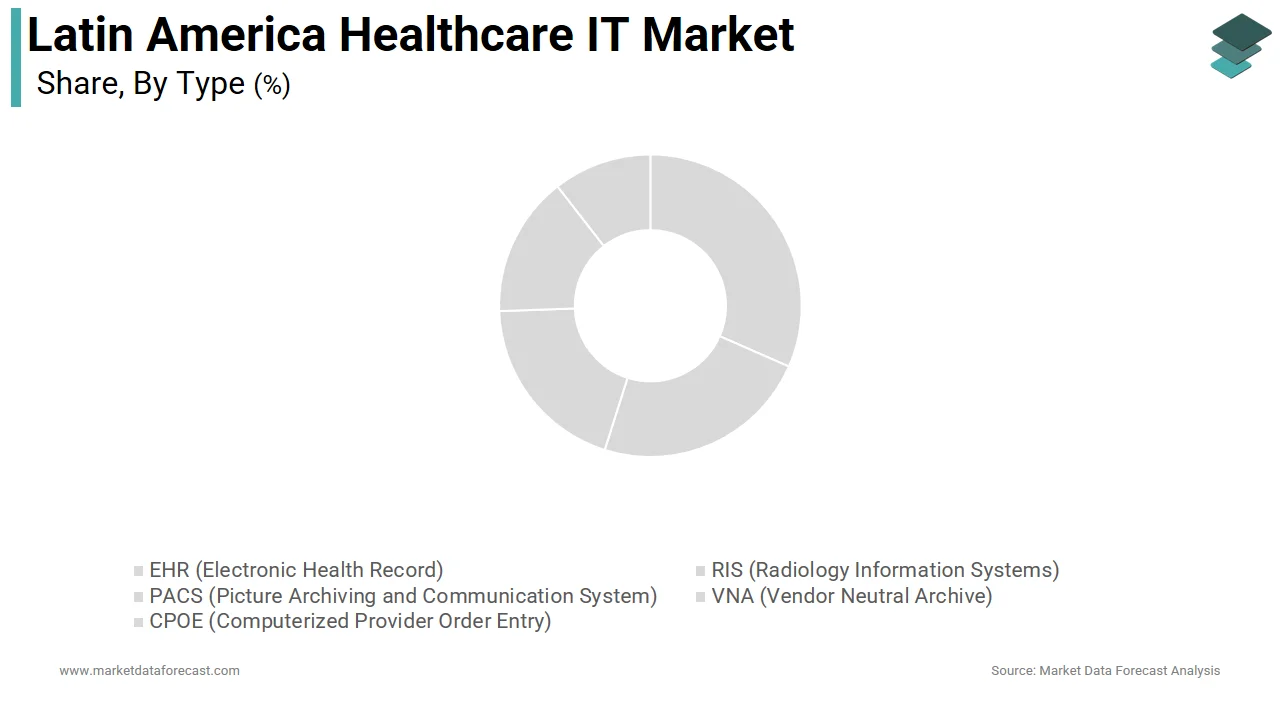
The telehealth segment is expected to grow at the fastest CAGR of 24.3% from 2026 to 2034, with the urgent need to extend medical access to remote and underserved populations. The pandemic accelerated the acceptance of virtual consultations, creating a permanent shift in patient and provider behavior across the region. According to the research, telehealth usage in Latin America has stabilized at levels three times higher than pre-pandemic rates, indicating sustained demand for remote care solutions. This growth is fueled by improving internet connectivity in urban centers and the proliferation of smartphone penetration among patients. Private insurers are increasingly reimbursing virtual visits, encouraging providers to invest in robust telehealth platforms. Technological advancements in wearable devices allow for real-time monitoring of vital signs, enhancing the clinical value of remote consultations. Startups focusing on niche specialties such as mental health and dermatology are attracting significant venture capital funding. Government programs in Brazil and Mexico are integrating telehealth into primary care networks to alleviate congestion in physical clinics.
By Component Insights
The services segment held a prominent share of the Latin America healthcare IT market. Implementation consulting, training, and ongoing technical support are critical for ensuring that software solutions deliver intended outcomes without disrupting clinical workflows. Hospitals rely on external partners to navigate regulatory compliance, data migration, and change management challenges. Inadequate staff training is a primary cause of EHR implementation failure, emphasizing the need for comprehensive educational services. Managed services are gaining traction as providers seek to outsource cybersecurity and infrastructure maintenance to specialized firms. This trend allows healthcare facilities to focus on patient care while leveraging expert knowledge for IT operations. The complexity of integrating legacy systems with new technologies further drives demand for customized integration services. Small and medium-sized clinics particularly benefit from service bundles that provide end-to-end support without requiring large internal IT teams.
The software segment is likely to witness the fastest CAGR of 18.3% during the forecast period with the increasing availability of cloud-based solutions and modular applications tailored to specific clinical needs. Healthcare providers are moving away from monolithic on-premise systems toward flexible software suites that can be updated and scaled easily. Software vendors are introducing artificial intelligence modules for diagnostics and predictive analytics, adding significant value to traditional record-keeping functions. The ease of deployment and lower upfront costs make software solutions attractive to private practices and smaller hospitals. Regulatory pushes for interoperability require frequent software updates to meet changing standards, driving recurring revenue streams for vendors. Mobile health applications are also contributing to this growth by extending software capabilities to patient-facing devices. The shift toward subscription-based pricing models lowers barriers to entry, allowing more providers to access advanced tools.
By End User Insights
The healthcare providers segment was the largest by capturing a significant share of the Latin America healthcare IT market, as they are the primary users of clinical information systems and bear the responsibility for direct patient care delivery. Hospitals, clinics, and diagnostic centers require comprehensive IT infrastructure to manage patient records, schedule appointments, and process billing efficiently. The sheer volume of patient interactions generates massive amounts of data, necessitating robust storage and processing capabilities. Public hospitals are undergoing major digital transformations funded by state budgets to reduce waiting times and improve resource allocation. Private healthcare chains are investing in premium IT solutions to differentiate their services and attract insured patients. The need for interoperability between different departments within large hospital networks drives the adoption of integrated enterprise resource planning systems. Physicians and nurses rely on these systems for clinical decision support, reducing medical errors and enhancing patient safety. As the burden of chronic diseases increases, providers require advanced analytics tools to manage population health effectively.
The payers segment is expected to grow at the fastest CAGR of 21.2% from 2026 to 2034 with the need to control rising healthcare costs and prevent fraud through advanced data analytics. Insurance companies and government health funds are increasingly adopting IT solutions to automate claims processing and detect irregular patterns indicative of fraudulent activity. Payers are leveraging big data analytics to assess risk profiles more accurately and design personalized insurance plans. The shift toward value-based care models requires payers to monitor patient outcomes and coordinate with providers through shared digital platforms. Regulatory mandates for transparency in pricing and coverage decisions force insurers to upgrade their legacy IT systems. Cloud-based solutions enable payers to scale their operations quickly during periods of high enrollment or claim volumes. Mobile applications allow members to access policy information and submit claims digitally, improving customer satisfaction. The integration of artificial intelligence helps automate routine tasks, reducing administrative overhead and speeding up reimbursement processes.
COUNTRY-LEVEL ANALYSIS
Brazil Healthcare IT Market Analysis
Brazil was the top performer of the Latin America healthcare IT market by capturing a 44.2% share in 2025 with its extensive public health system and aggressive digital health policies. The unified health system known as SUS serves over 150 million citizens, creating a massive demand for scalable IT solutions. According to the Brazilian Ministry of Health, the e SUS strategy aims to digitize all primary care records by 2025, fostering a standardized approach to data collection. This nationwide initiative drives significant investment in electronic health records and interoperability platforms. Private healthcare providers in major cities like São Paulo and Rio de Janeiro are also adopting advanced analytics and telemedicine to compete for affluent patients. The presence of local IT companies specializing in healthcare solutions supports the ecosystem with culturally and linguistically appropriate tools. Regulatory frameworks such as the General Data Protection Law enforce strict privacy standards, encouraging robust security investments. The country's large population and high prevalence of chronic diseases create a continuous need for efficient data management. Government partnerships with technology firms accelerate the deployment of cloud infrastructure in remote areas.
Mexico Healthcare IT Market Analysis
Mexico healthcare IT market was ranked second by holding 21.2% of the share in 2025, with the mixed public-private healthcare landscape and increasing regulatory pressure for digitalization. Private hospitals are investing in patient engagement platforms to enhance customer experience and retain insured clients. The proximity to the United States facilitates technology transfer and attracts foreign IT vendors seeking entry into the Latin American market. Telemedicine adoption has surged following legal reforms that recognize virtual consultations as equivalent to in-person visits. Cybersecurity concerns are prompting healthcare organizations to upgrade their infrastructure to protect sensitive patient data. The growing middle class demands higher quality care, driving competition among providers to adopt innovative IT tools. Government initiatives to expand health coverage in rural areas rely heavily on mobile health technologies.
Argentina Healthcare IT Market Analysis
Argentina healthcare IT market growth is likely to continue with the highly educated workforce and a tradition of medical excellence. The country has a high density of physicians per capita who are early adopters of digital tools for clinical decision support. Private healthcare providers in Buenos Aires are leading the adoption of cloud-based solutions to reduce operational costs. The economic volatility in the country encourages the use of subscription-based software models that avoid large upfront capital expenditures. Local startups are developing innovative applications for remote patient monitoring and mental health support, attracting international attention. The government is promoting open-source solutions to reduce dependency on proprietary foreign software. High internet penetration rates facilitate the widespread use of telehealth services.
Chile Healthcare IT Market Analysis
Chile healthcare IT market growth is likely to grow with the high regulatory standards and advanced digital infrastructure. The country has one of the highest rates of electronic health record adoption in Latin America, driven by efficient public-private partnerships. This high level of connectivity supports sophisticated population health management and predictive analytics initiatives. Private insurers are leveraging big data to optimize risk assessment and personalize coverage plans. The government actively promotes interoperability standards, ensuring that different systems can communicate effectively. Cybersecurity is a top priority with strict regulations governing data protection and privacy. The aging population drives demand for remote monitoring solutions and home care technologies. Chile's stable economic environment attracts foreign investment in healthcare technology startups.
Rest of Latin America
The Rest of Latin America healthcare IT market growth is driven by government initiatives and increasing private sector participation. Colombia has implemented a comprehensive digital health strategy aiming to connect all healthcare providers to a national network. Peru is focusing on telemedicine to bridge the gap between urban and rural healthcare access. Costa Rica leverages its reputation for medical tourism by adopting advanced patient management systems to attract international clients. Regional collaborations facilitate knowledge sharing and standardization of best practices. The growing middle class in these nations increases demand for private healthcare services, driving IT adoption. International aid and development banks provide funding for digital health projects in less developed areas.
COMPETITIVE LANDSCAPE
The Latin America Healthcare IT Market exhibits moderate competition characterized by a mix of global technology giants and specialized local vendors. International players leverage their extensive product portfolios and financial resources to secure contracts with large hospital networks and government agencies. Local companies compete by offering customized solutions that address specific regulatory and cultural nuances, often at lower price points. Competition extends beyond product features to include implementation support, training, and ongoing maintenance services, which are critical for customer retention. Strategic alliances with telecommunications providers and cloud infrastructure firms are becoming common to enhance service delivery capabilities. The lack of standardized regulations across borders creates barriers for regional expansion, forcing companies to adapt strategies for each country.
KEY MARKET PLAYERS
The leading companies operating in the Latin America healthcare IT market include:
- Cerner Corporation
- Oracle Corporation
- McKesson Corporation
- Philips Healthcare
- Novarad Corporation
- Philips
- GE Healthcare
- Carestream Health
- eClinicalWorks
- Epic Systems Corporation
- Siemens Healthcare (Siemens AG)
- athenahealth Inc.
- Allscripts Healthcare Solutions, Inc.
TOP PLAYERS IN THE MARKET
- Philips maintains a strong presence in Latin America by delivering integrated healthcare technology solutions that connect clinical data across care settings. The company recently expanded its telehealth capabilities in Brazil and Mexico to support remote patient monitoring for chronic diseases. Philips focuses on interoperability, allowing hospitals to integrate diagnostic imaging and patient monitoring systems seamlessly. Their strategic partnerships with local governments facilitate the deployment of digital health platforms in public hospitals. The organization continues to invest in artificial intelligence-driven analytics to enhance diagnostic accuracy and workflow efficiency. These efforts strengthen its position as a key enabler of digital transformation in the region.
- Cerner Corporation contributes significantly to the Latin America Healthcare IT Market through its comprehensive electronic health record systems and population health management tools. The company recently upgraded its infrastructure in Chile and Colombia to support cloud-based deployments for large hospital networks. Cerner focuses on providing scalable solutions that meet local regulatory requirements for data privacy and security. Their engagement with private healthcare chains enables the standardization of clinical workflows across multiple facilities. The organization offers robust training programs to address the shortage of skilled IT professionals in the region. These initiatives reinforce their role as a trusted partner for healthcare digitization in Latin America.
- Allscripts strengthens its market position by offering specialized electronic health record and practice management software tailored to diverse healthcare providers. The company recently enhanced its cloud platform accessibility in Argentina and Peru to support small and medium-sized clinics. Allscripts focuses on user-friendly interfaces that reduce clinician burnout and improve adoption rates among medical staff. Their solutions include advanced billing features that help practices navigate complex insurance reimbursement processes. The organization collaborates with local distributors to ensure timely technical support and customization for regional needs.
TOP STRATEGIES USED BY KEY MARKET PARTICIPANTS
Key players in the Latin America Healthcare IT Market employ several major strategies to strengthen their competitive positions and accelerate adoption. Companies prioritize strategic partnerships with local governments and private healthcare providers to navigate complex regulatory landscapes and ensure compliance with national digital health mandates. Developing cloud-based solutions allows vendors to offer scalable and cost-effective options that reduce the burden of upfront infrastructure investment for hospitals. Investing in local talent and training programs addresses the shortage of skilled IT professionals, ensuring successful implementation and maintenance of digital systems. Focusing on interoperability enables seamless data exchange between disparate systems, which is critical for improving care coordination and patient safety. Customizing solutions to meet specific regional needs such as language preferences and local billing practices enhances user acceptance and satisfaction.
MARKET SEGMENTATION
This Latin America healthcare IT market research report is segmented and sub-segmented into the following categories.
By Type
- EHR (Electronic Health Record)
- RIS (Radiology Information Systems)
- PACS (Picture Archiving and Communication System)
- VNA (Vendor Neutral Archive)
- CPOE (Computerized Provider Order Entry)
- HIE (Healthcare Information Exchange)
- Telehealth
- Healthcare Analytics
- Fraud Management
- Claims Management
By Component
- Services
- Software
- Hardware
By End-user
- Healthcare Providers
- Payers
- Others
By Country
- Mexico
- Brazil
- Argentina
- Chile
- Rest of Latin America