- Product Description Description
- Table of Contents TOC
- List of Table & Figure LOT
- Get Free Sample PDF Sample PDF
Market Size, 2025
$0.87 BnMarket Estimate, 2026
$0.99 BnMarket Forecast, 2034
$2.74 BnCAGR, 2026–2034
13.58%Executive Summary: Latin America eClinical Solutions Market
- Market Scope: Comprehensive Latin American eClinical solutions market analysis covering product categories (EDC, CDMS, CTMS, eCOA, eTMF), delivery modes (cloud-based, web-hosted, licensed enterprise), development phases (Phase I to IV), end-users (Hospitals, CROs, Academic Institutes, Pharma & Biotech), and country-level developments across Brazil, Mexico, Argentina, and Chile.
- Market Valuation: Valued at USD 0.87 billion (2025), estimated at USD 0.99 billion in 2026, and projected to reach USD 2.74 billion by 2034, registering a robust CAGR of 13.58% (2026–2034).
- Primary Growth Drivers: Increasing clinical trial outsourcing to regional Contract Research Organizations (CROs), regulatory harmonization with ICH standards and mandatory digital submissions, expansion of decentralized clinical trials (DCTs), and the integration of AI-driven predictive analytics.
Key Market Segment Metrics (2026–2034)
| Category | Leading Segment (2025 Position) | Fastest-Growing Segment |
|---|---|---|
| By Development Phase | Phase III Clinical Trials (holding the largest share due to massive scale, complex patient enrollment, and rigorous regulatory compliance demands) | Phase I Clinical Trials (expanding rapidly at a 15.5% CAGR driven by cost efficiencies, first-in-human studies, and decentralized early-phase tools) |
| By Delivery Mode | Cloud-Based Solutions (dominating market uptake for seamless real-time data synchronization, scalability, and remote monitoring) | Web-Hosted / On-Demand Platforms (surging due to lower upfront infrastructural costs and flexibility for smaller research sites) |
| By End-User | Pharmaceutical & Biotechnology Organizations / CROs (primary revenue contributors managing extensive multinational pipelines) | Hospitals & Specialized Research Centers (growing steadily with digital infrastructure upgrades and site-level adoption) |
| By Country | Brazil (leading with the largest market share backed by ANVISA streamlined frameworks, high trial volumes, and robust R&D infrastructure) | Mexico & Argentina (growing rapidly through nearshoring trends, cross-border collaborations, and specialized medical workforces) |
Major Market Players & Market Structure
Market Structure: Moderately competitive landscape featuring global tech giants (Oracle, Medidata, Veeva) competing alongside specialized regional providers, focusing heavily on localization (Spanish/Portuguese support), compliance with local data privacy laws (LGPD/GDPR standards), and strategic partnerships with CROs.
Key Companies: Oracle Corporation, Medidata Solutions, Inc., Parexel International Corporation, Bioclinica, Inc., Datatrak International, Inc., CRF Health, ERT Clinical, Merge Healthcare Incorporated, Omnicomm Systems, Inc., Veeva Systems, Maxisit Inc., Bio-Optronics, Inc., and eClinical Solutions, LLC.
Latin America eClinical Solutions Market Size
The Latin America eClinical solutions market was valued at USD 0.87 billion in 2025 and is projected to grow from USD 0.99 billion in 2026 to USD 2.74 billion by 2034, registering a CAGR of 13.58% from 2026 to 2034.
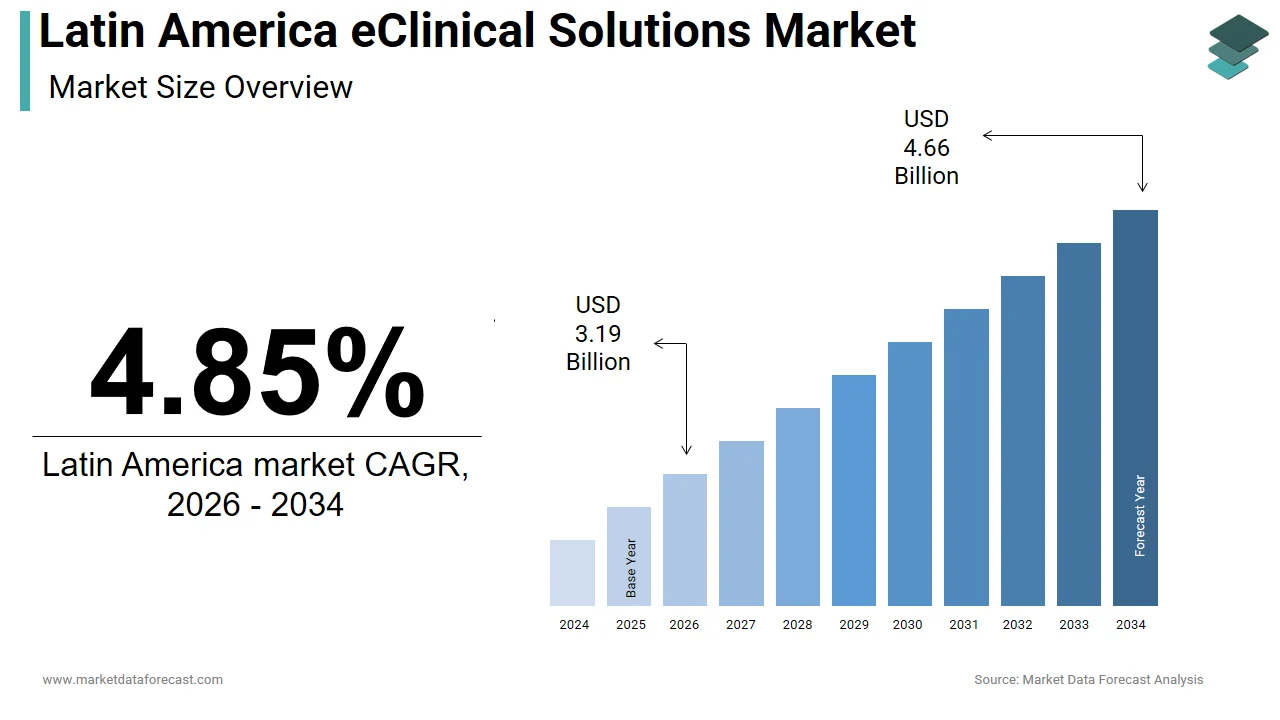
The Latin America eClinical solutions market is witnessing a transformative shift as pharmaceutical companies and contract research organizations increasingly adopt these tools to enhance operational efficiency and regulatory compliance. According to the World Health Organization, clinical research activity in Latin America is evolving, with countries like Brazil, Argentina, and Mexico serving as key hubs for regional drug development. Recent industry benchmarks suggest that the adoption of electronic data collection is becoming essential to meet international reporting requirements, with a significant majority of modern studies now shifting toward digital formats. The integration of cloud computing and mobile health applications further accelerates this transition by enabling real-time monitoring and remote patient participation. Regulatory bodies such as the National Health Surveillance Agency in Brazil and the Federal Commission for the Protection against Sanitary Risk in Mexico are aligning their guidelines with international standards like those of the International Council for Harmonisation. This harmonization facilitates the acceptance of digital data submissions, encouraging sponsors to invest in robust eClinical infrastructure. The market is thus evolving from a niche adoption phase to a critical component of the regional healthcare research landscape.
MARKET DRIVERS
Increasing Outsourcing of Clinical Trials to Contract Research Organizations
The growing trend of pharmaceutical companies outsourcing clinical trial operations to contract research organizations is majorly propelling the growth of the Latin America eclinical solutions market. For instance, the regional clinical trials market is growing exponentially, fueled by the expansion of outsourced research services. Global sponsors are increasingly leveraging the region's large patient pool and cost-effective operational environment to conduct multicentre studies. Contract research organizations rely heavily on integrated eClinical platforms to manage these complex trials, ensuring data consistency and regulatory compliance across different countries. These digital tools enable real-time visibility into trial progress, allowing sponsors to monitor performance metrics and identify issues promptly. The efficiency gained through automation reduces the time required for data cleaning and database lock, which is crucial for accelerating drug approval timelines. Furthermore, the ability to handle large volumes of data securely makes eClinical solutions indispensable for managing late-stage trials that involve thousands of participants. As outsourcing volumes continue to rise, the demand for scalable and interoperable digital infrastructure grows proportionally, creating a sustained revenue stream for eClinical vendors.
Regulatory Harmonization and Digital Submission Mandates
The alignment of regional regulatory frameworks with international standards and the increasing mandate for digital data submission will likely continue to propel the eClinical solutions market in Latin America as health authorities prioritize data integrity in the coming years. According to the International Council for Harmonisation, the adoption of electronic common technical document formats is becoming standard practice for regulatory filings globally, influencing regional expectations. Brazil’s National Health Surveillance Agency has implemented rigorous requirements for electronic data capture to ensure traceability. Recent industry reports indicate that the acceptance rate of digital submissions has risen steadily as authorities move away from paper-based records to improve oversight. This regulatory push forces sponsors and investigative sites to upgrade their technological infrastructure to remain compliant. The standardization of data formats facilitates cross-border collaborations and mutual recognition of trial results among regional health authorities. Additionally, the emphasis on transparency requires robust database systems that can securely store and retrieve information efficiently. Regulatory inspections now often include audits of electronic systems, making it essential for sites to maintain validated and secure platforms. The imperative to avoid non-compliance penalties drives continued investment in high-quality eClinical software.
MARKET RESTRAINTS
High Implementation Costs and Budget Constraints
The financial burden associated with implementing and maintaining advanced eClinical systems is expected to remain a primary barrier for smaller research institutions in Latin America in the next few years. According to data from the Brazilian Society of Clinical Research, cost remains a significant factor for independent investigative sites, particularly regarding licensing fees and hardware requirements for electronic data capture systems. The total cost of ownership includes not only software subscriptions but also personnel training, maintenance, and IT support, which can be prohibitive for smaller entities. Many public hospitals and universities rely on government funding that is often insufficient for purchasing proprietary digital tools. This financial disparity creates a landscape where only well-funded private centers can afford state-of-the-art platforms, while others lag behind. Additionally, currency fluctuations in major economies like Brazil and Argentina can significantly increase the cost of imported software solutions. These economic constraints slow down the overall adoption rate and limit the market potential to a subset of organizations with sufficient capital. Without more affordable pricing models or broader availability of subsidized technologies, the research community may continue to face challenges in achieving full digital integration.
Limited Technical Infrastructure and Connectivity Issues
Inconsistent technical infrastructure in various parts of Latin America is further impeding the Latin America eclinical solutions market expansion. According to the International Telecommunication Union, while urban centers have improved broadband access, rural and semi-urban areas often suffer from intermittent connectivity, which can disrupt real-time data synchronization. This technological gap poses significant challenges for multicenter trials that include sites in less developed areas, potentially leading to data delays. The reliance on cloud computing means that any downtime can halt trial activities, which is causing frustration among investigators and participants. Furthermore, the lack of standardized IT support services in many institutions means that technical issues take longer to resolve, impacting overall trial timelines. Power outages and hardware obsolescence further exacerbate these issues, requiring frequent investments in backup systems. These infrastructural limitations force some sponsors to prioritize specific geographic regions for their trial networks, which can reduce the diversity of patient populations. Until there is significant regional improvement in digital infrastructure, the full potential of eClinical solutions will remain partially constrained, necessitating the development of offline-capable software architectures.
MARKET OPPORTUNITIES
Expansion of Decentralized Clinical Trials and Remote Monitoring
The rise of decentralized clinical trials is projected to provide a major growth opportunity for the Latin America eClinical solutions market. For instance, the adoption of decentralized trial elements is growing globally as sponsors seek to reduce patient burden and improve retention rates. In Latin America, where geographical barriers often prevent patients from accessing major research centers, remote solutions offer a vital alternative. Research indicates that the use of remote monitoring tools can significantly decrease patient dropout rates by allowing participants to stay in trials without frequent site visits. eClinical platforms that integrate with wearable devices and mobile health applications enable continuous data collection, providing richer real-world data sets for analysis. The increased acceptance of telemedicine processes has created a highly favorable environment for these models. Vendors who offer integrated solutions for virtual visits, electronic consent, and home health kit logistics are well-positioned to capture this growing segment. As regulatory agencies become more comfortable with remote data sources, the demand for robust decentralized eClinical tools is expected to surge, helping to reach more diverse and underserved populations.
Integration of Artificial Intelligence for Predictive Analytics
The integration of artificial intelligence and machine learning into eClinical platforms is poised to transform trial efficiency and decision-making capabilities across Latin America in the coming years. According to research published in journals such as the Journal of Medical Internet Research, AI-driven patient matching can significantly reduce screening failure rates by identifying eligible participants more efficiently. For sponsors and contract research organizations in Latin America, where resource optimization is critical, these predictive capabilities provide a distinct competitive edge. eClinical vendors who incorporate advanced analytics into their suites can offer value-added services that move beyond simple data collection. Predictive models can monitor data quality in real time, flagging anomalies and suggesting corrective actions automatically. This proactive approach reduces the workload on data managers and accelerates the database lock process. Furthermore, AI can help personalize patient interactions, improving engagement and adherence to protocol requirements. As the volume of clinical data grows, the need for intelligent processing tools becomes paramount, and companies that lead in AI innovation will likely attract clients seeking smarter, faster trial execution.
MARKET CHALLENGES
Data Privacy and Security Concerns
Ensuring robust data privacy and security will remain a critical challenge for eClinical providers as they navigate an evolving regulatory landscape in Latin America over the next few years. According to the Organization of American States, several countries have enacted stringent data protection legislation similar to the European General Data Protection Regulation, requiring strict compliance from digital health vendors. Laws such as Brazil’s General Data Protection Law and Mexico’s Federal Law on Protection of Personal Data Held by Private Parties impose heavy penalties for data breaches. Industry reports indicate that the healthcare sector is a frequent target for cyberattacks, underscoring the need for platforms to invest heavily in encryption, access controls, and regular security audits. The lack of uniformity in privacy laws across different countries complicates multinational trials, requiring customized compliance strategies for each jurisdiction. Patients are also becoming more aware of their digital rights and may hesitate to participate in trials if they perceive inadequate security measures. Building trust requires transparent communication about data handling practices, which adds to the operational burden. Maintaining the delicate balance between high-end security and ease of use remains a constant requirement for vendors operating in this space.
Resistance to Change and Lack of Digital Literacy
Cultural resistance and varying levels of digital literacy among clinical staff are expected to pose persistent challenges to the Latin America eclinical solutions market growth. According to the Pan American Health Organization, many healthcare professionals are accustomed to traditional paper-based workflows and may view digital transitions as disruptive. Research suggests that a notable percentage of investigators report difficulty in adapting to new electronic data capture systems due to inadequate training or non-intuitive interfaces. This resistance can lead to slower adoption rates and higher error rates during the initial implementation phase. Older physicians, in particular, may require extensive support and mentoring, which increases operational costs for research centers. The lack of standardized digital skills training in medical education further exacerbates the problem, leaving many practitioners under-prepared for modern clinical trial demands. Overcoming this barrier requires vendors to invest in comprehensive change management programs and prioritize intuitive design principles. Without adequate support, sites may revert to hybrid systems that compromise data integrity, making the human element of technology adoption a critical factor in successful project execution.
REPORT COVERAGE
| REPORT METRIC | DETAILS |
| Market Size Available | 2025 to 2034 |
| Base Year | 2025 |
| Forecast Period | 2026 to 2034 |
| Segments Covered | By Product, Delivery Mode, Development Phase, End-User, and Country. |
| Various Analyses Covered | Global, Regional and Country-Level Analysis, Segment-Level Analysis, Drivers, Restraints, Opportunities, Challenges; PESTLE Analysis; Porter’s Five Forces Analysis, Competitive Landscape, Analyst Overview of Investment Opportunities |
| Countries Covered | Brazil, Mexico, Argentina, Chile, Rest of Latin America |
| Market Leaders Profiled | Oracle Corporation, Medidata Solutions, Inc., Parexel International Corporation, Bioclinica, Inc., Datatrak International, Inc., CRF Health, ERT Clinical, Merge Healthcare Incorporated, Omnicomm Systems, Inc., Veeva Systems, Maxisit Inc., Bio-Optronics, Inc., and Eclinical Solutions, LLC. |
SEGMENTAL ANALYSIS
By Development Phase Insights
The Phase III clinical trials segment held the leading share of the Latin America eClinical solutions market in 2025 and is expected to continue constituting the leading segment in the Latin America eClinical solutions market due to the massive scale of patient enrollment and data complexity inherent in late-stage drug development. According to research data, Phase III trials often involve thousands of participants, generating substantial volumes of electronic data that require robust management systems. In Latin America, where genetic diversity is high, sponsors rely on these trials to meet global regulatory standards for demographic representation. Current registry data reflects the region's strategic importance, with a significant proportion of all interventional studies classified as Phase III. The complexity of managing multiple sites across different countries necessitates advanced clinical trial management systems and electronic data capture platforms to ensure data integrity. Regulatory bodies require rigorous monitoring and auditing capabilities, which eClinical solutions provide efficiently. Given the high cost of failure at this stage, sponsors are highly motivated to invest in premium digital tools that minimize errors and accelerate database lock. This critical need for precision and scalability ensures that Phase III remains the largest consumer of eClinical resources in the region.
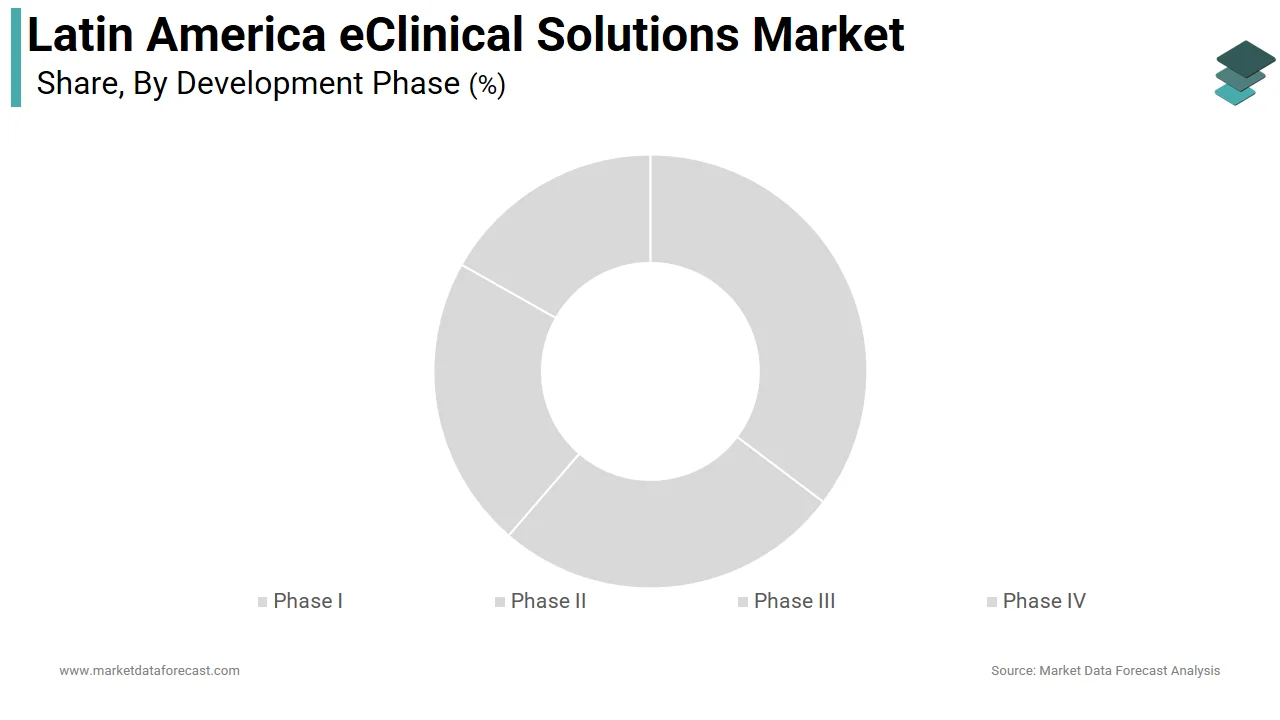
On the other side, the Phase I clinical trials segment represents the fastest-growing segment in the Latin America eClinical solutions market and is expected to register a CAGR of 15.5% during the forecast period owing to the increasing establishment of early-phase research units. The primary growth driver is the shift toward first-in-human studies in the region, which offers lower operational costs and access to treatment-naive patients. According to industry analysis, there has been a steady increase in Phase I facilities over the past five years, particularly in Brazil and Mexico. These early-stage trials require intensive pharmacokinetic and pharmacodynamic monitoring, which generates high-frequency data points best managed through specialized eClinical tools. Integrating wearable devices and mobile health applications allows for continuous remote monitoring, significantly enhancing data quality and patient compliance. Sponsors are increasingly adopting decentralized trial elements even in early phases to improve recruitment and retention. The need for rapid data turnaround to make critical go/no-go decisions accelerates the adoption of automated data processing solutions. As more global pharmaceutical companies include Latin American sites in their early development pipelines, the demand for agile and sophisticated eClinical platforms is expected to grow rapidly.
COUNTRY LEVEL ANALYSIS
Brazil eClinical Solutions Market Analysis
Brazil had the major share of the Latin America eClinical solutions market in 2025 and is expected to maintain its leadership position in the Latin America eClinical solutions market over the next few years due to its robust pharmaceutical industry and extensive clinical research infrastructure. The country boasts a high number of accredited investigative sites and ethical committees, which facilitates rapid trial initiation. Data indicates that Brazil consistently ranks among the top nations globally for clinical trial registrations, reflecting its strategic importance. The National Health Surveillance Agency has implemented processes to streamline reviews, effectively reducing approval times and encouraging sponsor investment. The presence of major multinational pharmaceutical companies and local generics manufacturers continues to drive demand for compliant eClinical systems. Government initiatives to strengthen public health research through institutions like Fiocruz further support market growth. While bureaucratic hurdles and currency fluctuations remain, Brazil’s mature regulatory framework and skilled workforce make it the primary hub for eClinical adoption in the region. Continuous investments in digital health infrastructure by both public and private sectors are set to sustain its leadership position.
Mexico eClinical Solutions Market Analysis
Mexico is projected to remain the second-largest market for eClinical solutions in the region, supported by its proximity to the United States and a growing pharmaceutical manufacturing base. The country benefits from trade agreements that facilitate cross-border collaborations and technology transfer. According to industry associations, the sector has seen steady annual growth in clinical research activities, partly driven by nearshoring trends. Regulatory data shows an increasing number of approvals for digital health tools and electronic data submission formats. Mexican hospitals and research centers are increasingly adopting international standards for data management to attract global sponsors. The rising prevalence of chronic diseases creates a significant patient base for metabolic trials. Local contract research organizations are expanding their capabilities by offering integrated eClinical services. Regulatory harmonization efforts with North American partners further enhance the acceptability of data generated in Mexico. While infrastructure gaps exist in rural areas, urban centers like Mexico City and Guadalajara offer world-class facilities. The competitive cost structure compared to the US makes Mexico an attractive destination for cost-conscious sponsors, ensuring continued growth in eClinical adoption.
Argentina eClinical Solutions Market Analysis
Argentina is poised to remain a significant player in the Latin America eClinical solutions market, leveraging its highly educated medical workforce and strong tradition in biomedical research in the coming years. The country maintains a dense network of public and private hospitals capable of conducting complex clinical trials. The government has implemented policies to promote clinical research as a tool for improving public health access to new therapies, leading to a steady increase in authorized trials, particularly in oncology and rare diseases. Argentine researchers are well-regarded internationally for their scientific rigor, which enhances the quality of data generated. While the economic situation poses challenges regarding funding and equipment imports, local expertise often compensates for these resource limitations. eClinical solution providers find significant opportunities in offering cost-effective, cloud-based models that reduce upfront infrastructure costs. The strong academic sector frequently collaborates with the industry, fostering innovation in trial design and data analysis. Despite economic volatility, Argentina remains a key destination for sponsors seeking high-quality data and scientific excellence, ensuring a steady outlook for eClinical market engagement.
Chile eClinical Solutions Market Analysis
Chile holds a specialized position in the Latin America eClinical solutions market distinguished by its political stability and advanced regulatory framework. The country is known for its efficiency in trial approvals and high standards of healthcare delivery. According to the Institute of Public Health of Chile, the agency has adopted digital submission processes that align with international best practices, facilitating faster study start-ups. Data from the Chilean Society of Clinical Pharmacology and Therapeutics highlights the country’s strength in conducting high-quality trials with low dropout rates. Chile’s small but homogeneous population is advantageous for certain genetic and epidemiological studies. The government supports innovation through grants and partnerships with private entities, promoting the adoption of digital health technologies. Local hospitals are well equipped with modern IT infrastructure supporting seamless integration of eClinical systems. The country serves as a gateway for introducing new technologies to the Andean region. While the market size is smaller than Brazil or Mexico, the value per trial is higher due to the premium placed on data quality and compliance. Chile’s reputation for reliability attracts sponsors looking for efficient and predictable trial execution environments.
COMPETITIVE LANDSCAPE
The competitive landscape of the Latin America eClinical solutions market is characterized by the presence of global technology giants alongside emerging regional players who offer specialized services. Large multinational corporations dominate due to their extensive product portfolios and established relationships with global pharmaceutical sponsors. However, local vendors compete effectively by providing personalized support and a deeper understanding of regional regulatory nuances. Competition is driven by factors such as ease of use, data security compliance capabilities, and cost-effectiveness. Vendors differentiate themselves through innovative features like artificial intelligence-driven analytics and mobile-friendly interfaces that enhance investigator experience. Strategic alliances with contract research organizations and hospital networks are common tactics to expand reach and credibility. Price sensitivity remains a key factor influencing procurement decisions, particularly among public institutions and smaller private clinics. The market is witnessing consolidation as larger players acquire niche providers to broaden their service offerings. Customer retention relies heavily on reliable technical support and continuous platform improvements. As demand for decentralized trials grows, companies that offer flexible and integrated solutions gain a competitive edge. The dynamic nature of regulatory changes further intensifies the need for agile and compliant technology providers.
KEY MARKET PLAYERS
The major players in the Latin America eClinical solutions market include
- Oracle Corporation
- Medidata Solutions, Inc.
- Parexel International Corporation
- Bioclinica, Inc.
- Datatrak International, Inc.
- CRF Health
- ERT Clinical
- Merge Healthcare Incorporated
- Omnicomm Systems, Inc.
- Veeva Systems
- Maxisit Inc.
- Bio-Optronics, Inc.
- eClinical Solutions, LLC
TOP PLAYERS IN THE MARKET
- Medidata maintains a strong presence in the Latin America eClinical solutions market by providing its unified cloud-based platform for clinical research and real-world evidence. The company serves major pharmaceutical sponsors and contract research organizations across Brazil, Mexico, and Argentina with integrated tools for data management and analytics. Recent strategic actions include expanding its local support teams to provide Spanish and Portuguese language assistance, ensuring better user adoption among regional investigators. Medidata has also enhanced its regulatory compliance features to align with specific requirements of health authorities like ANVISA and COFEPRIS. By offering scalable solutions that handle complex multinational trials, the company strengthens its position as a preferred partner for global sponsors operating in the region. Their focus on data standardization and interoperability helps streamline trial processes and accelerate drug development timelines for local and international stakeholders.
- Oracle Health Sciences contributes significantly to the Latin America market through its comprehensive suite of clinical development applications, including electronic data capture and clinical trial management systems. The company leverages its robust cloud infrastructure to deliver secure and scalable solutions for large-scale clinical trials in the region. Recent initiatives involve partnering with local technology integrators to facilitate smoother implementation and customization for diverse healthcare settings. Oracle has invested in training programs for clinical researchers in Latin America to enhance digital literacy and promote best practices in data management. The integration of artificial intelligence capabilities into their platform allows for predictive analytics, which helps sponsors optimize trial performance. By focusing on end-to-end visibility and operational efficiency, Oracle reinforces its reputation as a leader in enabling high-quality clinical research across Latin American countries.
- Veeva Systems has established a growing footprint in the Latin American eClinical solutions market by offering its cloud-based platform designed specifically for life sciences. The company provides unified solutions for content management, data collection, and site engagement that simplify clinical trial operations. Recent actions include launching localized versions of its software to meet regional language and regulatory needs, enhancing accessibility for local sites. Veeva has strengthened its partnerships with leading contract research organizations in the region to drive adoption of its connected clinical suite. The company focuses on improving the investigator experience through intuitive interfaces and mobile capabilities, which increase compliance and data quality. By emphasizing speed to market and user-centric design, Veeva attracts sponsors looking for agile and modern alternatives to traditional legacy systems in the rapidly evolving Latin American clinical research landscape.
TOP STRATEGIES USED BY KEY MARKET PARTICIPANTS
Key players in the Latin America eClinical solutions market primarily focus on localization and strategic partnerships to overcome regional barriers and enhance customer engagement. Companies invest in translating their platforms into Spanish and Portuguese while adapting workflows to meet local regulatory requirements such as those from ANVISA and COFEPRIS. Collaborating with local contract research organizations and technology integrators helps vendors navigate complex healthcare landscapes and build trust with investigative sites. Providing comprehensive training and support services addresses the digital literacy gap among clinical staff, ensuring successful implementation and adoption. Offering flexible pricing models and cloud-based subscriptions makes advanced solutions accessible to smaller research institutions with limited budgets. Continuous innovation in user experience and mobile capabilities improves investigator satisfaction and data quality. Expanding physical presence through local offices enhances responsiveness and customer service. These strategies collectively drive market penetration and sustain long-term growth in a competitive and diverse region.
MARKET SEGMENTATION
This Latin America eClinical solutions market research report is segmented and sub-segmented into the following categories.
By Product
- Electronic Data Capture (EDC) and Clinical Data Management Systems (CDMS)
- Clinical Trial Management Systems (CTMS)
- Clinical Analytics Platform
- Randomization and Trial Supply Management (RTMS)
- Clinical Data Integration Platform
- Electronic Clinical Outcome Assessment (eCOA)
- Safety Solutions
- Electronic Trial Master Files (eTMF)
- Regulatory Information Management Solutions (RIMS)
- Others
By Delivery Mode
- Web-hosted (On-demand)
- Licensed Enterprise (On-premise)
- Cloud-based
By Development Phase
- Phase I
- Phase II
- Phase III
- Phase IV
By End-User
- Hospitals
- CROs
- Academic institutes
- Pharma & Biotech Organizations
- Medical Device Manufacturers
By Country
- Brazil
- Mexico
- Argentina
- Chile
- Rest of Latin America