- Product Description Description
- Table of Contents TOC
- List of Table & Figure LOT
- Get Free Sample PDF Sample PDF
Market Size, 2025
$2.50 BnMarket Estimate, 2026
$2.62 BnMarket Forecast, 2034
$3.80 BnCAGR, 2026–2034
4.75%Executive Summary: Latin America Milk Powder Market
- Market Scope: Regional analysis of the Latin American milk powder sector, detailing product types, applications, functional properties, and country-level profiles spanning 2026 to 2034.
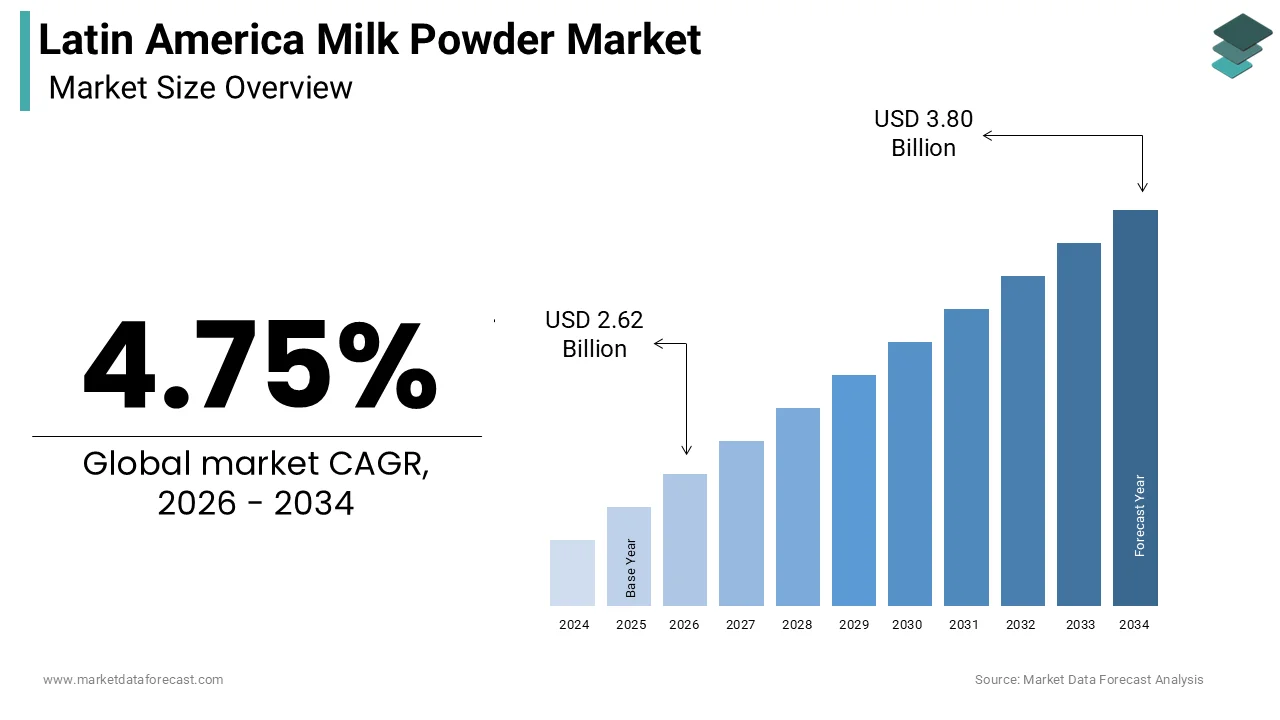
- Market Valuation: Valued at USD 2.50 billion in 2025, reaching USD 2.62 billion in 2026, and projected to expand to USD 3.80 billion by 2034, growing at a robust CAGR of 4.75% from 2026 to 2034.
- Primary Growth Drivers: Shifting dietary preferences toward dairy-rich tastes, extended shelf life due to low moisture content, reduced transportation and storage costs, rising disposable incomes, and increasing adoption as an alternative to fresh milk.
Key Market Segment Metrics
| Category | Leading Segment (Base Position) | Fastest-Growing / High-Growth Segment |
|---|---|---|
| By Type | Non-Fat Dry Milk & Dry Whole Milk (dominated baseline market share, anchored by traditional household use and commercial baking staples) | Dry Whey Products & Dairy Blends (fueled by rising demand for specialized nutritional formulations and functional food processing) |
| By Application | Infant Formulas (captured the largest sales share, supported by regional birth rates and premium nutritional formulation demand) | Nutritional Formulas & Confectioneries (fastest-growing segments propelled by health-conscious supplements and confectionery manufacturing) |
| By Function | Emulsification & Flavouring (held the major market share, supported by essential food processing and texture stabilization properties) | Foaming & Thickening (high-growth functional segments driven by beverage applications and bakery product developments) |
| By Region | Brazil (market leader with the largest regional share, backed by extensive dairy consumption and food processing output) | Mexico (fastest-growing regional market driven by urban retail expansion, rising disposable incomes, and dairy adoption) |
Major Market Players & Industry Landscape
Market Structure: Highly competitive regional marketplace characterized by major global dairy cooperatives and multinational food corporations scaling production networks and export supply chains throughout the 2026-2034 forecast period.
Key Companies: Nestlé, Danone, Lactalis, FrieslandCampina, and Fonterra.
 Download Free Sample Report
Latin America Milk Powder Market Size
The Latin America Milk Powder Market size was calculated to be USD 2.50 billion in 2025 and is anticipated to be worth USD 3.80 billion by 2034 from USD 2.62 billion In 2026, growing at a CAGR of 4.75% during the forecast period.
Milk powder is a dairy product which is obtained by evaporating milk until the milk becomes dry in the form of a powder. The main purpose of manufacturing milk powder is for preservation due to its low moisture content. It also saves transportation costs since the water is removed by heating.
Milk Powder is used in a wide array of applications. It is used in the preparation of infant’s formula and confectionaries like caramel candy and chocolate. It is also used in the preparation of famous Indian desserts Gulab Jamun and Chum-Chum. In food aid supplies for war struck countries, it is a common item since fresh milk is not a feasible option. It is heavily used in developing countries owing to low storage and transportation costs. Since milk powder resembles cocaine and other similar recreational drugs, it finds applications in film making as a prop.
Market Drivers
The Latin America Milk Powder market is driven by factors like diet preferences shifting towards dairy-rich tastes, high shelf life owing to less moisture content, reduced transportation and storage costs, rising disposable incomes and increasing adoption of powdered milk as alternative to fresh milk among others.
Market Restraints
However, the market is constrained by factors like concerns for ultra-high temperature milk, reduced nutritional content and stringent regulations.
Segmental Analysis
Latin America Milk Powder Market By Type
- Dry buttermilk
- Dry whey products
- Dry whole milk
- Dry dairy blends
- Non-fat dry milk
Latin America Milk Powder Market By Application
- Infant formulas
- Nutritional formulas
- Confectionaries and baked sweets
- Savouries
Latin America Milk Powder Market By Function
- Foaming
- Emulsification
- Flavouring
- Thickening
Latin America Milk Powder Market By Region
- Brazil
- Mexico
- Argentina
- Chile
- Rest of Latin America
Factors such as rising disposable incomes and growing adoption of milk powder as an alternative to fresh milk is expected to drive the market growth in the region.
Key Players in the Market
Major Key Players in the Latin America Milk Powder Market are Nestle (Switzerland), Danone (France), Lactalis (France), Frieslandcampina (Netherlands), Fonterra (New Zealand), Dean Foods (U.S.), Arla Foods (Denmark), Dairy Farmers Of America (U.S.), Kraft Foods (U.S.), Saputo (Canada)