- Product Description Description
- Table of Contents TOC
- List of Table & Figure LOT
- Get Free Sample PDF Sample PDF
Market Size, 2025
$5.16 BnMarket Estimate, 2026
$5.49 BnMarket Forecast, 2034
$9.03 BnCAGR, 2026–2034
6.41Executive Summary: Latin America Orthopedic Devices Market
- Market Scope: Comprehensive Latin American orthopedic devices market analysis covering anatomical locations, consumable types, country-level insights, regulatory frameworks, and import/export dynamics.
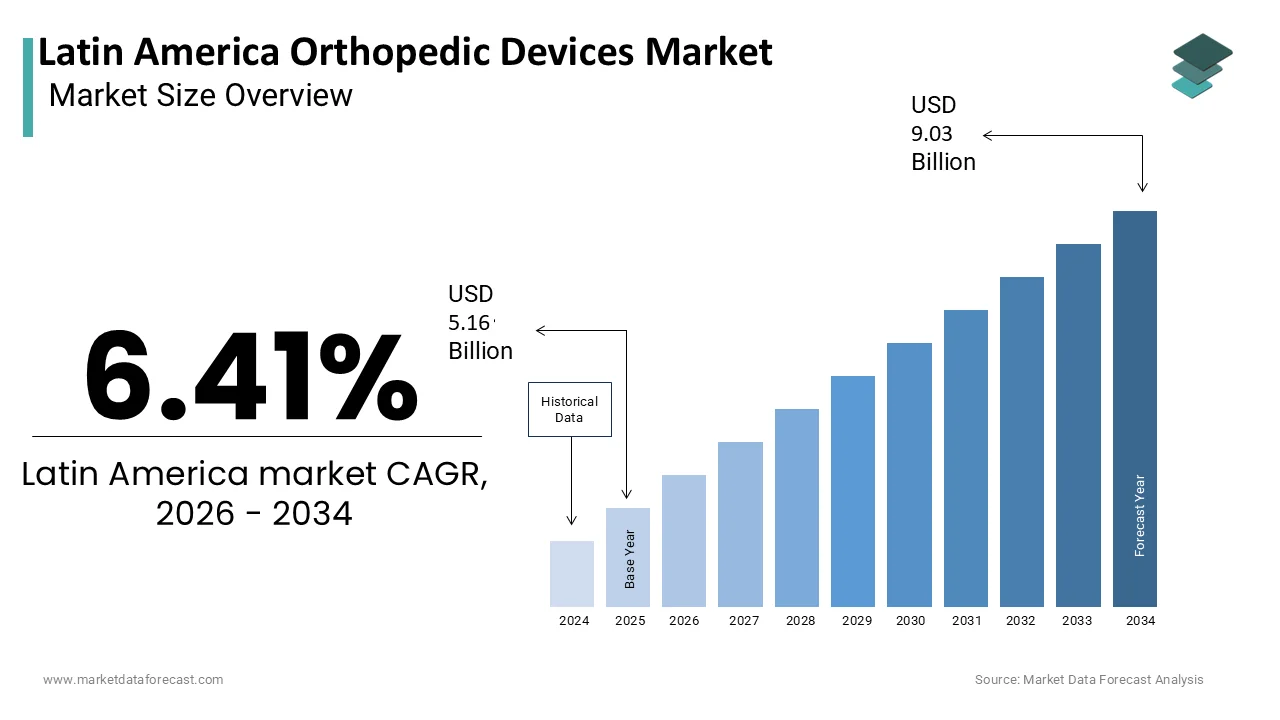
- Market Valuation: Valued at USD 5.16 billion (2025), estimated at USD 5.49 billion (2026), and projected to reach USD 9.03 billion by 2034, registering a steady CAGR of 6.41% (2026–2034).
- Primary Growth Drivers: Growing aging population, increasing prevalence of musculoskeletal disorders (osteoarthritis, osteoporosis, rheumatoid arthritis), rising incidence of road accidents and sports injuries, and early onset of conditions triggered by obesity and sedentary lifestyles.
Key Market Segment Metrics (2026–2034)
| Category | Leading Segment Position | Core Segment Categories |
|---|---|---|
| By Anatomical Location | Joint Reconstruction & Spine (led by high demand for knee, hip, and spinal orthopedic interventions among the aging demographic) | Shoulder, Foot, Ankle, Elbow, and Craniomaxillofacial |
| By Consumable Type | Orthopedic Suture Anchors & Staples (essential consumables for arthroscopic and minimally invasive orthopedic surgeries) | Resorbable Suture Anchors and Metallic Suture Anchors |
| By Country | Brazil & Mexico (dominating the regional market share, supported by Brazil's robust domestic manufacturing and Mexico's strong export manufacturing footprint) | Argentina, Chile, Peru, and Rest of Latin America |
Major Market Players & Market Structure
Market Structure: Highly consolidated market dominated by multinational medical device leaders specializing in high-specification implant technologies, working alongside local distributors and private healthcare networks.
Key Companies: Medtronic, Stryker, Zimmer Biomet (Zimmer Inc.), DePuy Synthes, Smith & Nephew, and Biomet.
Latin America Orthopedic Devices Market Size
The Latin America Orthopedic Devices Market is projected to grow from USD 5.16 billion in 2025 to USD 5.49 billion in 2026 and reach USD 9.03 billion by 2034, registering a CAGR of 6.41% during the forecast period from 2026 to 2034.
The orthopedic devices are range of implants, instruments,s and biologics designed to treat musculoskeletal disorders across the region. This sector is for addressing trauma, ma reconstructive surgery,ery and degenerative joint conditions that significantly impact patient mobility. The Pan American Health Organization states that musculoskeletal conditions are the leading contributor to disability globally, affecting approximately 1.71 billion people. In Latin America, specifically, the aging demographic profile exacerbates this burden as life expectancy continues to rise. This demographic shift directly correlates with increased incidence of osteoarthritis and fractures requiring surgical intervention. Additionally, road traffic injuries remain a major public health challenge in middle-income countries within the region. These incidents result in a high volume of orthopedic trauma cases necessitating immediate surgical care and hardware. Governments are increasingly investing in healthcare infrastructure to manage these growing clinical needs. Private healthcare providers are expanding their orthopedic service lines to cater to rising demand. Technological advancements in minimally invasive procedures are gaining traction among surgeons.
MARKET DRIVERS
Geriatric Population and Degenerative Joint Diseases
The expanding geriatric population is greatly influencing the growth of the Latin America Orthopedic Devices Market. As per the study, the number of people aged 60 years or older in Latin America and the Caribbean is expected to double from 78 million in 2020 to 157 million by 2050. This rapid demographic transition leads to a higher prevalence of age-related musculoskeletal conditions such as osteoarthritis and osteoporosis. These statistics amplify the urgent need for joint replacement surgeries and fracture fixation devices. Healthcare systems are witnessing a surge in demand for hip and knee arthroplasty procedures to restore mobility and quality of life for elderly patients. Public and private hospitals are expanding their orthopedic departments to accommodate this growing patient base. Government health programs are increasingly covering elective joint replacements as part of essential care packages. The chronic nature of degenerative diseases ensures a steady stream of patients requiring long-term orthopedic management. Surgeons are adopting advanced implant technologies that offer better longevity and functionality for active seniors.
Increasing Incidence of Sports Injuries and Trauma
The high frequency of sports injuries and trauma cases is significantly boosting the growth of the Latin America orthopedic devices market. The World Health Organization reported that unintentional injuries account for a substantial proportion of disability adjusted life years in the region, particularly among young adults. Road traffic accidents remain a leading cause of trauma, with the Pan American Health Organization reporting over 100000 deaths annually due to road crashes in the Americas. These incidents often result in complex fractures requiring internal fixation plates, es scr,ews and rods. Additionally, the growing popularity of sports such as football and rugby contributes to a rise in ligament tears and meniscal injuries. Hospitals are investing in advanced imaging and surgical navigation systems to improve outcomes for trauma cases. Emergency departments are equipped with specialized orthopedic trauma kits to handle acute injuries efficiently. Insurance coverage for sports-related injuries is expanding in countries like Brazil and Mexico. This trend encourages early intervention and surgical repair rather than conservative management.
MARKET RESTRAINTS
High Out-of-Pocket Expenditure and Limited Reimbursement
The financial constraints due to the widespread adoption of advanced devices are restraining the growth of the Latin America orthopedic devices market. The out-of-pocket health expenditure accounts for more than 30% of total health spending in several Latin American countries, including Mexico and Colombia, as per the research. This high financial burden limits patient access to premium orthopedic implants and innovative surgical technologies. Many public healthcare systems have limited budgets for elective procedures such as joint replacements, leading to long waiting lists. The inefficiencies in public health financing result in inadequate coverage for high-cost medical treatments. Patients often delay necessary surgeries due to affordability issues, leading to worsened clinical outcomes. Private insurance penetration remains low in lower-income segments, restricting market expansion. Hospitals struggle to procure expensive imported devices due to currency fluctuations and import tariffs. Manufacturers face pressure to reduce prices, which can compromise profit margins and investment in innovation. The lack of standardized reimbursement policies across different countries creates uncertainty for providers.
Regulatory Heterogeneity and Approval Delays
Regulatory fragmentation is the timely introduction of new devices that is also degrading the growth of the Latin American orthopedic devices market. Each nation has its own regulatory authority with distinct requirements for registration,n clinical data, and post-market surveillance. Only a few countries in the region have fully harmonized their medical device regulations with international standards. This lack of uniformity forces manufacturers to navigate complex and time-consuming approval processes for each sector. For instance, the National Agency for Surveillance of Medicines and Medical Devices in Argentina has different documentation requirements compared to the National Health Surveillance Agency in Brazil. These discrepancies lead to significant delays in product launches, preventing patients from accessing the latest technologies. Small and medium-sized enterprises often lack the resources to manage multiple regulatory submissions effectively. The absence of mutual recognition agreements means that approval in one country does not facilitate entry into neighboring markets. Regulatory changes can occur unexpectedly, causing further disruptions to supply chains. Manufacturers must maintain dedicated regulatory affairs teams for each jurisdiction,n increasing operational costs.
MARKET OPPORTUNITIES
Expansion of Private Healthcare Infrastructure
The growth of private healthcare infrastructure is creating new opportunities for the growth of the Latin America Orthopedic Devices Market. This expansion is driven by rising middle-class incomes and dissatisfaction with public healthcare services. Private hospitals and specialty clinics are investing heavily in state-of-the-art operating rooms and orthopedic centers. These facilities seek to differentiate themselves by offering advanced surgical options such as robotic-assisted joint replacements. The demand for premium orthopedic implants is higher in the private sector, where patients are willing to pay for better outcomes. Medical tourism is also boosting the private sector,r with countries like Costa Rica and Brazil attracting international patients for orthopedic surgeries. The Joint Commission International accreditation of many Latin American hospitals ensures adherence to global quality standards. This alignment encourages multinational device manufacturers to introduce their latest products in these facilities. Partnerships between device companies and private hospital groups facilitate training and technology transfer.
Adoption of Minimally Invasive Surgical Techniques
The increasing adoption of minimally invasive surgical techniques is additionally to pose new opportunities for the growth of the Latin American orthopedic devices market. These advantages are particularly appealing to patients who wish to return to work and daily activities quickly. Manufacturers are developing smaller implants and specialized instruments designed for arthroscopic and endoscopic procedures. The use of biocompatible materials and advanced coatings enhances the performance of these devices. Training programs for surgeons on minimally invasive techniques are becoming more widespread across the region. Universities and medical societies collaborate with industry partners to provide hands-on workshops. The availability of high-definition imaging systems supports the precision required for these complex procedures. Insurance providers are beginning to recognize the cost-effectiveness of minimally invasive surgeries due to reduced rehabilitation needs. Patient awareness of these options is growing through digital health platforms and social media. This shift in surgical preference creates demand for innovative devices that enable less traumatic interventions.
MARKET CHALLENGES
Counterfeit and Substandard Medical Products
The presence of counterfeit and substandard orthopedic products is likely to pose a major challenge for the growth of the Latin America orthopedic devices market. According to the World Health Organization, up to 10% of medical products in low- and middle-income countries are substandard or falsified. These counterfeit devices often fail to meet biomechanical standards, leading to premature failure and complications. Patients may suffer from infections, ns allergic reactions,ons or the need for revision surgeries due to poor-quality materials. Legitimate manufacturers face unfair competition from cheaper illicit products that undercut prices. Hospitals and surgeons struggle to verify the authenticity of supplies, especially in smaller clinics. The lack of track-and-trace systems makes it difficult to monitor the supply chain effectively. Regulatory authorities are working to strengthen controls, but resource limitations hinder enforcement efforts. Public awareness about the risks of counterfeit medical devices remains low. Trust in the healthcare system can be eroded if patients experience adverse events from fake products. Combating this issue requires coordinated efforts between governments, industry,y and healthcare providers.
Shortage of Skilled Orthopedic Surgeons
The scarcity of trained orthopedic surgeons limits the effective utilization, on that is to impede the growth of the Latin American orthopedic devices market. The Pan American Health Organization reports a significant maldistribution of healthcare professionals,s with rural areas facing severe shortages. This shortage leads to long waiting times for elective surgeries and overburdened emergency departments. Complex procedures requiring specialized skills such as spinal fusion or revision arthroplasty are often concentrated in major urban centers. Rural patients must travel long distances to access qualified care, increasing costs and logistical barriers. Medical education programs do not produce enough specialists to meet the growing demand. Brain drain further exacerbates the issue as trained surgeons migrate to North America or Europe for better opportunities. Continuous professional development is limited by funding constraints and lack of access to training facilities. Manufacturers find it challenging to introduce sophisticated technologies if there are insufficient skilled users. Training initiatives are essential but require significant investment and time to yield results.
REPORT COVERAGE
| REPORT METRIC | DETAILS |
| Market Size Available | 2025 to 2034 |
| Base Year | 2025 |
| Forecast Period | 2026 to 2034 |
| Segments Analysed | By Anatomical Location, Consumable Type and country |
| Various Analyses Covered | Regional & Country Level Analysis, Segment-Level Analysis, Drivers, Restraints, Opportunities, Challenges; PESTLE Analysis; Porter’s Five Forces Analysis, Competitive Landscape; Analyst Overview of Investment Opportunities |
| Countries Analysed | Mexico, Brazil, Argentina, Chile, Peru and Rest of Latin America |
| Market Leaders Profiled | Medtronic, Stryker, Zimmer Inc., DePuy, Synthes |
SEGMENTAL ANALYSIS
By Anatomical Location Insights
The knee segment was the largest,y holding 44.2% of the Latin America Orthopedic Devices Market share in 2025 due to the high prevalence of osteoarthritis and sports-related injuries affecting this joint. This condition disproportionately impacts the knee joint, leading to pain, stiffness, and reduced mobility. Consequently, there is a substantial demand for total knee arthroplasty and partial knee replacement procedures. This rise is attributed to the growing participation in high-impact sports such as football, which is deeply ingrained in the regional culture. Hospitals are investing in advanced knee implant systems that offer better range of motion and durability. Surgeons prefer modular designs that allow for customization based on patient anatomy. The aging population further exacerbates the need for knee interventions as cartilage degeneration accelerates with age. Public health initiatives promoting active lifestyles inadvertently increase injury rates among younger demographics, driving demand for repair devices.
The spine segment is projected to witness the fastest CAGR of 7.2% during the forecast period, with the increasing incidence of degenerative disc disease and spinal deformities. Advances in minimally invasive spinal surgery techniques have made procedures safer and more appealing to patients. Surgeons are adopting endoscopic and robotic-assisted technologies that reduce recovery time and complications. The aging population contributes to higher rates of spinal stenosis and spondylolisthesis, necessitating fusion and fixation devices. Additionally, the rise in occupational hazards related to manual labor increases the prevalence of traumatic spinal injuries. Insurance coverage for spinal procedures is expanding in key countries such as Brazil and Colombia. Manufacturers are introducing innovative implants such as interbody cages and pedicle screws designed for better biomechanical stability. Training programs for spine surgeons are becoming more prevalent, fostering expertise in complex procedures.
By Type Of Consumable Insights
The orthopedic suture anchors segment held a dominant share of the Latin America Orthopedic Devices Market in 2025. These devices are essential for soft tissue repair in shoulder, knee, ee and hip surgeries. The high volume of arthroscopic procedures drives the consistent demand for suture anchors. This preference for minimally invasive techniques necessitates the use of reliable fixation devices. Suture anchors provide secure attachment of tendons and ligaments to bone, facilitating healing and restoring function. Surgeons favor all suture anchors for their ease of insertion and strong pull-out strength. The increasing incidence of rotator cuff tears and anterior cruciate ligament injuries further boosts consumption. Hospitals maintain large inventories of various anchor sizes and materials to accommodate different surgical needs. The shift towards biocompatible materials reduces the risk of inflammatory reactions. Manufacturers offer comprehensive portfolios that include both metallic and resorbable options. Training workshops on anchor placement techniques enhance surgeon proficiency and product loyalty. Reimbursement codes for arthroscopic repairs support the financial viability of using these premium consumables.
The resorbable suture anchors segment is expected to grow at the fastest CAGR of 8.5% during the forecast period due to the desire to eliminate long-term complications associated with permanent metallic implants. The resorbable anchors reduce the risk of artifact interference in postoperative magnetic resonance imaging. This advantage is crucial for accurate follow-up assessments and diagnosis of recurrent injuries. Patients prefer resorbable materials as they dissolve over time, leaving no foreign body behind. The biological compatibility of these anchors minimizes inflammatory responses and promotes natural tissue healing. Manufacturers are developing advanced polymers that offer comparable strength to metal while maintaining resorbability. Surgeons are increasingly trained in the use of these next-generation anchors through specialized courses. The regulatory environment in countries like Brazil and Argentina is becoming more favorable for innovative biomaterials. Clinical studies demonstrating the safety and efficacy of resorbable anchors are influencing purchasing decisions. Hospitals are replacing older metallic inventory with resorbable options to align with modern surgical standards.
COUNTRY LEVEL ANALYSIS
Mexico Orthopedic Devices Market Analysis
Mexico was the largest contributor in the Latin America Orthopedic Devices Market, holding 56.2% of the share in 2025, with its proximity to the United States and robust manufacturing base. As per the Mexican Ministry of Health, noncommunicable diseases, including musculoskeletal disorders, rs account for 75% of deaths in the country. This high burden drives demand for orthopedic interventions in both public and private sectors. This local production capability ensures a steady supply of high-quality devices for domestic use. The prevalence of diabetes and obesity contributes to joint problems requiring surgical correction. Private hospitals in major cities like Mexico City and Guadalajara offer advanced orthopedic services, attracting medical tourists. The government has implemented reforms to improve access to healthcare services for the uninsured population. Regulatory alignment with international standards facilitates the introduction of new technologies.
Brazil Orthopedic Devices Market Analysis
Brazil orthopedic devices market was ranked second, holding 21.2% of the share in 2025 due to its large population and developed healthcare infrastructure. The Brazilian Ministry of Health indicates that the public healthcare system SUS performs thousands of orthopedic surgeries annually. This volume creates substantial demand for implants and instruments in the public sector. Private healthcare providers cater to affluent patients seeking premium devices and faster service. The high incidence of trauma from road accidents and urban violence drives emergency orthopedic care needs. Brazil has a strong local manufacturing industry for orthopedic consumables, reducing dependency on imports. Regulatory oversight by ANVISA ensures product safety and quality. The country hosts major orthopedic conferences that facilitate knowledge exchange and technology adoption. Rising awareness of sports injuries among the young population boosts demand for arthroscopic supplies.
Argentina Orthopedic Devices Market Analysis
Argentina orthopedic devices market is likely to grow due to high clinical expertise and advanced medical facilities. This abundance of skilled professionals drives the adoption of sophisticated orthopedic technologies. Economic challenges such as inflation and currency devaluation affect purchasing power and import capabilities. However, the demand for essential orthopedic supplies remains resilient due to the high burden of degenerative diseases. Local manufacturers produce a range of implants and instruments catering to domestic needs. The private sector dominates the market for premium devices as public funding is limited. Medical tourism from neighboring countries supports the private healthcare industry. Regulatory processes are stringent, ensuring high standards for medical devices.
Chile Orthopedic Devices Market Analysis
Chile orthopedic devices market growth is likely to grow with the strong economic fundamentals and healthcare reforms. The Chilean Ministry of Health reports that the country has achievednear-universall health coverage, ensuring access to orthopedic care for most citizens. This inclusive system drives consistent demand for implants and surgical supplies. Chile has one of the highest life expectancies in Latin America, leading to an aging population with increased joint issues. The private healthcare sector is well developed,d offering advanced orthopedic services. Regulatory frameworks are aligned with international standards,s facilitating market entry for global companies. The country serves as a testbed for new technologies due to its efficient healthcare delivery model. High levels of physical activity among the population contribute to sports-related injuries requiring orthopedic intervention.
COMPETITIVE LANDSCAPE
The competition in the Latin America orthopedic devices market features intense rivalry between established multinational corporations and emerging domestic manufacturers. Global leaders dominate the premium segment with advanced joint replacement and spinal technologies leveraging strong brand recognition and clinical evidence. Local companies compete effectively in trauma and basic consumables by offering affordable alternatives aligned with public sector budget constraints. Price sensitivity drives significant competition, particularly in government tenders, where lowest cost often determines contract awards. Differentiation increasingly relies on value-added services such as surgeon education, inventory management, and post-operative support rather than product specifications alone. Regional fragmentation necessitates distinct competitive approaches for each country due to varying regulatory environments and reimbursement. Consolidation activity is accelerating as larger firms acquire local players to gain distribution networks and manufacturing capabilities. Innovation cycles are slower than in North America due to approval delays, yet demand for minimally invasive solutions is rising rapidly. Success requires balancing premium offerings for private hospitals with economical solutions for public systems, while maintaining robust supply chains amidst economic volatility and currency fluctuations across this diverse and dynamic regional marketplace.
KEY MARKET PLAYERS
Some of the companies that are playing a dominating role in the Latin America Orthopedic Devices Market include:
- Medtronic plc
- Stryker Corporation
- Zimmer, Inc.
- DePuy
- Synthes
- Smith & Nephew plc
- Biomet, Inc.
TOP LEADING PLAYERS IN THE MARKET
- Stryker Corporation maintains a robust presence in the Latin America orthopedic devices market through its comprehensive portfolio of joint replacement and trauma solutions. The company actively supports surgeon education by funding cadaver labs and workshops across Brazil and Mexico to improve surgical outcomes. Recent actions include expanding its manufacturing facility in Tijuana to enhance regional supply chain resilience and reduce lead times. Stryker also introduced digital planning tools tailored for local healthcare infrastructure to optimize preoperative workflows. These initiatives strengthen relationships with key opinion leaders and ensure consistent product availability. Their commitment to training fosters brand loyalty among orthopedic specialists throughout the region.
- Zimmer Biomet Holdings contributes significantly to the Latin American orthopedic devices market by offering advanced knee and hip reconstruction technologies. The company focuses on personalized medicine through patient-specific instrumentation that addresses unique anatomical variations common in diverse populations. Recently, Zimmer Biomet launched a dedicated customer service center iSãoao Paulo to streamline technical support and logistics. They also partnered with local universities to conduct clinical research validating implant performance in regional demographics. These efforts enhance trust and demonstrate long-term commitment to improving patient care standards. Their educational programs empower surgeons to adopt complex techniques safely and effectively.
- DePuy Synthes plays a pivotal role in the Latin American orthopedic devices market with its extensive trauma and spine product lines. The company leverages its global expertise to address high volumes of road traffic injuries prevalent in the region. Recent strategic moves involve establishing a regional distribution hub in Colombia to improve access for Andean countries. DePuy Synthes also invested in mobile training units to reach surgeons in remote areas lacking specialized facilities. This outreach ensures equitable access to advanced surgical education and technology. Their focus on trauma care aligns perfectly with regional public health priorities and emergency needs.
TOP MAJOR STRATEGIES USED BY KEY MARKET PARTICIPANTS
Key players in the Latin America orthopedic devices market prioritize localized manufacturing to mitigate currency volatility and import tariffs while ensuring supply continuity. Companies invest heavily in surgeon training programs and cadaver labs to build brand loyalty and facilitate adoption of complex technologies. Strategic partnerships with local distributors enable deeper penetration into tier two and tier three cities where growth potential remains untapped. Firms adapt product portfolios to include cost-effective options specifically designed for public healthcare systems with limited budgets. Digital transformation initiatives such as telemedicine support and virtual planning tools help overcome geographical barriers to specialist care. Regulatory engagement teams work proactively with national agencies to expedite approvals and maintain compliance across fragmented jurisdictions. These multifaceted strategies allow multinational corporations to navigate economic instability while capturing value from rising demand for musculoskeletal care across diverse Latin American economies.
MARKET SEGMENTATION
This research report on the latin america orthopedic devices market has been segmented and sub-segmented into the following categories.
By Anatomical Location
- Knee
- Shoulder
- Foot
- Ankle
- Hip
- Spine
- Elbow
- Craniomaxillofacial
By Type Of Consumable
- Orthopedic Staples
- Orthopedic Suture Anchors
- Resorbable Suture Anchors
- Metallic Suture Anchors
By Country
- Mexico
- Brazil
- Argentina
- Chile
- Rest of Latin America