- Product Description Description
- Table of Contents TOC
- List of Table & Figure LOT
- Get Free Sample PDF Sample PDF
Market Size, 2025
$6.67 BnMarket Estimate, 2026
$7.08 BnMarket Forecast, 2034
$11.37 BnCAGR, 2026–2034
6.10%Latin America Palm Oil Market Size, Growth, Trends & Forecast (2026–2034)
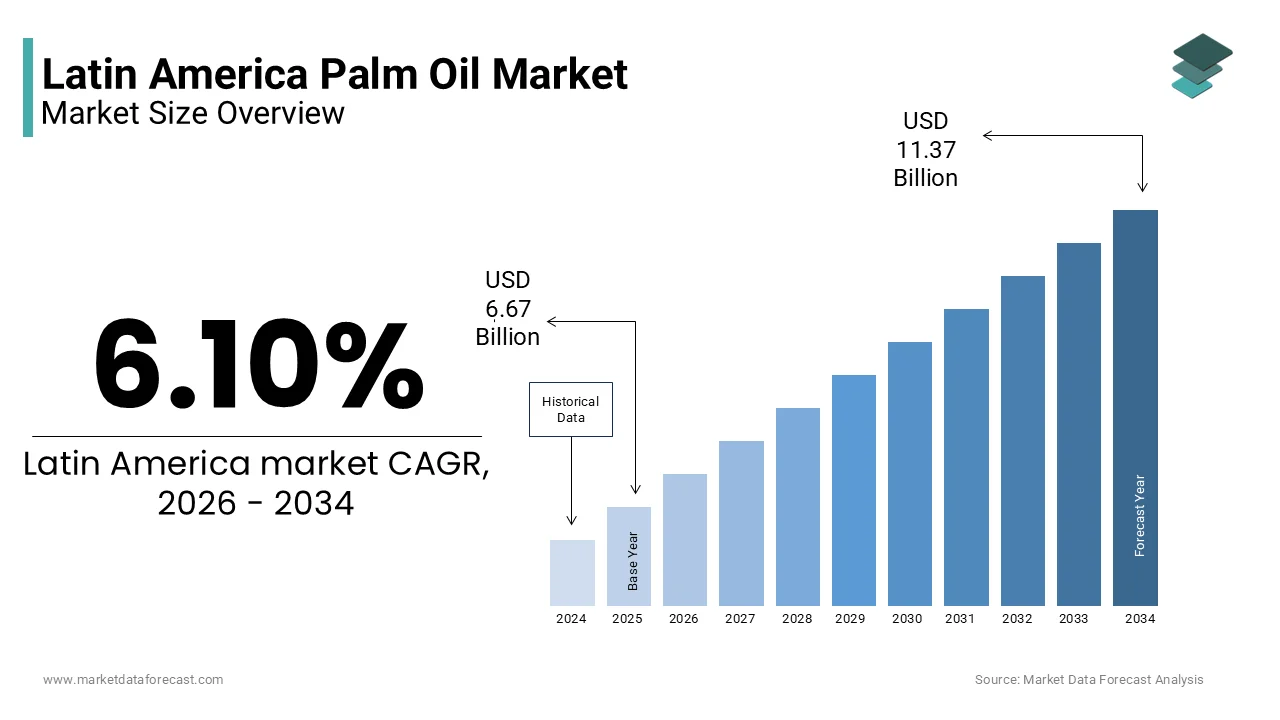
The Latin America palm oil market size was valued at USD 6.67 billion in 2025, is estimated to reach USD 7.08 billion in 2026, and is projected to expand to USD 11.37 billion by 2034, registering a compound annual growth rate (CAGR) of 6.10% from 2026 to 2034. Driven by growing domestic demand in food processing, government-backed biofuel mandates, and a strategic transition toward sustainable, certified production, the region continues to solidify its role in the global agro-industrial landscape.
Key Executive Metrics (At-a-Glance)
- 2025 Base Valuation: USD 6.67 Billion
- 2026 Current Valuation: USD 7.08 Billion
- 2034 Forecast Valuation: USD 11.37 Billion
- Compound Annual Growth Rate (CAGR): 6.10% (2026–2034)
- Dominant Derivative Segment: Crude Palm Oil (CPO), capturing 67.3% of total derivative consumption due to vital roles in edible processing and biodiesel blends
- Fastest-Growing Derivative Segment: Palm Kernel Cake (PKC), expanding at a rapid 9.2% CAGR as an economical protein-rich animal feed ingredient
- Dominant Application Segment: Edible Oil, holding a 54.5% market share driven by household cooking, baking, and snack manufacturing
- Fastest-Growing Application Segment: Biodiesel, projected at an 8.7% CAGR propelled by national carbon reduction targets and clean transport fuel policies
- Leading Country Market: Brazil, accounting for 33.4% of regional consumption backed by agricultural infrastructure and state tax incentives
- Key Importing/Consuming Hub: Mexico, relying entirely on robust imports to power its large-scale food processing and bakery sectors
Core Market Drivers & Opportunities
- Rising Food Industry Demand: Urbanization, middle-class expansion, and the preference for semi-solid, trans-fat-free alternatives in baked goods and snacks.
- Biofuel Policy Integration: National mandates (such as Colombia's B10 blend and Brazil's RenovaBio program) cementing palm oil's role in the regional energy transition.
- Sustainable & Certified Production (Opportunity): Growing adoption of Roundtable on Sustainable Palm Oil (RSPO) standards and IDB-backed financing to capture premium European and North American markets.
Primary Market Restraints & Challenges
- Environmental & Deforestation Pressures: Forest clearing risks in ecologically sensitive zones triggering strict sourcing restrictions and compliance costs.
- Land Use Conflicts: Social resistance and land disputes involving rural or indigenous communities affecting project timelines and investor sentiment.
- Regulatory Complexity & Climate Vulnerability: Inconsistent federal/state policies alongside weather disruptions from phenomena like El Niño impacting crop yields.
Latin America Palm Oil Market Segmentation Breakdown
| Segment Category | Leading Sub-Segment | Fastest-Growing Sub-Segment / Trends |
|---|---|---|
| By Derivative | Crude Palm Oil (CPO) (holding 67.3% share anchored by food processing and biodiesel use) | Palm Kernel Cake (PKC) (projected at 9.2% CAGR driven by poultry/dairy feed demand) |
| By Application | Edible Oil (holding 54.5% share for cooking, frying, and baking applications) | Bio-diesel (projected at 8.7% CAGR propelled by governmental blending mandates) |
| By Country | Brazil (market leader holding 33.4% regional consumption and domestic production) | Colombia & Ecuador (expanding export and sustainable biofuel integration hubs) |
Major Industry Players Profiled
Key multinational agribusinesses and regional leaders shaping the market include Golden Agri Resources Limited, Godrej Agrovet Limited, PT Astra Agro Lestari Tbk, Cargill Inc, Wilmar International Limited, Sime Darby, IOI Corp, Musim Mas Group, AAK, Grupo Palmas, and Bioenergy S.A.
Latin America Palm Oil Market Size
The Latin America palm oil market size was valued at USD 6.67 billion in 2025, and is expected to reach USD 11.37 billion by 2034 from USD 7.08 billion in 2026, at a CAGR of 6.10%.
Palm oil is a vegetable oil derived from the fruit of oil palms which has become one of the most widely consumed and traded vegetable oils globally due to its versatility, high yield per hectare, and cost-effectiveness. In Latin America, palm oil production and consumption have seen notable growth over the past decade, driven by both domestic demand and export opportunities. Countries such as Colombia, Ecuador, and Guatemala are among the leading producers in the region, leveraging tropical climates conducive to palm cultivation.
Like, according to the Food and Agriculture Organization (FAO), Latin America accounted for nearly 8% of global palm oil production in 2023, with Colombia alone contributing approximately 2.5 million metric tons annually. The region's palm oil is used across various sectors including food processing, biofuels, cosmetics, and animal feed. Despite environmental concerns surrounding palm oil expansion, Latin American countries have been adopting more sustainable practices, aligning with international certification standards like the Roundtable on Sustainable Palm Oil (RSPO). This changing and developing landscape positions Latin America as a growing player in the global palm oil industry.
MARKET DRIVERS
Rising Domestic Demand in the Food Industry
The surging domestic demand from the food processing sector is driving the growth of the Latin America palm oil market. Palm oil remains a preferred choice for manufacturers due to its semi-solid consistency at room temperature, long shelf life, and neutral flavour profile. It is extensively used in the production of margarine, baked goods, snacks, and fried foods across the region. Moreover, the urbanization trend and rising middle-class populations in countries like Colombia and Peru are further boosting processed food consumption, directly increasing palm oil demand. Fast food chains are expanding their presence as well as local bakeries are adopting palm-based shortenings, so this upward trajectory is expected to continue, strengthening palm oil's strategic importance in the regional agro-industrial complex.
Expansion of Biofuel Programs Across Latin America
The increasing integration of palm oil into biodiesel programs, particularly in countries seeking energy independence and cleaner fuel alternatives, also propels the Latin America palm oil market forward. Governments across the region have implemented mandates requiring the blending of biodiesel with conventional diesel, creating a steady demand for feedstocks like palm oil.
For instance, in Colombia, palm oil accounts for over 60% of biodiesel feedstock, with the government mandating a B10 blend (10% biodiesel in diesel) nationwide, as per the Ministry of Mines and Energy. The country’s production was forecasted to reach 780 million liters in 2023, with palm oil contributing around 670 million liters of that volume.
Moreover, Brazil, the world's second-largest biodiesel producer, continues to integrate palm oil into its RenovaBio program, aiming to reduce greenhouse gas emissions from the transport sector. These policy-driven initiatives stresses palm oil’s dual role as an economic and environmental asset in the Latin American energy transition.
MARKET RESTRAINTS
Environmental Concerns and Deforestation Pressures
Environmental concerns, particularly deforestation and biodiversity loss, is a major restraint for the Latin America palm oil market. The rapid expansion of palm oil plantations has led to forest clearing, especially in ecologically sensitive regions such as the Amazon basin and coastal rainforests of Colombia and Ecuador. The conversion of peatlands and primary forests not only contributes to carbon emissions but also threatens endemic species such as the jaguar and the brown-headed spider monkey. Palm oil expansion in Ecuador has contributed to a decline in habitat suitability for several endangered mammals. These environmental impacts have triggered regulatory scrutiny and public backlash. In response, several multinational buyers and retailers have imposed sourcing restrictions on non-certified palm oil. Consequently, Latin American producers face mounting pressure to adopt sustainable practices or risk losing access to premium markets in Europe and North America. The need for compliance with sustainability standards such as the Roundtable on Sustainable Palm Oil (RSPO) adds operational costs and complexity, slowing down plantation expansions and limiting market growth.
Land Use Conflicts and Social Resistance
Land use conflicts represent another significant restraint on the Latin America palm oil market, often stemming from disputes between palm oil companies and indigenous or rural communities. These conflicts arise when large-scale plantations encroach upon traditional lands without proper consultation or compensation, triggering legal battles and protests.
In Colombia, for instance, the Colombian Commission of Jurists (CCJ) reported many active land conflicts involving palm oil companies, affecting large hectares of planned or existing plantations. These disputes have delayed project timelines and increased operational risks for investors. Similarly, in Honduras, social unrest linked to palm oil expansion has led to violent confrontations, with several cases documented by Amnesty International highlighting forced evictions and human rights violations tied to agribusiness activities.
In Brazil, the situation is equally contentious. These incidents not only deter foreign investment but also tarnish the industry’s reputation, prompting stricter governmental oversight and higher compliance requirements. Therefore, all these significantly slow production growth and limit market expansion in key palm oil-producing zones.
MARKET OPPORTUNITIES
Growth in Sustainable and Certified Palm Oil Production
The increasing shift toward sustainable and certified palm oil production presents a promising opportunity for the Latin America palm oil market. As global consumers and regulators demand greater transparency and environmental responsibility, Latin American producers are positioning themselves to meet these expectations through improved farming practices and adherence to international sustainability standards.
Colombia leads the region in RSPO-certified output, with a significant portion of its palm oil exports meeting sustainability criteria, as per the National Federation of Oil Palm Growers (FEDEPALMA). This shift not only opens doors to premium markets in Europe and North America but also enhances brand value for Latin American exporters.
Furthermore, financial institutions and development agencies are increasingly supporting sustainable palm oil projects. The Inter-American Development Bank (IDB) has allocated substantial amount in funding since 2020 to promote eco-friendly palm oil initiatives across the region. These investments are enabling smallholder farmers to transition to sustainable practices, thereby improving productivity while reducing environmental impact.
Integration into Circular Economy Models and Byproduct Utilization
The adoption of circular economy principles, particularly in the efficient utilization of byproducts generated during palm oil extraction, is helping the Latin America palm oil market to gain momentum. Traditionally viewed as waste, materials such as palm kernel cake, empty fruit bunches, and palm oil mill effluent are now being repurposed into valuable inputs for energy generation, livestock feed, and organic fertilizers.
For example, In Colombia, palm oil mills have begun investing in biogas plants that convert palm oil mill effluent into renewable energy. Palm oil mills in the country now operate anaerobic digesters, collectively generating significant GWh of electricity annually. This not only reduces reliance on fossil fuels but also lowers operational costs and carbon emissions.
Similarly, in Ecuador, palm kernel cake is increasingly being used as a protein-rich livestock feed supplement, particularly in poultry and dairy farming. Also, Brazil has also expanded its use of palm fiber and shell as biomass fuel for cogeneration in palm mills, contributing to energy self-sufficiency and reducing landfill dependency.
This shift toward resource efficiency and byproduct valorization presents a compelling opportunity for Latin American palm oil producers.
MARKET CHALLENGES
Regulatory Complexity and Policy Uncertainty
The inconsistent regulatory framework across different countries, which creates uncertainty for producers and investors, remain a key challenge for the Latin America palm oil market. While some governments actively support palm oil expansion through subsidies and infrastructure development, others impose stringent environmental controls and land-use restrictions that hinder growth.
For instance, in Brazil, federal and state-level regulations differ markedly. While the Amazon Fund under the Ministry of Environment has historically restricted palm oil expansion in certain areas, individual states like Pará have promoted plantation development through tax incentives. This inconsistency complicates long-term planning for agribusinesses.
Colombia, despite having a relatively stable policy environment, has faced criticism for overlapping jurisdiction between environmental authorities and agricultural ministries, causing delays in permitting new plantations. Likewise, Ecuador has struggled with fluctuating policies; the government revised its biofuel mandate twice in three years, disrupting palm oil procurement strategies for biodiesel producers.
Such regulatory volatility discourages both domestic and foreign investment, forcing companies to navigate a patchwork of rules that vary by region and political administration.
Vulnerability to Climate Change and Weather Variability
Climate change poses a growing threat to the Latin America palm oil market, with shifting rainfall patterns, prolonged droughts, and extreme weather events impacting crop yields and plantation viability. Palm oil thrives in stable tropical conditions, making it highly susceptible to climate fluctuations that disrupt production cycles and increase operational risks.
In 2023, Colombia experienced one of the strongest El Niño phenomena in recent history, resulting in a reduction in palm oil yields in certain regions. The Cauca Valley, a major palm-growing area, saw water shortages that affected irrigation systems and reduced fruit bunch size. Similarly, Brazil, though less impacted overall, still saw localized losses in the northern states where excessive rainfall caused flooding in palm plantations To mitigate these risks, producers are investing in climate-resilient varieties and irrigation technologies, but such adaptations require substantial capital and time.
REPORT COVERAGE
| REPORT METRIC | DETAILS |
| Market Size Available | 2025 to 2034 |
| Base Year | 2025 |
| Forecast Period | 2026 to 2034 |
| CAGR | 6.10% |
| Segments Covered | By Derivative, Application, and Region |
| Various Analyses Covered | Global, Regional, & Country Level Analysis; Segment-Level Analysis; DROC; PESTLE Analysis; Porter’s Five Forces Analysis; Competitive Landscape; Analyst Overview of Investment Opportunities |
| Regions Covered | Latin America include Brazil, Argentina, Mexico, and the Rest of Latin America |
| Market Leaders Profiled | Golden Agri Resources Limited, Godrej Agrovet Limited, PT Astra Agro Lestari Tbk, Cargill Inc, United Palm Oil Industry Public Company Limited, Wilmar International Limited, Sime Darby, IOI Corp, London Sumatra, Kulim Bhd, Musim Mas Group, Alami Group, ADM, and others. |
SEGMENTAL ANALYSIS
By Derivative Insights
The crude palm oil (CPO) segment dominated the Latin America palm oil market by accounting for 67.3% of total derivative consumption in 2024. The dominance of CPO segment is primarily attributed to its extensive use in food processing and biodiesel production. In the edible sector, countries like Brazil and Mexico rely heavily on palm oil as a cost-effective substitute for soybean and sunflower oils. In addition, Colombia has integrated crude palm oil into its national biofuel strategy under the B10 mandate, which requires a 10% biodiesel blend in diesel fuel. This dual utility cements crude palm oil's leading position in the Latin American palm oil derivatives landscape.
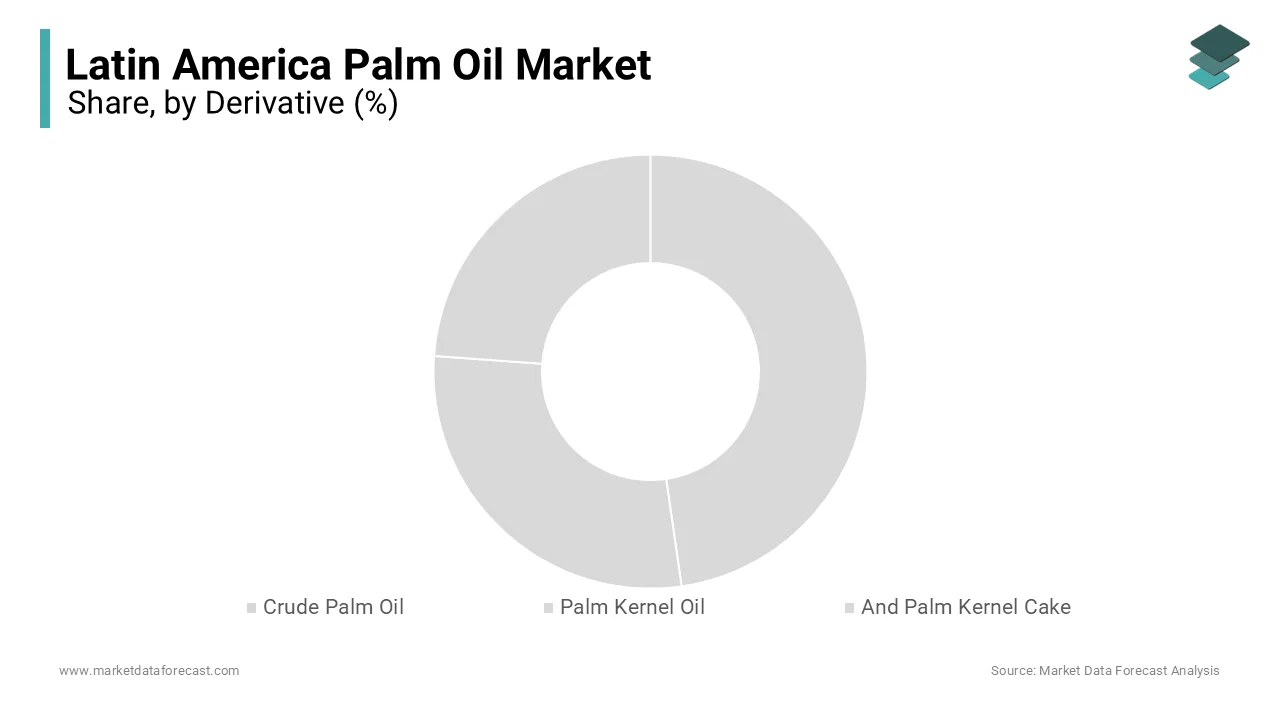
The palm kernel cake (PKC) segment is emerging as the fastest-growing segment within the Latin America palm oil derivatives market, projected to expand at a CAGR of 9.2% between 2025 and 2033. This rapid growth of PKC segment is largely attributed to its increasing adoption as a protein-rich livestock feed ingredient, particularly in poultry and dairy farming. In Ecuador, palm kernel cake now constitutes a noticeable portion of commercial animal feed formulations, replacing more expensive alternatives like soybean meal. Besides, Colombia has witnessed a surge in demand for palm kernel cake due to government-backed initiatives promoting circular agriculture models.
By Application Insights
The edible oil segment remained the commanding application in the Latin America palm oil market by holding a share of 54.5% in 2024. This superiority of edible oil segment is mainly propelled by the widespread use of palm oil in household cooking, food manufacturing, and frying applications across the region.
Brazil favours palm oil for its stability at high temperatures and long shelf life, making it ideal for frying and baking processes in both industrial and informal food sectors. Mexico follows closely. Palm oil in Mexicois the preferred choice for margarine, snacks, and baked goods due to its semi-solid consistency without hydrogenation, reducing trans-fat content. Apart from these, urbanization and changing dietary habits are accelerating packaged food consumption, further boosting edible palm oil demand.
The bio-diesel segment is the fastest-growing application segment in the Latin America palm oil market is likely expanding at a CAGR of 8.7% during the forecast period. This growth of bio-diesel segment is primarily fueled by government mandates promoting cleaner transport fuels and carbon reduction targets.
Colombia leads this trend and continues to invest in sustainable palm-based biodiesel to meet international environmental standards. Like, Ecuador has also ramped up its use of palm oil in biofuels, recording an increase in utilization for biodiesel production. Meanwhile, Brazil’s RenovaBio program encourages palm oil integration into biofuel supply chains.
REGIONAL ANALYSIS
Brazil Palm Oil Market Analysis
Brazil remained at the forefront in the Latin America palm oil industry by accounting for 33.4% of regional consumption in 2024. Positioned as both a major importer and producer. The country’s vast agricultural infrastructure supports domestic palm oil cultivation, particularly in the northern state of Pará, where plantation expansion has been encouraged through tax incentives. However, Brazil’s palm oil production remains modest compared to its import volumes due to limited land suitability and competition from other crops like soybeans. Despite this, Brazil plays a pivotal role in shaping regional demand, especially in the edible oil and biofuel sectors. So,with continued policy support and rising industrial demand, Brazil remains the dominant force in the Latin American palm oil market.
Mexico Palm Oil Market Analysis
Mexico stands as the key consumer of palm oil in Latin America. Unlike Brazil, Mexico does not cultivate palm oil domestically but relies entirely on imports, primarily from Southeast Asia and Colombia. The primary driver of palm oil demand in Mexico is the food processing sector, particularly in the production of margarine, snacks, and fried foods. Fast food chains and large-scale bakeries have significantly increased their reliance on palm oil-based shortenings and frying oils, reinforcing its importance in the edible oil segment. Also, Mexico’s commitment to clean energy initiatives has led to exploratory discussions on incorporating palm oil into biofuel blends. It’s palm oil consumption is expected to remain robust, maintaining its key position in the Latin American market.
Argentina Palm Oil Market Analysis
Argentina is positioning itself as a growing player in regional consumption. While it is traditionally known for its soybean oil production, rising domestic demand for affordable and stable fats has led to increased palm oil incorporation in edible products. Moreover, Argentina’s expanding livestock sector has seen growing interest in palm kernel cake as a cost-effective feed supplement. Though still modest in scale compared to Brazil and Mexico, Argentina’s palm oil demand is steadily increasing, supported by evolving consumer preferences and industrial diversification.
Chile Palm Oil Market Analysis
Chile represents a smaller yet stable segment of the Latin America palm oil market. Unlike larger markets, it does not utilize palm oil extensively in mass food production due to higher consumer awareness and regulatory scrutiny regarding saturated fat content. However, niche applications such as specialty baked goods, confectionery, and non-hydrogenated fats continue to drive steady demand. In addition, Chile has explored palm oil as a potential component in green energy initiatives. Despite its relatively minor market size, Chile maintains consistent palm oil consumption patterns, supported by premium food applications and emerging sustainability-linked opportunities.
The Rest of Latin America (ROLA), encompassing countries such as Colombia, Ecuador, Guatemala, Peru, and Honduras, collectively accounts for notable share of the regional palm oil market. This diverse group exhibits varied levels of production and consumption, with Colombia leading as both a producer and exporter. Colombia’s strategic focus on sustainable practices and biofuel integration has bolstered both domestic and international demand. Ecuador, too, has expanded its palm oil footprint. Peru and Guatemala show rising consumption trends, particularly in processed foods and bakery products.
COMPETITIVE LANDSCAPE
The Latin America palm oil market exhibits a moderately competitive landscape, shaped by a mix of large agribusiness firms, independent producers, and emerging cooperatives. While a few dominant players control significant shares of production and exports, particularly in Colombia and Ecuador, the market remains fragmented due to the presence of numerous smallholder farmers and regional processors. This diversity fosters competition not only in terms of volume and pricing but also in sustainability practices and value-added product offerings.
Competition is further intensified by growing demand from both domestic sectors—such as food processing and biofuels—and international buyers seeking ethically sourced palm oil. As regulatory scrutiny and consumer awareness increase, companies are differentiating themselves through sustainable certifications, improved land management, and investment in downstream processing capabilities. However, challenges such as land conflicts, policy inconsistencies, and environmental concerns continue to shape competitive dynamics, requiring firms to adopt more transparent and socially responsible strategies to maintain market relevance and growth momentum.
KEY MARKET PLAYERS
Key Players In Palm Oil Market are Golden Agri Resources Limited, Godrej Agrovet Limited, PT Astra Agro Lestari Tbk, Cargill Inc, United Palm Oil Industry Public Company Limited, Wilmar International Limited, Sime Darby, IOI Corp, London Sumatra, Kulim Bhd, Musim Mas Group, Alami Group, ADM.
TOP PLAYERS IN THE MARKET
- Grupo Palmas is one of the leading palm oil producers in Colombia and a major player in Latin America. The company operates across the entire value chain, from plantation to refining and biodiesel production. Known for its commitment to sustainable practices, Grupo Palmas plays a significant role in shaping regional palm oil policies and export standards. Its focus on integrated operations and environmental stewardship has positioned it as a responsible leader in the industry.
- Bioenergy S.A. is a key agro-industrial company specializing in palm oil cultivation, processing, and biofuel production. With extensive plantations and modern processing facilities, the company contributes significantly to Colombia’s palm oil exports and domestic consumption. It has been instrumental in advancing the use of palm oil in renewable energy initiatives, supporting national biofuel mandates and sustainability goals across Latin America.
- AAK, a global leader in plant-based oils and fats, has a strong presence in the Latin American palm oil market through strategic sourcing and partnerships. The company sources certified sustainable palm oil from Colombia and Ecuador, aligning with international sustainability benchmarks. AAK’s influence extends beyond production into innovation, where it develops high-quality food and industrial applications using Latin American palm oil, reinforcing the region's role in the global supply chain.
TOP STRATEGIES USED BY KEY MARKET PLAYERS
One major strategy employed by key players in the Latin America palm oil market is the adoption of sustainable and certified production practices. Companies are increasingly aligning with global sustainability frameworks such as RSPO to meet international buyer demands and access premium markets. This shift not only enhances brand reputation but also ensures long-term supply chain viability.
Another crucial approach is vertical integration, where companies control multiple stages of the supply chain—from planting and harvesting to refining and distribution. This allows for greater cost efficiency, quality control, and resilience against market fluctuations, strengthening their competitive edge in both domestic and export markets.
Lastly, strategic partnerships and collaborations with research institutions and financial organizations are being leveraged to improve agricultural productivity and promote eco-friendly innovations. These alliances help companies enhance yield efficiency, develop climate-resilient crops, and expand their operational footprint while maintaining compliance with evolving environmental and social governance standards.
RECENT HAPPENINGS IN THE MARKET
- In February 2023, Grupo Palmas launched a new sustainability initiative aimed at achieving zero deforestation across all its palm oil plantations in Colombia. The program included satellite monitoring systems and community engagement efforts to ensure responsible land use and biodiversity protection.
- In August 2023, Bioenergy S.A. expanded its refining capacity in partnership with a European green energy firm, enhancing its ability to supply high-quality palm oil for both edible and biofuel applications across Latin America and overseas markets.
- In January 2024, AAK deepened its sourcing commitments in Ecuador by signing long-term agreements with local cooperatives to procure certified sustainable palm oil, reinforcing its supply chain integrity and supporting smallholder development programs.
- In May 2024, Daabon Organic, a Colombian palm oil producer, introduced a new line of organic palm oil products tailored for health-conscious consumers in North America and Europe, expanding its market reach beyond traditional bulk exports.
- In September 2024, Cargill increased its investments in Brazil’s Pará state by upgrading logistics infrastructure to streamline palm oil transportation and reduce supply chain bottlenecks, strengthening its position in the regional agribusiness sector.
MARKET SEGMENTATION
This research report on the Latin America palm oil market is segmented and sub-segmented into the following categories.
By Derivative
- Crude Palm Oil
- Palm Kernel Oil
- And Palm Kernel Cake
By Application
- Edible Oil
- Cosmetics
- Bio-diesel
- Lubricants
By Country
- Brazil
- Argentina
- Mexico
- Rest of Latin America