- Product Description Description
- Table of Contents TOC
- List of Table & Figure LOT
- Get Free Sample PDF Sample PDF
Market Size, 2025
$71.87 BnMarket Estimate, 2026
$75.61 BnMarket Forecast, 2034
$113.42 BnCAGR, 2026–2034
5.2%Global Palm Oil Market Size, Growth, Trends & Forecast (2026–2034)
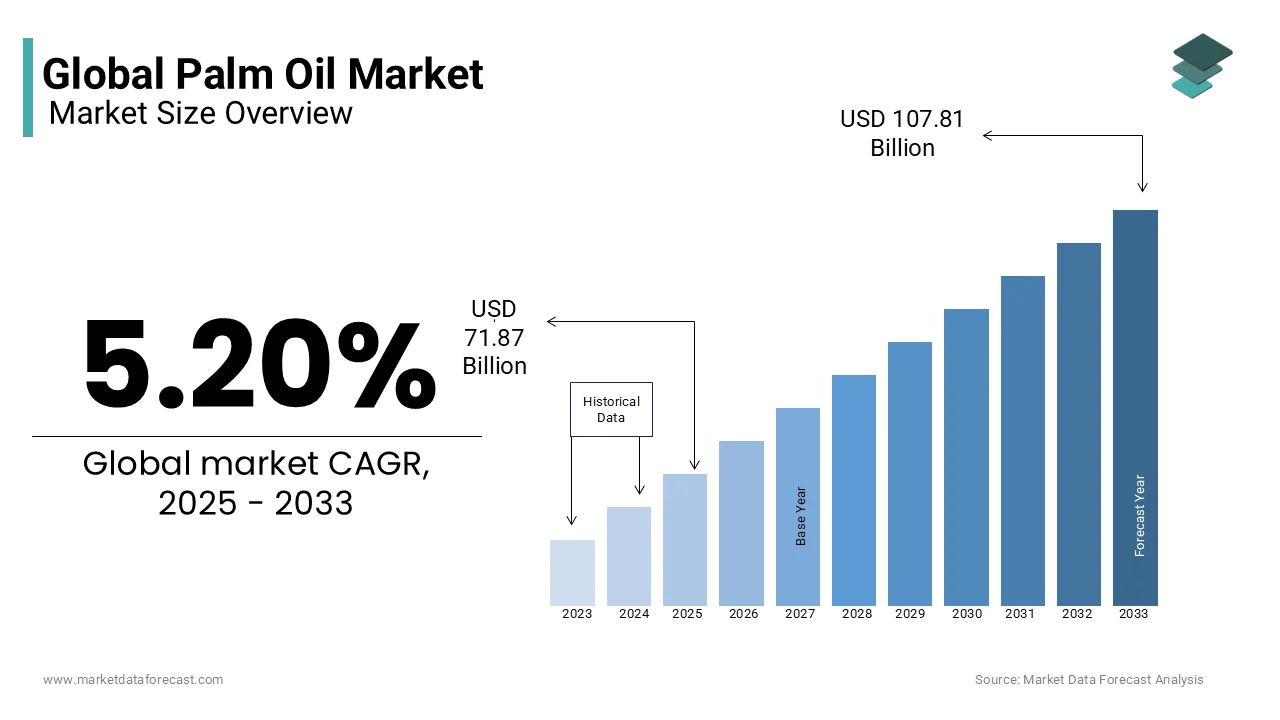
The global palm oil market size was valued at USD 71.87 billion in 2025, reached USD 75.61 billion in 2026, and is projected to expand up to USD 113.42 billion by 2034, registering a compound annual growth rate (CAGR) of 5.20% during the forecast period from 2026 to 2034. Driven by extensive use across the food and beverage industry, cosmetics, personal care, and biofuels, the market continues steady global expansion.
Key Executive Metrics (At-a-Glance)
- 2025 Base Valuation: USD 71.87 Billion
- 2026 Current Valuation: USD 75.61 Billion
- 2034 Forecast Valuation: USD 113.42 Billion
- Compound Annual Growth Rate (CAGR): 5.20% (2026–2034)
- Leading Region: Asia-Pacific (Home to major producers and exporters including Indonesia, Malaysia, India, Thailand, and Vietnam, supported by raw material availability and high agricultural productivity)
- Prominent Regions: Europe (Driven by high consumer demand for premium cosmetics and personal care) & Middle East and Africa (Boosted by demographic transitions and clean, natural wellness trends)
- Leading Derivative Segment: Crude Palm Oil (Held a significant 28.2% share of global market revenue, widely adopted in food and beverages, cosmetics, and pharmaceuticals)
- Leading Application Segment: Edible Oil (Dominated the global market with a 67.3% share in 2023, serving as a primary ingredient in baked goods, margarine, and home cooking)
- Fastest-Growing Application Segment: Cosmetics (Projected to grow the fastest during the forecast period due to rising demand for natural, organic, plant-based, and sustainable personal care items)
- Prominent Application Segment: Bio-Diesel (Estimated to experience steady moderate growth supported by government blending initiatives and eco-friendly energy alternatives)
Core Market Drivers
- Broad Industrial Applicability: Cost-effectiveness, prolonged shelf life, and versatility across food items, cosmetics, surfactants, and first-generation biofuels.
- Government Biofuel Initiatives: Worldwide regulatory blending mandates and global sustainability frameworks (such as RSPO and POIG) encouraging certified green production.
Primary Market Restraints & Challenges
- Environmental & Sustainability Regulations: Strict compliance requirements regarding zero deforestation, peatland protection, and high production costs associated with sustainable extraction.
- Health & Nutritional Concerns: High saturated fat content linked to elevated cholesterol and cardiovascular health risks, alongside competition from healthy alternative vegetable oils.
Global Palm Oil Market Segmentation Highlights
| Segment Category | Leading / Dominant Segment | Fastest-Growing / Prominent Segment |
|---|---|---|
| By Derivative | Crude Palm Oil (28.2% revenue share) | Fractionated Palm Oil (Gaining traction due to economic feasibility and availability) |
| By Application | Edible Oil (67.3% share in 2023) | Cosmetics (Fastest-growing segment driven by natural/organic beauty trends) |
| By Region | Asia-Pacific (Leading production and export hub via Indonesia and Malaysia) | Middle East & Africa (Growing workforce and clean wellness demand driving adoption) |
Major Industry Players Profiled
Key operators leading the global palm oil market include Wilmar International Limited, Golden Agri Resources Limited, Cargill Inc, Sime Darby, IOI Corp, Musim Mas Group, PT Astra Agro Lestari Tbk, Godrej Agrovet Limited, United Palm Oil Industry Public Company Limited, London Sumatra, Kulim Bhd, Alami Group, and Archer Daniels Midland.
Global Palm Oil Market Size
The global palm oil market size was valued at USD 71.87 billion in 2025, and the global market size is expected to be worth USD 75.61 billion in 2026 and is anticipated to reach a valuation of USD 113.42 billion by 2034 with a CAGR of 5.20% .
The global palm oil market is growing at a breakneck pace. Palm oil is an economically essential and versatile vegetable oil used as a raw material for food and non-food products. It is used worldwide and is found in supermarkets ranging from sweets, cakes, margarine, cereals, detergents, and cosmetics. Palm oil is also used as a first-generation biofuel. It is also used to prevent vitamin A deficiency, cancer, brain disease, and aging and treat malaria, high blood pressure, cholesterol, and cyanide poisoning. Most of this oil is produced in regions like Asia, Africa, and South America because trees need warm temperatures, sunlight, and lots of rain to maximize agricultural production.
Current Scenario of the Global Palm Oil Market
The global palm oil market has grown significantly in recent years due to its broad applicability in various sectors, including food and beverages, cosmetics, pharmaceuticals, biofuels, and energy. The major market players are from the Asia Pacific region due to the region's wide availability of raw materials. Various benefits of palm oil are enhancing the industries' choice of it as it has a prolonged shelf life and is less expensive than vegetable oils, raising the adoption in the food and beverages sector. Palm oil is the major component in almost 50% of grocery stores' food and non-food items. Crude palm oil is commonly used in home cooking in Southeast Asia, Africa, and Brazil, impacting the market revenue growth positively. The vast applicability of palm oil in cosmetics, as it provides skin hydration, foaming, and skin softening, contributes primarily to the expansion of the market size in the coming years. Palm oil plays a crucial role in biodiesel production, augmenting the market expansion in the energy and biofuels sector.
MARKET DRIVERS
Various government initiatives regarding blending conventional fuel with bio-based fuel and the increasing use of products such as bio-based diesel have gained worldwide acceptance in recent years. Consumers worldwide know cosmetics, lubricants, and surfactants of organic origin, which has also stimulated the Palm Oil market. We note that several government regimes, such as RSPO, POIG, and more, positively impact the global palm oil market. Several multinationals in this field continually invest in their R&D department to improvise their product portfolio, thus responding to a broader application base and supporting the Palm Oil market. Technological improvisation and significant foreign investment in sustainable production methods should create many opportunities for industry participants worldwide. All these factors are expected to accelerate the global palm oil market revenue.
Palm oil is a widely used vegetable oil and a common ingredient in margarine, cookies, instant noodles, bread, lipsticks, cereals, chocolates, candies, ice cream, shampoos, and detergents. Palm oil is low in trans-fat and profitable due to its higher demand worldwide. A technological invention coupled with significant foreign funds in the field for sustainable production methods is estimated to create many opportunities for participants from all over the world. Palm Oil Innovation Group (POIG) is committed to manufacturing extremely pure palm oil, free of trans-fats, that can be used as cooking oil. Created in 2013, the activity was created in partnership with driving NGOs and dynamic palm oil manufacturers.
The Asia Pacific regional countries like India and Indonesia have a significant share of the global market due to raw material availability, rising urbanization, and increasing demand from the food and beverages industry, creating opportunities in the region. The increasing demand for palm oil in the cosmetic industry and pharmaceuticals is boosting the expansion of the global market size. The upsurging food sector across various regions contributes to the global market revenue.
MARKET RESTRAINTS
In addition to several favorable factors, the strict environmental regulations that govern the production are expected to hinder growth in the global Palm Oil market. The Palm Oil Market is characterized by strict government regulations that require companies to comply with the sustainability of production and extraction, limiting the market's expansion. The presence of higher production costs due to the adoption of sustainable production methods is another factor hampering the global market growth. The availability of other healthy alternatives in the food sector is estimated to limit the market value growth. As palm oil is rich in saturated fat, it induces heart diseases by boosting the bad cholesterol and triglycerides in the body, which limits the adoption rate and impedes market revenue growth. Various environmental effects negatively impact the market expansion as palm oil production has been the significant driver of deforestation.
REPORT COVERAGE
| REPORT METRIC | DETAILS |
| Market Size Available | 2025 to 2034 |
| Base Year | 2025 |
| Forecast Period | 2026 to 2034 |
| CAGR | 5.20% |
| Segments Covered | By Derivative, Application And Region |
| Various Analyses Covered | Global, Regional and Country Level Analysis; Segment-Level Analysis; DROC; PESTLE Analysis; Porter’s Five Forces Analysis; Competitive Landscape; Analyst Overview of Investment Opportunities |
| Regions Covered | North America, Europe, APAC, Latin America, Middle East & Africa |
| Market Leaders Profiled | Golden Agri Resources Limited, Godrej Agrovet Limited, PT Astra Agro Lestari Tbk, Cargill Inc, United Palm Oil Industry Public Company Limited, Wilmar International Limited, Sime Darby, IOI Corp, London Sumatra, Kulim Bhd, Musim Mas Group, Alami Group, Archer Daniels Midland. |
SEGMENTAL ANALYSIS
By Derivative Insights
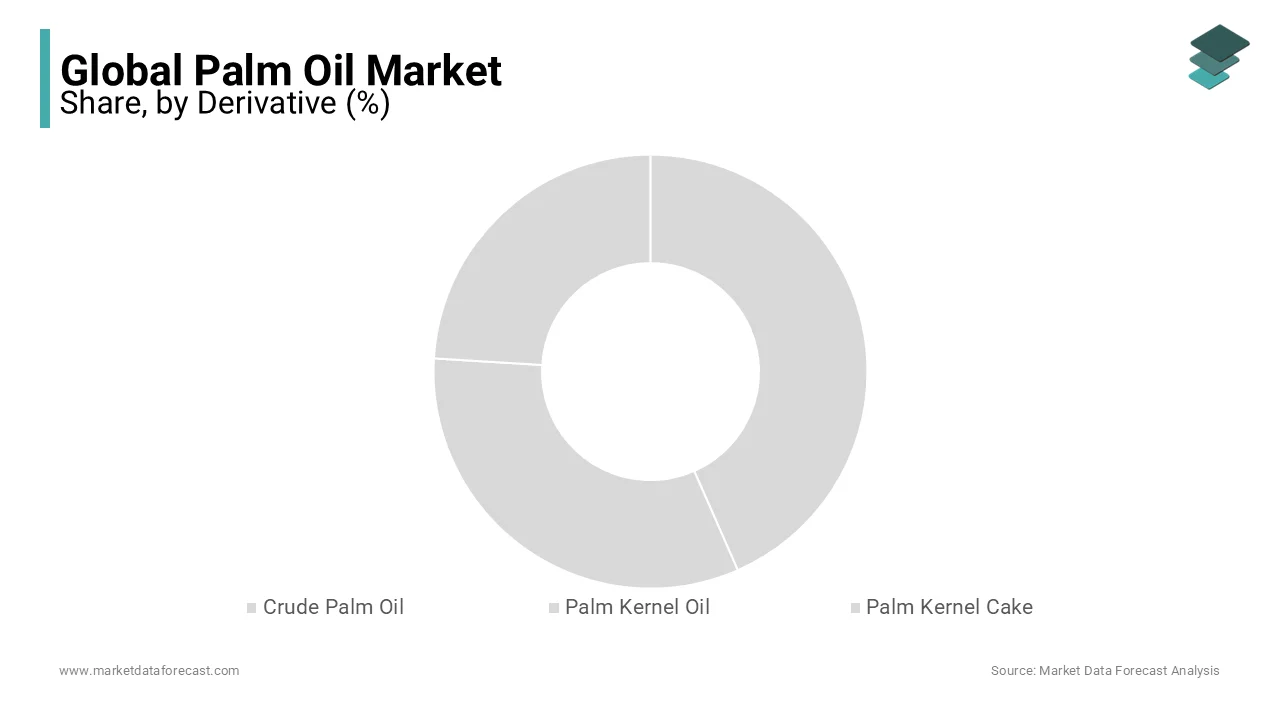
The crude palm oil segment held a significant share of 28.2% of the global market revenue. Due to its wide application, the food and beverage industry widely adopts crude palm oil. The vast applications of crude palm oil in various end-users like cosmetics and pharmaceuticals are considered crucial parts of the production of different products. These factors drive the segment growth through wider adoption, leading to global market growth. Fractionated palm oil has been gaining traction recently due to its ease of availability and economically feasible prices.
By Application Insights
The edible oil segment dominated the global palm oil market, with a market share of 67.3% in 2023. The growing usage of products in the food and beverages industry and the increasing product portfolios are enhancing the demand for palm oil as a raw material, driving the segment growth. The expanding food industry is expected to contribute a significant share in expanding the palm oil edible segment.
The cosmetics segment is expected to grow the fastest during the forecast period due to the wide adoption of palm oil in the production of cosmetics. The escalating demand for natural and organic plant-based products with sustainability is enhancing the adoption of palm oil in cosmetics, leading to segment growth.
The bio-diesel segment is estimated to have moderate growth in the coming years as the demand for environmentally friendly alternatives is accelerating. The growing technological advancements are expected to improve biofuel production, enhancing market growth opportunities.
REGIONAL ANALYSIS
The United States and Canada have relatively low per capita consumption due to the predominance of national soybean and corn oils in the market. As a result, the issue of sustainable sourcing has not been a high priority for companies in North America and the level of awareness of the impacts of their products among consumers is still relatively low. Therefore, the region is expected to grow at a slower pace than developing areas such as Asia-Pacific and the MEA.
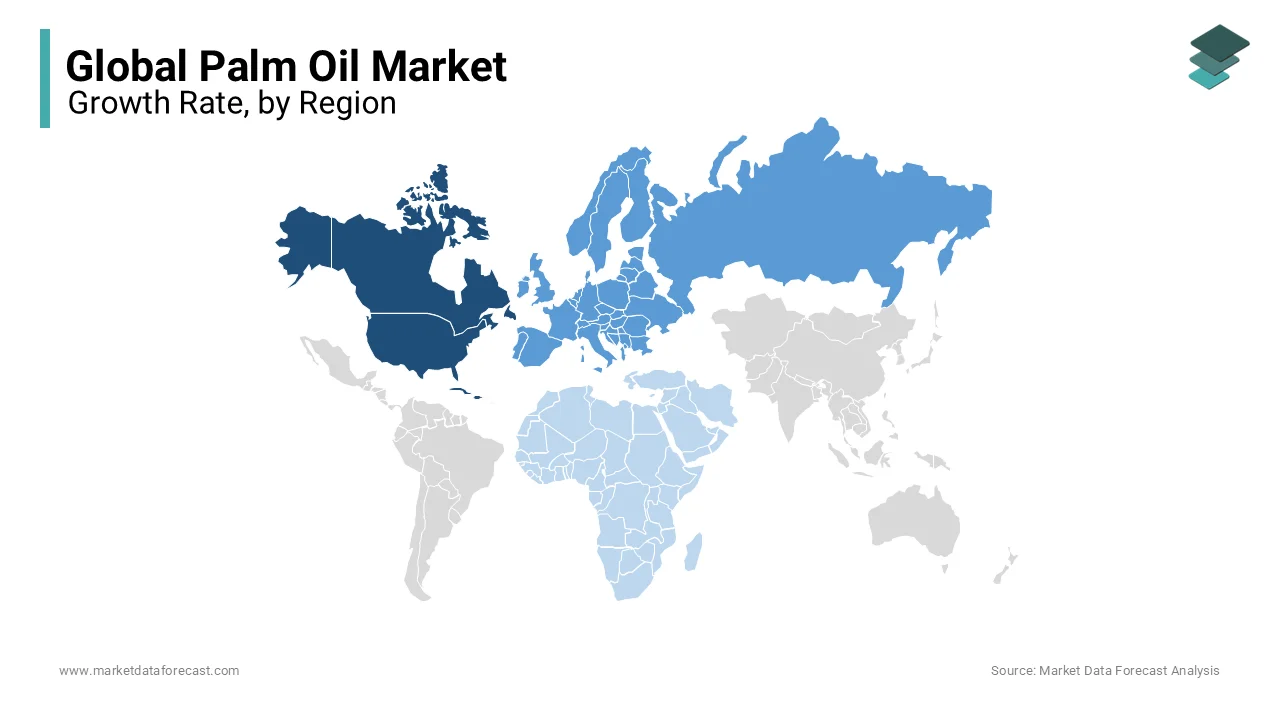
In Europe, the high income of consumers and the growing influence of social networks have driven the demand for high-end cosmetics and personal care. Men are also rapidly adapting to new trends in the consumer cosmetics market, using products such as hair and beard care products. These trends have encouraged cosmetic companies to develop specific products with unique characteristics aimed at this demographic.
The Asia Pacific is home to several large emerging markets, including India, Vietnam, Thailand, Malaysia, and Indonesia, most of which are large producers and exporters. Most of these countries are also committed to a high level of sustainability, with innovations to achieve greater efficiency in life and maximize production in the global Palm Oil market growth. Another factor that contributes to the growth of the industry is the accelerated replanting and mechanization of various harvesting and processing techniques.
The demographic transition in the Middle East and Africa, which includes the growing workforce, has increased spending on goods related to health and well-being. Clean and natural products are also consumed to a large extent, as consumers realize the benefits of these products, compared to others that contain artificial additives. This trend is particularly marked among white-collar workers, nonresidential foreign returnees and expatriates working in the region. These factors have resulted in a change in the direction towards sustainable and organic sources in culinary and other applications.
KEY PLAYERS IN THE PALM OIL MARKET
Key players in the palm oil market are Golden Agri Resources Limited, Godrej Agrovet Limited, PT Astra Agro Lestari Tbk, Cargill Inc, United Palm Oil Industry Public Company Limited, Wilmar International Limited, Sime Darby, IOI Corp, London Sumatra, Kulim Bhd, Musim Mas Group, Alami Group, Archer Daniels Midland.
RECENT HAPPENINGS IN THE MARKET
-
In January 2023, Godrej Agrovet Ltd. Received the Indian Oil Palm Certification under the Indian Palm Oil Sustainability (IPOS) framework in recognition of ethical business practices it has implemented in the production.
-
In May 2022, Ruchi Soya announced its acquisition of Patanjali’s Food retail business. This initiative by the company mainly aims to acquire Patanjali’s food retail business, which involves manufacturing, packaging, labeling, and retail trading of certain food products, including palm oil.
-
In June 2021, Cargill constructed a new coconut oil refinery in Indonesia. This will speed the company’s efforts to establish a sustainable palm supply chain and offer clients verified deforestation-free goods.
-
In June 2020, Fuji Oil Group formulated and launched its “Responsible Palm Oil Procurement Policy,” which sets out a commitment to zero forestation, no peatland, and no exploitation, including the supply chain of all palm oil products.
MARKET SEGMENTATION
This research report on the global Palm Oil Market has been segmented and sub-segmented based on Derivative, Application, & region.
By Derivative:
- Crude Palm Oil
- Palm Kernel Oil
- Palm Kernel Cake
By Application:
- Edible Oil
- Cosmetics
- Bio-diesel
- Lubricants
- Surfactants
By Region
- North America
- Latin America
- Europe
- Asia Pacific
- Middle East and Africa