- Product Description Description
- Table of Contents TOC
- List of Table & Figure LOT
- Get Free Sample PDF Sample PDF
Market Size, 2025
$238.78 BnMarket Estimate, 2026
$249.29 BnMarket Forecast, 2034
$351.81 BnCAGR, 2026–2034
4.40%Executive Summary: Global Fats And Oils Market
- Market Scope: Comprehensive global fats and oils market analysis covering product categories, application sectors, regional leadership frameworks, key industry players, and emerging industrial and consumer nutrition trends.
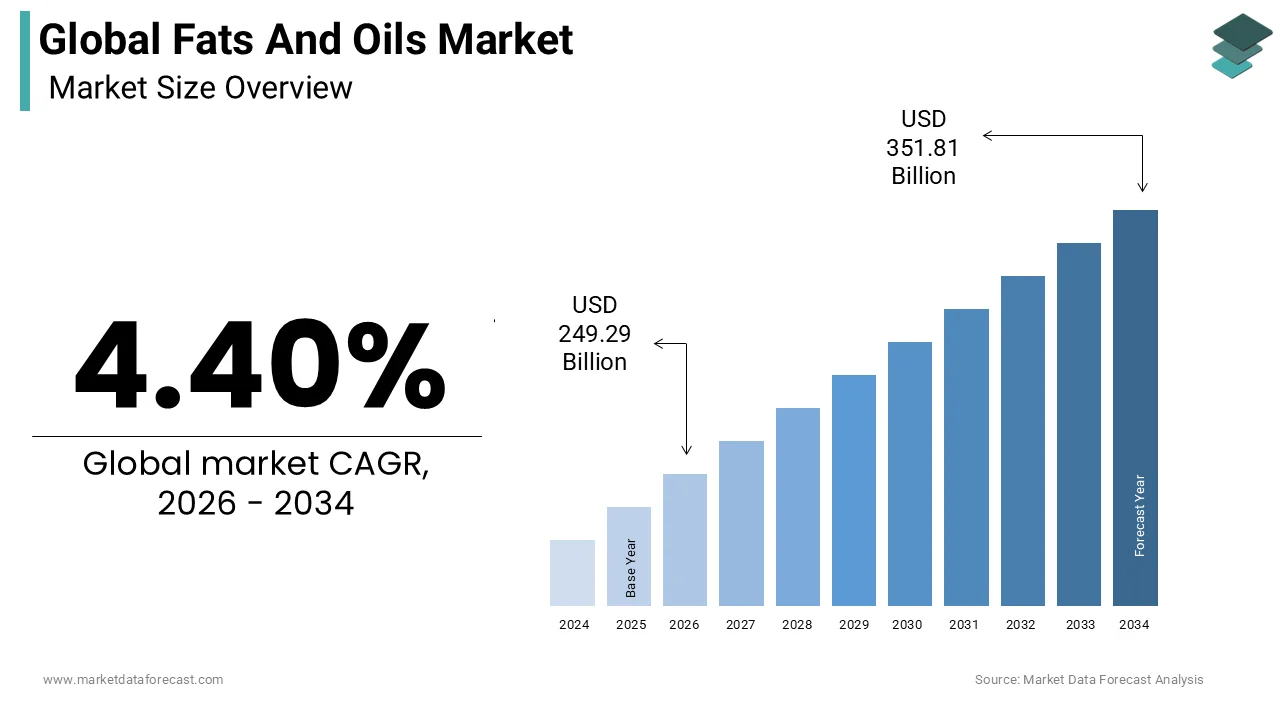
- Market Valuation: Valued at USD 238.78 billion (2025), estimated at USD 249.29 billion (2026), and projected to reach USD 351.81 billion by 2034, registering a steady CAGR of 4.40% (2026–2034).
- Primary Growth Drivers: Rising global population levels, increasing disposable incomes, shifting consumer preferences toward processed and convenience foods, growing demand for biodiesel and industrial applications, and foodservice sector expansion in emerging economies.
Key Market Segment Metrics (2026–2034)
| Category | Leading Segment (2025 Position) | Fastest-Growing Segment |
|---|---|---|
| By Product Type | Palm oil (holds the largest share due to cost-effectiveness and versatility in food and biofuels) | Specialized and low-saturated healthy oil variants (such as oleic canola oil) |
| By Application | Food and beverage application segment (dominates, accounting for ~75% of total consumption) | Biodiesel and specialized industrial application segments |
| By Region | Asia Pacific region (leads market, fueled by high consumption in China, India, and Indonesia) | Emerging regional markets and health-focused specialty oil sectors across North America and Europe |
Major Market Players & Market Structure
Market Structure: Highly competitive global agricultural commodities and food ingredients landscape featuring major multinationals competing on supply chain efficiency, low-saturated fat innovations, premium bakery solutions, and biofuel distribution contracts.
Key Companies: Cargill, Archer Daniels Midland Company, Bunge Limited, Wilmar International, and Conagra Foods.
Global Fats and Oils Market Size
The global fats and oils market size was anticipated to be worth USD 238.78 billion in 2025 and is anticipated to be worth USD 351.81 billion by 2034 from USD 249.29 billion In 2026, growing at a CAGR of 4.40% during the forecast period.
The demand for fats and oils is increasing as interest in biofuels such as biodiesel from vegetable oils and animal fats increases. Fats and oils are very crucial elements in the diet widely used in various industries. They are only organic substances, fats in solid form and oil in liquid form at room temperature. Fats and oils are foods that have more energy and more energy than proteins and carbohydrates. Cooking oil is mainly used for soap production and other purposes. Most of the oils and fats are produced from fatty acid esters. They are used mostly in butter, salad oil, margarine and cooking oil, along with animal feed, fatty acids, personal care products like soaps, alkyd resins based paints, biodiesel, engine oils, and greases. The roots of fats and oils comprise edible vegetable oils, palm oil, industrial oils, animal fats, and marine oils. Food applications represent a significant part (approximately 3/4) of the consumption of fats and oils worldwide. However, there has been a continuous transition from food consumption to industrial use, especially biodiesel. Due to a surge in living standards and population growth, the demand for each food sector in these countries is the driving force behind the fats and oils market.
MARKET DRIVERS
The global fats and oils market is expected to have positive growth during the forecast period due to changes in consumer eating habits.
The increase in consumption of processed foods along with the demand for high-quality cooking oil is supposed to have a positive impact on the global market. Increased health awareness and increased disposable income in emerging markets are estimated to strengthen the global market further. Fast food and convenience food consumption are assumed to fuel the demand for fat and oil during the outlook period. The food industry dominated fat and oil applications, and the transition to industrial, chemical, personal care, animal feed and pharmaceutical applications is expected to gain momentum in the future. There was a high demand for fats and oils in the food and beverage industry. Changing consumer eating habits are driving demand in local and oil markets. Other prominent industries that find applications of fats and oils are chemical, pharmaceutical, animal feed, industrial and personal care products.
Market demand is growing as demand for alternative biodiesel fuels increases in the transportation sector. Increased health problems and rising raw material prices may hinder future market growth. Consumers around the world have learned more about the difference between healthy and unhealthy fats and oils. Most of these consumers now show a greater willingness to consider and test fats and oils extracted from non-traditional sources and the perceived benefits of being sustainable, organic or non-biotech. Today, foods that are free of genetically modified organisms (GMOs) and that contain minimally processed fats and natural oils are increasingly favored by young consumers around the world.
The Millennium generation and young consumers prefer to avoid overly processed ingredients and foods, which intensifies the demand for unrefined natural oils. As health awareness increases, most consumers around the world readily adapt and search for certain animal and vegetable fats, such as butter, eggs, olive oil, and avocado fat. The adoption of butter-based fats is reviving by providing excellent performance in promoting clean and straightforward ingredient labels. This is because clean, simple labels are the new standard for Gen Z and Millennial consumers. An increase in R&D to develop innovative applications such as trans-fat substitute development and biodiesel production promise ample opportunities for local and oil market participants.
MARKET RESTRAINTS
The increase in health problems caused by excessive consumption of fats and oils is anticipated to hinder the growth of the global fats and oils market.
Regulations regulating food safety and labeling issues are believed to further slow market growth. High raw material prices are expected to affect the market's growth prospects adversely.
REPORT COVERAGE
| REPORT METRIC | DETAILS |
| Market Size Available | 2025 to 2034 |
| Base Year | 2025 |
| Forecast Period | 2026 to 2034 |
| CAGR | 4.4% |
| Segments Covered | By Product Type, Application, Form, Source, and Region |
| Various Analyses Covered | Global, Regional & Country Level Analysis; Segment-Level Analysis, DROC, PESTLE Analysis, Porter’s Five Forces Analysis, Competitive Landscape, Analyst Overview of Investment Opportunities |
| Regions Covered | North America, Europe, APAC, Latin America, Middle East & Africa |
| Market Leaders Profiled | Cargill, Corteva, Archer Daniels Midland Company, Arista Industries, Unilever, Conagra Foods, Bunje Limited, Ajinomoto, British Foods, Wilmar International, United Plantations Berhad and Others. |
SEGMENTAL ANALYSIS
By Product Type Insights
The Palm Oil segment holds the largest share in the cheese ingredients market. Palm oil is widely used in cheese production, particularly in processed and dairy-free cheese alternatives, due to its cost-effectiveness and favorable fat composition. It helps to achieve the desired texture, consistency, and shelf stability in various cheese products, including processed cheeses, spreads, and cheese-like substitutes. The large-scale production and availability of palm oil make it a dominant ingredient, especially in the global cheese industry where affordability and consistency are key factors.
The Olive Oil segment is the fastest-growing in the cheese ingredients market. With the rising demand for healthier, plant-based alternatives and the growing consumer interest in Mediterranean diets, olive oil is increasingly being incorporated into both traditional and specialty cheese products. Olive oil’s health benefits, including its role in reducing cholesterol and providing antioxidants, have made it a popular choice in premium cheese formulations and in dairy-free cheese products. The increasing trend toward natural, high-quality ingredients and healthier options is driving the rapid growth of olive oil in the market.
By Application Insights
The Food & Beverages segment holds the largest share in the cheese ingredients market. Cheese is a staple ingredient in a wide range of food products, including pizzas, sandwiches, sauces, and snacks. It is also used in beverages such as milk-based drinks and protein shakes. The growing consumer demand for convenience foods, as well as the increasing popularity of dairy-based products in various cuisines, keeps the food and beverage sector as the dominant application for cheese rise in consumer preference for cheese-laden products.
The Pharmaceuticals segment is the fastest-growing in the cheese ingredients market. This growth is driven by the increasing use of cheese ingredients such as whey protein and lactose in pharmaceutical formulations. These ingredients are essential for creating nutraceuticals, protein supplements, and medications that target digestive health, muscle building, and weight management. As the health and wellness trend continues to rise, the demand for cheese-derived ingredients in the pharmaceutical industry is rapidly expanding, making it the fastest-growing segment within the cheese ingredients market.
By Form Insights
The Solid form holds the largest share in the cheese ingredients market. Solid cheese ingredients, such as grated cheese, cheese powders, and cheese chunks, are widely used in a variety of food applications, including baked goods, snacks, sauces, and ready-to-eat meals. The preference for solid cheese ingredients is driven by their versatility, long shelf life, and ease of use in both industrial and home-based food preparation. Solid cheese ingredients are particularly important in the processed cheese and snack industries, where they are used to enhance flavor and texture.
The Liquid form is the fastest-growing segment in the cheese ingredients market. Liquid cheese ingredients, including cheese sauces, liquid cheese concentrate, and whey protein liquids, are gaining popularity due to their ease of application, especially in ready-to-eat meals, fast food, and beverage formulations. Liquid cheese offers convenience and can be easily integrated into various food processes, providing consistent flavor and texture. The growth of the fast food and convenience meal industries, along with the increasing demand for customizable and ready-to-use cheese products, is driving the expansion of the liquid cheese ingredients segment.
By Source Insights
The Animals source holds the largest share in the cheese ingredients market. Animal-derived cheese ingredients, primarily from cow, goat, and sheep milk, form the backbone of the traditional cheese-making industry. These ingredients are essential for producing a wide range of cheese types, including cheddar, mozzarella, and parmesan, which are widely consumed across the globe. The dominance of animal-derived cheese ingredients is due to their established production processes, consistent quality, and widespread consumer acceptance.
The Plants source is the fastest-growing segment in the cheese ingredients market. As plant-based diets become more popular, driven by health and sustainability trends, the demand for plant-derived cheese ingredients such as nut-based cheeses, soy, and coconut milk alternatives is increasing. These ingredients are used in dairy-free cheese products, catering to the growing number of consumers with lactose intolerance, dietary restrictions, or ethical concerns about animal-based products. The rapid expansion of the plant-based food sector is fueling the growth of plant-derived cheese ingredients
REGIONAL ANALYSIS
The global fats and oils market is diversified into Asia Pacific, Europe, North America, and other countries.
The Asia Pacific region dominates the worldwide business. Emerging economies like India, Malaysia, China, and Indonesia have a significant market share in oil and fats markets worldwide. Contributing factors to this growth are increased consumer awareness of health, higher disposable income for people, and high consumption of processed foods and cooking oil. Growth in local and oil markets in the Asia-Pacific region is presumed to accelerate, especially in Asian countries such as China and India, where fat and oil consumption is likely to increase. Population growth in the Asia-Pacific region and the development of the food and non-food industries require more fat and oil than any other end-use sector in the world. Latin America and North America also have a significant share in the fat and oil market due to higher application in the industry. Biodiesel production, along with other pharmaceutical applications in countries such as Argentina, Brazil, and the United States, has contributed to the growth of the local market.
KEY PLAYERS IN THE GLOBAL FATS AND OILS MARKET
Major Key Players in the Global fats and oils market are Cargill, Corteva, Archer Daniels Midland Company, Arista Industries, Unilever, Conagra Foods, Bunje Limited, Ajinomoto, British Foods, Wilmar International, United Plantations Berhad and Others.
RECENT HAPPENINGS IN THE MARKET
- In 2019 Cargill launched the latest range of premium filler greases, CremoFLEX, on the European market. The new variety of fats can be used in many applications, including filled biscuits and sandwich biscuits, wafers, filled chocolate bars and pralines.
- Bunge Agribusiness Singapore Pt Ltd., a wholly-owned subsidiary of Bunge Ltd., and Oleo-Fats, Inc., a wholly-owned subsidiary of D & L Industries has made a distribution contract for food services, retail and food processing sector in the Asia Pacific region.
- Cargill has introduced the world's lowest oleic high saturated fat and oleic canola oil, which is made from hybrid canola cones with a saturated fat content of 4.5% or less that maintains high frying performance and shelf life, freshness and flavor. It can limit saturated fat content by up to 35% over previous canola oil products.
DETAILED SEGMENTATION OF THE GLOBAL FATS AND OILS MARKET INCLUDED IN THIS REPORT
This research report on the global fats and oils market has been segmented and sub-segmented based on product type, application, form, source, and region.
By Product Type
- Olive Oil
- Soybean Oil
- Coconut Oil
- Sunflower Seed Oil
- Rapeseed Oil
- Palm Oil
By Application
- Food & Beverages
- Pharmaceuticals
- Personal Care
- Animal Feed
- Industrial Uses
By Form
- Solid
- Liquid
By Source
- Animals
- Plants
By Region
- North America
- Europe
- The Asia Pacific
- Latin America
- The Middle East and Africa