- Product Description Description
- Table of Contents TOC
- List of Table & Figure LOT
- Get Free Sample PDF Sample PDF
Market Size, 2025
$159.29 BnMarket Estimate, 2026
$169.34 BnMarket Forecast, 2034
$276.28 BnCAGR, 2026–2034
6.31%Latin America Telecommunication Market Size
The Latin America telecommunication market was valued at USD 159.29 billion in 2025, is estimated to reach USD 169.34 billion in 2026, and is projected to reach USD 276.28 billion by 2034, growing at a CAGR of 6.31% from 2026 to 2034.
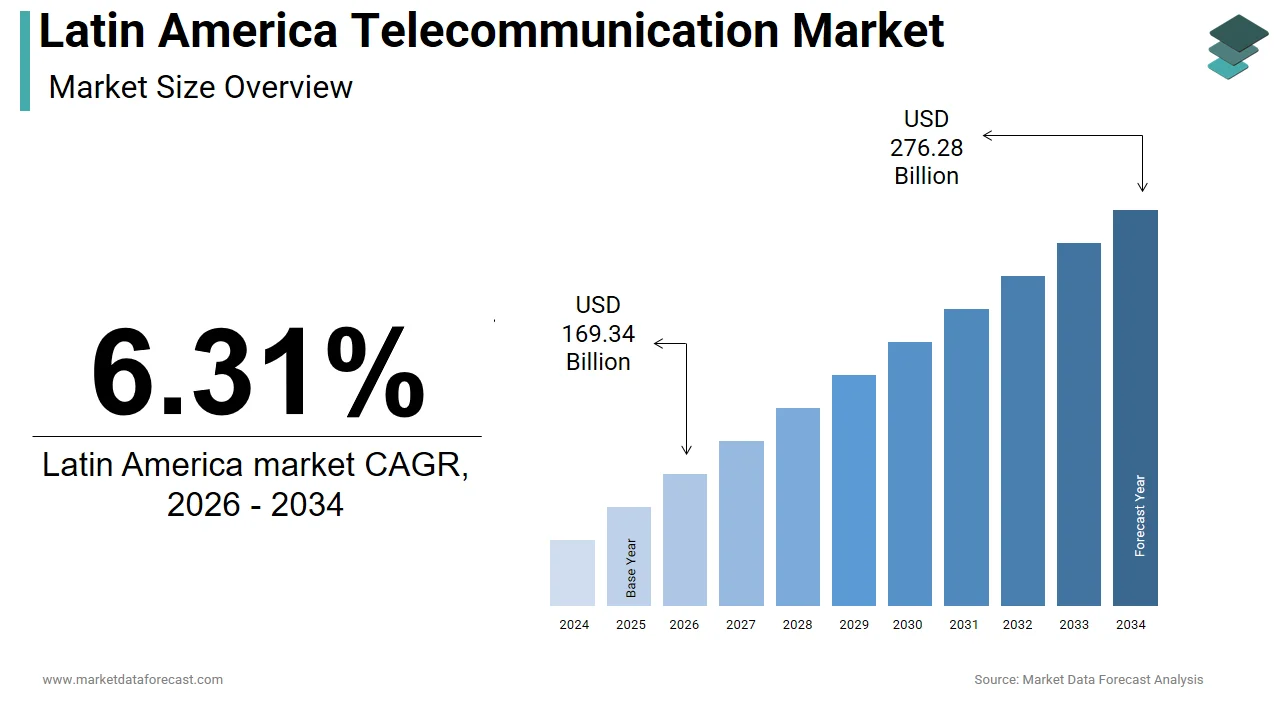
Telecommunication is an ecosystem of fixed-line, mobile, broadband, and emerging digital communication services across 20 countries, including major economies such as Brazil, Mexico, and Argentina. Characterized by rapid technological adoption and regulatory evolution, the sector serves over 700 million people, with mobile penetration exceeding 120% in several nations due to multi-SIM usage. Urban centers like São Paulo and Mexico City exhibit near-saturation in mobile connectivity, whereas rural and indigenous regions face persistent infrastructure deficits.
MARKET DRIVERS
Accelerated Demand for Mobile Data Driven by Digital Lifestyle Expansion
The surge in mobile data consumption across Latin America is fundamentally reshaping telecommunication infrastructure investment and service delivery models. As smartphone adoption climbs, fueled by affordable handsets and digital financial inclusion, users increasingly rely on mobile networks for e-commerce, remote education, and telehealth. Like, mobile data traffic in the region grew notably between 2022 and 2023. This behavioral shift is particularly pronounced among younger demographics; in Colombia, most individuals aged 15–35 use mobile apps for daily banking. The demand for uninterrupted streaming, social media, and cloud-based services compels operators to enhance network capacity and coverage, directly stimulating capital expenditure and technological upgrades across the sector.
Government-Led Digital Inclusion Initiatives Bridging Connectivity Gaps
Public sector interventions aimed at reducing the digital divide are catalyzing telecommunication expansion, particularly in historically underserved regions. National broadband plans in countries like Peru and Chile have prioritized fiber-optic deployment and subsidized internet access for schools and public institutions. These initiatives often involve public-private partnerships, enabling operators to expand into low-density areas with reduced financial risk. Besides, regulatory reforms in Argentina have streamlined spectrum allocation, accelerating rural 4G rollout. Such policy momentum not only expands market reach but also fosters long-term customer acquisition in previously unviable territories.
MARKET RESTRAINTS
Persistent Infrastructure Gaps in Rural and Marginalized Regions
Vast segments of Latin America remain disconnected due to inadequate physical infrastructure. Geographic challenges, including the Amazon rainforest, Andean mountain ranges, and dispersed rural populations, impede cost-effective network deployment. Also, only 35% of households in rural Honduras have access to fixed broadband, compared to 68% in urban zones. In Bolivia, many indigenous communities lack reliable mobile coverage. The high capital intensity of extending fiber or cellular towers into remote areas discourages private investment without state subsidies. Moreover, inconsistent electricity supply in regions like northern Guatemala further undermines network reliability. These structural limitations constrain service scalability and hinder the realization of universal connectivity goals.
Regulatory Fragmentation and Spectrum Allocation Delays
The telecommunication landscape in Latin America is hampered by inconsistent regulatory frameworks across jurisdictions, creating operational inefficiencies for multinational operators. Spectrum auctions, critical for 5G and advanced network deployment, frequently face delays due to bureaucratic hurdles and political instability. In Ecuador, the 2023 spectrum auction was postponed twice due to legal disputes, as documented by the Regional Association of Telecommunication Regulators of the Americas (REGULATEL). Similarly, Peru’s spectrum licensing process took over 18 months to finalize, delaying network modernization. This fragmentation increases compliance costs, slows innovation, and deters foreign direct investment in next-generation infrastructure.
MARKET OPPORTUNITIES
Expansion of 5G Networks in High-Density Urban Corridors
The gradual rollout of 5G technology in metropolitan hubs presents a transformative opportunity for enhanced connectivity and industrial digitization. Major cities such as Santiago, Bogotá, and Monterrey are witnessing early adoption, driven by demand for ultra-low latency applications in smart transportation, telemedicine, and augmented reality. As per Ericsson’s Mobility Report 2024, 5G subscriptions in Latin America are projected to reach 120 million by 2028, up from 18 million in 2023, representing a compound annual growth rate of 38%. Operators like América Móvil and Telefónica are investing heavily in millimeter-wave spectrum and network slicing capabilities. Furthermore, 5G-enabled IoT deployments in sectors like logistics and manufacturing are gaining traction.
Satellite-Based Connectivity Solutions for Remote Areas
The emergence of low Earth orbit (LEO) satellite constellations is unlocking unprecedented access to broadband in geographically isolated regions. Companies such as Starlink have begun commercial operations in countries including Brazil, Chile, and Argentina, offering high-speed internet where terrestrial networks are unfeasible. In Brazil, Starlink adoption is growing rapidly. With fiber deployment costs per kilometer in remote areas is high, satellite solutions offer a scalable alternative. Regulatory approvals for non-geostationary satellite networks are expanding, enabling new entrants to address the region’s persistent connectivity gap.
MARKET CHALLENGES
Cybersecurity Vulnerabilities in Expanding Digital Networks
As telecommunication networks grow in complexity and reach, they become increasingly susceptible to cyber threats, particularly in nations with underdeveloped cybersecurity frameworks. Latin America experienced an increase in ransomware attacks targeting telecom operators between 2022 and 2023. In Brazil, a 2023 breach at a major carrier exposed personal data of over 50 million users, highlighting systemic vulnerabilities. The region’s average spending on cybersecurity remains below 3% of IT budgets, far under the global benchmark of 7%, as per the Inter-American Development Bank. With 5G and IoT adoption increasing the attack surface, insufficient encryption standards and legacy systems pose critical risks. Strengthening cyber resilience requires coordinated regulatory action, workforce training, and cross-border threat intelligence sharing.
Economic Volatility and Currency Instability Affecting Investment Cycles
Macroeconomic instability across several Latin American nations directly impacts the financial viability of long-term telecommunication projects. High inflation rates, fluctuating exchange rates, and sovereign debt pressures constrain both public funding and private capital allocation. In Argentina, annual inflation exceeded 200% in 2023, severely eroding the purchasing power of consumers and increasing the cost of imported network equipment, as reported by the International Monetary Fund. Similarly, depreciation of the Colombian peso against the U.S. dollar in 2023 raised procurement expenses for fiber-optic. These conditions deter foreign investors seeking predictable returns, leading to delayed infrastructure rollouts. Operators are increasingly adopting hedging strategies and localized supply chains to mitigate financial exposure in volatile markets.
REPORT COVERAGE
| REPORT METRIC | DETAILS |
| Market Size Available | 2025 to 2034 |
| Base Year | 2025 |
| Forecast Period | 2026 to 2034 |
| Segments Covered | By Product, Service Type, Application, Transmission, and Region. |
| Various Analyses Covered | Global, Regional and Country-Level Analysis, Segment-Level Analysis, Drivers, Restraints, Opportunities, Challenges; PESTLE Analysis; Porter’s Five Forces Analysis, Competitive Landscape, Analyst Overview of Investment Opportunities |
| Countries Covered | Brazil, Mexico, Argentina, Chile, Rest of Latin America |
| Market Leaders Profiled | Qualcomm Technologies, Nokia, Huawei, Ericsson, Mimosa Networks Inc., Cohere Technologies Inc., Siklu Communication, AT&T Inc., Verizon Communications Inc., Cisco, Arqiva, Cellular South Inc., Orange S.A., United States Cellular Corporation, and Others. |
SEGMENTAL ANALYSIS
By Product Insights
The mobile data segment stood as the biggest product type in the Latin America telecommunication market by commanding an estimated 48.3% of total revenue in 2024. This dominance is primarily driven by the explosive demand for high-speed internet access across both urban and semi-urban populations. The proliferation of affordable smartphones has significantly amplified data consumption, with a high percentage of internet users in the region accessing services via mobile devices. Streaming platforms, social media, and digital banking applications now account for more than 60% of mobile data traffic, reinforcing reliance on robust cellular networks. Additionally, the expansion of 4G LTE coverage has enabled seamless broadband experiences, further entrenching mobile data as the backbone of digital engagement across Latin America.
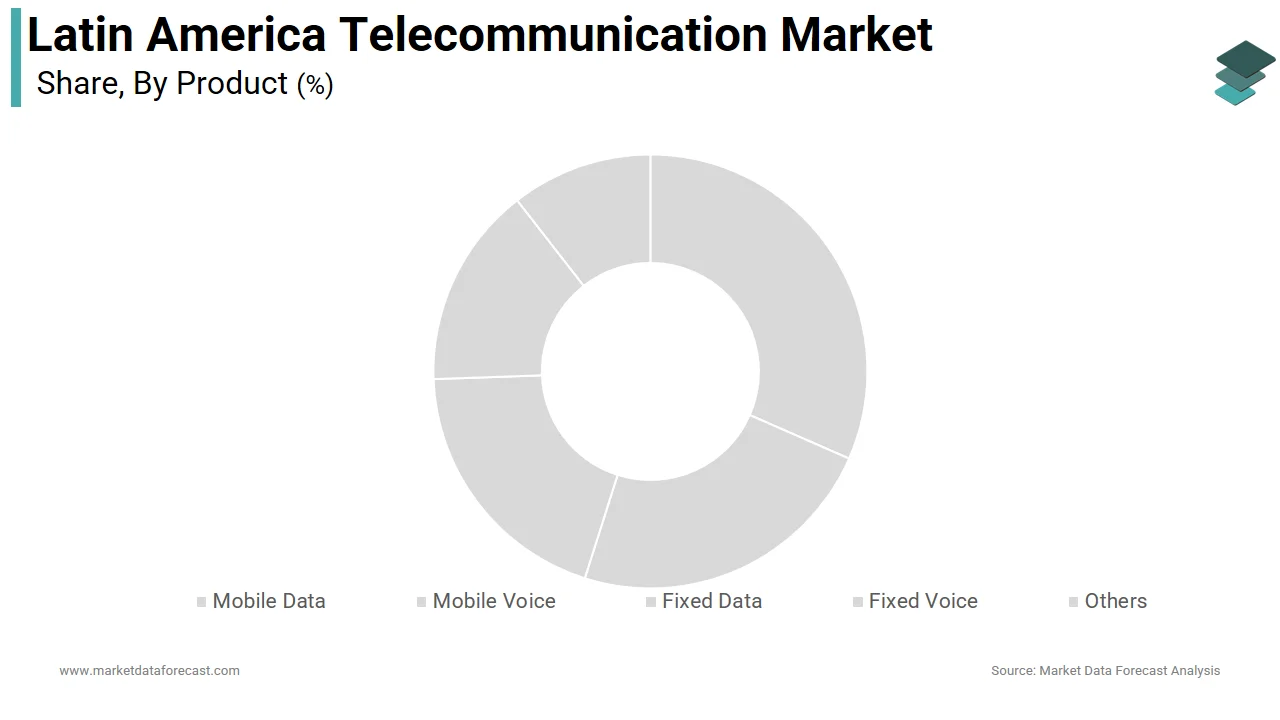
The fixed data segment is the fastest-growing in the market and is projected to expand at a CAGR of 7.3% from 2026 to 2034. This surge is fueled by increasing demand for stable, high-capacity internet connections in both residential and business environments. The shift toward remote work and hybrid education models has intensified the need for reliable fiber-to-the-home (FTTH) and cable broadband services. In Chile, fixed broadband penetration rose significantly in 2023. Moreover, government-backed fiber deployment initiatives, such as Brazil’s “Plano Nacional de Banda Larga,” have accelerated infrastructure rollout, particularly in underserved municipalities. As enterprises adopt cloud computing and IoT systems, the necessity for low-latency, high-availability fixed networks continues to escalate, positioning Fixed Data as the most dynamically expanding product category.
By Service Type Insights
The basic communication segment remained the dominant service type in the Latin American telecommunication sector by capturing 65.2% of total service revenue in 2024. This segment, encompassing voice calls, SMS, and standard mobile data plans, continues to dominate due to its foundational role in personal and business connectivity. The region’s vast subscriber base relies heavily on entry-level and prepaid packages, especially in lower-income demographics. In countries like Guatemala and Bolivia, a high percentage of mobile users operate on prepaid plans. Furthermore, despite the rise of over-the-top (OTT) messaging, traditional SMS and voice services remain critical for financial alerts, public service notifications, and customer service interactions, particularly in areas with limited smartphone penetration.
The Value-added Services (VAS) segment is the fastest-growing and is anticipated to grow at a CAGR of 9.1% between 2025 and 2033. This acceleration stems from rising consumer demand for digital convenience and personalized telecom offerings. Mobile financial services, such as carrier-billed payments and mobile wallets, are gaining traction. In Colombia, mobile operators have integrated VAS platforms offering music streaming, cybersecurity tools, and cloud storage, leading to an increase in ARPU from value-added subscriptions. Additionally, partnerships between telecom providers and OTT platforms, such as Telmex’s bundling of Netflix with broadband plans, are enhancing service differentiation and customer retention, driving rapid monetization beyond traditional connectivity.
By Application Insights
The Residential application segment prevailed in the Latin America telecommunication market by accounting for 57.1% of total revenue in 2024. This dominance is because of the region’s massive consumer base and the growing integration of digital services into everyday household activities. With over 220 million households across Latin America, increasing adoption of smart devices, video conferencing, and online entertainment has intensified demand for reliable home connectivity. In Mexico, residential broadband subscriptions saw a year-on-year increase. Moreover, the expansion of bundled services, combining internet, television, and fixed-line telephony, has enhanced affordability and accessibility, particularly in middle-income urban areas. The persistence of high mobile penetration further solidifies the residential sector as the primary revenue engine for telecom operators.
The Commercial application segment is experiencing the fastest growth and is projected to grow at a CAGR of 8.6% from 2026 to 2034. This acceleration is driven by digital transformation across small and medium enterprises (SMEs) and large corporations alike. As businesses adopt cloud-based ERP systems, VoIP telephony, and secure enterprise networks, demand for dedicated internet lines and managed services has surged. Additionally, the rise of industrial IoT in sectors such as logistics and agriculture, particularly in Chile’s mining industry and Argentina’s agribusiness, is increasing reliance on private LTE and 5G-enabled networks. With governments promoting digital entrepreneurship and fintech innovation, commercial telecom services are becoming indispensable for operational efficiency and market competitiveness.
COUNTRY-LEVEL ANALYSIS
Brazil Telecommunication Market Insights
Brazil occupied a preeminent position in the Latin American telecommunication market by representing 34.6% of the regional share in 2024. The country’s telecom sector is characterized by high mobile penetration, with over 250 million subscriptions serving a population of 215 million, reflecting widespread multi-SIM usage. The expansion of 5G services, launched in major cities in 2022, has accelerated data consumption, with mobile data traffic increasing. Additionally, public-private partnerships under the “Internet para Todos” initiative have extended broadband access to remote Amazonian communities. Regulatory stability and a competitive operator landscape, led by Vivo, Claro, and TIM, continue to drive investment, positioning Brazil as both the largest and most technologically advanced market in the region.
Mexico Telecommunication Market Insights
Mexico is also a major player in Latin America’s telecommunication market. The country’s market is defined by robust infrastructure development and rising digital inclusion efforts. Fixed broadband subscriptions reached a key level in 2023, with fiber-optic connections growing. América Móvil, through its Claro and Telmex brands, dominates both mobile and fixed services, while regulatory reforms have encouraged competition in underserved areas. The government’s “México Conectado” program has equipped over 100,000 public institutions with high-speed internet. Furthermore, cross-border data center investments by firms like Digital Realty and Equinix highlight Mexico’s strategic role as a digital gateway between North and Latin America, reinforcing its telecom sector’s structural strength.
Argentina Telecommunication Market Insights
Argentina holds a significant share of the regional telecommunication market. Despite economic volatility, the sector has demonstrated resilience, with mobile penetration reaching 135% in 2023 due to multi-device usage. The government’s “Argentina Digital 2024” strategy has prioritized fiber-optic expansion, resulting in an increase in FTTH subscriptions between 2022 and 2023. Buenos Aires has emerged as a regional hub for tech startups, increasing demand for high-speed commercial connectivity. However, inflation and currency devaluation have constrained capital investment, leading operators to focus on cost optimization. Nevertheless, regulatory improvements and rising demand for digital services in education and healthcare continue to sustain moderate growth in both residential and enterprise segments.
Chile Telecommunication Market Insights
Chile commands a notable share of the Latin American telecommunication market. The country stands out for its advanced regulatory framework and high connectivity standards. Fixed broadband penetration is among the highest in the region. Santiago has implemented smart city initiatives leveraging IoT and fiber networks, driving demand for integrated services. The competitive market, featuring Entel, WOM, and Claro, has led to aggressive pricing and innovation. Additionally, Chile’s stable macroeconomic environment has attracted foreign investment in submarine cable landings, such as the EllaLink and Seabras-1 systems, enhancing its role as a regional digital interconnection hub.
COMPETITIVE LANDSCAPE
The competition in the Latin America telecommunication market is intense, shaped by a mix of regional giants and agile national operators vying for dominance across mobile, fixed, and digital services. Market dynamics are influenced by rapid technological shifts, regulatory diversity, and uneven infrastructure development across countries. Incumbents like América Móvil and Telefónica face pressure from disruptive players such as WOM in Chile and Megacable in Mexico, who leverage aggressive pricing and superior network performance. Spectrum availability and digital policy reforms further intensify rivalry, particularly in 5G deployment. Operators are differentiating through service innovation, including bundled offerings, cybersecurity, and fintech integration. The competitive landscape is also evolving with the entry of satellite internet providers and hyperscalers, compelling traditional telcos to redefine their value propositions and accelerate digital transformation to maintain relevance.
KEY MARKET PLAYERS
Some of the noteworthy companies in the Latin America telecommunication market profiled in this report are
- Qualcomm Technologies
- Nokia
- Huawei
- Ericsson
- Mimosa Networks Inc.
- Cohere Technologies Inc.
- Siklu Communication
- AT&T Inc.
- Verizon Communications Inc.
- Cisco
- Arqiva
- Cellular South Inc.
- Orange S.A.
- United States Cellular Corporation
- Telus Corporation
- Telefónica S.A.
- Mobile Telephone Networks
- Swisscom
- Hrvatski Telekom
- Gio
- Vodafone
- Airtel
- Idea
- EE
- Spectrum
- T-Mobile
- Rogers Communications Inc.
- Time Warner Cable Inc.
- DirecTV Group
- Sprint Corporation
- China Mobile
- Deutsche Telekom
- SoftBank Group Corp.
- Nippon Telegraph & Telephone Corp.
- América Móvil
- China Telecom
TOP LEADING PLAYERS IN THE MARKET
- América Móvil, headquartered in Mexico, operates under leading brands such as Claro, Telmex, and Embratel across Latin America. The company has significantly advanced network modernization by expanding 5G deployment in high-density urban centers, including Bogotá, Santiago, and São Paulo. It launched Claro Pay in multiple countries, enabling mobile-based financial transactions for unbanked populations. The company continues to drive digital inclusion via public-private partnerships, supporting government connectivity programs in remote regions and reinforcing its role as a pivotal enabler of regional digital transformation.
- Telefónica, a Spain-based multinational, maintains a robust presence in Latin America through its Movistar brand in countries including Brazil, Argentina, Chile, and Colombia. The company has prioritized network resilience and digital innovation, launching commercial 5G services in key metropolitan areas since 2022. It has also expanded its fiber footprint, doubling FTTH connections in Chile and Peru over two years. Through its Tech for Good initiative, Telefónica supports digital literacy programs and connects public institutions. The company has streamlined operations by divesting non-core assets and focusing on converged services, integrating broadband, IoT, and cybersecurity solutions to meet evolving enterprise and consumer demands across the region.
- Embratel, a major Brazilian telecommunication provider, plays a critical role in delivering enterprise-grade connectivity and digital infrastructure across Latin America. It operates one of the largest fiber-optic backbones in South America, supporting high-capacity data transmission for businesses, government agencies, and cloud providers. In recent years, Embratel has intensified its focus on hybrid cloud solutions and secure enterprise networks, partnering with AWS and Microsoft Azure to offer integrated cloud connectivity services. The company has also expanded its data center footprint in Rio de Janeiro and Brasília, catering to growing demand for localized data storage and processing, particularly amid tightening data sovereignty regulations across the region.
TOP STRATEGIES USED BY KEY MARKET PARTICIPANTS
Key players in the Latin America telecommunication market are deploying multi-faceted strategies to consolidate their competitive edge. Network modernization remains a primary focus, with operators investing heavily in 5G rollout and fiber-optic expansion to meet escalating data demands. Strategic partnerships with technology vendors such as Ericsson and Huawei enable faster deployment of cloud-native core networks. Companies are increasingly adopting convergence models, bundling mobile, fixed, TV, and digital services to improve customer retention and average revenue per user. Market participants are also entering the fintech space, launching mobile wallets and carrier billing solutions to tap into the unbanked population. Additionally, operators are pursuing asset optimization by selling tower portfolios to infrastructure funds and reinvesting in high-growth digital services, ensuring long-term sustainability in a highly competitive environment.
RECENT MARKET DEVELOPMENTS
- In January 2023, Telefónica launched commercial 5G services in Argentina and Uruguay, enhancing network speed and capacity in major urban centers and supporting digital transformation for businesses and consumers across the Southern Cone region.
- In June 2023, América Móvil expanded its fiber-optic network in Colombia, connecting over 500,000 additional homes and businesses, significantly improving broadband access and reinforcing its leadership in converged service delivery.
- In September 2023, Embratel inaugurated a new Tier IV data center in São Paulo, increasing its cloud and colocation capacity to meet rising enterprise demand for secure, low-latency digital infrastructure in Brazil.
- In February 2024, Claro launched Claro Pay in Peru, a mobile financial service enabling digital transactions for unbanked populations, thereby expanding its value-added service portfolio and deepening customer engagement.
- In May 2024, Telefónica partnered with Microsoft to deploy Azure Private Edge Zones in Chile, enabling enterprises to run cloud applications with ultra-low latency and high security, strengthening its position in the B2B digital services segment.
MARKET SEGMENTATION
This Latin America telecommunication market research report is segmented and sub-segmented into the following categories.
By Product
- Mobile Data
- Mobile Voice
- Fixed Data
- Fixed Voice
- Others
By Service Type
- Basic Communication
- Value-added
By Application
- Residential
- Commercial
By Transmission
- Wireline
- Wireless
By Country
- Brazil
- Mexico
- Argentina
- Chile
- Rest of Latin America