- Product Description Description
- Table of Contents TOC
- List of Table & Figure LOT
- Get Free Sample PDF Sample PDF
Market Size, 2025
$23.52 BnMarket Estimate, 2026
$25.14 BnMarket Forecast, 2034
$42.88 BnCAGR, 2026–2034
6.9%Executive Summary: Latin America Cybersecurity Market
- Market Scope: Regional analysis of Latin America's cybersecurity sector, detailing security types, hardware/solution components, cloud-based and on-premise deployments, end-user verticals, and country-level profiles.
- Market Valuation: Valued at USD 25.14 billion in 2026, and projected to expand to USD 42.88 billion by 2034, growing at a robust CAGR of 6.9% from 2026 to 2034.
- Primary Growth Drivers: Accelerated digital transformation, rapid fintech and mobile banking expansion, and rising government investments in national cybersecurity infrastructure.
Key Market Segment Metrics
| Category | Leading Segment (Base Position) | Fastest-Growing / High-Growth Segment |
|---|---|---|
| By Security Type | Network Security (held leading share in 2026, driven by high frequencies of network threats, firewalls, and digital infrastructure demands) | Cloud Security (projected at an 18.7% CAGR, fueled by enterprise workload migrations to cloud and SaaS environments) |
| By Component | Solution (captured dominant market share in 2026, backed by advanced threat detection, EDR, IAM, and AI-driven security tools) | Hardware (projected at a 14.3% CAGR, driven by critical infrastructure modernization and hardened ICS/SCADA network defenses) |
| By End User | BFSI (dominated market share in 2026, supported by massive digital banking transactions and compliance mandates like LGPD) | Healthcare (projected at a 19.5% CAGR, propelled by electronic health records digitization and increasing ransomware threats) |
| By Country | Brazil (market leader with the largest share in 2026, backed by the E-Ciber strategy, LGPD, and robust enterprise investments) | Chile (positioning as a progressive regional leader with strong regulatory transparency, mandatory incident reporting, and policy maturity) |
Major Market Players & Industry Landscape
Market Structure: Highly fragmented and competitive ecosystem featuring global tech giants alongside regional providers and agile startups, all focusing on advanced threat intelligence and cloud-native security models.
Key Companies: IBM, Cisco Systems, Fortinet, Palo Alto Networks, Check Point Software, Trend Micro, Broadcom (Symantec), Softtek, Módulo, and Digiware.
 Download Free Sample Report
Latin America Cybersecurity Market Size
The size of the Latin America cybersecurity market was valued at USD 23.52 billion in 2025. This market is expected to grow at a CAGR of 6.9% from 2026 to 2034 and be worth USD 42.88 billion by 2034 from USD 25.14 billion in 2026.

Cybersecurity is a wide range of technologies, services, and solutions aimed at protecting digital infrastructure, networks, and data from cyber threats. As digital transformation accelerates across industries such as banking, healthcare, government, and telecommunications, the need for robust cybersecurity measures has become increasingly critical. The region’s growing reliance on cloud computing, mobile banking, and internet-connected devices has heightened exposure to cyberattacks, prompting both public and private entities to invest in advanced security frameworks.
According to the Organization of American States (OAS), governments across Latin America are increasingly recognizing the strategic importance of cybersecurity in safeguarding national interests and economic stability. As per the Economic Commission for Latin America and the Caribbean (ECLAC), several countries have introduced national cybersecurity strategies to strengthen institutional resilience and foster cross-border cooperation in threat intelligence sharing.
Besides, rising awareness among enterprises regarding data privacy regulations such as Brazil’s General Data Protection Law (LGPD) has contributed to stronger demand for compliance-driven security solutions. According to the United Nations Conference on Trade and Development (UNCTAD), increasing digital inclusion initiatives and expanding fintech ecosystems are further shaping the region’s cybersecurity landscape.
MARKET DRIVERS
Digital Transformation and Expansion of Financial Technology (Fintech)
The rapid pace of digital transformation, particularly in the financial sector where fintech adoption has surged in recent years is one of the most significant drivers influencing the Latin America cybersecurity market. According to the Inter-American Development Bank (IDB), Latin America has emerged as one of the fastest-growing fintech hubs globally, with over 1,500 active startups operating in the region by the end of 2023. This growth has been fueled by increased smartphone penetration, widespread use of mobile payments, and government-backed financial inclusion initiatives. Similarly, Mexico and Colombia have seen a proliferation of neobanks and digital lending platforms, all of which depend heavily on cybersecurity to protect sensitive user data and prevent fraud. Moreover, traditional banks have also embraced digital banking services, leading to an expanded attack surface vulnerable to phishing, ransomware, and data breaches. Like, cybercrime targeting financial institutions in Latin America increased, reinforcing the urgency for enhanced security protocols.
Rising Government Investments in National Cybersecurity Infrastructure
The growing commitment of national governments to strengthen digital defense mechanisms through dedicated investments and policy reforms is another key driver of the Latin America cybersecurity market. Also, more than ten Latin American countries updated or launched new national cybersecurity strategies between 2020 and 2023, reflecting a heightened focus on digital sovereignty and cyber resilience. Brazil, for instance, has taken notable steps through the implementation of the National Cybersecurity Strategy (E-Ciber), which outlines comprehensive measures for securing critical infrastructure and enhancing public-private collaboration. According to the Ministry of Justice and Public Security, in 2023, Brazil allocated additional funding to establish regional cybersecurity operation centers, aimed at detecting and responding to cyber threats in real-time. Similarly, Mexico has prioritized cybersecurity within its national development plan, with the Secretariat of Communications and Transportation emphasizing the need for coordinated incident response frameworks. In addition, international organizations such as the World Bank and the International Telecommunication Union (ITU) have supported capacity-building efforts in countries like Peru, Ecuador, and El Salvador, helping them develop institutional frameworks for cyber threat mitigation.
MARKET RESTRAINTS
Limited Cybersecurity Awareness and Skilled Workforce Shortages
The limited awareness and understanding of cyber threats among businesses, especially small and medium-sized enterprises (SMEs), is a major restraint affecting the Latin America cybersecurity market. One of the primary challenges is the shortage of trained cybersecurity professionals, which hampers the ability of organizations to implement and manage effective security measures. The Economic Commission for Latin America and the Caribbean (ECLAC) brought to light that in 2023, there were few certified cybersecurity experts across the entire region, compared to in the United States. Furthermore, educational institutions have been slow to integrate cybersecurity into mainstream curricula, limiting the availability of skilled talent. This skills gap is exacerbated by the low level of investment in employee training and internal cyber risk management, particularly in sectors such as retail, logistics, and manufacturing.
Fragmented Regulatory Frameworks and Policy Gaps
Fragmented regulatory frameworks and inconsistent enforcement of cybersecurity policies pose a significant challenge to the Latin America cybersecurity market. Unlike the European Union’s harmonized GDPR framework, Latin American countries maintain disparate legal and compliance requirements, making it difficult for multinational firms to deploy uniform security strategies. According to the United Nations Conference on Trade and Development (UNCTAD), only a handful of Latin American nations have fully implemented comprehensive data protection laws, while others rely on outdated or sector-specific regulations. In Argentina, despite the existence of a national data protection law, enforcement remains weak, with limited penalties for non-compliance. Also, cross-border data transfer regulations vary widely, complicating operations for global enterprises seeking to establish cloud-based services in multiple Latin American markets. The Pan American Health Organization (PAHO) emphasized that inconsistent cybersecurity legislation across the region creates vulnerabilities in health information systems, delaying the implementation of secure telehealth platforms.
MARKET OPPORTUNITIES
Expansion of Cloud-Based Security Solutions Across Enterprises
The growing adoption of cloud-based security solutions, driven by the increasing shift toward digital transformation and remote work environments is a significant opportunity emerging in the Latin America cybersecurity market. Cloud computing adoption in Latin America grew in 2023, necessitating advanced security measures to protect data stored in distributed environments. Businesses across sectors such as banking, healthcare, and e-commerce are increasingly investing in cloud-native security tools, including Zero Trust Architecture, Secure Access Service Edge (SASE), and endpoint detection and response (EDR) solutions. Moreover, governments and regulatory bodies are promoting cloud security compliance frameworks, encouraging organizations to adopt secure cloud practices.
Rise of Cybersecurity Startups and Innovation Hubs
The rise of cybersecurity startups and innovation hubs represents a compelling opportunity for the Latin America cybersecurity market. As cyber threats evolve, venture capital interest in homegrown tech solutions has surged, fostering a new wave of entrepreneurial ventures focused on adaptive security technologies. The influx of capital has enabled innovative firms to develop cutting-edge products ranging from AI-powered threat detection to decentralized identity management systems. Brazil has emerged as a hotspot for cybersecurity entrepreneurship, with São Paulo hosting numerous startup incubators and accelerators specializing in digital security. Meanwhile, Colombia and Chile are actively promoting technology clusters and offering tax incentives to attract cybersecurity entrepreneurs. These initiatives are stimulating job creation and also contributing to the region’s capability to develop localized solutions tailored to Latin American threat landscapes.
MARKET CHALLENGES
Increasing Sophistication and Frequency of Cyberattacks
The escalating sophistication and frequency of cyberattacks targeting both public and private institutions is a major challenge facing the Latin America cybersecurity market. As digital transformation progresses, cybercriminal groups are leveraging more advanced tactics, including ransomware, business email compromise (BEC), and supply chain intrusions, to exploit vulnerabilities in enterprise and government networks. According to the Organization of American States (OAS), Latin America experienced a 35% increase in high-impact cyber incidents in 2023, with Brazil, Mexico, and Argentina being the most targeted economies. The Brazilian Computer Emergency Response Team (CERT-BR) recorded over 900,000 cyberattack reports in 2023, indicating a rapidly expanding threat landscape. These attacks have had severe implications, including operational disruptions, financial losses, and compromised citizen data. According to the Mexican National Security Commission (CNS), in 2023, multiple state-owned utilities suffered ransomware attacks that temporarily disrupted energy distribution, highlighting the growing impact of cyber warfare on critical infrastructure. Furthermore, the lack of centralized threat intelligence-sharing platforms across Latin American countries limits the effectiveness of collective defense mechanisms.
Underdeveloped Legal and Enforcement Mechanisms
Underdeveloped legal and enforcement mechanisms represent a fundamental challenge to the Latin America cybersecurity market, impeding the effective prosecution and deterrence of cybercriminal activities. Despite growing awareness of cyber threats, many countries in the region lack comprehensive legal frameworks to address digital crimes, resulting in low conviction rates and minimal consequences for perpetrators. According to the United Nations Office on Drugs and Crime (UNODC), only six Latin American countries have fully operational cybercrime units equipped with forensic capabilities and investigative expertise, limiting the capacity to track and prosecute cybercriminals effectively. Moreover, legal ambiguities around data jurisdiction, digital evidence handling, and cross-border investigations hinder international cooperation. Moreover, limited judicial understanding of digital crime further complicates case resolution.
REPORT COVERAGE
| REPORT METRIC | DETAILS |
| Market Size Available | 2025 to 2034 |
| Base Year | 2025 |
| Forecast Period | 2026 to 2034 |
| Segments Covered | By Security Type, Component, Deployment, End User, and Region. |
| Various Analyses Covered | Global, Regional, and Country-Level Analysis, Segment-Level Analysis, Drivers, Restraints, Opportunities, Challenges; PESTLE Analysis; Porter’s Five Forces Analysis, Competitive Landscape, Analyst Overview of Investment Opportunities |
| Countries Covered | Brazil, Mexico, Argentina, Chile, Rest of Latin America |
| Market Leaders Profiled | IBM, Cisco Systems, Fortinet, Palo Alto Networks, Check Point Software, Trend Micro, Broadcom (Symantec), Softtek, Módulo, and Digiware. |
SEGMENTAL ANALYSIS
By Security Type Insights
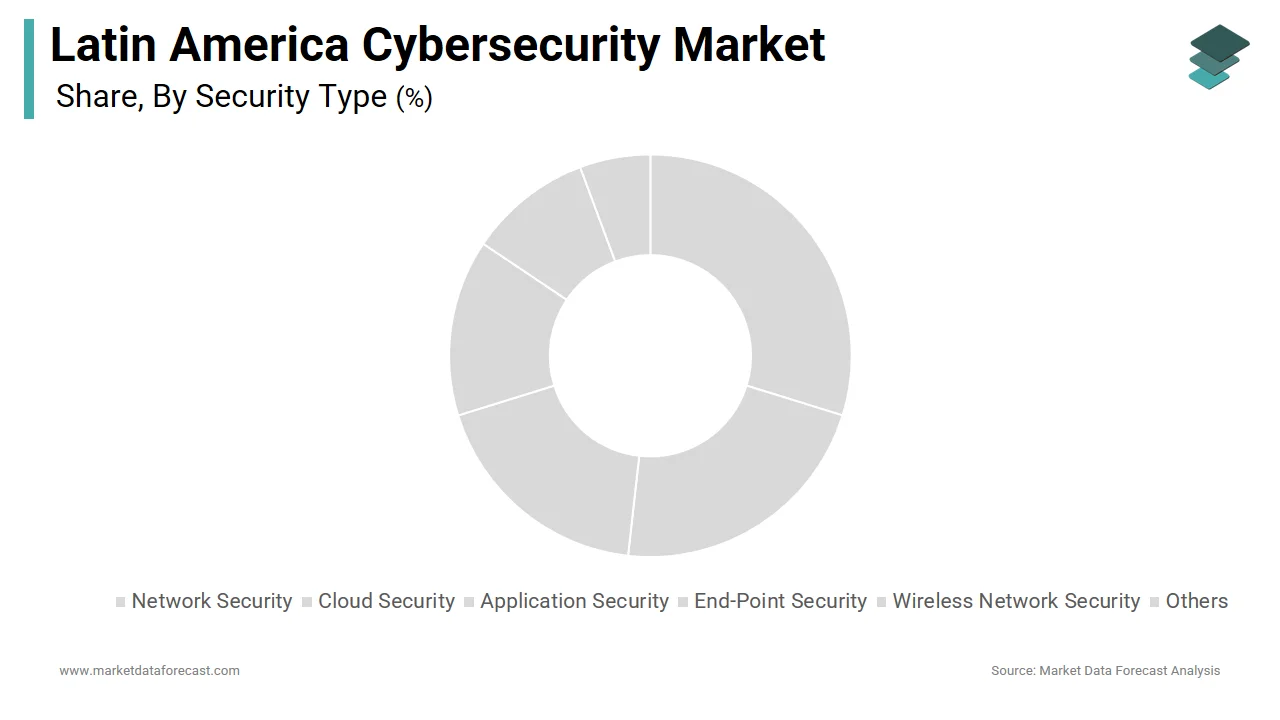
The network security segment held the largest share in the Latin America cybersecurity market and accounted for 34.5% of total revenue in 2024. The dominance of the network security segment is primarily attributed to the increasing frequency of network-based cyber threats such as distributed denial-of-service (DDoS) attacks, malware propagation, and unauthorized access attempts. A further key driver behind the progress of the segment is the widespread adoption of firewalls, intrusion detection systems (IDS), and secure gateways across enterprises and government institutions, particularly in Brazil and Mexico. In addition, the digitization of public infrastructure and financial services has intensified the demand for robust network protection solutions, with regulators mandating compliance with minimum security standards. Furthermore, telecom operators and internet service providers are enhancing their network security protocols to protect against large-scale cyberattacks targeting digital infrastructure.
The cloud security segment is emerging as the fastest-growing segment in the Latin America cybersecurity market and is projected to expand at a CAGR of 18.7%. The surge in cloud computing adoption across sectors such as banking, healthcare, and e-commerce, where sensitive data is increasingly stored and processed off-premises is one of the primary growth catalysts of the cloud security segment. This rapid ascent is also propelled by the accelerating migration of enterprise workloads to cloud environments and the growing reliance on Software-as-a-Service (SaaS) applications. Moreover, regulatory bodies are enforcing stricter data protection mandates for cloud-based operations, particularly in response to high-profile breaches affecting financial institutions and health records. Besides, the expansion of fintech platforms and digital banking services has amplified demand for secure cloud-native architectures, including Zero Trust models and Secure Access Service Edge (SASE) solutions. Like, public sector agencies in Mexico began adopting cloud security-as-a-service models to protect citizen data and streamline digital governance.
By Component Insights
The solutions segment constituted the prominent component of the Latin America cybersecurity market by capturing 68.7% of total market revenue in 2024. This dominance of the segment is also driven by the increasing deployment of software-driven security tools designed to detect, prevent, and respond to cyber threats across diverse industry verticals. A further key factor fueling this segment's lead position is the rising adoption of advanced threat detection and response solutions, including endpoint detection and response (EDR), identity and access management (IAM), and security information and event management (SIEM) systems. Another major enabler is the integration of artificial intelligence and machine learning into cybersecurity platforms, enabling predictive analytics and automated incident response capabilities. Additionally, cloud-native security platforms are gaining traction among SMEs seeking cost-effective and scalable protection, eliminating the need for extensive hardware investments. Also, new cybersecurity deployments in Mexico involved cloud-based solutions, signaling a shift toward flexible and adaptive security strategies tailored to evolving digital demands.
The hardware segment is the fastest-growing component in the Latin America cybersecurity market and is projected to grow at a CAGR of 14.3% through 2023. A significant growth enabler is the expansion of critical infrastructure modernization programs, particularly in energy, transportation, and defense sectors, which require hardened hardware defenses to protect industrial control systems (ICS) and supervisory control and data acquisition (SCADA) networks. While traditionally overshadowed by software solutions, hardware-based cybersecurity products such as secure routers, next-generation firewalls, and hardware security modules (HSMs) are experiencing renewed interest due to rising concerns over physical device integrity and tampering risks. Moreover, financial institutions are investing in hardware security tokens, biometric authentication devices, and encrypted storage appliances to combat sophisticated fraud schemes. In addition, enterprise demand for dedicated security appliances to safeguard remote work environments is also driving hardware adoption.
By End User Insights
The Banking, Financial Services, and Insurance (BFSI) segment dominated the Latin America cybersecurity market by holding an estimated 32.6% of total end-user expenditure in 2024. The sector’s heightened exposure to cyber threats, including ransomware, phishing, and payment fraud, necessitates continuous investment in protective measures is fuelling the progress of the BFSI segment. The rapid expansion of digital banking and mobile payment platforms, which have become prime targets for cybercriminals, also contributes to the growth of the segment. According to the Brazilian Internet Steering Committee (CGI.br), in 2023, digital banking transactions in Brazil exceeded 2 billion annually, underscoring the scale of online financial activity requiring secure infrastructure. Moreover, fintech proliferation has intensified demand for cybersecurity solutions, with startups and neobanks deploying advanced encryption, multi-factor authentication, and behavioral analytics to secure user data. Also, regulatory mandates such as Brazil’s General Data Protection Law (LGPD) and Mexico’s Data Privacy Act are compelling BFSI institutions to implement comprehensive security frameworks.
The healthcare sector is the fastest-growing end-user segment in the Latin America cybersecurity market, projected to expand at a CAGR of 19.5%. This surge of the segment is majorly fueled by the increasing digitization of medical records, telehealth expansion, and the growing number of cyberattacks targeting hospitals and health agencies. The accelerated adoption of electronic health records (EHRs) and patient data digitization, particularly in Brazil, Chile, and Colombia is an additional key driver. Another growth catalyst is the increase in ransomware attacks targeting healthcare institutions, disrupting medical services and exposing sensitive patient data. Furthermore, governments are implementing stricter cybersecurity regulations for health data handling, aligning with global standards like HIPAA.
COUNTRY LEVEL ANALYSIS
Brazil Cybersecurity Market Insights
Brazil spearheaded the Latin America cybersecurity market by an estimated 35.5% in 2024. As the region’s most digitally advanced economy, Brazil benefits from a well-established legal framework, proactive government initiatives, and a growing number of cybersecurity startups catering to both the public and private sectors. A key strength lies in the National Cybersecurity Strategy (E-Ciber), which outlines comprehensive measures for protecting critical infrastructure and fostering public-private collaboration. Moreover, in 2023, Brazil allocated additional funding to establish regional cybersecurity operation centers, aimed at detecting and responding to cyber threats in real time. Also, Brazil has been at the forefront of cybercrime legislation and enforcement, with the implementation of the General Data Protection Law (LGPD) strengthening data privacy and corporate accountability. So, Brazil remains a dominant force in shaping the cybersecurity landscape of Latin America.
Mexico Cybersecurity Market Insights
Mexico remains a significant player in the Latin America cybersecurity market, capturing approximately 25% of the regional market share in 2023, as per data from the Mexican Center for Innovation in Technology (CENIT). The country serves as a strategic hub for cybersecurity innovation and cross-border cooperation, benefiting from its proximity to the United States and integration within the USMCA trade agreement. A defining feature of Mexico’s cybersecurity landscape is the national push for digital sovereignty and infrastructure resilience, supported by the Secretariat of Communications and Transportation. Moreover, Mexico has made strides in enhancing its cybercrime response capabilities, with the Federal Police establishing a dedicated cybercrime unit to track and dismantle illicit digital networks. Besides, private-sector investment in cybersecurity is rising, particularly in financial services, manufacturing, and telecom industries.
Argentina Cybersecurity Market Insights
Argentina is maintaining a modest yet strategically important presence despite economic volatility, as per the Buenos Aires School of Economics. The country’s cybersecurity sector is shaped by policy reforms, growing awareness of digital threats, and increasing participation in regional cyber resilience efforts. A key strength lies in Argentina’s recent advancements in data protection laws, particularly the implementation of the National Data Protection Regulation, which enhances personal data safeguards and imposes stricter penalties for non-compliance. Despite macroeconomic challenges, cybersecurity spending among financial institutions and government agencies has seen steady growth, with the Buenos Aires City Government launching a municipal cybersecurity strategy to protect digital infrastructure. Apart from that, Argentina is actively participating in international cybersecurity capacity-building initiatives, particularly those led by the International Telecommunication Union (ITU) and the Organization of American States (OAS).
Chile Cybersecurity Market Insights
Chile is positioning itself as a progressive leader in regulatory transparency and digital trust, as per the Chilean National Cybersecurity Agency (ANSIBLE). The country benefits from a stable legal framework, strong intellectual property protections, and early adoption of international cybersecurity standards, making it an attractive destination for institutional investment. A defining feature of Chile’s cybersecurity landscape is the early adoption of advanced security policies, particularly in public administration and critical infrastructure protection. Also, Chile ranked first in Latin America for cybersecurity policy maturity, with mandatory incident reporting requirements and standardized threat intelligence sharing mechanisms. Additionally, Chile has taken a proactive approach to protecting financial and educational institutions from cyber threats, with the Superintendence of Finance integrating cybersecurity audits into banking compliance assessments. Moreover, Chile has emerged as a regional leader in cybersecurity education and workforce development, with several universities offering specialized cybersecurity curricula.
Rest of Latin America
The Rest of Latin America (RoLA), encompassing countries such as Colombia, Peru, Ecuador, Costa Rica, and Central American nations, collectively holds a notable share of the regional cybersecurity market share. While individually these markets are smaller, they present substantial growth potential due to increasing digitalization, rising cybercrime reports, and government-backed cybersecurity initiatives. Colombia stands out as a key contributor, with the National Cybersecurity Program (PNC) reporting that in 2023, new cybersecurity regulation enforcement boosted enterprise compliance and investment in threat detection systems. The country is also witnessing a rise in public-private partnerships to strengthen digital infrastructure, particularly in the finance and energy sectors. Meanwhile, Central American nations such as Panama and Costa Rica are attracting foreign investment in cybersecurity infrastructure, leveraging political stability and geographic advantages. With improving governance, regulatory alignment, and cross-border collaboration, RoLA is gradually strengthening its cybersecurity footprint, with international players expanding into secondary cities and underserved regions.
COMPETITIVE LANDSCAPE
The competition in the Latin America cybersecurity market is intensifying as both global technology vendors and regional players vie for influence in an environment marked by growing digitalization and increasing cyber threats. Multinational corporations such as Cisco, IBM, and Fortinet maintain a strong presence through advanced technological offerings and strategic alliances, while local firms are gaining traction by delivering cost-effective, culturally aligned solutions. The market remains highly fragmented, with varying levels of maturity across countries, influenced by regulatory environments, economic conditions, and institutional readiness.
A defining characteristic of this competitive landscape is the coexistence of enterprise-focused security providers and startups addressing niche vulnerabilities, creating a dynamic ecosystem that fosters innovation. Government agencies and financial institutions are among the top spenders, driving demand for next-generation security tools. At the same time, small and medium-sized businesses are becoming more security-conscious due to rising ransomware and phishing incidents.
Moreover, the expansion of digital banking, e-governance, and smart city initiatives has heightened the need for robust security frameworks, prompting vendors to differentiate themselves through localized service delivery, hybrid cloud security models, and rapid incident response capabilities. As cyber threats evolve, so too does the level of sophistication among market participants, making adaptability and agility essential traits for long-term competitiveness.
KEY MARKET PLAYERS
Noteworthy Companies dominating the Latin America cybersecurity market profiled in the report are
- IBM
- Cisco Systems
- Fortinet
- Palo Alto Networks
- Check Point Software
- Trend Micro
- Broadcom (Symantec)
- Softtek
- Módulo
- Digiware
TOP LEADING PLAYERS IN THE MARKET
- Cisco is a dominant player in the Latin America cybersecurity market, offering a comprehensive portfolio of network security solutions, including firewalls, intrusion prevention systems, and secure access services. The company plays a crucial role in securing enterprise and government networks across Brazil, Mexico, and Colombia. Cisco’s integration of AI-driven threat detection and its emphasis on Zero Trust architecture has made it a trusted partner for organizations seeking scalable and intelligent security frameworks.
- IBM Security is a key contributor to the Latin American cybersecurity landscape, particularly in areas such as threat intelligence, data encryption, and managed security services. Its presence in the region is bolstered by advanced analytics and cognitive security platforms like QRadar, which support real-time monitoring and incident response. IBM collaborates with local governments and academic institutions to enhance cyber resilience through research and capacity-building initiatives.
- Kaspersky has established a strong foothold in Latin America by providing endpoint protection, anti-malware solutions, and consumer cybersecurity products tailored to regional needs. The company supports both individual users and SMEs with cost-effective, high-performance security tools. Kaspersky also engages in public awareness campaigns and works closely with local regulators to improve digital safety standards across the region.
TOP STRATEGIES USED BY KEY MARKET PARTICIPANTS
Key players in the Latin America cybersecurity market are adopting strategic approaches that align with evolving digital threats and regulatory demands. One of the most prevalent strategies is expanding localized operations through partnerships and joint ventures, allowing global firms to better understand regional risk landscapes and offer customized security solutions tailored to local compliance requirements.
Another critical approach is investing in education and workforce development, where companies collaborate with universities and technical institutes to build a skilled cybersecurity talent pool. These efforts include funding research programs, sponsoring certifications, and organizing cybersecurity training workshops for public sector employees and private enterprises.
Additionally, integrating cloud-native and AI-powered security technologies into existing product portfolios is a major growth strategy. Firms are increasingly deploying automated threat detection, behavioral analytics, and Secure Access Service Edge (SASE) models to meet the rising demand for agile and proactive defense mechanisms across industries such as finance, healthcare, and telecommunications.
RECENT MARKET DEVELOPMENTS
- In March 2023, Cisco launched a regional cybersecurity innovation center in Sao Paulo, Brazil, aimed at developing tailored threat detection solutions and fostering collaboration between tech experts, academic institutions, and government agencies to enhance digital resilience.
- In August 2023, IBM Security expanded its QRadar Managed Detection and Response (MDR) services to Mexico and Argentina, enabling local enterprises to leverage advanced threat intelligence and real-time monitoring without requiring large internal security teams.
- In January 2024, Kaspersky announced a partnership with a leading Chilean telecom provider to integrate endpoint protection into consumer broadband packages, expanding its reach among home users and small businesses concerned with online safety.
- In May 2024, Palo Alto Networks established a new channel partner program across Colombia and Peru, empowering local resellers with training and technical resources to deliver next-generation firewall and cloud security solutions more effectively.
- In September 2024, Check Point Software Technologies introduced a Latin America-focused version of its Infinity Platform, designed to support hybrid work environments and secure remote access for enterprises undergoing digital transformation across the region.
MARKET SEGMENTATION
This Latin America cybersecurity market research report is segmented and sub-segmented into the following categories.
By Security Type
- Network Security
- Cloud Security
- Application Security
- End-Point Security
- Wireless Network Security
- Others
By Component
- Hardware
- Solution
- Threat Intelligence and Response
- Identity and Access Management
- Data Loss Prevention
- Security and Vulnerability Management
- Intrusion Prevention System
- Others
- Services
By Deployment
- Cloud-based
- On-premise
By End User
- Banking, Financial Services, and Insurance
- Healthcare
- Manufacturing
- Retail
- Government
- IT and telecommunication
- Others
By Country
- Brazil
- Mexico
- Argentina
- Chile
- Rest of Latin America