- Product Description Description
- Table of Contents TOC
- List of Table & Figure LOT
- Get Free Sample PDF Sample PDF
Market Size, 2025
$2,192 BnMarket Estimate, 2026
$2,673 BnMarket Forecast, 2034
$13,047 MnCAGR, 2026–2034
21.92%Executive Summary: Leisure Travel Market
- Market Scope: Comprehensive global leisure travel industry analysis covering traveler types, sales channels, demographic age groups, regional leadership frameworks, and competitive landscapes.
- Market Valuation: Valued at USD 2,192 billion (2025), estimated at USD 2,673 billion (2026), and projected to reach USD 13,047 billion by 2034, registering a robust CAGR of 21.92% (2026–2034).
- Primary Growth Drivers: Rising disposable incomes, rapid digitalization, government tourism infrastructure initiatives, global outbound tourism expansion, and AI/big data analytics integration. Restraints include intense corporate competition and regulatory impacts.
Key Market Segment Metrics (2026–2034)
| Category | Leading Segment / Position | Scope / Focus Area |
|---|---|---|
| By Traveler & Channel | Solo traveler (holds major market share) and Online sales channels (dominate bookings) | Exploration trends, group vs. solo travel, and digital booking platforms |
| By Age Group | Millennials (represent the largest age group segment globally) | Demographic travel demand and experience-led tourism preferences |
| By Region / Country | Asia Pacific (holds major regional share driven by India, China, and Australia) | North America (second-largest share) and Europe (increasing value via investments) |
Major Market Players & Market Structure
Market Structure: Highly competitive global travel and tourism ecosystem driven by major corporate travel agencies, digital platforms, and customized tour operators catering to modern consumer demands.
Key Companies: Thomas Cook Limited (India), Carlson Wagonlit Travel, JTB Americas Group, World Travel, Inc., American Express Travel, Expedia Group, Priceline Group, Travel Leaders Group, TUI Group, and Cox & Kings Ltd.
Global Leisure Travel Market Size
The global leisure travel market was valued at USD 2,192 billion in 2025 and is projected to reach USD 2,673 billion in 2026 and USD 13,047 billion by 2034, growing at a CAGR of 21.92% from 2026 to 2034.
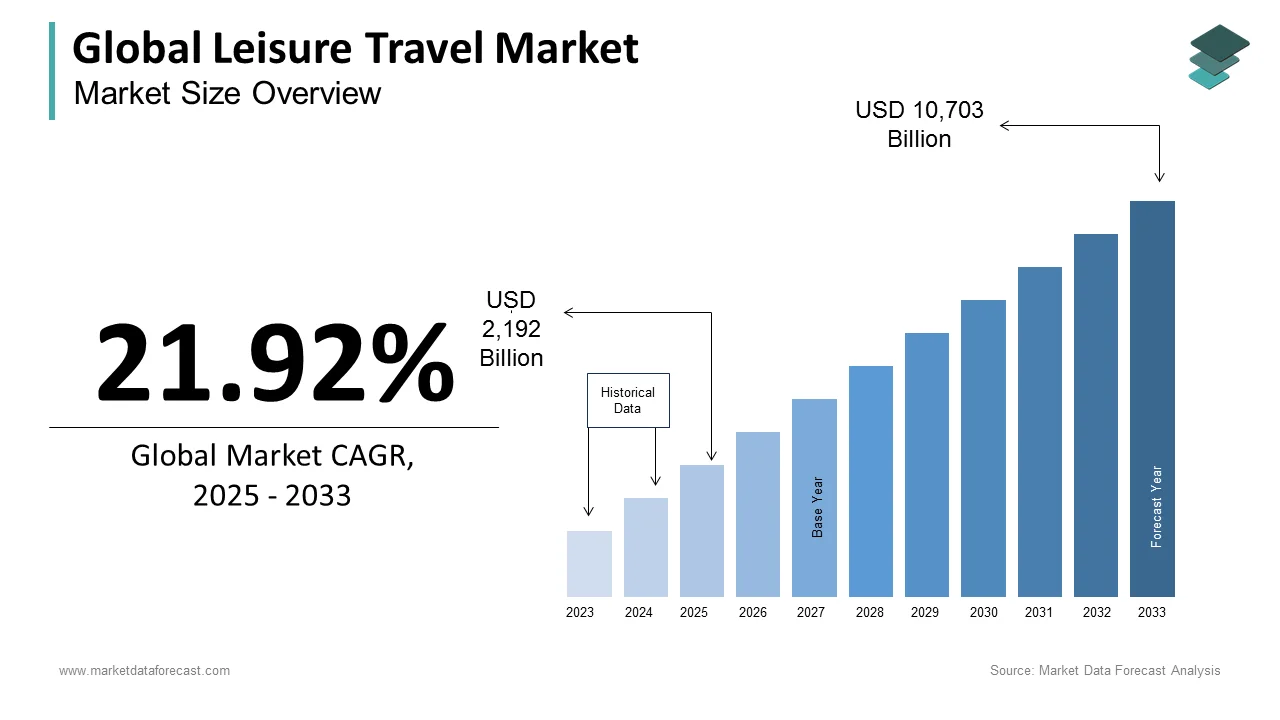
Leisure travel is any trip taken during personal free time for pleasure, relaxation, exploration, or entertainment rather than for work or mandatory duties. This market represents the discretionary consumption arm of global mobility, distinguished from corporate travel by its sensitivity to consumer confidence, seasonal patterns, and experiential value propositions rather than contractual obligations. According to the United Nations World Tourism Organization, international tourist arrivals grew 4 percent in 2025 to reach an estimated 1.52 billion global overnight visitors. As per the International Air Transport Association, global passenger traffic will more than double by 2050, maintaining a 3.6 percent compound annual growth rate driven primarily by infrastructure development and rising middle-class demand. According to the World Bank, international comparison program metrics highlight that lower-middle-income economies maintain significant structural cost discrepancies across food, transport, and essential public utilities. Unlike transactional business trips, leisure journeys involve complex emotional decision-making, longer planning horizons, and higher price sensitivity, creating distinct vendor engagement dynamics. This definition excludes commuting and mandatory relocations, focusing exclusively on voluntary movement motivated by psychological restoration, social bonding, or curiosity fulfillment within finite time and budget constraints shaped by macroeconomic conditions and sociocultural trends.
MARKET DRIVERS
Post-Pandemic Experience Prioritisation Over Material Accumulation
A fundamental shift in consumer values following a global health crisis has permanently elevated experiential spending above material goods acquisition, which drives the growth of the leisure travel market. As per the Organisation for Economic Co-operation and Development, structural shifts in post-pandemic household expenditure reflect increased consumption allocation toward personal travel and recreational hospitality services across major member economies. According to the Bureau of Economic Analysis, United States real personal consumption expenditures increased 2.8 percent in 2024, supported by solid growth in consumer spending on recreational services. As per the International Monetary Fund, global cross-border payments and services trade continued their upward trajectory throughout 2024, supported by sustained travel and digital transaction demand. Unlike cyclical recoveries, this transformation reflects generational value recalibration where Millennials and Generation Z view travel as an identity formation mechanism rather than a luxury indulgence. According to the Organisation for Economic Co-operation and Development, household net saving rates across the euro area and major member economies stabilised above historical lows in 2024 despite cost-of-living adjustments. Social media amplification creates continuous aspiration cycles where documented journeys serve as social currency reinforcing expenditure justification. This psychological reordering ensures leisure travel maintains a growth trajectory independent of traditional income elasticity models as consumers treat experiential consumption as a non-negotiable component of wellbeing rather than an optional discretionary category.
Digital Platform Democratization Reducing Planning Friction Costs
Integrated booking platforms, AI itinerary builders, and peer review ecosystems have lowered the time and mental effort needed to plan travel, which further propels the expansion of the leisure travel market. This easy process now attracts many new travellers who are not experts. According to the International Telecommunication Union, global mobile broadband subscriptions and digital platform access expanded significantly in 2024, driving greater commercial mobile usage across emerging and developed markets. As per Eurostat, 60 percent of individuals in the European Union aged 16 to 74 used the internet for travel arrangements and accommodation services. According to the United Nations World Tourism Organization, digital innovation and artificial intelligence integration are accelerating operational efficiencies across international tourism booking channels. Unlike legacy distribution, requiring specialised knowledge, modern platforms provide transparent pricing, verified reviews, and instant confirmation, creating psychological safety for first-time international travelers. User-generated content serves as a trust proxy, replacing institutional branding with authentic peer validation, lowering perceived risk for unfamiliar destinations. This technological infrastructure transforms leisure travel from a complex logistical challenge into an accessible lifestyle habit, expanding the participation base across age, income, and geographic segments previously excluded by planning complexity.
MARKET RESTRAINTS
Persistent Inflation Eroding Real Disposable Income Allocation
Core living costs continue to rise and compress household budgets, which hampers the growth of the leisure travel market. This financial pressure persists because wage increases have not kept pace with inflation since 2021. According to the International Monetary Fund, real household disposable income across several advanced economies grew moderately in 2025, driven by declining inflation and strong labour markets. As per Eurostat, services annual inflation in the euro area stood at 3.3 percent, outstripping food, alcohol, and tobacco price adjustments. According to the Federal Reserve Bank of New York, total US household credit card balances reached 1.13 trillion dollars in the fourth quarter of 2023, reflecting heightened pressure from overall consumer prices. Unlike temporary shocks, persistent inflation forces structural tradeoffs where families reduce trip frequency, duration, or destination tier rather than eliminate travel, degrading average transaction values. As per The Conference Board, anticipated consumer spending on services pared back marginally as households adjusted discretionary allocations toward primary service targets like restaurants and utilities. Energy and transportation components remain particularly volatile. This erosion of purchasing power creates a ceiling on market expansion regardless of supply-side innovations or marketing intensity as fundamental budget constraints bind consumer choices.
Geopolitical Instability Creating Unpredictable Risk Perception
Escalating regional conflicts, terrorism threats, and diplomatic tensions generate volatile safety perceptions, which in turn hinder the expansion of the leisure travel market. These unstable perceptions suppress leisure demand irrespective of actual statistical risk profiles in affected and adjacent destinations. According to the Institute for Economics and Peace, the global peace index assessment documented 59 active state-based armed conflicts, highlighting the highest level of conflict concentration since the end of the Second World War. As per the United Nations World Tourism Organization, the full restoration of cross-border mobility patterns generated 1.52 billion international tourist arrivals worldwide. According to the United Nations World Tourism Organization, localized geopolitical crises alter immediate destination selection parameters, forcing travelers to redirect booking flows toward alternative stable regional tourism markets. Unlike localized incidents, contemporary geopolitical tensions feature transnational implications including airspace closures, refugee flows, and sanctions regimes disrupting multi-country itineraries common in leisure circuits. Insurance providers increasingly exclude conflict-adjacent regions from standard coverage, forcing travellers to assume uninsured risks or abandon plans entirely. This risk amplification through media and official channels creates demand destruction disproportionate to actual incident probability, as leisure travellers possess zero tolerance for safety uncertainty compared to essential business mobility.
MARKET OPPORTUNITIES
Silver Economy Expansion Creating Premium Accessible Travel Segment
The rapidly ageing populations in developed and emerging nations offer an underpenetrated, high-value leisure travel demographic in the global market. This group has distinct needs for accessibility, comfort, and meaningful engagement rather than adventure intensity. According to the United Nations Department of Economic and Social Affairs, global demographic shifts indicate that the population of individuals aged 65 and older is expanding rapidly, driving significant changes in labor markets and national healthcare infrastructures worldwide. As per the Organisation for Economic Co-operation and Development, the expanding longevity economy and rising disposable incomes among older age cohorts are generating sustained consumer demand for specialized hospitality and long-distance travel services. According to the European Travel Commission, senior demographics display resilient travel frequency patterns, with older cohorts prioritizing extended itineraries and regional exploration during off-peak periods. Unlike youth segments prioritising novelty, silver travelers demonstrate higher loyalty, repeat visitation and willingness to pay premiums for guaranteed comfort, medical support and intergenerational programming. Healthcare integration, including telemedicine, access to medication logistics and mobility assistance, transforms perceived barriers into manageable considerations, unlocking pent demand. This demographic inevitability creates decade-long structural opportunity for operators investing in age-inclusive design rather than chasing saturated youth markets.
Secondary Destination Dispersion Alleviating Overtourism Pressures
Growing traveler fatigue with overcrowded iconic destinations is combining with government incentives for regional development, which is expected to unlock potential for the leisure travel market. This shift creates an acceleration opportunity for secondary cities and rural areas seeking leisure market entry. According to the European Commission, the strategic transition pathway framework focuses on accelerating the green and digital transformation of travel infrastructure to promote lesser-known destinations across member states. As per the World Bank, rural tourism initiatives serve as critical mechanisms for local economic development by distributing visitor spending directly to remote agricultural communities. According to Eurostat, rising consumer interest in non-capital destinations and smaller urban centres is driving high accommodation utilisation rates outside traditional metropolitan hubs. Unlike top-down marketing campaigns, successful dispersion requires coordinated investment in connectivity, signage, digital presence and experience curation addressing practical barriers preventing organic discovery. Climate resilience further favors secondary destinations as heat stress and wildfire risks intensify in traditional hotspots, creating natural demand migration toward temperate alternatives. This rebalancing addresses sustainability imperatives while unlocking new revenue streams in regions previously dependent on extractive industries or agricultural subsidies.
MARKET CHALLENGES
Workforce Shortages Degrading Service Quality Standards
Chronic labour deficits across hospitality, aviation, and ground services create systemic capacity constraints that challenge the growth of the leisure travel market. This erodes guest satisfaction and limits revenue capture despite robust demand signals. According to the International Labour Organization, structural decent work deficits, high informality, and persistent global jobs gaps continue to challenge labor market stabilization across developing and emerging economies. As per the American Hotel & Lodging Association, workforce recruitment and retention remain significant operational priorities for the lodging sector as property operators adjust compensation and flexible scheduling to meet guest demand. According to Eurofound, European working conditions research highlights that elevated job demands, physical risks, and work intensity require targeted organizational strategies to sustain employee well-being across member states. Unlike cyclical labour fluctuations, current shortages reflect structural demographic shifts, immigration restrictions, and post-pandemic career reassessment, reducing the available workforce pool permanently. Automation provides partial mitigation but cannot replicate human interaction central to the leisure value proposition, particularly in premium segments. Wage inflation required to attract talent compresses margins, forcing operators to choose between profitability and service standards, creating a strategic dilemma without sustainable resolution absent fundamental industry restructuring regarding compensation, working conditions, and career pathways.
Climate Volatility Disrupting Seasonal Demand Predictability
Accelerating climate change further impedes the expansion of the leisure travel market. This undermines foundational assumptions about seasonal weather patterns, destination suitability, and operational planning windows that leisure travel business models have depended upon for decades. According to the World Meteorological Organisation, global mean near-surface temperatures and ocean heat content reached record highs, driving widespread extreme weather events and severe hydrological disruptions worldwide. As per the European Environment Agency, projected increases in summer temperatures and heatwaves across Southern Europe and the Mediterranean require comprehensive urban adaptation and cooling interventions to protect public health. According to the Swiss Re Institute, global insured losses from natural catastrophes exceeded 100 billion dollars annually, driven by the increasing severity of secondary perils and growing property exposure accumulation. Unlike gradual warming allowing incremental adaptation, increasing frequency of acute events, including hurricanes, floods and wildfires, creates binary disruption scenarios where entire seasons are lost without recovery opportunity. The Caribbean Tourism Organisation documents that hurricane seasons now extend two months beyond historical norms, compressing viable operating windows and concentrating demand into shorter periods, exacerbating overtourism during safe intervals. Snow-dependent winter destinations face parallel challenges with reliable ski seasons shrinking. This climatic destabilisation invalidates historical forecasting models, forcing operators to develop dynamic contingency capabilities while accepting higher baseline risk premiums that constrain investment returns and destination competitiveness.
REPORT COVERAGE
| REPORT METRIC | DETAILS |
| Market Size Available | 2025 to 2034 |
| Base Year | 2025 |
| Forecast Period | 2026 to 2034 |
| Segments Covered | By Traveller Type, Sales Channel, Age Group, and Region. |
| Various Analyses Covered | Global, Regional, and Country-Level Analysis, Segment-Level Analysis, Drivers, Restraints, Opportunities, Challenges; PESTLE Analysis; Porter’s Five Forces Analysis, Competitive Landscape, Analyst Overview of Investment Opportunities |
| Countries Covered |
|
| Market Leaders Profiled | Thomas Cook Limited, Carlson Wagonlit Travel, JTB Americas Group, World Travel, Inc., American Express Travel, Booking Holdings, Expedia Group, Priceline Group, Travel Leaders Group, Airbnb, TUI Group, Cox & Kings Ltd, and Others. |
SEGMENTAL ANALYSIS
By Traveller Type Insights
The group traveler segment led the leisure travel market and captured a significant share in 2025. This segment led because leisure travel fundamentally serves as social glue, reinforcing familial bonds, friendships, and collective identity formation in an increasingly digitally isolated world. According to the United Nations World Tourism Organization, international tourist arrivals recovered significantly in 2024 to reach approximately 1.4 billion global overnight visitors. According to the Organisation for Economic Co-operation and Development, changing consumer demand profiles require destinations to implement unified public policies to support balanced tourism performance. Unlike solo travel requiring self-directed logistics, group travel benefits from distributed decision-making, cost sharing, and mutual safety nets, reducing perceived barriers to complex long-haul destinations. Social media amplification further reinforces group preference as documented collective moments generate higher engagement than individual content, creating aspirational feedback loops. This social embeddedness ensures the group segment maintains dominance regardless of economic cycles because relationship maintenance represents a non-discretionary psychological need transcending pure recreational calculus.
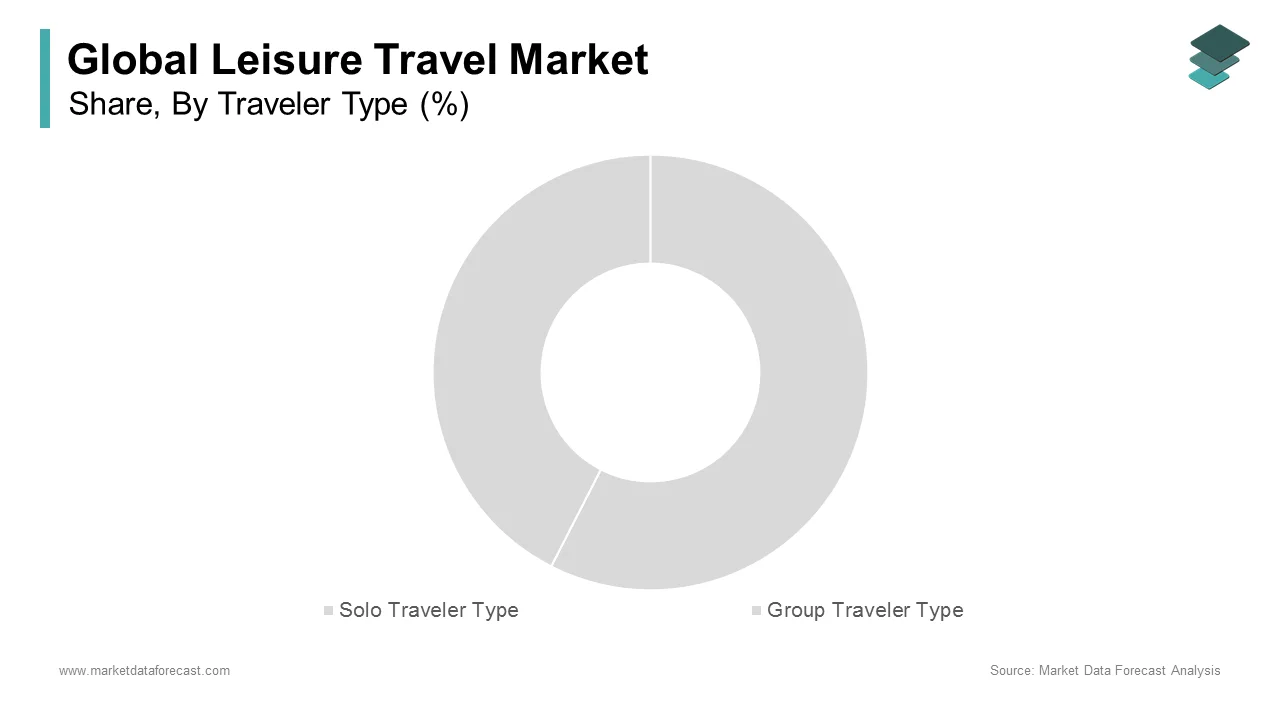
Group travel structures inherently reduce per capita costs and operational uncertainties, making them an economically rational choice for budget-constrained households navigating inflationary environments. According to Eurostat, European Union residents generated approximately 1.19 billion total individual tourism trips across domestic and international territories. Unlike solo travelers bearing full financial and logistical risk individually groups distribute exposure across multiple participants, enabling access to premium experiences otherwise unaffordable or intimidating alone. As per the International Air Transport Association, total industry-wide domestic revenue passenger kilometers surpassed baseline pre-pandemic output trends to establish steady long-term capacity utilization networks. Insurance providers also offer discounted group policies, reducing ancillary costs that compound affordability advantages. These economic and risk mitigation dynamics create a self-reinforcing cycle where group configurations remain the default choice for mainstream leisure consumption across income segments.
The solo traveler segment is estimated to register the fastest CAGR of 16.6%between 2026 and 2034 due to cultural normalization of individual autonomy and rejection of traditional social scripts governing leisure mobility. According to Eurostat, short-term accommodation options and digital holiday booking channels support a high concentration of personal travel arrangements across the European market ecosystem. As per the World Bank, international development frameworks evaluate absolute household microfinance parameters, targeted anti-poverty indicators, and physical infrastructure investments to elevate female economic participation. Unlike previous eras where solo travel signalled social deficit, contemporary framing positions it as an intentional lifestyle choice aligned with wellness, mindfulness, and identity exploration narratives dominant in digital culture. Platform innovations including solo-friendly filtering, community forums, and verified safety badges reduce historical friction points, accelerating conversion from aspiration to action among demographics previously deterred by stigma or practical concerns.
Technology platforms have systematically dismantled traditional barriers to solo travel, including safety concerns, navigation challenges, and social isolation, creating an infrastructure layer that makes independent mobility accessible to mainstream audiences. According to Eurostat, independent travel planning channels handle the vast majority of consumer itineraries, with over 70 percent of journeys taking place within residents' home countries. As per the United Nations World Tourism Organization, international tourist export generation expanded significantly, returning total sector economic contributions to pre-pandemic parity. Unlike group travel relying on interpersonal coordination, solo mobility depends entirely on technological mediation for trust verification, logistics execution, and social connection during transit. Safety technology, including location sharing, panic buttons, and AI-powered risk assessment tools address gender specific concerns that historically suppressed female solo participation. Community platforms connecting solo travelers pre-trip enable ad hoc meetups and advice exchange, replicating group benefits without commitment constraints. This digital scaffolding transforms solo travel from a high-risk niche activity into a scalable mainstream product category, unlocking latent demand among populations previously excluded by infrastructure deficits rather than interest absence.
By Sales Channel Insights
The online channels segment dominated the leisure travel market and accounted for a substantial share in 2025. This dominance was driven by the fact that algorithmic recommendation engines and real-time inventory access satisfy modern traveler expectations for personalized discovery and immediate confirmation, which conventional channels cannot match. According to the United Nations World Tourism Organisation, the continuous expansion of digital travel platforms accelerates microeconomic supplier operational efficiencies and enhances direct destination visibility worldwide. As per Eurostat, 60 percent of individuals in the European Union aged 16 to 74 utilized internet services to organize travel arrangements and short-term accommodations. According to the International Telecommunication Union, surging global mobile broadband subscriptions are driving substantial expansions in mobile commerce and real-time independent merchant transactions across emerging economies. Unlike conventional agents operating within business hours and limited inventory visibility, online platforms provide 24-hour global access to dynamically priced options, enabling spontaneous decision-making aligned with contemporary attention patterns. User-generated review ecosystems serve as a scalable trust mechanism, replacing institutional reputation with peer validation at zero marginal cost. Payment innovation, including buy now pay later and digital wallets, further reduces conversion barriers, particularly among younger demographics. This technological superiority creates network effects where larger user bases attract more suppliers, improving selection, which attracts more users, establishing winner-take-most dynamics that marginalise offline alternatives.
Online platforms dominate because they solve fundamental information asymmetry problems that historically justified travel agent commissions through transparent price comparison and bundled value optimization unavailable through opaque conventional channels. According to the Organisation for Economic Co-operation and Development, the introduction of automated comparison engines altered retail pricing transparency across major online market ecosystems. As per the Organisation for Economic Co-operation and Development, algorithmic matching tools and online parity clauses structurally reduce market search friction for consumer-facing digital services. Unlike negotiated corporate rates, leisure travellers face dynamic pricing requiring continuous monitoring that only automated tools can perform at scale. Review-integrated pricing displays enable quality-adjusted comparisons, preventing race-to-the-bottom dynamics that would otherwise degrade service standards. This transparency revolution has permanently altered consumer expectations, making opacity intolerable and ensuring online channels maintain structural advantage regardless of marketing spend by legacy distributors attempting to reclaim relevance through relationship-based selling.
The conventional channels segment is anticipated to witness the fastest CAGR of 9.2% during the forecast period owing to affluent travellers seeking expert curation for intricate multi-destination itineraries that exceed algorithmic capabilities. According to the European Travel Commission, luxury travel demographics display a strong preference for bespoke cultural itineraries and experiential services handled via specialized providers. As per the Ministry of Land, Infrastructure, Transport and Tourism of Japan, expanding human resources training and professional certifications within local travel agencies improves operational resilience across high-end regional tourism networks. Unlike commoditised bookings, where price dominates, complex leisure experiences involve subjective quality dimensions, including guide compatibility, timing nuances and cultural appropriateness that require contextual judgment algorithms cannot replicate. Post-pandemic uncertainty amplified demand for human advocates who provide real-time problem resolution and reassurance during disruptions, restoring confidence among risk-averse high-net-worth individuals. This specialization trend transforms conventional channels from mass distribution relics into premium advisory boutiques serving segments where trust and expertise justify service fees independent of commission structures.
Growing consumer scepticism toward algorithmic recommendations, fake reviews, and greenwashing claims creates counter-cyclical opportunity for conventional channels offering verified authenticity and accountability that anonymous digital platforms cannot guarantee. According to the Organisation for Economic Co-operation and Development, shifting regulatory policies regarding online platform consumer reviews focus on combating artificial manipulation to protect transparent consumer choice. As per the Federal Trade Commission, consumer protection registries document a rising volume of merchant dispute submissions associated with third-party digital subscription and reservation services. Unlike transactional platforms optimising for conversion velocity, conventional advisors optimise for relationship longevity, incentivising honest recommendations over upselling that builds compounding trust capital. Verification capabilities, including site inspections, supplier vetting, and reference checks, provide assurance layers absent in user-generated content ecosystems. Regulatory frameworks holding licensed advisors accountable for misrepresentation create legal recourse unavailable with offshore digital entities. This trust restoration dynamic enables conventional channels to capture a growing segment of disillusioned digital natives seeking reliable guidance amid information overload and authenticity crises.
By Age Group Insights
The segment of Millennials aged 28 to 43 was the largest in 2025 and occupied a commanding share of the leisure travel market. This demographic occupies a unique intersection of peak earning capacity, refined travel sophistication, and a cultural preference for experiences over physical assets. According to the Organisation for Economic Co-operation and Development, structural household consumption shifts across major member countries indicate sustained long-term consumer allocation toward personal travel and leisure services. As per the Federal Reserve Board Survey of Consumer Finances, comprehensive triennial metrics track multi-year shifts in U.S. household assets, liabilities, and comparative balance sheets across diverse demographic groups. Unlike older cohorts shaped by material acquisition norms, millennials came of age during the experience economy emergence, embedding travel as an identity formation mechanism rather than optional luxury. Digital nativity enables efficient discovery and booking, reducing planning friction that constrains older demographics. Student debt burdens delaying homeownership paradoxically increase discretionary travel allocation as mortgage savings redirect toward mobility experiences. Social media integration transforms travel into continuous identity performance, reinforcing expenditure justification through documented social capital generation. This generational positioning ensures millennial dominance persists through the decade as the cohort advances into the highest-earning life stage while maintaining values-based consumption patterns established in formative years.
Millennial technological comfort eliminates traditional barriers to complex international leisure travel, enabling autonomous planning, execution, and real-time adaptation that older cohorts delegate to intermediaries or avoid entirely. According to sources, longitudinal social surveys trace general communication preferences, technology asset distributions, and core digital resource access patterns among adult cohorts. As per the United Nations World Tourism Organization, industry-wide deployment of digital check-in infrastructures and mobile travel technologies streamlines microeconomic transaction management at major transport hubs. Unlike generations requiring reassurance through institutional branding, millennials trust peer validation and platform design cues enabling confident navigation of unfamiliar suppliers and destinations. Multilingual translation apps, currency converters, and navigation tools function as cognitive prosthetics extending capability boundaries without skill acquisition costs. This technological empowerment expands the addressable destination universe and experience complexity for millennials while simultaneously compressing planning timelines, enabling higher-frequency spontaneous travel that compounds market share advantages through volume multiplication.
The Generation Z aged 12 to 27 segment is on the rise and is expected to be the fastest-growing segment in the market with a CAGR of 19.7% from 2026 to 2034. This swift expansion of the segment is propelled by uncompromising demand for authentic culturally immersive experiences aligned with ethical values and identity exploration imperatives. According to Eurostat, short-stay accommodation options and flexible short-term holiday rentals capture significant consumer transaction volumes across non-capital destinations and regional markets. As per the United Nations World Tourism Organization, sustainable tourism guidelines require destination managers to minimize negative environmental impacts while optimizing the socioeconomic benefits delivered to local communities. Unlike previous generations progressing through predictable travel maturity stages, Gen Z enters the market with sophisticated expectations shaped by digital exposure to global diversity before physical mobility, creating compressed learning curves and elevated quality thresholds. Mental health awareness frames travel as therapeutic necessity rather than luxury, justifying expenditure even amid economic constraints. Content creation skills transform every journey into a potential income stream through influencer monetisation, blurring leisure and productive activity boundaries. This generational distinctiveness ensures acceleration continues as the cohort gains economic agency while maintaining values intensity that reshapes industry standards toward authenticity and responsibility.
Generation Z achieves travel funding through unconventional income streams, including content creation, gig economy participation, and digital entrepreneurship, enabling leisure mobility independent of traditional career progression timelines that delayed previous generations. According to Goldman Sachs research, the global creator economy is expanding significantly, with total sector revenues projected to reach approximately 480 billion dollars by 2027 through enhanced digital monetization streams and creator enablement tools. As per the International Labour Organization, global youth labor market challenges persist, with the global youth unemployment rate standing at 12.4 percent while one in five young people remain outside employment, education, or training. Unlike millennials who deferred travel until post-education career establishment, Gen Z integrates exploration concurrently with income generation through location-independent work models. Student side hustles, including tutoring, reselling, and micro consulting, generate disposable income streams earmarked specifically for travel budgets separate from parental support. Financial technology platforms enabling instant cross-border payments and cryptocurrency acceptance reduce friction for young travelers excluded from traditional banking products. This economic model decouples travel from linear life stage progression, creating perpetual mobility capability that accelerates market participation velocity beyond demographic weight would suggest.
REGIONAL ANALYSIS
North America Leisure Travel Market Analysis
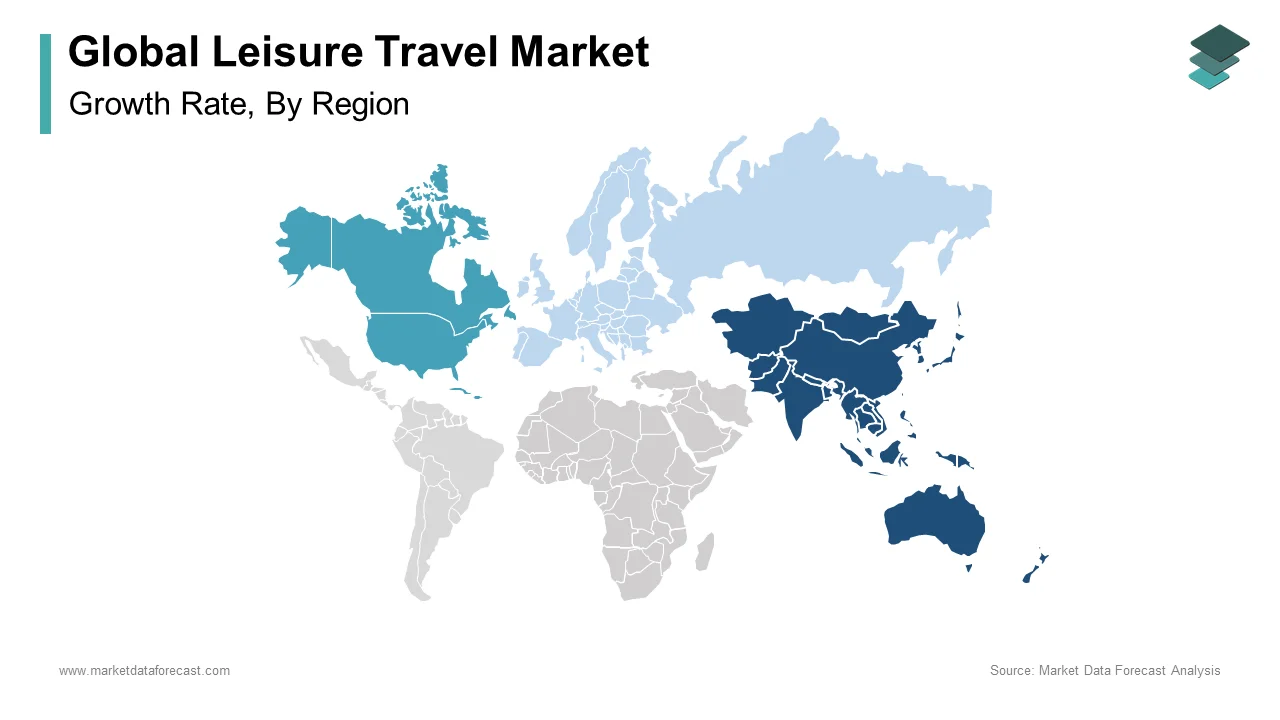
North America outperformed other regions in the global leisure travel market and held a 32.6% share in 2025. This regional supremacy was propelled by the highest per capita spending and the most mature domestic tourism infrastructure, supporting resilient demand independent of international fluctuations. Extensive geographic diversity allows this region to offer a broad array of vacation options entirely within national borders. Consequently, local tourism becomes less dependent on cross-border travel, a sector frequently disrupted by political tension and health emergencies. According to the U.S. Travel Association, domestic leisure travel spending in the United States reached 1 trillion dollars in 2024, demonstrating persistent consumer demand despite elevated household pricing pressures. As per Statistics Canada, overall domestic tourism spending by Canadian residents expanded steadily, reinforcing regional transportation and accommodation revenues. Unlike regions dependent on international arrivals, North America benefits from a large, affluent population base with established travel habits formed through decades of interstate highway system development and national park infrastructure investment. Corporate wellness programs increasingly incorporating travel stipends create institutional demand floors supplementing consumer discretion. Strong currency position enhances outbound purchasing power while attracting inbound visitors seeking value relative to European alternatives. This combination of domestic scale affluence and institutional support ensures North America maintains the largest market share despite slower growth rates compared to emerging regions.
Europe Leisure Travel Market Analysis
Europe followed closely behind in the global leisure travel market and secured a share of 28.9% in 2025. This position of the European market was supported by treating leisure travel as a social right rather than a luxury privilege, embedding mobility into welfare state frameworks through paid leave mandates and youth exchange programs. It is known for unparalleled cultural density, regulatory sophistication, and intra-regional mobility facilitated by Schengen Area integration and low-cost carrier networks. According to Eurostat, European Union residents made almost 1.2 billion total tourism trips with at least one overnight stay in 2024, with roughly 90 percent executed for personal purposes. As per the European Commission, the tourism transition pathway framework coordinates multi-country stakeholder commitments to accelerate green infrastructure and digital transformation across the region. Unlike fragmented markets, Europe benefits from unified aviation policy, rail integration and consumer protection frameworks, reducing transaction costs and perceived risks for cross-border leisure mobility. Cultural heritage density enables multi-destination itineraries within compact geographies, maximising experience variety per travel day. Demographic aging creates silver travel opportunities while youth mobility programs sustain next-generation pipeline. This institutional embeddedness ensures Europe maintains the second-largest share through structural advantages rather than cyclical demand spikes.
Asia Pacific Leisure Travel Market Analysis
Asia Pacific is rapidly expanding its share of the global leisure travel market due to massive middle-class expansion, digital leapfrogging, and the government's strategic prioritization of tourism as an economic development engine. The region's unique trajectory stems from the simultaneous emergence of supply and demand sides, creating compressed adoption timelines unlike Western markets where infrastructure preceded mass participation by decades. According to the Asian Development Bank, rising middle-class populations, higher disposable incomes, and enhanced digital infrastructures remain core drivers of expanding consumer travel markets across Asia and the Pacific. As per the Pacific Asia Travel Association, the rapid convergence of digital platforms and deep regional travel corridors positions the Asia-Pacific tourism landscape as a primary driver of industry performance. According to the Japan National Tourism Organisation, foreign visitor expenditures in Japan reached a record 8.14 trillion yen, establishing a major economic milestone for the national lodging and retail sectors. Unlike mature markets constrained by saturation, Asia Pacific benefits from greenfield destination development incorporating the latest sustainability and technology standards, avoiding legacy infrastructure burdens. Government visa liberalization across ASEAN and bilateral air service agreements reduce friction barriers systematically. Digital payment integration, including QR code interoperability across six nations, enables seamless cross-border transactions for digitally native travellers. This convergence of demographic tailwinds, policy support, and technological modernisation ensures Asia Pacific continues gaining share through structural transformation rather than cyclical recovery dynamics.
Latin America Leisure Travel Market Analysis
Latin America contributes notably to the global leisure travel market owing to exceptional natural capital endowments, cultural authenticity, and emerging middle-class mobility, creating growth potential that exceeds its current proportional representation. The region's competitive advantage derives from biodiversity assets hosting a significant portion of world species across Amazon, Atlantic Forest, and Andean ecosystems, providing an irreplaceable foundation for nature-based leisure experiences increasingly demanded by global travellers. According to the Inter-American Development Bank, international tourism revenues grew significantly to represent 1.6 percent of Latin America and the Caribbean's total gross domestic product. According to the United Nations Economic Commission for Latin America and the Caribbean, regional service exports, led primarily by international tourism, expanded by 9.5 percent to outpace the global average. Unlike developed regions facing overtourism pressures, Latin America possesses vast underutilised destination capacity enabling sustainable scaling without degradation tradeoffs. Currency depreciation enhances competitiveness for international visitors while stimulating domestic substitution effects. Community-based tourism models ensure local benefit retention exceeding global averages, creating social license for expansion. Political stabilisation trends in Colombia, Peru and the Dominican Republic unlock previously constrained destinations. This combination of natural monopoly assets, emerging demand and improving governance ensures Latin America maintains strategic relevance beyond current share through differentiation rather than volume competition.
Middle East and Africa Leisure Travel Market Analysis
The Middle East and Africa region is expected to grow further in the global leisure travel market from 2026 to 2034. It is a critical frontier for luxury desert tourism, wildlife conservation experiences, and cultural heritage preservation, with outsized strategic importance relative to size. The region's distinctive contribution emerges from integrating leisure travel with arid land adaptation, biodiversity protection, and civilizational narrative reclamation, creating unique value propositions unavailable elsewhere. According to the African Union, tourism serves as a critical socioeconomic sector for the continent, contributing approximately 8.5 percent of total African gross domestic product before global structural market disruptions. As per the Ministry of Tourism of Saudi Arabia, the Kingdom's comprehensive Vision 2030 tourism program positions up to 800 billion dollars in total investment commitments to transform national hospitality infrastructure. Unlike temperate zones facing climate homogenization, the Middle East and Africa possess climatic and ecological distinctiveness, creating defensible niche positioning against substitutable beach destinations. Infrastructure mega projects, including NEOM and Cape Town Waterfront expansion, address historical capacity constraints limiting upscale participation. Diaspora return travel creates a stable demand floor independent of Western economic sentiment. Conservation levy models link tourism revenue directly to habitat protection, aligning economic and environmental incentives. This combination of sovereign wealth investment, natural uniqueness and developmental imperative ensures the region maintains strategic relevance through specialisation rather than scale competition.
COMPETITIVE LANDSCAPE
Competition in the leisure travel market exhibits intense fragmentation between online platforms, traditional operators and emerging direct suppliers, each pursuing distinct value creation strategies. Digital aggregators compete through algorithmic personalization, scale advantages, and seamless user experience, leveraging data network effects that create formidable entry barriers for smaller players. Traditional travel agencies differentiate through high-touch advisory services, expertise in complex itineraries, and trusted relationships appealing to affluent travelers overwhelmed by digital choice abundance. Direct suppliers, including hotels and tour operators, increasingly bypass intermediaries through loyalty programs, exclusive content and price parity enforcement, attempting to reclaim margin and customer ownership. Competition intensifies around authenticity as travelers seek genuine local experiences over standardized tourism products, forcing platforms to incorporate peer validation and community features. Price transparency creates downward pressure on margins, rewarding operators with superior cost structures or differentiated value propositions justifying premiums. Mobile-first interfaces have become table stakes, with desktop-only players facing existential relevance challenges among younger demographics. Sustainability credentials emerge as a new competitive dimension where verified claims command preference over unsubstantiated marketing. Ultimately, success requires balancing technological efficiency with emotional resonance in discretionary spending decisions where rational optimization coexists with aspirational identity expression, creating complex strategic landscapes resistant to simple formulaic solutions.
KEY MARKET PLAYERS
The leading companies operating in the global leisure travel market include:
- Thomas Cook Limited
- Carlson Wagonlit Travel
- JTB Americas Group
- World Travel, Inc.
- American Express Travel
- Booking Holdings
- Expedia Group
- Priceline Group
- Travel Leaders Group
- Airbnb
- TUI Group
- Cox & Kings Ltd.
TOP PLAYERS IN THE MARKET
- Booking Holdings shapes the global leisure travel market through its extensive accommodation inventory and AI-driven personalization technologies that simplify complex trip planning for diverse traveler segments. The company recently expanded its Connected Trip platform, integrating flights, car rentals, and attractions into seamless single-transaction experiences, reducing planning friction for multi-component journeys. Booking Holdings launched enhanced mobile-first features enabling spontaneous booking decisions among Generation Z travelers seeking instant confirmation. These initiatives strengthen their position by capturing a higher share of wallet through cross-selling while improving conversion rates via reduced cognitive load. The company also invested heavily in sustainable travel labeling, helping conscious consumers identify verified eco-friendly options efficiently without greenwashing confusion. This transparency builds trust with values-driven demographics increasingly influencing mainstream leisure purchasing decisions globally across all age cohorts and destination types.
- Expedia Group contributes significantly to leisure travel through an integrated brand portfolio spanning mass market to luxury segments, enabling comprehensive coverage of heterogeneous consumer preferences and price points. The company recently deployed generative artificial intelligence trip planning tools across platforms, allowing natural language itinerary creation that democratizes complex travel design previously requiring expert assistance. Expedia Group strengthened supplier relationships through dynamic packaging algorithms optimizing bundle pricing for cost-sensitive families navigating inflationary pressures. This technological advancement enhances user experience while increasing average transaction value through intelligent upselling. The company also expanded the One Key loyalty program, unifying rewards across brands, creating a retention ecosystem discouraging platform switching. These actions demonstrate commitment to leveraging scale advantages for personalized service delivery, matching niche player intimacy with enterprise-level inventory depth and global operational capabilities essential for modern leisure travel competition.
- Airbnb transforms leisure travel through a home-sharing model enabling authentic local immersion and extended stay capabilities that traditional hospitality cannot replicate at comparable price points. The company recently introduced the Airbnb Icons category featuring extraordinary stays tied to cultural moments attracting media attention and aspirational demand beyond functional accommodation needs. Airbnb expanded long-term stay filters and monthly discount structures, capturing the remote worker segment blending leisure with productivity in the post-pandemic mobility landscape. This product evolution strengthens its position by addressing a structural shift toward flexible, location-independent lifestyles rather than competing solely on nightly rates. The company also enhanced host quality verification standards, improving consistency and trust metrics critical for converting hesitant first-time users from conventional hotels. These innovations reinforce differentiation through a unique supply and community belonging narrative that commoditized lodging providers struggle to emulate despite significant capital investments in alternative accommodation formats.
TOP STRATEGIES USED BY KEY MARKET PARTICIPANTS
Key players in the leisure travel market prioritize artificial intelligence integration to personalize discovery, reduce planning friction, and increase conversion through predictive recommendations aligned with individual preferences. Companies invest heavily in mobile optimization, recognizing that spontaneous booking behavior dominates younger demographics, requiring seamless interface performance and instant confirmation capabilities. Strategic partnerships with airlines, hotels, and experience providers enable dynamic packaging, creating bundled value propositions that lock in customer spend while improving margin structures. Loyalty program unification across brand portfolios increases switching costs and lifetime value through accumulated reward ecosystems, discouraging comparison shopping. Sustainable travel verification initiatives address growing consumer demand for ethical options while differentiating offerings from competitors lacking credible certification frameworks. Content marketing strategies leverage user-generated reviews and influencer collaborations, building social proof that reduces perceived risk for unfamiliar destinations or suppliers. Flexible cancellation policies and buy now pay later financing options remove budget barriers, expanding the addressable market among cash-constrained but experience-motivated travelers. Supply-side exclusivity agreements secure unique inventory, preventing commoditization and enabling premium positioning based on access rather than price alone. These multifaceted approaches reflect an understanding that winning requires balancing technological efficiency with emotional connection in discretionary purchase decisions.
MARKET SEGMENTATION
This global leisure travel market research report has been segmented and sub-segmented based on traveler type, sales channel, age group, and region.
By Traveler Type
- Solo traveler type
- Group traveler type
By Sales Channel
- Conventional channels
- Online channels
By Age Group
- Baby boomers
- Generation X
- Millennials
- Generation Z
By Region
- North America
- Europe
- Asia Pacific
- Latin America
- Middle East & Africa