- Product Description Description
- Table of Contents TOC
- List of Table & Figure LOT
- Get Free Sample PDF Sample PDF
Market Size, 2025
$0.79 BnMarket Estimate, 2026
$1.25 BnMarket Forecast, 2034
$47.81 BnCAGR, 2026–2034
57.7%Europe Li-Fi (Light Fidelity) Market Report Summary
The Europe Li-Fi (Light Fidelity) market was valued at USD 0.79 billion in 2025, is estimated to reach USD 1.25 billion in 2026, and is projected to reach USD 47.81 billion by 2034, growing at an exceptional CAGR of 57.7% during the forecast period from 2026 to 2034. The growth of the Europe Li-Fi market is driven by increasing demand for high-speed wireless communication, rapid adoption of Industry 4.0 technologies, and growing investments in smart buildings and Internet of Things (IoT) ecosystems. Rising concerns over network security, increasing congestion in radio frequency (RF) spectrum, and advancements in LED lighting technologies are further supporting market growth. Additionally, expanding applications of Li-Fi across industrial automation, healthcare, defense, education, and commercial infrastructure are accelerating market adoption across Europe.
Key Market Trends
-
Rising demand for ultra-fast, secure, and low-latency wireless communication is driving the adoption of Li-Fi technology.
-
Increasing implementation of Industry 4.0, smart factories, and IoT-enabled environments is supporting market growth.
-
Growing concerns over RF spectrum congestion and cybersecurity are encouraging the adoption of optical wireless communication.
-
Advancements in LED lighting infrastructure are creating new opportunities for Li-Fi deployment.
-
Increasing investments in smart cities, connected buildings, and next-generation communication technologies are accelerating market expansion.
Segmental Insights
-
Based on end-user industry, the industrial sector dominated the Europe Li-Fi market by accounting for 25.4% of the market share in 2025. The segment's leadership is attributed to increasing deployment of Li-Fi in smart manufacturing facilities, industrial automation systems, connected machinery, and IoT-based production environments where secure and interference-free communication is essential.
Regional Insights
-
The Europe Li-Fi market is witnessing rapid growth due to increasing digital transformation initiatives, expanding smart infrastructure projects, and growing adoption of advanced wireless communication technologies.
-
Germany dominated the Europe Li-Fi market by accounting for 28.5% of the regional market share in 2025. The country's leadership is supported by strong investments in smart factories, industrial automation, advanced manufacturing technologies, and robust IoT ecosystems that require secure, high-speed wireless connectivity.
-
The United Kingdom remains a significant market due to increasing investments in smart buildings, research and development, and digital infrastructure modernization.
-
France is witnessing steady market growth, supported by smart city initiatives, expanding telecommunications innovation, and growing adoption of advanced networking technologies.
-
The Netherlands is emerging as a promising market owing to its focus on digital innovation, connected infrastructure, and widespread implementation of intelligent lighting systems.
Competitive Landscape
The Europe Li-Fi market is highly competitive, with technology providers focusing on product innovation, advanced optical communication solutions, and strategic partnerships to strengthen their market positions. Companies are investing in research and development, next-generation Li-Fi systems, smart lighting integration, and commercial deployment of optical wireless communication technologies to meet the growing demand across industrial, commercial, healthcare, education, and government sectors. Key players operating in the Europe Li-Fi (Light Fidelity) market include Panasonic Holdings Corporation, Signify N.V., Renesas Electronics Corporation, Wipro Lighting, pureLiFi Limited, Oledcomm, VLNComm, Velmenni, LiFiComm Tech, and Lucibel SA.
Europe Li-Fi (Light Fidelity) Market Size
The Europe Li-Fi (Light Fidelity) market size was valued at USD 0.79 billion in 2025. The European market size is estimated to be worth USD 47.81 billion by 2034 from USD 1.25 billion in 2026, growing at a CAGR of 57.7% from 2026 to 2034.
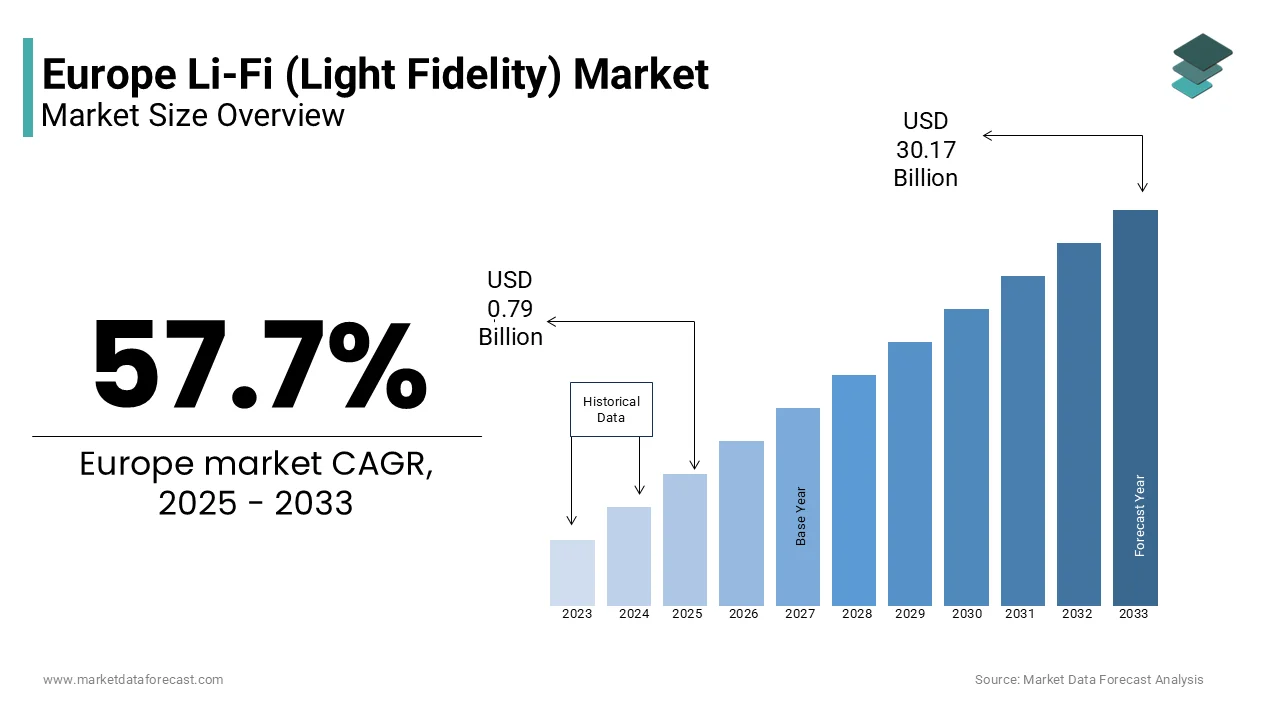
The Europe Li-Fi (Light Fidelity) market is witnessing rapid adoption, driven by the need for secure, high-speed data transmission in environments where traditional Wi-Fi faces limitations. The demand for Li-Fi is further fueled by its application in sensitive sectors like healthcare and defense, where electromagnetic interference must be minimized. As per Eurostat, over 30% of European enterprises have expressed interest in adopting Li-Fi solutions by 2026, with its growing relevance. Additionally, government investments in smart city projects and IoT integration are propelling the market forward.
MARKET DRIVERS
Increasing Demand for Secure Communication Solutions
The rising need for secure communication channels is a key driver of the Europe Li-Fi market. According to the European Cybersecurity Organization, cyberattacks targeting sensitive industries like healthcare and defense increased by 40% in 2023 with vulnerabilities in traditional wireless networks. Li-Fi offers a secure alternative, as it uses light waves that cannot penetrate walls, significantly reducing the risk of unauthorized access. This feature makes it ideal for hospitals, where patient data confidentiality is paramount, and defense facilities requiring classified communication.
Integration with Smart City Initiatives
Smart city development across Europe is accelerating the adoption of Li-Fi technology. According to the European Smart Cities Observatory, over 100 cities in Europe are implementing smart infrastructure projects, including intelligent lighting and connected public spaces. Li-Fi-enabled LED systems not only provide energy-efficient illumination but also facilitate high-speed internet connectivity, creating dual-purpose infrastructure. For instance, Barcelona’s smart streetlights equipped with Li-Fi technology have demonstrated a 30% reduction in energy consumption while enhancing connectivity for IoT devices. The investments in smart cities are expected to provide a fertile ground for Li-Fi deployment.
MARKET RESTRAINTS
High Initial Deployment Costs
The high cost of Li-Fi system installation poses a significant barrier to widespread adoption. Setting up a Li-Fi network requires specialized hardware, including photodetectors and modulators, which can increase initial expenses by 50% compared to traditional Wi-Fi setups. This financial burden is particularly challenging for SMEs, which account for over 90% of European businesses. As per the European Federation of Small Businesses, less than 15% of SMEs have the resources to invest in advanced technologies like Li-Fi that is limiting its market penetration. While larger enterprises can absorb these costs, smaller organizations often delay adoption is hindering overall market growth.
Limited Awareness and Technical Expertise
A lack of awareness and technical expertise among end-users and installers is another restraint affecting the Europe Li-Fi market. According to the European Technology Training Institute, over 60% of IT professionals are unfamiliar with Li-Fi technology and its applications. This knowledge gap creates hesitation among potential adopters in industries like retail and education, where decision-makers prioritize proven solutions. Additionally, as per the European Skills Gap Report, there is a shortage of skilled technicians capable of deploying and maintaining Li-Fi systems, further slowing adoption rates. Bridging this gap requires extensive training programs and awareness campaigns, which remain underdeveloped in many regions.
MARKET OPPORTUNITIES
Expansion into Untapped Sectors
Emerging sectors such as disaster management and hospitality present untapped opportunities for the Europe Li-Fi market. According to the European Disaster Management Agency, Li-Fi can play a critical role in emergency response scenarios by providing secure and reliable communication in areas with damaged traditional networks. For instance, Li-Fi-enabled drones were successfully deployed during flood relief operations in Italy in 2023 that is demonstrating its potential. Similarly, the hospitality sector is exploring Li-Fi for guest rooms and conference halls by offering seamless connectivity without compromising privacy. As per the European Hotel and Restaurant Association, over 50% of luxury hotels are considering Li-Fi installations by 2026 with its growth potential in niche markets.
Collaboration with IoT Ecosystems
The integration of Li-Fi with IoT ecosystems offers significant growth opportunities. According to the European IoT Alliance, the number of connected devices in Europe is expected to reach 5 billion by 2028 by creating a massive demand for high-speed, low-latency communication solutions. Li-Fi’s ability to support dense device networks makes it ideal for IoT applications in industrial automation, smart homes, and transportation. For example, German automotive manufacturers are leveraging Li-Fi to enable real-time vehicle-to-infrastructure communication, reducing traffic congestion and improving safety. As per the European Industrial IoT Consortium, Li-Fi adoption in IoT applications is projected to grow by 80% annually, positioning it as a cornerstone of future connectivity.
REPORT COVERAGE
| REPORT METRIC | DETAILS |
| Market Size Available | 2025 to 2034 |
| Base Year | 2025 |
| Forecast Period | 2026 to 2034 |
| CAGR | 57.7% |
| Segments Covered | By End-User Industry, and Region |
| Various Analyses Covered | Global, Regional, & Country Level Analysis; Segment-Level Analysis; DROC; PESTLE Analysis; Porter’s Five Forces Analysis; Competitive Landscape; Analyst Overview of Investment Opportunities |
| Regions Covered | UK, France, Spain, Germany, Italy, Russia, Sweden, Denmark, Switzerland, Netherlands, Turkey, Czech Republic, Rest of Europe |
| Market Leaders Profiled | Panasonic Holdings Corporation, Signify N.V., Renesas Electronics Corporation, Wipro Lighting, pureLiFi Limited, Oledcomm, VLNComm, Velmenni, LiFiComm Tech, and others. |
SEGMENT ANALYSIS
By End-User Industry Insights
The industrial sector was the largest segment with 25.4% of the Europe Li-Fi market share in 2025 with the need for secure, high-speed data transmission in factory environments, where electromagnetic interference from Wi-Fi can disrupt operations. According to Eurostat, over 40% of European manufacturing facilities are integrating Li-Fi into their Industry 4.0 initiatives by enabling real-time monitoring and predictive maintenance. The technology’s compatibility with IoT devices further enhances operational efficiency with its position as the leading segment.
The healthcare segment is projected to grow at a CAGR of 70.3% in the next coming years driven by the need for secure communication in sensitive environments. According to the European Health Technology Institute, Li-Fi’s ability to prevent electromagnetic interference ensures uninterrupted operation of medical devices, making it indispensable in hospitals. Its application in telemedicine and remote diagnostics is further fueling adoption, with over 60% of European healthcare providers planning to integrate Li-Fi by 2027.
REGIONAL ANALYSIS
Germany led the Europe Li-Fi market with 28.5% of share in 2025 with the robust investments in smart factories and IoT ecosystems, where over 50% of industrial facilities have adopted Li-Fi technology. According to Eurostat, Germany’s focus on Industry 4.0 initiatives has created a fertile ground for Li-Fi adoption in manufacturing and logistics sectors.

Spain is projected to grow at a CAGR of 75.1% throughout the forecast period with its aggressive smart city initiatives. According to the Spanish Ministry of Industry, over 30 cities are integrating Li-Fi-enabled LED systems into public infrastructure, such as streetlights and transportation hubs. This push towards sustainable urban development is coupled with government incentives for green technologies, positions Spain as the fastest-growing market for Li-Fi in Europe.
According to the UK Department for Digital, Culture, Media & Sport, UK, France, and Italy are investing heavily in healthcare and transportation sectors that is driving Li-Fi adoption. France’s focus on aerospace applications and Italy’s advancements in disaster management solutions further enhance their contributions to the market.
COMPETITIVE LANDSCAPE
The Europe Li-Fi market is highly competitive is characterized by the dominance of established players like pureLiFi, Signify, and Oledcomm, alongside emerging firms focusing on niche segments. Oledcomm’s affordability strategy appeals to budget-conscious clients, particularly SMEs. Regional fragmentation allows smaller innovators to carve out niches, fostering innovation. Pricing wars occasionally arise in cost-sensitive markets like Eastern Europe. Regulatory frameworks further intensify rivalry, as manufacturers must continuously adapt to evolving compliance requirements. Despite challenges, collaboration opportunities exist in integrating green technologies and IoT-driven solutions.
KEY MARKET PLAYERS
Some of the key players in the Europe Li-Fi (Light Fidelity) market are
- Panasonic Holdings Corporation
- Signify N.V.
- Renesas Electronics Corporation
- Wipro Lighting
- pureLiFi Limited
- Oledcomm
- VLNComm
- Velmenni
- LiFiComm Tech
- Lucibel SA
TOP PLAYERS IN THIS MARKET
- PureLiFi dominates the market. The company specializes in secure communication solutions, catering primarily to defense and healthcare sectors. pureLiFi’s cutting-edge innovations, such as its next-generation Li-Fi modules, ensure high-speed data transmission while maintaining unparalleled security, making it a preferred choice for sensitive environments.
- Signify’s Li-Fi-enabled LED systems are widely adopted in European smart cities, including Barcelona and Amsterdam. The company’s strategic partnerships with municipal governments have enabled large-scale deployment of Li-Fi infrastructure is reinforcing its domiannce in the commercial and public sectors.
- Oledcomm’s affordable and scalable solutions appeal to SMEs and emerging markets. Its collaborations with IoT providers have expanded its global footprint is positioning it as a key player in niche industries like retail analytics and smart warehousing.
TOP STRATEGIES USED BY THE KEY MARKET PLAYERS
Key players employ diverse strategies to maintain competitiveness and drive growth. Product innovation remains central, with pureLiFi launching advanced modules for secure data transmission. Strategic partnerships are another focus, exemplified by Signify’s collaborations with municipal governments for smart city projects. Oledcomm emphasizes affordability , targeting SMEs through cost-effective solutions. Additionally, all three companies prioritize sustainability by aligning with EU regulations and consumer demand for eco-friendly technologies. These multifaceted approaches ensure sustained market presence while addressing evolving customer needs.
RECENT HAPPENINGS IN THE MARKET
- In March 2025, pureLiFi launched its next-generation Li-Fi module in Europe. This initiative aims to enhance data security in sensitive environments in defence and healthcare sectors.
- In May 2025, Signify partnered with Barcelona’s municipal government. This collaboration seeks to integrate Li-Fi into smart streetlights by reducing energy consumption while improving connectivity.
- In July 2025, Oledcomm announced a distribution agreement with TechData in Italy. This move enhances accessibility to affordable Li-Fi solutions for SMEs in underserved regions.
- In September 2025, pureLiFi expanded its Berlin R&D center. This development ensures localized innovation for European clients by accelerating product development and customization.
- In November 2025, Signify initiated a training program for IoT professionals in France. This action addresses the talent gap in Li-Fi deployment by fostering long-term industry growth and expertise.
MARKET SEGMENTATION
This research report on the Europe Li-Fi (Light Fidelity) market is segmented and sub-segmented into the following categories.
By End-User Industry
-
Industrial
-
Healthcare
-
Retail
-
Corporate Buildings
-
Education
-
Residential
-
Aerospace and Defense
-
Automotive and Transportation
-
Other End-user Industries (Hospitality, Disaster Management, and Others)
By Country
- UK
- France
- Spain
- Germany
- Italy
- Russia
- Sweden
- Denmark
- Switzerland
- Netherlands
- Turkey
- Czech Republic
- Rest of Europe