- Product Description Description
- Table of Contents TOC
- List of Table & Figure LOT
- Get Free Sample PDF Sample PDF
Market Size, 2025
$322.4 BnMarket Estimate, 2026
$359.7 BnMarket Forecast, 2034
$863.6 BnCAGR, 2026–2034
11.57%Global Logistics Market Summary
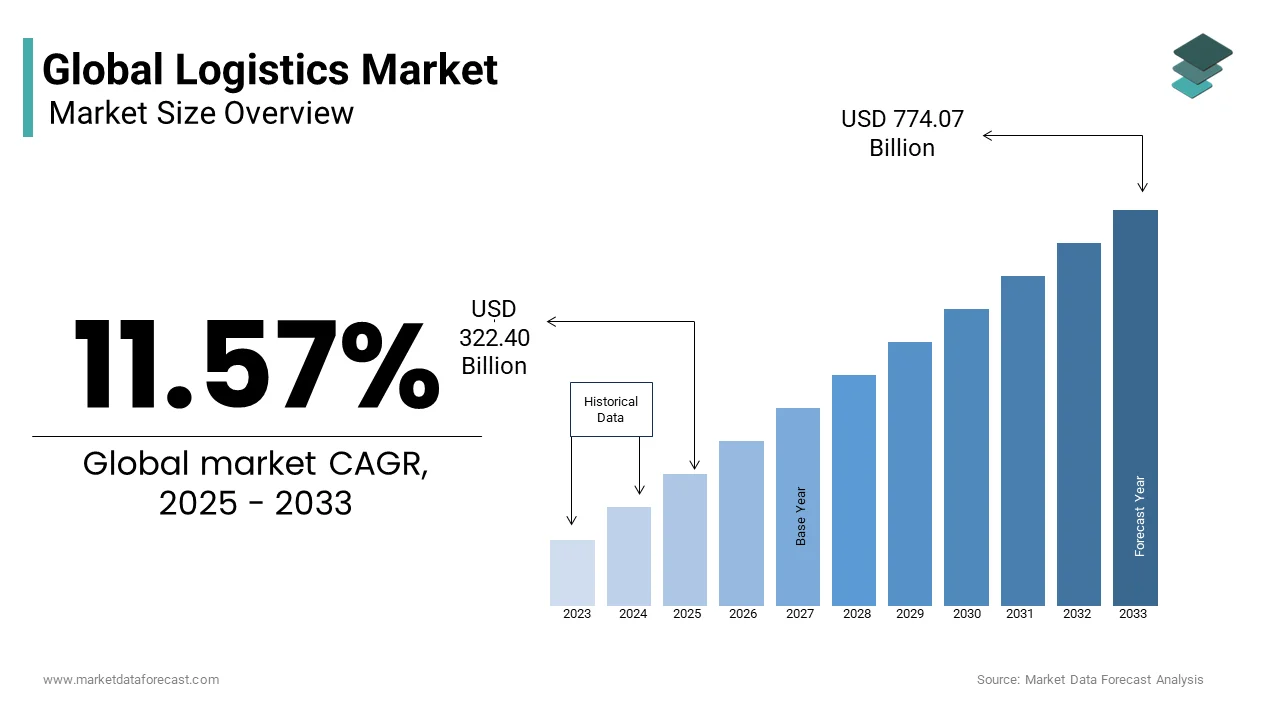
The global logistics market size was valued at USD 322.40 billion in 2025, projected to reach USD 359.70 billion in 2026 and USD 863.62 billion by 2034, expanding at a CAGR of 11.57% from 2026 to 2034. Growth is driven by the rapid expansion of e-commerce, increasing globalization of trade, and rising demand for efficient supply chain solutions. Technological innovations such as AI, IoT, and automation are also reshaping logistics operations, enhancing real-time visibility and efficiency.
Key Market Trends
- Rising adoption of digital freight platforms and smart logistics solutions
- Growing focus on green logistics and sustainability practices
- Increasing use of automation, robotics, and AI in warehouses and last-mile delivery
- Strong demand from the e-commerce and retail sectors is driving logistics service expansion
Segmental Insights
- Based on the Model, the Third-Party Logistics (3PL) segment dominated the global logistics market in 2024, as companies increasingly outsourced logistics operations to reduce costs and improve efficiency.
- Based on Transportation Mode, the road transportation segment captured the largest market share in 2024, supported by extensive road networks and the growing need for flexible last-mile delivery.
- Based on End-Use Sector, the Fast-Moving Consumer Goods (FMCG) sector led the logistics market with 34.3% share in 2024, driven by rising consumer demand and retail distribution needs.
Regional Insights
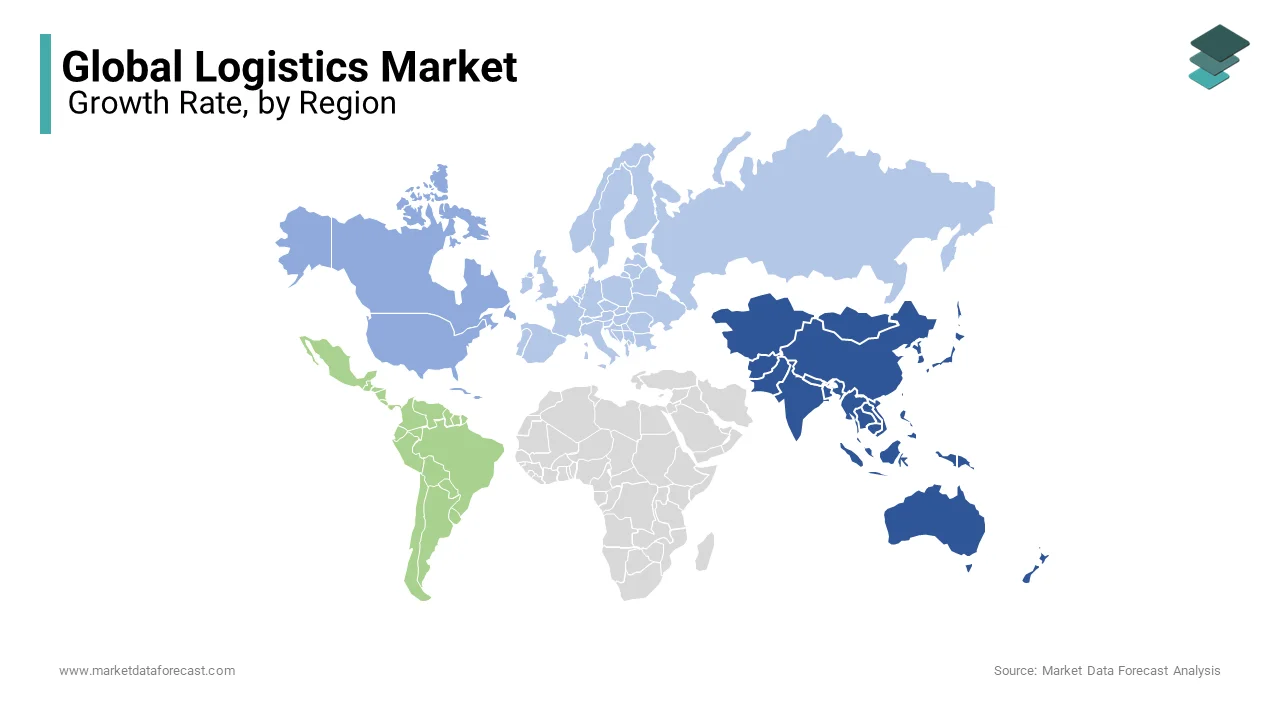
- The Asia Pacific logistics market was the top performer in 2024, capturing 44.3% of the global share, fueled by strong manufacturing output, rising trade volumes, and robust e-commerce activity.
- North America is expected to grow steadily, supported by advanced logistics infrastructure and technology adoption, while Europe focuses on green logistics and cross-border trade optimization.
- Emerging regions like Latin America and the Middle East & Africa are witnessing rising investments in infrastructure and logistics hubs.
Competitive Landscape
Leading companies in the global logistics market include A.P. Moller – Maersk, C.H. Robinson Worldwide, Inc., DB Schenker (Deutsche Bahn Group), Deutsche Post AG (DHL Group), DSV (DSV Panalpina), FedEx, Geodis, Kuehne+Nagel, and Nippon Express. These players are focusing on strategic partnerships, acquisitions, and technology integration to strengthen their logistics networks and enhance service efficiency.
Global Logistics Market Size
The global logistics market size was valued at USD 322.40 billion in 2025 and is anticipated to reach USD 359.70 billion in 2026 and USD 863.62 billion by 2034, growing at a CAGR of 11.57% during the forecast period from 2026 to 2034.
The logistics are the integrated coordination of transportation, warehousing, inventory management, and information systems to ensure the seamless movement of goods from origin to consumption. It functions as the backbone of global trade, enabling supply chain continuity across industries ranging from pharmaceuticals to e-commerce. According to the World Bank’s Logistics Performance Index 2023, countries with advanced logistics infrastructure experienced 28% lower trade transaction costs than those in the bottom quartile.
MARKET DRIVERS
Logistics Market Expansion Fueled by Cross-Border E-Commerce Surge
The logistics market growth is majorly driven by the rapid expansion of cross-border e-commerce, which demands agile, customer-centric delivery networks. Consumers in emerging and developed markets alike are increasingly purchasing goods from international platforms, necessitating efficient customs clearance, last-mile delivery, and reverse logistics. According to the United Nations Conference on Trade and Development, global cross-border e-commerce sales reached $6.3 trillion in 2023, a 9.4% increase from the previous year, with Asia-Pacific leading in outbound and inbound digital trade. This surge places immense pressure on logistics providers to offer transparent tracking, faster transit times, and localized fulfillment. Companies like DHL and FedEx have responded by expanding regional sorting hubs in Southeast Asia and Eastern Europe.
The shift toward nearshoring and supply chain regionalization in response to geopolitical volatility and pandemic-era disruptions is additionally fuelling the growth of the logistics market. Multinational corporations are relocating production and distribution closer to end markets to reduce lead times and mitigate risks. This trend is particularly evident in the automotive and electronics sectors, where just-in-time manufacturing requires proximity to assembly plants. The U.S. Department of Commerce reported a 14% increase in warehouse construction starts in 2023, which is primarily for distribution centers serving reshored operations.
MARKET RESTRAINTS
Logistics Market Growth Constrained by Labor Shortages and Energy Cost Volatility
The persistent shortage of qualified drivers and warehouse personnel in developed economies is restricting the growth of the logistics market. This labor deficit disrupts service reliability and inflates operational costs. According to the American Trucking Associations, the U.S. faced a shortage of approximately 80,000 truck drivers in 2023, a figure projected to exceed 100,000 by 2026 due to an aging workforce and low entry rates.
The escalating cost and volatility of energy, particularly diesel and aviation fuel, which is also hindering the growth of the logistics market. According to the International Energy Agency, global diesel prices rose by 22% between January 2022 and December 2023. For logistics firms, fuel can account for up to 30% of operating costs in road freight, as noted by the International Road Union. Airlines faced even steeper increases, with jet fuel prices up 28% over the same period, forcing cargo carriers to impose surcharges or reduce capacity. This volatility undermines pricing predictability and profit margins, especially for small and mid-sized logistics providers without hedging capabilities. Additionally, the push for decarbonization adds financial pressure, as companies must invest in alternative-fuel vehicles and infrastructure without guaranteed short-term returns, which is complicating long-term planning and investment decisions.
MARKET OPPORTUNITIES
Autonomous Technologies and Blockchain Drive Efficiency and Transparency in Logistics Market Growth
The deployment of autonomous logistics technologies, including self-driving trucks, warehouse robotics, and drone deliveries, enhances efficiency and reduces dependency on human labor. According to the International Federation of Robotics, the global installation of logistics robots in warehouses increased by 35% in 2023, with over 120,000 units deployed across distribution centers in the U.S., China, and Germany. Companies like Amazon and Alibaba have integrated robotic picking and sorting systems that reduce processing time by up to 50%. These advancements are paving the way for 24/7 operations and reduced last-mile delivery costs, particularly in high-density urban corridors.
The integration of blockchain technology to enhance transparency, traceability, and trust in advanced operations is set to create new opportunities for the growth of the logistics market. By creating immutable, shared records of shipment events, blockchain reduces documentation errors, fraud, and delays in customs clearance. According to the World Economic Forum, blockchain-enabled trade platforms can reduce document processing times by up to 40% and lower transaction costs by 15–20%. Maersk and IBM’s TradeLens platform, though restructured in 2023, demonstrated that digitized bills of lading reduced port dwell times by an average of 40 hours across 300 ports.
MARKET CHALLENGES
Logistics Market Challenges from Regulatory Complexity and Infrastructure Deficiencies
The increasing regulatory complexity surrounding emissions, data privacy, and cross-border trade compliance is inhibiting the growth of the logistics market. Governments worldwide are imposing stricter environmental standards, such as the European Union’s Fit for 55 package, which mandates a 55% reduction in transport emissions by 2030. Simultaneously, data localization laws in countries like China and Russia require logistics firms to store shipment information within national borders, complicating global IT integration. Many international shipments faced delays due to non-compliant documentation, with the operational burden of navigating divergent regulatory regimes across jurisdictions.
The infrastructure inadequacy in key emerging markets, where port congestion, road deficiencies, and railways are hampering the growth of the logistics market. According to the World Bank’s 2023 Connecting to Compete report, the average container dwell time in ports across Sub-Saharan Africa was 11.3 days, compared to 3.2 days in East Asia. In India, despite recent investments, freight trains operate at an average speed of 24 km/h due to track congestion and aging signaling systems, as reported by the Ministry of Railways. Similarly, in Indonesia, inter-island logistics costs account for nearly 25% of retail prices, limiting market integration.
REPORT COVERAGE
| REPORT METRIC | DETAILS |
| Market Size Available | 2025 to 2034 |
| Base Year | 2025 |
| Forecast Period | 2026 to 2034 |
| CAGR | 11.57% |
| Segments Covered | By Model, Transportation, End-User Industry, End-User, and Region |
| Various Analyses Covered | Global, Regional, and Country Level Analysis; Segment-Level Analysis; DROC; PESTLE Analysis; Porter’s Five Forces Analysis; Competitive Landscape; Analyst Overview of Investment Opportunities |
| Regions Covered | North America, Europe, APAC, Latin America, Middle East & Africa |
| Market Leaders Profiled | A.P. MOLLER – MAERSK, C.H. ROBINSON WORLDWIDE, INC., DB SCHENKER (DEUTSCHE BAHN GROUP (DB GROUP)), DEUTSCHE POST AG (DHL GROUP), DSV (DSV PANALPINA), FEDEX, GEODIS, KUEHNE+NAGEL, NIPPON EXPRESS |
SEGMENTAL ANALYSIS
By Model Insights
The Third-Party Logistics (3PL) segment dominated the global logistics market share in 2024, with the growing preference among enterprises to outsource non-core logistics functions to specialized providers capable of delivering scalable, integrated solutions. According to the Council of Supply Chain Management Professionals, companies utilizing 3PL services reported a 24% improvement in order fulfillment accuracy and a 19% reduction in logistics costs compared to in-house operations. 3PLs offer multi-client distribution centers, dynamic routing algorithms, and returns management systems that are prohibitively expensive for individual brands to build.
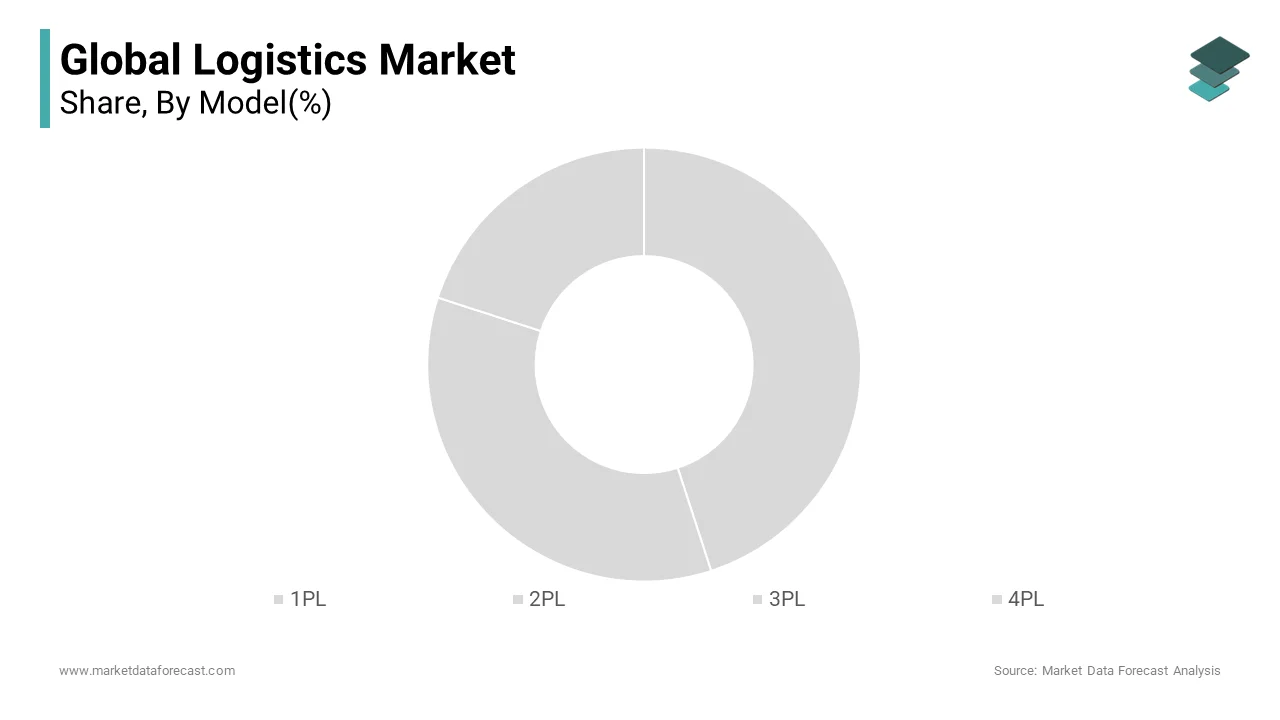
The Fourth-Party Logistics (4PL) segment is lucratively growing with an expected CAGR of 12.8% during the forecast period, owing to the increasing need for end-to-end supply chain orchestration in a fragmented, multi-vendor environment. Unlike 3PLs, which manage execution, 4PL providers act as strategic integrators, overseeing multiple 3PLs, carriers, and technology platforms through a single control tower.
By Transportation Insights
The road transportation segment was the largest by capturing a prominent share of the global logistics market in 2024. In most countries, road freight is the only viable option for last-mile delivery, a function that has grown exponentially with the rise of e-commerce. According to the International Road Transport Union, over 7.4 billion tons of goods were transported by truck in Europe alone in 2023, representing 76% of inland freight movements. Temperature-controlled trucks are essential for maintaining product integrity across fragmented supply chains.
The air freight segment is anticipated to witness a CAGR of 8.4% in the coming years, with rising demand for speed, reliability, and global reach in high-value and time-sensitive shipments. The expansion of the pharmaceutical and biotechnology sectors, where temperature-controlled air cargo is leveraging the growth of the logistics market. The growth of express e-commerce and cross-border retail, where consumers expect delivery within 3–5 days regardless of origin, is also propelling the growth of the segment.
By End-Use Industry Insights
The Fast-Moving Consumer Goods (FMCG) sector accounted in holding 34.3% of the logistics market share in 2024, with the sector’s high volume, rapid turnover, and extensive distribution networks, which require constant replenishment across retail, e-commerce, and wholesale channels. FMCG companies like Procter & Gamble, Unilever, and Nestlé operate complex, multi-tier supply chains that span continents and demand precise inventory synchronization. Additionally, sustainability pressures are reshaping packaging and transportation strategies.
The Healthcare logistics segment is projected to expand at a CAGR of 11.6% during the forecast period with the growth of biopharmaceuticals, including mRNA vaccines, cell and gene therapies, and monoclonal antibodies, which require ultra-cold chain logistics and real-time monitoring. According to the World Health Organization, the global vaccine market exceeded $65 billion in 2023, with over 90% of shipments requiring temperature control between -70°C and 8°C.
REGIONAL ANALYSIS
Asia Pacific Market Analysis
Asia Pacific was the top performer of the global logistics market by capturing 44.3% the market share in 2024. China remains the cornerstone, handling over 30% of global container traffic through ports like Shanghai and Shenzhen, as reported by the United Nations Conference on Trade and Development. The country’s Belt and Road Initiative has expanded overland freight routes into Central Asia and Europe, with rail cargo volume increasing by 18% in 2023. India is rapidly modernizing its logistics infrastructure, with the National Logistics Policy aiming to reduce freight costs from 13% to 8% of GDP by 2030.
North America Market Analysis
North America's logistics market growth is second only to the Asia Pacific, with a developed transportation infrastructure and an advanced supply chain ecosystem. The U.S. freight system moved 18.7 billion tons of goods in 2023, according to the Bureau of Transportation Statistics, with road and rail dominating intercity haulage. The rise of nearshoring from Mexico and Canada has increased cross-border logistics activity, with the U.S. Department of Transportation recording a 14% increase in truck crossings at the Mexican border in 2023. Canada’s logistics market growth is likely to grow with the automation and digital logistics platforms, such as AI-driven route optimization and electronic logging devices, positioning it at the forefront of efficiency and regulatory compliance in freight management.
Europe Market Analysis
Europe's logistics market growth is likely to be driven by its integrated multimodal network and stringent sustainability standards. Germany serves as the continent’s logistics nucleus, operating the largest truck fleet and hosting key rail and inland waterway hubs. The European Union’s Green Deal is reshaping logistics with a 55% reduction in transport emissions by 2030. The European Environment Agency reported that 38% of new freight vehicles registered in 2023 were electric or hybrid, the highest rate globally. The Netherlands, with Rotterdam as Europe’s largest port, processed 467 million tons of cargo in 2023, per the Port of Rotterdam Authority, serving as a critical gateway for intra-European distribution.
Latin America Market Analysis
Latin America logistics market growth is expected to continue, with Brazil and Mexico driving regional activity through industrial production and trade integration. Brazil’s logistics sector is heavily focused on agribusiness, with the Ministry of Infrastructure reporting that 60% of freight tonnage in 2023 consisted of soybeans, corn, and sugar moving from inland farms to export ports. Mexico’s proximity to the U.S. makes it a key player in nearshoring logistics, with the Secretariat of Infrastructure, Communications, and Transportation noting a 22% increase in cross-border truck traffic in 2023.
Middle East And Africa Market Analysis
The Middle East & Africa logistics market growth is due to strategic infrastructure investments and regional trade initiatives. The UAE, particularly Dubai and Abu Dhabi, has emerged as a global logistics hub, with Jebel Ali Port handling 14.2 million TEUs in 2023, as reported by DP World. The Saudi Vision 2030 plan includes $100 billion in logistics infrastructure spending, aiming to position the kingdom as a global transit corridor between Asia, Europe, and Africa.
COMPETITIVE LANDSCAPE
The competition in the logistics market is intensifying as traditional carriers evolve into integrated supply chain orchestrators, leveraging technology and data to differentiate service offerings. Incumbents face pressure from agile digital freight platforms and regional specialists that offer lower costs and niche expertise. Differentiation is increasingly based on reliability, sustainability credentials, and end-to-end visibility rather than price alone. The rise of nearshoring and regulatory fragmentation is forcing providers to localize operations while maintaining global coordination. Companies that combine physical infrastructure with digital control towers, cold chain capabilities, and decarbonization strategies are gaining a strategic advantage. Investment in automation, AI, and green logistics is reshaping the competitive landscape, with leadership shifting toward those who can deliver resilient, transparent, and sustainable supply chain solutions at scale across diverse geographies and regulatory environments.
KEY MARKET PLAYERS
A few of the market players in the global logistics market include
- A.P. MOLLER – MAERSK,
- C.H. ROBINSON WORLDWIDE, INC.,
- DB SCHENKER (DEUTSCHE BAHN GROUP (DB GROUP)),
- DEUTSCHE POST AG (DHL GROUP),
- DSV (DSV PANALPINA),
- FEDEX,
- GEODIS,
- KUEHNE+NAGEL,
- NIPPON EXPRESS
Top Players In The Market
- DHL Supply Chain is a leading global logistics provider with a robust and expanding footprint across the Asia Pacific region. The company has strategically invested in intelligent warehousing, cold chain infrastructure, and e-commerce fulfillment centers in high-growth markets such as India, Vietnam, and Indonesia. In 2023, DHL launched a digital control tower in Singapore to provide real-time visibility for multinational clients across Southeast Asia, integrating data from transportation, inventory, and customs clearance. It also expanded its healthcare logistics network in Japan and South Korea to support the growing demand for temperature-sensitive pharmaceutical distribution.
- Maersk has transformed from a container shipping line into an integrated logistics provider, with a strong focus on end-to-end supply chain solutions in the Asia Pacific. The company has intensified its investments in inland logistics, warehousing, and digital platforms to complement its maritime dominance. In 2023, Maersk opened a multimodal logistics hub in Chengdu, China, connecting rail freight to European markets under the China-Europe Railway Express, reducing transit time by 12 days compared to sea freight. It also launched a digital freight marketplace in India, enabling small exporters to book container slots and inland transport seamlessly.
- Kuehne+Nagel has established a differentiated presence in the Asia Pacific through its focus on high-value, complex logistics segments such as aerospace, automotive, and life sciences. The company operates state-of-the-art cold chain facilities in Hong Kong, Shanghai, and Sydney, compliant with GDP and CEIV Pharma standards, serving global pharmaceutical manufacturers. In 2023, Kuehne+Nagel introduced a blockchain-enabled track-and-trace system for clinical trial shipments across Australia and Japan, ensuring data integrity and regulatory compliance. It also expanded its airfreight charter operations in Southeast Asia to support urgent medical and technology cargo movements.
Top Strategies Used By The Key Market Participants
Key players in the logistics market are deploying a combination of digital integration, vertical specialization, network densification, sustainability innovation, and strategic acquisitions to consolidate their competitive advantage. Companies are investing in cloud-based transportation and warehouse management systems to offer real-time visibility and predictive analytics. There is a growing emphasis on sector-specific solutions, particularly in healthcare, e-commerce, and high-tech manufacturing, where compliance and speed are critical. Firms are expanding regional hubs and last-mile networks to support nearshoring and omnichannel distribution. Electrification of fleets, use of sustainable aviation fuel, and carbon reporting platforms are being adopted to meet ESG goals. Additionally, integration of AI for route optimization, demand forecasting, and risk management is becoming standard, enabling greater resilience and efficiency across global supply chains.
RECENT MARKET NEWS
- In March 2024, DHL Supply Chain launched an AI-powered demand forecasting platform in Bangalore, India, by enabling FMCG clients to optimize inventory levels and reduce stockouts by 32% across southern distribution networks.
- In January 2024, Maersk inaugurated a fully automated container terminal at the Port of Tanjung Pelepas in Malaysia, which is integrating IoT sensors and automated guided vehicles to increase throughput by 25%.
- In August 2023, Kuehne+Nagel partnered with Panasonic in Osaka to establish a dedicated logistics center for electric vehicle battery components by featuring explosion-proof storage and 24/7 monitoring.
- In May 2024, FedEx expanded its carbon-neutral shipping program to Singapore and Seoul, offering customers verified emissions offsets for all express and freight shipments in the Northeast Asia corridor.
- In February 2024, UPS activated a new regional healthcare logistics hub in Dubai, equipped with GDP-certified cold storage and real-time GPS tracking, serving 18 countries across the Middle East and Africa.
MARKET SEGMENTATION
This research report on the global logistics market is segmented and sub-segmented into the following categories.
By Model
- 1PL
- 2PL
- 3PL
- 4PL
By Transportation
- Roadways
- Railways
- Seaways
- Airways
By End-Use Industry
- Healthcare
- Automotive
- FMCG
- Energy & Utilities
- Industrial Machinery & Equipment
By End-User
- B2B
- B2C
By Region
- North America
- Europe
- Asia-Pacific
- Latin America
- Middle East and Africa