- Product Description Description
- Table of Contents TOC
- List of Table & Figure LOT
- Get Free Sample PDF Sample PDF
Global Low Intensity Sweeteners Market Summary
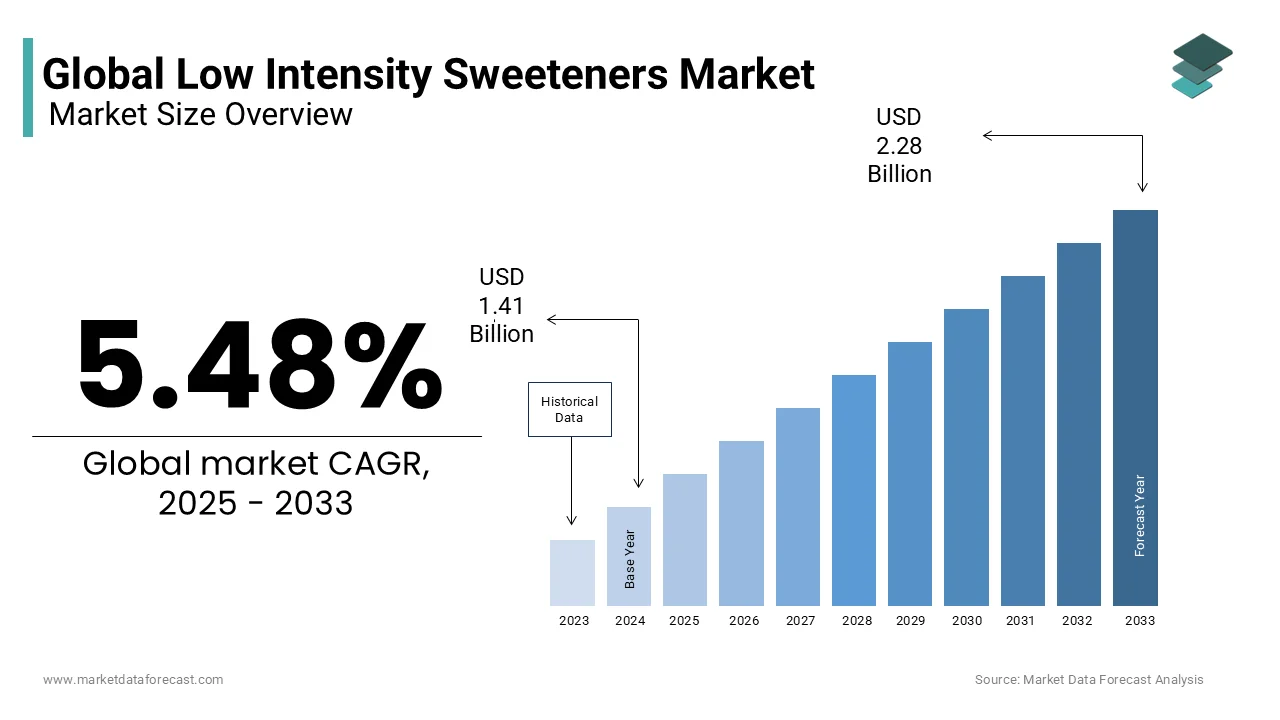
The global low intensity sweeteners market size is expected to reach USD 2.28 billion by 2033 from USD 1.41 billion in 2024, growing at a CAGR of 5.48% from 2025 to 2033. Low intensity sweeteners like sucrose and fructose offer taste, texture, and energy. They dominate global use due to natural origin and key roles in food and beverage processing.
Rising health awareness is driving demand for natural low intensity sweeteners in processed foods and functional drinks, offering clean-label appeal and functional benefits like energy, taste, and texture.
- North America led the market with 28.5% share in 2023, driven by clean-label trends and strong F&B and supplement sectors.
- Europe holds a major share due to Nutri-Score labeling and reformulation in bakery and dairy alternatives.
- Asia-Pacific is the fastest-growing region, led by China, driven by rising demand for functional drinks and healthy snacks.
- Based on application, the food and beverage segment led the market in 2024 with 38.4% share due to high use in processed foods.
- Based on application, the pharmaceuticals segment is the fastest-growing with a 7.9% CAGR, driven by sugar-free drug formulations.
Global Low Intensity Sweeteners Market Size
The low intensity sweeteners market is anticipated to rise from USD 1.41 billion in 2024 to USD 2.28 billion in 2033, growing at a CAGR of 5.48%.
Low Intensity Sweeteners Market Overview
Low intensity sweeteners, also known as nutritive or caloric sweeteners, are food additives used to enhance sweetness in various consumables while contributing energy value. Unlike high-intensity sweeteners that offer intense sweetness at minimal usage levels, low intensity sweeteners such as sucrose, fructose, glucose, and maltose are often used in larger quantities and provide both taste and texture benefits. They play a critical role in the formulation of beverages, baked goods, dairy products, and processed foods. The demand for these sweeteners remains robust due to their functional properties in food processing and their natural origin compared to artificial alternatives.
According to data from Food and Agriculture Organization (FAO), global sugar production reached approximately 185 million metric tons in 2023, underlining the continued reliance on traditional sweetening agents across food industries. In parallel, the World Health Organization continues to emphasize balanced consumption patterns, prompting innovations in partially replacing standard sugars with alternative nutritive sweeteners that offer better glycemic profiles.
As per the International Sweeteners Association, nutritive sweeteners still account for a majority of total sweetener use globally, reflecting their entrenched role in consumer diets and industrial applications. These dynamics set the stage for understanding the evolving landscape of the Low Intensity Sweeteners Market.
KEY MARKET DRIVERS
Rising Demand for Natural Sweeteners in Processed Foods
- A key driver fueling the growth of the low intensity sweeteners market is the increasing preference for natural sweeteners in processed food products. Consumers are becoming more health-conscious and seeking clean-label ingredients that align with holistic wellness trends.
- Low intensity sweeteners such as honey, maple syrup, coconut sugar, and agave nectar are gaining traction due to their perceived naturalness and additional nutritional benefits compared to refined sugar or artificial sweeteners.
- As per the Organic Trade Association, sales of organic packaged foods in the U.S. grew by 6.4% in 2023, reaching $55.9 billion, signaling a strong shift toward minimally processed and naturally sourced ingredients.
- Also, the growing inclination has led manufacturers to reformulate their products with nutritive, low intensity sweeteners that offer moderate sweetness along with functional benefits such as browning, moisture retention, and fermentation support in bakery and dairy applications.
- The market response has been evident across major food categories. This trend underscores the pivotal role of consumer-driven ingredient transparency in propelling the demand for low intensity sweeteners across the food and beverage sector.
Expansion of the Functional Beverage Industry
- A further catalyst behind the growth of the low intensity sweeteners market is the rapid expansion of the functional beverage industry, which includes sports drinks, energy drinks, ready-to-drink teas, and enhanced waters.
- These beverages often require sweeteners that not only improve taste but also complement the functional attributes of the product, such as electrolyte balance, hydration, or digestive wellness. Low intensity sweeteners like dextrose, fructose, and maltodextrin are increasingly being used in combination with other ingredients to meet these dual objectives.
- Moreover, a major segment within this market—sports and performance nutrition drinks—is witnessing robust demand, particularly among fitness enthusiasts and athletes who seek quick energy sources without artificial aftertastes.
- Moreover, companies, and emerging brands such as Celsius and LMNT are incorporating blends of low intensity sweeteners to achieve desired mouthfeel and flavor profiles while avoiding excessive calorie density.
- This rising integration into functional beverages is significantly boosting the consumption and innovation within the Low Intensity Sweeteners Market.
MARKET RESTRAINTS
Growing Awareness of Sugar-Related Health Issues
- A key restraint for the low intensity sweeteners market is the increasing public awareness regarding the adverse health effects associated with excessive sugar consumption. While low intensity sweeteners like sucrose, fructose, and glucose are considered natural and provide functional benefits in food manufacturing, they still contribute to overall caloric intake.
- As health concerns surrounding obesity, diabetes, and cardiovascular diseases intensify, consumers are actively seeking ways to reduce their sugar intake, leading to a gradual shift away from traditional nutritive sweeteners.
- According to the Centers for Disease Control and Prevention (CDC), more than 100 million adults in the United States alone are living with diabetes or prediabetes, prompting widespread dietary changes.
- Besides, the World Health Organization recommends that free sugars should constitute less than 10% of total daily caloric intake, further reinforcing the need for reduced sugar consumption.
- Consequently, many food and beverage manufacturers are exploring alternatives such as high-intensity sweeteners or fiber-based bulking agents to maintain sweetness while lowering calories.
- This shift is reflected in market behavior. As a result, companies including Coca-Cola and PepsiCo have reformulated several products to include stevia, erythritol, or allulose, reducing their reliance on low intensity sweeteners. Such developments are directly impacting the growth trajectory of the Low Intensity Sweeteners Market, despite their functional advantages in food processing.
Regulatory Scrutiny and Labeling Requirements
- Regulatory scrutiny and evolving labeling requirements pose a significant challenge to the Low Intensity Sweeteners Market. Governments and health organizations around the world are implementing stricter regulations aimed at curbing excessive sugar consumption.
- These policies often include front-of-pack warning labels, sugar taxes, and mandatory disclosures of added sugars on nutrition facts panels. As a result, food manufacturers face mounting pressure to reduce or substitute nutritive sweeteners in their formulations.
- In 2023, the European Commission implemented updated guidelines under the Nutri-Score system, which evaluates food products based on their nutritional content, including sugar levels. Products with higher sugar content receive lower scores, potentially influencing consumer purchasing decisions.
- Similarly, in the United States, the Food and Drug Administration (FDA) mandated the inclusion of “added sugars” on Nutrition Facts labels, effective from January 2021, enhancing consumer awareness about sugar content in packaged foods.
- These regulatory shifts have prompted major food companies to reformulate their offerings. According to data from the Grocery Manufacturers Association, nearly 40% of packaged food companies in North America reported reducing added sugars in their products between 2020 and 2023.
- Brands such as Kellogg’s and Danone have launched low-sugar variants of popular cereals and yogurts, utilizing alternative sweetening systems. Consequently, while low intensity sweeteners remain essential in food production, tightening regulatory frameworks are compelling manufacturers to explore non-nutritive options, thereby constraining market growth.
MARKET OPPORTUNITIES
Innovation in Clean Label and Minimally Processed Ingredients
- An emerging opportunity for the Low Intensity Sweeteners Market lies in the growing demand for clean label and minimally processed ingredients across the food and beverage industry. Consumers are increasingly scrutinizing ingredient lists and favoring products with recognizable, natural components.
- Low intensity sweeteners such as evaporated cane juice, brown rice syrup, date syrup, and fruit concentrates align well with this trend due to their simple processing methods and absence of synthetic additives.
- Within this context, low intensity sweeteners are being leveraged not only for their sweetness but also for their ability to enhance texture, color, and shelf life in a variety of applications.
- For instance, dates and figs are being used in plant-based protein bars and oat milk beverages to provide natural sweetness while contributing fiber and minerals.
- Leading food manufacturers are capitalizing on this trend. In 2023, KIND Snacks expanded its line of nut bars using honey and tapioca syrup as primary sweeteners, emphasizing their whole-food origins. Similarly, Chobani introduced a line of oat-based yogurts sweetened exclusively with apple juice concentrate, catering to consumers seeking fewer artificial ingredients.
Expansion of Plant-Based and Alternative Dairy Products
- The rapid growth of the plant-based and alternative dairy sector presents a significant opportunity for the Low Intensity Sweeteners Market. With the rise of veganism, lactose intolerance awareness, and environmental concerns, consumers are shifting toward plant-based milks, yogurts, and cheeses made from almonds, oats, soy, peas, and coconuts.
- These products often require nutritive sweeteners to enhance palatability, mask inherent bitterness, and replicate the creamy mouthfeel of traditional dairy items.
- Oat milk, in particular, has seen exponential growth, driven by brands like Oatly and Califia Farms, both of which utilize barley malt extract and cane sugar to achieve a balanced flavor profile. These nutritive sweeteners not only improve taste but also aid in stabilization and fermentation processes.
- As consumer demand for indulgent yet wholesome alternatives rises, the Low Intensity Sweeteners Market stands to benefit significantly from this evolving food landscape.
MARKET CHALLENGES
Volatility in Raw Material Prices and Supply Chain Disruptions
- Among the foremost challenges facing the low intensity sweeteners market is the volatility in raw material prices and disruptions in global supply chains. Many low intensity sweeteners, such as sucrose, corn syrup, and maltodextrin, are derived from agricultural commodities whose availability and pricing are influenced by climatic conditions, geopolitical tensions, and trade policies.
- These fluctuations can significantly impact production costs and profit margins for manufacturers relying on stable inputs.
- For instance, according to the U.S. Department of Agriculture (USDA), sugar prices in the United States rose by 18% in 2023 due to reduced beet sugar yields caused by unfavorable weather conditions in major producing states like Minnesota and North Dakota.
- Similarly, corn prices experienced volatility following export restrictions imposed by certain South American countries amid inflationary pressures and currency devaluations.
- Supply chain bottlenecks have further exacerbated the situation. The lingering effects of the pandemic, coupled with ongoing geopolitical conflicts, have disrupted shipping routes and delayed raw material deliveries.
- Drewry’s World Container Index recorded a 22% increase in freight rates during the first half of 2023, adding to operational costs for sweetener producers. These challenges force manufacturers to either absorb rising costs or pass them onto consumers, both of which can affect market competitiveness.
Competition from High-Intensity Sweeteners and Sugar Alternatives
- Intense competition from high-intensity sweeteners and emerging sugar alternatives poses a substantial challenge to the growth of the low intensity sweeteners market. Consumers and food manufacturers alike are increasingly turning to non-nutritive sweeteners such as stevia, monk fruit extract, erythritol, and allulose, which offer sweetness without contributing significant calories.
- These alternatives appeal to health-conscious individuals and diabetic consumers seeking to manage blood sugar levels without compromising on taste.
- The popularity of zero-calorie sweeteners has surged, particularly in the beverage sector, where companies like Coca-Cola and PepsiCo have introduced sugar-free versions of flagship products using blends of stevia and erythritol. These formulations allow brands to meet consumer demands for reduced sugar content while maintaining acceptable taste profiles.
- Furthermore, advancements in fermentation technology have enabled the commercialization of rare sugars such as allulose, which mimics sucrose in texture and functionality but does not significantly impact blood glucose levels. Tate & Lyle and Cargill have invested heavily in scaling up allulose production, further intensifying competition.
- As a result, even though low intensity sweeteners offer functional advantages in baking, fermentation, and moisture retention, the growing adoption of calorie-free alternatives is gradually eroding their market share, presenting a formidable challenge for industry stakeholders.
SEGMENTAL ANALYSIS
By Application Insights
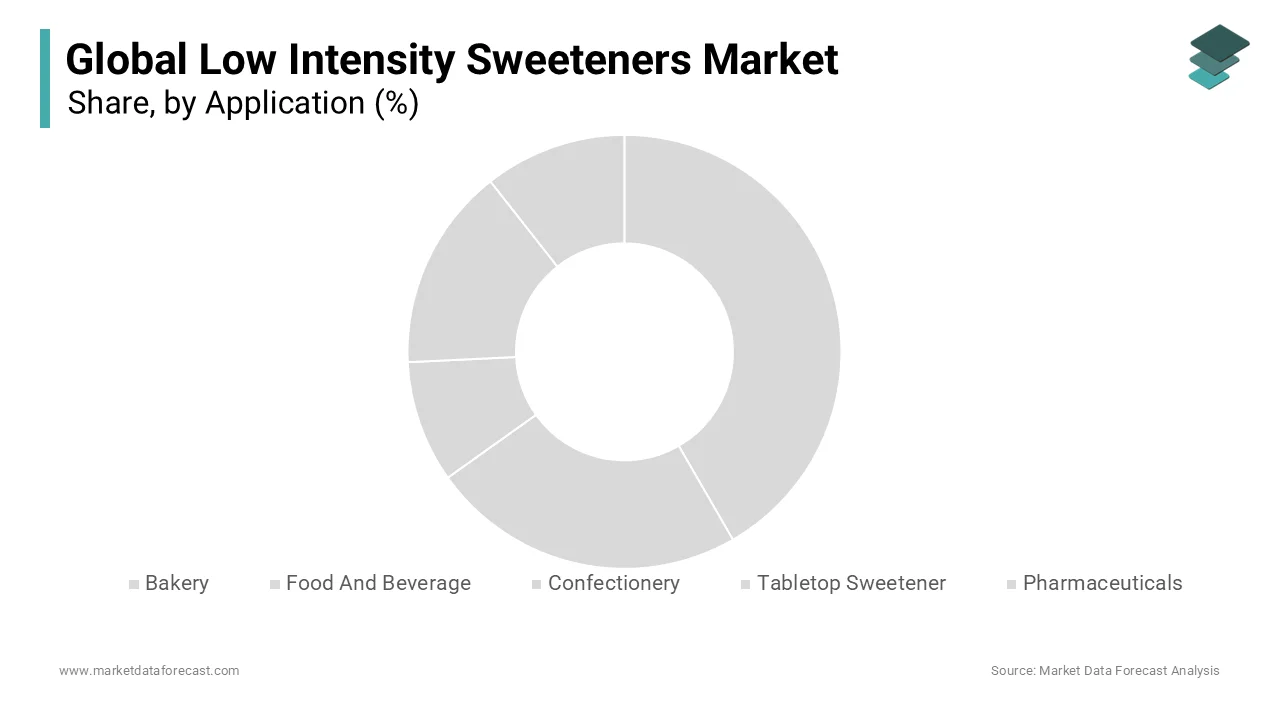
The Food and Beverage segment held the largest share of the low intensity sweeteners market, accounting for 38.4% of total consumption in 2024.
- This dominance is primarily driven by the extensive use of nutritive sweeteners such as sucrose, glucose syrup, and fructose in processed foods and ready-to-drink beverages.
- One key driver of this segment’s growth is the rising demand for functional and fortified beverages. Within this category, sports drinks, flavored waters, and plant-based beverages increasingly rely on low intensity sweeteners like maltodextrin and dextrose for balanced sweetness and energy delivery.
- Also, the food processing industry continues to expand, particularly in emerging markets where packaged food consumption is on the rise. Manufacturers are incorporating nutritive sweeteners not only for taste but also for their role in texture development, moisture retention, and fermentation support in products such as sauces, dressings, and frozen desserts.
- These factors collectively reinforce the Food and Beverage segment’s leading position in the market.
- The Pharmaceuticals segment is projected to be the fastest-growing application area in the low intensity sweeteners market, with a CAGR of 7.9%.
- This rapid expansion is attributed to the increasing use of nutritive sweeteners in oral dosage forms, syrups, chewable tablets, and nutritional supplements, especially for pediatric and geriatric populations.
- A key driving factor behind this growth is the rising prevalence of chronic diseases such as diabetes and obesity, which has led to an increased demand for sugar-free or reduced-sugar pharmaceutical formulations.
- However, certain medications still require low intensity sweeteners to improve palatability without compromising stability. For example, lactose and mannitol are commonly used in tablet manufacturing due to their binding and bulking properties.
- These trends shows the expanding role of low intensity sweeteners in pharmaceutical applications, fueling robust market growth.
REGIONAL ANALYSIS
North America held the leading position in the global Low Intensity Sweeteners Market, accounting for 28.5% in 2023.
- The United States dominates this region, driven by a well-established food and beverage industry, high consumer awareness about ingredient labeling, and strong regulatory frameworks governing sweetener usage.
- One of the key drivers is the growing adoption of clean-label ingredients in packaged foods. In addition, the presence of major food manufacturers such as General Mills, Kellogg’s, and PepsiCo has accelerated product reformulations aimed at reducing artificial sweetener content.
- Moreover, the dietary supplement and functional food sectors have expanded significantly. These factors collectively reinforce North America's dominant position in the Low Intensity Sweeteners Market.
Europe is maintaining a significant presence due to its mature food processing sector and stringent regulatory environment.
- Germany leads within the region, followed closely by France and the United Kingdom, all of which contribute substantially to overall market dynamics.
- A primary growth driver is the European Union’s Nutri-Score system, introduced to help consumers make informed dietary choices. Manufacturers are increasingly opting for low intensity sweeteners like maltitol and erythritol to reduce free sugars while maintaining sensory attributes.
- Apart from these, the demand for plant-based and dairy alternative products is rising sharply. Furthermore, the German Federal Institute for Risk Assessment (BfR) emphasized the importance of moderate sugar intake, prompting reformulation efforts across confectionery and bakery sectors. These developments underscore Europe’s evolving yet resilient position in the Low Intensity Sweeteners Market.
Asia-Pacific represents one of the fastest-expanding regions in the low intensity sweeteners market.
- China leads the regional market, supported by India and Japan, all of which are experiencing heightened demand across food and beverage sectors.
- One of the primary growth drivers is the booming packaged food industry. This expansion has been accompanied by a shift toward healthier ingredient options, including the use of fruit-derived sweeteners and rice syrup in snack bars, instant noodles, and ready-to-eat cereals. Another key factor is the rising popularity of functional beverages.
- These developments position Asia-Pacific as a crucial growth engine in the global market.
Latin America holds a moderate share of the low intensity sweeteners market.
- Brazil emerges as the leading country in the region, followed by Mexico and Argentina, driven by strong domestic consumption and agricultural raw material availability.
- A major driver of growth is the deep-rooted tradition of sugar consumption, particularly in beverages and confectionery.
- This abundance supports the continued use of nutritive sweeteners in soft drinks, baked goods, and local delicacies.
- In addition, the region has seen a surge in artisanal and premium food products that emphasize natural ingredients. Moreover, Chilean authorities have implemented voluntary sugar reduction programs, encouraging moderate use rather than outright substitution, thereby preserving the relevance of low intensity sweeteners. These factors collectively support Latin America’s steady growth trajectory in the market.
The Middle East and Africa is an emerging low intensity sweeteners market, with Egypt and South Africa emerging as key contributors.
- While the region remains relatively underdeveloped compared to others, it is witnessing gradual growth due to urbanization, changing dietary habits, and increasing investments in food processing infrastructure.
- One of the key drivers is the rising consumption of processed and convenience foods. Traditional bakery and confectionery items, which often rely on nutritive sweeteners, are gaining traction in both formal and informal retail channels.
- Furthermore, the demand for halal-certified food products is growing across Gulf Cooperation Council (GCC) countries. Also, Saudi Arabia’s Vision 2030 initiative includes food security as a priority, prompting investment in domestic food manufacturing, which favors the use of locally sourced nutritive sweeteners.
- These developments indicate a positive outlook for market expansion in the Middle East and Africa.
Key Players in the Low Intensity Sweeteners Market
Key Players In Low Intensity Sweeteners Market Are Gulshan Polyols Limited, Cargill Inc, EcogreenOleochemicals, Food Chem International Corporation, Spi Pharma Inc, ZuChem Inc, E.I. Du Pont de Nemours and Company, Matsutani Chemical Industry Co., Ltd, Ingredion Incorporated, Roquette Freres Company.
Top Low Intensity Sweeteners Market Players
Cargill, Incorporated
- Cargill is a global leader in the food and agricultural sector, playing a pivotal role in the Low Intensity Sweeteners Market through its diverse portfolio of natural sweetening solutions. The company offers a wide range of nutritive sweeteners derived from corn, cane, and beet sources, catering to food and beverage manufacturers worldwide.
- Cargill’s emphasis on sustainable sourcing and innovation has enabled it to maintain strong relationships with both raw material suppliers and end-use industries. Its strategic collaborations with food processors and investment in clean-label ingredients have positioned it as a key player shaping market dynamics.
Tate & Lyle PLC
- Tate & Lyle is a major contributor to the Low Intensity Sweeteners Market, known for its expertise in developing functional and nutritious sweetening solutions. The company supplies bulk sweeteners such as sucrose, glucose syrups, and polyols that are widely used across bakery, dairy, and beverage applications.
- Tate & Lyle’s focus on health and wellness has led to the development of modified nutritive sweeteners that align with evolving consumer preferences. Its long-standing presence in North America and Europe, coupled with continuous R&D initiatives, has reinforced its influence in the global marketplace.
Ingredion Incorporated
- Ingredion plays a crucial role in the Low Intensity Sweeteners Market by offering a broad range of starch-based sweeteners and texturants. The company serves diverse sectors including beverages, snacks, and nutrition products, providing customized sweetness solutions tailored to specific formulation needs.
- Ingredion's commitment to innovation and sustainability has enhanced its competitive edge. Through strategic acquisitions and product development, the company continues to support food manufacturers in achieving desired taste, texture, and nutritional profiles, making it a key driver in the expansion of the nutritive sweetener segment.
Strategies Used by Key Players
- Product innovation and diversification: One of the primary strategies employed by leading players in the Low Intensity Sweeteners Market is product innovation and diversification. Companies are continuously developing new formulations that offer improved functionality, cleaner labels, and better nutritional profiles. This approach allows them to cater to evolving consumer preferences while maintaining relevance in various application sectors.
- Strategic partnerships and collaborations: Another critical strategy is strategic partnerships and collaborations. Market leaders frequently engage with food and beverage manufacturers, research institutions, and ingredient suppliers to enhance product development and optimize supply chain efficiency. These alliances help firms expand their reach and reinforce their market position.
- Expansion into emerging markets: Lastly, expansion into emerging markets is a key growth tactic. As demand for nutritive sweeteners rises in Asia-Pacific, Latin America, and Africa, companies are investing in local production facilities and distribution networks to strengthen their global footprint and capture untapped opportunities.
Low Intensity Sweeteners Market Recent News
- In February 2024, Cargill announced the launch of a new line of upcycled nutritive sweeteners derived from sugar beet processing by-products. This initiative supports the company’s sustainability goals while expanding its portfolio of clean-label ingredients tailored for use in baked goods and dairy products.
- In May 2024, Tate & Lyle partnered with a European plant-based beverage manufacturer to co-develop a reduced-sugar oat milk formulation using a proprietary blend of low intensity sweeteners. This collaboration enhances Tate & Lyle’s presence in the alternative dairy sector while addressing consumer demand for naturally sweetened products.
- In July 2024, Ingredion expanded its production capacity at a facility in Southeast Asia to meet rising demand for glucose syrups and maltodextrins. This move strengthens Ingredion’s foothold in the region and ensures a more resilient supply chain for key food and beverage clients.
- In September 2024, Roquette Frères introduced a new range of organic nutritive sweeteners designed specifically for use in sports nutrition bars and shakes. Targeting health-conscious consumers, this product line leverages Roquette’s expertise in plant-based ingredients and reinforces its position in the wellness-focused food market.
- In November 2024, Südzucker AG acquired a German-based clean-label syrup producer to broaden its capabilities in natural sweetener formulations. This acquisition enables Südzucker to better serve customers seeking transparent ingredient lists and aligns with broader trends toward minimally processed foods.
Low Intensity Sweeteners Market Report Scope
| Metric | Value |
| Base Year | 2024 |
| Market Size Available | 2024 to 2033 |
| Forecast Period | 2025 to 2033 |
| Quantitative Units | Market Size in USD Billion and CAGR from 2025 to 2033 |
| Various Analyses Included | Global, Regional & Country-Level Analysis; Segment-Level Analysis; DROC; PESTLE; Porter's Five Forces; Competitive Landscape; Investment Opportunities |
| Segments Covered | Application |
| Regions Analyzed | North America, Europe, APAC, Latin America, Middle East & Africa |
| Countries Covered | U.S, Canada, Mexico, UK, France, Spain, Germany, Italy, Russia, Sweden, Denmark, Switzerland, Netherlands, Turkey, Czech Republic, India, China, Japan, South Korea, Australia, New Zealand, Thailand, Malaysia, Vietnam, Philippines, Indonesia, Singapore, Brazil, Argentina, Chile, KSA, UAE, Israel, rest of GCC countries, South Africa, Ethiopia, Kenya, Egypt, Sudan and Other Countries |
| Report Format | PDF, Excel, PPT, BI |
| Customization | Report customization as per your requirements with respect to countries, region and segmentation. |
MARKET SEGMENTATION
This research report on the global low intensity sweeteners market has been segmented and sub-segmented based on application, and region.
By Application
- Bakery
- Food And Beverage
- Confectionery
- Tabletop Sweetener
- Pharmaceuticals
By Region
- North America
- Asia Pacific
- Europe
- Latin America
- Middle East and Africa