- Product Description Description
- Table of Contents TOC
- List of Table & Figure LOT
- Get Free Sample PDF Sample PDF
Market Size, 2025
$154.93 BnMarket Estimate, 2026
$161.44 BnMarket Forecast, 2034
$224.36 BnCAGR, 2026–2034
4.2%Executive Summary: Global Maize Market
- Market Scope: Comprehensive market evaluation of the global maize (corn) sector, analyzing product variants (field maize, sweet maize, popcorn, Indian maize), end-use sectors (chemical, food & beverages, animal feed, pharmaceutical), distribution channels (B2B vs. B2C), and regional trade balances.
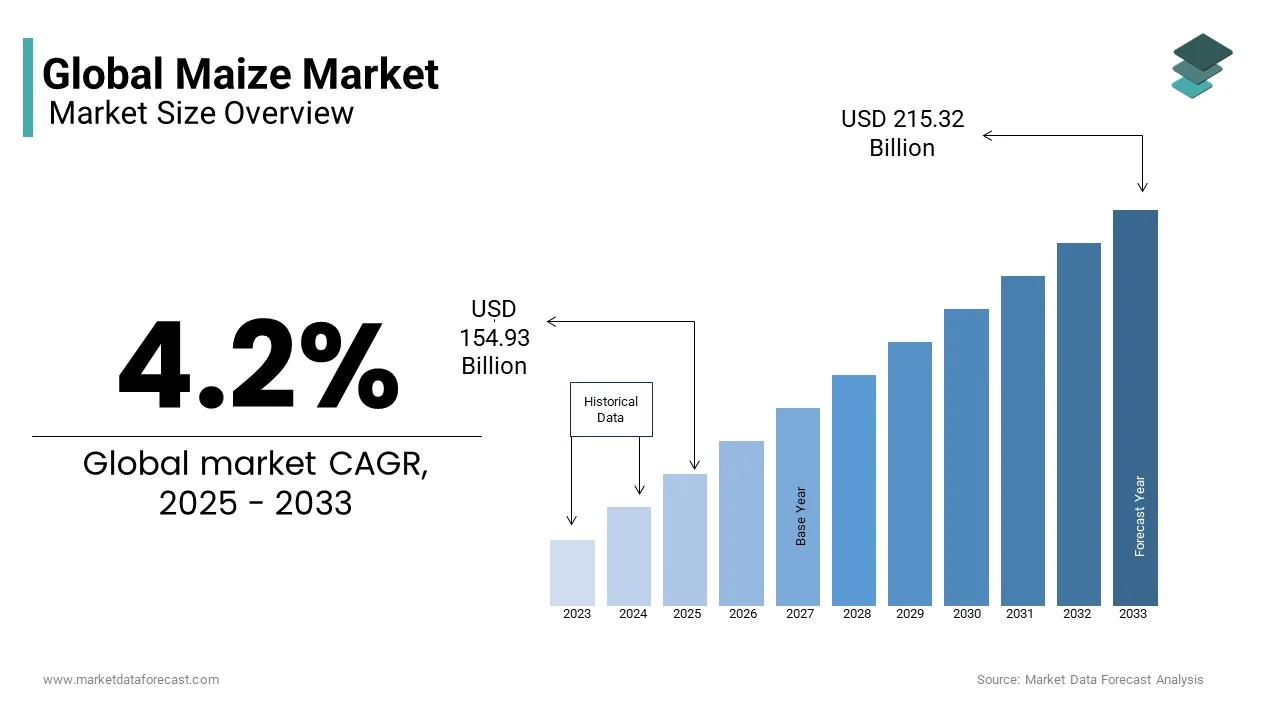
- Market Valuation: Valued at USD 154.93 billion in 2025, reaching USD 161.44 billion in 2026, and projected to expand up to USD 224.36 billion by 2034, registering a steady CAGR of 4.20% throughout the forecast period from 2026 to 2034.
- Primary Growth Drivers: Escalating global consumption of meat, dairy, and animal-derived protein boosting the compound feed industry; surging demand for starch-based bio-ethanol as an alternative energy source; and high productivity rates and geographic adaptability of maize farming.
Key Market Segment Metrics
| Category | Leading Segment (Base Year Position) | Fastest-Growing / High-Impact Segment |
|---|---|---|
| By Type, End-Use & Distribution | Field Maize (dominant type driven by livestock feed demands) & Business-to-Business (B2B) Distribution Channel (primary bulk supply route) | Chemical / Biofuel Industry segment (rapid growth fueled by starchy feedstock requirements for ethanol distillation) & Organic Corn sector. |
| By Region / Country | North America (dominant regional market anchored by the United States as the world's leading maize producer and exporter) | Asia-Pacific (fastest-expanding regional market driven by intensifying livestock production and rising industrial grain processing in emerging economies). |
Major Market Players & Market Structure
Market Structure: A highly consolidated global agricultural commodity market shaped by major agribusiness conglomerates managing large-scale grain trading, seed biotechnology, and export logistics networks.
Key Companies: Archer Daniels Midland Company (ADM), Bunge Limited, Louis Dreyfus Company, COFCO Group, Glencore plc, Bayer AG (Monsanto), DowDuPont (Corteva Agriscience), Limagrain Group Holding, and Satake Corporation.
Global Maize Market Size
The global maize market was valued at USD 154.93 billion in 2025 and is anticipated to reach USD 161.44 billion in 2025 from USD 224.36 billion by 2034, growing at a CAGR of 4.2% during the forecast period from 2026 to 2034.
Current Introduction and Definition of the Maize Market
Maize is a tall grain plant that produces kernels on ears, and it is widely known as corn. This cereal grain functions as the primary metabolic input for modern food systems, where its starch, protein and oil fractions are fractionated into thousands of derivative products spanning sweeteners, ethanol, bioplastics and pharmaceutical excipients. As per the Food and Agriculture Organization of the United Nations, global primary crop production reached 9.9 billion tonnes in 2023, while maize, wheat, and rice collectively accounted for 91% of total cereal production. According to the Food and Agriculture Organization of the United Nations, maize serves as a primary source of calories in the daily diets of 230 million inhabitants across developing nations. As per the International Energy Agency, liquid biofuels collectively meet 4% of global transport energy demand, with road transport accounting for the highest expansion. Furthermore According to the Intergovernmental Panel on Climate Change, maize crops experience a severe yield loss of over 16% per 1°C temperature rise without any significant carbon dioxide offset benefits. This creates systemic vulnerability in supply chains that underpin both caloric availability and industrial feedstock security across interconnected geopolitical regions.
MARKET DRIVERS
Industrial Biofuel Mandates Creating Structural Demand Floors
Government renewable fuel standards accelerate the growth of the maize market. This creates non-discretionary demand for maize as ethanol feedstock, transforming agricultural markets into energy policy instruments with legislated consumption floors independent of food or feed economics. According to the United States Environmental Protection Agency, the United States fuel ethanol consumption reached 15.6 billion gallons in 2024, driving the demand for corn ethanol primarily based on stable gasoline demand during the regulatory period. As per Brazil's National Petroleum, Natural Gas and Biofuels Agency, Brazil generated 32 billion liters of decarbonizing ethanol, supported by the RenovaBio market framework. According to China's National Development and Reform Commission, a multi-ministry joint plan implemented a 10% ethanol-blended gasoline mandate to roll out fuel distribution across domestic markets. These mandates function as permanent demand anchors absorbing a notable portion of global maize output through regulatory compulsion rather than voluntary consumption choices. When crude oil prices rise, ethanol economics improve further, amplifying maize demand, while low oil periods trigger waiver requests but rarely eliminate baseline volumes due to infrastructure lock-in and rural political economy considerations. This energy agriculture nexus ensures maize markets remain tethered to fuel policy cycles, creating predictable volume baselines that support long term planting decisions and processing investments even during periods of weak traditional demand.
Intensifying Livestock Production Requiring Energy-Dense Feed
Global meat, dairy, and egg production expansion further contributes to the growth of the maize market. This drives sustained maize consumption, as monogastric animals require energy-dense carbohydrate sources for efficient conversion ratios that alternative grains cannot match without performance penalties. According to the Food and Agriculture Organisation, global poultry meat production increased to over 141.3 million metric tons in 2024, securing its position as the most produced animal protein worldwide. As per the Brazilian Animal Protein Association, Brazilian chicken exports reached 5.25 million tons in 2024. According to China's Ministry of Agriculture and Rural Affairs, the livestock industry introduced a Grain-Saving Action Plan to reduce corn and soybean meal usage in feed. Unlike ruminants that can utilise forages and fibrous byproducts, pigs, chickens and farmed fish possess digestive physiologies optimised for starch digestion, making maize irreplaceable in least-cost formulations. Rising per capita protein consumption in emerging economies combined with intensification trends in developed markets creates compound demand growth where each unit of animal protein expansion multiplies maize requirements through feed conversion inefficiencies embedded in biological systems.
MARKET RESTRAINTS
Climate Volatility Disrupting Yield Stability and Supply Predictability
Extreme weather is happening more often, which hurts maize production and creates sudden supply shortages, and ultimately hinders the expansion of the maize market. Since most maize exports come from these climate-vulnerable areas, the resulting shortages spread across global markets instantly. According to the World Meteorological Organisation, extreme weather events in 2024 exacerbated regional food crises and intensified output volatility within primary grain production systems. As per the European Commission Joint Research Centre, the dry summer of 2022 reduced global grain maize yields across Europe by 8.6%. According to India's Ministry of Earth Sciences, structural climate adaptations led to a record domestic kharif maize production estimate of 28.3 million tonnes during the production season. Unlike diversified crops with multiple growing seasons or geographic dispersion, maize production is concentrated in temperate zones with narrow planting windows, making the entire annual supply vulnerable to single-season weather failures. Climate models project increased variance rather than a linear decline, meaning volatility itself becomes the core constraint. Pricing now embeds risk premiums, storage costs are rising for buffer stocks, and contract reliability is deteriorating. These factors force end-users to either maintain expensive inventories or switch away from maize during disruptions.
Trade Policy Distortions and Export Restriction Cascades
Protectionist interventions during supply crises amplify price volatility and undermine the functioning of the maize market. This happens because importing nations face sudden availability constraints unrelated to physical production capacity or logistics infrastructure. According to the International Food Policy Research Institute Food Security Portal, global trade tracking revealed that China enacted a domestic corn starch export ban to safeguard local agribusiness reserves. As per Argentina's Ministry of Economy shows that the government completely withdrew proposed fiscal revisions to raise agricultural export taxes on primary crop shipments. The policy responses reflect rational national interests but create collective action problems where individual safeguards aggregate into systemic dysfunction. Import-dependent nations respond by diversifying suppliers, investing in domestic production or substituting alternatives, permanently reducing long-term maize trade intensity. The unpredictability of intervention timing and duration makes forward contracting hazardous, discouraging private sector storage investment and shifting risk management burden onto public institutions lacking fiscal capacity to stabilise markets effectively during prolonged stress periods.
MARKET OPPORTUNITIES
Biodegradable Plastics and Bio-Based Chemical Manufacturing
Emerging biopolymer technologies are creating new industrial demand streams for maize starch, which is expected to drive the growth of the global market. This shift accelerates as petroleum substitution grows, driven by plastic pollution treaties and corporate sustainability commitments targeting fossil-free packaging. According to the European Bioplastics Association, global bioplastics production capacity reached 2.47 million tonnes in 2024, with total manufacturing facilities operating at an average utilisation rate of 58%. As per NatureWorks LLC, the global biobased manufacturer built its second polylactic acid manufacturing complex in Thailand to add 75,000 metric tons of annual capacity by 2024. According to the Renewable Carbon Institute, China's combined annual production capacity of PLA and PBAT reached 1.5 million tonnes amid rapid capital investment in biodegradable polymers. Unlike mature ethanol markets constrained by blending walls, bioplastics face exponential adoption curves driven by regulatory bans on single-use plastics and brand owner pledges creating demand elasticity absent in saturated fuel applications. According to the Food and Agriculture Organization, technical processing shifts intersect with global supply adjustments as localized grain output drops push up multi-region export pricing benchmarks. The diversification reduces maize market dependence on any single end use segment, spreading risk across food, feed, fuel and materials sectors while capturing value from environmental externalities increasingly monetised through carbon pricing and extended producer responsibility schemes.
Speciality High Value Maize Varieties for Niche Applications
Specialty maize varieties, including waxy, high-amylose, high-oil, and colored types, offer distinct genetic differentiation, which is anticipated to fuel the expansion of the global maize market. This allows brands to secure premium positioning and command high price multiples over commodity benchmarks in the food ingredient, functional starch, and nutraceutical sectors. As per the Ingredion Incorporated annual report, core starch products collectively accounted for approximately 49 percent of the company's total net sales for 2024. According to a commercial industry development report by GRAIN, seed manufacturers deployed genome editing techniques on waxy maize hybrids specifically to bypass the traditional yield drag compared to non-waxy counterparts. High oleic maize oil offers oxidative stability superior to soybean and canola oils enabling extended shelf life in fried snacks and baked goods without hydrogenation addressing trans fat elimination mandates globally. As consumer preferences fragment toward functional, nutritional, and aesthetic attributes, specialty maize captures value from quality dimensions invisible in bulk commodity grading systems. This shift creates resilient niches insulated from the oversupply cycles affecting undifferentiated production.
MARKET CHALLENGES
Mycotoxin Contamination and Food Safety Compliance Costs
Fungal toxins build up in maize kernels and create serious food safety hazards that lead to high testing and cleanup costs, and thereby challenge the growth of the global maize market. As a result, supply chains are disrupted, and market access is limited, particularly in humid tropical areas without proper climate-controlled storage. According to the World Health Organisation, dietary aflatoxin exposure functions as a major global risk factor for hepatocellular carcinoma, with sub-Saharan Africa, Southeast Asia, and China experiencing the highest burden of disease. As per the European Commission, rapid response food safety tracking logged 59 notifications for mycotoxins in cereal commodities across regional distribution hubs. According to the US Department of Agriculture, the country's advisory panels support consumer transparency by sustaining independent federal grain standards and user-fee inspection models. Climate change exacerbates contamination risk as warmer nights and erratic rainfall during silking promote Aspergillus and Fusarium infection. According to research, agricultural research networks deployed a digital Aflatoxin Early Warning System mapping high-risk zones across regional food systems. Testing infrastructure gaps in developing regions means contaminated grain enters informal markets unmonitored, creating public health crises while the formal sector bears disproportionate compliance costs, eroding competitiveness against less regulated origins.
Input Cost Inflation Compressing Producer Margins and Planting Decisions
Simultaneous escalation of fertilizer, fuel, and financing costs compresses maize profitability, which impedes the expansion of the maize market. This economic pressure forces acreage shifts, input rationing, and technology disadoption that undermine yield potential and supply responsiveness to price signals. As per the International Fertilizer Association, international fertilizer pricing indices averaged USD 589 per tonne during peak agribusiness trade periods. According to the US Department of Agriculture, farm support programs maintain Direct Farm Operating Loans at a 4.750% interest rate to sustain cash flow flexibility for agricultural producers. As per the Mato Grosso Institute of Agricultural Economics, fuel and lubricants structurally account for 5% of farm operating costs across central-western production networks. According to the US Department of Agriculture, federal agricultural credit operations set Direct Farm Ownership Loans at an indexed 5.250% base rate. Farmers respond by reducing fertiliser rates, switching to less input-intensive crops like soybeans or wheat or delaying technology upgrades, cumulatively depressing yield trajectories and supply elasticity. This cost price squeeze creates structural vulnerability where brief periods of low commodity prices trigger disproportionate supply response through input cutbacks that take multiple seasons to reverse once soil fertility and equipment bases degrade.
REPORT COVERAGE
| REPORT METRIC | DETAILS |
| Market Size Available | 2025 to 2034 |
| Base Year | 2025 |
| Forecast Period | 2026 to 2034 |
| CAGR | 4.2% |
| Segments Covered | By Type, End-User Industry, By Distribution Channel, and Region |
| Various Analyses Covered | Global, Regional, & Country Level Analysis; Segment-Level Analysis, DROC, PESTLE Analysis, Porter’s Five Forces Analysis, Competitive Landscape, Analyst Overview of Investment Opportunities |
| Regions Covered | North America, Europe, APAC, Latin America, Middle East & Africa |
| Market Leaders Profiled | Louis Dreyfus Company, COFCO Group, Bunge Limited, Archer Daniels Midland Company, Glencore plc, Maize Suppliers, SATAKE CORPORATION, DowDuPont Inc., Limagrain Group Holding, Bayer AG |
SEGMENTAL ANALYSIS
By Type Insights
Field Maize
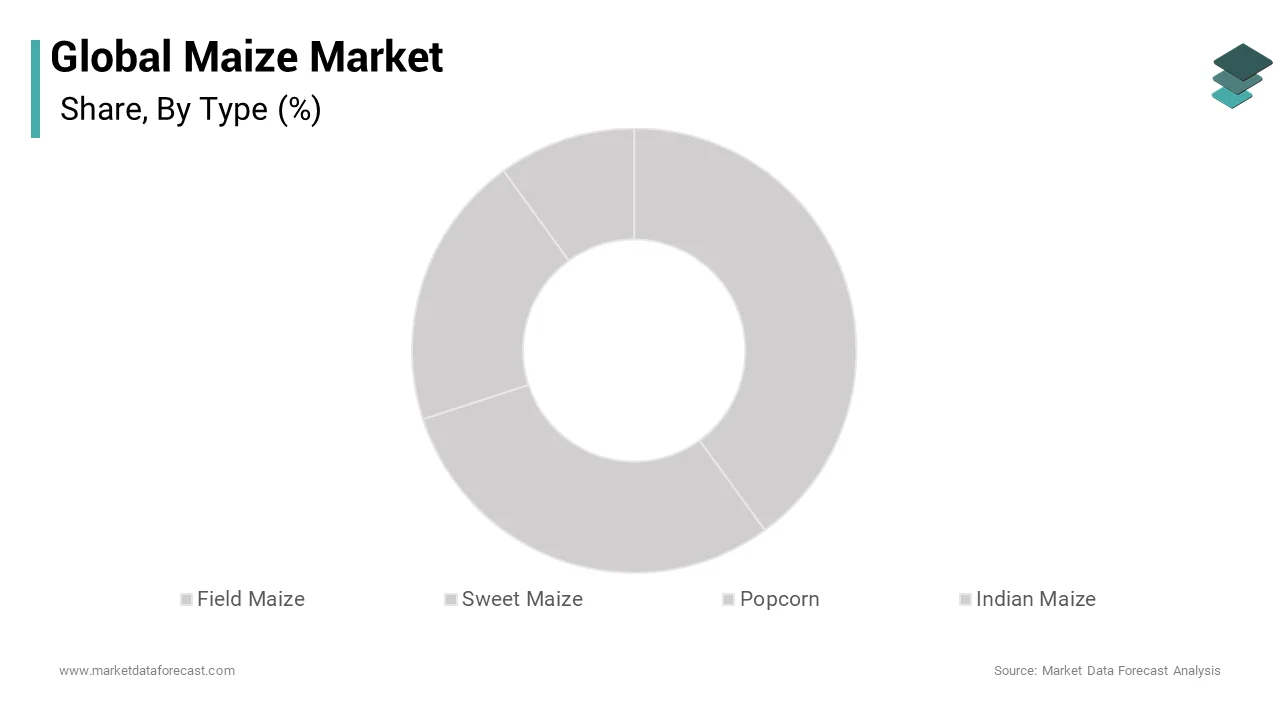
In 2025, the field maize segment held the majority share in the global maize market because of its unparalleled versatility as industrial feedstock, animal feed, and processed food ingredients across all major consuming sectors. The livestock and biofuel industries heavily require field maize’s high starch content and dry matter yield for energy-dense rations and ethanol fermentation. The massive scale of these two sectors is the primary driver for the segment's dominance. As per the United States Department of Agriculture Foreign Agricultural Service, global maize production reached approximately 1.23 billion metric tons, marking a stable volume expansion driven by primary output hubs. According to the United States Department of Agriculture Foreign Agricultural Service, international crop monitoring services maintain active baseline datasets to evaluate global trade dynamics across multi-regional agricultural supply chains. Mechanised harvesting and bulk storage infrastructure developed over decades creates economies of scale. According to Iowa State University Extension and Outreach, grain handling firms deploy large-scale elevated bin storage silos to reduce spatial constraints and cut bagging costs through mechanical automation. This combination of biological adaptability, infrastructure lock-in, and multi-sector demand elasticity ensures field maize maintains overwhelming volume leadership regardless of premium pricing opportunities available to differentiated types.
The foremost factor securing this segment's leading position is the continuous genetic improvement pipeline delivering yield gains, stress tolerance, and trait stacking that compound productivity advantages over alternative types lacking equivalent R&D investment intensity. As per Corteva Agriscience, seed developers commercialized advanced genetically modified maize hybrids to provide robust resistance against lepidopteran pests and tolerance to herbicide applications. According to the United States Department of Agriculture, maize production yields achieved 11.1 tonnes per hectare in the United States, compared to an average of approximately 7 tonnes per hectare across the European Union. As per the United States Department of Agriculture, food-producing animals globally consume between 70% to 90% of genetically engineered crop biomass within commercial livestock channels. The R&D concentration creates a self-reinforcing cycle where superior genetics attract more acreage, generating larger royalty revenue streams funding next generation development while specialty types face chronic underinvestment limiting their competitive potential even when price premiums temporarily improve relative economics.
Sweet Maize
The sweet maize segment is on the rise and is expected to be the fastest-growing segment in the market, with a CAGR of 6.8% between 2026 and 2034. This expansion of the segment is fuelled by rising fresh vegetable consumption, urbanisation, and processed food product innovation in emerging markets. A key growth factor is the dietary transition accompanying income growth in Asia-Pacific and Latin America, as consumers shift from staple grains toward fresh vegetables and convenient processed foods. Consequently, this shift positions sweet maize as an affordable, nutritious, and versatile ingredient. According to the United States Department of Agriculture Foreign Agricultural Service, major East Asian import markets like Japan and South Korea expanded their grain trade purchases to 14.9 million tonnes and 11 million tonnes, respectively. As per China's Ministry of Agriculture and Rural Affairs, the government implemented the Large-Scale Yield Improvement Promotion Plan to advance green, high-yield, and high-efficiency farming techniques. According to a regional agricultural analysis by the Mato Grosso Institute of Agricultural Economics, seed developers in Latin America expanded corn seed distribution to support Brazil's massive crop yield hitting 135 million metric tons. Unlike field maize consumed indirectly through meat, dairy, or processed ingredients, sweet maize captures value directly at the consumer level, enabling premium pricing and brand differentiation insulated from commodity price volatility. According to China's Ministry of Agriculture and Rural Affairs, regional economic crop evaluations peg the pricing structure of local sweet maize at USD 0.43 per kilogram.
Multiple factors accelerate this growth, including the expansion of processing capacity and export-oriented production in tropical regions, leveraging climate advantages and labor cost differentials to supply Northern Hemisphere markets during off-season windows. According to the Thai Ministry of Commerce, the ministry authorized strategic private-sector trade frameworks to purchase 1 million tonnes of high-quality feed commodities from the United States. As per the Thai Ministry of Commerce, the country expanded its overall global agricultural shipment value to USD 19.82 billion, ranking as the top agro-exporter within the ASEAN economic zone. According to the Thai Ministry of Commerce, the regional agricultural layout spans 1.21 million hectares of maize area to support a gross annual grain output of 5.3 million metric tons. The export led growth model decouples sweet maize expansion from domestic demand constraints, enabling production scaling based on global arbitrage opportunities where tropical climate and labour advantages offset transportation costs, creating a sustainable competitive position independent of local income levels or dietary preferences.
By End Use Industry Insights
Animal Feed
The animal feed segment remained the largest in 2025 and occupied a 62.3% share of the global maize market. This supremacy of the segment was credited to maize's irreplaceable role as a primary energy source in monogastric livestock rations worldwide. The main force behind this is the biological necessity of starch-dense carbohydrates for efficient feed conversion in poultry, swine, and aquaculture production systems. In these systems, alternative grains cannot match maize's metabolizable energy density without performance penalties or formulation complexity. According to the Alltech Global Feed Survey, global compound feed production reached over 1.39 billion metric tons, sustaining continuous expansion within commercial livestock supply chains. As per China's Ministry of Agriculture and Rural Affairs, the country deployed an industry-wide Grain-Saving Action Plan specifically designed to reduce the baseline quantities of corn and soybean meal mixed into domestic animal rations. Unlike ruminants utilising forages and fibrous byproducts, pigs, chickens, and farmed fish possess digestive systems evolved for starch digestion, making maize functionally irreplaceable in least-cost formulations. Rising per capita protein consumption in emerging economies combined with intensification trends globally creates compound demand growth where each unit of animal protein expansion multiplies maize requirements through feed conversion inefficiencies embedded in biological systems, ensuring sustained volume dominance regardless of price fluctuations or alternative grain availability.
The leading position of this segment is bolstered by the integrated supply chain relationships between feed manufacturers, livestock producers, and grain traders, creating structural dependencies that resist substitution even during periods of extreme price volatility. As per the Alltech Global Feed Survey, international feed output rebounded across global markets to touch 1.396 billion tonnes, demonstrating structural operational resilience despite persistent inflationary and supply constraints. According to the United States Department of Agriculture Foreign Agricultural Service, large-scale procurement shifts caused South Korea and Japan to raise their global feed crop imports to 11 million tonnes and 14.9 million tonnes, respectively. As per the Mato Grosso Institute of Agricultural Economics, massive structural grain supply expansions across South America propelled Brazil's annual crop volume to 135 million metric tons. Technical service teams from major feed additive companies provide formulation support optimised specifically for maize-based diets, generating proprietary nutritional databases that competitors cannot replicate without multi-year feeding trials. This ecosystem integration transforms maize from an interchangeable commodity to a system component, where switching costs exceed simple price differentials, ensuring demand stability through biological, technical, and logistical interdependencies accumulated over decades of co-evolution between grain and livestock industries.
Chemical Industry
The chemical applications segment is likely to experience the fastest CAGR of 9.2% over the forecast period due to bioplastics, bio-based chemicals, and industrial fermentation replacing petroleum-derived inputs under sustainability mandates and corporate decarbonization commitments. One leading cause of this growth is the regulatory and corporate push toward a circular bioeconomy, creating mandatory substitution targets for fossil-based plastics, solvents, and platform chemicals that maize starch and sugars can fulfill through established fermentation pathways. According to the European Bioplastics Association, global bioplastics processing capacity stood at 2.47 million tonnes, with production distribution spanning multiple biodegradable polymer formulations. As per the Renewable Carbon Institute, China's aggregate manufacturing layout for PLA and PBAT climbed to 1.5 million tonnes following continuous facility expansion. Unlike mature ethanol markets constrained by blending walls, bio-based chemicals face exponential adoption curves driven by brand owner sustainability pledges, retailer packaging mandates and extended producer responsibility schemes, creating demand elasticity absent in saturated fuel applications. Technical advances in metabolic engineering and enzymatic hydrolysis continuously improve conversion efficiency, reducing maize intensity per tonne of chemical output while maintaining cost competitiveness against petrochemical incumbents at crude oil prices above 70 dollars per barrel, ensuring a structural growth trajectory independent of temporary subsidy regimes.
The swift expansion of this segment gains further momentum from the diversification of the maize-derived product portfolio beyond commoditized ethanol and starch into high-value specialty molecules, commanding premium margins and creating multiple revenue streams per bushel of feedstock. According to UKHI, multinational electronics leader Apple achieved near-complete elimination of plastic materials from its commercial packaging line. As per GreenAir Online, international transport carriers KLM and Lufthansa executed long term commercial offtake contracts with AltAir and Gevo to acquire locally sourced sustainable biofuels. This product diversification reduces dependence on any single chemical application, spreading risk across packaging, textiles, fuels and speciality chemicals while capturing value from environmental attributes increasingly monetised through carbon pricing, green premiums and regulatory compliance mechanisms unavailable to fossil incumbents.
By Distribution Channel Insights
Business to Business (B2B)
The business-to-business distribution segment led the global maize market and captured a significant share in 2025. This leading position of the segment was attributed to the industrial-scale nature of end users, including feed mills, ethanol plants, processors, and exporters who procure in bulk quantities through contractual and spot market mechanisms. The prominence of this segment is further reinforced by the sheer magnitude of industrial consumption, where single facilities require thousands of tonnes monthly, necessitating logistics infrastructure and procurement systems incompatible with retail distribution channels. According to the Grain and Feed Trade Association, international crop trade networks manage grain transacting systems via standardized contract templates and arbitration mechanisms to streamline cross-border commercial execution. As per the Mato Grosso Institute of Agricultural Economics, massive agribusiness production expansions across South America propelled Brazil's annual crop volume to 135 million metric tons. Industrial buyers possess sophisticated risk management capabilities using futures, options, and swaps to hedge price exposure, enabling large volume commitments that stabilise producer revenues and facilitate planting decisions. Storage and transportation infrastructure, including country elevators, rail terminals and port facilities, are designed for bulk commodity flows. This infrastructure and scale advantage create insurmountable cost barriers for B2C channels attempting to compete in primary maize distribution, ensuring B2B dominance persists despite growing consumer interest in direct farm purchasing.
Moreover, this segment maintains its top market share, driven by the regulatory and quality assurance framework governing commercial grain transactions that requires documentation, testing and traceability systems calibrated for institutional buyers rather than individual consumers. According to the International Grains Council, global grain market analysis indicates that total international trade in grains reached 230 million tonnes amid changing multi-region import demands. As per the European Commission, rapid response safety tracking logged 59 notifications for mycotoxins in cereal commodities across regional distribution hubs. Chicago Board of Trade delivery standards specify grade factors, test weight, broken kernels and foreign material tolerances enforced through licensed inspectors and official weighing ensuring contract performance for institutional counterparties but irrelevant for consumer purchases where visual assessment and brand trust substitute for technical grading. According to a commercial industry development report by GRAIN, seed manufacturers deployed genome editing techniques on waxy maize hybrids specifically to bypass the traditional yield drag compared to non-waxy counterparts. Financial intermediaries, including trade finance banks and insurance providers, structure products around commercial bill of lading and warehouse receipt collateral unavailable for consumer transactions, further embedding B2B channels as the default distribution mechanism. These institutional frameworks create path dependency where decades of standard setting infrastructure investment, and legal precedent reinforce B2B dominance regardless of technological possibilities for disintermediation through digital platforms.
Business to Customer (B2C)
The business-to-customer distribution segment is expected to exhibit a noteworthy CAGR of 14.5% from 2026 to 2034, owing to e-commerce expansion, direct-to-consumer farm sales, and specialty product retailing enabled by digital platforms and changing consumer preferences. Growth in this sector is propelled by the proliferation of online grocery and specialty food platforms connecting consumers directly with producers and niche brands, bypassing traditional wholesale intermediaries, and enabling the discovery of differentiated maize products. According to the United States Department of Agriculture, maize production yields achieved 11.1 tonnes per hectare in the United States, compared to an average of approximately 7 tonnes per hectare across the European Union. Social media influencer marketing and recipe content drive trial and repeat purchase. As per the United States Department of Agriculture Foreign Agricultural Service, large-scale procurement shifts caused South Korea and Japan to raise their global feed crop imports to 11 million tonnes and 14.9 million tonnes, respectively. Subscription box services integrating maize-based snacks, flours and fresh sweet corn into curated deliveries introduce products to adventurous consumers, reducing search costs and building brand loyalty through recurring exposure. This digital enablement transforms B2C from a marginal channel to a viable growth vector by solving historical discovery, distribution, and trust barriers that previously confined direct sales to farmers' markets and roadside stands.
In addition, this segment's expansion is heavily fueled by the premiumization trend, where consumers willingly pay multiples over commodity prices for story-driven, sustainably produced, and nutritionally enhanced maize products, creating margin pools attractive to producers and retailers. According to the Hartman Group, millennial shoppers actively drive shifts in food retail preferences by prioritizing sustainability and corporate social responsibility during product selection. As per the Union of Concerned Scientists, concentrated industrial monoculture systems focus heavily on high-volume production of corn and soybeans for livestock feed and biofuel infrastructure. According to the Food and Agriculture Organization, major South American production hubs like Argentina and Brazil achieved record-breaking maize harvests despite localized climate shifts. The premiumization dynamic creates sustainable B2C economics where value derives from narrative nutrition and experience rather than caloric content alone, enabling channel growth independent of commodity price cycles and volume-based competition dominating B2B distribution.
REGIONAL ANALYSIS
North America Market Analysis
North America dominated the global maize market and accounted for a 30.7% share in 2025. This supremacy of the North American market was propelled by unmatched yield productivity, advanced biotechnology adoption and integrated domestic processing infrastructure. The region’s market status reflects technological and infrastructural maturity. According to the USDA National Agricultural Statistics Service, United States farmers projected an average nationwide corn yield of 183.1 bushels per acre during the 2024 production season. As per the USDA, the domestic corn quantity allocated for fuel ethanol production was officially revised upward to hit 5.4 billion bushels within the federal supply and demand framework. According to Statistics Canada, domestic farmers reported a significant nationwide reduction in overall corn and canola acreage as weather patterns shifted crop choices. As per the U.S. Department of Agriculture, Mexico's total corn import volume reached 18.2 million tons to satisfy industrial and livestock feed demands. However, water depletion in the Corn Belt threatens long-term irrigated production. As per the USDA Economic Research Service, the vast majority of U.S. crop value concentrates heavily within corn and soybean commodities grown throughout the Midwest row-crop corridor. Trade tensions with China and Mexico periodically disrupt export flows, creating policy uncertainty despite structural demand fundamentals. The region maintains leadership through a combination of genetic infrastructure and policy support, creating self reinforcing ecosystem difficult for competitors to replicate quickly despite closing yield gaps elsewhere.
Asia Pacific Market Analysis
Asia-Pacific followed closely behind in the global maize market and held a 28.9% share in 2025. This position of the APAC market shows massive domestic consumption, import dependency, and diverse production systems ranging from Chinese industrial-scale to Southeast Asian smallholder cultivation. The region’s market status reflects a structural deficit where population density and protein demand growth outpace domestic production capacity creating permanent import requirements concentrated in China, Japan, South Korea and the Philippines. According to the China National Grain and Oils Information Center, local processing operations expanded procurement to hold historically high soybean inventories at primary domestic crushing centers. As per the Indian Council of Agricultural Research, the central government established the official baseline Minimum Support Price for maize at INR 2,400 per quintal. According to the USDA Foreign Agricultural Service, import logistics tracking indicates that Japan remains a prominent destination market by absorbing 14.9 million tonnes of global corn shipments. Climate vulnerability affects regional stability. The region’s growth trajectory depends on balancing import dependency with domestic productivity enhancement through technology transfer, irrigation investment and policy reform addressing land fragmentation and input access constraints limiting smallholder competitiveness.
Latin America Market Analysis
Latin America occupies a significant position in the global maize market due to export-oriented production, double-cropping systems, and rapid technological adoption, particularly in Brazil and Argentina, which have emerged as the world’s leading suppliers. The region’s market status reflects competitive advantage derived from a tropical climate enabling two annual harvests, vast arable land reserves and currency depreciation enhancing export competitiveness despite infrastructure deficits. According to Brazil’s National Supply Company (CONAB), the country's multi-crop corn infrastructure generated an expanded second-season safrinha yield of 111.03 million tons to stabilize domestic grain inventories. As per sources, Argentina's total corn export performance reached 29.1 million tonnes during the specified marketing season. According to CONAB, Brazil achieved a comprehensive corn volume increase of 1.3% to hit an aggregate yield forecast of 142.95 million tonnes. As per the Observatory of Economic Complexity, Argentina's primary international corn market expanded rapidly to establish Vietnam as its largest global destination hub. Currency volatility creates both opportunity and risk, with real depreciation boosting export margins but inflating imported fertiliser and machinery costs, compressing net returns. The region’s export leadership depends on continued infrastructure investment, climate adaptation and policy stability amid political transitions affecting agricultural taxation and trade regulations.
Europe Market Analysis
Europe is moving ahead steadfastly in the global maize market. The European market is known for mixed self-sufficiency, stringent environmental regulations, and significant import dependency for feed and industrial applications, particularly in Southern and Eastern member states. In addition, the region’s market status reflects regulatory constraints where Common Agricultural Policy greening requirements, pesticide reduction mandates and nitrate directives limit intensification potential, distinguishing European production dynamics from less regulated exporting regions. According to the European Commission, total regional maize production dropped approximately 10% below its five-year rolling average to log 60.1 million tonnes. As per Eurostat, regional grain maize production fell by 3.4% as a consequence of adverse climatic shifts across primary growing zones. According to the European Commission, aggregate cereal crop outputs across the continent decreased by approximately 7% compared to the five-year average due to severe weather volatility. According to the European Commission Joint Research Centre MARS Bulletin, regional summer crop yield forecasts for grain maize, sunflowers, and soybeans faced downward revisions driven by worsening agro-climatic conditions across Bulgaria, Romania, Hungary, Croatia, and Italy. The region’s future trajectory depends on balancing food security, environmental objectives and farmer livelihoods through precision agriculture technology, drought-tolerant genetics and targeted income support rather than production maximisation paradigms dominating exporting regions.
Middle East and Africa Market Analysis
The Middle East and Africa region grew moderately in the global maize market, with activity heavily concentrated in South Africa, Egypt, Ethiopia, Nigeria, and Kenya. This growth was driven by food security imperatives, livestock expansion, and selective commercial production amid widespread subsistence cultivation. The region’s market status reflects extreme duality where South Africa operates as a sophisticated exporter while neighbouring countries face chronic deficits and aid dependency, creating fragmented market dynamics distinct from integrated global trading system. According to the South African Grains and Oilseed Supply and Demand Estimates Committee, national trade forecasts indicate that total maize exports were adjusted down to reach 1.85 million tonnes during the marketing cycle. As per the South African Agricultural Product Standards Act, commercial grain transactions enforce strict marketing boundaries by mandating a maximum 14% moisture limit for all marketable maize. According to the South African Crop Estimates Committee, favourable rainfall conditions and improved agricultural yields expanded the country's aggregate maize production to 16.32 million tonnes. Climate vulnerability remains acute. The region’s development depends on climate resilient genetics, irrigation investment and regional trade integration, reducing aid dependency while building domestic productive capacity aligned with African Union Malabo Declaration food sovereignty targets.
COMPETITIVE LANDSCAPE
Competition in the maize market features stratified rivalry between multinational grain traders integrated agribusinesses seed technology companies and regional cooperatives each pursuing distinct paths toward value creation and risk management in highly commoditized yet strategically critical sector. Global traders compete on logistics scale financing capacity and information advantages leveraging cross border arbitrage opportunities and balance sheet strength to absorb volatility smaller players cannot withstand during disruption periods. Integrated processors differentiate through end use specialization capturing premiums in food pharmaceutical and industrial segments where functional specifications and certification requirements create barriers to entry absent in bulk commodity channels. Seed and trait companies compete on genetic performance trait stacking and digital agronomy services creating recurring revenue streams and ecosystem lock in independent of grain price cycles affecting downstream participants. Regional cooperatives leverage member loyalty local knowledge and policy advocacy maintaining relevance despite scale disadvantages through relationship capital and community embeddedness multinationals cannot replicate. Competition intensifies around sustainability credentials and traceability as retailer mandates and regulatory frameworks transform environmental attributes into tradable value dimensions alongside traditional quality and price metrics. Consolidation accelerates as capital requirements for infrastructure technology and compliance exceed mid sized operator capacities forcing mergers and strategic alliances to maintain competitiveness. However biological variability geographic dispersion and policy fragmentation prevent complete homogenization enabling multiple viable business models to coexist serving distinct customer segments and risk appetites within this complex evolving landscape shaped by climate uncertainty geopolitical tensions and sustainability imperatives continuously reshaping competitive boundaries and value capture mechanisms across global maize value chains.
KEY MARKET PLAYERS
Some of the market players dominate the global maize market.
- Louis Dreyfus Company
- COFCO Group
- Bunge Limited
- Cargill Incorporated
- ADM (Archer Daniels Midland)
- Corteva AgriscienceCorteva Agriscience
- Archer Daniels Midland Company
- Glencore plc
- Maize Suppliers
- SATAKE CORPORATION
- DowDuPont Inc.
- Limagrain Group Holding
- Bayer AG
Top Players In The Market
- Corteva Agriscience maintains extensive involvement in the maize market through industry leading seed genetics and crop protection technologies serving growers across all major production regions globally. Its initiatives demonstrate a commitment to genetic innovation and integrated solutions, creating value beyond commodity seed sales while addressing the climate volatility and weed resistance challenges that define modern maize production economics. Consequently, these efforts ensure sustained grower loyalty through performance reliability and agronomic support networks spanning diverse agroecological zones and regulatory environments worldwide.
- ADM contributes significantly to the maize market through global origination processing and trading operations spanning 70 countries with integrated value chains connecting farmers to end users in feed fuel food and industrial sectors. Recent actions include launching digital procurement platform ReadiConnect enabling direct farmer contracting and real time pricing transparency across North American origination footprint. These strategies leverage scale integration and digital transformation to capture value across multiple maize end uses while reducing counterparty risk and logistics costs through vertical coordination ensuring competitive positioning amid consolidating global grain trade and evolving sustainability requirements from downstream customers seeking verified low carbon supply chains.
- Cargill plays vital role in maize market as world’s largest privately held grain trader and processor operating numerous country elevators wet mills and ethanol plants across Americas Europe and Asia. Recent actions include partnering with BASF on nitrogen use efficiency trials integrating biological nitrification inhibitors with Cargill maize hybrids addressing environmental concerns while maintaining yield performance. These initiatives reflect holistic approach combining physical infrastructure sustainability services and agronomic innovation to differentiate offerings in commoditized markets where traditional price competition erodes margins creating new value streams tied to environmental outcomes and supply chain transparency increasingly demanded by regulators retailers and consumers globally.
Top Strategies Used By Key Market Participants
Key players in the maize market employ vertical integration strategies controlling seed genetics origination storage processing and end use manufacturing to capture margin across value chain reduce counterparty risk and ensure supply security for downstream customers requiring consistent quality and volume commitments. Companies pursue geographic diversification across hemispheres and production zones mitigating climate and political risks concentrated in single region sourcing while enabling year round supply assurance for global customers dependent on continuous flow rather than seasonal availability. Digital platform development connects farmers directly with buyers enabling transparent pricing contract execution and traceability documentation satisfying sustainability verification requirements and reducing intermediary markups that historically fragmented value capture. Sustainability service bundling including carbon credit generation regenerative practice incentives and deforestation free certification transforms commodities into differentiated products commanding premiums and securing long term offtake agreements with ESG conscious buyers. Strategic acquisitions target regional handlers processors and technology providers filling geographic or capability gaps faster than organic buildouts while acquiring local relationships and regulatory approvals essential for market access. R&D investment prioritizes climate resilience traits water use efficiency and input optimization addressing producer pain points from volatility and regulation rather than pure yield maximization reflecting shifting value drivers in mature markets. Ecosystem partnerships with input suppliers equipment manufacturers and financial institutions create integrated solution offerings increasing switching costs and customer retention beyond transactional commodity relationships.
MARKET SEGMENTATION
This research report on the global maize market is segmented and sub-segmented based on type, End-Use Industry, Distribution Channel, and Region.
By Type
- Field Maize
- Sweet Maize
- Popcorn
- Indian Maize
By End-Use Industry
- Chemical
- Food & Beverages
- Animal Feed
- Pharmaceutical
By Distribution Channel
- Business to Business (B2B)
- Business to Customer (B2C)
By Region
- North America
- Europe
- Asia Pacific
- Latin America
- Middle East And Africa