- Product Description Description
- Table of Contents TOC
- List of Table & Figure LOT
- Get Free Sample PDF Sample PDF
Market Size, 2025
$1.55 BnMarket Estimate, 2026
$1.65 BnMarket Forecast, 2034
$2.73 BnCAGR, 2026–2034
6.50%Executive Summary: Global Microbial Pesticides Market Analysis & Forecast (2026–2034)
- Market Scope: Comprehensive global agricultural sector analysis covering product classifications, crop application targets, regional performance frameworks, Integrated Pest Management (IPM) alignment, and non-chemical crop protection trends.
- Market Valuation: Valued at USD 1.55 billion (2025), estimated at USD 1.65 billion (2026), and projected to reach USD 2.73 billion by 2034, registering a compound annual growth rate (CAGR) of 6.50% from 2026 to 2034.
- Primary Growth Drivers: Heightened human, animal, and environmental health concerns regarding chemical residues; strict import-export regulations on synthetic pesticide tolerances; low toxicity on non-target species; and robust industry investments through corporate partnerships, acquisitions, and R&D.
Key Market Segment Metrics (2026–2034)
| Category | Leading Segment (2025 Position) | Fastest-Growing Segment |
|---|---|---|
| By Type | Bacteria-Based Pesticides (dominant market share led by Bacillus thuringiensis variants like var. israelensis) | Fungi-Based Pesticides (led by Trichoderma species) & Virus/Nematode lines |
| By Form / Application | Fruits and Vegetables (account for the highest application market share due to stringent residue limits) | Maize, Rice, and Cotton Protection Formulations |
| By Region | Asia-Pacific (largest regional market driven by major agricultural output across China, Japan, and India) | Latin America (lucrative expansion led by Brazil's expansive commercial agribusiness sector) |
Major Market Players & Competitive Landscape
Market Structure: Highly collaborative and consolidated industry landscape featuring specialized biological innovators and legacy chemical conglomerates competing on strain efficacy, eco-friendly formulation stability, licensing agreements, and integrated crop protection portfolios.
Key Companies: Becker Underwood, Valent BioSciences, Certis, BioWorks, Ecogen, Koppert Biological Systems, Agri Life, AgraQuest, Marrone Bio Innovations, Novozymes Biologicals, Bayer CropScience, BASF, Isagro SpA, and De Sangosse.
 Download Free Sample Report
Global Microbial Pesticides Market Size
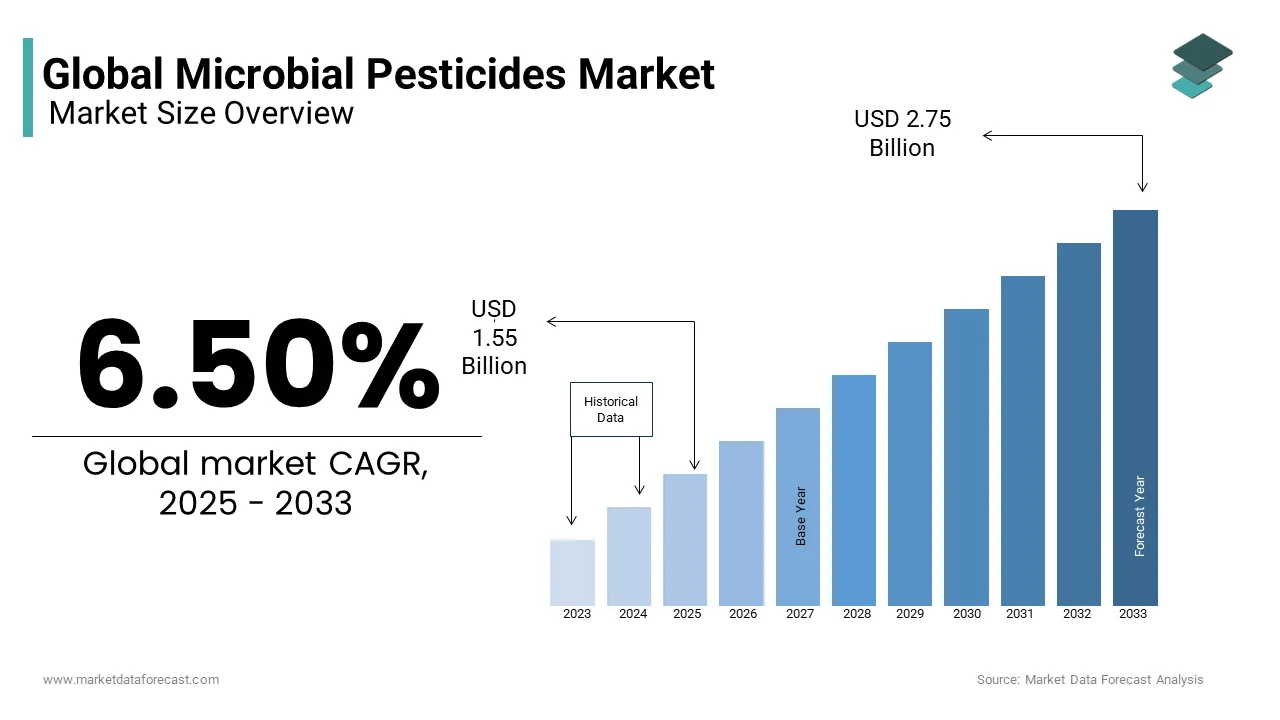
The global microbial pesticides market size was valued at USD 1.55 billion in 2025 and is anticipated to reach USD 1.65 billion in 2026 to reach USD 2.73 billion by 2034, growing at a CAGR of 6.50% during the forecast period from 2026 to 2034.
CURRENT SCENARIO OF THE GLOBAL MICROBIAL PESTICIDES MARKET
Microbial pesticides are certain types of pesticides derived from such natural materials as animals, plants, bacteria, and certain minerals. For example, baking soda and canola oil have pesticide-like applications and are considered biopesticides. Biopesticides are usually inherently less toxic than conventional pesticides and generally affect only the target pest and closely related organisms, in contrast to broad-spectrum, conventional pesticides that may have a harmful effect on organisms as different as birds, insects, and mammals. They are often effective in very small quantities and often decompose quickly, resulting in lower exposures and largely avoiding the pollution problems caused by conventional pesticides. When used as a component of Integrated Pest Management (IPM) programs, they can significantly reduce the use of conventional pesticides while crop yields remain high.
MARKET DRIVERS AND RESTRAINTS
While the prevalence of chemical or synthetic pesticides in crop protection would continue, human, animal, and environmental health concerns would play key roles in driving growth for biopesticides. Several countries are adopting a stringent approach concerning the number of imports, with a special focus on regulating the number of pesticide residues. As a result, the use and demand of non-chemical treatments for crop protection are increasing. Other factors favoring the market growth include low toxicity of microbial pesticides on non-target pest species, compatibility with synthetic chemicals and no residual toxicity for humans and other animals. In spite of their low toxicity and environmental impact levels, microbial pesticides have a major restraint in the form of high costs and low availability. Furthermore, Multiple acquisitions, licensing agreements, partnerships and huge investments in research and development by large companies will drive the growth of the crop protection market in the coming years.
REPORT COVERAGE
| REPORT METRIC | DETAILS |
| Market Size Available | 2025 to 2034 |
| Base Year | 2025 |
| Forecast Period | 2026 to 2034 |
| CAGR | 6.50% |
| Segments Covered | By Type, Form, and Region. |
| Various Analyses Covered | Global, Regional & Country Level Analysis, Segment-Level Analysis, DROC, PESTLE Analysis, Porter’s Five Forces Analysis, Competitive Landscape, Analyst Overview of Investment Opportunities |
| Regions Covered | North America, Europe, APAC, Latin America, Middle East & Africa |
| Market Leaders Profiled | Becker Underwood, Valent BioSciences, Certis, BioWorks, Ecogen, Koppert Biological System, Agri Life, AgraQuest, Marrone Bio Innovations, Novozyme Biological, Bayer crop science, BASF, IsAgro Spa, and De Sangosse. |
SEGMENTAL ANALYSIS
By Type Insights
Bacteria-based microbial pesticides dominate the market. Among bacteria-based pesticides B. thuringiensis var. israelensis is the most commonly used bacteria. Fungi based microbial pesticides form the largest market segment after bacteria. Trichoderma sp. is the most commonly used fungi for the preparation of microbial pesticides. Most of the products available in the market are insect control products.
By Form Insights
Fruits and vegetables account for the highest market share of the global microbial pesticides market.
REGIONAL ANALYSIS
On the basis of geography, the microbial pesticide market is segmented into various regions, namely North America, Europe, Asia Pacific, Latin America, and the Middle East and Africa. The Asia Pacific is the largest microbial pesticide market. China, Japan, and India are the major markets driving industry growth.
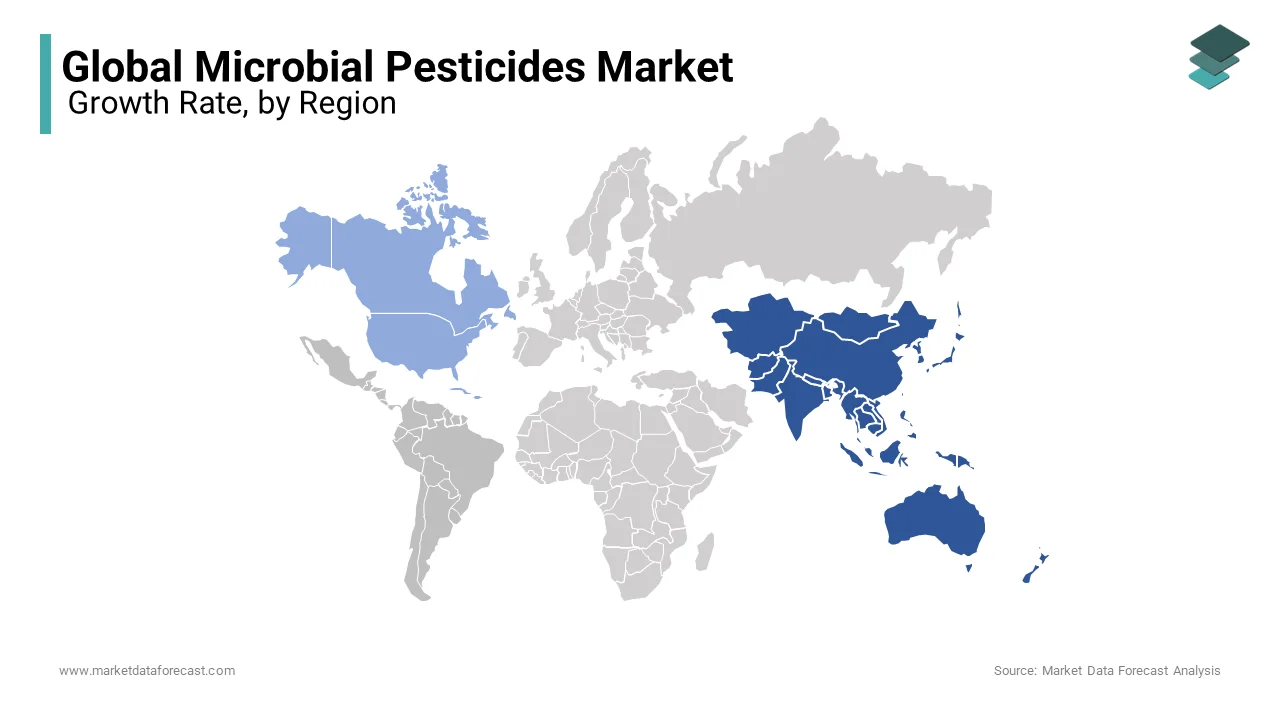
North America held the second-largest share of the market with the USA holding the largest market share by revenue. Latin America held is expected to witness lucrative growth with Brazil being the largest market in the region.
KEY MARKET PLAYERS
The market is dominated by companies like
- Becker Underwood
- Valent BioSciences
- Certis
- BioWorks
- Ecogen
- Koppert Biological System
- Agri Life
- AgraQuest
- Marrone Bio Innovations
- Novozyme Biological
- Bayer crop science
- BASF
- IsAgro Spa
- De Sangosse.
MARKET SEGMENTATION
This research report on the global microbial pesticides market is segmented and sub-segmented based on Type, Form, and Region.
By Type
- Bacteria Based Pesticides
- Fungi Based Pesticides
- Virus-Based Pesticides
- Nematode Based Pesticides
By Form
- Fruits and Vegetables
- Maize
- Rice
- Cotton
- Others
By Region
- North America
- Europe
- Asia Pacific
- Latin America
- Middle East and Africa