- Product Description Description
- Table of Contents TOC
- List of Table & Figure LOT
- Get Free Sample PDF Sample PDF
Market Size, 2025
$15.56 BnMarket Estimate, 2026
$16.75 BnMarket Forecast, 2034
$30.23 BnCAGR, 2026–2034
7.66%Executive Summary: Middle East and Africa Fish Feed Market
- Market Scope: Regional analysis of the Middle East and Africa (MEA) fish feed market covering ingredients, additives, end-user categories (fish types such as carp, tilapia, and catfish), and country-level breakdowns across KSA, UAE, Israel, GCC countries, South Africa, Ethiopia, Kenya, Egypt, Sudan, and the Rest of MEA.
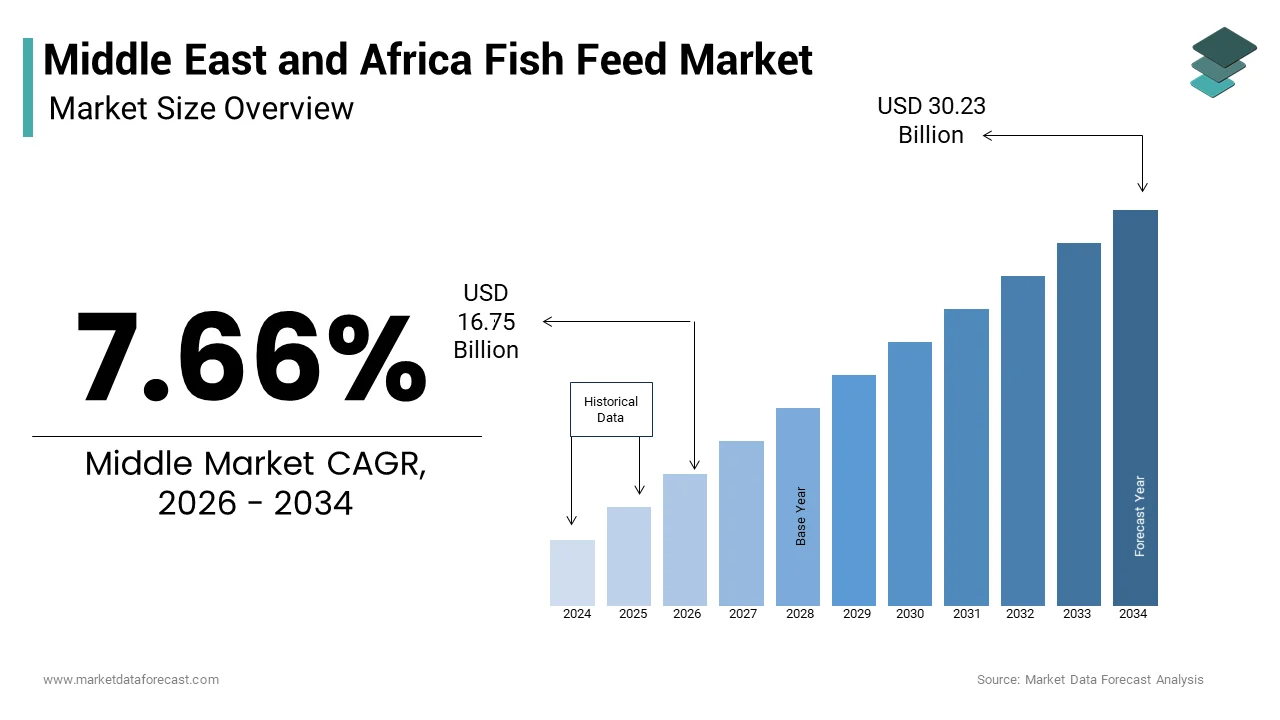
- Market Valuation: Valued at USD 15.56 billion (2025), estimated at USD 16.75 billion (2026), and projected to reach USD 30.23 billion by 2034, registering a steady CAGR of 7.66% (2026–2034).
- Primary Growth Drivers: Rapid population growth, rising disposable incomes, urbanization, strong expansion of commercial aquaculture, and the critical need for fish farming to supplement plateauing wild-catch yields under food security initiatives.
Key Market Segment Metrics (2026–2034)
| Category | Leading Segments / Overview | Market Position & Scope |
|---|---|---|
| By Ingredients | Corn, Soybean, Fish oil, Fish meal, Additives, and Others | Continuous refinement of nutrient balance and digestibility while expanding sustainable alternative components to reduce dependence on fishmeal and fish oil |
| By Additives | Vitamins, Antibiotics, Amino Acids, Antioxidants, Feed Acidifiers, Feed Enzymes, and Other Additives | Crucial formulations designed to enhance immunity, metabolic performance, and overall feed conversion efficiency |
| By End-User | Fish (specifically categorized into carp feed, tilapia feed, and catfish feed) | Focused on freshwater finfish species driving commercial aquaculture production across arid and developing regional sectors |
| By Country / Region | KSA, UAE, Israel, Rest of GCC, South Africa, Ethiopia, Kenya, Egypt, Sudan, and Rest of MEA | Propelled by regional aquaculture investments, food security frameworks, and efficiency-driven distribution channels |
Major Market Players & Competitive Landscape
Market Structure: An expanding regional market influenced by major international animal nutrition leaders and specialized feed producers focusing on sustainable aquafeed solutions.
Key Companies: Ridley Corporation Limited, Archer Daniels Midland Company, Nutreco N.V. (Skretting), Cargill, Avanti Feeds Limited, Purina Animal Nutrition, Biostadt India Limited, Alltech, Nutriad, and BioMar.
Middle East and Africa Fish Feed Market Size
The Middle East and Africa fish feed market size was valued at USD 15.56 billion in 2025 and is anticipated to reach USD 16.75 billion in 2026 to reach USD 30.23 billion by 2034, growing at a CAGR of 7.66% from 2026 to 2034.
Fish Feed is an important part of modern commercial aquaculture, providing the balanced nutrition needed by farmed fish. The feeds, in the form of pellets or granules, provide the nutrition in a concentrated and a stable form, enabling the fish to feed efficiently and grow at their full potential.
Traditionally two of th,e most important ingredients have been fish oil and fishmeal. The development of dry pelleted fish feeds to date has two main themes. One theme is improving digestibility and refining the balance of nutrients to meet the needs of the different species of fish more precisely at different periods of development. The other type is to improve the sustainability of the ingredients used. This is being attained mainly by identifying additional sustainable sources of ingredients, in particular, to reduce the need for fish oil and fishmeal. Improving the efficiency of feeding also assists sustainability.
The driving factors of the Middle East and Africa fish feed market are population growth, rising income, and rapid urbanization, which are facilitated by the strong expansion of fish production and more efficient distribution channels. The yield which is obtained from the wild catch cannot be increased sustainably, therefore, the opinion of observers such as the Food and Agriculture Organization of the United Nations, aquaculture must fill the gap.
REPORT COVERAGE
| REPORT METRIC | DETAILS |
| Market Size Available | 2025 to 2034 |
| Base Year | 2025 |
| Forecast Period | 2026 to 2034 |
| CAGR | 7.66% |
| Segments Covered | By Ingredients, Additives, End-User, Region. |
| Various Analyses Covered | Global, Regional & Country Level Analysis, Segment-Level Analysis, DROC, PESTLE Analysis, Porter’s Five Forces Analysis, Competitive Landscape, Analyst Overview of Investment Opportunities |
| Regions Covered | KSA, UAE, Israel, rest of GCC countries, South Africa, Ethiopia, Kenya, Egypt, Sudan, rest of MEA |
| Market Leaders Profiled | Ridley Corporation Limited, Archer Daniels Midland Company, Nutreco N.V., Cargill, Avanti Feeds Limited, Purina Animal Nutrition, Biostadt India Limited, Alltech, Nutriad, and Biomar |
KEY MARKET PLAYERS
Some of the major players in the market are
- Ridley Corporation Limited
- Archer Daniels Midland Company
- Nutreco N.V.
- Cargill
- Avanti Feeds Limited
- Purina Animal Nutrition
- Biostadt India Limited
- Alltech
- Nutriad
- Biomar
MARKET SEGMENTATION
This research report on the Europe Middle East and Africa fish feed market is segmented and sub-segmented into the following categories.
By Ingredients
- Corn
- Soybean
- Fish oil
- Fish meal
- Additives
- Others
By Additives
- Vitamins
- Antibiotics
- Amino Acids
- Antioxidants
- Feed Acidifiers
- Feed Enzymes
- Other Additives
By End-user
- Fish
- Carp feed
- Tilapia feed
- CCatfishfeed
By Country
- KSA
- UAE
- Israel
- Rest Of GCC Countries
- South Africa
- Ethiopia
- Kenya
- Egypt
- Sudan
- Rest Of MEA