- Product Description Description
- Table of Contents TOC
- List of Table & Figure LOT
- Get Free Sample PDF Sample PDF
Market Size, 2025
$156.48 BnMarket Estimate, 2026
$161.61 BnMarket Forecast, 2034
$209.22 BnCAGR, 2026–2034
3.28%Global Metal Packaging Market Summary
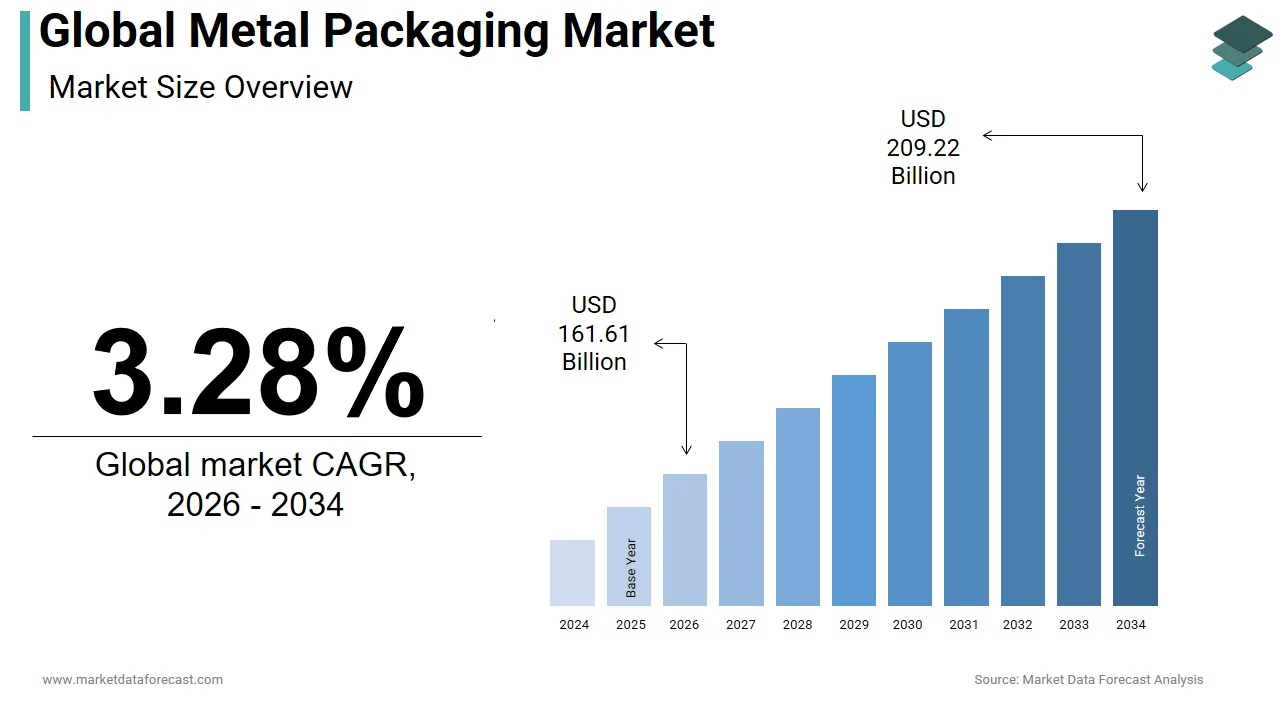
The global metal packaging market was valued at USD 156.48 billion in 2025, is estimated to reach USD 161.61 billion in 2026, and is projected to grow significantly to USD 209.22 billion by 2034, expanding at a CAGR of 3.28% from 2026 to 2034. The growth of the global metal packaging market is attributed to increasing demand for sustainable and recyclable packaging, rising consumption of canned food and beverages, and the growing adoption of durable packaging solutions across industries such as pharmaceuticals, personal care, and household products.
Key Market Trends
- Increasing focus on eco-friendly and recyclable packaging solutions to reduce plastic waste.
- The growing popularity of ready-to-drink beverages and canned foods is boosting demand for cans and containers.
- Rising penetration of metal packaging in pharmaceuticals and healthcare for product safety and shelf life extension.
- Technological innovations, such as lightweight and high-strength steel/aluminum packaging.
- Expansion of premium packaging formats inthe cosmetics and personal care industries.
Segmental Insights
- Based on material, the steel-based metal packaging segment dominated the market with a 58.1% share in 2024, supported by its strength, cost-effectiveness, and recyclability.
- Based on product type, the containers and cans segment led the market with 63.4% share in 2024, driven by rising consumption of soft drinks, energy drinks, and packaged foods.
- Based on end use, the food and beverage segment captured 65.8% of the global market share in 2024, highlighting the critical role of metal packaging in preserving freshness and extending shelf life.
Regional Insights
- Asia-Pacific dominated the global metal packaging market with a 39.5% share in 2024, driven by rising urbanization, growing packaged food demand, and industrial expansion.
- North America maintained a strong position, supported by beverage can consumption and recycling initiatives.
- Europe showed stable growth due to strict sustainability regulations and demand for eco-friendly packaging.
- Latin America is witnessing steady expansion with increasing adoption of canned beverages and processed foods.
- Middle East & Africa are emerging markets with rising demand for durable and sustainable packaging solutions.
Competitive Landscape
Key companies in the global metal packaging market include Ball Corporation (U.S.), Crown Holdings Inc. (U.S.), Silgan Holdings (U.S.), Amcor Limited (Australia), Ardagh Group SA (Europe), Tata Steel (India), Toyo Seikan Group Holdings Inc. (Japan), Greif Incorporated (U.S.), Ton Yi Industrial (China), Can-Pack SA (Netherlands), CCL Containers (U.S.), Sonoco Products Company (U.S.), Mauser Packaging Solutions (U.S.), Tubex GmbH (Germany), and DS Containers Inc. (U.S.). These players focus on sustainability, lightweight designs, and strategic expansions to strengthen their market presence.
Global Metal Packaging Market Size
The global metal packaging market was valued at USD 156.48 billion in 2025, is estimated to reach USD 161.61 billion in 2026, and is projected to reach USD 209.22 billion by 2034, growing at a CAGR of 3.28% from 2026 to 2034.
Metal packaging is fabricated primarily from steel and aluminum, engineered to preserve the integrity, safety, and shelf life of products across food, beverage, pharmaceutical, and industrial sectors. It is known for its durability, barrier properties, and recyclability. Metal packaging plays an important role in minimizing product degradation and contamination. Unlike permeable materials, metal provides an absolute barrier against light, oxygen, and moisture, which makes it indispensable for preserving sensitive contents such as canned vegetables, aerosolized medical treatments, and corrosive chemicals.
MARKET DRIVERS
Rising Demand for Shelf-Stable and Ready-to-Eat Foods
The global surge in consumption of shelf-stable and ready-to-eat (RTE) meals is propelling the growth of the metal packaging market. Urbanization and shifting lifestyle patterns have intensified demand for convenient, long-lasting food solutions, particularly in densely populated regions. According to the Food and Agriculture Organization of the United Nations, more than 56% of the world’s population resides in urban areas, a figure projected to rise to 60% by 2030, amplifying the need for durable, transport-safe packaging. Metal cans offer unparalleled protection against spoilage by maintaining food safety without refrigeration for extended periods. In emergency food distribution and military rations, metal packaging remains the standard due to its resilience.
Stringent Regulatory Standards for Product Safety and Integrity
The increasing regulatory scrutiny on product safety across industries is driving the growth of the metal packaging market. Agencies such as the U.S. Food and Drug Administration and the European Food Safety Authority mandate rigorous packaging standards to prevent contamination, especially in food, pharmaceuticals, and medical devices. Metal packaging, due to its hermetic seal and impermeability, ensures compliance with these requirements. For instance, in the pharmaceutical sector, metal blister packs and vials are essential for protecting moisture-sensitive drugs. According to research, a portion of medicines in low- and middle-income countries are compromised due to inadequate packaging, emphasizing the need for robust solutions. These regulatory imperatives strengthen metal packaging’s role as a non-negotiable component in safeguarding public health and ensuring logistical reliability.
MARKET RESTRAINTS
Environmental Impact of Primary Metal Production
The initial production of aluminum and steel imposes significant environmental burdens, particularly in terms of energy consumption and greenhouse gas emissions, which restrict the growth of the metal packaging market. Primary aluminum production is highly energy-intensive, according to the research. This process contributes to metric tons of CO₂ emissions annually, representing a portion of global industrial emissions. In regions reliant on coal-based power, such as parts of China and India, the carbon footprint of virgin metal production is substantially higher. As per the Intergovernmental Panel on Climate Change, metal manufacturing is among the top industrial sectors for emissions, limiting the sustainability appeal of non-recycled metal packaging. Recycling mitigates this impact; only a portion of aluminum scrap is currently collected efficiently in developing economies.
Vulnerability to Raw Material Price Volatility
Acute sensitivity towards fluctuations in the prices of aluminum, steel, and tin hinders the growth of the metal packaging market. These fluctuations are influenced by geopolitical tensions, trade policies, and mining output. Similarly, steel prices experienced an increase during the same period, as per the research, directly impacting production costs for packaging manufacturers. These instabilities complicate long-term pricing agreements with food and beverage clients by eroding profit margins.
MARKET OPPORTUNITIES
Advancements in Lightweighting and Material Efficiency
Innovations in lightweighting technologies to enhance sustainability and reduce logistical costs are setting up new opportunities for the growth of the metal packaging market. Manufacturers are engineering thinner yet stronger can walls through advanced alloying and forming techniques by decreasing material use without compromising structural integrity. This evolution lowers transportation emissions and increases payload efficiency; each kilogram saved in packaging allows for additional product shipment. Furthermore, these advancements align with corporate sustainability goals; companies have started work to reduce packaging weight, which drives demand for next-generation metal solutions.
Expansion of E-Commerce and Demand for Durable Shipping Solutions
The exponential growth of e-commerce has amplified the need for packaging that withstands complex logistics networks, setting up new opportunities for the metal packaging market. This rise positions metal containers as a resilient option for high-value and sensitive goods. Metal packaging, with its superior crush resistance and tamper-evident properties, is increasingly adopted for premium products such as luxury spirits, specialty foods, and electronic components. In China, where cross-border e-commerce has grown, brands are utilizing metal tins and boxes to ensure product integrity and enhance unboxing experiences. This reliability is fostering new applications beyond traditional sectors, including in smart packaging integrations and subscription-based gourmet product deliveries.
MARKET CHALLENGES
Competition from Alternative Sustainable Packaging Materials
Intense competition from emerging bio-based and compostable materials that align more closely with zero-waste initiatives degrades the growth of the metal packaging market. Polylactic acid (PLA), molded fiber, and cellulose-based films are gaining traction in sectors traditionally dominated by metal, particularly in single-serve food portions and cosmetics. According to the research, many consumer goods companies have pledged to replace conventional plastics and metals with renewable materials, accelerating R&D in plant-based packaging. As per the study, bioplastic production capacity is set to expand, reaching notable million metric tons annually.
Complexities in Multi-Material Recycling Streams
The contamination from multi-material composites and improper sorting impedes recovery efficiency, which challenges the growth of the metal packaging market. Many metal containers incorporate polymer coatings, plastic linings, or laminated labels, which complicate recycling processes and degrade output quality. According to the study, a portion of collected metal packaging is rejected at recycling facilities due to residual organic matter or mixed-material residues. In developing nations, where waste segregation infrastructure is underdeveloped, contamination rates exceed, according to the research.
REPORT COVERAGE
| REPORT METRIC | DETAILS |
| Market Size Available | 2025 to 2033 |
| Base Year | 2025 |
| Forecast Period | 2026 to 2034 |
| Segments Covered | By Material, Product Type, End-use, and Region. |
| Various Analyses Covered | Global, Regional and Country-Level Analysis, Segment-Level Analysis, Drivers, Restraints, Opportunities, Challenges; PESTLE Analysis; Porter’s Five Forces Analysis, Competitive Landscape, Analyst Overview of Investment Opportunities |
| Regions Covered | North America, Europe, Asia-Pacific, Latin America, Middle East and Africa |
| Market Leaders Profiled | Ball Corporation (U.S.), Crown Holdings Inc. (U.S.), Silgan Holdings (U.S.), Amcor Limited (Australia), Ardagh Group SA (Europe), Tata Steel (India), Toyo Seikan Group Holdings Inc. (Japan), Grief Incorporated (U.S.), Ton Yi Industrial (China), Can-Pack SA (Netherlands), CCL Containers (U.S.), Sonoco Products Company (U.S.), Mauser Packaging Solutions (U.S.), Tubex GmbH (Germany), DS Containers Inc. (U.S.) |
SEGMENTAL ANALYSIS
By Material Insights
The steel-based metal packaging segment dominated the metal packaging market by capturing 58.1% of the global market share. The growth of the steel-based metal packaging segment is driven by steel’s widespread use in food cans, aerosol containers, and industrial drums, particularly in emerging economies where cost efficiency and durability are paramount. Tinplate steel, a corrosion-resistant variant, is the preferred material for canned vegetables, fish, and pet food due to its excellent barrier properties and compatibility with retort sterilization processes. According to the study, a large number of food cans are produced annually worldwide, with a portion made from tinplate steel.
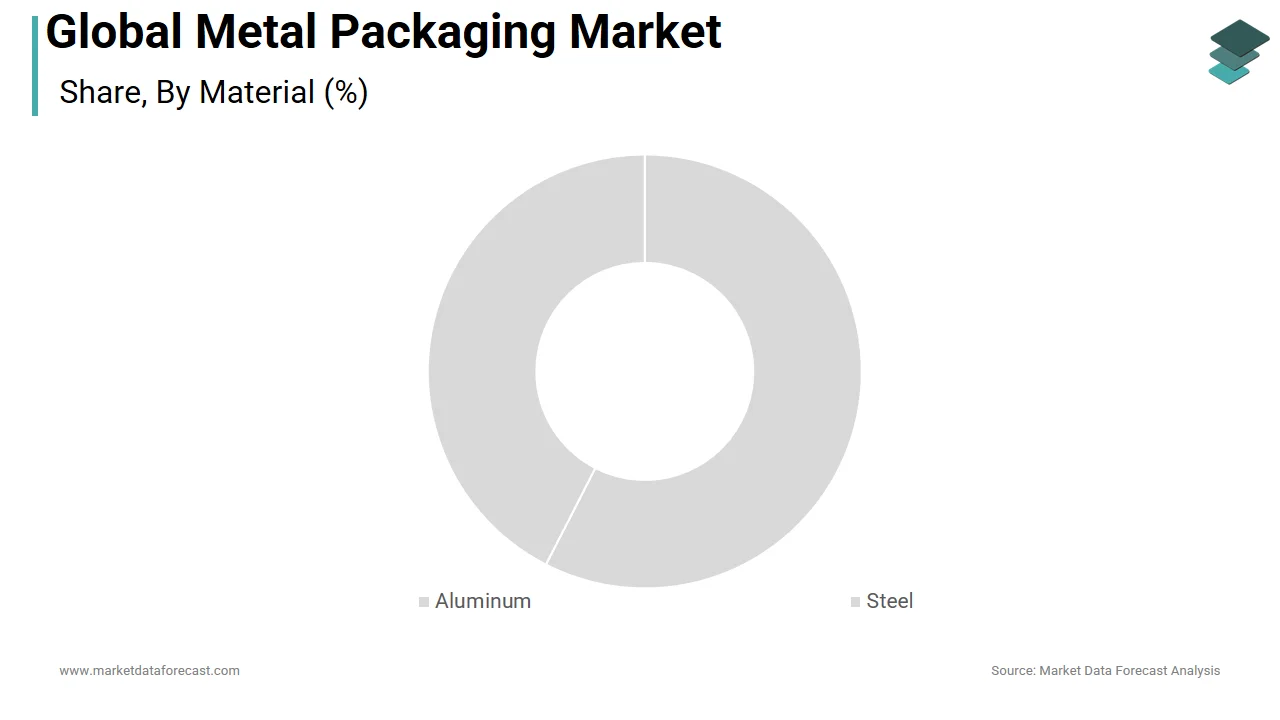
The aluminum segment is expected to register a CAGR of 6.4% from 2026 to 2034, with the rising demand for lightweight, infinitely recyclable beverage cans and premium packaging in personal care and pharmaceuticals. Aluminum’s high scrap value and energy efficiency make it a cornerstone of circular economy initiatives. Recycling aluminum saves a portion of the energy compared to virgin production, reducing CO₂ emissions by metric tons per ton of metal recycled. Beverage can recycling rates in countries foster brand loyalty among environmentally conscious consumers. Furthermore, advancements in can wall thinning have reduced, which enhances transport efficiency and lowers carbon footprints across supply chains.
By Product Type Insights
The containers and cans segment led the metal packaging market by capturing 63.4% of the global market share in 2024. The growth of the containers and cans segment is driven by their indispensable role in preserving perishable goods, particularly in the food and beverage industry. Two-piece aluminum cans and three-piece steel cans are the standard for carbonated drinks, juices, soups, and ready-to-eat meals. Their hermetic seals ensure product safety, extended shelf life, and resistance to physical damage, which makes them ideal for mass distribution.
The caps and closures segment is likely to experience a CAGR of 7.1% from 2026 to 2034, with the increasing demand for tamper-evident, resealable, and child-resistant metal closures across pharmaceuticals, cosmetics, and premium beverages driving the expansion of the caps and closures segment in the global market. Aluminum screw caps, roll-on pilfer-proof (ROPP) closures, and crown corks are gaining traction due to their durability, aesthetic appeal, and functional reliability. Apart from these, the rise of premium spirits and craft beverages has elevated the use of high-end metal caps to convey brand quality.
By End Use Insights
The food and beverage segment dominated the metal packaging market by capturing 65.8% of the global market share in 2024. Steel and aluminum cans are widely used for canned fruits, vegetables, seafood, soups, and carbonated soft drinks due to their impermeability to light, oxygen, and moisture. Metal packaging reduces post-harvest food losses in developing nations, where cold chain infrastructure is limited. In India, canned food production grew annually, which reflects rising urban consumption.
The pharmaceuticals segment is likely to grow with an expected CAGR of 7.3% from 2026 to 2034. The growth of the pharmaceuticals segment is propelled by the rising use of metal packaging for sterile containment, including aluminum blister packs, aerosol inhalers, and vials for injectables. The U.S. promotes that primary packaging for moisture-sensitive drugs must provide an absolute moisture barrier, a requirement that metal-based solutions fulfill more effectively than plastic or paper alternatives. According to the study, a portion of respiratory medications globally is delivered via metal aerosol cans.
REGIONAL ANALYSIS
Asia-Pacific Metal Packaging Market Insights
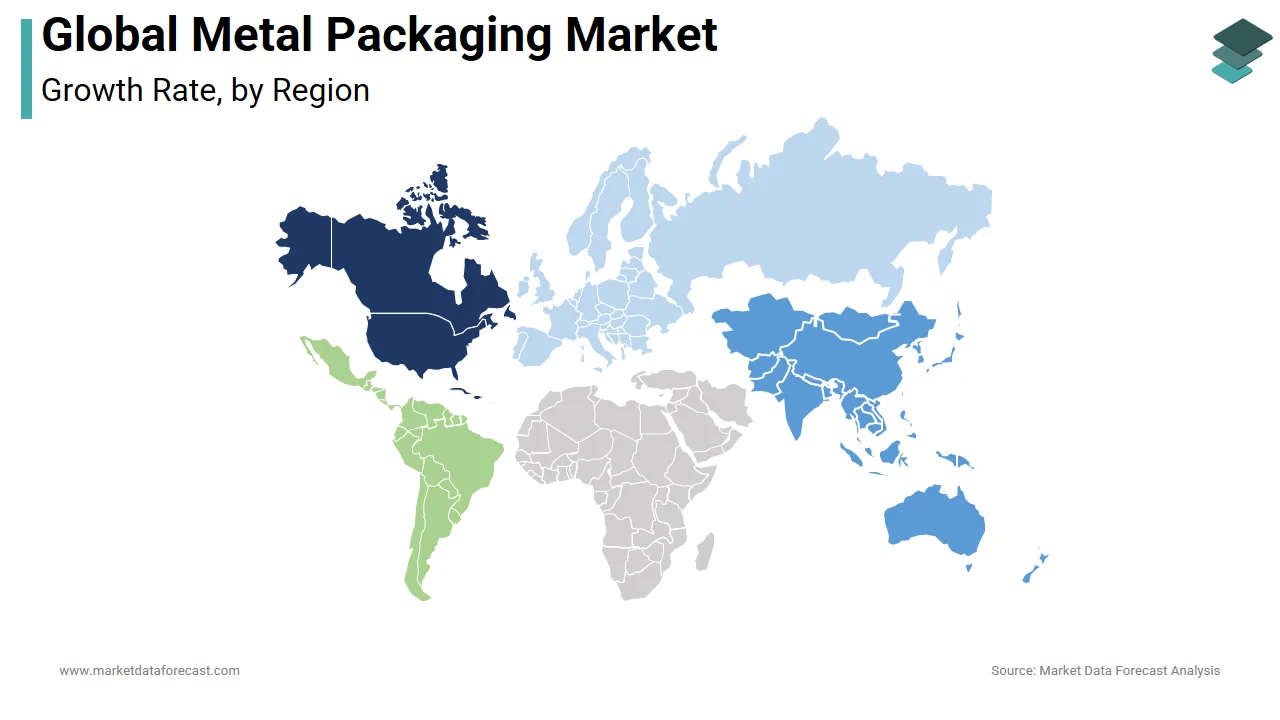
Asia-Pacific was the top performer in the metal packaging market in 2024 and accounted for 39.5% of the global market share in 2024. The domination of Asia Pacific in the global market is primarily driven by its massive manufacturing base, rapid urbanization, and growing middle-class consumption. China alone produces a portion of the world’s metal food and beverage cans, according to the research. India’s metal packaging business is expanding annually, driven by government initiatives to modernize food processing and reduce waste. As per the study, packaged food sales in the region surged, with canned and bottled products gaining popularity. Apart from these, Japan maintains a high recycling rate for aluminum cans by setting a benchmark for circular economy practices.
North America Metal Packaging Market Insights
North America metal packaging market was positioned second by capturing 25.4% of the share in 2024. The region’s mature beverage industry drives consistent demand for aluminum cans, which account for a portion of beer and soft drink packaging. According to a study, the U.S. can produce an excessive number of units. Canada complements this with strong demand in pharmaceutical and industrial packaging. The region is also at the forefront of sustainable innovation, with companies investing in low-carbon aluminum can lines.
Europe Metal Packaging Market Insights
Europe metal packaging market growth is likely to grow, with Germany, France, and the UK leading in production and consumption. The region’s stringent environmental regulations and advanced recycling infrastructure have positioned it as a leader in sustainable packaging practices. The beverage sector remains a major consumer, witha large number of metal cans produced annually across the EU. Apart from these, the cosmetics industry in France and Italy is increasingly using metal tubes and caps for premium skincare products.
Latin America Metal Packaging Market Insights
Latin America grew steadily in the metal packaging market, with Brazil and Mexico driving regional growth. Brazil is the largest producer and consumer, with billions of metal cans manufactured annually, primarily for beer, soft drinks, and canned fruits, according to the study. The country’s National Health Surveillance Agency promotes metal packaging for its role in food safety and reduced spoilage. Mexico’s proximity to the U.S. has enabled integration into North American supply chains, particularly in beverage and automotive coatings.
Middle East and Africa Metal Packaging Market Insights
The Middle East and Africa are likely to grow in the metal packaging market, with South Africa, Saudi Arabia, and the UAE serving as key markets. South Africa leads in production by hosting major metal packaging facilities that serve the Southern African Development Community. The country’s metal can production reached a significant number of units, as per the research. In the Gulf Cooperation Council, rising urbanization and imported food consumption are driving demand for canned goods.
COMPETITIVE LANDSCAPE
The metal packaging market exhibits a competitive landscape characterized by technological differentiation, sustainability prominence, and regional manufacturing agility. Companies are increasingly evaluated not only on price and performance but also on environmental footprint and compliance with circular economy principles. The Asia-Pacific region has emerged as an important theater of competition due to rising consumption, urbanization, and evolving regulatory standards. Firms are differentiating through end-to-end sustainability programs, digital integration, and strategic alliances with brand owners.
KEY MARKET PLAYERS
Some of the companies that are playing a dominating role in the global metal packaging market market include
- Ball Corporation (U.S.)
- Crown Holdings Inc. (U.S.)
- Silgan Holdings (U.S.)
- Amcor Limited (Australia)
- Ardagh Group SA (Europe)
- Tata Steel (India)
- Toyo Seikan Group Holdings Inc. (Japan)
- Grief Incorporated (U.S.)
- Ton Yi Industrial (China)
- Can-Pack SA (Netherlands)
- CCL Containers (U.S.)
- Sonoco Products Company (U.S.)
- Mauser Packaging Solutions (U.S.)
- Tubex GmbH (Germany)
- DS Containers Inc. (U.S.)
Top Strategies Used by the Key Market Participants
Key players in the metal packaging market are deploying a range of strategic initiatives to maintain competitive advantage and expand regional influence. Major strategies include technological innovation in lightweighting and barrier coatings to improve performance and sustainability. Companies are investing in energy-efficient manufacturing processes and low-carbon aluminum integration to meet corporate net-zero commitments. Geographic expansion, particularly in high-growth markets like India and Southeast Asia, is being pursued through greenfield plants and joint ventures. Strategic partnerships with beverage and food brands enable the co-development of customized packaging solutions. Digital transformation, including IoT-enabled production monitoring and blockchain for supply chain transparency, is enhancing operational efficiency.
Top Players in the Market
Ball Corporation
Ball Corporation, a U.S.-based global leader in metal packaging, maintains a strategic and expanding presence across the Asia-Pacific region, particularly in China, India, and Southeast Asia. The company specializes in lightweight aluminum beverage cans and sustainable packaging solutions for major beverage brands. The facility incorporates energy-efficient technologies and closed-loop water systems, aligning with ASEAN’s circular economy goals. Ball also collaborates with local recyclers to enhance collection infrastructure, which strengthens its commitment to environmental stewardship.
Crown Holdings, Inc.
Crown Holdings has established a deep footprint in the Asia-Pacific metal packaging market through its extensive network of manufacturing plants in China, Japan, Australia, and Thailand. The company supplies steel and aluminum containers for food, beverages, and aerosol products by serving multinational corporations and regional brands alike. Known for its innovation in can design and production efficiency. Its commitment to reducing greenhouse gas emissions per can has strengthened its appeal among eco-conscious clients.
Toyo Seikan Group Holdings Ltd.
Toyo Seikan, headquartered in Japan, is a dominant force in the Asia-Pacific metal packaging sector, with operations spanning Japan, China, India, and Southeast Asia. The company produces a wide range of containers for food, beverages, and industrial applications, including specialty cans for seafood and ready meals, key staples in Asian diets. The company also expanded its production capacity to meet rising demand from local food processors. Its R&D center in Yokohama focuses on developing ultra-thin, high-strength steel cans to reduce material use and transportation emissions.
GLOBAL METAL PACKAGING MARKET NEWS
- In November 2021, Nampak Limited, a South African metal packaging firm, expanded its beverage can production capacity in Johannesburg to meet rising demand from soft drink and energy drink brands across sub-Saharan Africa, enhancing regional self-sufficiency and reducing import reliance.
MARKET SEGMENTATION
This global metal packaging market research report is segmented and sub-segmented into the following categories.
By Material
- Aluminum
- Steel
By Product Type
- Containers & Cans
- Bottles & Jars
- Caps & Closures
- Tins
- Barrels & Drums
- Others
By End Use
- Food & Beverages
- Personal Care & Cosmetics
- Pharmaceuticals
- Paints & Varnishes
- Household
- Others
By Region
- North America
- Europe
- Asia-Pacific
- Middle East Africa
- Latin America