- Product Description Description
- Table of Contents TOC
- List of Table & Figure LOT
- Get Free Sample PDF Sample PDF
Market Size, 2025
$649.92 MnMarket Estimate, 2026
$711.66 MnMarket Forecast, 2034
$1470 MnCAGR, 2026–2034
9.5%Executive Summary: Global Microbial Soil Inoculants Market
- Market Scope: Comprehensive global analysis of the microbial soil inoculants market covering types (PGPMs, bio-control agents, plant-resistance stimulants), sources (bacterial, fungal), crop types (cereals & grains, oilseeds & pulses, fruits & vegetables), and regional frameworks across North America, Europe, Asia Pacific, Latin America, and Middle East & Africa.
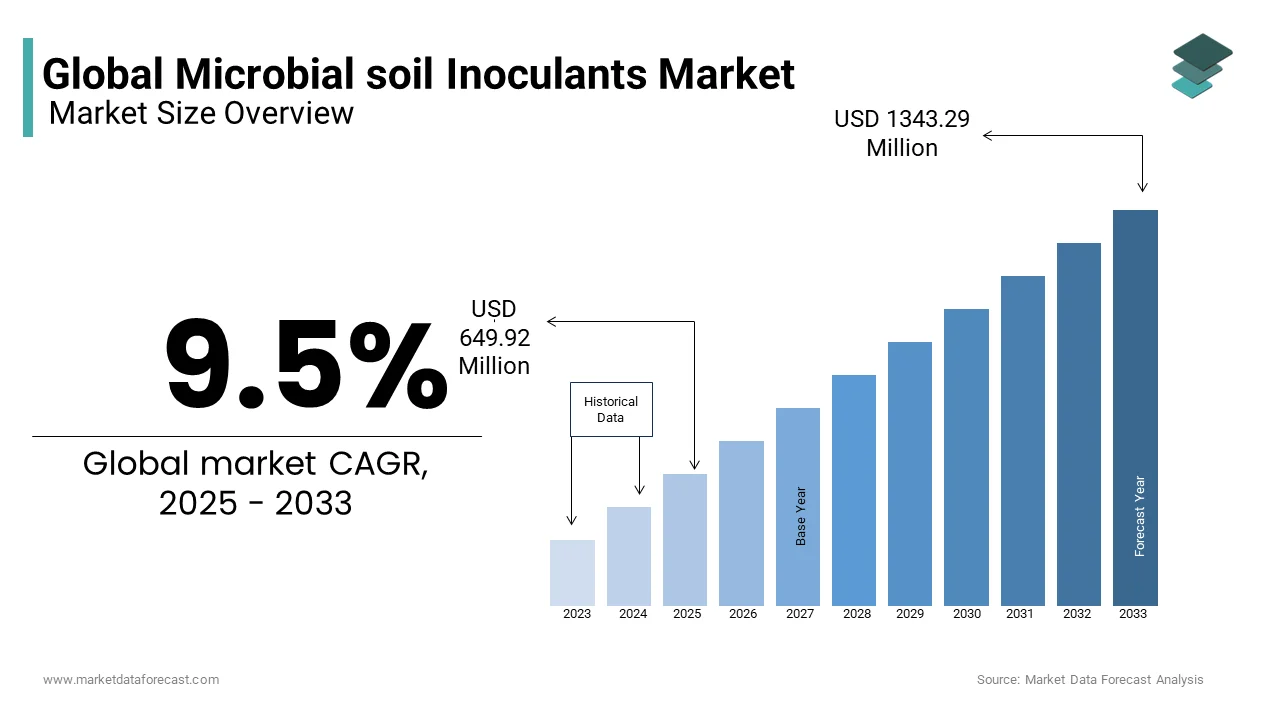
- Market Valuation: Valued at USD 649.92 million in 2025, estimated at USD 711.66 million in 2026, and projected to reach USD 1,470.91 million by 2034, registering a strong CAGR of 9.5% over the forecast period from 2026 to 2034.
- Primary Growth Drivers: Surging global demand for organic fertilizers and eco-friendly farming practices; rising adoption of agricultural inoculants across developing economies in Asia Pacific; and government promotional initiatives. Key restraints include low product shelf-life, inadequate storage infrastructure, and high transportation costs.
Key Market Segment Metrics (2026–2034)
| Category | Leading Segment / Position | Growth Details / Highlights |
|---|---|---|
| By Type | Plant Growth-Promoting Microorganisms (PGPMs), Bio-control agents, and Plant-resistance stimulants | Focused on symbiotic rhizobia and nitrogen-fixing efficiency for legumes and soil stabilization. |
| By Source | Bacterial and Fungal sources | Widely customized for targeted seed and soil formulations to improve plant nutrition and suppress diseases. |
| By Crop Type | Cereals & grains, Oilseeds & pulses, and Fruits & vegetables | Commercialized cultivation of corn, soybeans, and grain crops drives heavy volumetric consumption. |
| By Region | North America (market share leader) | Latin America is projected as the fastest-growing market; Asia Pacific holds massive potential led by China, India, and Japan. |
Major Market Players & Market Structure
Market Structure: A dynamic and specialized global market landscape featuring leading biotechnology firms, agricultural chemical corporations, and biological research enterprises scaling sustainable crop inputs.
Key Companies: BASF SE, E.I. DuPont De Nemours Company, Bayer CropScience, Novozymes A/S, Verdesian Life Sciences LLC, Advanced Biological Marketing Inc., BrettYoung, Precision Laboratories LLC, Queensland Agricultural Seeds Pty Limited, and Xitebio Technologies Incorporated.
Global Microbial Soil Inoculants Market Size
The global microbial soil inoculants market size was valued at USD 649.92 million in 2025 and is anticipated to reach USD 711.66 million in 2026 to reach USD 1470.91 million by 2034, growing at a CAGR of 9.5% during the forecast period from 2026 to 2034.
CURRENT SCENARIO OF THE GLOBAL MICROBIAL SOIL INOCULANTS MARKET
Microbial agricultural inoculants are customized formulations for soils or seeds to improve plant health and raise agricultural productivity. Microbial agricultural inoculants, also called soil inoculants, are beneficial for plant growth and nutrition. The use of microbial agricultural inoculants enhances plant growth, suppresses diseases, increases yield, and protects the environment. For better productivity in crops, microbial agricultural inoculants focus on the symbiotic rhizobia that are used for the establishment of nitrogen-fixing symbiosis with the legumes. Microbial agricultural inoculants also play an important role in the aggregation and stabilization of soil.
MARKET DRIVERS
The growth of this market is driven by the increase in demand for organic fertilizers in the agricultural sector. Secondary factors driving the market include a rise in organic and environment-friendly farming practices, a rise in demand for agricultural inoculants in developing countries like the Asia-Pacific, and promotion by government agencies. Inadequate know-how and availability, coupled with physical constraints like the relatively low shelf life of agricultural inoculants, are the primary constraints for the market. Shoddy infrastructure, inadequate storage facilities, and hefty transportation costs are challenges for market growth.
REPORT COVERAGE
| REPORT METRIC | DETAILS |
| Market Size Available | 2025 to 2034 |
| Base Year | 2025 |
| Forecast Period | 2026 to 2034 |
| CAGR | 9.5% |
| Segments Covered | By Type, Source, Crop Type, and Region |
| Various Analyses Covered | Global, Regional & Country Level Analysis, Segment-Level Analysis, DROC, PESTLE Analysis, Porter’s Five Forces Analysis, Competitive Landscape, Analyst Overview on Investment Opportunities |
| Regions Covered | North America, Europe, APAC, Latin America, Middle East & Africa |
| Market Leaders Profiled | BASES.E, E. I. Dupont De Nemours Company, Bayer Crop Science, Novozymes A/S, Verdesian Life Sciences LLC, Advanced Biological Marketing Inc, BrettyoungPrecisionon Laboratories LLC, Queensland Agricultural Seeds Pty Limited, Xitebio Technologies Incorporated. |
SEGMENTAL ANALYSIS
By Type Insights
REGIONAL ANALYSIS
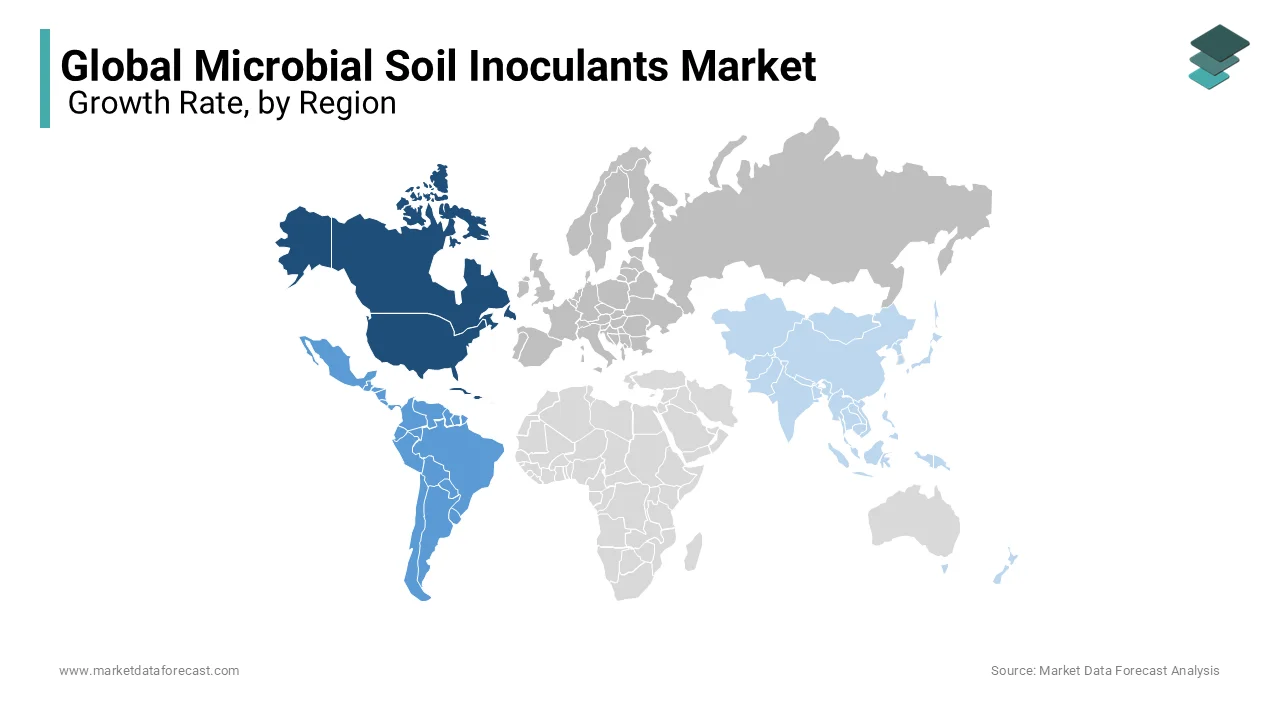
North America accounted for the largest share of the agricultural inoculants market in 2018. Growth in the North American region is due to a high rate of adoption of new technologies to increase the efficiency of crop production and minimize the cost of operations. The Latin American region is projected to be the fastest-growing market due to the commercialized cultivation of corn and soybean crops. Asia Pacific has considerable potential for the development of the microbial agricultural inoculants market, with vital contributors being China, India, and Japan, inter alia.
KEY MARKET PLAYERS
Some of the market players dominate the global microbial inoculants market.
- BASF SE
- E. I. Dupont De Nemours Company
- Bayer Crop Science
- Novozymes A/S
- Verdesian Life Sciences LLC
- Advanced Biological Marketing Inc
- Brettyoung,
- PrecisionLaboratories LLC
- Queensland Agricultural Seeds Pty Limited
- Xitebio Technologies Incorporated
MARKET SEGMENTATION
This research report on the global inoculants market is segmented and sub-segmented based on Type, Source, Crop Type, and Region.
By Type
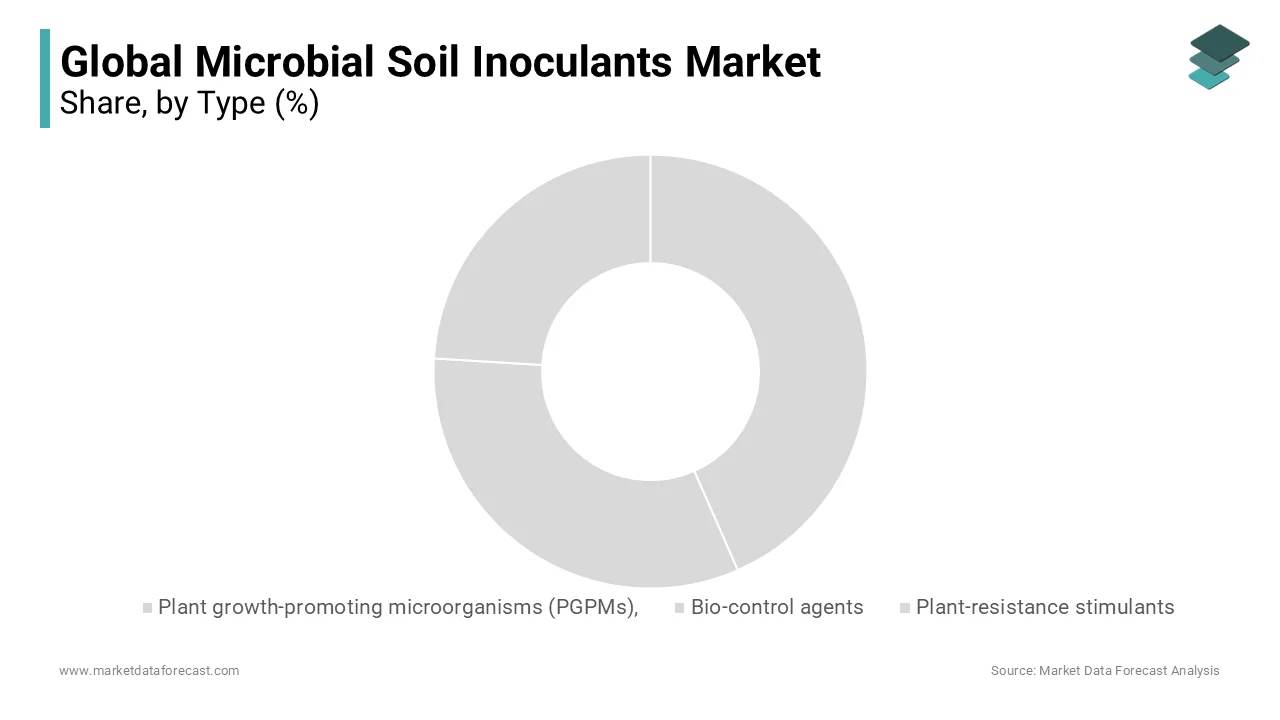
- Plant growth-promoting microorganisms (PGPMs),
- Bio-control agents
- Plant-resistance stimulants
By Source
- Bacterial
- Fungal
- Others
By Crop Type
- Cereals & grains
- Oilseeds & pulses
- Fruits & vegetables
- Crops
By Region
- North America
- Latin America
- Europe
- Asia Pacific
- Middle East and Africa