- Product Description Description
- Table of Contents TOC
- List of Table & Figure LOT
- Get Free Sample PDF Sample PDF
Market Size, 2025
$8.84 BnMarket Estimate, 2026
$9.96 BnMarket Forecast, 2034
$25.86 BnCAGR, 2026–2034
12.66%Executive Summary: Middle East and Africa (MEA) Biomaterials Market
- Market Scope: Regional analysis of the Middle East and Africa biomaterials market covering material types, clinical application fields, country-level breakdowns, and biocompatibility advancements.
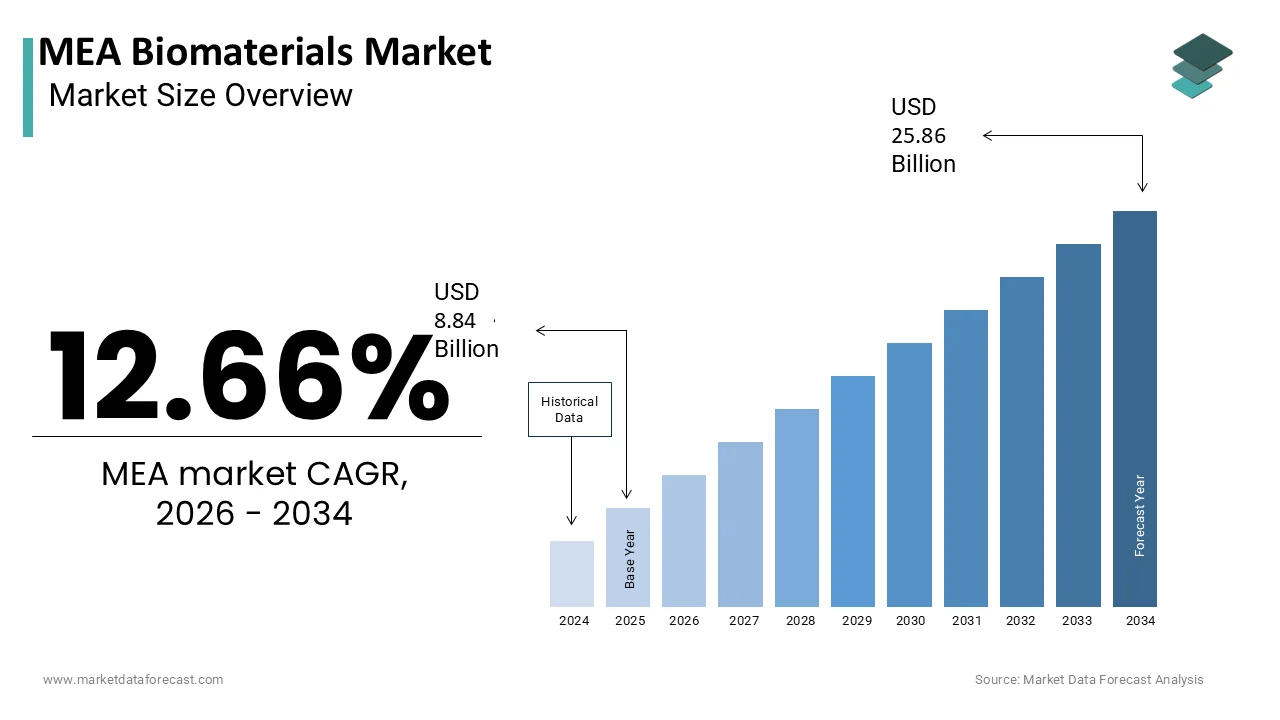
- Market Valuation: Valued at USD 8.84 billion in 2025, estimated at USD 9.96 billion in 2026, and projected to reach USD 25.86 billion by 2034, registering a strong CAGR of 12.66% from 2026 to 2034.
- Primary Growth Drivers: Shift from conventional metals/plastics toward biocompatible and mechanically superior implant materials; increased government funding and technology availability (e.g., hydrogen scaffolding, decellularized dermal matrixes); and growing geriatric populations requiring cardiology, orthopedic, and wound healing interventions.
Key Market Segment Metrics (2026–2034)
| Category | Leading Segment / Position | Segment Details / Breakdown |
|---|---|---|
| By Type | Metallic Biomaterials, Polymeric Biomaterials, Ceramic Biomaterials & Natural Biomaterials | Diverse material classes drive structural, biodegradable, and bioactive device innovations across clinical pipelines. |
| By Application | Orthopedic, Cardiovascular, Ophthalmology, Dental, Plastic Surgery, Wound Healing, Tissue Engineering, Neurological/CNS & Urinary | Orthopedic and cardiovascular applications capture significant revenue share due to rising surgical volumes and chronic disease prevalence. |
| By Country / Region | KSA, UAE, Israel, South Africa & Egypt | GCC economies and key African healthcare hubs drive robust market demand and adoption. Additional coverage includes rest of GCC countries, Ethiopia, Kenya, Sudan, and Rest of MEA. |
Major Market Players & Market Structure
Market Structure: Highly competitive advanced materials and medical technology sector driven by major global enterprises expanding their portfolios through organic development and strategic acquisitions.
Key Companies: Royal DSM, Zimmer Biomet Holdings, Inc., Wright Medical Technology, Inc., Corbion N.V., Berkeley Advanced Biomaterials, Bayer AG, Carpenter Technology Corporation, Evonik Industries AG, Covalon Technologies Ltd., BASF SE, Invibio Ltd., CAM Bioceramics BV, and Collagen Matrix, Inc.
 Download Free Sample Report
MEA Biomaterials Market Size
The MEA Biomaterials Market is projected to grow from USD 8.84 billion in 2025 to USD 9.96 billion in 2026 and reach USD 25.86 billion by 2034, registering a CAGR of 12.66% from 2026 to 2034.
Biomaterials are a specialized sector dedicated to the development and application of synthetic and natural materials designed to interact with biological systems for medical, therapeutic,c and diagnostic purposes. This domain includes metallic, polymeric, ceramic, amic and composite materials utilized in orthopedics, cardiovascular devices,s tissue engineering, and wound care applications. The socioeconomic trends create a fertile environment for the adoption of advanced biomaterials that offer superior biocompatibility and mechanical performance. Regulatory bodies in nations such as Saudi Arabia and the United Arab Emirates are streamlining approval processes for innovative medical devices, thereby accelerating market entry. Manufacturers are investing heavily in research and development to createnext-generationn materials that address complex clinical needs, while adhering to stringent safety standards.
MARKET DRIVERS
Rising Prevalence of Chronic Diseases and Orthopedic Conditions Drives Demand
The escalating prevalence of chronic diseases and orthopedic conditions due to the increasing need for surgical interventions and implantable devices is impacting positively on the growth of the Middle East and Africa biomaterials market. This substantial patient base creates a continuous demand for vascular grafts, stents,s and wound care materials that facilitate healing and restore function. Furthermore, musculoskeletal conditions affect over 100 million people in the region, leading to a surge in joint replacement surgeries that rely on high-performance metal and ceramic biomaterials, according to the study. The correlation between aging populations and degenerative joint diseases ensures a steady volume of procedures requiring hip and knee implants. Healthcare systems in countries like Saudi Arabia and Egypt are expanding their orthopedic care capabilities to meet this growing burden, thereby driving procurement of premium biomaterials. The economic impact of untreated chronic conditions further motivates governments to invest in advanced surgical solutions.
Government Initiatives to Modernize Healthcare Infrastructure Enhance Adoption
The rapid expansion of healthcare infrastructure driven by robust government initiatives in key Middle Eastern nations significantly drives the adoption of advanced biomaterials by raising standards of care and patient expectations. Government initiatives to modernize healthcare infrastructure enhance adoption is accelerating the growth of the Middle East and Africa biomaterials market. This strategic investment facilitates the introduction of advanced biomaterials such as bioresorbable scaffolds and tissue-engineered skin substitutes in clinical practice. The availability of advanced facilities enables surgeons to perform complex procedures that demand specialized biomaterials for optimal outcomes. The presence of multinational healthcare providers in the region further accelerates the transfer of technology and best practices. This infrastructure boom creates a sustainable demand for high-quality biomaterials as healthcare institutions strive to deliver superior clinical outcomes.
MARKET RESTRAINTS
High Cost of Advanced Biomaterials Restricts Accessibility in Developing Nations
The prohibitive cost of advanced biomaterials in developing nations, where healthcare budgets are constrained, is majorly declining the growth of the Middle East and Africa Biomaterials market. The out-of-pocket health expenditure in countries like Yemen and Sudan is making expensive imported biomaterials financially inaccessible for the majority of the population. This economic barrier restricts the use of premium implants and regenerative materials to affluent urban centers, leaving rural populations reliant on basic and often less effective alternatives. Furthermore, lack of local manufacturing capabilities for high-end biomaterials forces reliance on imports, which are subject to tariffs and currency fluctuations, further inflating prices. The high initial cost of these materials discourages public hospitals from stocking them in sufficient quantities,s leading to supply shortages and delayed treatments. Patients often face long waiting lists for subsidized procedures or are forced to forego necessary surgeries due to financial constraints. This disparity in access creates a fragmented market where advanced biomaterials are underutilized despite their clinical benefits. Manufacturers struggle to penetrate price-sensitive segments without compromising on quality or profitability.
Regulatory Heterogeneity and Approval Delays Impede Market Entry
The lack of harmonized regulatory frameworks for timely commercialization is additionally hindering the growth of the Middle East and Africa biomaterials market. According to the Gulf Standardization Organization, while efforts toward harmonization are underway, each member state maintains distinct approval processes and technical requirements for medical devices,s resulting in delays of up to 18 months for entry in some jurisdictions. This regulatory fragmentation increases compliance costs for manufacturers, who must navigate varying documentation standards, ds clinical trial requirements, and post-market surveillance obligations. Furthermore, the rigorous evaluation process for novel biomaterials often requires extensive local clinical data, which may not be accepted by other regional regulators, necessitating redundant studies. Companies must allocate significant resources to manage regulatory affairs in each country, which diverts funds from research and development. The absence of a unified regional approval pathway means that patients in different countries receive access to new treatments at vastly different times.
MARKET OPPORTUNITIES
Growing Focus on Regenerative Medicine and Tissue Engineering Creates Opportunities
The increasing focus on regenerative medicine and tissue engineering, as researchers and clinicians seek solutions that restore rather than just replace damaged tissues, is creating new opportunities for the growth of the Middle East and Africa biomaterials market. This financial commitment enables the translation of laboratory discoveries into clinical applications, creating a pipeline of innovative biomaterials for organ repair and wound healing. Additionally, as per the South African Medical Research Council, clinical trials involving biomaterial-based therapies for bone regeneration have shown promising results, with an improvement in functional outcomes for patients. These successes encourage healthcare providers to adopt regenerative approaches that offer long-term benefits over traditional prosthetics. The aging population in Gulf countries drives demand for therapies that improve quality of life and reduce dependency on permanent implants. Pharmaceutical and biotechnology companies are forming partnerships with material scientists to develop integrated solutions that combine drugs with delivery matrices.
Advancements in 3D Printing and Personalized Implants Drive Innovation
The rapid advancements in 3D printing technology and the subsequent ability to create personalized implants by enabling customized, patient-specific solutions that is alsolevelingl up the growth of the Middle East and Africa biomaterials market. According to the study, the adoption of additive manufacturing in medical device production in the UAE has grown in the last three years, allowing for the creation of complex geometries that match individual patient anatomy. This customization improves fit and integration, reducing the risk of implant failure and revision surgeries. Furthermore, several hospitals in Egypt have implemented 3D-printed titanium and polymer implants for cranial reconstruction, demonstrating the clinical viability of this approach. The ability to use patient imaging data to design bespoke biomaterial structures enhances surgical precision and outcomes. Manufacturers are investing in biocompatible printing materials such as polycaprolactone and hydroxyapatite composites to expand the range of printable applications. The reduction in lead time for custom implants compared to traditional manufacturing methods appeals to surgeons managing urgent cases. This technological shift transforms biomaterials from standardized commodities into tailored therapeutic tools.
MARKET CHALLENGES
Intellectual Property Protection Issues Hinder Innovation Investment
Weak intellectual property protection mechanisms discourage investment in research and development due to fears of imitation is a huge challenge for the growth of the Middle East and Africa biomaterials market. Infringement undermines the return on investment for innovators who spend years and millions of dollars developing novel materials. The lack of robust legal recourse makes it difficult for companies to protect their trade secrets and proprietary formulations. This environment discourages multinational corporations from introducing their latest technologies in markets with weak IP regimes, limiting patient access to cutting-edge treatments. Local startups also hesitate to innovate if they cannot secure their inventions against larger entities with greater resources. The resulting stagnation in innovation slows the overall progress of the biomaterials sector.
Supply Chain Volatility for Raw Materials Impacts Production Stability
The volatility in the supply chain for raw materials used in biomaterial production also impedes the growth of the Middle East and Africa biomaterials market. This price instability makes it difficult for manufacturers to maintain consistent pricing strategies and profit margins. Furthermore, disruptions in the supply of high-purity medical-grade plastics from Asia have led to production delays for several major device distributors, impacting the availability of essential surgical kits. The dependence on single-source suppliers for specialized biomaterial precursors increases vulnerability to logistical bottlenecks. Manufacturers face challenges in securing long-term contracts at fixed prices, leaving them exposed to market shocks. The lack of diversified sourcing options within the region exacerbates these risks. Hospitals and clinics experience uncertainty in inventory planning,g which can affect surgical scheduling.
REPORT COVERAGE
| REPORT METRIC | DETAILS |
| Market Size Available | 2025 to 2034 |
| Base Year | 2025 |
| Forecast Period | 2026 to 2034 |
| Segments Covered | By Type, Application, and Country. |
| Various Analyses Covered | Global, Regional & Country Level Analysis, Segment-Level Analysis; DROC, PESTLE Analysis, Porter's Five Forces Analysis, Competitive Landscape, Analyst Overview of Investment Opportunities |
| Country Covered | KS, UAE, Israel, rest of GCC countries, South Africa, Ethiopia, Kenya, Egypt, Sudan, Rest of MEA. |
| Market Leader Profiled | Royal DSM, Zimmer Biomet Holdings, Inc., Wright Medical Technology, Inc. |
SEGMENTAL ANALYSIS
By Type Insights
The metallic biomaterials segment held a significant share of the Middle East and Africa Biomaterials Market in 2025 due to their superior mechanical strength, durability,ity and extensive use in orthopedic and cardiovascular applications. Materials such as titanium, stainless steel, and cobalt chromium alloys are preferred load-bearingring implants because of their biocompatibility and resistance to corrosion. The surging demand for orthopedic implants, particularly hip and knee replacements, across the aging populations in the Middle East and Africa. This high incidence rate creates a consistent and large volume demand for titanium and cobalt-chromium alloys, which offer the necessary structural integrity for long-term implantation. The reliability of metallic materials in withstanding cyclic loading forces makes them indispensable for weight-bearing applications. Healthcare providers in developing nations like Egypt and Kenya are increasingly adopting these standard materials due to their proven track record and availability. The correlation between rising fracture rates and the necessity for durable surgical solutions ensures that metallic biomaterials remain the cornerstone of the orthopedic sector.
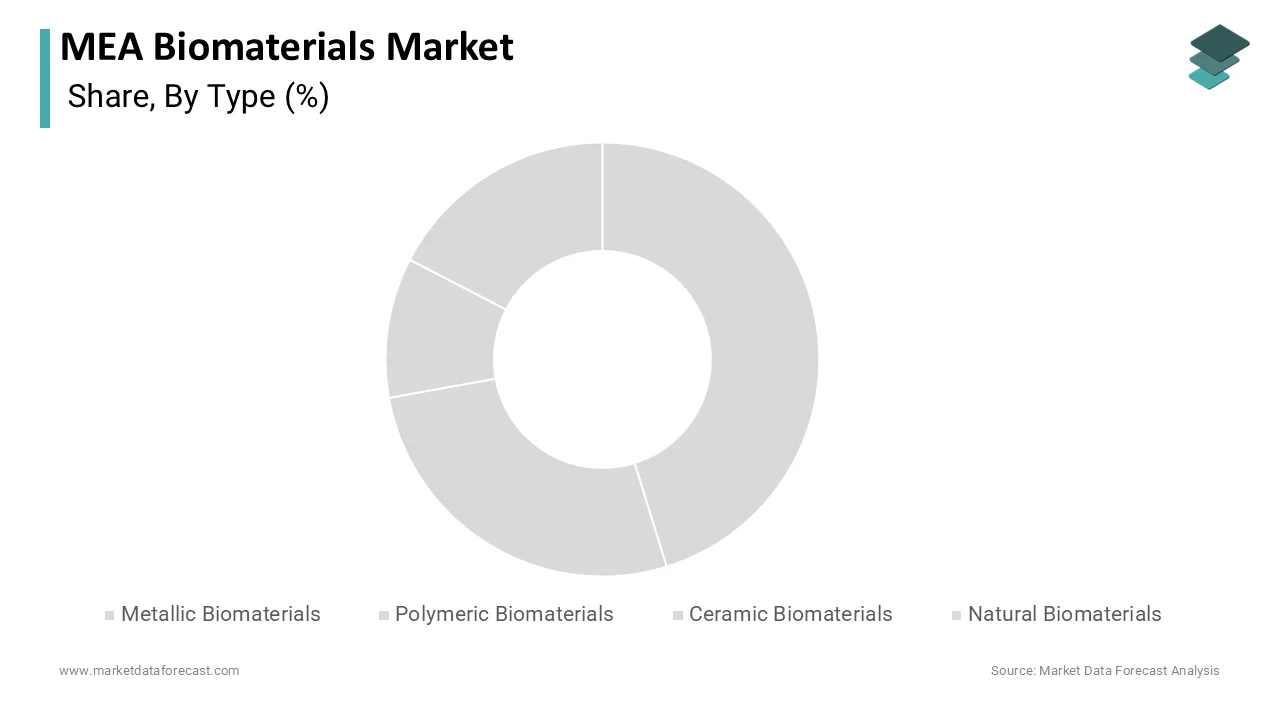
The natural biomaterials segment is projected to register the fastest CAGR of 10.8% during the forecast period owing to the expanding field of tissue engineering; materials such as collagen, chitosan,,n and alginate are used to create scaffolds for cell growth and tissue regeneration. These natural polymers offer superior biological signaling capabilities compared to synthetic alternatives,ves promoting faster integration and healing. The ability of natural materials to degrade safely within the body eliminates the need for secondary removal surgeries,ries making them highly attractive for pediatric and soft tissue applications. Governments in the region are providing grants for biofabrication projects, which accelerate the development of novel natural composites. The shift from passive implants to active regenerative solutions drives the adoption of natural biomaterials.
By Application Insights
The orthopedic segment held a dominant share of the Middle East and Africa Biomaterials Market in 2025 due to the high prevalence of musculoskeletal disorders and the increasing number of joint replacement surgeries. This demographic shift directly increases the demand for orthopedic biomaterials, including bone cement, plates,s scr,ews and artificial joints. Furthermore, as per the Global Burden of Disease Study, low back pain and neck pain are among the leading causes of disability in the region,n affecting over 50 million individuals, who often require surgical intervention using spinal implants made from advanced biomaterials. The economic burden of mobility loss motivates governments and insurance providers to cover orthopedic procedures,e s thereby facilitating access to these treatments. The widespread availability of orthopedic surgeons and specialized hospitals in urban centers further supports the high volume of procedures.
The tissue engineering segment is expected to grow at the fastest CAGR of 12.5% during the forecast period with the development of complex bioartificial organs. The rapid growth of the tissue engineering segment is fueled by the successful integration of stem cell therapy with biomaterial scaffolds to regenerate damaged tissues and organs. These combinations allow for the targeted delivery of cells to injury sites, enhancing regeneration ofbonen, cartilage,g,,e and cardiac tissue. This efficacy drives adoption in chronic wound care and reconstructive surgery. Governments in countries like Saudi Arabia and the UAE are establishing dedicated regenerative medicine parks to foster collaboration between material scientists and biologists. The ability to engineer tissues that closely mimic native physiology reduces the reliance on donor organs, which are in short supply.
COUNTRY LEVEL ANALYSIS
Saudi Arabia Biomaterials Market Analysis
Saudi Arabia was the top performer by holding 33.2% of the Middle East and Africa biomaterials market share in 2025 with its Vision 2030 healthcare transformation and massive infrastructure investments. This strategic push drives demand for orthopedic and cardiovascular implants. Furthermore, the prevalence of diabetes and obesity remains high,igh affecting over 18% of the adult population, which increases the need for wound care and vascular biomaterials. The government is actively supporting local manufacturing initiatives to reduce import dependency. The presence of world-class hospitals in Riyadh and Jeddah attracts international medical device companies.
UAE Biomaterials Market Analysis
The United Arab Emirates Biomaterials Market was ranked second, holding an 18.6% share in 2025, with high healthcare spending and a focus on medical tourism. This investment supports the growing demand for cosmetic and reconstructive surgery biomaterials. High disposable income among residents drives demand for premium dental and orthopedic implants.
Israel Biomaterials Market Analysis
Israel biomaterials market is likely to grow with its robust research and development ecosystem. This innovation hub attracts significant global investment and fosters collaborations with international pharmaceutical companies. Furthermore, Israel has one of the highest rates of medical device exports in the region, driving the development of high-value biomaterial products. The strong intellectual property protection framework encourages innovation and commercialization. The aging population drives steady demand for orthopedic and cardiovascular biomaterials.
South Africa Biomaterials Market Analysis
South Africa biomaterials market is likely to grow with a well-developed private healthcare sector. The country has a high burden of trauma and orthopedic conditions driving demand for fixation devices and implants. Furthermore, regulatory pathways for medical devices are becoming more structured that is also propelling the growth of the market. Local manufacturing capabilities are emerging, but imports still dominate the high-end segment.
COMPETITIVE LANDSCAPE
The competitive landscape of the MEA Biomaterials Market is characterized by intense rivalry between multinational corporations and emerging regional distributors, striving for dominance in specialized medical applications. Global leaders leverage extensive research capabilities,s established brand recognition, and comprehensive product portfolios to dominate premium segments such as orthopedics and cardiovascular devices. However, local players in Israel,l South Africa, and Egypt are gaining traction by offering cost-effective alternatives and responding swiftly to regulatory changes. Competition is increasingly driven by technological differentiation rather than price alone, with companies racing to develop bioactive coatings, personalized implants,s and regenerative scaffolds. Strategic alliances with hospitals and research institutes are common, as firms seek to generate local clinical evidence and influence treatment guidelines.
KEY MARKET PLAYERS
Some of the companies that are playing a dominating role in the Middle East & Africa Biomaterials Market include:
- Royal DSM
- Zimmer Biomet Holdings, Inc.
- Wright Medical Technology, Inc.
- Corbion N.V.
- Berkeley Advanced Biomaterials
- Bayer AG
- Carpenter Technology Corporation
- Evonik Industries AG
- Covalon Technologies Ltd.
- BASF SE
- Invibio Ltd.
- CAM Bioceramics B.V.
- Collagen Matrix, Inc.
TOP LEADING PLAYERS IN THE MARKET
- Johnson & Johnson MedTech maintains a prominent presence in the MEA Biomaterials Market through its extensive portfolio of orthopedic and surgical biomaterials. The company actively supplies advanced metallic and polymeric implants to hospitals across the Gulf Cooperation Council and South Africa. Recently, Johnson & Johnson expanded its regional training center in Dubai to enhance surgeon proficiency with next-generation tissue engineering scaffolds. This strategic initiative ensures safe and effective device utilization in complex procedures. The company also partnered with Saudi Arabian research institutions to validate bioactive materials for diabetic wound care.
- Stryker Corporation plays a significant role in the MEA Biomaterials Market by offering specialized orthopedic and neurotechnology biomaterials tailored to diverse patient populations. The company has strengthened its market position by establishing a new distribution hub in Cairo to improve product availability across North Africa. Recently, Stryker launched customize3D-printeded titanium implants specifically designed for cranial reconstruction cases prevalent in the region. This innovation addresses unique anatomical requirements and reduces surgical complications. The company also collaborated with Israeli universities to advance ceramic biomaterial research for joint replacements.
- Medtronic plc contributes significantly to the MEA Biomaterials Market through its comprehensive cardiovascular and spinal biomaterial solutions. The company focuses on delivering drug-eluting stents and biocompatible spinal implants that meet stringent regional safety standards. Recently, Medtronic opened a technical support center in Riyadh to provide rapid maintenance and training for cardiac assist devices utilizing advanced polymers. This expansion enhances service reliability for critical care facilities. The company also initiated clinical trials in South Africa to evaluate novel vascular graft materials for high-risk diabetic patients.
TOP STRATEGIES USED BY KEY MARKET PARTICIPANTS
Key players in the MEA Biomaterials Market primarily employ localization strategies and strategic partnerships to enhance their competitive positioning. Companies frequently establish regional distribution hubs and training centers to improve product accessibility and clinical expertise across diverse markets. This approach helps overcome logistical challenges and builds trust with local healthcare providers. Another major strategy involves collaborating with government entities and academic institutions to conduct region-specific clinical validation studies. Manufacturers also invest in regulatory affairs teams to navigate complex approval processes in countries like Saudi Arabia and South Africa. Additionally, firms focus on developing cost-effective biomaterial variants tailored to price-sensitive markets while maintaining quality standards.
MARKET SEGMENTATION
This research report on the MEA biomaterials market has been segmented and sub-segmented the Europea biomaterials market into the following categories.
By Type
- Metallic Biomaterials
- Polymeric Biomaterials
- Ceramic Biomaterials
- Natural Biomaterials
By Application
- Orthopedic
- Cardiovascular
- Ophthalmology
- Dental
- Plastic Surgery
- Wound Healing
- Tissue Engineering
- Neurological / Central Nervous System
- Urinary
- Other Applications
By Country
- KSA
- UAE
- Israel
- Rest of GCC countries
- South Africa
- Ethiopia
- Kenya
- Egypt
- Sudan
- Rest of MEA