- Product Description Description
- Table of Contents TOC
- List of Table & Figure LOT
- Get Free Sample PDF Sample PDF
Market Size, 2025
$41.48 BnMarket Estimate, 2026
$43.16 BnMarket Forecast, 2034
$59.34 BnCAGR, 2026–2034
4.06%Executive Summary: Middle East and Africa Bulk Food Ingredients Market
- Market Scope: Comprehensive Middle East and Africa bulk food ingredients market analysis covering product types, application verticals, regional leadership frameworks, growth drivers, and supply chain challenges.
- Market Valuation: Valued at USD 41.48 billion (2025), estimated at USD 43.16 billion (2026), and projected to reach USD 59.34 billion by 2034, registering a robust CAGR of 4.06% (2026–2034).
- Primary Growth Drivers: Rapid urbanization and the expansion of processed food industries, government initiatives for food security and strategic stockpiling, and rising consumer demand for convenience and packaged goods. Key operational metrics include the FAO reporting that the region imports ~50% of its cereal requirements, and urban population in Sub-Saharan Africa projected to double by 2050.
Key Market Segment Metrics (2026–2034)
| Category | Leading Segment (2025 Position) | Fastest-Growing Segment |
|---|---|---|
| By Type | Grains & Seeds (accounted for 49.2% market share) / Flour (captured 38.1% market share) | Herbs & Spices (6.8% CAGR) / Dry Fruits & Nuts (11.2% CAGR) |
| By Application | Bakery Products (holding 28.2% market share) | Ready Meals (exhibiting a 7.2% CAGR) |
| By Region | Saudi Arabia (accounting for 28.2% market share) | Emerging African and Middle Eastern economies with expanding urban centers |
Major Market Players & Market Structure
Market Structure: Highly competitive landscape characterized by large multinational corporations alongside strong regional players and local traders competing on price reliability, service quality, vertical integration, and adherence to food safety and Halal standards.
Key Companies: Tate & Lyle PLC, Associated British Foods plc, Ingredion Incorporated, Cargill Incorporated, DMH Ingredients, Olam International, E.I. du Pont de Nemours and Company, Archer Daniels Midland Company, EHL Ingredients, and Community Foods Limited.
 Download Free Sample Report
Middle East and Africa Bulk Food Ingredients Market Size
The Middle East and Africa Bulk Food Ingredients Market size was calculated to be USD 41.48 billion in 2025 and is anticipated to be worth USD 59.34 billion by 2034, from USD 43.16 billion in 2026, growing at a CAGR of 4.06% during the forecast period.
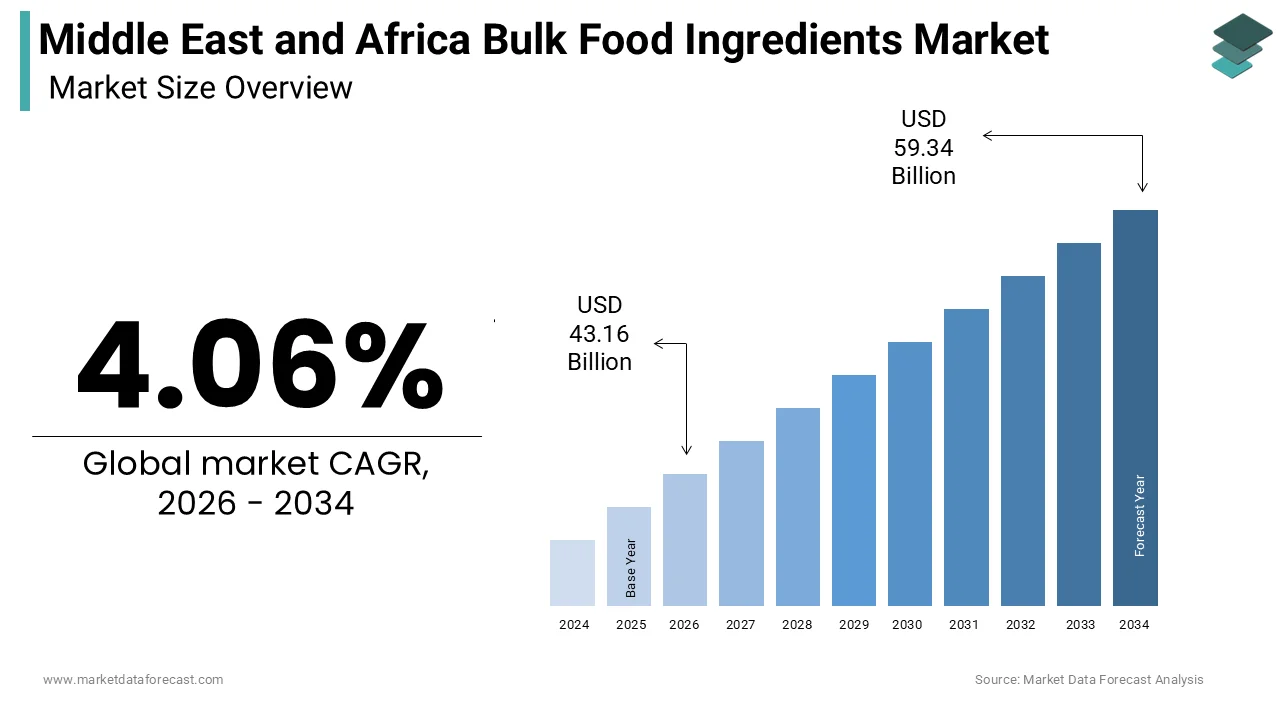
Bulk food ingredients are the large-scale supply of foundational culinary components, such as flours, sugars, oils, starches, and functional additives that serve as the backbone for regional food manufacturing and hospitality sectors. According to the Food and Agriculture Organization, the region imports approximately 50% of its cereal requirements, creating a robust demand for bulk wheat flour and grain-based ingredients to sustain daily consumption patterns. The rapid urbanization across Sub-Saharan Africa has shifted dietary habits toward processed and convenience foods, driving the need for standardized bulk ingredients that ensure consistency in industrial production. As per the World Bank, the urban population in Sub-Saharan Africa is projected to double by 2050, indicating a structural shift in food procurement from traditional markets to industrial supply chains. Regulatory bodies in countries like Saudi Arabia and South Africa are increasingly enforcing strict food safety standards, which necessitates high-quality, traceable bulk ingredients. The hospitality industry, particularly in tourist hubs like Dubai and Cape Town, consumes vast quantities of bulk dairy, spices, and baking supplies to cater to international visitors.
MARKET DRIVERS
Rapid Urbanization and Expansion of Processed Food Industries Drive Volume Demand
The accelerating pace of urbanization is a prominent factor bolstering the growth of the Middle East and Africa bulk food ingredients market. As rural populations migrate to cities, there is a marked shift away from home-cooked meals toward ready-to-eat and processed food products that require standardized industrial ingredients. According to the United Nations Department of Economic and Social Affairs, the urban population in Africa is expected to reach 1.2 billion by 2050, creating a massive consumer base for packaged goods. This demographic transition drives food manufacturers to scale up production capacities, thereby increasing their procurement of bulk staples, such as refined sugar, vegetable oils, and wheat flour. In the Middle East, countries like the United Arab Emirates and Qatar have seen a surge in the number of quick service restaurants and hypermarkets, which rely heavily on consistent bulk supplies to maintain operational efficiency. The middle class in emerging African economies is growing at an annual rate of 3%, leading to higher disposable incomes spent on convenience foods, as per the study. Consequently, ingredient suppliers are expanding their distribution networks to serve these urban centers by ensuring timely delivery of high-volume orders. The demand for shelf-stable ingredients that can withstand long supply chains further boosts the market for preservatives and stabilizers.
Government Initiatives for Food Security and Strategic Stockpiling Increase Institutional Procurement
The government-led initiatives aimed at enhancing national food security and establishing strategic reserves are another factor promoting the growth of the Middle East and Africa bulk food ingredients market. Many nations in the region face inherent vulnerabilities due to limited arable land and water scarcity, prompting state authorities to invest heavily in securing reliable supplies of essential commodities. For instance, Saudi Arabia’s Ministry of Environment, Water and Agriculture has implemented policies to maintain six months of strategic stock for key staples, requiring regular large-scale purchases from global suppliers. Similarly, in Africa, the African Union’s Comprehensive Africa Agriculture Development Programme encourages member states to build resilience against supply shocks by increasing local processing capabilities and storage infrastructure. These institutional procurement programs create a stable and predictable demand channel for bulk ingredient suppliers who can meet stringent quality and volume requirements. The emphasis on reducing post-harvest losses through better storage facilities also drives demand for packaging materials and preservation agents. Furthermore, subsidies provided by governments to local millers and processors lower the cost of production, encouraging higher throughput of bulk raw materials.
MARKET RESTRAINTS
Volatile Global Commodity Prices and Currency Fluctuations Disrupt Supply Chain Stability
The headwinds from volatile global commodity prices and erratic currency fluctuations that disrupt supply chain planning and cost management are hampering the growth of the Middle East and Africa bulk food ingredients market. Since the region is a net importer of most bulk ingredients, it is highly exposed to international price swings driven by geopolitical tensions, weather events, and energy costs. Currency depreciation in several African nations, such as Nigeria and Egypt, exacerbates this issue by increasing the local cost of imported ingredients denominated in US dollars. This financial instability leads to inconsistent supply availability as suppliers hesitate to commit tolong-termm contracts without adequate hedging mechanisms. Small and medium-sized enterprises are particularly vulnerable, as they lack the financial instruments to mitigate foreign exchange risks. Consequently, businesses often resort to spot buying, which results in higher average costs and potential shortages during peak demand periods. The unpredictability of input costs also discourages investment in value-added processing facilities, keeping the market reliant on basic raw material trading rather than developing a more resilient integrated supply chain.
Inadequate Cold Chain Infrastructure and Logistics Bottlenecks Limit Product Quality and Reach
The lack of robust cold chain infrastructure and persistent logistics disruptions is also inhibiting the growth of the Middle East and Africa bulk food ingredients market. A significant portion of bulk ingredients, including dairy fats, certain oils, and fresh produce derivatives, requires temperature-controlled storage and transportation to maintain quality and safety. In the Middle East, while major hubs like Dubai have advanced infrastructure, inland areas and smaller nations often struggle with inconsistent electricity supply and inadequate refrigerated transport options. The World Logistics Performance Index indicates that several countries in the region rank low in terms of infrastructure quality, resulting in delayed shipments and increased handling costs. These logistical challenges force suppliers to limit their geographic reach to major urban centers, leaving rural and semi-urban markets underserved. The high cost of maintaining cold chains also inflates the final price of ingredients, making them less accessible to price-sensitive consumers. Furthermore, regulatory inconsistencies regarding food safety standards across borders complicate cross-border trade, causing delays at customs checkpoints.
MARKET OPPORTUNITIES
Expansion of Halal Certified Ingredient Supply Chains Offers Premium Market Access
The growing global and regional demand for Halal certified food products is a key factor in escalating new opportunities for the growth of the Middle East and Africa bulk food ingredients market. With Islam being the dominant religion in the region, Halal compliance is not just a preference but a mandatory requirement for the majority of consumers. Suppliers who obtain recognized Halal certifications for their bulk ingredients such as gelatin, enzymes, and emulsifiers can command higher prices and secure contracts with major food manufacturers and hospitality chains that prioritize religious compliance. The Standardization and Metrology Institute for GCC Countries has been working to harmonize Halal standards across member states, simplifying the certification process for international suppliers. This standardization reduces barriers to entry and encourages more players to enter the market with certified products. Additionally, the export potential of Halal-certified ingredients from the region to other Muslim-majority countries in Asia and Europe creates additional revenue streams. Companies investing in dedicated Halal production lines and transparent supply chain tracking systems can build strong brand loyalty and trust.
Development of Local Processing Capabilities Reduces Import Dependency and Adds Value
The strategic push toward developing local processing capabilities for agricultural raw materials is also to bolster the growth of the Middle East and Africa bulk food ingredients market. Governments and private investors are increasingly focusing on value addition within the region to reduce reliance on finished imported goods and create jobs. In countries like Kenya and Ethiopia, there is a growing trend of establishing large-scale milling and refining facilities for maize, sorghum, and coffee, which creates a steady demand for processing aids and bulk additives. Similarly, in the Middle East, initiatives to localize date palm processing and dairy production are driving demand for specialized ingredients such as natural sweeteners and stabilizers. This shift allows local suppliers to source raw materials domestically and process them into higher-value bulk ingredients, reducing logistics costs and lead times. The development of industrial parks and special economic zones provides the necessary infrastructure and tax incentives for these processing units.
MARKET CHALLENGES
Climate Change and Water Scarcity Threaten Raw Material Availability and Pricing
Climate change and severe water scarcity directly impact the availability and cost of agricultural raw materials, which is a major challenge for the growth of the Middle East and Africa bulk food ingredients market. The region is one of the most water-stressed areas in the world, with agriculture consuming over 80% of available freshwater resources according to the World Resources Institute. Rising temperatures and unpredictable rainfall patterns are reducing crop yields for key ingredients such as wheat, maize, and vegetables, leading to supply shortages and price spikes. This environmental pressure forces manufacturers to rely even more heavily on imports, exposing them to global market volatility. Additionally, extreme weather events, such as droughts and floods, disrupt local supply chains and damage storage facilities, leading to significant post-harvest losses. Suppliers must invest in climate-resilient sourcing strategies and alternative ingredients, which often come at a higher cost. The uncertainty surrounding future agricultural output makes long-term planning difficult for both producers and buyers.
Complex Regulatory Frameworks and Lack of Harmonization Impede Cross-Border Trade
The fragmented and complex regulations are additionally hindering the growth of the Middle East and Africa bulk food ingredients market. Each country maintains its own set of food safety standards, labeling requirements, and import regulations, creating a cumbersome compliance burden for suppliers operating across multiple jurisdictions. The non-tariff barriers, such as differing sanitary and phytosanitary measures, significantly increase the cost and time required for cross-border trade in the region. For instance, an ingredient approved for use in Saudi Arabia may require separate testing and documentation to be sold in Egypt or South Africa, delaying entry and increasing operational costs. The lack of mutual recognition agreements means that suppliers must navigate a maze of bureaucratic procedures for each individual market. This regulatory fragmentation discourages smaller players from expanding regionally and limits competition. Furthermore, frequent changes in regulations without adequate notice create uncertainty for businesses, making it difficult to maintain consistent supply chains. The absence of a unified regional food safety authority means that standards are often enforced inconsistently, leading to confusion and potential disputes.
REPORT COVERAGE
| REPORT METRIC | DETAILS |
| Market Size Available | 2025 to 2034 |
| Base Year | 2025 |
| Forecast Period | 2026 to 2034 |
| CAGR | 4.06% |
| Segments Covered | By Type, Application, And Country |
| Various Analyses Covered | Regional and Country Level Analysis; Segment-Level Analysis; DROC; PESTLE Analysis; Porter’s Five Forces Analysis; Competitive Landscape; Analyst Overview of Investment Opportunities |
| Regions Covered | KSA, UAE, Israel, the rest of GCC countries, South Africa, Ethiopia, Kenya, Egypt, Sudan, and the Rest of MEA |
| Market Leaders Profiled | Tate & Lyle PLC, Associated British Foods plc, Ingredion Incorporated, Cargill Incorporated, DMH Ingredients, Olam International, E.I. du Pont de Nemours and Company, Archer Daniels Midland Company, EHL Ingredients, and Community Foods Limited |
SEGMENTAL ANALYSIS
By Type Insights
The grains and seeds segment was the largest, accounting for 49.2% of the Middle Easta nd Africa bulk food ingredients market share in 2025. Wheat, rice, maize, and sorghum are essential for producing bread, couscous, injera, and other staple foods that constitute a significant portion of household expenditure. According to the Food and Agriculture Organization, the Middle East and North Africa region imports approximately 50% of its cereal consumption, creating a massive and consistent demand for bulk grain ingredients to ensure food security. In Sub-Saharan Africa, maize serves as the primary staple for over 300 million people, driving continuous procurement by local millers and food processors. The lack of extensive domestic production capacity in many Gulf Cooperation Council countries further necessitates large-scale imports of high-quality grains. Suppliers who can offer consistent quality and reliable logistics gain long-term contracts with national strategic reserve agencies and private milling conglomerates.
The herbs and spices segment is expected to witness the fastest CAGR of 6.8% from 2026 to 2034 with the region’s rich culinary traditions and growing global export opportunities. The Middle East and Africa are historically renowned for producing high-value spices such as cumin, coriander, cardamom, saffron, and black pepper, which are integral to local cuisines and traditional medicine. The global demand for authentic ethnic flavors has boosted exports from the region, with the European Union importing over 400000 tonnes of spices from Africa and the Middle East annually. Domestic consumption is also rising as urban populations seek convenient yet flavorful meal solutions that rely on spice blends. Furthermore, the shift toward natural preservatives and clean label products in the global food industry has increased demand for antimicrobial spices like turmeric and ginger. Local governments are investing in processing facilities to add value before export, reducing reliance on raw commodity trading.
The flour segment was the largest by capturing 38.1% of the Middle East and Africa bulk food ingredients market share in 2025, as it serves as the critical input for the rapidly expanding bakery and confectionery industries. The urbanization trend has led to a surge in the consumption of baked goods such as bread, pastries, and cakes, which require standardized, high-quality flour for consistent production. According to the World Bank, the urban population inSub-Saharann Africa is expected to double by 2050, driving the proliferation of industrial bakeries and quick service restaurants that rely on bulk flour supplies. In the Gulf Cooperation Council countries, the hospitality sector consumes vast quantities of premium wheat flour to cater to tourists and residents, with Saudi Arabia alone importing millions of tonnes of wheat for milling annually. The Egyptian government’s subsidy program for baladi bread ensures a steady baseline demand for fortified flour, supporting large-scale milling operations. Additionally, the rise of gluten-free alternatives using rice and corn flour is creating new niches within the segment. Manufacturers are investing in advanced milling technologies to produce specialized flours with specific protein contents and ash levels to meet diverse industrial requirements. The convenience of ready-to-use flour blends for commercial kitchens further boosts demand.
The dry fruits and nuts segment is likely to grow at the fastest CAGR of 11.2% from 2026 to 2034, with the increasing health awareness and the cultural significance of these items as premium gifts and festive staples in the Middle East and Africa. Consumers are increasingly replacing unhealthy snacks with nutrient-dense options such as almonds, walnuts, dates, and raisins, which are perceived as natural sources of energy and essential fats. The prevalence of lifestyle diseases like diabetes and obesity in the Gulf region has prompted a shift toward healthier dietary choices, boosting demand for unsalted and organic nuts. The date industry in particular is a major driver, with Saudi Arabia and Egypt being among the top global producers and exporters. During religious holidays such as Ramadan and Eid, the consumption of dried fruits spikes significantly, creating seasonal surges in bulk procurement. Retailers and wholesalers are stocking a wider variety of exotic nuts to meet consumer curiosity and demand for culinary diversity.
By Application Insights
The bakery products segment was the largest by holding 28.2% of the Middle East and Africa bulk food ingredients market share in 2025. The widespread consumption of flatbreads, loaves, and pastries drives continuous demand for bulk ingredients such as flour, yeast, sugar, and fats. According to the United States Department of Agriculture, per capita wheat consumption in North Africa exceeds 200 kilograms annually, largely in the form of bread. The industrialization of the bakery sector in urban centers has shifted production from small artisanal shops to large-scale factories that require consistent and high-volume supplies of standardized ingredients. In countries like Egypt and Turkey, government subsidies for bread ensure that bakery products remain affordable and accessible, maintaining steady demand regardless of economic fluctuations. The growth of the quick service restaurant sector has also increased the need for bulk bakery supplies for burgers, sandwiches, and wraps. Additionally, the introduction of fortified flours to address micronutrient deficiencies has created a specialized sub-segment within the bakery ingredients market. Manufacturers are innovating with whole grain and multigrain blends to meet health-conscious consumer preferences.
The ready meals segment is expected to exhibit the fastest CAGR of 7.2% from 2026 to 2034, with the changing lifestyles and the increasing number of dual-income households. Urban professionals and young families are seeking convenient meal solutions that save time without compromising on taste or nutrition, driving the adoption of frozen and shelf-stable ready meals. The expansion of modern retail formats, such as hypermarkets and online grocery platforms, has improved accessibility to a wide variety of ready meal options. In Gulf countries, the high proportion of expatriate workers who often live alone or in shared accommodations contributes to the demand forsingle-servee ready meals. Local manufacturers are responding by introducing culturally relevant dishes such as biryani, kabsa, and tagine in convenient formats. The improvement in cold chain infrastructure is also enabling the distribution of frozen ready meals to wider geographic areas. Additionally, the tourism sector drives demand for high-quality ready meals in hotels and catering services.
REGIONAL ANALYSIS
Saudi Arabia Bulk Food Ingredients Market Analysis
Saudi Arabia was the top performer of the Middle East and Africa bulk food ingredients market by accounting for 28.2% of the share in 2025, with its large population, high per capita consumption, and strategic focus on food security. According to the studies, the population of Saudi Arabia exceeded 32 million in 2023, with a high proportion of young consumers driving demand for processed and convenience foods. The government’s Vision 2030 initiative includes significant investments in local food processing and storage infrastructure to reduce dependency on imports, stimulating demand for bulk processing aids and packaging materials. The Ministry of Environment, Water and Agriculture maintains strategic reserves of key commodities, ensuring consistent large-scale procurement from global suppliers. The hospitality sector, bolstered by religious tourism to Mecca and Medina, consumes vast quantities of bulk ingredients annually. Local manufacturers are expanding capacity to produce value-added products, further increasing the demand for specialized bulk inputs.
United Arab Emirates Bulk Food Ingredients Market Analysis
The United Arab Emirates bulk food ingredients market held second position by accounting for 19.2% of the share in 2025, with its strategic location and world-class logistics infrastructure. Dubai and Abu Dhabi act as gateways for food distribution to surrounding regions, driving high volumes of bulk ingredient imports. The UAE’s food and beverage sector contributes significantly to the non-oil economy, with re-exports accounting for a substantial portion of trade, as per the study. The thriving tourism and hospitality industry, which welcomed over 14 million international visitors in 2023, as per the study, creates immense demand for high-quality bulk ingredients for hotels and restaurants. The presence of numerous multinational food manufacturers in the UAE’s industrial zones further boosts local consumption of bulk raw materials. The government’s focus on food safety and quality standards ensures that only premium ingredients enter the market, attracting suppliers who prioritize compliance.
South Africa Bulk Food Ingredients Market Analysis
South Africa bulk food ingredients market growth is expected to have prominent growth opportunities throughout the forecast period due to its advanced manufacturing base, sophisticated retail networks, and relatively stable economic environment. The country is a major producer and processor of maize, wheat, and sugar, supplying both domestic and regional markets. According to Statistics South Africa, the food and beverage manufacturing sector is one of the largest contributors to the country’s industrial output, driving consistent demand for bulk ingredients. The dominance of large retail chains, such as Shoprite and Pick n Pay, ensures efficient distribution of processed foods to urban and rural areas, supporting steady ingredient procurement. South Africa’s well-developed port infrastructure facilitates the import of raw materials and export of finished goods, integrating it into global supply chains. The growing middle class is driving demand for diverse and premium food products, encouraging manufacturers to innovate with new ingredient combinations.
Egypt Bulk Food Ingredients Market Analysis
Egypt bulk food ingredients market growth is driven by its large population of over 100 million people and government-subsidized bread programs. Wheat is the most important ingredient, with the state purchasing millions of tonnes annually to produce baladi bread for millions of citizens. Egypt is consistently among the top three global wheat importers, creating a predictable and high-volume demand channel for international suppliers. The government’s Takaful and Karama social protection programs further stabilize demand for basic food staples. Local milling and baking industries are heavily supported by state policies, ensuring continuous operation and ingredient procurement. The growing population and urbanization are also increasing demand for other bulk ingredients such as sugar, oils, and dairy products for processed foods. While currency fluctuations pose challenges, the essential nature of food consumption ensures resilient demand.
COMPETITION OVERVIEW
The competition in the Middle East and Africa bulk food ingredients market is characterized by the presence of large multinational corporations alongside strong regional players and local traders who compete on price reliability and service quality. Major global companies leverage their extensive supply networks and financial resources to offer consistent product availability and competitive pricing, while regional firms capitalize on their deep understanding of local markets and regulatory environments. Innovation in supply chain management and sustainability practices serves as a key differentiator, with companies investing in technology to enhance traceability and efficiency. Regulatory compliance and adherence to international food safety standards are critical factors that influence buyer decisions and shape competitive dynamics. Price volatility of raw materials creates margin pressure,s prompting firms to optimize operational costs and hedge against risks. Customer loyalty is driven by reliability, technical support, and the ability to provide customized solutions for specific industrial applications.
KEY MARKET PLAYERS
A few major key Players in the MEA bulk food ingredients market include
- Tate & Lyle PLC
- Associated British Foods plc
- Ingredion Incorporated
- Cargill Incorporated
- DMH Ingredients
- Olam International
- E.I. du Pont de Nemours and Company
- Archer Daniels Midland Company
- EHL Ingredients
- Community Foods Limited
Top Strategies Used by the Key Market Participants
Key players in the Middle East and Africa bulk food ingredients market primarily focus on vertical integration and strategic partnerships to secure reliable supply chains and enhance market access. Companies invest heavily in local infrastructure such as storage facilities and processing plants to reduce dependency on imports and mitigate logistical challenges. Sustainability initiatives form a core strategy where firms adopt regenerative agriculture practices and support smallholder farmers to ensure long-term raw material availability. Manufacturers also prioritize regulatory compliance and food safety certifications to build trust with government agencies and industrial clients. Digital transformation is another major strategy, with companies implementing advanced analytics and supply chain tracking systems to improve efficiency and transparency.
Leading Players in the Market
- Cargill Incorporated operates as a global leader in agricultural processing and ingredient supply with a significantfootprint, across the Middle East and Africa. The company provides essential bulk commodities such as wheat, corn, oils, and starches to food manufacturers and government agencies in the region. Cargill focuses on building resilient supply chains by investing in local storage facilities and logistics networks to ensure consistent delivery despite infrastructure challenges. Recent actions include expanding its animal nutrition and food ingredient facilities in South Africa and Egypt to better serve regional demand. The company collaborates with local farmers to improve crop quality and yield through sustainable agricultural practices. Cargill also engages in strategic partnerships with government bodies to support national food security initiatives.
- Archer Daniels Midland Company is a major processor of oilseeds, grains, and other agricultural commodities that plays an important role in the Middle East and Africa bulk food ingredients market. The company supplies high-quality vegetable oils, proteins, and sweeteners to industrial clients across the region. ADM has recently strengthened its market position by enhancing its distribution capabilities in key hubs like Dubai and Johannesburg. The company invests in innovation to develop specialized ingredient solutions that meet the specific dietary and cultural needs of MEA consumers. ADM also focuses on sustainability by supporting smallholder farmers with training and resources to improve productivity. Its commitment to regulatory compliance and food safety standards builds trust among local manufacturers and regulators.
- Bunge Global SA is a prominent agribusiness and food company that contributes significantly to the supply of bulk food ingredients in the Middle East and Africa. The company specializes in the sourcing and processing of oilseeds, grains, and sugar, providing essential raw materials for the regional food industry. Bunge has recently expanded its operations in North Africa by upgrading milling and refining facilities to increase production capacity and efficiency. The company emphasizes sustainable sourcing practices and works closely with local suppliers to ensure quality and traceability. Bunge also leverages its global trading network to manage price volatility and ensure stable supply for its customers in the MEA region.
MARKET SEGMENTATION
This research report on the Middle East and Africa bulk food ingredients market has been segmented and sub-segmented based on type, application & region.
By Type
- Primary Processed
- Grains & Seeds
- Herbs & Spices
- Sugar
- Salt
- Oilseeds
- Nuts
- Others
- Secondary Processed
- Dry Fruits & Nuts
- Grains & Seeds
- Flour
- Herbs & Spices
- Sugar
- Salt
- Others
By Application
- Ready Meals
- Bakery Products
- Confectionery Products, Snacks & Spreads
- Others
By Region
- KSA
- UAE
- Israel
- The rest of the GCC countries
- South Africa
- Ethiopia
- Kenya
- Egypt
- Sudan
- Rest of MEA