- Product Description Description
- Table of Contents TOC
- List of Table & Figure LOT
- Get Free Sample PDF Sample PDF
Market Size, 2025
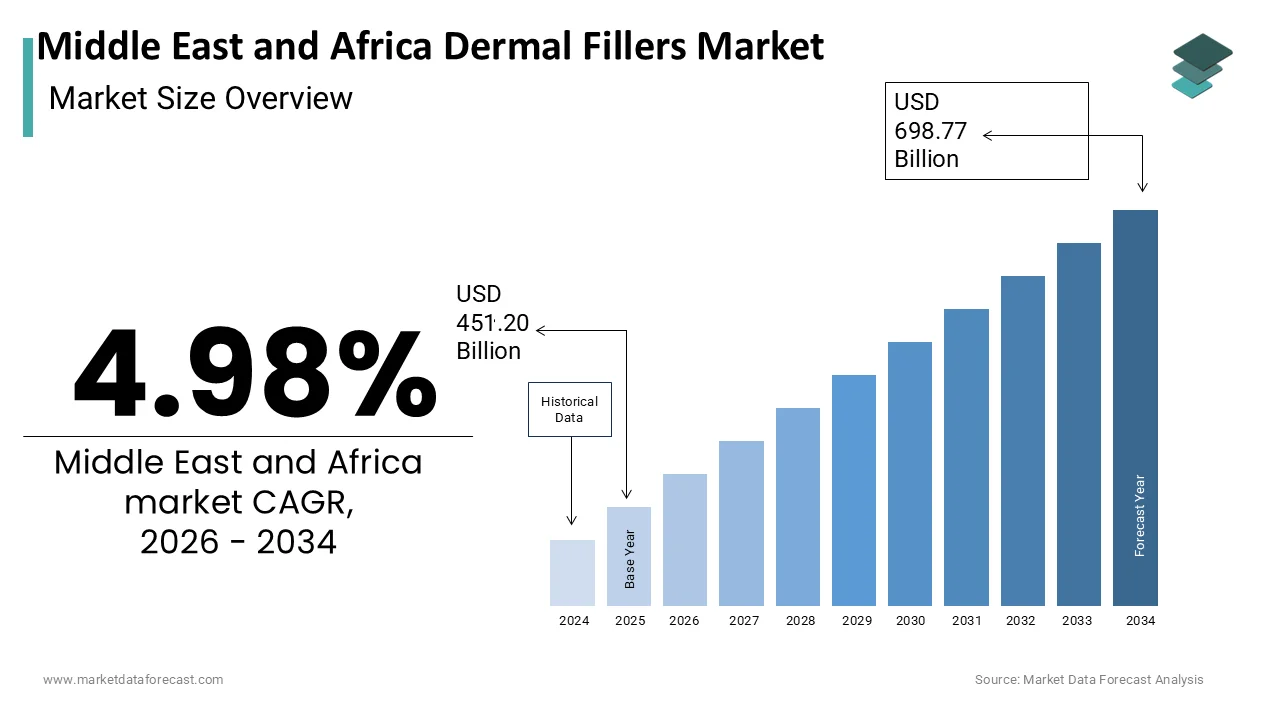
$451.20 MnMarket Estimate, 2026
$473.20 MnMarket Forecast, 2034
$698.77 MnCAGR, 2026–2034
4.98%Executive Summary: Middle East and Africa Dermal Fillers Market
- Market Scope: Regional analysis of the dermal fillers industry focusing on product formulations, therapeutic applications, and country-level growth across the Middle East and Africa.
- Market Valuation: Valued at USD 451.20 million in 2025, reaching USD 473.20 million in 2026, and projected to expand to USD 698.77 million by 2034, supported by a compound annual growth rate (CAGR) of 4.98%.
- Primary Growth Drivers: Rising urbanization and lifestyle modernization prioritizing aesthetic wellness, alongside the accelerating influence of medical tourism in regional hubs offering competitive, advanced dermatological care.
Key Market Segment Metrics (2026–2034)
| Category | Leading Segment / Core Focus | Fastest-Growing / Key Segments |
|---|---|---|
| By Product | Absorbable or Biodegradable (dominated the market in 2024 driven by consumer preference for reversible, low-risk interventions and HA-based fillers) | Non-Absorbable or Non-Biodegradable (predicted to witness a CAGR of 11.4% attributed to rising demand for long-term facial volume restoration and reconstructive rehabilitation) |
| By Therapeutic Area | Wrinkles (led the market with a 45.8% share in 2024 fueled by the prevalence of dynamic facial lines exacerbated by chronic UV exposure in the region) | Scars (estimated to register the fastest CAGR of 12.1% owing to a large patient pool seeking corrective aesthetic interventions for acne and trauma-related depressions) |
| By Country | Saudi Arabia (top performer with a 28.4% share in 2024 anchored by Vision 2030’s healthcare modernization agenda and the rise of specialized clinics) | United Arab Emirates & Israel (UAE driven by cosmopolitan consumers and medical tourism; Israel serving as a robust biotech and clinical research hub) |
Major Market Players & Industry Landscape
Competitive Structure: The regional landscape is dynamically evolving, expanding through digital consultation platforms and formal aesthetic medicine training programs, while actively navigating challenges tied to regulatory fragmentation, high costs of premium fillers, and the proliferation of unlicensed practitioners.
Key Companies Profiled: Allergan Inc., AQTIS Medical, Bioha Laboratories, Suneva Medical, Galderma, Merz Aesthetics, Cynosure, Syneron, and Cytophil Inc.
Middle East and Africa Dermal Fillers Market Size
The Middle East and Africa Dermal Fillers Market was valued at USD 451.20 million in 2025, is estimated to reach USD 473.20 million in 2026, and is projected to reach USD 698.77 million by 2034, growing at a CAGR of 4.98% from 2026 to 2034.
MARKET DRIVERS
Rising Urbanization and Lifestyle Modernization Driving Demand
Urbanization is bringing shifts in lifestyle priorities with increasing emphasis on personal appearance and aesthetic wellness, which is fuelling the growth of the Middle East and Africa dermal fillers market. The urban population in the region is projected to increase by 2030, up from that in 2020. In Saudi Arabia, for instance, Instagram penetration is high among individuals aged 18–35, fostering heightened awareness and acceptance of aesthetic enhancements. As urban centers expand, so does the density of specialized aesthetic clinics. This infrastructural growth, combined with rising consumer confidence in non-invasive procedures, has positioned dermal fillers as a preferred solution for facial rejuvenation,n which directly amplifies market demand.
Growing Influence of Medical Tourism in Aesthetic Care
The increasing medical tourism is also accelerating the growth of the Middle East and Africa dermal fillers market. It is accelerating demand for dermal fillers in countries positioning themselves as regional hubs for aesthetic excellence. The UAE attracted notable international medical tourists, with aesthetic procedures representing a portion of all treatments sought. Dubai and Abu Dhabi have invested heavily in JCI-accredited clinics equipped with advanced dermatological technologies by offering dermal filler treatments at competitive price points compared to Western Europe and North America. Moreover, countries like Turkey, geographically and culturally linked to the region, serve as procedural gateways by performing several aesthetic injections annually, many of which cater to clients from neighboring African and Arab nations.
MARKET RESTRAINTS
Stringent Regulatory Fragmentation Hindering Market Uniformity
The lack of harmonized regulatory frameworks governing aesthetic products and procedures is restraining the growth of the Middle East and Africa dermal fillers market.
While countries such as the UAE and South Africa have established medical device regulations through bodies like the Gulf Cooperation Council (GCC) Conformity Marking and the South African Health Products Regulatory Authority (SAHPRA), many nations across North and Sub-Saharan Africa operate under inconsistent or underdeveloped approval systems. As per the research, only 54 African countries possess functional regulatory agencies capable of evaluating injectable cosmetics. This regulatory disparity fosters a parallel market for unapproved or counterfeit fillers.
High Cost of Premium Dermal Fillers Limiting Mass Adoption
The affordability of branded dermal fillers remains a significant barrier to widespread adoption, which restrains the growth of the Middle East and Africa dermal fillers market. Leading hyaluronic acid-based products such as Juvederm and Restylane typically retail per syringe in private clinics, a sum that exceeds the average monthly income in countries like Egypt and Kenya. The per capita GDP in Egypt is comparatively high, while in Kenya it is low, rendering repeated treatments financially unviable for most consumers. Even in wealthier Gulf states, out-of-pocket expenditure for aesthetic procedures is not covered by public or private insurance, which increases patient burden. A study revealed that a portion of potential patients in Saudi Arabia and in South Africa cited cost as the primary reason for deferring or avoiding filler treatments.
MARKET OPPORTUNITIES
Expansion of Digital Consultation Platforms Enhancing Accessibility
The proliferation of tele-aesthetic platforms for consumer engagement and service delivery is another opportunity propelling the Middle East and Africa dermal fillers market growth. Companies offer AI-driven skin analysis and remote physician consultations by enabling patients in remote or underserved areas to access expert advice on dermal filler suitability. These initiatives not only improve diagnostic accuracy but also build consumer confidence before in-person procedures.
Increasing Investment in Aesthetic Medicine Training Programs
The institutionalization of aesthetic medicine education across the region also provides an opportunity for the expansion of the Middle East and Africa dermal fillers market. Historically, the absence of standardized training has led to inconsistent clinical outcomes and safety concerns. However, recent initiatives by regional health authorities and international medical academies are addressing this gap. In addition, Saudi Arabia introduced a formal fellowship in aesthetic medicine, aiming to certify practitioners. These programs emphasize evidence-based injection techniques, adverse event management, and product-specific protocols, thereby elevating procedural standards.
MARKET CHALLENGES
Inadequate Post-Procedure Monitoring Infrastructure
The limited capacity for post-injection follow-up and adverse event tracking is challenging the growth of the Middle East and Africa dermal fillers market. Unlike in North America or Western Europe, where electronic health records and national registries enable longitudinal monitoring, most clinics in the region lack integrated systems to document complications such as granulomas, vascular occlusions, or asymmetry. This absence of systematic surveillance hampers data collection on long-term safety and efficacy by complicating regulatory oversight and brand accountability. Furthermore, underreporting of adverse events remains prevalent due to patient reluctance and physician liability concerns.
Proliferation of Unlicensed Aesthetic Practitioners
The rapid commercialization of these fillers has led to a surge in unqualified individuals administering injections in urban centers with high consumer demand, which is challenging the growth of the Middle East and Africa dermal fillers market. In countries like Lebanon and South Africa, non-physician providers, including beauty salon staff and nurses without specialized training, routinely perform filler injections, often using substandard or unregulated products. As per the research, unlicensed practitioners were apprehended for conducting illegal aesthetic procedures, many involving dermal fillers. Similarly, Nigeria reported the seizure of counterfeit injectables, many linked to informal clinics.
REPORT COVERAGE
| REPORT METRIC | DETAILS |
| Market Size Available | 2025 to 2034 |
| Base Year | 2025 |
| Forecast Period | 2026 to 2034 |
| Segments Covered | By Product, Therapeutic Area, and Country. |
| Various Analyses Covered | Global, Regional & Country Level Analysis, Segment-Level Analysis; DROC, PESTLE Analysis, Porter's Five Forces Analysis, Competitive Landscape, Analyst Overview of Investment Opportunities |
| Country Covered | KS, UAE, Israel, the rest of GCC countries, South Africa, E Ethiopia, Kenya, Egypt, Sudan, Rest of MEA. |
| Market Leader Profiled | Allergan Inc., AQTIS Medical, Bioha Laboratories, Suneva Medical, Galderma |
SEGMENTAL ANALYSIS
By Product Insights
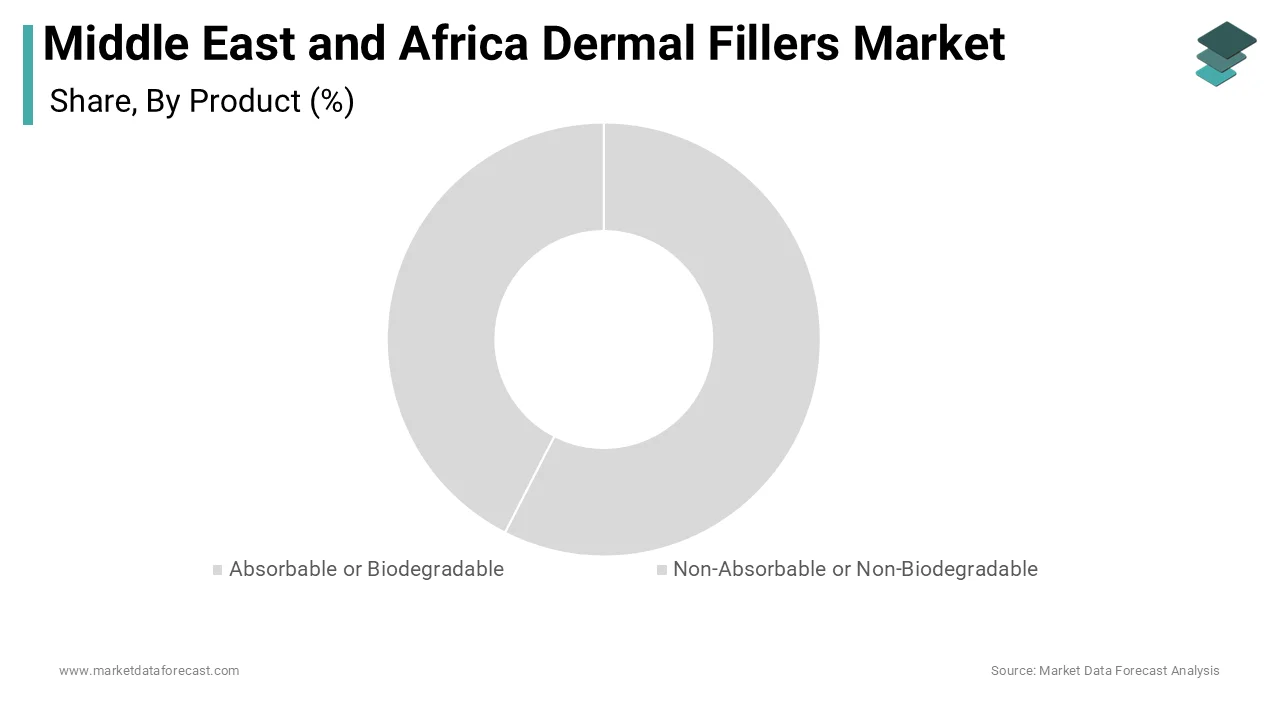
The absorbable or biodegradable segment dominated the Middle East and Africa dermal fillers market by capturing a substantial share in 2024. The growth of the absorbable or biodegradable segment is driven by consumer preference for reversible, low-risk aesthetic interventions. Hyaluronic acid (HA)-based fillers, which fall under this category, account for a notable share of absorbable filler usage due to their proven safety profile and enzymatic reversibility via hyaluronidase.
The non-absorbable or non-biodegradable dermal fillers segment is predicted to witness a CAGR of 11.4% from 2025 to 2033. The growth of the non-absorbable or non-biodegradable dermal fillers segment can be attributed to the rising demand for long-term volume restoration in reconstructive and post-oncological facial rehabilitation. Polymethylmethacrylate (PMMA) and calcium hydroxylapatite (CaHA) fillers, though less reversible, are increasingly adopted for structural augmentation in temples, cheeks, and jawlines. Furthermore, medical tourism clinics in Egypt and Jordan are incorporating semi-permanent fillers into combination therapies for international patients seeking cost-effective and long-lasting results.
By Therapeutic Area Insights
The wrinkles segment led the Middle East and Africa dermal fillers market by accounting for a 45.8% share in 2024. The growth of the wrinkles segment is driven by the widespread prevalence of dynamic facial lines, particularly in sun-exposed populations across the Arabian Peninsula and North Africa. Ultraviolet radiation accelerates collagen degradation, with the study showing that individuals in Saudi Arabia and Egypt experience skin aging up to many years earlier than their European counterparts due to chronic UV exposure. Consequently, preventive and corrective treatments for periorbital and glabellar lines are in high demand. Moreover, the integration of neuromodulators like botulinum toxin with hyaluronic acid fillers has amplified treatment efficacy, which strengthens wrinkle correction as the cornerstone of non-surgical facial rejuvenation.
The scars segment is estimated to register the fastest CAGR of 12.1% from 2025 to 203,3, owing to the increasing demand for corrective aesthetic interventions among patients with acne scars, surgical scars, and trauma-related facial depressions. Acne affects a notable share of adolescents and young adults in urban centers, as per a study. This high incidence has created a vast patient pool seeking dermal augmentation to smooth atrophic lesions. In response, clinics have adopted advanced techniques such as micro-polydroplet injection and subcision combined with fillers, achieving improvement in scar depth, as per the research.
COUNTRY LEVEL ANALYSIS
Saudi Arabia Dermal Fillers Market Insight
Saudi Arabia was the top performer in the Middle East and Africa dermal fillers market and accounted for a 28.4% share in 2024. The domination of Saudi Arabia in the regional market is driven by Vision 2030’s healthcare modernization agenda, which includes the development of specialized aesthetic medicine centers and the licensing of several dermatologists and plastic surgeons. The rise of female-led clinics in Riyadh and Jeddah, which are supported by eased social regulations, has broadened access to cosmetic treatments, with an increase in female patients undergoing filler procedures.
United Arab Emirates Dermal Fillers Market Insights
The United Arab Emirates was the second largest in the Middle East and Africa dermal fillers market. The country’s cosmopolitan population and high disposable income, per capita GDP increasing as per the study, enable sustained consumer spending on premium aesthetic treatments. Dubai alone attracts several medical tourists annually for cosmetic procedures, where many are seeking dermal fillers from globally recognized brands such as Restylane and Teosyal, as per the study.
Israel Dermal Fillers Market Insights
Israel's growth is likely to grow steadily in the Middle East and Africa dermal fillers market due to its robust biotech and medical device innovation sector, which produces globally recognized filler technologies such as Restylane (developed by Q-Med, now Galderma) and emerging hyaluronic acid derivatives with extended longevity. Israeli dermatologists perform several filler procedures annually. The country also serves as a clinical research hub by conducting a portion of all Middle East-based trials on next-generation dermal fillers. Its proximity to Gulf markets and growing medical diplomacy initiatives have enabled technology transfer and training collaborations with Saudi and Emirati institutions, which enhance its strategic relevance beyond its size.
KEY MARKET PLAYERS
Allergan Inc., AQTIS Medical, Bioha Laboratories, Suneva Medical, Galderma, Merz Aesthetics, Cynosure, Syneron, and Cytophil Inc. are a few of the noteworthy players in the MEA dermal fillers market profiled in this report.
MARKET SEGMENTATION
This research report on the Middle East and Africa dermal fillers market has been segmented & sub-segmented into the following categories
By Product
- Absorbable or Biodegradable
- Non-Absorbable or Non-Biodegradable
By Therapeutic Area
- Wrinkles
- Deep Facial Lines
- Sagging Skin
- Scars
By Country
- KSA
- UAE
- Israel
- rest of the GCC countries
- South Africa
- Ethiopia
- Kenya
- Egypt
- Sudan
- Rest of MEA