- Product Description Description
- Table of Contents TOC
- List of Table & Figure LOT
- Get Free Sample PDF Sample PDF
Market Size, 2025
$38.66 BnMarket Estimate, 2026
$40.14 BnMarket Forecast, 2034
$54.26 BnCAGR, 2026–2034
3.84%Middle East and Africa Fast Food Market Summary
The Middle East and Africa fast food market was valued at USD 38.66 billion in 2025 and is projected to reach USD 40.14 billion in 2026 and further grow to USD 54.26 billion by 2034, expanding at a CAGR of 3.84% from 2026 to 2034. The growth of the fast food market in the Middle East and Africa is driven by the region’s rising urban population, increasing disposable incomes, and growing preference for convenient, affordable, and Western-style quick meals. The expanding presence of international QSR chains, digital delivery platforms, and menu localization strategies are further supporting market expansion.
Key Market Trends
- Strong consumer preference for burgers, sandwiches, and fried chicken meals.
- Rising adoption of online food delivery apps and aggregator platforms.
- Increasing franchising opportunities, attracting global QSR brands.
- Menu diversification with healthier and plant-based fast food options.
- Growing influence of youth-driven demand for quick, affordable dining.
Segmental Insights
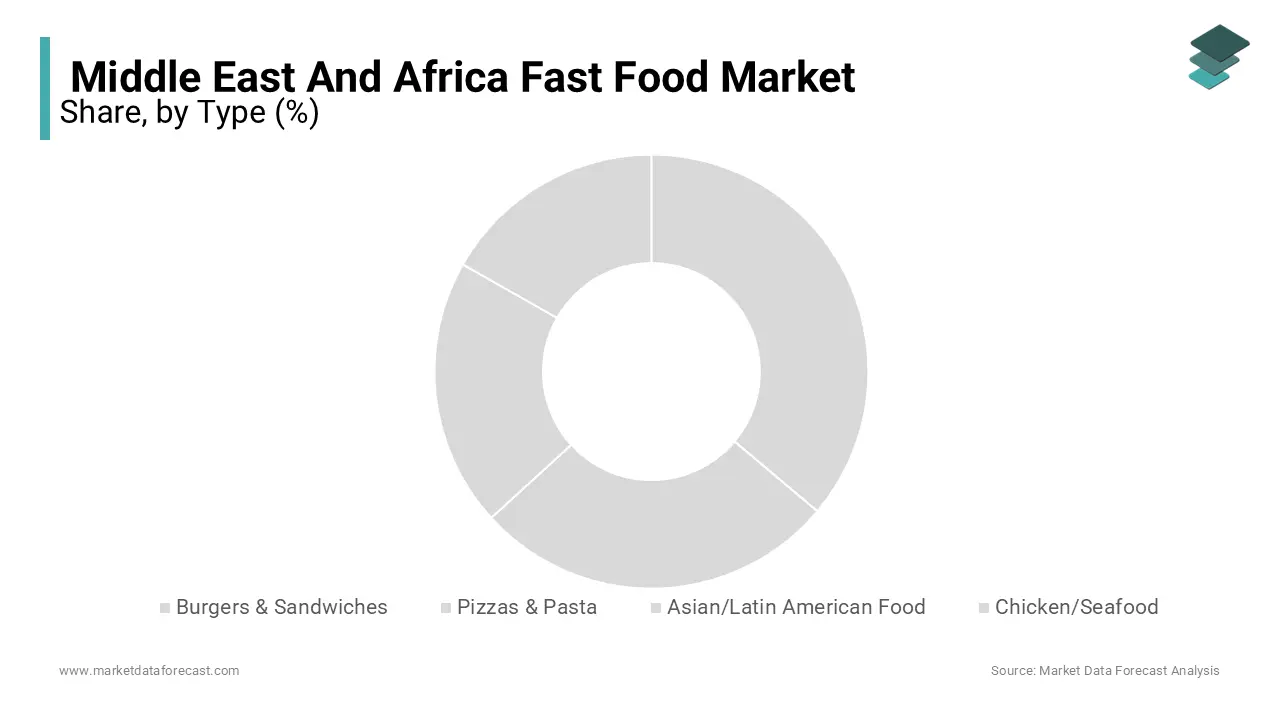
- Based on type, the burgers & sandwiches segment dominated the Middle East and Africa fast food market with 36.4% share in 2025, reflecting its broad consumer appeal.
- Based on distribution channel, the quick service restaurant (QSR) segment held the leading share in 2025, driven by the expansion of international and regional chains across urban hubs.
Regional Insights
- Saudi Arabia was the top-performing market, capturing 22.3% of the regional share in 2025, supported by strong consumer spending and rapid QSR expansion.
- United Arab Emirates is witnessing robust growth, fueled by a thriving tourism industry and a diverse expatriate population.
- South Africa is a key market with rising urbanization and increasing demand for international fast food brands.
- Nigeria is emerging as a promising market, driven by a young, urban consumer base.
- Other parts of the Middle East & Africa are gradually adopting fast food trends through expanding delivery services and localized franchise outlets.
Competitive Landscape
Leading players in the Middle East and Africa fast food market include Domino’s Pizza, Burger King, KFC, Subway, Dunkin’ Donuts, McDonald’s, Hardee’s, Pizza Hut, Firehouse Subs, and Auntie Anne’s. These companies are focusing on digital ordering platforms, franchise expansion, and localized menu innovations to capture a wider customer base.
Middle East and Africa Fast Food Market Size
The fast food market size in the Middle East and Africa was valued at USD 38.66 billion in 2025 and is estimated to be worth USD 54.26 billion by 2034, from USD 40.14 billion in 2026, growing at a CAGR of 3.84% from 2026 to 2034

The Middle East and Africa Fast Food Market is rapidly evolving ecosystem of quick-service food outlets, delivery platforms, and hybrid culinary models with the shifting urban lifestyles, cultural preferences, and economic dynamics across two highly diverse regions. The sector includes both international franchises such as McDonald’s, KFC, and Domino’s, as well as indigenous brands like Al Baik in Saudi Arabia and Chicken Cottage in Nigeria, which have achieved regional dominance through culturally attuned menus and operational agility.
MARKET DRIVERS
Urbanization and Demographic Growth
Rapid urbanization in the Middle East and Africa (MEA) is a primary driver of the fast food market in the Middle East and Africa. According to the United Nations Department of Economic and Social Affairs, more than 58% of the MEA population resided in urban areas by 2022 and urbanization rates projected to increase by 3.5% annually through 2035. This urban shift fosters a lifestyle demanding convenience, making fast food a preferred choice. Additionally, the growing young population in this regionis characterized by a higher propensity for dining out and digital engagement, which is boosting the demand for quick-service restaurants and online food delivery platforms.
Increasing Disposable Income and Consumer Spending
Rising disposable income across the MEA region is significantly boosting the regional market expansion. According to the International Monetary Fund (IMF), a 4.3% annual increase in real GDP per capita in Gulf Cooperation Council countries was observed between 2020 and 2023, which highlights stronger purchasing power. Similarly, household consumption expenditure in South Africa grew by 2.7% in 2022, as reported by Statistics South Africa. This financial growth enables consumers to allocate more to dining and lifestyle spending and support the expansion of international and regional fast-food chains. Furthermore, rising investments in fast food franchising and marketing in economically vibrant cities such as Dubai, Riyadh, and Johannesburg amplify consumer engagement and fast food market growth in this region.
MARKET RESTRAINTS
Health Awareness and Lifestyle Shifts
Increasing health consciousness among consumers is a key restraint for the Middle East and Africa fast food market. According to the World Health Organization (WHO), the prevalence of obesity in the region reached 30% in Gulf Cooperation Council countries and 27% in South Africa as of 2022. This has prompted consumers to pivot towards healthier meal options and reduces the appeal of traditional fast food offerings. Governments are also stepping in, with Saudi Arabia introducing a sugar tax in 2019, which expanded to cover sugary drinks and fast food items by 2021. This regulatory landscape, along with the growing awareness of diet-related illnesses, poses challenges to fast food chains, which must adapt by offering healthier alternatives to retain their customer base.
Economic Disparities and Market Volatility
Economic disparities and market volatility hinder the growth of the fast food market in some parts of the MEA region. According to the World Bank, approximately 33% of the population in Sub-Saharan Africa lived below the international poverty line of USD 2.15 per day in 2022 and limits consumer spending on non-essential items such as fast food. Moreover, rising food inflation, recorded at 16.2% in 2023 across the region, has increased operational costs for restaurants, as per data from the International Monetary Fund (IMF). These economic challenges and geopolitical instability in countries such as Sudan and Libya are disrupting supply chains and impacting the affordability and accessibility of fast food, especially in low-income markets.
MARKET OPPORTUNITIES
Rising Digital Transformation and Food Delivery Services
The growth of digital infrastructure in the Middle East and Africa presents significant opportunities for the fast food market in this region. As per the reports of the International Telecommunication Union (ITU), internet penetration in the region reached 65% in 2023, which is an increase from 50% in 2018. This expansion supports the rapid adoption of online food delivery platforms and mobile app-based ordering. For instance, as per the UAE Telecommunications and Digital Government Regulatory Authority, online food delivery services grew by 35% annually between 2020 and 2023 in the UAE. Such platforms not only expand customer reach but also enable fast-food chains to diversify revenue streams through promotions and partnerships with delivery aggregators to position them for sustained growth in this digital era.
Expansion into Emerging Markets and Localized Offerings
Emerging markets in Sub-Saharan Africa, such as Nigeria, Kenya, and Ghana offer substantial growth opportunities for fast food chains. According to the World Bank, the population of Nigeria is projected to exceed 230 million by 2030, accompanied by a burgeoning middle class that is expected to constitute 35% of the population. This demographic shift increases demand for accessible and affordable dining options. Moreover, the localization of menus to reflect regional tastes, such as incorporating halal-certified ingredients in the Middle East or traditional African flavors in Sub-Saharan markets, enhances brand appeal. Governments such as the Ministry of Tourism of Kenya have also encouraged foreign investments in urban centers to provide a favorable environment for international fast-food franchises to establish a foothold.
MARKET CHALLENGES
Supply Chain Disruptions and Rising Costs
Supply chain challenges that are compounded by geopolitical instability and inflation are a significant hurdle for the Middle East and Africa fast food market. According to the International Monetary Fund (IMF), food price inflation in the region reached 16.2% in 2023 and impacting the cost of raw materials and operations. Additionally, as per the reports of the United Nations Office for the Coordination of Humanitarian Affairs, conflicts in countries such as Sudan and Libya are disrupting the availability of imported ingredients and packaging materials. These disruptions create logistical inefficiencies and increased operational expenses for fast food chains, particularly those reliant on international supply chains. Such challenges necessitate innovative sourcing strategies and localization of supply to ensure business continuity and cost management.
Cultural and Regulatory Barriers
Cultural sensitivities and evolving regulations present challenges for fast-food brands operating in the region. For instance, religious dietary laws in Middle Eastern countries necessitate halal certification, which requires brands to adapt their offerings and operations. The Saudi Food and Drug Authority mandates stringent compliance for halal certification and creates operational complexities. Furthermore, as introduced by the governments in 2021, rising regulatory measures to combat non-communicable diseases, such as sugar taxes in Saudi Arabia and the UAE, limit the appeal of high-calorie menu items. According to the World Health Organization (WHO), 60% of deaths in the region are attributed to non-communicable diseases, which are further driving stricter regulations.
REPORT COVERAGE
| REPORT METRIC | DETAILS |
| Market Size Available | 2025 to 2034 |
| Base Year | 2025 |
| Forecast Period | 2026 to 2034 |
| CAGR | 3.84% |
| Segments Covered | By Type, Distribution Channel and Country |
| Various Analyses Covered | Regional and Country Level Analysis; Segment-Level Analysis; DROC; PESTLE Analysis; Porter’s Five Forces Analysis; Competitive Landscape; Analyst Overview of Investment Opportunities |
| Regions Covered | KSA, UAE, Israel, the rest of GCC countries, South Africa, Ethiopia, Kenya, Egypt, Sudan and the Rest of MEA |
| Market Leaders Profiled | Domino's Pizza, Burger King, KFC, Subway, Dunkin' Donuts, McDonald's, Hardee's, Pizza Hut, Firehouse Subs and Auntie Anne's |
SEGMENTAL INSIGHTS
By Type Insights
The Burgers & Sandwiches segment was accounted in holding 36.4% of the Middle East and Africa fast food market share in 2025 with the widespread acceptance of Western-style quick meals, particularly in urban centers where international chains and localized variants have established strong brand recognition. The product’s success illustrates how global formats can be indigenized to achieve mass appeal. In Egypt, the "taameya sandwich" sold by fast food vendors combines falafel with pickles and tahini in pita bread, reflecting a hybrid fast food culture. According to the Cairo Institute for Urban Nutrition, 68% of working professionals in Greater Cairo consume sandwich-based meals at least three times per week due to their portability and affordability.
The Asian/Latin American Food segment is projected to expand at a CAGR of 12.4% during the forecast period owing to the increasing exposure to global cuisines through migration, media, and digital platforms, particularly among younger, cosmopolitan consumers. These communities create sustained demand for familiar flavors, while local populations develop a taste for bold, aromatic dishes such as biryani, pad Thai, and empanadas. A 2023 survey by the Pan-African Gastronomy Council found that 54% of urban consumers aged 18–35 had tried Asian or Latin American fast food in the past six months, citing novelty and spiciness as key attractions. Additionally, food delivery apps have accelerated discovery, with Talabat and Jumia Food reporting a 92% year-on-year increase in orders for Thai, Indian, and Mexican-inspired meals.
By Distribution Channel Insights
The Quick Service Restaurant (QSR) segment dominated the Middle East and Africa Fast Food Market share in 2025. In the Gulf Cooperation Council (GCC) countries, where air-conditioned malls and family entertainment zones are central to social life, QSRs function as destination venues. According to the Dubai Department of Economy and Tourism, food courts and standalone fast food outlets account for 38% of mall foot traffic, with families representing 62% of visitors. Additionally, QSRs benefit from brand investment in store design, digital kiosks, and loyalty programs that enhance customer retention.
The online food delivery channel segment is expected to register a CAGR of 16.8% from 2026 to 2034 with the inrtegration of smartphone penetration, mobile payment adoption, and evolving urban lifestyles that prioritize convenience over traditional dining. In major cities like Lagos, Nairobi, and Amman, where traffic congestion and long working hours limit time for meal preparation, consumers increasingly rely on apps such as Deliveroo, Bolt Food, and Jahez to access fast food without leaving their homes or offices. According to the United Nations Economic Commission for Africa, mobile internet usage in urban Sub-Saharan Africa reached 61% in 2023, enabling seamless app-based transactions.
REGIONAL ANALYSIS
Saudi Arabia Fast Food Market Insights
Saudi Arabia was the top performer of the Middle East and Africa fast food market with 22.3% of the share in 2025 with its ambitious economic diversification agenda under Vision 2030, which prioritizes private sector growth, entertainment, and domestic consumption. The Ministry of Municipal and Rural Affairs confirms that over 12,000 new food and beverage outlets opened between 2020 and 2023, including flagship locations for international chains and homegrown giants like Al Baik, which operates over 180 branches. The rise of mixed-use developments, entertainment cities like Qiddiya, and women’s workforce participation have normalized eating out as a social and professional activity. According to the King Abdullah Economic City report, foodservice spending grew by 19% annually from 2021 to 2023. Additionally, the government’s support for franchising and digital transformation has accelerated the adoption of delivery platforms and cloud kitchens.
United Arab Emirates Fast Food Market Insights
United Arab Emirates was positioned second by holding 18.4% of the share in 2025 with the growing prominence for global cuisines and premium dining experiences. The country’s world-class infrastructure, including smart cities and 5G-enabled delivery networks, supports rapid service innovation. The Department of Economic Development in Dubai reports that 78% of fast food transactions now involve digital payments or app-based ordering. Additionally, regulatory clarity and business-friendly policies have attracted major international chains and venture-backed startups alike.
South Africa Fast Food Market Insights
South Africa fast food market growth is projected to grow with highest CAGR during the forecast period. The country serves as the dominant fast food hub in Sub-Saharan Africa, characterized by a mature retail ecosystem, high urbanization, and a relatively developed franchise culture. Brands like Nando’s, Steers, and Chicken Licken have achieved pan-African recognition, exporting their models to neighboring countries. According to the South African National Department of Trade, informal food vendors contribute over 30% of urban fast food consumption, but formal QSRs are gaining ground due to hygiene concerns and brand trust. The arrival of global players such as Domino’s and KFC has intensified competition, with over 5,000 outlets operating nationwide.
Egypt Fast Food Market Insights
Egypt fast food market growth is likely to have significant growth opportunities with over 110 million and a vibrant youth demographic that embraces modern lifestyles despite economic constraints. Cairo alone is home to over 20 million people by creating a dense urban market for affordable, quick meals. According to the Egyptian Ministry of Trade and Industry, fast food sales grew by 17% annually from 2020 to 2023, outpacing inflation. Local chains like El Abd Patisserie and international franchises such as Pizza Hut have adapted to consumer preferences by offering value meals and installment-based ordering via platforms like ValU. Street food remains prevalent, but branded outlets are gaining traction due to perceived safety and consistency.
KEY MARKET PLAYERS AND COMPETITIVE LANDSCAPE
Companies playing a notable role in the Middle East and Africa fast food market include Domino's Pizza, Burger King, KFC, Subway, Dunkin' Donuts, McDonald's, Hardee's, Pizza Hut, Firehouse Subs and Auntie Anne's.
The competitive dynamics of the Middle East and Africa fast food market are shaped by a unique interplay between global franchises, homegrown chains, and the vast informal sector. Unlike in mature markets where competition revolves around brand loyalty and pricing, here the battle is for cultural legitimacy, operational adaptability, and trust in food safety. International players like McDonald’s and Burger King compete not only with each other but with powerful regional brands such as Al Baik and Chicken Cottage that enjoy deep consumer affinity and operational agility. The presence of millions of street vendors offering low-cost, culturally familiar meals adds another layer, forcing formal chains to justify their premium through consistency, hygiene, and convenience. Digital platforms have intensified competition by lowering entry barriers, enabling delivery-only brands and cloud kitchens to challenge established outlets without physical storefronts.
TOP PLAYERS IN THE MARKET
Al Baik
Al Baik has emerged as a cultural and commercial phenomenon in the Middle Eastand Africa, where it has redefined fast food through a blend of affordability, speed, and localized flavor innovation. Unlike global chains, Al Baik built its dominance organically, focusing on halal grilled and fried chicken, proprietary garlic sauce, and efficient service models tailored to family and individual diners. The brand’s success lies in its deep cultural resonance, operational consistency, and avoidance of international franchising, preserving its regional authenticity.
KFC (Yum! Brands)
KFC (Yum! Brands) holds a pivotal position in the Middle East and Africa fast food landscape, leveraging its global scale while demonstrating exceptional adaptability to regional norms and tastes. The brand’s operational resilience, investment in cold chain infrastructure, and partnerships with local poultry producers have enabled long-term sustainability in complex markets. KFC’s presence has also catalyzed the formalization of the fast food sector in countries where informal dining once dominated, setting standards for hygiene, service, and employment practices. Its ability to thrive in diverse regulatory and economic environments promotes its strategic importance in shaping the region’s modern foodservice ecosystem.
Nando’s stands out as a pan-African success story that has elevated regional cuisine onto the global stage through its signature peri-peri chicken and bold, values-driven brand identity. Originating in South Africa, Nando’s blends Portuguese-African flavors with contemporary dining aesthetics, creating a fast-casual experience that appeals to urban professionals and families alike. The brand is renowned for its commitment to local sourcing, community engagement, and artistic expression, often incorporating African art and music into its restaurant design. Nando’s has expanded across the Middle East and into Europe, serving as a cultural ambassador for African culinary innovation.
TOP STRATEGIES USED BY KEY MARKET PLAYERS
One major strategy is hyper-localization of menus and branding, where global and regional chains adapt their offerings to reflect local tastes, religious requirements, and cultural preferences. This goes beyond simple halal certification to include region-specific ingredients, flavor profiles, and meal formats that resonate with indigenous consumers, which is fostering deeper emotional connections and brand loyalty.
Another key approach is strategic investment in digital ecosystems, including proprietary apps, third-party delivery integrations, and AI-driven customer engagement tools. Companies are leveraging data analytics to personalize promotions, optimize delivery routes, and anticipate demand, transforming fast food from a transactional service into a seamless, tech-enabled experience.
RECENT HAPPENINGS IN THE MARKET
- In February 2023, Al Baik launched a digital loyalty program across its Saudi outlets, which is integrating mobile ordering and rewards to enhance customer retention and streamline peak-hour operations.
- In May 2023, KFC Middle East partnered with Jahez with a leading Saudi food delivery platform, to expand its online reach and improve last-mile delivery efficiency in urban centers.
- In September 2023, Nando’s introduced a new menu in Kenya featuring locally sourced peri-peri peppers and maize-based sides, reinforcing its commitment to regional ingredients and sustainability.
- In January 2025, KFC Egypt inaugurated a new poultry processing facility in partnership with local farmers, which is strengthening its cold chain and reducing reliance on imported chicken.
- In April 2025, Al Baik opened its first drive-thru outlet in Riyadh’s King Salman Energy Park that is signaling expansion into high-income, car-dependent neighborhoods.
MARKET SEGMENTATION
This research report on the Middle East and Africa fast food market is segmented and sub-segmented into the following categories.
By Type
- Burgers & Sandwiches
- Pizzas & Pasta
- Asian/Latin American Food
- Chicken/Seafood
By Distribution Channel
- Quick Service Restaurant (QSR)
- Street Vendors
- Food Delivery Services
- Online Food Delivery
By Country
- KSA
- UAE
- Israel
- rest of GCC countries
- South Africa
- Ethiopia
- Kenya
- Egypt
- Sudan
- Rest of MEA