- Product Description Description
- Table of Contents TOC
- List of Table & Figure LOT
- Get Free Sample PDF Sample PDF
Market Size, 2025
$2.35 BnMarket Estimate, 2026
$2.48 BnMarket Forecast, 2034
$3.76 BnCAGR, 2026–2034
5.35%Executive Summary: Middle East and Africa Food Additives Market
- Market Scope: Comprehensive regional analysis of the food additives sector across the Middle East and Africa, covering additive types (flavors, sweeteners, preservatives, emulsifiers, acidulants), sources (natural, synthetic), application categories (beverages, bakery & confectionery, dairy, sauces & dressings), country/regional markets, and distribution profiles.
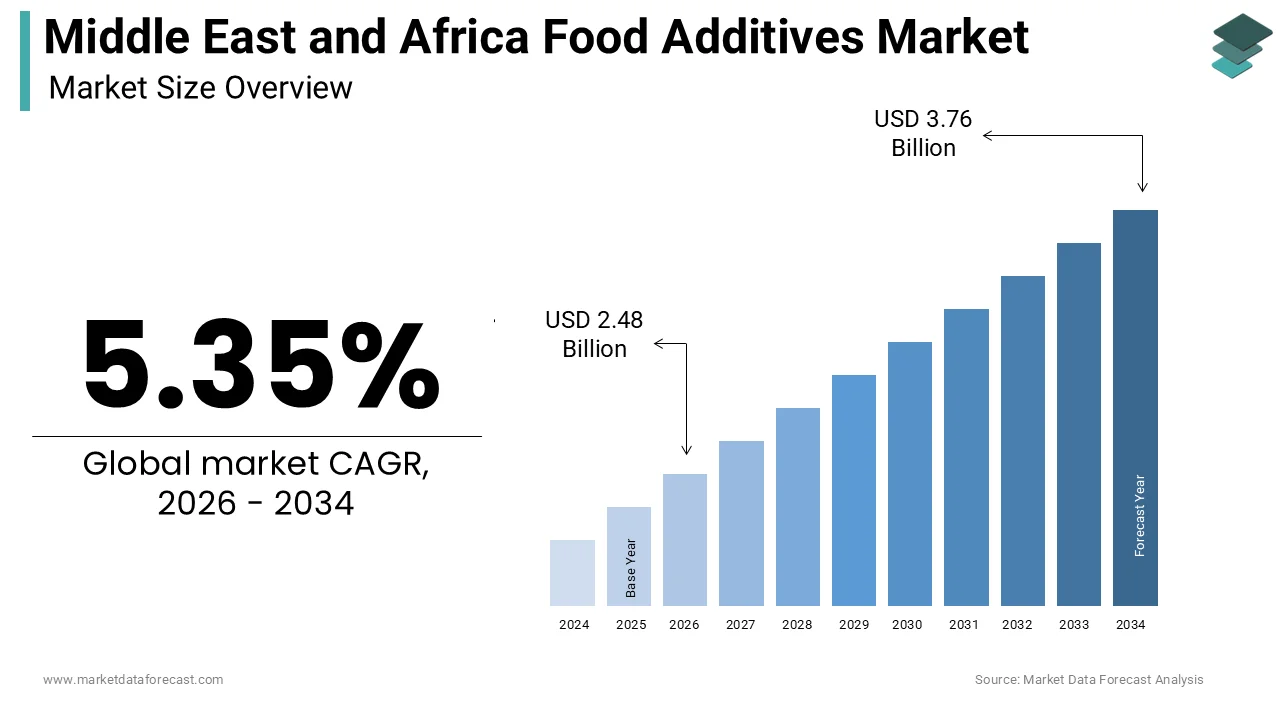
- Market Valuation: Valued at USD 2.35 billion in 2025, reaching USD 2.48 billion in 2026, and projected to expand to USD 3.76 billion by 2034, growing at a compound annual growth rate (CAGR) of 5.35% from 2026 to 2034.
- Primary Growth Drivers: Growing supply chain complexities and inefficiencies in the food and beverage industry necessitating preservation and taste enhancement, rising domestic consumption, and foreign investments/partnerships entering emerging regional economies.
Key Market Segment Metrics
| Category | Leading Segment (Base Position) | Fastest-Growing / High-Growth Segment |
|---|---|---|
| By Type | Flavors (accounted for the largest market share followed closely by sweeteners in regional consumption) | Natural Additives & Functional Enzymes (expanding steadily alongside clean-label and health-conscious consumer preferences) |
| By Application | Beverages (demanded the largest share backed by commercial drink manufacturing and hydration trends) | Sauces, Dressings, Spices & Condiments (projected to be the fastest-growing application segment across the region) |
| By Region | Middle East Region (led overall market valuation driven by advanced food processing and developed urban retail infrastructure) | Africa Region (projected to grow at a high CAGR propelled by rising domestic consumption and foreign enterprise partnerships) |
Major Market Players & Industry Landscape
Market Structure: Highly competitive regional food ingredients and biochemical landscape featuring global agricultural processors, flavor houses, and specialty chemical conglomerates.
Key Companies: E.I. du Pont de Nemours and Company (Danisco), Archer Daniels Midland Company, Cargill, Incorporated, Chr. Hansen Holding A/S, Kerry Group Plc, and BASF SE.
 Download Free Sample Report
Middle East and Africa Food Additives Market Size
The size of the Middle East and Africa food additives market was calculated to be USD 2.35 billion in 2025 and is anticipated to be worth USD 3.76 billion by 2034, from USD 2.48 billion in 2026, growing at a CAGR of 5.35% during the forecast period.
Food additives are ingredients which are added to the end food products to enhance the taste and appearance. They are being utilized for the preservation of food by pickling, sulfur dioxide for wines, salting as in the case of bacon, etc. Food additives can be of both artificial and natural origin.
The market for food additives in Middle-East and Africa is mainly driven due to growing supply chain complexities/inefficiencies in the food and beverage industry which is making them resort to food additives which helps in preserving as well as enhancing the taste of the products. But, the market growth can be constrained due to strong organic movement, coupled with decreasing reliance on synthetic chemicals owing to adverse effects on human health.
This research report on the Middle East and Africa Food Additives Market is segmented and sub-segmented into the following categories.
Middle East and Africa Food Additives Market By Type
- Acidulants
- Anti-caking agents
- Colors
- Emulsifiers
- Enzymes
- Flavors
- Hydrocolloids
- Preservatives
- Sweeteners
The flavors segment accounts for the largest market share followed by the sweeteners segment in the market by type
Middle East and Africa Food Additives Market By Source
- Natural
- Synthetic
Middle East and Africa Food Additives Market By Application
- Bakery & confectionery
- Beverages
- Convenience foods
- Dairy & frozen desserts
- Spices & condiments
- Sauces & dressings
The demand for food additives in beverages accounted for the largest share, while the sauces, dressings, spices, condiments segment is projected to be the fastest-growing segments.
Middle East and Africa Food Additives Market By Region
- Middle-East region
- Africa region
The Food Additives market in the Middle-East and Africa region is projected to grow at a high CAGR, due to many foreign companies entering the emerging economies through partnerships as they see the developed countries as matured markets in terms of revenue growth. Also, this area is likely to be a high potential market owing to growing domestic consumption coupled with government support to attract new investment.
KEY MARKET PLAYERS
Major key players in the MEA Food Additives Market are E.I. DuPont , Archer Daniels Midland Company, Cargill, Incorporated, CHR. Hansen Holding A/S, Kerry Group Plc, and BASF SE are the major players of Middle-East and Africa Food Additives market.