- Product Description Description
- Table of Contents TOC
- List of Table & Figure LOT
- Get Free Sample PDF Sample PDF
Market Size, 2025
$1.06 BnMarket Estimate, 2026
$1.26 BnMarket Forecast, 2034
$5.05 BnCAGR, 2026–2034
18.95%Executive Summary: Middle East & Africa Healthcare Analytics Market
- Market Scope: Comprehensive Middle East and Africa healthcare analytics market analysis covering component types, application verticals, deployment models, regional leadership frameworks, and healthcare IT adoption metrics.
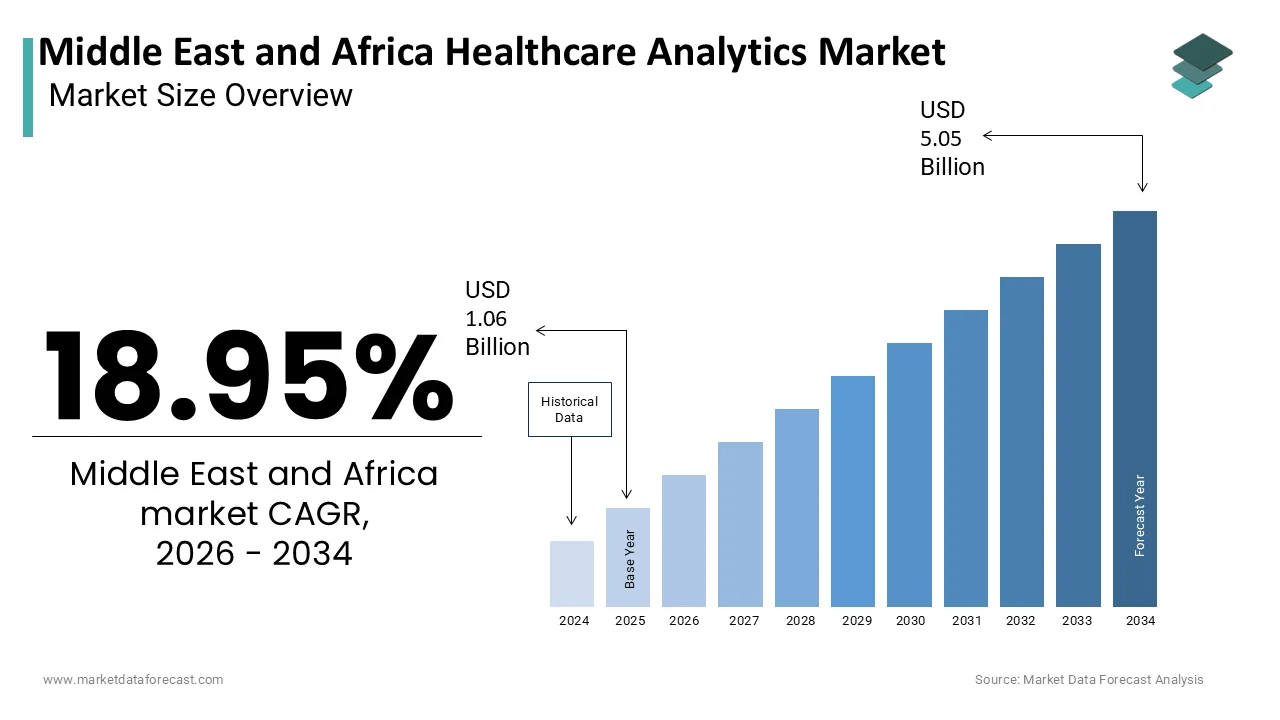
- Market Valuation: Valued at USD 1.06 billion (2025), estimated at USD 1.26 billion (2026), and projected to reach USD 5.05 billion by 2034, registering a robust CAGR of 18.95% (2026–2034).
- Primary Growth Drivers: Rising healthcare IT adoption, expansion of electronic health records (EHR), shift toward cloud-based technologies, increasing chronic disease prevalence, major healthcare investments, personalized medicine, fraud detection, and exploding volumes of health data. Key regional highlights include the MEA region accounting for ~4.6% of the global market in 2025, driven heavily by GCC infrastructure developments.
Key Market Segment Metrics (2026–2034)
| Category | Leading Segment (2025 Position) | Fastest-Growing Segment |
|---|---|---|
| By Component | Healthcare Analytics Software Solutions (core market share) | Managed Healthcare Analytics Services & Consulting Support |
| By Deployment Model | On-Premises Healthcare Infrastructure (historical baseline share) | Cloud-Based Analytics Solutions & SaaS Health Platforms |
| By Application Area | Clinical & Financial Analytics (dominant operational focus areas) | Population Health Management & Predictive Personalized Medicine |
| By Region / Country | GCC Countries (Saudi Arabia, UAE, Kuwait, Qatar, Bahrain, Oman) & South Africa (highest regional shares) | Saudi Arabia & the United Arab Emirates (accelerated by digital hospital mega-projects) |
Major Market Players & Market Structure
Market Structure: Highly competitive regional healthcare IT landscape featuring global technology giants and specialized health informatics providers competing intensely on software capabilities, cloud deployment, digital health records integration, population health management, and data-driven improvements in clinical and operational outcomes.
Key Companies: SAS Institute, Optum, IBM Corporation, Truven Health Analytics, Cerner Corporation, Verisk Analytics, McKesson Corporation, Allscripts Health Solutions, Oracle Corporation, MedeAnalytics, Inovalon, and Health Catalyst.
Middle East and Africa Healthcare Analytics Market Size
The Middle East and Africa Healthcare Analytics Market is projected to grow from USD 1.06 billion in 2025 to USD 1.26 billion in 2026 and reach USD 5.05 billion by 2034, registering a CAGR of 18.95% from 2026 to 2034.
Healthcare analytics is the systematic collection, interpretation, and use of medical and operational data to improve patient care, lower costs, and streamline hospital management. The market includes the systematic computational analysis of data or statistics within the healthcare sector to improve patient outcomes and operational efficiency. This domain integrates predictive modelling, big data, and artificial intelligence to transform raw clinical and administrative information into actionable insights. According to the World Health Organisation Regional Office for Africa, the region faces a double burden of disease, with non-communicable diseases accounting for 37% of all deaths, necessitating data-driven management strategies. This epidemiological shift drives the adoption of analytics for chronic disease monitoring and resource allocation. As per the Saudi Vision 2030 Health Sector Transformation Program, the digital health transformation aims to ensure the dissemination of the unified digital medical record to include 100% of the population. Such infrastructure development creates a foundational layer for advanced analytical applications. Governments in the Gulf Cooperation Council prioritize smart city initiatives that include integrated health data platforms. Private insurers increasingly utilise claims analytics to detect fraud and manage risk pools. The scarcity of specialised medical personnel in remote areas amplifies the need for remote monitoring analytics. These factors collectively accelerate the transition from reactive care to proactive population health management across the region.
MARKET DRIVERS
Government Initiatives for Digital Health Transformation
Aggressive government mandates for digital health infrastructure significantly drive the Middle East & Africa Healthcare Analytics Market. This creates a mandatory framework for data collection and analysis. National visions in countries like Saudi Arabia and the United Arab Emirates prioritize the integration of artificial intelligence and big data into public health systems. As per the Saudi Data and Artificial Intelligence Authority, the national strategy aims to attract 20 billion dollars in national and foreign investments in data and AI by 2030, while AI is projected to contribute significantly more to the gross domestic product. This financial commitment fuels the procurement of advanced analytics platforms by public hospitals. The United Arab Emirates Ministry of Health and Prevention has implemented a unified electronic health record system across all emirates, enabling centralised data aggregation. This centralization allows for real-time epidemiological surveillance and resource optimization. Public-private partnerships facilitate the deployment of cloud-based analytics solutions for smaller clinics. Regulatory bodies enforce standards for data interoperability, ensuring seamless information exchange. Government funding supports training programs for healthcare professionals in data literacy. These top-down directives create a stable demand environment for analytics vendors. The alignment with national economic diversification goals ensures long term political support.
Rising Prevalence of Chronic Non-Communicable Diseases
The escalating burden of chronic non-communicable diseases further propels the Middle East & Africa Healthcare Analytics Market. This necessitates sophisticated tools for population health management. Lifestyle changes and ageing populations have led to a surge in diabetes, cardiovascular diseases, and obesity, requiring continuous monitoring and intervention. As per the International Diabetes Federation, the Middle East and North Africa region has the highest comparative prevalence of diabetes globally at 16.2% among adults, driving demand for predictive analytics. Healthcare providers use these tools to identify high-risk patients and personalise treatment plans. As per sources, cardiovascular diseases cause around 31% of all deaths in the Eastern Mediterranean Region, highlighting the need for early detection algorithms. Analytics platforms integrate data from wearable devices and electronic health records to track patient vitals remotely. Insurance companies leverage this data to design value-based care models that reduce hospital readmissions. Pharmaceutical companies utilise real-world evidence generated by analytics to demonstrate drug efficacy. Hospitals optimise staffing and inventory based on predicted disease outbreaks. This clinical urgency accelerates the adoption of data-driven decision-making tools.
MARKET RESTRAINTS
Fragmented Healthcare Infrastructure and Data Silos
Disparate healthcare systems and lack of interoperability slow down the growth of the Middle East & Africa Healthcare Analytics Market. This is because they prevent comprehensive data aggregation. Many healthcare facilities in the region operate on legacy systems that do not communicate with each other, creating isolated data silos. According to sources, healthcare facilities across sub-Saharan Africa frequently face constraints in adopting fully functional electronic medical record systems due to implementation costs, poor electricity supply, and limited internet connectivity, which restricts the amount of data available for deep analysis. This fragmentation hinders the development of robust predictive models that require large, diverse datasets. Private and public sectors often use incompatible software platforms, complicating data exchange efforts. The absence of standardised coding systems for diagnoses and procedures leads to inconsistent data quality. Rural clinics frequently rely on paper-based records, which are difficult to digitise and analyse. Lack of technical infrastructure such as reliable internet connectivity further exacerbates the issue. Healthcare providers struggle to gain a holistic view of patient history across different care settings. Vendors face challenges in integrating their solutions with heterogeneous IT environments. This structural inefficiency slows the realisation of analytics benefits.
Stringent Data Privacy Regulations and Security Concerns
Strict data privacy laws and cybersecurity threats hamper the expansion of the Middle East & Africa Healthcare Analytics Market. This increases compliance costs and operational complexity. Governments are enacting rigorous regulations to protect patient confidentiality, which restricts data sharing and usage. As per the Saudi Personal Data Protection Law, organisations must obtain explicit consent for data processing and implement strict security measures, facing heavy penalties for non-compliance. These requirements demand significant investment in encryption and access control technologies. The South African Protection of Personal Information Act imposes similar obligations, creating legal hurdles for analytics providers. Fear of data breaches discourages some institutions from adopting cloud-based analytics solutions. Cyberattacks on healthcare infrastructure have increased globally, raising awareness of vulnerabilities. Limited local expertise in cybersecurity makes it difficult for hospitals to manage risks effectively. Legal ambiguities regarding cross-border data transfer complicate international collaborations. Patients remain sceptical about how their data is used, affecting consent rates. These regulatory and security barriers slow market penetration. Providers must balance innovation with stringent compliance requirements.
MARKET OPPORTUNITIES
Expansion of Telemedicine and Remote Patient Monitoring
The rapid growth of telemedicine and remote patient monitoring offers a major opportunity for the Middle East & Africa Healthcare Analytics Market. This generates vast streams of real-time health data. Virtual care platforms require analytical engines to process vital signs, symptoms, and medication adherence data from home settings. As per the Dubai Health Authority, telehealth consultations in Dubai reached nearly 375,000 in 2023, reflecting a 28% increase compared to 2022. Analytics tools help triage patients and predict deterioration before emergency visits are needed. The Kenyan Ministry of Health promotes mobile health initiatives that reach remote populations, generating unique data points. Machine learning algorithms can identify patterns in this data to optimise chronic disease management. Insurance providers use remote monitoring data to offer personalised premiums and incentives. Pharmaceutical companies leverage this real-world data for post-market surveillance. Technology partners collaborate with telecom operators to enhance connectivity and data transmission. This digital expansion opens new revenue streams for analytics vendors. It enables proactive care models that reduce overall healthcare costs.
Adoption of Artificial Intelligence in Diagnostic Imaging
The integration of artificial intelligence in diagnostic imaging unlocks major potential for the Middle East & Africa Healthcare Analytics Market. This enhances accuracy and efficiency. AI algorithms analyse medical images such as X-rays, MRIs, and CT scans to detect abnormalities faster than human radiologists. According to studies, deep learning and AI-assisted workflows can help reduce radiologists' clinical image interpretation times by up to 30% to 40%, depending on the specific application, while maintaining diagnostic accuracy. Hospitals in the region face a deficit of trained radiologists, making AI tools essential for timely diagnosis. The Egyptian Ministry of Health has initiated pilots using AI for tuberculosis screening in rural areas, improving detection rates. Analytics platforms aggregate these imaging findings with clinical data to provide comprehensive patient profiles. Startups in Israel and South Africa develop proprietary algorithms tailored to regional disease profiles. Regulatory bodies are establishing frameworks for approving AI-based medical devices. Investment in AI research centers fosters local innovation and talent development. This technological leap improves patient outcomes and operational throughput. It positions analytics as a critical component of modern diagnostic workflows.
MARKET CHALLENGES
Shortage of Skilled Data Science Professionals
A critical shortage of qualified data scientists and health-informatics specialists impedes the Middle East & Africa Healthcare Analytics Market. This limits implementation capabilities. Healthcare institutions struggle to find personnel who possess both clinical knowledge and technical expertise in data analysis. As per the United Nations Educational, Scientific and Cultural Organisation, the region faces a significant brain drain, with many skilled professionals migrating to Europe and North America for better opportunities. This talent gap hinders the effective deployment and maintenance of complex analytics systems. Universities in the region are slowly introducing specialised programs, but graduation rates remain low. Existing staff require extensive upskilling, which is time-consuming and costly. External consultants are expensive and may lack understanding of local contextual nuances. High turnover rates disrupt project continuity and knowledge retention. Healthcare leaders often lack the technical literacy to champion analytics initiatives internally. This human capital deficit slows the translation of data into actionable insights. Organisations must invest heavily in training and retention strategies. Until this gap is addressed, market growth remains constrained.
High Implementation Costs and Budget Constraints
Prohibitive implementation costs and a limited healthcare budget challenge the Middle East & Africa Healthcare Analytics Market. This restricts access for public and smaller private facilities. Advanced analytics platforms require substantial upfront investment in software licenses, hardware, and integration services. As per the World Health Organization, many African countries spend less than 50 dollars per capita on health annually, leaving little room for discretionary technology spending. Public hospitals prioritise essential medicines and basic infrastructure over digital tools. Maintenance and subscription fees add to the total cost of ownership, straining operational budgets. Currency fluctuations in some countries increase the cost of imported software solutions. Return on investment is often long-term and difficult to quantify immediately, deterring decision-makers. Smaller clinics cannot afford enterprise-grade solutions, leading to market exclusion. Funding agencies may not prioritise analytics in their grant allocations. Vendors face pressure to lower prices, which impacts profitability and innovation. This financial barrier prevents widespread adoption across the healthcare spectrum. Affordable and scalable solutions are needed to overcome this hurdle.
REPORT COVERAGE
| REPORT METRIC | DETAILS |
| Market Size Available | 2025 to 2034 |
| Base Year | 2024 |
| Forecast Period | 2026 to 2034 |
| Segments Covered | By Component, Application, Deployment Mo de, End U ser, Delivery, Mode, and Country. |
| Various Analyses Covered | Global, Regional & Country Level Analysis, Segment-Level Analysis; DROC, PESTLE Analysis, Porter's Five Forces Analysis, Competitive Landscape, Analyst Overview of Investment Opportunities |
| Country Coverage: | UAE, Israel, rest of GCC countries, South Africa, Ethiopia, Kenya, Egypt, Sudan, Rest of MEA. |
| Market Leader Profiled | SAS Institute, Inc., Optum, Inc., IBM Corporation, Truven Health Analytics Inc |
SEGMENTAL ANALYSIS
By Component Insights
The software segment dominated the Middle East & Africa Healthcare Analytics Market and accounted for a substantial share in 2025. It serves as the foundational infrastructure required for digital health transformation initiatives across the region. Government mandates for electronic health records and unified data platforms drive substantial procurement of analytical software licenses. As per the Saudi Ministry of Health, the Wasfaty digital app has processed over 40 million prescriptions, while the Seha Virtual Hospital initiative serves as the world's largest virtual network connecting over 200 hospitals across the Kingdom. This massive scale necessitates robust analytics engines capable of processing diverse clinical datasets in real time. As per the United Arab Emirates Department of Health – Abu Dhabi, 100% of public healthcare facilities have adopted standardized electronic medical record systems, creating a mandatory demand for compatible analytics modules. Hospitals prioritize software investments because they enable immediate visibility into operational bottlenecks and clinical outcomes without requiring extensive physical infrastructure upgrades. Cloud-based deployment models reduce upfront capital expenditure, making advanced analytics accessible to smaller private clinics. Regulatory requirements for data reporting and quality metrics further compel institutions to acquire compliant software solutions. Vendors continuously update platforms with artificial intelligence features to maintain competitive differentiation. This structural dependency ensures software remains the primary revenue generator in the component segment.
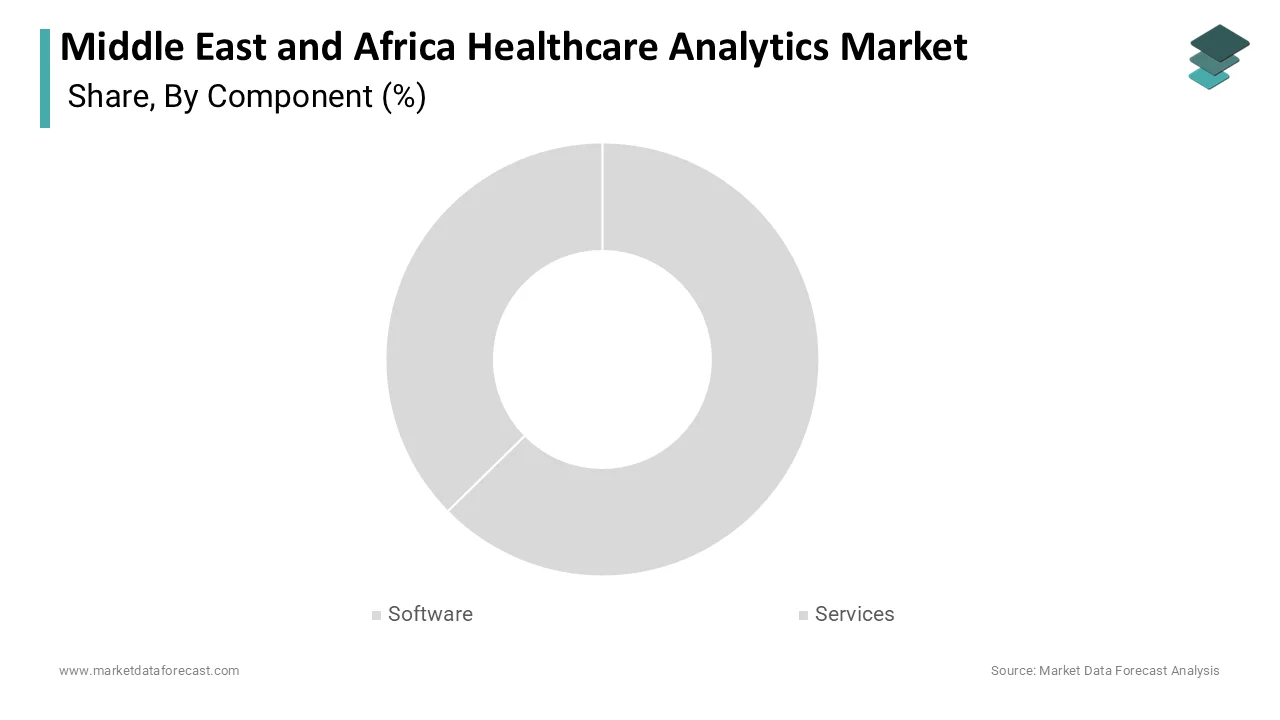
The services segment is predicted to witness the highest CAGR of 18.5% between 2026 and 2034, owing to an acute shortage of local technical expertise and complex implementation requirements. Healthcare organisations lack internal capacity to deploy, configure, and maintain sophisticated analytics platforms, necessitating external professional support. As per the World Health Organization Eastern Mediterranean Regional Office, projections indicate that by 2030, the region faces a shortfall of 2.1 million health workers, which accounts for over 20% of the estimated global deficit. Consulting firms provide critical gap analysis, workflow redesign, and change management services that are essential for successful adoption. Training programs delivered by service providers help upskill existing staff to operate new systems effectively, reducing resistance to digital transformation. Managed analytics services allow hospitals to outsource data processing and interpretation when hiring full-time data scientists is not feasible. Post-implementation support contracts generate recurring revenue streams for vendors while ensuring system sustainability. Customisation services adapt global platforms to local regulatory and linguistic requirements, enhancing usability. Integration services connect disparate legacy systems, enabling comprehensive data aggregation. This human capital constraint transforms services from ancillary offerings into strategic growth drivers.
By Application Insights
The clinical analytics segment led the Middle East & Africa Healthcare Analytics Market and captured a significant share in 2025. This leading position was attributed to an urgent need to improve patient safety and treatment efficacy amidst high disease burdens. Healthcare providers utilise these tools to identify at-risk patients, optimise treatment protocols, and reduce medical errors. As per the International Diabetes Federation, the Middle East and North Africa region has the highest comparative prevalence of diabetes globally at 16.2% among adults, driving demand for predictive modelling in chronic disease. Hospitals deploy clinical decision support systems to alert physicians about potential drug interactions and guideline deviations during consultations. As per sources, implementing patient safety software ecosystems and clinical tracking systems across hospitals helps reduce serious adverse medical events by creating standardized monitoring mechanisms. Electronic health record integrations enable real-time access to patient histories, facilitating personalised care decisions. Research institutions leverage clinical analytics to conduct retrospective studies and generate real-world evidence for regional disease profiles. Regulatory bodies mandate quality reporting, which relies heavily on clinical data extraction and analysis. Insurance payers increasingly reimburse based on clinical outcomes rather than volume, incentivising provider adoption. This direct impact on patient care sustains market leadership.
The population health analytics segment is estimated to register the fastest CAGR of 19.2% over the forecast period due to government initiatives targeting preventive care and resource optimization. National health strategies emphasise shifting from reactive treatment to proactive wellness management, requiring sophisticated population-level insights. As per the World Bank, non-communicable diseases account for 74% of all deaths in the Middle East and North Africa, prompting ministries to invest in surveillance systems for early intervention. Analytics platforms aggregate data from multiple sources, including primary care clinics, hospitals,s and community screenings, to identify geographic hotspots and vulnerable demographics. The Kenyan Ministry of Health utilises population health dashboards to track immunisation coverage and maternal health indicators across counties, improving resource allocation efficiency. Predictive models forecast disease outbreaks, enabling preemptive public health responses. Value-based care pilots in the Gulf Cooperation Council countries use population analytics to measure provider performance against health outcomes. Social determinants of health data integration enhances understanding of root causes beyond clinical factors. Public health agencies collaborate with technology partners to build national registries. This strategic pivot toward prevention accelerates segment expansion significantly.
By End User Insights
The healthcare providers segment remained the largest in 2025 and occupied a commanding share of the Middle East & Africa Healthcare Analytics Market. This segment serves as the primary generator and consumer of clinical and operational data. Hospitals and clinics face immense pressure to improve efficiency, reduce costs,s and enhance quality under tightening budgets and regulatory scrutiny. According to research, public healthcare networks in Dubai capture extensive volumes of outpatient data, generating crucial operational datasets that are vital for long-term health facility capacity planning. Providers use analytics to optimise bed utilisation, staffing schedules, es and supply chain management, reducing operational waste. Clinical analytics support diagnosis, treatment planning, and patient safety initiatives directly impacting care delivery. The Egyptian Ministry of Health, in cooperation with global firms, is planning the launch of an "Egypt Smart Healthcare Platform" to connect health facilities through unified digital electronic health records. Private hospital groups compete on quality metrics and patient experience scores, driving investment in benchmarking tools. Telemedicine expansions generate additional data streams requiring integration and analysis. Accreditation standards from Joint Commission International require continuous quality improvement supported by data analytics. This centrality to healthcare delivery ensures providers remain the largest end-user segment.
The pharmaceutical and biotechnology companies segment is anticipated to witness the fastest CAGR of 17.8% from 2026 to 2034. This swift growth of the segment is propelled by increasing demand for real-world evidence and market access insights. Drug manufacturers face pressure to demonstrate value beyond clinical trial efficacy to secure reimbursement and formulary inclusion in cost-conscious markets. As per the Journal of Pharmaceutical Policy and Practice, regulatory agencies in the Gulf Cooperation Council increasingly require post-marketing surveillance data using local patient populations to maintain product registrations. Analytics platforms enable companies to mine electronic health records and claims data for safety signals, effectiveness comparisons, and patient journey mapping. Market access teams use predictive analytics to forecast demand and optimise distribution networks across fragmented geographies. Clinical research organisations leverage analytics to identify eligible trial participants, accelerating recruitment timelines in the region. Pharmacovigilance departments automate adverse event detection from unstructured clinical notes, improving compliance efficiency. Partnerships with healthcare providers facilitate access to de-identified datasets for research purposes. Digital therapeutics development requires analytics to validate intervention effectiveness. This strategic shift toward evidence generation propels rapid segment growth.
COUNTRY LEVEL ANALYSIS
Saudi Arabia Healthcare Analytics Market Analysis
Saudi Arabia was the top performer in the Middle East & Africa Healthcare Analytics Market and held a substantial share in 2025. This prominence of the Saudi market was supported by the Vision 2030 digital health transformation initiative and massive public sector investment. The Kingdom prioritises building integrated national health information exchanges to unify fragmented data sources. As per the Saudi Data and Artificial Intelligence Authority, the national strategy aims to attract 20 billion dollars in national and foreign investments in data and AI by 2030, while AI is projected to contribute significantly more to the overall gross domestic product. Large-scale projects like NEOM and the Red Sea Project incorporate smart health ecosystems requiring advanced analytics infrastructure. The Ministry of Health’s Seha Virtual Hospital demonstrates commitment to technology-enabled care delivery at national scale. Privatisation of healthcare services creates new demand for commercial analytics solutions among emerging provider groups. Local content requirements encourage partnerships with international vendors, fostering knowledge transfer. High smartphone penetration supports mobile health data collection initiatives. Regulatory frameworks for data governance are maturing rapidly, providing clarity for investors. This comprehensive ecosystem positions Saudi Arabia as the undisputed regional leader in market size and innovation velocity.
United Arab Emirates Healthcare Analytics Market Analysis
The United Arab Emirates was the next prominent region in the Middle East & Africa Healthcare Analytics Market in 2025. This region is known for its advanced digital infrastructure and pioneering regulatory frameworks for health data. The country serves as a regional hub for health technology innovation, attracting global vendors and startups. As per the Department of Health Abu Dhabi, the Malaffi health information exchange connects over 3000 healthcare facilities, enabling seamless data sharing and analytics across the emirate. Dubai’s Smart City initiative integrates health data with other municipal services, creating unique opportunities for cross-sector analytics. The UAE was among the first in the region to enact comprehensive personal data protection legislation, providing legal certainty for analytics deployments. Medical tourism drives demand for quality benchmarking and patient experience analytics. Free zones like Dubai Healthcare City offer testbeds for novel analytics applications. Government-backed accelerators fund local health tech entrepreneurship. High expatriate population creates diverse datasets valuable for research. Strong purchasing power enables rapid adoption of premium solutions. This mature environment sustains steady high-value market activity.
Israel Healthcare Analytics Market Analysis
Israel plays a key role in the Middle East & Africa Healthcare Analytics Market because of its world-class health data infrastructure and a vibrant health tech ecosystem. The country’s four health maintenance organisations cover nearly the entire population, with decades of longitudinal electronic health records creating unparalleled datasets for analytics. As per the Israel Innovation Authority, health tech startups drew 1.6 billion dollars in private investments during 2025, which represents a decline from the 2 billion dollars raised in 2022. Academic medical centres collaborate closely with industry to develop and validate novel algorithms. Regulatory sandbox approaches allow controlled testing of innovative analytics solutions in real clinical settings. Strong cybersecurity capabilities address data privacy concerns effectively. Export-oriented companies develop solutions adaptable to global markets, generating international revenue. Military service creates a talent pipeline of skilled data scientists and engineers. Cultural acceptance of technology facilitates patient engagement with digital tools. Government grants de-risk early-stage development. This innovation density makes Israel a disproportionate contributor to regional technological advancement despite smaller geographic size.
South Africa Healthcare Analytics Market Analysis
South Africa is moving ahead steadfastly in the Middle East & Africa Healthcare Analytics Market due to a relatively developed private healthcare sector and research infrastructure. The country hosts numerous academic institutions and clinical research organizations generating demand for analytical tools. As per the South African Medical Research Council, national health research priorities include strengthening health information systems supporting analytics capacity building. Private hospital groups like Netcare and Mediclinic invest in analytics to manage capitated contracts and improve clinical governance. Discovery Health’s Vitality program pioneered behavioural analytics for wellness incentives, influencing regional models. National Health Insurance preparations drive public sector interest in population health analytics for resource planning. Strong telecommunications infrastructure supports cloud analytics deployment. Local startups develop contextually appropriate solutions addressing unique challenges. Regulatory alignment with international standards enhances credibility. Economic constraints limit widespread adoption but create niche opportunities for cost-effective solutions. This dual sector dynamic shapes distinctive market characteristics.
Ethiopia Healthcare Analytics Market Analysis
Ethiopia is a rising player in the regional market. In this market, healthcare analytics focuses primarily on public health surveillance and donor-funded programs. The government prioritises strengthening health information systems as a foundation for universal health coverage. According to sources, the Ethiopian Ministry of Health has prioritized digital health strategies and electronic records under its Information Revolution roadmap, driving basic health data management and analytics adoption across facilities. International donors like USAID and WHO fund digital health initiatives, creating initial market entry points. Community health worker programs generate grassroots data for epidemiological monitoring. Mobile health platforms bridge connectivity gaps in rural areas. Addis Ababa serves as a hub for pilot projects and training centres. Limited privasector activityy r restricts commercial analytics demand currently. Infrastructure deficits pose significant implementation challenges. Capacity building remains the primary focus over advanced applications. Government ownership ensures alignment with national priorities. This developmental stage offers long-term potential as systems mature.
COMPETITIVE LANDSCAPE
The competition in the Middle East & Africa Healthcare Analytics Market is characterized by the presence of global technology giants and emerging regional specialists striving for dominance. Major players compete primarily on technological sophistication, regulatory compliance, and local presence rather than price alone. The market exhibits moderatefragmentation,n with no single entity holding overwhelming control due to diverse regulatory environments across countries. Global firms leverage their established brand reputation and extensive product portfolios to serve large government contracts and private hospital chains. Regional players capitalize on their understanding of local language,s cultural nuances, and specific health system workflows to capture niche segments. Regulatory heterogeneity creates barriers to entry that protect incumbent providers with established compliance frameworks. Trust remains a critical factor as healthcare providers prioritize data security and patient privacy above all else. Strategic alliances with local distributors and technology partners help global vendors navigate complex procurement processes. Innovation in cloud-based and mobile-first solutions serves as a key differentiator for reaching remote areas. This dynamic environment fosters steady growth for established players who can demonstrate consistent reliability and localized support. New entrants face challenges in building credibility and scaling operations efficiently amidst infrastructure constraints.
KEY MARKET PLAYERS
Some of the companies that are playing a dominating role in the MEA Healthcare Analytics Market include:
- SAS Institute, Inc.
- Optum, Inc.
- IBM Corporation
- Truven Health Analytics Inc.
- Cerner Corporation
- Verisk Analytics, Inc.
- McKesson Corporation
- Allscripts Health Solutions
- Oracle Corporation
- MedeAnalytics
- Inovalon, Inc.
- Health Catalyst
TOP LEADING PLAYERS IN THE MARKET
- Oracle Corporation maintains a strong presence in the Middle East & Africa Healthcare Analytics Market through its comprehensive cloud infrastructure and specialized health data platforms. The company provides robust database management systems that support large-scale electronic health record integration and real-time analytics. Oracle recently expanded its cloud region footprint in Saudi Arabia and the United Arab Emirates to comply with local data sovereignty laws. This strategic expansion enables healthcare providers to store sensitive patient data locally while accessing advanced analytical tools. The firm collaborates with government entities to build national health information exchanges that unify fragmented data sources. Oracle emphasizes security and compliance features to address regional regulatory requirements effectively. Its partnership with local system integrators facilitates customized deployments for public hospitals. These initiatives strengthen its position as a trusted infrastructure provider for digital health transformation. The company continues to invest in artificial intelligence capabilities embedded within its health applications. Such innovations enhance predictive modeling and clinical decision support functionalities for regional clients.
- International Business Machines Corporation contributes significantly to the Middle East & Africa Healthcare Analytics Market by offering advanced artificial intelligence and machine learning solutions tailored for healthcare. The company leverages its Watson Health platform to provide cognitive computing capabilities that assist in diagnosis and treatment planning. IBM recently partnered with leading medical institutions in Egypt and South Africa todeploy AI-drivenn analytics for chronic disease management. This collaboration aims to improve patient outcomes through personalized care recommendations derived from complex datasets. The firm focuses on interoperability solutions that connect disparate health information systems across the region. IBM provides extensive training programs to upskill local healthcare professionals in data science and analytics. Its commitment to ethical AI practices builds trust among regulators and patients alike. The company also supports public health initiatives by providing analytics tools for disease surveillance. These efforts reinforce its reputation as a technology leader in the healthcare sector. Continuous innovation in natural language processing enhances data extraction from unstructured clinical notes.
- Cerner Corporation plays a pivotal role in the Middle East & Africa Healthcare Analytics Market by delivering integrated electronic health record systems with built-in analytical capabilities. The company serves major hospital groups and government health ministries with scalable solutions that improve operational efficiency and clinical quality. Cerner recently secured contracts to modernize health information systems in several Gulf Cooperation Council countries,es supporting national digital health strategies. These projects involve deploying population health analytics modules that enable proactive disease management and resource optimization. The firm emphasizes user-friendly interfaces that encourage adoption among clinicians and administrative staff. Cerner collaborates with local partners to ensure cultural and linguistic customization of its platforms. Its focus on interoperability standards facilitates seamless data exchange between different healthcare facilities. The company also provides managed services to support ongoing system maintenance and optimization. These comprehensive offerings help healthcare organizations achieve their digital transformation goals effectively. Continuous updates incorporate the latest clinical guidelines and regulatory requirements,ts ensuring sustained relevance.
TOP STRATEGIES USED BY KEY MARKET PARTICIPANTS
Key players in the Middle East & Africa Healthcare Analytics Market employ diverse strategies to maintain competitive advantage and drive sustainable growth. Establishing local cloud data centers remains a primary strategy to comply with strict data sovereignty regulations in countries like Saudi Arabia and the United Arab Emirates. Strategic partnerships with local system integrators and telecommunications providers facilitate market entry and enhance distribution reach across fragmented regions. Companies invest heavily in customizing solutions to address specific regional health challenges such as high prevalence of diabetes and infectious diseases. Training and capacity building programs are implemented to overcome the shortage of skilled data professionals and ensure successful adoption of analytics tools. Regulatory engagement helps shape favorable policies and standards for health data exchange and privacy protection. Offering flexible pricing models, including subscription-based services,e s makes advanced analytics accessible to resource-constrained public healthcare systems. Continuous innovation in artificial intelligence and machine learning capabilities differentiates products in a competitive landscape. Focus on interoperability ensures seamless integration with existing legacy systems widely used in the region. These multifaceted approaches enable firms to navigate complex market dynamics effectively.
MARKET SEGMENTATION
This research report on the Middle East & Africa healthcare analytics market has been segmented and sub-segmented into the following categories
By Component
- Software
- Services
By Application
- Clinical Analytics
- Financial Analytics
- Operational Analytics
- Population Health Analytics
- Other Applications
By Deployment Mode
- On-Premises
- Cloud-Based
By End User
- Healthcare Providers
- Healthcare Payers
- Pharmaceutical & Biotechnology Companies
- Other End Users
By Delivery Mode
- On-Premise Deployment
- Cloud-Based Deployment
- Web-Based Deployment
By Country
-
KSA
- UAE
- Israel; Rest of GCC countries
- South Africa
- Ethiopia
- Kenya
- Egypt
- SudaRestst of MEA