- Product Description Description
- Table of Contents TOC
- List of Table & Figure LOT
- Get Free Sample PDF Sample PDF
Market Size, 2025
$20.69 BnMarket Estimate, 2026
$22.29 BnMarket Forecast, 2034
$40.47 BnCAGR, 2026–2034
7.74%Executive Summary: Middle East and Africa Home Healthcare Market
- Market Scope: Comprehensive regional Middle East and Africa home healthcare market analysis covering product categories, service types, software solutions, country-level leadership frameworks, and chronic disease management drivers.
- Market Valuation: Valued at USD 20.69 billion (2025), estimated at USD 22.29 billion (2026), and projected to reach USD 40.47 billion by 2034, registering a steady CAGR of 7.74% (2026–2034).
- Primary Growth Drivers: Escalating prevalence of chronic diseases (non-communicable diseases and diabetes), aging demographic transitions, digital health remote patient monitoring integration, and Saudi Arabia’s Vision 2030 initiatives.
Key Market Segment Metrics (2026–2034)
| Category | Leading Segment (2025 Position) | Fastest-Growing Segment |
|---|---|---|
| By Product & Service Type | Testing, Screening & Monitoring (44.6% share) & Skilled Nursing Care (36.5% share) | Therapeutic Products (18.9% CAGR) & Rehabilitation Therapy Services (21.4% CAGR) |
| By Software & Region | Clinical Management Systems (52.7% share) & Saudi Arabia (33.5% regional share) | Hospice Solutions Software (23.6% CAGR) & UAE/South Africa Innovation Hubs |
Major Market Players & Market Structure
Market Structure: Emerging regional home care and medtech ecosystem featuring global healthcare giants coexisting with regional innovators and government-backed service providers navigating fragmented reimbursement landscapes.
Key Companies: Almost Family Inc., Amedisys Inc., General Electric Company, Kinnser Software Inc., Linde plc, Omron Corporation, Roche Holding AG, Philips Healthcare, McKesson Corporation, LHC Group Inc., Kindred Healthcare LLC, Fresenius SE & Co. KGaA, Abbott Laboratories, and Apria Healthcare Group Inc.
Middle East and Africa Home Healthcare Market Size
The Middle East and Africa home healthcare market size was valued at USD 20.69 billion in 2025 and is anticipated to reach USD 22.29 billion in 2026 from USD 40.47 billion by 2034, growing at a CAGR of 7.74% during the forecast period from 2026 to 2034.
Home Healthcare refers to the medical and supportive health services delivered in non-clinical, home-based settings, encompassing chronic disease management, post-acute care, palliative support, and remote monitoring. This model is gaining traction as healthcare systems grapple with hospital overcrowding and rising patient demand. These dynamics are reshaping care delivery across socioeconomic and geographic divides.
MARKET DRIVERS
The escalating prevalence of chronic diseases, which necessitates prolonged, patient-centered care outside traditional hospital environments, is a primary driver of the Middle East & Africa Home Healthcare Market. According to the World Health Organization, non-communicable diseases (NCDs) account for 37% of all deaths in the African region, with cardiovascular conditions alone responsible for over 1.1 million fatalities annually. In the Middle East, the International Diabetes Federation estimates that one in six adults lives with diabetes, totaling more than 73 million individuals. This burden strains public hospitals. These initiatives reflect a systemic shift toward sustainable, long-term care models.
The demographic transition toward an aging population, particularly in Gulf nations, which is increasing demand for geriatric and palliative home care, is another critical driver. This shift has prompted policy reforms. These developments underscore institutional recognition of home care as essential for dignified aging.
MARKET RESTRAINTS
The scarcity of trained home healthcare professionals, which limits service scalability and quality, is one major restraint in the Middle East & Africa Home Healthcare Market. According to the World Health Organization, Africa faces a deficit of 2.4 million health workers. In the Gulf, despite high investment, Saudi Arabia reported a notable vacancy rate in home care nursing positions within its Ministry of Health’s home services division. This human resource gap leads to inconsistent care delivery, reduced patient trust, and operational bottlenecks in expanding home healthcare programs.
The lack of standardized reimbursement mechanisms for home healthcare services, discouraging both provider participation and patient adoption, is another significant restraint. In Egypt, where 72% of health expenditures are private, home healthcare remains unaffordable for most households, as per the Central Agency for Public Mobilization and Statistics. Even in wealthier Gulf states, coverage remains fragmented. The absence of uniform billing codes and regulatory clarity further deters private sector investment. So, it is constraining market growth despite high clinical demand.
MARKET OPPORTUNTIES
The integration of digital health technologies with home care delivery, enabling remote monitoring, virtual consultations, and real-time data transmission, is a transformative opportunity. This infrastructure supports the deployment of wearable devices and telehealth platforms in home settings.
The expansion of public-private partnerships (PPPs) to finance and deliver home healthcare services, particularly in low-resource settings is another substantial opportunity. As per the World Bank, out-of-pocket health spending accounts for over 60% of total health expenditure in Nigeria and Sudan, creating a critical gap that PPPs can address. These collaborations leverage private sector efficiency and innovation while expanding access through public oversight, creating sustainable models for inclusive care delivery.
MARKET CHALLENGES
The inadequate availability of medical infrastructure and supply chains necessary to support home-based treatments is a critical challenge in the Middle East & Africa Home Healthcare Market. In conflict-affected regions such as Sudan and northern Nigeria, logistics disruptions further impede the delivery of medical equipment to patients’ residences. Even in urban centers, load-shedding and poor cold-chain systems compromise the storage of insulin and biologics at home. Without robust last-mile distribution networks, home healthcare remains aspirational for many, regardless of clinical need.
The cultural and social resistance to receiving medical care outside institutional settings, particularly in conservative and rural communities, is another pressing challenge. In parts of Saudi Arabia and Egypt, familial stigma around chronic conditions like diabetes or mental health disorders discourages open use of home health services. Overcoming these behavioral barriers requires sustained community engagement and culturally sensitive education campaigns.
REPORT COVERAGE
| REPORT METRIC | DETAILS |
| Market Size Available | 2025 to 2034 |
| Base Year | 2025 |
| Forecast Period | 2026 to 2034 |
| CAGR | 7.74% |
| Segments Covered | By Product Type, Services Type, Software and Region. |
| Various Analyses Covered | Global, Regional, & Country Level Analysis; Segment-Level Analysis, DROC, PESTLE Analysis, Porter’s Five Forces Analysis, Competitive Landscape, Analyst Overview of Investment Opportunities |
| Regions Covered | Saudi Arabia (KSA), the United Arab Emirates (UAE), Israel, the Rest of the GCC countries, South Africa, Ethiopia, Kenya, Egypt, Sudan, and the Rest of the Middle East and Africa (MEA). |
| Market Leaders Profiled | Almost Family Inc. (U.S.), Amedisys Inc. (U.S.), General Electric Company (U.S.), Kinnser Software Inc. (U.S.), Linde plc (Ireland), Omron Corporation (Japan), Roche Holding AG (Switzerland), Philips Healthcare (Netherlands), McKesson Corporation (U.S.), LHC Group, Inc. (U.S.), Kindred Healthcare, LLC (U.S.), Fresenius SE & Co. KGaA (Germany), Abbott Laboratories (U.S.), and Apria Healthcare Group Inc. (U.S.) |
SEGMENTAL ANALYSIS
By Product Type Insights
The Testing, Screening, & Monitoring Products segment dominated the Middle East & Africa Home Healthcare Market by capturing 44.6% of total product revenue in 2025. This lead position is primarily driven by the escalating burden of chronic diseases requiring continuous at-home surveillance. According to the International Diabetes Federation, about 85 million adults in the MENA region live with diabetes as of June 2024, a condition necessitating regular glucose monitoring. A further pivotal factor is the increasing adoption of remote patient monitoring (RPM) technologies in post-acute care. A DoH press release from August 4, 2020, announced that 160 healthcare facilities and more than 2,700 doctors were accessible via its Remote Healthcare Platform. These initiatives underscore the centrality of diagnostic and monitoring products in enabling decentralized care.
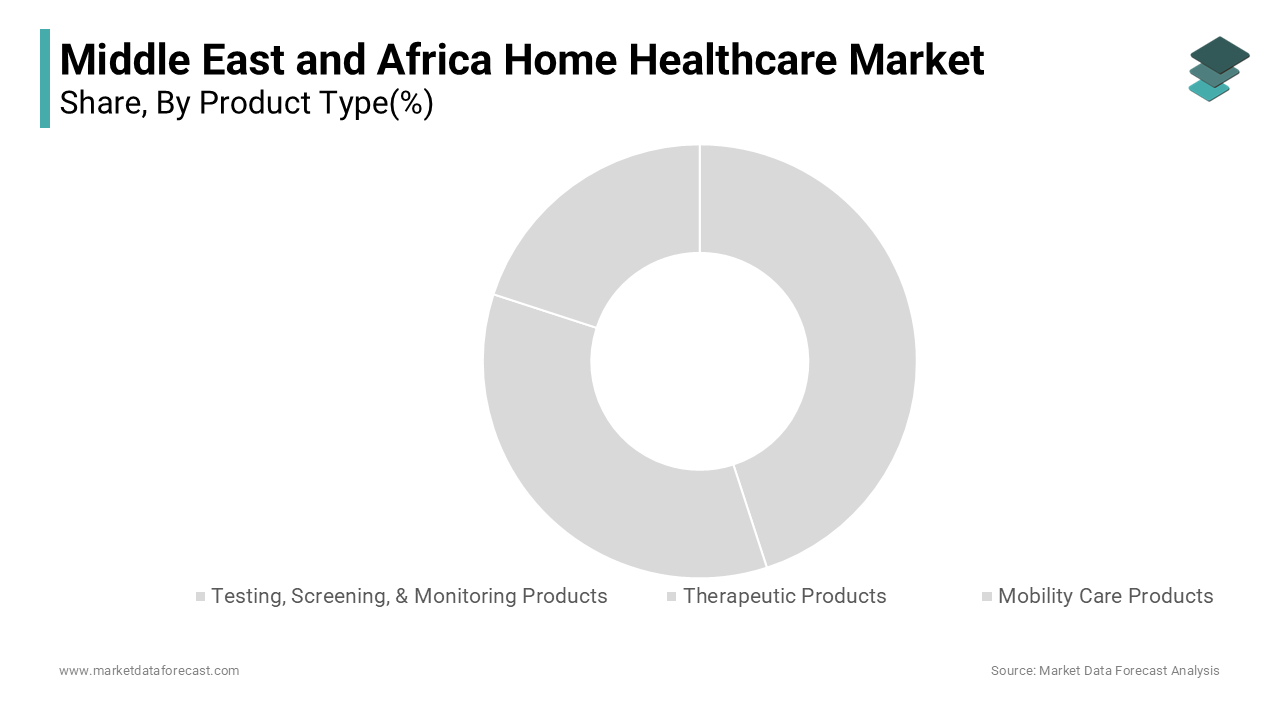
The Therapeutic Products segment is emerging as the fastest-growing category and is projected to expand at a CAGR of 18.9% from 2026 to 2034. This growth is fueled by rising demand for home-based infusion and respiratory therapies, particularly for chronic and post-hospitalization care. An additional key driver is the integration of biologic drug delivery into home settings, particularly for autoimmune diseases. These shifts reflect a structural transformation in care delivery, where therapeutic products are no longer confined to clinical environments.
By Services Type Insights
The Skilled Nursing Care Services segment represented the prominent service type by accounting for 36.5% of the total home healthcare services market in 2025. This dominance is supported by the growing need for professional clinical interventions in home settings, especially for post-surgical recovery, wound care, and chronic disease management. A different major contributing factor is the integration of skilled nursing into national elderly care strategies. According to the United Nations Population Fund, the number of individuals aged 60 and above in the Middle East will reach 42 million by 2050, necessitating expanded in-home clinical support. With formal training, regulatory oversight, and insurance coverage increasingly aligned, skilled nursing has become the cornerstone of professional home healthcare delivery.
The Rehabilitation Therapy Services segment is the fastest-growing and is projected to grow at a CAGR of 21.4% between 2026 and 2034. This surge is driven by rising demand for post-stroke, post-orthopedic, and neurorehabilitation care delivered at home. A further crucial driver is the expansion of insurance coverage for home rehabilitation. With growing recognition of early and continuous rehabilitation as critical to recovery, this segment is rapidly becoming integral to post-acute care models across the region.
By Software Insights
The Clinical Management Systems segment was the prevailing software in the home healthcare software market by accounting for 52.7% of total software revenue in 2025. This dominance is attributed to the urgent need for integrated digital platforms that streamline patient records, care planning, and clinician coordination. The system has reduced duplicate testing by 24% and improved care continuity for home-based patients. An additional driving factor is the regulatory push for digitized care documentation in home settings. These systems enhance clinical accuracy, regulatory compliance, and operational efficiency, making them indispensable in modern home healthcare operations.
The Hospice Solutions software segment is the fastest-growing and is projected to expand at a CAGR of 23.6% during the forecast period. This growth is driven by increasing institutional focus on end-of-life care digitization and regulatory support for palliative services. The software supports real-time pain assessment tracking and advanced care planning, improving care quality for terminal patients. A different key driver is the expansion of formal hospice programs in the Gulf. As per the World Health Organization, less than 10% of Africans with palliative care needs currently receive it, creating immense potential for digital scaling. As awareness and policy support grow, hospice software is becoming essential for delivering dignified, coordinated end-of-life care.
REGIONAL ANALYSIS
Saudi Arabia led the MEA home healthcare market by commanding a 33.5% of regional share in 2025. The Kingdom’s dominance is anchored in its Vision 2030-driven healthcare transformation, which prioritizes home-based care to reduce hospital congestion and improve patient experience. It has expanded services to a substantial number of patients across regions, offering skilled nursing, infusion therapy, and telemonitoring. With notable notable budget commitment for home healthcare infrastructure, Saudi Arabia is setting a benchmark for institutionalized, technology-enabled domiciliary care in the region.
The United Arab Emirates is another major player in the market which is driven by advanced regulatory frameworks and high insurance penetration. Dubai’s Home Healthcare Policy has coverage for numerous home-based services, including physiotherapy, dialysis, and palliative care. The emirate’s smart health strategy has integrated home care into Malaffi, the unified health record system, ensuring seamless data flow between clinicians and home providers. The UAE’s elderly population is growing rapidly, prompting expanded geriatric home care programs.
South Africa occupies a strategic position and is serving as the primary hub for home healthcare innovation in Sub-Saharan Africa. The country’s National Health Insurance (NHI) program includes home-based care as a core component. The Hospice Palliative Care Association delivers significant home visits annually, supported by digital case management systems. However, disparities persist. Despite challenges, South Africa remains a model for integrating home care into universal health coverage.
Egypt holds a considerable share of the market and is driven by large-scale government digitization and chronic disease burden. With 33 million adults living with diabetes or hypertension, demand for home monitoring and nursing is surging. Mobile health integration further strengthens service delivery.
Israel captures a small share of the regional market, distinguished by its fully integrated, technology-driven home healthcare ecosystem. The country’s four health maintenance organizations (HMOs) provide 100% coverage for home-based chronic and palliative care, supported by centralized digital records. The Ministry of Health mandates that all home care providers use certified software for care planning and reporting. With one of the highest life expectancies in the region, Israel’s focus on aging-in-place has made home healthcare a national priority, influencing policy and innovation across the MEA region.
COMPETITIVE LANDSCAPE
The competitive landscape of the Middle East & Africa Home Healthcare Market is evolving into a hybrid ecosystem where global medical technology firms coexist with regional innovators and government-backed service providers. Multinational corporations leverage their technological sophistication and regulatory expertise to dominate high-end therapeutic and monitoring segments, particularly in the Gulf. Local startups and health tech platforms are gaining traction by offering affordable, culturally attuned solutions for chronic and elderly care. Competition is intensifying in digital therapeutics, remote monitoring, and home infusion services, with differentiation driven by integration capabilities, clinician networks, and insurance coverage. Public procurement policies, data governance frameworks, and workforce availability vary widely, compelling companies to adopt highly adaptive strategies. The absence of dominant market leaders allows for agile entrants to capture niche segments, fostering a dynamic and fragmented yet rapidly maturing industry.
KEY MARKET PLAYERS
Companies playing a crucial role in the MEA Home Healthcare Market include
- Almost Family Inc.
- Amedisys Inc.
- General Electric Company (GE)
- Kinnser Software Inc.
- Linde Group
- Omron Corporation
- Roche Holding AG
- Philips Healthcare
- McKesson Corporation
- LHC Group Inc.
- Kindred Healthcare
- Fresenius SE & Co. KGaA
- Abbott Laboratories
- Apria Healthcare Group
Top Players in the Market
Philips Middle East & Africa has significantly advanced home healthcare through its integrated remote monitoring and telehealth solutions across the region. The company’s IntelliSpace Critical Care platform enables centralized surveillance of patients in home settings, particularly for chronic respiratory and cardiac conditions in Saudi Arabia and the UAE. The company also launched wearable biosensors linked to mobile health apps in Egypt and Kenya, supporting early deterioration detection. Philips continues to expand its sleep and respiratory care portfolio, introducing portable CPAP devices with cloud connectivity for home use in South Africa. Its collaboration with local insurers to cover home respiratory therapy has enhanced patient access, reinforcing its leadership in technology-driven domiciliary care models.
B. Braun Middle East plays a pivotal role in expanding home-based infusion and parenteral nutrition services across the Gulf and North Africa. The company supplies sterile pharmaceuticals, infusion pumps, and home care training programs to hospitals and private providers in Saudi Arabia, UAE, and Egypt. It also introduced the SpaceStation® infusion system in the UAE, a compact, user-friendly device designed for long-term home use. B. Braun collaborates with national health authorities to develop clinical protocols for home chemotherapy and antibiotic therapy, ensuring safety and compliance. Its integration of smart pump technology with remote monitoring platforms in Kuwait and Oman has enhanced treatment accuracy, positioning the company as a key enabler of complex therapeutic delivery outside hospitals.
Liva Healthcare (acquired by Ahila Health) has emerged as a digital front-runner in chronic disease management through personalized home-based behavioral coaching. Operating in Saudi Arabia and the UAE, Liva’s AI-powered platform supports patients with diabetes, obesity, and cardiovascular conditions via mobile-guided lifestyle interventions delivered remotely. The company also collaborated with Dubai’s Insurance Company to offer digital home care as a covered benefit. By blending digital coaching with clinical oversight, Liva is redefining preventive home healthcare, particularly in urban centers where lifestyle diseases are escalating rapidly.
Top Strategies Used by the Key Market Participants
Key players in the Middle East & Africa Home Healthcare Market are leveraging strategic partnerships with governments, digital integration, workforce training, service localization, and insurance collaboration to solidify their presence. Companies are aligning with national health visions such as Saudi Vision 2030 and the UAE’s Smart Health Strategy to secure public contracts. Investment in AI-driven remote monitoring and cloud-based clinical platforms enhances care continuity. Firms are establishing regional training academies to address shortages in skilled home care personnel. Localization of devices and software—adapting language, cultural context, and regulatory compliance—is critical for user adoption. Additionally, collaborations with private insurers and health maintenance organizations ensure reimbursement pathways, making home care financially viable for patients and sustainable for providers.
MARKET SEGMENTATION
This research report on the Middle East and Africa home healthcare market is segmented and sub-segmented into the following categories.
By Product Type
- Testing, Screening, & Monitoring Products
- Therapeutic Products
- Mobility Care Products
By Type
- Home Telehealth Monitoring Devices
- Home Telehealth Services
- Home Telehealth Software
By Services Type
- Rehabilitation Therapy Services
- Infusion Therapy Services
- Unskilled Care Services
- Respiratory Therapy Services
- Pregnancy Care Services
- Skilled Nursing Care Services
- Hospice
- Palliative Care Services
By Software
- Agency Software
- Clinical Management Systems
- Hospice Solutions
By Country
- KSA
- UAE
- Israel
- rest of the GCC countries
- South Africa
- Ethiopia
- Kenya
- Egypt
- Sudan
- rest of MEA