- Product Description Description
- Table of Contents TOC
- List of Table & Figure LOT
- Get Free Sample PDF Sample PDF
Market Size, 2025
$6.31 BnMarket Estimate, 2026
$6.46 BnMarket Forecast, 2034
$7.79 BnCAGR, 2026–2034
2.37%Executive Summary: Middle East Oilfield Services Market
- Market Scope: Comprehensive regional analysis tracking technical and operational support services across exploration, drilling, production, and reservoir maintenance in the Middle East.
- Market Valuation: Valued at USD 6.31 billion in 2025, reaching USD 6.46 billion in 2026, and projected to expand to USD 7.79 billion by 2034, growing at a steady CAGR of 2.37% during the forecast period (2026–2034).
- Primary Growth Drivers: Strategic investments by national and international oil companies in field modernization, digital oilfield technologies (AI, IoT), and large-scale upstream expansion projects. Key restraints include political instability, geopolitical tensions, strict regulatory/environmental pressures for carbon reduction, and oil price volatility.
Key Market Segment Metrics (2026–2034)
| Category | Leading Segment (2025 Position) | Fastest-Growing Segment |
|---|---|---|
| By Application | Onshore (held a dominant market share in 2025, driven by vast onshore oil and gas reserves in Saudi Arabia, Iraq, and Kuwait) | Offshore (projected at a CAGR of 7.6% fueled by deepwater developments in the UAE, Qatar, and Iran) |
| By Service Type | Drilling Services (accounted for 32.2% of the market in 2025, driven by expansive upstream and unconventional gas projects) | Drilling Waste Management Services (expected to register a CAGR of 8.9% due to stringent green initiatives and environmental regulations) |
| By Region | Saudi Arabia (led the market with 35.4% share in 2025, backed by Saudi Aramco's long-term development plans) | United Arab Emirates (second-largest position at 25.3% share) and Iraq (12.4% share with major infrastructure and EOR projects) |
Major Market Players & Market Structure
Market Structure: Highly competitive and consolidated environment featuring global oilfield service giants alongside agile regional players competing for long-term integrated service contracts with national oil companies.
Key Companies: Schlumberger Limited, Halliburton Company, Baker Hughes Company, Weatherford International plc, National Oilwell Varco (NOV), Arabian Drilling Company, NESR (National Energy Services Reunited Corp.), AlMansoori Specialized Engineering, ADES International Holding, National Petroleum Services (NPS), Saipem S.p.A., China Oilfield Services Limited (COSL), Petrofac Limited, KCA Deutag, and Nabors Industries Ltd.
Middle East Oilfield Services Market Size
The Middle East Oilfield Services Market Size was calculated to be USD 6.31 billion in 2025 and is anticipated to be worth USD 7.79 billion by 2034, from USD 6.46 billion in 2026, growing at a CAGR of 2.37% during the forecast period.
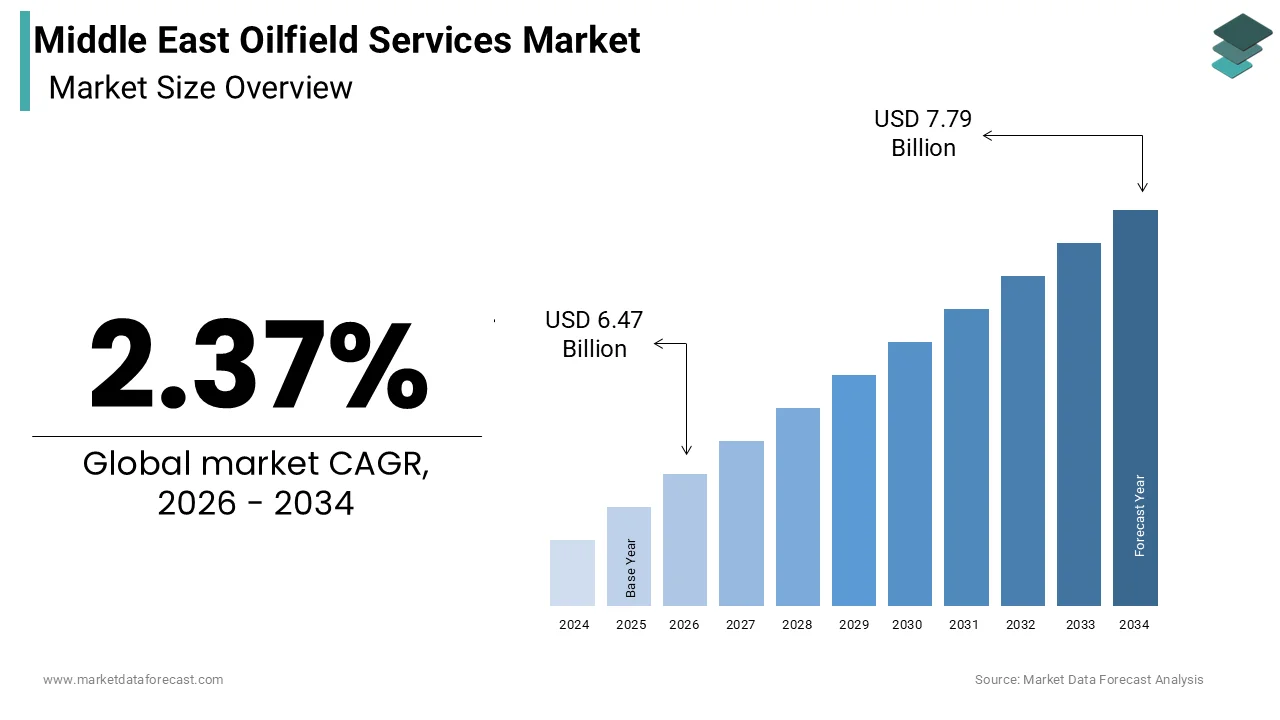
The Middle East oilfield services market encompasses a wide range of technical and operational support services essential for the exploration, drilling, production, and maintenance of oil and gas reservoirs. Countries like Saudi Arabia, the United Arab Emirates, Iraq, Iran, and Kuwait dominate the market due to their extensive oil and gas infrastructure and strategic investments in upstream and downstream activities. According to the Organization of Petroleum Exporting Countries (OPEC), the Middle East holds over 48% of the world’s proven crude oil reserves, making it a focal point for international and regional oilfield service providers. As per the International Energy Agency (IEA), Middle Eastern oil producers are increasingly adopting digital oilfield technologies and automation to optimize production and reduce environmental impact. This shift has led to a growing reliance on specialized service providers that offer integrated solutions, from real-time monitoring to predictive maintenance.
MARKET DRIVERS
Strategic Investments in Oilfield Modernization and Digitalization
The strategic push by national oil companies (NOCs) and international oil companies (IOCs) to modernize oilfield operations and integrate digital technologies is propelling the growth of the Middle East oilfield services market. In Saudi Arabia, for instance, Saudi Aramco has launched several digital transformation initiatives, including the deployment of artificial intelligence (AI) and Internet of Things (IoT) platforms to monitor well performance and optimize production. According to the King Abdullah Petroleum Studies and Research Center (KAPSARC), these initiatives have led to a 20% improvement in production efficiency and a significant reduction in maintenance costs. These modernization efforts have created a growing demand for specialized oilfield services such as data analytics, remote monitoring, and automated drilling solutions.
Expansion of Upstream Investment and Field Development Projects
The expansion of upstream investment and the initiation of large-scale field development projects are enhancing the growth of the Middle East oilfield services market. According to the Iraq Energy Institute, these projects require extensive drilling, well completion, and reservoir management services, creating significant opportunities for oilfield service providers. Saudi Arabia is also expanding its upstream operations, with Saudi Aramco investing heavily in the development of unconventional gas fields and offshore projects such as the Jafurah Basin and the Marjan Incremental Development. In addition, the UAE’s Abu Dhabi National Oil Company (ADNOC) has awarded multiple integrated exploration and production contracts to international firms, including TotalEnergies and Eni, to enhance field productivity.
MARKET RESTRAINTS
Political Instability and Geopolitical Tensions
The political instability and geopolitical tensions are limiting the growth of the Middle East oilfield services market. Conflicts, sanctions, and regional disputes have disrupted oil production and discouraged foreign investment in key oil-producing regions. In Iran, for example, U.S. sanctions have severely limited the ability of international oilfield service companies to operate, restricting access to advanced technology and capital. According to the Iranian Oil Ministry, foreign investment in the country’s upstream sector has declined by over 60% since 2018, which is impacting the development of major oilfields.
Volatility in Oil Prices and Budgetary Constraints
The oil price volatility is additionally limiting the growth of the Middle East oilfield services market. In 2020, the sharp decline in oil prices due to the pandemic and OPEC+ disagreements led to widespread budget cuts across the region. In the UAE, Abu Dhabi National Oil Company (ADNOC) postponed several offshore drilling projects in response to market uncertainty, as reported in its annual sustainability report. This sensitivity to oil price fluctuations makes the Middle East oilfield services market highly cyclical, which requires service providers to adopt flexible business models to navigate periods of economic uncertainty.
MARKET OPPORTUNITIES
Growth in Unconventional and Tight Oil Reservoir Development
The development of unconventional and tight oil reservoirs in Saudi Arabia, the UAE, and Iraq is creating new opportunities for the growth of the Middle East oilfield services market. In Saudi Arabia, the development of the Jafurah unconventional gas field represents a significant growth opportunity. According to Saudi Aramco, Jafurah contains over 200 trillion cubic feet of rich gas and will require extensive hydraulic fracturing, horizontal drilling, and well completion services. In the UAE, Abu Dhabi National Oil Company (ADNOC) is expanding its unconventional exploration activities in the Al Dhafra region. Iraq is also exploring tight oil formations in the western desert basins, where preliminary assessments suggest significant hydrocarbon potential.
Expansion of Integrated Oilfield Services and EPC Contracts
The increasing adoption of integrated oilfield services and Engineering, Procurement, and Construction (EPC) contracts presents a major opportunity for service providers in the Middle East. National oil companies are shifting from traditional service models to full-field integrated contracts that offer end-to-end solutions, from exploration to production. Abu Dhabi National Oil Company (ADNOC) has pioneered the integrated services model through its recent contracts with international firms such as Schlumberger, Baker Hughes, and Halliburton. Saudi Aramco has awarded several integrated EPC contracts for major upstream projects, including the Marjan and Berri Incremental Development programs. Iraq is also moving toward integrated service models, with the Ministry of Oil seeking long-term partnerships with international operators to develop large oilfields.
MARKET CHALLENGES
Environmental and Regulatory Pressures for Carbon Reduction
The increasing environmental and regulatory pressures as global energy policies shift toward carbon reduction and sustainability are likely to challenge the Middle East oilfield services market players. Governments and oil companies in the region are under growing scrutiny to align with international climate goals, which is leading to stricter emissions regulations and increased investment in carbon capture and green technologies. In Saudi Arabia, for instance, the Saudi Green Initiative has set ambitious targets to reduce carbon emissions from the oil and gas sector. According to the Saudi Ministry of Energy, the country plans to achieve net-zero emissions by 2060, which will require significant modifications to existing oilfield operations and the adoption of cleaner technologies. These environmental mandates are reshaping the oilfield services landscape, pushing service providers to adapt by offering low-carbon solutions such as electric drilling rigs, digital monitoring for emissions tracking, and methane detection technologies.
Workforce Localization and Skills Gap in the Oilfield Sector
The workforce localization and the skills gap in the oilfield sector are. Governments in the region are increasingly mandating the Saudization, Emiratization, and Arabization of the workforce, requiring oilfield service companies to hire and train local talent.
In Saudi Arabia, the government’s Nitaqat program enforces employment quotas for Saudi nationals in private sector jobs, including oilfield services. According to the Human Resources Development Fund (Hadaf), companies that fail to meet localization targets face restrictions on foreign worker visas and business expansion.
Similarly, in the UAE, the Emiratization policy requires oilfield service providers to employ a minimum percentage of Emirati nationals. The Abu Dhabi Department of Economic Development (ADDED) reports that Emiratization targets in the energy sector have increased by 15% over the past three years.
However, the region faces a shortage of technically skilled local workers in specialized oilfield disciplines such as directional drilling, well logging, and subsea engineering. According to the Gulf Research Center (GRC), expatriates still account for over 70% of the oilfield services workforce in the GCC.
This skills gap necessitates significant investment in training and development programs, which can be both time-consuming and costly for service providers. Balancing workforce localization mandates with operational efficiency remains a key challenge for the Middle East oilfield services market.
REPORT COVERAGE
| REPORT METRIC | DETAILS |
| Market Size Available | 2025 to 2034 |
| Base Year | 2025 |
| Forecast Period | 2026 to 2034 |
| CAGR | 2.37% |
| Segments Covered | By Service Type, Application, And Country |
| Various Analyses Covered | Regional and Country Level Analysis; Segment-Level Analysis; DROC; PESTLE Analysis; Porter’s Five Forces Analysis; Competitive Landscape; Analyst Overview of Investment Opportunities |
| Regions Covered | KSA, UAE, Israel, the Rest of the GCC countries, and the Rest of the Middle East |
| Market Leaders Profiled | Schlumberger Limited, Halliburton Company, Baker Hughes Company, Weatherford International plc, National Oilwell Varco (NOV), Arabian Drilling Company, NESR (National Energy Services Reunited Corp.), AlMansoori Specialized Engineering, ADES International Holding, National Petroleum Services (NPS), Saipem S.p.A., China Oilfield Services Limited (COSL), Petrofac Limited, KCA Deutag, Nabors Industries Ltd. |
SEGMENTAL ANALYSIS
By Application Insights
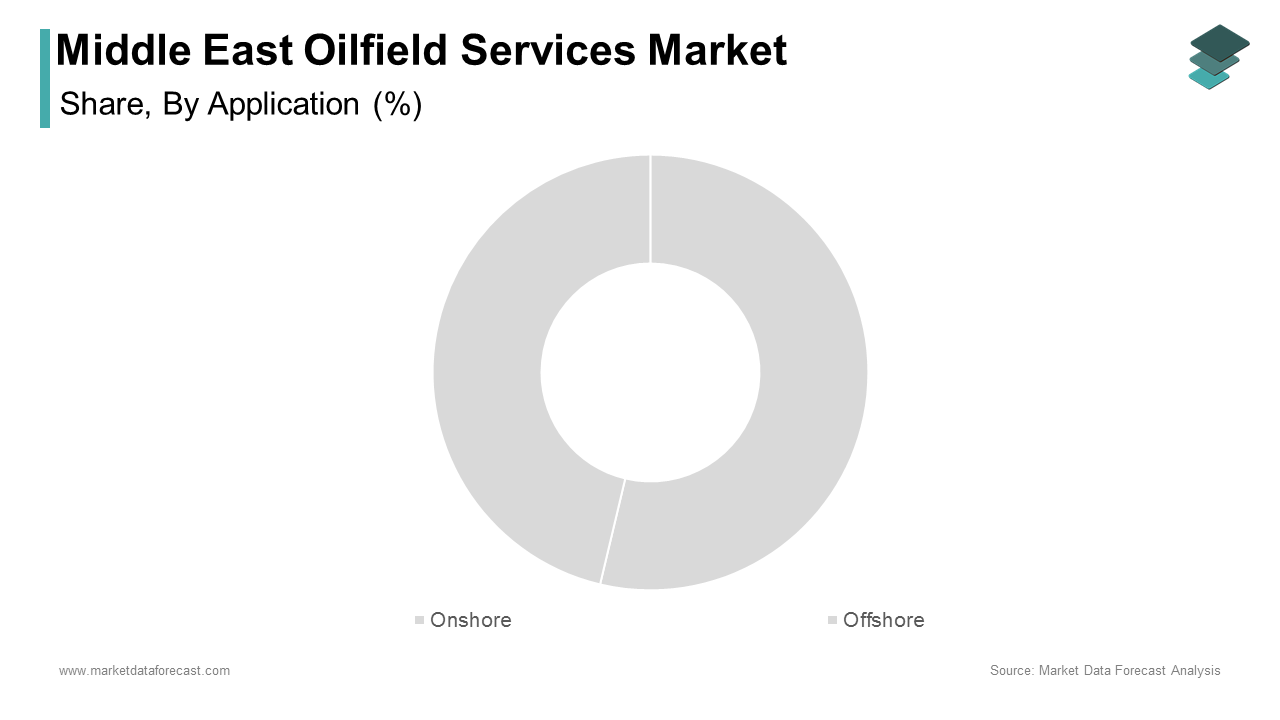
The onshore segment was accounted for in holding a dominant share of the Middle East oilfield services market in 2025, with the vast onshore oil and gas reserves in the region in Saudi Arabia, Iraq, and Kuwait, which continue to be the focal points for upstream investment and field development.
The maturity and accessibility of onshore fields, which allow for lower operational costs and faster project execution compared to offshore developments, are also propelling the growth of the segment. According to the Saudi Energy Ministry, over 70% of Saudi Arabia’s crude production comes from onshore fields, reinforcing the dominance of this segment. Additionally, the expansion of unconventional gas projects, such as Saudi Aramco’s Jafurah Basin development, is further boosting demand for onshore oilfield services.
The offshore segment is swiftly emerging with a CAGR of 7.6% from 2026 to 2034, with the increasing investment in deepwater and ultra-deepwater field developments, particularly in the UAE, Qatar, and Iran, where offshore reserves represent a significant portion of total hydrocarbon resources. Similarly, in Qatar, the North Field Expansion project, one of the world’s largest LNG developments, is driving demand for offshore engineering and construction services.
By Service Type Insights
The Drilling Services segment accounted in holding 32.2% of the Middle East oilfield services market in 2025, with the ongoing expansion of upstream projects by major national oil companies (NOCs) such as Saudi Aramco and ADNOC. In Saudi Arabia, for example, the Jafurah unconventional gas project requires extensive drilling services, with over 1,000 wells planned for development over the next decade, as reported by the Saudi Energy Ministry. Additionally, in the UAE, Abu Dhabi National Oil Company (ADNOC) has awarded long-term drilling contracts to international service providers such as Schlumberger and Baker Hughes to support the development of offshore fields like Umm Shaif and Nasr. According to ADNOC’s Strategic Outlook, drilling operations have increased by 18% annually over the past five years due to field expansion and enhanced recovery initiatives. Furthermore, the growing reliance on advanced drilling technologies, including automated drilling rigs and real-time monitoring systems, has contributed to the segment’s sustained growth. These innovations improve efficiency and reduce non-productive time, which is making drilling services an essential component of the region’s oilfield operations.
The drilling waste management services segment is expected to register a CAGR of 8.9% from 2026 to 2034. In Saudi Arabia, the government’s Saudi Green Initiative has mandated stricter waste disposal standards, compelling oilfield operators to adopt advanced drilling waste management solutions. According to the Saudi Environment Ministry, over 1.2 million tons of drilling waste were generated in 2023, necessitating specialized treatment and disposal services to comply with environmental guidelines. Moreover, the increasing complexity of unconventional drilling operations, particularly in shale and tight gas fields, has led to a rise in the volume and diversity of drilling waste generated. Service providers such as Halliburton and Tetra Technologies have expanded their presence in the region to meet this growing demand.
REGIONAL ANALYSIS
Saudi Arabia Oilfield Services Market Insights
Saudi Arabia was the top performer of the MEA oilfield services market by holding 35.4% of the share in 2025, with the strategic expansion of upstream projects under Saudi Aramco’s long-term development plan. The company is investing heavily in unconventional gas fields like Jafurah, offshore developments such as the Marjan and Berri Incremental projects, and enhanced oil recovery initiatives in mature fields like Ghawar. Additionally, the government’s Vision 2030 strategy includes a strong emphasis on energy sector modernization, leading to increased adoption of digital oilfield technologies, automation, and smart drilling solutions. Moreover, Saudi Aramco’s long-term integrated service contracts with global oilfield service providers such as Schlumberger, Halliburton, and Baker Hughes have ensured a steady flow of investment and technological expertise. These factors collectively reinforce Saudi Arabia’s dominant position in the MEA oilfield services market.
United Arab Emirates Oilfield Services Market Insights
United Arab Emirates was positioned second with 25.3% of the MEA oilfield services market share in 2025. The UAE has been a key player in the oilfield services sector due to its strategic investments in both onshore and offshore hydrocarbon developments and its push toward energy diversification. According to Abu Dhabi National Oil Company (ADNOC), the UAE’s upstream sector has seen a 15% increase in capital expenditure over the past three years, driven by major offshore projects such as the Umm Shaif, Nasr, and Ghasha developments. Additionally, ADNOC’s integrated service model, which includes long-term contracts with global firms like TotalEnergies, Eni, and BP, has strengthened the UAE’s position as a regional oilfield services hub. The UAE has also embraced digital transformation, with initiatives like the Smart Field program leveraging AI, IoT, and predictive analytics to enhance reservoir management.
Iraq Oilfield Services Market Insights
Iraq oilfield services market held 12.4% of the share in 2025. The Iraqi Ministry of Oil reports that the country’s proven oil reserves exceed 145 billion barrels, with major fields such as Rumaila, West Qurna, and Majnoon requiring continuous drilling, well completion, and production services. In 2023, Iraq produced over 4.2 million barrels per day, with plans to increase output to 8 million barrels per day by 2030. Additionally, infrastructure modernization efforts, including the expansion of water injection systems and enhanced oil recovery (EOR) techniques, are contributing to increased service demand.
LEADING PLAYERS IN THE MIDDLE EAST OILFIELD SERVICES MARKET
Schlumberger
Schlumberger is a global leader in oilfield services and holds a dominant position in the Middle East due to its comprehensive technology portfolio and long-standing partnerships with national oil companies. The company plays a key role in advancing digital oilfield solutions, drilling automation, and reservoir management in the region. Schlumberger's contributions to the global market include pioneering reservoir characterization, real-time data analytics, and integrated field development solutions that enhance operational efficiency and sustainability.
Halliburton
Halliburton has a strong presence in the Middle East, providing a wide range of services including drilling, completion, hydraulic fracturing, and production optimization. The company has been instrumental in supporting major upstream developments in Saudi Arabia, the UAE, and Iraq. Halliburton contributes to the global market by delivering innovative technologies in unconventional resource development, well construction, and subsurface analytics, positioning itself as a key enabler of field efficiency and cost optimization.
Baker Hughes
Baker Hughes maintains a significant footprint in the Middle East through strategic alliances with regional oil producers and a broad portfolio of oilfield equipment and services. The company supports the region’s energy transition by integrating digital technologies and offering low-emission drilling solutions. Globally, Baker Hughes contributes to advancing sustainable oilfield operations through automation, predictive maintenance, and integrated digital ecosystems that improve asset performance and reduce environmental impact.
TOP STRATEGIES USED BY KEY MARKET PARTICIPANTS
Expansion of Integrated Field Development Solutions
A major strategy employed by leading oilfield service providers in the Middle East is the delivery of integrated field development solutions that combine exploration, drilling, completion, and production services under long-term contracts. This approach enhances project efficiency and strengthens relationships with national oil companies seeking end-to-end service providers.
Digitalization and Adoption of Smart Oilfield Technologies
Oilfield service companies are investing heavily in digital transformation by deploying artificial intelligence, Internet of Things (IoT), and predictive analytics to improve drilling accuracy, reduce downtime, and optimize reservoir performance. These technologies are critical for meeting the Middle East’s growing demand for data-driven oilfield operations.
KEY MARKET PLAYERS AND COMPETITIVE OVERVIEW
Major Players of the Middle East Oilfield Services Market include Schlumberger Limited, Halliburton Company, Baker Hughes Company, Weatherford International plc, National Oilwell Varco (NOV), Arabian Drilling Company, NESR (National Energy Services Reunited Corp.), AlMansoori Specialized Engineering, ADES International Holding, National Petroleum Services (NPS), Saipem S.p.A., China Oilfield Services Limited (COSL), Petrofac Limited, KCA Deutag, Nabors Industries Ltd.
The Middle East oilfield services market is highly competitive, characterized by the presence of both global oilfield service giants and regional players striving to secure long-term contracts with national oil companies. The dominance of multinational firms such as Schlumberger, Halliburton, and Baker Hughes is reinforced by their technological expertise, financial strength, and extensive service portfolios. These companies have established deep partnerships with regional oil producers, enabling them to secure multi-year integrated service contracts that provide stable revenue streams.
At the same time, regional service providers and joint ventures between international and local firms are gaining traction by offering cost-effective solutions and aligning with nationalization policies. The competitive landscape is also being shaped by rapid technological advancements, with companies investing in digital oilfield solutions, automation, and sustainability-focused services to meet evolving industry demands.
Additionally, the push for workforce localization, environmental compliance, and cost efficiency is forcing service providers to continuously adapt their business models. Companies that can effectively balance innovation, regulatory alignment, and customer-centric service delivery are better positioned to maintain and expand their market presence in this dynamic and strategically vital region.
RECENT HAPPENINGS IN THE MARKET
- In January 2023, Schlumberger launched a new digital reservoir management platform in Saudi Arabia, designed to enhance subsurface data analytics and improve recovery rates in mature oilfields. This initiative was part of a broader digital transformation strategy aimed at strengthening Schlumberger’s long-term partnership with Saudi Aramco.
- In May 2023, Halliburton signed a multi-year integrated service contract with Abu Dhabi National Oil Company (ADNOC) to support offshore drilling and production activities in the Umm Shaif and Nasr fields. The agreement was intended to improve operational efficiency and reduce non-productive time through advanced drilling automation.
- In October 2023, Baker Hughes formed a joint venture with a local Emirati engineering firm to develop localized oilfield equipment manufacturing capabilities. The partnership was designed to align with the UAE’s Emiratization policies and enhance supply chain resilience for oilfield operations.
- In February 2025, Schlumberger announced the expansion of its drilling fluids facility in Kuwait, aimed at supporting increased upstream activity in the country. The upgraded facility was expected to improve service delivery speed and reduce logistics costs for local oilfield operations.
- In July 2025, Halliburton deployed a new fleet of electric fracturing units in Oman as part of a sustainability initiative to reduce carbon emissions from hydraulic fracturing operations. This move was aligned with the company’s global strategy to integrate low-emission technologies into oilfield services.
MARKET SEGMENTATION
This research report on the Middle East and Africa oilfield services market has been segmented and sub-segmented based on application, service type, and region.
By Application
- Onshore
- Offshore
By Service
- Drilling Services
- Drilling and Completion Fluids
- Formation Evaluation
- Completion and Production Services
- Drilling Waste Management Services
- Other Services
By Region
- KSA
- UAE
- Israel
- Rest of GCC countries
- Rest of the Middle East