- Product Description Description
- Table of Contents TOC
- List of Table & Figure LOT
- Get Free Sample PDF Sample PDF
Market Size, 2025
$17.82 BnMarket Estimate, 2026
$18.96 BnMarket Forecast, 2034
$31.14 BnCAGR, 2026–2034
6.4%Global Military Embedded System Market Size, Share, & Growth Analysis (2026–2034)
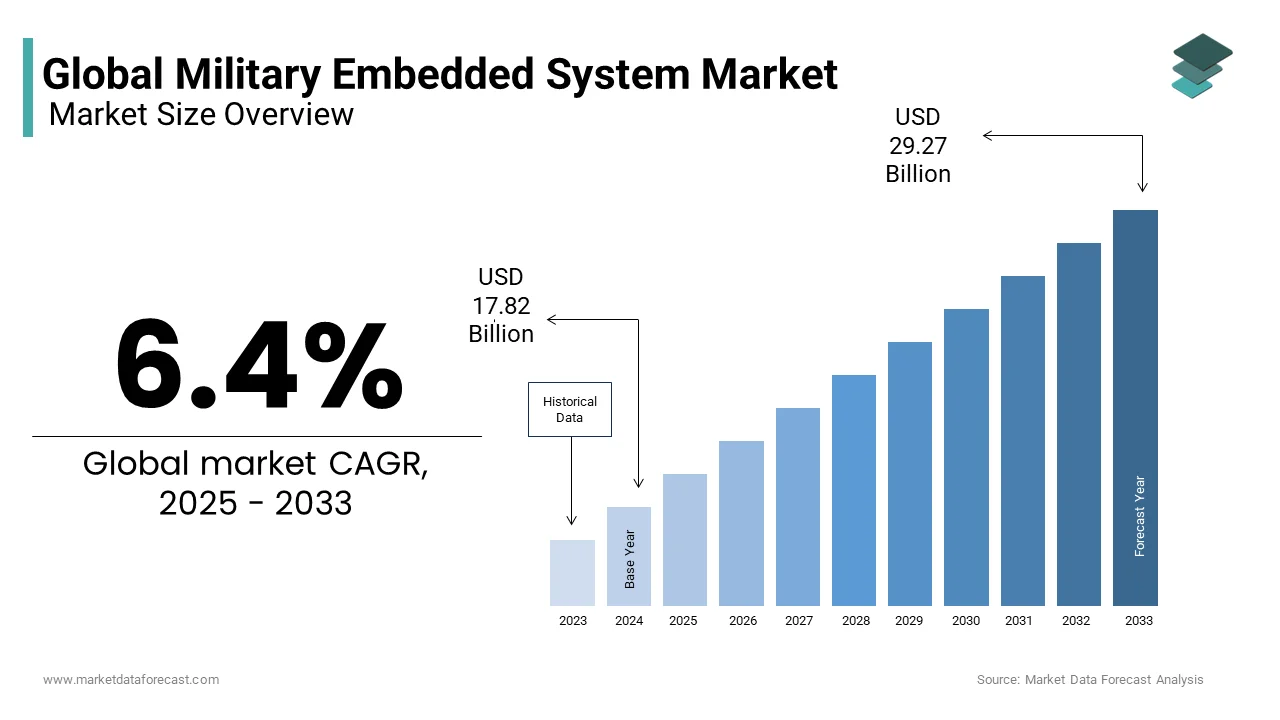
The global military embedded system market was valued at USD 17.82 billion in 2025, estimated at USD 18.96 billion in 2026, and is projected to reach USD 31.14 billion by 2034, registering a CAGR of 6.4% from 2026 to 2034. This comprehensive report covers platform types, applications, installation modes, product architectures, and regional frameworks worldwide.
- Market Valuation: USD 18.96B (2026) to USD 31.14B by 2034 (6.4% CAGR).
- Primary Growth Drivers: Escalating geopolitical tensions, heavy modernization of defense infrastructure, and the rapid integration of artificial intelligence and autonomous combat systems at the tactical edge.
- Key Market Restraints: Rigorous certification and qualification requirements (e.g., MIL-STD-810, DO-254) along with critical semiconductor supply chain vulnerabilities.
Global Military Embedded System Market Segment Metrics (2026–2034)
| Category | Leading Segment Focus | Segment Overview & Key Details | Fastest-Growing Segment Focus |
|---|---|---|---|
| By Platform | Airborne Platforms | Dominates market revenue due to extensive digital integration, avionics complexity, and long-term service lifecycles in tactical aircraft. | Unmanned Systems (Highest CAGR at 9.8%) driven by swarm intelligence and autonomous ISR missions. |
| By Application | Communication & Navigation | Holds the majority market share to ensure secure, reliable, and jam-resistant connectivity in all operational domains. | Electronic Warfare (Fastest CAGR at 10.2%) driven by advanced signal processing and real-time threat neutralization. |
| By Installation | New Installations | Accounts for foundational revenue through the large-scale procurement of next-generation digitally native defense platforms. | Upgradations (Fastest CAGR at 8.5%) driven by budget constraints and the necessity of extending legacy asset lifespans. |
| By Product | Open VPX | Supremacy supported by high bandwidth scalability, modular ruggedness, and robust sensor-fusion data throughput. | Compact PCI Serial (Fastest CAGR at 7.9%) due to space-constrained requirements and COTS compatibility. |
Major Market Players & Market Structure
Market Structure: Highly specialized defense computing environment dominated by tier-one electronics and aerospace primes standardizing modular open systems approaches (MOSA).
Key Companies: SMART Embedded Computing, Curtiss-Wright Corporation, Thales Group, Kontron AG, Advantech Co., Ltd., General Micro Systems, General Dynamics Corporation, Eurotech, Xilinx, and Mercury Systems.
 Download Free Sample Report
Global Military Embedded System Market Size
The global military embedded system market size was valued at USD 17.82 billion in 2025 and is anticipated to reach a valuation of USD 18.96 billion in 2026 and USD 31.14 billion by 2034, growing at a CAGR of 6.4%, from 2026 to 2034.
Introduction to the Military Embedded System Market
A military embedded system is a specialized combination of computer hardware and software designed to perform dedicated, mission-critical tasks within larger defense platforms. The market comprises specialized computing hardware and software integrated into defense platforms to perform dedicated control monitoring and data processing functions. These systems are engineered to withstand extreme environmental conditions including high vibration temperature fluctuations and electromagnetic interference while ensuring real time operational reliability. They serve as the computational backbone for modern warfare enabling capabilities such as autonomous navigation secure communication radar signal processing and weapon guidance. According to the Stockholm International Peace Research Institute (SIPRI), global military expenditure reached $2.44 trillion USD in 2023, representing a 6.8% increase that fuels investments in modern electronic and defense infrastructure. The shift toward network centric warfare requires robust embedded solutions that can process vast amounts of sensor data at the edge reducing latency and enhancing decision making speed. As per the United States Department of Defense modernization priorities emphasize the integration of artificial intelligence and machine learning into tactical edge devices necessitating high performance embedded processors. Furthermore, the European Defence Agency (EDA) actively harmonizes open standards and interoperability benchmarks through the European Defence Standardisation (EDSTAR) index to unify collaborative defense systems across allied member states. This strategic focus on digital transformation and technological superiority drives the demand for ruggedized high reliability embedded components across land sea air and space domains establishing the sector as a critical enabler of national security and operational effectiveness in contemporary geopolitical landscapes.
MARKET DRIVERS
Escalating Geopolitical Tensions and Modernization of Defense Infrastructure
Rising geopolitical instability and territorial disputes globally have compelled nations to accelerate the modernization of their defense infrastructure with a heavy emphasis on digital and electronic capabilities, which drives the growth of the military embedded system market. The conflict in Eastern Europe and tensions in the Indo Pacific region have demonstrated the critical importance of superior command and control systems which rely heavily on advanced embedded computing. In addition, the International Institute for Strategic Studies (IISS) reveals that European NATO members boosted their defense budgets by 19% in 2023, driving the rapid replenishment of stockpiles and widespread modern equipment overhauls. This surge in expenditure is directed toward acquiring next generation fighter jets unmanned aerial vehicles and naval vessels that require sophisticated embedded systems for mission critical operations. Official guidelines from the North Atlantic Treaty Organization (NATO) outline that member nations have committed to escalating defense spending targets up to 5% of their national GDP to accelerate emerging technology upgrades and systemic deterrence. The need for real time situational awareness and precision strike capabilities drives the integration of high performance processors and field programmable gate arrays into military hardware. Furthermore the proliferation of asymmetric threats necessitates responsive and adaptable electronic systems that can be updated rapidly to counter emerging dangers. This strategic imperative ensures sustained demand for ruggedized embedded solutions that offer high reliability and processing power in hostile environments thereby acting as a primary catalyst for market expansion across major defense economies worldwide.
Integration of Artificial Intelligence and Autonomous Systems
The rapid adoption of artificial intelligence and autonomous technologies in military applications is a powerful factor boosting the expansion of the military embedded system market. This is because these functionalities require substantial computational power at the tactical edge. Modern unmanned systems including drones ground robots and underwater vehicles depend on embedded processors to execute complex algorithms for navigation object recognition and decision making without human intervention. These systems must process sensor data from lidar cameras and radar in real time to operate effectively in dynamic combat scenarios. As per sources, the demand for AI capable embedded chips in defense applications is growing at a double digit rate driven by the need for faster data processing and reduced latency. The ability to perform machine learning tasks locally on the device enhances security by minimizing data transmission and reduces reliance on cloud connectivity which may be compromised in contested environments. Furthermore the U.S. Department of Defense Chief Digital and Artificial Intelligence Office (CDAO) prioritizes tactical edge computing to achieve operational advantages and reliable communication inside highly distributed warfare frameworks. This technological shift toward intelligent autonomous platforms necessitates advanced embedded systems that can handle intensive computational loads while maintaining strict size weight and power constraints thereby propelling market growth significantly.
MARKET RESTRAINTS
Stringent Certification and Qualification Requirements
The rigorous certification and qualification processes mandated for military electronics are a significant restraint to the military embedded system market. This extends development timelines and increases costs for manufacturers. Military embedded systems must comply with strict standards such as MIL STD 810 for environmental engineering considerations and DO 254 for design assurance guidance which require extensive testing and documentation. Avionics and defense systems verification cycles indicate that complex, safety-critical military embedded modules routinely require 18 to 36 months to clear comprehensive airworthiness and defensive compliance checks. This prolonged timeline delays product launches and reduces the agility of suppliers in responding to rapidly evolving technological trends. Furthermore, the cost of compliance is substantial with testing and validation expenses often accounting for 30 to 40 percent of the total development budget. As per data from defense contractors small and medium sized enterprises often struggle to meet these financial and regulatory burdens limiting competition and innovation in the sector. The need for long term supply chain stability also complicates matters as military programs require components to be available for decades forcing manufacturers to maintain obsolete production lines. This rigidity contrasts sharply with the fast paced commercial electronics industry where rapid iteration is the norm. Hence, the high barrier to entry and slow pace of approval discourage new entrants and constrain the overall growth potential of the military embedded system market despite strong demand.
Supply Chain Vulnerabilities and Component Shortages
Global supply chain disruptions and shortages of critical semiconductor components also hinder the expansion of the military embedded system market. This affects production schedules and program costs. The dependence on a limited number of suppliers for specialized radiation hardened and high reliability chips creates bottlenecks when demand surges or production facilities face interruptions. According to the Semiconductor Industry Association lead times for certain military grade microcontrollers extended to over 50 weeks during recent global shortages impacting the delivery of key defense platforms. This scarcity forces original equipment manufacturers to redesign systems or seek alternative components which requires requalification and adds significant expense. As per reports from the US Government Accountability Office supply chain risks are a top concern for the Department of Defense with many critical components sourced from foreign entities that may pose security risks. The geopolitical tension further exacerbates these issues as export controls and trade restrictions limit access to advanced manufacturing technologies. Furthermore the lack of domestic production capacity for specialized semiconductors in many Western nations increases vulnerability to external shocks. A study indicates that inventory hoarding by defense primes has led to uneven distribution of components leaving smaller suppliers unable to fulfill contracts. These supply chain instabilities undermine the reliability of defense procurement programs and hinder the timely deployment of new capabilities thereby restraining market growth and operational readiness.
MARKET OPPORTUNITIES
Expansion of Unmanned Aerial and Ground Vehicles
The proliferating use of unmanned aerial vehicles and unmanned ground vehicles in modern warfare is a key growth area for the military embedded system market. These platforms are relying entirely on embedded computing for operation. The shift toward swarm tactics and distributed operations requires thousands of small inexpensive drones equipped with capable embedded processors for coordination and autonomous behavior. Studies project that the expanding military unmanned aerial vehicle sector will exceed $20 billion in value over the next few years, driving a parallel surge in demand for lightweight, low-power rugged embedded processing modules. These systems must balance high processing power with minimal weight and power consumption to maximize flight time and payload capacity. As per sources, newer generations of tactical drones require embedded systems that can support real time video analytics and secure data links simultaneously. The modular nature of unmanned platforms allows for rapid integration of new sensors and weapons which in turn drives demand for flexible and scalable embedded architectures. Furthermore the development of loyal wingman concepts where manned aircraft operate alongside autonomous drones necessitates robust inter platform communication systems powered by advanced embedded networks. This trend toward automation and decentralization creates a vast addressable market for suppliers who can provide ruggedized high performance computing solutions tailored to the unique constraints of unmanned systems thereby offering significant growth potential.
Adoption of Open Standards and Modular Architectures
The transition toward open standards and modular architectures in defense electronics offers a significant opportunity for participants in the military embedded system market. This helps to facilitate interoperability and reduce lifecycle costs. Initiatives such as the Sensor Open Systems Architecture and the Future Airborne Capability Environment promote the use of standardized interfaces and form factors allowing for easier integration of third party components. Acquisition case studies published by the United States Department of Defense (DoD) demonstrate that implementing a Modular Open Systems Approach (MOSA) reduces integration timelines and life-cycle development overhead by up to 30% compared to legacy proprietary designs. This shift enables military branches to mix and match best of breed components from different vendors fostering competition and innovation. As per the VITA standards organization the adoption of open modular systems allows for quicker technology refresh cycles ensuring that military platforms remain current with commercial advancements. Furthermore the ability to upgrade individual modules rather than entire systems extends the service life of expensive military assets providing better return on investment. This approach also simplifies maintenance and repair logistics as standardized parts are more readily available and interchangeable. The push for joint all domain command and control capabilities further reinforces the need for open architectures that can seamlessly connect land sea air and space assets. Thus, suppliers who align their product portfolios with these open standards are well positioned to capture a larger share of future defense contracts and drive market expansion.
MARKET CHALLENGES
Cybersecurity Threats and Electronic Warfare Risks
The increasing sophistication of cyber-attacks and electronic warfare tactics remains a serious challenge to the military embedded system market. These systems are becoming prime targets for adversarial exploitation. Embedded devices connected to military networks are vulnerable to malware injection data interception and remote hijacking which can compromise mission integrity and national security. Manufacturers must integrate robust encryption secure boot mechanisms and tamper resistant features into their designs which adds complexity and cost to the development process. As per research, traditional embedded systems were not designed with security as a primary concern making retrofits difficult and expensive. The rise of software defined radios and networked sensors further expands the attack surface requiring continuous monitoring and patching capabilities. Furthermore electronic warfare techniques such as jamming and spoofing can disrupt the functionality of embedded sensors and communication modules rendering them ineffective in combat. The challenge lies in balancing high performance with stringent security requirements without compromising system reliability or latency. This constant arms race between attackers and defenders demands ongoing investment in secure by design principles and rigorous testing which strains resources and slows down deployment timelines for new embedded solutions.
Rapid Obsolescence of Commercial Off The Shelf Components
The rapid pace of technological advancement in the commercial electronics sector leads to frequent obsolescence of components used in military embedded systems, which in turn impedes the expansion of the global market. This creates significant lifecycle management challenges. Military platforms often have service lives exceeding 30 years while commercial semiconductor products may be discontinued within three to five years. When a critical component becomes unavailable manufacturers must engage in costly last time buy agreements or undertake expensive redesigns to qualify alternative parts. This mismatch between commercial product cycles and military longevity requirements disrupts supply chains and increases the risk of system failures. As per studies, the lack of long term commitment from commercial chip makers to military grade variants forces defense primes to maintain large inventories of obsolete parts tying up capital. Furthermore the process of qualifying replacement components involves extensive testing and recertification which can take years and delay operational readiness. The reliance on commercial off the shelf technology for cost efficiency thus introduces a paradox where short term savings lead to long term sustainability issues. Addressing this challenge requires innovative strategies such as component emulation and digital twins but these solutions add further complexity and cost to the military embedded system ecosystem hindering efficient market operations.
REPORT COVERAGE
| REPORT METRIC | DETAILS |
| Market Size Available | 2025 to 2034 |
| Base Year | 2025 |
| Forecast Period | 2026 to 2034 |
| CAGR | 6.4% |
| Segments Covered | By Platform, Application, Server Architecture, Installation, Component, Product, and Region |
| Various Analyses Covered | Global, Regional & Country Level Analysis, Segment-Level Analysis, DROC, PESTLE Analysis, Porter’s Five Forces Analysis, Competitive Landscape, Analyst Overview of Investment Opportunities |
| Regions Covered | North America, Europe, APAC, Latin America, Middle East & Africa |
| Market Leaders Profiled | SMART Embedded Computing, Curtiss-Wright Corporation, Thales Group, KONTRON AG, Advantech Co., Ltd, General Micro Systems, General Dynamics Corporation, EUROTECH, Xili,nx, and Mercury Systems |
SEGMENTAL ANALYSIS
By Platform Insights
The airborne platforms segment led the military embedded system market and captured a significant share in 2025. Moreover, the high complexity and extensive electronic integration required for modern aircraft, helicopters, and unmanned aerial vehicles are the key factors attributed to the leading position of this segment. The primary driver for this dominance is the critical need for advanced avionics flight control systems and mission computers that ensure operational superiority in contested airspace. According to the US Department of Defense the F 35 Lightning II program alone involves billions of dollars in embedded software and hardware development highlighting the immense value placed on airborne computing capabilities. Modern fighter jets contain millions of lines of code and hundreds of embedded processors that manage radar electronic warfare and weapon systems simultaneously. Sources indicate that because of the rapid transition toward software-defined military aircraft, electronic assemblies and embedded software configurations now account for more than 40% of total structural aircraft system value. The requirement for real time data processing at high speeds necessitates ruggedized high performance embedded modules that can withstand extreme g forces and temperature variations. Furthermore the proliferation of fifth generation fighters globally drives continuous demand for upgraded embedded architectures that support sensor fusion and network centric warfare. The longevity of aircraft platforms which often remain in service for 30 to 40 years ensures a sustained market for both new installations and mid life upgrades. This combination of high unit cost technological complexity and long service life solidifies the position of airborne platforms as the largest revenue generator in the military embedded system sector.
Apart from this, the unmanned systems segment is predicted to witness the highest CAGR of 9.8% from 2026 to 2034 due to the strategic shift toward autonomous operations and risk mitigation for personnel. The rapid expansion is also fueled by the increasing deployment of drones for intelligence surveillance reconnaissance and strike missions across land sea and air domains. These systems require sophisticated embedded processors to handle autonomous navigation obstacle avoidance and real time video analytics without human intervention. Policy assessments published by the Center for a New American Security (CNAS) emphasize that the geopolitical shift toward swarm intelligence and distributed operations requires rapidly scalable, low-power embedded computing processing inside modern autonomous military architectures. The modular nature of unmanned vehicles allows for rapid integration of new sensors and payloads which drives demand for flexible open architecture embedded systems. Furthermore the lower cost of unmanned platforms compared to manned aircraft enables higher procurement volumes amplifying the market impact. Industry analysis indicates that small tactical drones alone account for a significant portion of new embedded system orders as militaries seek affordable attritable assets. This trend toward automation and decentralization positions unmanned systems as the primary engine of growth in the military embedded market.
By Application Insights
In 2025, the communication and navigation applications segment held the majority share of the military embedded system market because of the fundamental requirement for secure reliable connectivity and precise positioning in all military operations. The main reason behind this dominance is the transition toward joint all domain command and control which relies on seamless data exchange between disparate platforms and services. According to the North Atlantic Treaty Organization interoperability standards mandate robust embedded communication modules that can operate in contested electromagnetic environments ensuring mission continuity. Modern military radios and satellite terminals utilize advanced embedded processors to implement encryption frequency hopping and anti jamming techniques. Official modernization strategies from the United States Department of Defense (DoD) show that upgrading tactical networks, cloud edge-enablement, and secure communication links remains an essential top priority for contemporary U.S. Army IT operations. The integration of Global Positioning System alternatives such as inertial navigation systems requires high precision embedded sensors and algorithms to maintain accuracy when GPS signals are denied. Furthermore the rise of software defined radios allows for flexible waveform updates via embedded software enhancing adaptability to emerging threats. Industry reports indicate that every major defense platform from tanks to submarines requires multiple redundant communication and navigation embedded units. This ubiquitous demand across all branches of the military ensures that communication and navigation remain the largest application segment providing a stable and substantial revenue base for embedded system manufacturers globally.
However, the electronic warfare segment is estimated to register the fastest CAGR of 10.2% during the forecast period owing to the increasing sophistication of radar and communication threats in modern conflict zones. The surge in demand is attributed to the need for advanced signal processing capabilities to detect identify and counter adversarial electronic attacks in real time. According to the Congressional Research Service electronic warfare capabilities are considered a top priority for near peer competitors prompting significant investment in next generation jamming and protection systems. Modern electronic warfare suites rely heavily on high performance embedded field programmable gate arrays and digital signal processors to analyze vast spectra of radio frequencies instantly. As per research, the complexity of electronic warfare missions has increased exponentially requiring embedded systems that can execute machine learning algorithms for threat classification at the edge. The proliferation of low probability of intercept radars and spread spectrum communications necessitates more sensitive and agile embedded receivers. Furthermore the integration of cyber and electronic warfare functions creates a new class of hybrid systems that demand powerful embedded computing resources. Data from market studies shows that electronic warfare payloads now constitute a larger portion of aircraft and naval vessel budgets than in previous decades. This strategic emphasis on electromagnetic spectrum dominance ensures that electronic warfare remains the most dynamic and rapidly expanding application area for military embedded systems.
By Installation Insights
The new installation segment dominated the military embedded system market and accounted for a substantial share in 2025. This dominance of the segment was driven by the procurement of next generation platforms that incorporate state of the art digital architectures from the outset. One of the major drivers of this dominance is the global modernization of armed forces which involves replacing legacy equipment with advanced systems capable of network centric operations. These new platforms are designed with open architecture standards that facilitate the integration of high performance embedded modules for computing sensing and control. As per sources, new production lines for fighters like the F 35 and FC 31 require thousands of embedded units per vehicle to support advanced avionics and mission systems. The complexity of modern warfare demands inherent digital connectivity which is best achieved through purpose built new installations rather than retrofits. Furthermore government contracts for new fleet acquisitions often include long term support agreements that ensure steady demand for embedded components during the initial production phases. Industry forecasts indicate that new platform deliveries will continue to rise as nations seek to counter emerging threats with technologically superior assets. This consistent flow of new procurement programs establishes new installation as the foundational pillar of the military embedded system market.
On the other hand, the Upgradation segment is anticipated to witness the fastest CAGR of 8.5% from 2026 to 2034. The need to extend the service life of existing military assets and integrate new capabilities into legacy platforms is propelling the swift growth of this segment. The rapid growth is also fueled by budget constraints that make replacing entire fleets prohibitively expensive leading militaries to opt for mid life upgrades instead. In addition, the U.S. Government Accountability Office (GAO) show that operating and sustaining weapon systems accounts for roughly 70% of their total life-cycle costs, making retrofits and mid-life electronics upgrades a financial necessity to extend the utility of defense assets. Embedded system upgrades allow older aircraft ships and vehicles to gain new functionalities such as improved radar processing secure communications and artificial intelligence enabled decision support. As per studies, retrofitting legacy systems with modern embedded modules is significantly cheaper and faster than developing new platforms from scratch. The modular nature of open standards like Open VPX facilitates easier integration of new computing boards into existing chassis reducing downtime and technical risk. Furthermore the rapid obsolescence of commercial electronics used in military systems necessitates frequent replacements to maintain operational readiness. Data from supply chain analysts shows a rising trend in last time buy orders and component replacements for aging platforms. This cycle of continuous improvement and technology refresh ensures that the upgradation segment grows at a faster pace than new installations in mature markets with large existing inventories.
By Product Insights
The open VPX segment was the largest in the military embedded system market and occupied a commanding share in 2025. This supremacy of the segment was supported by its high bandwidth scalability and suitability for rugged harsh environments required by modern defense applications. The main factor driving this position is the adoption of Open VPX as the standard for high performance computing in airborne and ground vehicles where data throughput is critical. According to the VITA standards organization Open VPX supports data rates exceeding 100 gigabits per second making it ideal for sensor fusion and real time signal processing tasks. The modular design allows for easy integration of various processor memory and input output modules enabling customized solutions for specific mission requirements. Moreover, the standard also supports advanced cooling techniques such as conduction cooling which is essential for sealed enclosures in extreme temperatures. Furthermore the broad ecosystem of suppliers offering compatible boards and chassis reduces supply chain risks and encourages competition. Industry analysis indicates that Open VPX is increasingly replacing older standards like VME Bus in new designs due to its superior performance and future proofing capabilities. This widespread acceptance among prime contractors and system integrators solidifies Open VPX as the dominant product type in the military embedded sector.
But the compact PCI Serial segment is likely to experience the fastest CAGR of 7.9% over the forecast period. This quick surge of the segment is driven by its robustness and compatibility with commercial off the shelf technologies. The swift expansion is further attributed to the need for reliable high speed serial connections in space constrained military applications such as unmanned vehicles and portable radios. According to research, Compact PCI Serial offers improved signal integrity and higher data transfer rates compared to parallel bus architectures making it suitable for modern high bandwidth sensors. The standard leverages widely available commercial components which reduces development costs and lead times for military suppliers. As per sources, the adoption of Compact PCI Serial has increased significantly in naval and ground applications where vibration resistance and compact form factors are paramount. The ability to mix and match modules from different vendors enhances flexibility and reduces vendor lock in. Furthermore the standard supports hot swapping allowing for maintenance and upgrades without powering down the system which is crucial for continuous operations. Industry reports highlight that many legacy VME and Compact PCI systems are being migrated to Compact PCI Serial to benefit from newer processor technologies. This transition combined with the growing demand for ruggedized industrial grade components in defense applications drives the accelerated growth of the Compact PCI Serial segment.
REGIONAL ANALYSIS
North America Market Analysis
North America was the top performer in the global military embedded system market and accounted for a substantial share in 2025. This prominence of the regional market was fuelled by substantial defense budgets and a strong domestic industrial base. The region benefits from the presence of major prime contractors and technology providers who drive innovation in embedded computing. According to data from the Stockholm International Peace Research Institute (SIPRI), the United States accounts for approximately 40% of global military spending, sustaining an expansive market for high-tier electronic and defense infrastructure. The focus on modernizing legacy platforms and developing next generation weapons systems creates a robust market for high performance embedded modules. As per the Aerospace Industries Association US defense contractors invest heavily in research and development to maintain technological superiority. The implementation of open architecture standards such as MOSA further stimulates competition and innovation among suppliers. Furthermore strong government initiatives to secure supply chains and promote domestic semiconductor manufacturing enhance market stability. The prevalence of large scale programs like the Joint Strike Fighter and Columbia Class submarine ensures long term demand for specialized embedded solutions. This combination of financial resources technological leadership and strategic priorities positions North America as the undisputed leader in the military embedded system market.
Europe Market Analysis
Europe followed closely behind in the military embedded system market and captured a significant share in 2025. This growth of the European market was supported by collaborative defense initiatives and increasing national security concerns. The region is characterized by a strong emphasis on interoperability and standardization among NATO member states. Countries like Germany France and the United Kingdom are investing heavily in next generation fighter programs such as the FCAS which require advanced embedded computing capabilities. As per industry reports the European market is shifting toward open standards to reduce dependency on non European suppliers and enhance sovereign capabilities. The presence of specialized embedded system manufacturers in countries like Sweden and Italy contributes to a diverse and competitive supply chain. Furthermore regulatory frameworks promoting cybersecurity and data protection influence the design and deployment of military embedded systems. The ongoing modernization of naval and land forces in response to regional geopolitical tensions further drives demand. This strategic focus on collaboration and sovereignty ensures steady growth in the European military embedded system market.
Asia Pacific Market Analysis
Asia Pacific is the fastest growing region in the military embedded system market due to rising geopolitical tensions and increasing defense expenditures among key nations. Countries such as China India Japan and South Korea are aggressively modernizing their armed forces with a focus on indigenous technology development. In addition, the International Institute for Strategic Studies (IISS) shows that Asia-Pacific defense spending continues an uninterrupted multi-year upward trajectory, driven primarily by localized geopolitical tensions and widespread modernization initiatives. The proliferation of unmanned systems and advanced naval vessels in the region creates substantial demand for ruggedized embedded controllers. As per data from local defense ministries governments are prioritizing self reliance in critical technologies including semiconductors and embedded software. The expansion of domestic aerospace and defense industries in China and India reduces reliance on imports and stimulates local innovation. Furthermore regional conflicts and territorial disputes drive the need for real time surveillance and communication systems. Industry analysis indicates that Asia Pacific will account for a growing share of global military embedded system procurement in the coming years. This dynamic environment characterized by rapid modernization and strategic competition positions Asia Pacific as a key growth engine for the market.
Latin America Market Analysis
Latin America is an evolving player in the military embedded system market owing to internal security challenges and gradual modernization efforts. The regional market is known for limited defense budgets compared to North America and Europe, but shows increasing interest in cost effective solutions. Research shows that countries like Brazil and Chile are directing capital toward modernizing their naval fleets and air capabilities to counter illicit trafficking and reinforce regional maritime border security. The demand for embedded systems is primarily focused on communication navigation and surveillance applications for patrol vessels and aircraft. As per research, local manufacturers are partnering with international suppliers to provide tailored solutions that meet specific operational needs. The political instability in some countries affects procurement timelines but overall the trend toward professionalization of armed forces supports steady demand. Furthermore participation in international peacekeeping missions requires interoperable communication systems driving adoption of standardized embedded modules. While the market size remains small compared to other regions the potential for growth exists as economic conditions improve and security priorities evolve. This gradual modernization process creates opportunities for suppliers offering affordable and reliable embedded technologies.
Middle East and Africa Market Analysis
The Middle East and Africa region is expected to grow notably in the military embedded system market from 2026 to 2034 due to high spending in Gulf states and emerging needs in African nations. Countries like Saudi Arabia and the United Arab Emirates invest heavily in advanced defense systems to protect critical infrastructure and maintain regional influence. The focus is on air defense missile systems and unmanned vehicles which require high performance computing modules. In Africa defense spending is generally lower but growing in response to insurgency and terrorism threats. As per sources, countries like Nigeria and Kenya are acquiring surveillance and communication systems to enhance border security. The lack of domestic manufacturing capacity means most embedded systems are imported creating dependence on foreign suppliers. However initiatives to develop local defense industries in countries like Egypt and South Africa are beginning to change this dynamic. The diverse security landscape and varying economic conditions create a complex but potentially rewarding market for military embedded system providers.
COMPETITIVE LANDSCAPE
The competition in the military embedded system market is characterized by intense rivalry among specialized technology providers and large diversified defense contractors striving for technological leadership. Major players compete on the basis of performance reliability compliance with military standards and ability to support open architecture initiatives. The market sees frequent launches of advanced processing modules featuring higher bandwidth lower power consumption and enhanced security features for contested environments. Companies are increasingly focusing on integrating artificial intelligence accelerators into embedded systems to support autonomous operations and real time decision making. Strategic acquisitions and collaborations are common as firms seek to expand their product portfolios and strengthen supply chain resilience. Regulatory compliance and cybersecurity certifications serve as critical differentiators since defense customers prioritize trusted and secure components. The shift toward modular open systems approach encourages innovation but also increases pressure on manufacturers to maintain compatibility with diverse platforms. Price competition is less significant than technical capability and long term support reliability in this sector. The entry of commercial technology firms into the defense space adds further complexity as they bring rapid innovation cycles. This dynamic environment drives continuous improvement in ruggedization and processing power benefiting military operators through more capable and resilient systems.
KEY MARKET PLAYERS
A few of the market players in the global military embedded system market include
- SMART Embedded Computing
- Curtiss-Wright Corporation
- Thales Group
- KONTRON AG
- Advantech Co., Ltd.
- General Micro Systems
- General Dynamics Corporation
- EUROTECH
- Xili,nx,
- Mercury Systems
Top Players In The Market
Curtiss Wright Corporation
Curtiss Wright Corporation is a leading provider of highly engineered critical components and embedded computing solutions for defense applications. The company specializes in ruggedized open architecture systems including Open VPX and Compact PCI Serial boards that meet stringent military standards. Curtiss Wright recently expanded its product portfolio by introducing next generation processors with enhanced artificial intelligence capabilities for edge computing in unmanned systems. The firm actively collaborates with prime contractors to develop customized solutions for airborne and ground platforms ensuring high reliability in harsh environments. By focusing on rapid prototyping and modular design the company strengthens its position as a trusted supplier of mission critical embedded technologies for global defense forces.
Mercury Systems Inc
Mercury Systems Inc is a prominent player in the military embedded market known for its high performance processing modules and sensor fusion technologies. The company provides advanced signal processing solutions using field programmable gate arrays and graphics processing units for electronic warfare and radar applications. Mercury Systems recently launched new ruggedized servers designed for artificial intelligence workloads at the tactical edge supporting real time data analysis. The firm emphasizes secure supply chain practices and domestic manufacturing to meet government requirements for trusted microelectronics. Through continuous innovation in high bandwidth interconnects and cooling technologies Mercury Systems enhances operational readiness for modern military platforms worldwide.
Kontron AG
Kontron AG is a global leader in embedded computing technology offering a wide range of ruggedized boards and systems for military and aerospace sectors. The company focuses on open standards such as Open VPX and COM Express to ensure interoperability and long term availability of components. Kontron recently introduced new conduction cooled modules specifically designed for extreme temperature environments in naval and airborne applications. The firm invests heavily in research and development to integrate latest commercial processor technologies into military grade form factors. By providing comprehensive lifecycle management and customization services Kontron supports defense customers in maintaining technological superiority and operational efficiency across diverse mission profiles.
Top Strategies Used By Key Market Participants
Key players in the military embedded system market primarily focus on adopting open architecture standards to ensure interoperability and reduce integration costs for defense programs. Companies invest significantly in research and development to create ruggedized high performance computing modules that support artificial intelligence and machine learning at the tactical edge. Strategic partnerships with semiconductor manufacturers help secure supply chains for critical components and mitigate obsolescence risks. Manufacturers also emphasize domestic production capabilities to comply with national security regulations and build trust with government clients. Additionally firms offer comprehensive lifecycle management services including long term support and customization to address the unique longevity requirements of military platforms. These strategies enable participants to deliver reliable secure and scalable solutions that meet evolving defense needs effectively.
MARKET SEGMENTATION
This research report on the global military embedded system market has been segmented and sub-segmented based on component, product type, platform, and region.
By Platform:
- Land
- Airborne
- Naval
- Unmanned
- Space
By Application:
- Intelligence, Surveillance, & Reconnaissance (ISR)
- Electronic Warfare
- Communication & Navigation
- Command & Control
- Weapon & Fire Control
- Wearables
- Others
By Server Architecture:
- Blade Server
- Rack-mount Server
By Installation Type:
- New Installation
- Upgradation
By Component:
- Hardware
- Processor
- Memory
- Converter
- Graphical Processing Unit (GPU)
- Others
- Software
By Product Type:
- Advanced Telecom Computing Architecture (ATCA)
- Compact-PCI (CPCI) Boards
- Compact-PCI (CPCI) Serial
- VME Bus
- Open VPX
- Motherboard
- Others
By Region
- North America
- Europe
- Asia Pacific
- Latin America
- Middle East and Africa