- Product Description Description
- Table of Contents TOC
- List of Table & Figure LOT
- Get Free Sample PDF Sample PDF
Market Size, 2025
$40.72 BnMarket Estimate, 2026
$53.89 BnMarket Forecast, 2034
$507.02 BnCAGR, 2026–2034
32.34%Global Mobile Accelerator Market Size
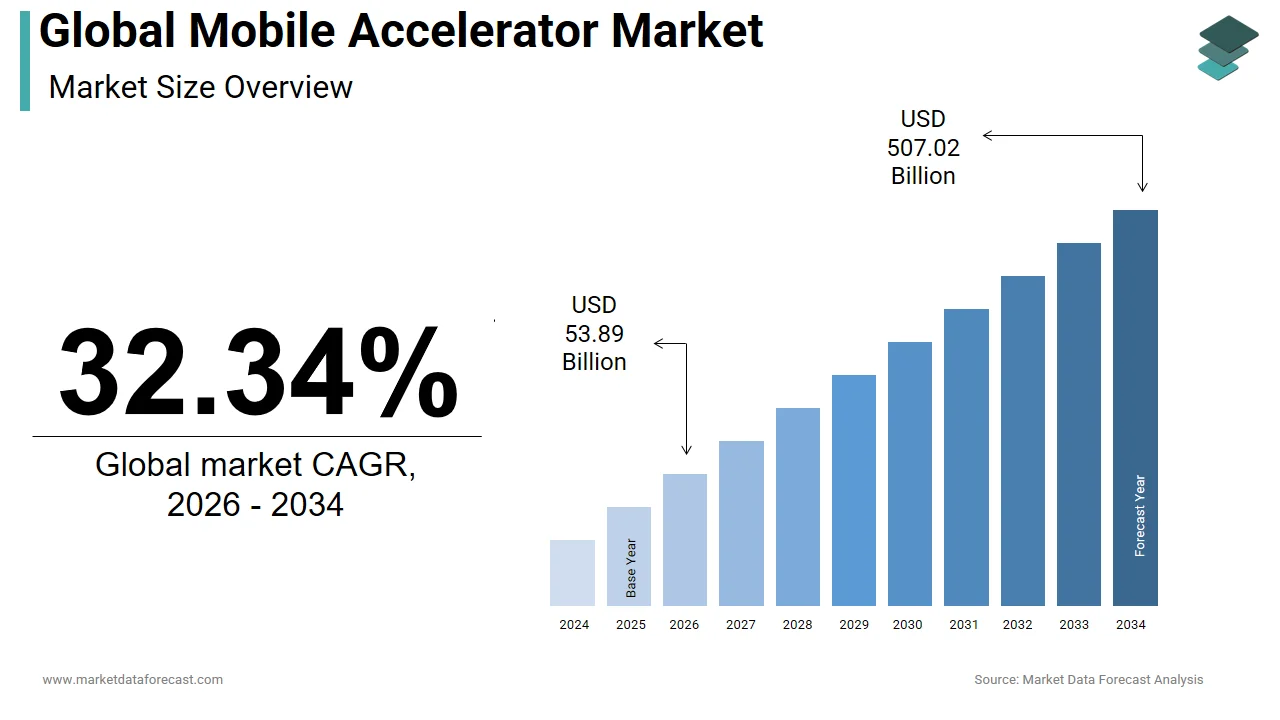
The global mobile accelerator market was valued at USD 40.72 billion in 2025. The global market is estimated at USD 53.89 billion in 2026 and is expected to reach USD 507.02 billion by 2034, garnering a CAGR of 32.34% from 2026 to 2034.
The mobile accelerator is a specialized suite of software and hardware solutions designed to optimize the performance speed and reliability of mobile applications and network connectivity. These technologies include content delivery networks application performance management tools and edge computing infrastructures that reduce latency and enhance user experience across diverse devices. As digital transformation accelerates, the demand for seamless mobile interactions has become critical for enterprise productivity and consumer satisfaction. The European Commission reports that 5G coverage now reaches 80% of the urban population in Europe necessitating advanced acceleration techniques to handle increased data throughput. In the United States, the Federal Communications Commission notes that average mobile download speeds have increased by year over year driven by infrastructure upgrades and optimization tools. The proliferation of Internet of Things devices further complicates network traffic with Cisco estimating that machine to machine connections will account for 50% of total connected devices by 2025. This surge in connected endpoints requires sophisticated acceleration mechanisms to prevent congestion and ensure real time data processing. Enterprises increasingly rely on these solutions to maintain competitive advantage through superior application responsiveness. The integration of artificial intelligence into acceleration algorithms allows for predictive traffic management and dynamic resource allocation. This technological evolution reflects a broader shift toward instantaneous digital experiences where milliseconds determine user retention and operational efficiency in an increasingly mobile first world.
MARKET DRIVERS
Proliferation of High Bandwidth Mobile Applications and Services
The exponential growth of high bandwidth mobile applications, such as augmented reality, virtual reality, and hig-definition video streaming is accelerating the growth of the mobile accelerator market. These applications consume significant network resources and are highly sensitive to jitter and packet loss making acceleration technologies essential for maintaining quality of service. Data from the Video Advertising Bureau indicates that mobile video consumption accounts for 75% of all digital video views globally with users expecting instant playback and minimal buffering. Streaming platforms rely on adaptive bitrate streaming and edge caching to deliver content efficiently across varying network conditions. The rise of remote work and collaboration tools further amplifies this demand with Microsoft reporting that Teams mobile usage increased by 40% in 2023 requiring robust acceleration for video conferencing and file sharing. Enterprise applications involving large data sets and real time analytics also depend on accelerated connections to function effectively. As developers create more complex and data intensive applications the need for backend optimization and frontend delivery speed becomes paramount. Mobile accelerators mitigate network bottlenecks by compressing data optimizing protocols and routing traffic through the most efficient paths. This technical necessity ensures that users receive consistent performance regardless of their location or network congestion levels.
Expansion of 5G Networks and Edge Computing Infrastructure
The widespread deployment of 5G networks and the concurrent expansion of edge computing infrastructure is significantly bolstering the growth of the mobile accelerator market. The global 5G connections surpassed 1500 million in 2023, representing a rapid transition from legacy networks to high speed connectivity, as per the research. While 5G offers higher bandwidth it also introduces complexity in network management due to increased device density and diverse service requirements. Mobile accelerators are crucial for optimizing traffic flow in these dense environments ensuring that critical applications receive priority handling. The European Telecommunications Standards Institute highlights that edge computing reduces latency by processing data closer to the source which complements mobile acceleration strategies. The worldwide spending on edge infrastructure will reach 200000 million dollars by 2025, supporting real time applications in manufacturing healthcare and autonomous vehicles, as per recent study. These industries require deterministic latency and high reliability which mobile accelerators help achieve through intelligent traffic steering and load balancing. The integration of 5G standalone cores allows for network slicing enabling customized acceleration profiles for different use cases. Telecom operators are investing heavily in multi access edge computing platforms to support these capabilities. As enterprises migrate workloads to the edge, the demand for acceleration tools that can manage distributed architectures grows. This synergy between 5G and edge computing creates a robust ecosystem where mobile accelerators play a pivotal role in unlocking the full potential of next generation connectivity.
MARKET RESTRAINTS
High Implementation and Maintenance Costs for Small Enterprises
The substantial financial burden associated with implementing and maintaining advanced mobile acceleration solutions for small and medium sized enterprises is restricting the growth of the mobile accelerator market. According to the study, approximately 60% of small businesses cite technology costs as a major barrier to digital adoption. Mobile acceleration platforms often require significant upfront investment in software licenses hardware infrastructure and specialized personnel for configuration and monitoring. For smaller organizations with limited IT budgets these costs are prohibitive leading them to rely on basic native network capabilities rather than optimized solutions. The complexity of integrating acceleration tools with existing legacy systems further increases implementation time and expense. Many small businesses lack the technical expertise to manage dynamic caching policies and traffic routing rules resulting in suboptimal performance or misconfiguration. The rapid pace of technological change also necessitates continuous upgrades and patches adding to long term maintenance costs. Cloud based subscription models offer some relief but recurring fees can still strain tight operating margins. Many small enterprises delay or forego adoption of advanced acceleration technologies limiting their ability to compete with larger rivals who offer superior digital experiences.
Complexity of Integrating with Legacy IT Systems
The technical complexity involved in integrating modern mobile acceleration solutions with legacy IT infrastructure for many organizations is hindering the growth of the mobile accelerator market. According to the study, over 70% of enterprise data resides in legacy systems that were not designed for mobile first architectures. These older systems often lack the APIs and interoperability standards required for seamless connection with contemporary acceleration platforms. Legacy databases and mainframes may struggle to handle the high volume of concurrent requests generated by accelerated mobile applications leading to backend hurdles. Organizations must invest in middleware and custom development to bridge the gap between old and new technologies, which increases project risk and timeline. The lack of standardized protocols across different vendor solutions further complicates the integration process requiring specialized knowledge and extensive testing. Security concerns also arise when connecting legacy systems to external acceleration networks as older protocols may have vulnerabilities that modern tools do not address. IT teams often face resistance from internal stakeholders who are reluctant to modify stable but outdated systems. This inertia slows down the adoption of mobile acceleration technologies as companies prioritize stability over performance enhancements.
MARKET OPPORTUNITIES
Adoption of AI Driven Predictive Optimization
The integration of artificial intelligence and machine learning into mobile acceleration platforms for enhancing performance through predictive optimization is creating new opportunities for the growth of the mobile accelerator market. According to the study, AI driven operations can improve network efficiency by up to 30% by anticipating traffic patterns and adjusting resources proactively. Modern accelerators use machine learning algorithms to analyze historical data and predict peak usage times allowing for dynamic allocation of bandwidth and caching resources. Data from the International Journal of Network Management indicates that AI based traffic shaping reduces latency by 25% compared to static rule-based systems. This capability is particularly valuable for applications with fluctuating demand, such as e-commerce platforms during sales events or news apps during breaking stories. Enterprises can leverage these insights to optimize user experience and reduce infrastructure costs by avoiding over provisioning. The ability to automatically detect and mitigate anomalies such as DDoS attacks or sudden traffic spikes enhances security and reliability. Vendors are developing self healing networks that can reroute traffic instantly in response to congestion or failures without human intervention. This level of automation reduces operational overhead and improves service level agreement compliance. As AI models become more sophisticated, they will enable granular personalization of acceleration strategies for individual users based on their behavior and device characteristics.
Growth of Mobile Commerce and Digital Payment Solutions
The rapid expansion of mobile commerce and digital payment ecosystems for mobile accelerator providers to enhance transaction security and speed, which is additional factor to bolster the growth of the mobile accelerator market. Any delay or failure in payment processing can result in lost sales and damaged customer trust making performance optimization essential. Mobile accelerators help mitigate this risk by optimizing SSL handshakes and reducing round trip times for transaction requests. The rise of contactless payments and digital wallets requires real time verification, which depends on low latency networks. Acceleration tools can prioritize payment traffic over less critical data ensuring that financial transactions are processed swiftly even during network congestion. Additionally, these solutions provide enhanced security features such as encryption and threat detection which are vital for protecting sensitive financial information. Retailers and banks are increasingly partnering with acceleration providers to improve the mobile shopping experience and drive conversion rates. As consumers become more accustomed to instant gratification, the demand for seamless mobile payment experiences will continue to grow.
MARKET CHALLENGES
Security Vulnerabilities in Encrypted Traffic Inspection
The increasing prevalence of end-to-end encryption in mobile applications that rely on traffic inspection for optimization, which is a major challenge for the growth of the mobile accelerator market. The web traffic is now encrypted making it difficult for acceleration tools to analyze and compress data without decrypting it first. This decryption process introduces security risks and privacy concerns as it requires man in the middle capabilities that can be exploited by malicious actors. Regulatory frameworks, such as the General Data Protection Regulation in Europe impose strict penalties for unauthorized data access complicating compliance for acceleration providers. Organizations must balance the need for performance optimization with the obligation to protect user privacy and maintain trust. Implementing secure decryption zones and strict access controls adds complexity and cost to acceleration infrastructure. Some applications refuse to allow traffic inspection altogether limiting the effectiveness of traditional acceleration techniques. Providers are developing new methods, such as client-side optimization and protocol level improvements that do not require deep packet inspection. However, these alternatives may not offer the same level of performance gain as traditional methods.
Fragmentation of Mobile Devices and Operating Systems
The extreme fragmentation of mobile devices and operating systems for developing universal mobile acceleration solutions is another factor to inhibit the growth of the mobile accelerator market. According to study, there are over 24000 distinct Android device models in circulation each with different hardware capabilities screen sizes and network interfaces. This diversity makes it difficult to create a one size fits all acceleration strategy that works optimally across all devices. Older devices may not support modern compression algorithms or protocol enhancements leading to inconsistent performance improvements. Developers must test and optimize their applications for a wide range of configurations which increases development time and cost. Acceleration providers face similar challenges in ensuring their tools are compatible with various operating system versions and manufacturer customizations. Frequent OS updates can break existing acceleration integrations requiring continuous maintenance and patching. The lack of standardization in network stack implementations across different vendors further complicates traffic management. As a result, acceleration solutions may perform well on flagship devices but fail to deliver significant benefits on mid-range or budget phones. This inconsistency undermines the value proposition for enterprises targeting broad demographics.
SEGMENTAL ANALYSIS
By Device Insights
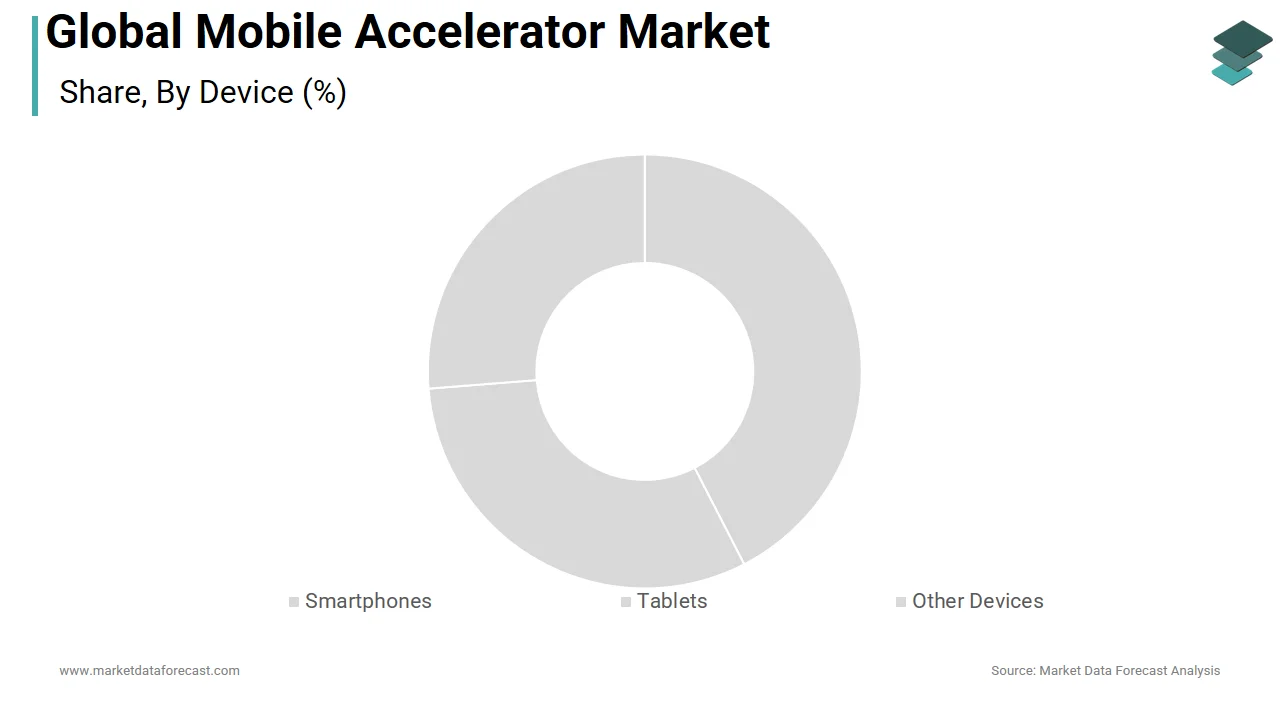
The smartphones segment was accounted in holding by 46.2% of the mobile accelerator market share in 2025 due to their status as the primary computing device for billions of users globally driving massive data consumption and performance expectations. The average smartphone user consumes nearly 20 gigabytes of data per month, as reported by Ericsson in its Mobility Report driven by high definition video streaming social media and cloud-based applications. This intense usage creates significant network congestion necessitating advanced acceleration techniques to maintain acceptable load times and responsiveness. Mobile accelerators optimize content delivery by compressing images caching frequently accessed data and prioritizing critical traffic ensuring smooth user experiences even during peak hours. The proliferation of 5G capable smartphones further amplifies this demand as users expect instantaneous access to rich media content. Enterprises also rely heavily on smartphone based workflows requiring secure and fast access to corporate resources remotely. As application complexity increases the need for specialized optimization tools tailored to smartphone hardware and operating systems becomes indispensable for service providers and developers alike.
The other devices segment is likely to exhibit a fastest CAGR of 18.5% during the forecast period. According to the research, the global number of IoT connections is expected to reach 41000 million by 2025, creating an unprecedented volume of machine to machine traffic. These devices often operate on constrained networks with limited bandwidth and battery life requiring highly efficient acceleration protocols to transmit data effectively. Smartwatches fitness trackers and health monitors generate continuous streams of biometric data that must be processed and stored in the cloud in real time. Acceleration technologies optimize this data flow by minimizing packet size and reducing handshake overheads ensuring timely delivery without draining device batteries. In the automotive sector, connected cars produce up to 25 gigabytes of data per hour requiring robust acceleration for navigation telemetry and over the air updates. Industrial IoT applications in manufacturing and logistics also rely on fast data transmission for predictive maintenance and operational efficiency. As the ecosystem of connected devices expands beyond traditional consumer electronics, the need for tailored acceleration mechanisms grows rapidly. This segment offers significant growth potential as industries digitize their operations and rely on real time data insights.
By Type Insights
The content delivery network segment was the largest 32.1% of the mobile accelerator market share in 2025 due to its fundamental role in distributing digital content efficiently, across global networks. CDNs cache static and dynamic content on servers located closer to end users significantly reducing latency and improving load times for mobile applications. This performance boost is crucial for retaining mobile users who have little patience for slow loading pages. Streaming services news portals and e commerce platforms depend heavily on CDN acceleration to deliver high quality video and images without buffering or distortion. The rise of 4K and 8K video content further increases the demand for robust CDN infrastructure capable of handling large file sizes. As mobile data consumption grows, CDNs adapt by implementing smarter caching algorithms and edge computing capabilities. The ability to scale automatically during traffic spikes ensures consistent performance for millions of concurrent users.
The mobile application segment is expected to grow at a fastest CAGR of 16.2% from 2025 to 2034 owing to the increasing complexity and prevalence of native and hybrid mobile applications. Unlike web content, mobile apps require specialized acceleration techniques to optimize API calls database queries and background processes. Mobile Application Accelerators provide software development kits that enable developers to implement caching compression and offline capabilities directly into their code. These tools help non-technical users create performant apps without extensive coding knowledge. The shift toward microservices architecture in app development also drives demand for accelerators that can manage distributed backend services efficiently. Real time collaboration apps financial trading platforms and healthcare monitoring tools require millisecond level responsiveness which Mobile Application Accelerators facilitate through intelligent routing and protocol optimization. As the app economy matures, the focus shifts from mere availability to superior performance making these accelerators essential for competitive success.
REGIONAL ANALYSIS
North America Mobile Accelerator Market Analysis
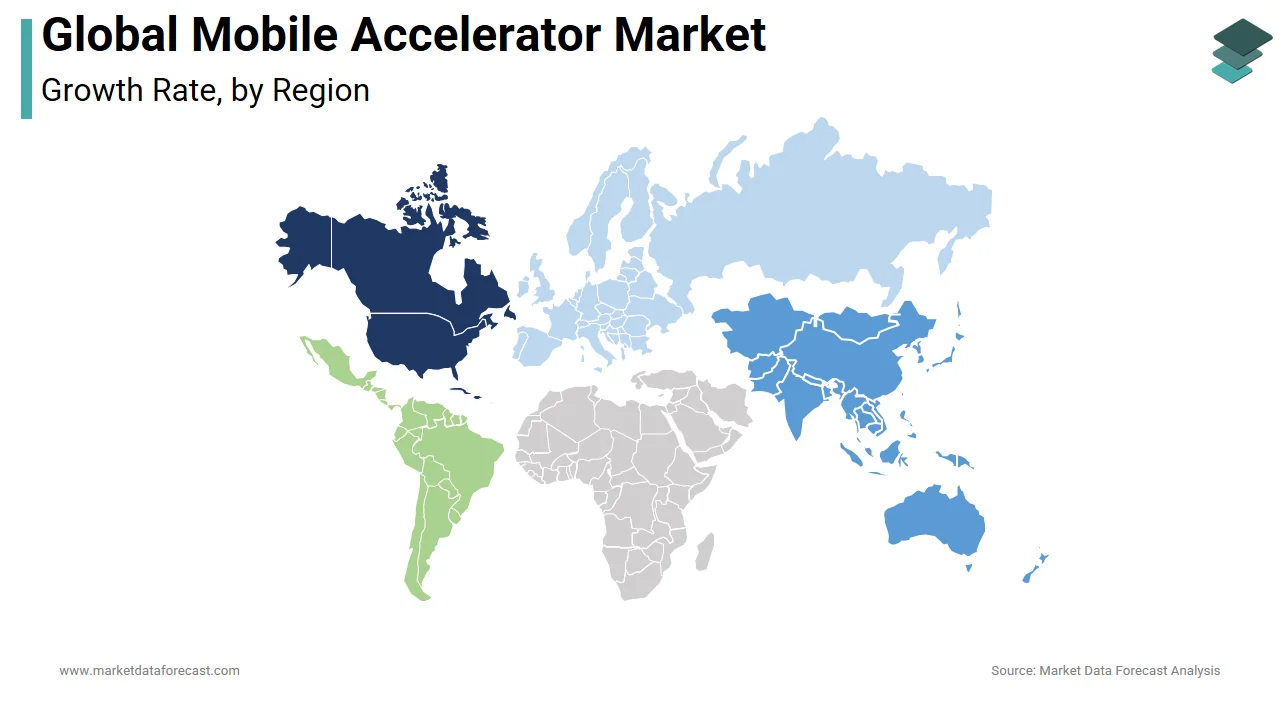
North America was the largest contributor in the mobile accelerator market by holding 35.3% of share in 2025 owing to the advanced digital infrastructure and high smartphone penetration. The United States leads the region with widespread 5G deployment and a mature ecosystem of technology providers. According to the study, 5G coverage reaches over 90% of the US population enabling high speed mobile experiences that require sophisticated acceleration. Major tech giants such as Google, Amazon, and Microsoft are headquartered in the region investing heavily in edge computing and content delivery networks. Canada mobile accelerator market growth is likely to grow with the strong telecommunications sector and government initiatives to improve rural connectivity. Enterprise mobility is also advanced with many corporations implementing bring your own device policies that require robust acceleration for security and performance. Regulatory frameworks supporting net neutrality and open internet access foster innovation in acceleration technologies. The presence of leading venture capital firms encourages startups to develop novel acceleration solutions.
Europe Mobile Accelerator Market Analysis
Europe mobile accelerator market ranked second by holding 25.4% of share in 2025 with the stringent data privacy regulations and a strong focus on digital sovereignty. According to the European Commission, the General Data Protection Regulation influences how acceleration technologies handle user data promoting solutions that prioritize privacy and security. This expansion drives demand for acceleration tools that can manage increased traffic and low latency requirements. The European telecommunications industry is highly competitive with operators investing in network virtualization and edge computing to enhance service quality. Cross border digital services require efficient content delivery networks to ensure consistent performance across different countries. The region’s emphasis on sustainability also encourages the development of energy efficient acceleration algorithms. Government funding for digital transformation projects supports the adoption of advanced mobile technologies.
Asia Pacific Mobile Accelerator Market Analysis
Asia Pacific mobile accelerators market growth is expected to grow at a fastest CAGR in coming years with the rapid urbanization and massive mobile user bases in China, India, and Southeast Asia. According to the study, there are over 1000 million internet users in China with nearly all accessing the web via mobile devices. The widespread adoption of super apps like WeChat and Alipay creates complex traffic patterns that require advanced acceleration for smooth operation. Southeast Asian countries such as Indonesia and Vietnam are seeing rapid growth in mobile commerce and gaming driving demand for performance optimization. Governments in the region are investing heavily in digital infrastructure to support economic growth. The diversity of network conditions and device types in Asia Pacific necessitates flexible and robust acceleration solutions.
Latin America Mobile Accelerator Market Analysis
Latin America mobile accelerator market growth is driven by increasing smartphone adoption and improving network infrastructure. According to the research, mobile broadband penetration in Latin America has reached 70% enabling greater access to digital services. Brazil leads the region with a vibrant fintech sector that relies on fast and secure mobile connections for transactions. Mexico benefits from its proximity to the United States and growing manufacturing sector which adopts mobile technologies for supply chain management. Economic challenges and currency fluctuations sometimes hinder investment but the demand for affordable mobile data remains strong. Prepaid mobile plans are popular requiring efficient data usage which acceleration technologies help achieve. Social media and messaging apps are widely used driving traffic that benefits from optimization. As network quality improves and digital literacy increases, the potential for mobile accelerator adoption grows. Regional operators are partnering with global technology providers to enhance their service offerings.
Middle East and Africa Mobile Accelerator Market Analysis
The Middle East and Africa mobile accelerators market growth is significantly growing with the digital transformation initiatives and young populations. Countries are investing heavily in smart city projects, such as NEOM in Saudi Arabia, which require advanced mobile connectivity and acceleration. The UAE has one of the highest smartphone penetration rates globally with the Telecommunications and Digital Government Regulatory Authority reporting over 95% coverage. South Africa serves as a hub for sub-Saharan Africa with a developing fintech and e-commerce sector that demands reliable mobile performance. Limited bandwidth in some areas makes acceleration technologies particularly valuable for optimizing data usage and improving user experience. Mobile money services are widespread in East Africa requiring secure and fast transaction processing. Governments are promoting digital inclusion through infrastructure investments and policy reforms. As connectivity improves and digital services expand the demand for mobile accelerators will increase.
COMPETITIVE LANDSCAPE
The competitive landscape of the mobile accelerator market is characterized by intense rivalry among established technology giants and innovative niche providers, who compete on speed reliability and security. Major players leverage their extensive global infrastructure to offer superior content delivery and latency reduction capabilities. These companies benefit from strong brand recognition and long-term relationships with enterprise clients and telecommunications operators. Smaller firms compete by offering specialized solutions tailored to specific industries such as gaming or e commerce. Innovation in edge computing and artificial intelligence serves, as a key differentiator allowing companies to provide smarter and more adaptive acceleration services. Price competition is moderate as buyers prioritize performance and service level agreements over cost alone. Strategic alliances with cloud providers and device manufacturers create integrated ecosystems that enhance value propositions. The market sees continuous evolution as new protocols and standards emerge requiring constant adaptation. Regulatory compliance regarding data privacy and security further shapes competitive dynamics.
KEY MARKET PLAYERS
The major players in the global mobile accelerator market include
- Akamai Technologies Inc.
- Juniper Networks Inc.
- Flash Networks Inc.
- Huawei Technologies Co. Ltd.
- Telefonaktiebolaget LM Ericsson
- F5 Networks Inc.
- Riverbed Technology Inc.
- Fastly Inc.
- Cloudflare Inc.
- Rockstart Inc.
- Qualcomm Inc.
- Mobidia Technology Inc.
- Ascom Holding AG
TOP PLAYERS IN THE MARKET
- Akamai Technologies Inc. is a global leader in content delivery and cloud security providing robust mobile acceleration solutions that enhance application performance. The company leverages its extensive edge network to reduce latency and optimize data delivery for mobile users worldwide. Akamai recently integrated advanced machine learning algorithms into its platform to predict traffic patterns and dynamically adjust resource allocation. This innovation ensures consistent speed and reliability even during peak usage periods. The company actively collaborates with major telecommunications providers to deploy edge computing capabilities closer to end users. Akamai focuses on securing mobile transactions through enhanced encryption and threat detection mechanisms. Their commitment to sustainability drives the development of energy efficient caching strategies.
- Cloudflare Inc. offers a comprehensive suite of network services, including mobile acceleration tools that improve website and application load times. The company utilizes a vast anycast network to route mobile traffic through the most efficient paths reducing congestion and packet loss. Cloudflare recently launched specialized mobile optimization features that automatically compress images and minify code for faster rendering on handheld devices. Their focus on developer friendly APIs allows seamless integration of acceleration technologies into existing mobile applications. The company emphasizes security by providing distributed denial of service protection alongside performance enhancements. Cloudflare expands its edge presence by partnering with local internet exchange points globally. Their transparent pricing model and easy deployment process attract small businesses and large enterprises alike.
- Fastly Inc. provides a real time content delivery platform designed for high performance mobile applications and dynamic content delivery. The company distinguishes itself through its programmable edge cloud, which allows developers to customize acceleration logic at the network edge. Fastly recently introduced new tools for instant purging and real time analytics enabling businesses to respond quickly to changing user demands. Their architecture supports high throughput and low latency making it ideal for streaming and gaming applications. Fastly collaborates with major cloud providers to offer hybrid solutions that combine edge and central processing capabilities. The company invests heavily in research to optimize video delivery protocols for mobile networks.
TOP STRATEGIES USED BY KEY MARKET PARTICIPANTS
Key players in the mobile accelerator market, primarily focus on expanding their global edge networks to reduce latency and improve content delivery speeds. Companies invest heavily in artificial intelligence and machine learning to predict traffic patterns and optimize resource allocation dynamically. Strategic partnerships with telecommunications providers facilitate deeper integration of acceleration services into mobile networks. Developing specialized solutions for emerging technologies such as Internet of Things and augmented reality drives innovation and market differentiation. Enhancing security features alongside performance optimization addresses growing concerns about data privacy and cyber threats. Offering flexible pricing models and easy to use APIs attracts a broader range of customers from startups to enterprises. Continuous investment in research and development ensures compatibility with new mobile standards and devices.
MARKET SEGMENTATION
This research report on the global mobile accelerator market has been segmented and sub-segmented based on the following categories.
By Device
- Smartphones
- Tablets
- Other Devices
By Type
- Content/Web Applications
- Content Delivery Network Acceleration
- WAN Optimization
- Mobile Application Accelerator
- Device/User End Acceleration
- Other Types
By Application
- Gaming Applications
- M-Commerce Applications
- Location-based Service Applications
- Social Networking Applications
- Music and Messaging Applications
- Other Applications
By Region
- North America
- Europe
- Asia-Pacific
- Latin America
- The Middle East and Africa