- Product Description Description
- Table of Contents TOC
- List of Table & Figure LOT
- Get Free Sample PDF Sample PDF
Market Size, 2025
$3.71 BnMarket Estimate, 2026
$4.77 BnMarket Forecast, 2034
$35.37 BnCAGR, 2026–2034
28.47%North America Agricultural Drones Market Size, Share, Trends & Forecast (2026–2034)
- Market Scope: Regional analysis of the North American agricultural drone market covering product types (hardware segments like fixed-wing, rotary blade, and hybrid, alongside software data and imaging solutions), application frameworks (field mapping, variable rate application, crop scouting, crop spraying, and livestock), and country-level evaluations (United States, Canada, and Mexico).
- Market Valuation: Valued at USD 3.71 billion in 2025, estimated at USD 4.77 billion in 2026, and projected to reach USD 35.37 billion by 2034, growing at a robust CAGR of 28.47% from 2026 to 2034.
- Primary Growth Enablers: Surging demand for precision agriculture, increased automation to maximize farm productivity, and the widespread adoption of aerial drone spraying to cut down chemical fertilizer and pesticide waste.
Key North America Agricultural Drones Segment Metrics (2026–2034)
| Category | Leading Segment Insights | Growth & Structural Highlights |
|---|---|---|
| By Product | Hardware (accounted for the majority share due to high-cost physical UAV components including fixed wings, rotary blades, and hybrids) | Hybrid UAVs are projected for strong growth due to their combined capability for long-distance tasks and precise field hovering. Software categories focus heavily on data management and analytics. |
| By Application | Field Mapping (historically dominated regional market size by tracking crop performance and analyzing large tracts of land) | Crop Scouting is experiencing significant expansion owing to pinpoint accuracy in targeted fertilizer and pesticide spraying. |
| By Country / Region | United States & Canada (anchor North America's position as a global leader in agricultural drone deployments) | Driven by advanced technical literacy, established farming infrastructure, and rapid integration of precision farming solutions. |
Major Market Players, Structure & Strategic Landscape
Market Structure: Highly competitive environment focused on hardware durability, thermal/multispectral sensor improvements, and software-driven agricultural analytics designed to overcome labor shortages and lack of skilled professionals.
Key Companies: Trimble Navigation Ltd., DJI Technology, 3D Robotics, PrecisionHawk, AeroVironment Inc., Parrot SA, and DroneDeploy.
North America Agricultural Drones Market Size
The North American agricultural drone market was valued at USD 3.71 billion in 2025 and is anticipated to reach USD 4.77 billion in 2026 to reach USD 35.37 billion by 2034, growing at a CAGR of 28.47% during the forecast period from 2026 to 2034.
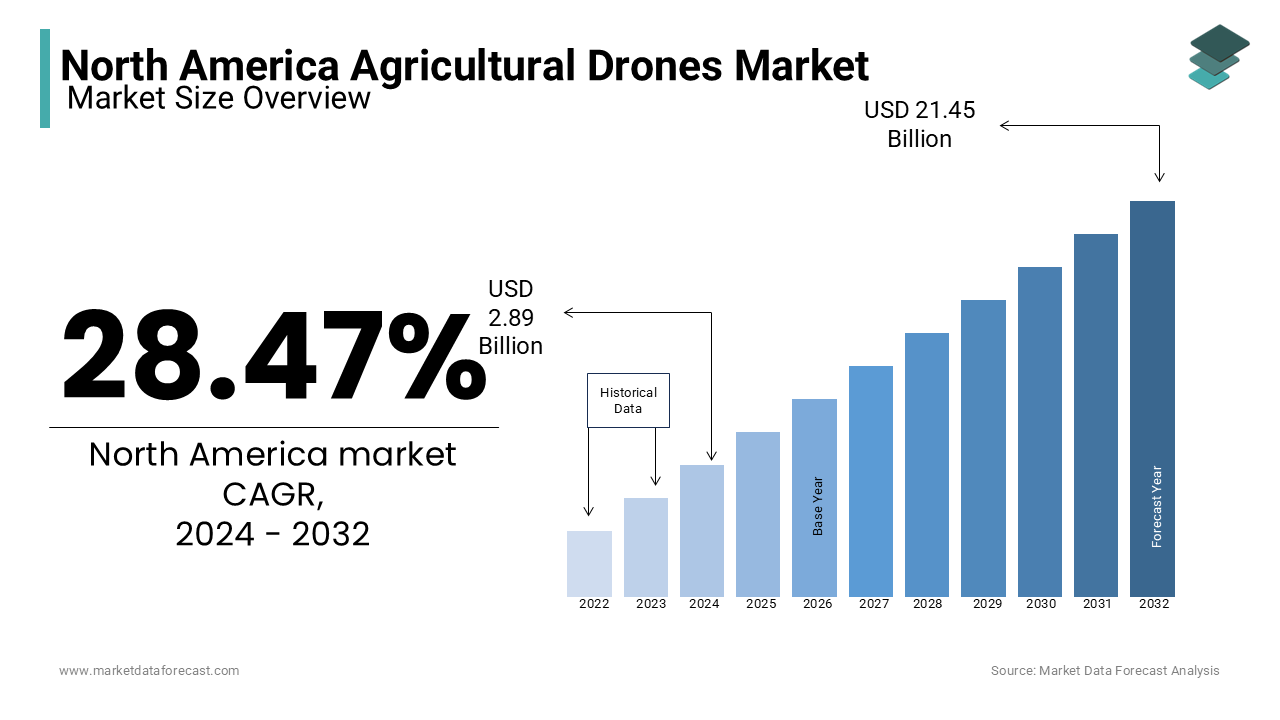
Agricultural drones use an automated process to make farming more productive, and they are about to be on the brink of becoming the new workhorses on farms. Drones provide better, more flexible visualization. With the focus on productivity in agriculture spiraling upward in the farming sector, drones could be the answer to improved automation and precise control of farm monitoring and operations.
Robots are beginning to transform the way the agriculture sector functions, and the advent of agricultural drones could take that change to a whole new level. Farmers are adapting to drone availability, using aerial cameras to visualize plants. Video, specialized video, targeted video, and agricultural spraying systems are offered. Agricultural drones use Technology for Spraying, Mapping, Pest Control, Seeding, Remote Sensing, and precision agriculture.
The market is primarily driven by the increasing adoption of drones for crop spraying applications, resulting in an increase in the yield and reducing the wastage in spraying fertilizers & pesticides. Also, farmers are increasingly implementing this technology in farming to gain better productivity and to increase the efficiency in the usage of water, land, and fertilizers. Moreover, technological advancements, including sensors, better materials, and imaging capabilities, are also expected to drive the agricultural sector. However, a lack of awareness and a limited number of skilled professionals are restraining the growth of the market.
REPORT COVERAGE
| REPORT METRIC | DETAILS |
| Market Size Available | 2025 to 2034 |
| Base Year | 2025 |
| Forecast Period | 2026 to 2034 |
| CAGR | 27.55% |
| Segments Covered | By Product, Application, and Country |
| Various Analyses Covered | Global, Regional, and country-level analysis; Segment-Level Analysis, DROC, PESTLE Analysis, Porter’s Five Forces Analysis, Competitive Landscape, Analyst Overview of Investment Opportunities |
| Country's Covered | The United States, Canada, and the Rest of North America |
| Market Leaders Profiled | Trimble Navigation Ltd., DJI Technology, 3D Robotics, Precision Hawk, AeroVironment, Inc., Parrot SA, and Drone Deploy. |
SEGMENT ANALYSIS
By Product Insights

By Application Insights
Hardware accounted for the majority of the agricultural drone market share in 2016, owing to high-cost components such as a fixed wing, rotary blade, and hybrid UAVs. Hybrid UAVs will witness growth in the forecast period since they can perform long-distance tasks along with hovering over the agricultural fields. Field mapping applications dominated the North American agricultural drone market size. Benefits such as increasing yield benefits by analyzing and monitoring the crops are expected to support the segment's growth over the forecast timeline. Crop scouting is expected to witness significant growth owing to its accuracy in fertilizer spraying.
COUNTRY ANALYSIS
The North American market has been geographically segmented into the US and Canada. The North American region dominates the global agriculture drone market due to the increasing trend of implementing UAVs and growing awareness of precision agriculture for field mapping and crop scouting.
KEY MARKET PLAYERS
Some of the major key players in the market are
- Trimble Navigation Ltd.
- DJI Technology
- 3D Robotics
- PrecisionHawk
- AeroVironment, Inc.
- Parrot SA
- DroneDeploy.
MARKET SEGMENTATION
This research report on the North American agricultural drones market is segmented and sub-segmented into the following categories.
By Product
- Hardware
- fixed-wing
- rotary blade
- hybrid
- Software
- data management
- imaging software
- data analysis
By Application
- field mapping
- variable rate application
- crop scouting
- crop spraying
- livestock
- agriculture photography
- others
By Country
- The United States
- Canada
- Mexico