- Product Description Description
- Table of Contents TOC
- List of Table & Figure LOT
- Get Free Sample PDF Sample PDF
Market Size, 2025
$8,070.37 MnMarket Estimate, 2026
$9,195.38 MnMarket Forecast, 2034
$26,120.37 MnCAGR, 2026–2034
13.94%Executive Summary: North America eHealth Market
- Market Scope: North American regional market analysis covering technology sectors, digital health solutions, clinical information systems, and country-level market structures.
- Market Valuation: Valued at USD 8,070.37 million (2025), estimated at USD 9,195.38 million (2026), and projected to reach USD 26,120.37 million by 2034, growing at a CAGR of 13.94% (2026–2034). (Historical context notes a 2024 valuation of USD 7,083 million).
- Primary Growth Drivers: Aging population demographics, escalating healthcare costs, rising consumer demand for accessible care, and rapid adoption of telemedicine, electronic health records (EHR), Internet of Things (IoT), artificial intelligence, wearable devices, and remote patient monitoring.
Key Market Segment Metrics (2026–2034)
| Category | Leading Segment (2025 Position) | Fastest-Growing Segment |
|---|---|---|
| By Technology & Scope | Telemedicine, EHR, ePrescribing, mHealth, Consumer Information Systems, Clinical Decision Support | IT Services (projected at a 13.94% CAGR) |
| By Region / Country | United States (leads North America due to mature infrastructure, heavy healthcare spending, and telehealth expansion) | Canada (offers significant growth opportunities via health informatics and EHR investments) |
Major Market Players & Market Structure
Market Structure: Highly competitive digital health and technology landscape driven by continuous software innovation, connected care models, artificial intelligence integration, wearable technology rollouts, remote patient monitoring platforms, and robust digital health information architectures.
Key Companies: Boston Scientific Corp., IBM, Motion Computing Inc., GE Healthcare, Epocrates Inc., Telecare Corp., CompuMed, Medisafe, SetPoint Medical, Doximity, Lift Labs, Proteus Digital Health, and Apple.
North America eHealth Market Size
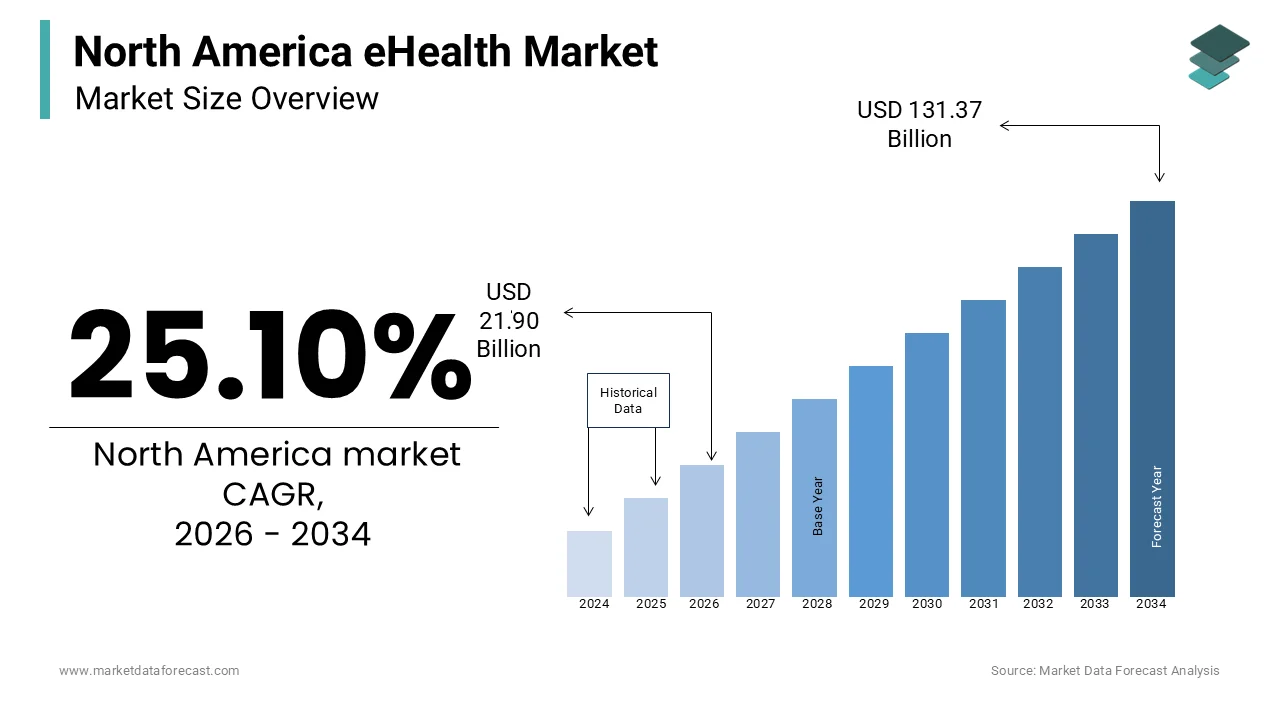
The North America eHealth Market was valued at USD 8,070.37 million in 2025, is projected to grow at a CAGR of 13.94% from 2026 to 2034, and is expected to reach USD 26,120.37 million by 2034, up from USD 9,195.38 million in 2026.
MARKET DRIVERS
The aging population in North America is a significant influence on the eHealth market by driving the demand for innovative healthcare solutions.
As the elderly population in the region continues to expand, so does the demand for better management of chronic health conditions and improved access to healthcare services. Thankfully, modern eHealth technologies have emerged as a crucial solution to address these challenges. These technologies empower healthcare providers to remotely monitor patients, offering not just improved health outcomes for seniors but also alleviating the burden on our healthcare system. However, eHealth solutions make it incredibly convenient for elderly individuals to access healthcare services, regardless of where they live. Through telemedicine and digital health platforms, we're bridging the gap for those who might have limited mobility or reside in remote areas. This ensures that they receive the care and attention they need without the struggle of long journeys or waiting times, truly providing a lifeline for our seniors. Therefore, the aging population's healthcare demands are a driving force behind the expansion and innovation of the North American eHealth market growth by fostering a future where healthcare is more accessible and efficient.
The North American eHealth market is thriving due to advancements in technology.
As innovations like the Internet of Things and artificial intelligence are rising day by day, the healthcare industry is also offering better solutions that drive market growth and improve patient outcomes. However, wearable devices empower individuals to monitor their health in real time by providing valuable data to both patients and healthcare providers. IoT enables the seamless integration of various healthcare devices and systems, also creating a connected healthcare ecosystem that allows for remote patient monitoring and the rapid exchange of critical health information. AI, with its capabilities in data analysis and predictive modeling, offers personalized care pathways, aiding in early disease detection and treatment optimization. Therefore, these technologies collectively enhance the efficiency of healthcare delivery, reduce medical errors, and improve patient outcomes, making them essential drivers of the eHealth market's expansion in North America.
The North American eHealth market faces a notable restraint in the form of the high costs of implementing eHealth solutions, particularly for smaller healthcare practices. While these technologies hold immense promise in improving healthcare delivery, enhancing patient outcomes, and reducing administrative burdens, the financial burden of adoption can be a significant deterrent for smaller healthcare providers. Smaller practices often operate on tighter budgets, making it challenging to allocate funds for the acquisition, implementation, and maintenance of advanced eHealth technologies. The initial investment includes purchasing electronic health record (EHR) systems, telehealth platforms, and other digital health tools, as well as training staff to use them effectively. Ongoing costs for software updates, data security, and tech support can also strain limited resources.
eHealth platforms, hindering care coordination. But on the positive side, COVID-19 acted as a catalyst for the widespread adoption of eHealth solutions. Telehealth, in particular, saw unprecedented growth, providing safe and convenient access to healthcare services while reducing the risk of virus transmission. The pandemic accelerated the development and integration of digital health tools, such as contact tracing apps and remote patient monitoring, to better manage and respond to health crises
COUNTRY LEVEL ANALYSIS
North America has historically been a dominant force in the eHealth market as it has a mature healthcare infrastructure, significant investments in digital health technologies, and a growing aging population that necessitates advanced healthcare solutions.
The United States is leading with the dominant eHealth market share with the increasing aging population, growing healthcare costs, and rising healthcare infrastructure. The U.S. has witnessed significant market growth in telehealth and digital health startups, with a strong focus on innovation and technological advancements in the industries.
Canada's eHealth market also holds significant growth opportunities by including the aging population and the need for cost-effective healthcare solutions. The Canadian healthcare system is publicly funded and administered provincially, which can create some variability in eHealth adoption and interoperability. Canada has invested in health informatics and EHRs, aiming to improve data sharing and care coordination. Challenges include data privacy concerns, the vast geographic landscape, and the need for standardized eHealth solutions across provinces.
KEY MARKET PLAYERS
Companies playing a dominant role in the North America eHealth Market profiled in this report are Boston Scientific Corp., IBM, Motion Computing Inc., GE Healthcare, Epocrates Inc., Telecare Corp., CompuMed, Medisafe, SetPoint Medical, Doximity, Lift Labs, Proteus Digital Health and Apple.
MARKET SEGMENTATION
This research report on the North American eHealth Market has been segmented and sub-segmented into the following categories
By Type
-
Telemedicine
-
Consumer Information System
-
EHR
-
ePrescribing
-
Health Information
-
mHealth
-
Health Management
-
Clinical Decision Support
By Services
-
Administrative
-
Diagnostic
-
Monitoring
-
Financial
By End-Use
-
Healthcare Consumers
-
Providers
-
Government
-
Insurers
By Country
-
The United States
-
Canada
-
Rest of North America