- Product Description Description
- Table of Contents TOC
- List of Table & Figure LOT
- Get Free Sample PDF Sample PDF
Market Size, 2025
$229 MnMarket Estimate, 2026
$245.26 MnMarket Forecast, 2034
$425 MnCAGR, 2026–2034
7.10%Executive Summary: North America Hyperbaric Oxygen Therapy Devices Market
- Market Scope: Comprehensive market analysis of the North American hyperbaric oxygen therapy (HBOT) devices industry covering product types (monoplace, multiplace, and topical chambers), clinical applications, and country-level growth across the United States, Canada, and Mexico.
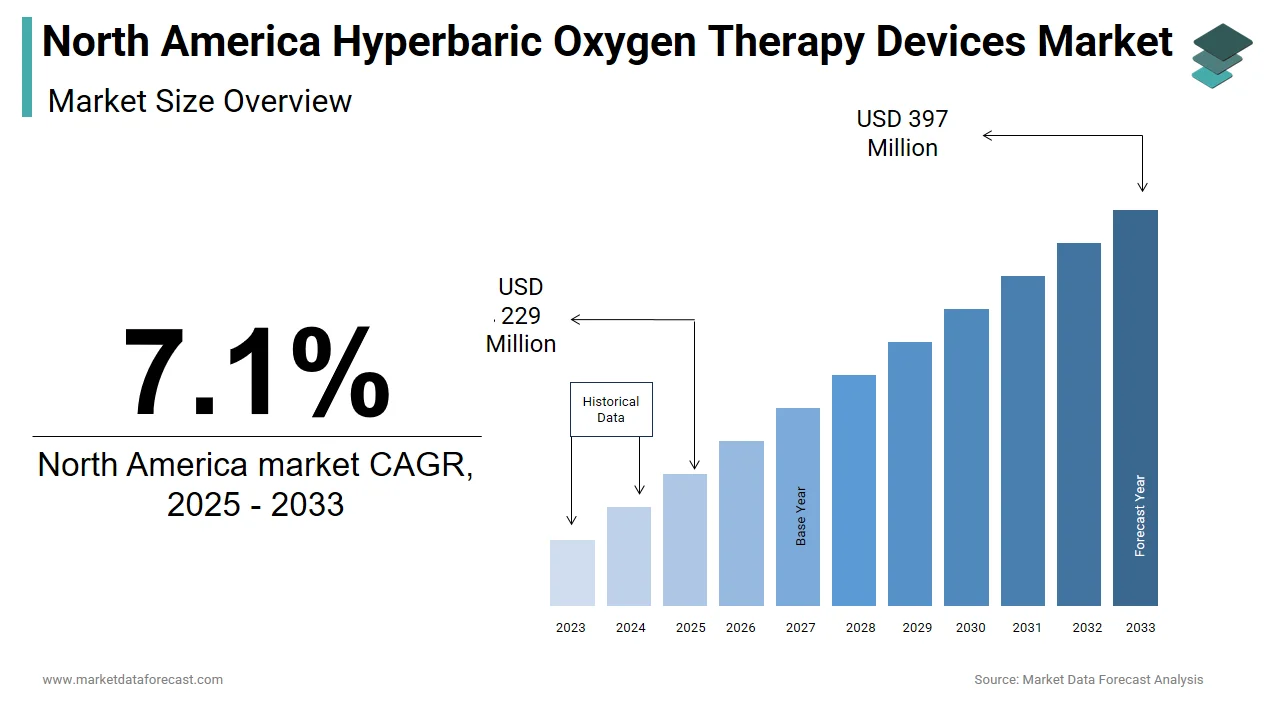
- Market Valuation: Valued at USD 229 million in 2025, estimated at USD 245.26 million in 2026, and projected to reach USD 425 million by 2034, registering a solid CAGR of 7.10% (2026–2034).
- Primary Growth Drivers: Escalating prevalence of chronic non-healing wounds and diabetic complications, expansion of FDA-approved clinical indications, rising utilization in sports medicine and veteran care, and technological advancements like telemedicine integration.
Key Market Segment Metrics (2026–2034)
| Category | Leading Segment (2025 Position) | Fastest-Growing Segment |
|---|---|---|
| By Product | Monoplace HBOT Devices (dominating with a 44.3% market share due to cost-effectiveness, compact size, and outpatient suitability) | Multiplace HBOT Devices (projected at a 7.2% CAGR driven by critical care and simultaneous patient capacity) |
| By Application | Wound Healing (holding the dominant share via diabetic foot ulcer treatments and radiation tissue damage management) | Sports Medicine & Neurological Care Applications |
| By Country | United States (dominating with an 85.3% share supported by advanced healthcare infrastructure and strong Medicare reimbursement) | Canada & Mexico (expanding via hospital infrastructure upgrades and rising specialized wound care needs) |
Major Market Players & Market Structure
Market Structure: Moderately consolidated medical device landscape dominated by established manufacturers with high regulatory compliance standards, robust engineering expertise, and specialized after-sales service networks.
Key Companies: Sechrist Industries, Inc., Fink Engineering, Perry Baromedical Corporation, Gulf Coast Hyperbarics, Inc., ETC Hyperbaric Chambers (Environmental Tectonics Corporation), HAUX-LIFE-SUPPORT, HEARMEC, IHC Hytech B.V. (Royal IHC), Hyperbaric SAC, OxyHeal International, and SOS Group North America Ltd.
North America Hyperbaric Oxygen Therapy Devices Market Size
The size of the North America hyperbaric oxygen therapy devices market was worth USD 229 million in 2025. The North America market is anticipated to grow at a CAGR of 7.10% from 2026 to 2034 and be worth USD 425 million by 2034 from USD 245.26 million in 2026.
The hyperbaric oxygen therapy devices are specialized chambers designed to deliver 100% oxygen at pressures greater than sea-level atmospheric pressure. These devices are important for treating conditions such as carbon monoxide poisoning, diabetic foot ulcers, and radiation-induced tissue damage by enhancing oxygen delivery to hypoxic tissues. Furthermore, the Department of Veterans Affairs reports that thousands of veterans receive hyperbaric oxygen therapy annually for traumatic brain injuries and post-traumatic stress disorder, amplifying its role in specialized care. The Food and Drug Administration has approved fourteen specific indications for hyperbaric oxygen therapy, ensuring standardized clinical protocols. As awareness of the regenerative benefits of hyperoxia grows among clinicians and patients, the demand for both hospital-grade monoplace chambers and portable multiplace units continues to rise.
MARKET DRIVERS
Rising Prevalence of Chronic Non-Healing Wounds And Diabetic Complications
The escalating prevalence of chronic non-healing wounds, particularly diabetic foot ulcers, is accelerating the growth of the North America Hyperbaric Oxygen Therapy Devices Market. Diabetes significantly impairs blood circulation and immune response, leading to wounds that fail to heal through conventional methods, creating an important need for adjunctive therapies. According to the American Diabetes Association, approximately 1.5 million new cases of diabetes are diagnosed annually in the United States, increasing the pool of patients at risk for severe complications. Hyperbaric oxygen therapy promotes angiogenesis and enhances leukocyte function, which are essential for wound closure in hypoxic environments. The hyperbaric treatment can reduce the risk of major amputation by up to 50% in selected patients with severe diabetic foot infections, according to the study. This clinical efficacy drives hospitals and wound care centers to invest in hyperbaric chambers to improve patient outcomes and reduce long-term care burdens. The aging population further exacerbates this trend as older adults are more prone to vascular insufficiency and slow healing.
Expansion of Approved Indications and Clinical Evidence Base
The expansion of approved medical indications and the growing body of clinical evidence is majorly fuelling the growth of the North America hyperbaric oxygen therapy devices market. While traditionally used for decompression sickness and gas embolism, regulatory bodies and medical societies have increasingly recognized its efficacy in treating conditions, such as radiation tissue damage, sudden sensorineural hearing loss, and traumatic brain injury. According to the study, the number of accepted indications has grown to fourteen, providing clear guidelines for reimbursement and clinical use. Recent studies published in peer-reviewed journals demonstrate that hyperbaric oxygen therapy improves cognitive function in patients with mild traumatic brain injury, a condition affecting millions of veterans and civilians. The ongoing research initiatives investigating hyperbaric therapy for post-traumatic stress disorder and stroke recovery further validate its therapeutic potential. This broadening scope of application encourages neurologists, oncologists, and emergency medicine specialists to incorporate hyperbaric chambers into their treatment protocols. Insurance providers are more likely to cover treatments with strong clinical backing, reducing financial barriers for patients. The accumulation of robust scientific data enhances physician confidence and patient acceptance, fostering a favorable environment for market growth.
MARKET RESTRAINTS
High Capital Investment and Operational Costs
The high capital investment and substantial operational costs, which are a concern in smaller healthcare facilities, are limiting the growth of the North America hyperbaric oxygen therapy devices market. Monoplace and multiplace hyperbaric chambers are complex medical devices requiring specialized installation, safety systems, and regular maintenance, which can cost between 100000 and 500000 USD depending on the configuration. The total cost of ownership includes not only the initial purchase price but also expenses for compressed air systems, oxygen supply, and trained personnel. Many community hospitals hesitate to invest in hyperbaric units due to the low patient volume required to achieve return on investment. Reimbursement rates for hyperbaric therapy sessions vary by payer and indication, sometimes failing to cover the full operational costs, including staffing and facility overhead. The need for certified hyperbaric technologists adds to labor expenses as these professionals command higher salaries due to their specialized training. Small private practices often lack the financial resources to sustain such high fixed costs, leading to limited access in rural or underserved areas.
Stringent Safety Regulations and Regulatory Compliance Burdens
The stringent safety regulations and rigorous regulatory compliance are additionally declining the growth of the North America Hyperbaric Oxygen Therapy Devices Market. Hyperbaric chambers operate under high pressure and involve pure oxygen, creating significant fire and explosion risks that necessitate strict adherence to safety standards. Compliance with these standards requires extensive documentation, regular inspections, and specialized staff training, which increases administrative and operational burdens. Manufacturers must undergo rigorous premarket approval processes to demonstrate safety and efficacy, which can delay product launches and increase development costs. Healthcare facilities face penalties and liability risks if they fail to meet safety standards, discouraging some providers from offering the therapy. The variability in state-level regulations further complicates operations for multi-facility health systems. These regulatory hurdles create high barriers to entry for new manufacturers and limit the flexibility of existing providers.
MARKET OPPORTUNITIES
Integration with Telemedicine and Remote Monitoring Technologies
The integration of telemedicine and remote monitoring technologies by enhancing patient management and expanding access to care is creating new opportunities for the growth of the North America hyperbaric oxygen therapy devices market. Modern hyperbaric chambers are increasingly equipped with sensors and connectivity features that allow clinicians to monitor patient vital signs and chamber parameters in real time from remote locations. This technology enables specialists to oversee multiple hyperbaric sessions simultaneously, improving resource utilization and reducing the need for on-site presence. The remote monitoring can reduce adverse events by enabling immediate intervention when anomalies are detected. This capability is particularly valuable for home-based hyperbaric therapy, which is gaining traction for certain indications. Manufacturers are developing smart chambers that integrate with electronic health records, streamlining data collection and analysis. The ability to provide continuous care and track long-term outcomes enhances the value proposition of hyperbaric therapy. As digital health infrastructure improves, the synergy between hyperbaric devices and telemedicine will facilitate broader adoption and improved patient engagement.
Growing Demand for Sports Medicine and Performance Recovery Applications
The growing demand for sports medicine and performance recovery applications, beyond traditional clinical indications, is also to amplify the growth of the North America Hyperbaric Oxygen Therapy Devices Market. Professional athletes and fitness enthusiasts are increasingly utilizing hyperbaric oxygen therapy to accelerate recovery from injuries, reduce inflammation, and enhance physical performance. High-profile endorsements by elite athletes have raised public awareness and destigmatized the use of hyperbaric therapy for non-medical purposes. These facilities cater to an affluent demographic willing to pay out of pocket for premium recovery services. Manufacturers are responding by designing sleek, compact, and user-friendly chambers suitable for wellness environments. The expansion into the sports and wellness sector diversifies revenue streams and reduces dependence on healthcare reimbursement.
MARKET CHALLENGES
Reimbursement Uncertainty and Coverage Limitations
The reimbursement uncertainty and coverage limitations are affecting both providers and patients, which is anticipated to pose a major challenge for the growth of the North America Hyperbaric Oxygen Therapy Devices Market. While Medicare and many private insurers cover hyperbaric therapy for approved indications, such as diabetic foot ulcers and gas embolism, coverage for off-label uses remains inconsistent and often denied. The variations in payer policies create confusion and administrative burdens for healthcare providers, who must navigate complex prior authorization processes. Patients seeking treatment for conditions like traumatic brain injury or autism spectrum disorder often face high out-of-pocket costs as these indications are not universally covered. This financial uncertainty discourages some physicians from prescribing the therapy and limits patient access. The lack of standardized national coverage policies forces providers to absorb costs or pass them to patients, reducing affordability. Advocacy groups are working to expand coverage, but progress is slow.
Shortage of Trained Hyperbaric Technologists and Specialists
The shortage of trained hyperbaric technologists and qualified medical specialists is also inhibiting the growth of the North America hyperbaric oxygen therapy devices market. Operating hyperbaric chambers requires specialized knowledge of pressure physiology, safety protocols, and emergency procedures, which is not commonly taught in standard medical or nursing curricula. Data from healthcare staffing agencies indicates that vacancies for hyperbaric positions often remain open for months due to the limited pool of qualified candidates. This scarcity forces facilities to rely on cross-trained staff, who may lack deep expertise, potentially compromising patient safety and treatment efficacy. The rigorous certification process and limited training programs further exacerbate the shortage. High turnover rates in healthcare add to the instability of the workforce. Without sufficient skilled personnel, hospitals cannot maximize the utilization of their hyperbaric equipment, leading to inefficiencies and lost revenue. Educational institutions and professional organizations must collaborate to expand training opportunities and attract new entrants to the field.
REPORT COVERAGE
| REPORT METRIC | DETAILS |
| Market Size Available | 2025 to 2034 |
| Base Year | 2025 |
| Forecast Period | 2026 to 2034 |
| Segments Covered | By Product, Application, and Region. |
| Various Analyses Covered | Global, Regional and Country-Level Analysis, Segment-Level Analysis, Drivers, Restraints, Opportunities, Challenges; PESTLE Analysis; Porter’s Five Forces Analysis, Competitive Landscape, Analyst Overview of Investment Opportunities |
| Countries Covered | UK, France, Spain, Germany, Italy, Russia, Sweden, Denmark, Switzerland, Netherlands, Turkey, Czech Republic, and the Rest of Europe. |
| Market Leaders Profiled | Gulf Coast Hyperbarics, Inc.; Fink Engineering; ETC Hyperbaric Chambers (Environmental Tectonics Corporation); HAUX-LIFE-SUPPORT; HEARMEC; IHC Hytech B.V. (Royal IHC); Hyperbaric SAC; Sechrist Industries, Inc.; OxyHeal International; and SOS Group North America Ltd., and Others. |
SEGMENTAL ANALYSIS
By Product Insights
The monoplace chamber segment was the dominant by accounting for 44.3% of the North America Hyperbaric Oxygen Therapy Devices Market share in 2025 due to its cost-effectiveness, ease of operation, and suitability for single-patient treatment. Monoplace chambers accommodate one patient at a time and are pressurized with 100% oxygen, making them ideal for treating conditions like diabetic foot ulcers and carbon monoxide poisoning. These chambers require less floor space and lower initial capital investment compared to multiplace units, making them accessible to smaller hospitals and private clinics. The simplicity of operation allows nursing staff to manage treatments without the need for a dedicated hyperbaric technologist inside the chamber, reducing labor costs. Reimbursement structures favor outpatient treatments, which are efficiently delivered in monoplace units. The high volume of wound care patients who do not require critical care monitoring fits well with the monoplace model. Manufacturers continue to innovate with improved comfort features and safety systems, enhancing patient compliance.

The multiplace chamber segment is likely to grow with an anticipated CAGR of 7.2% during the forecast period, driven by the need for critical care capabilities and the ability to treat multiple patients simultaneously. Multiplace chambers can accommodate several patients and medical staff, allowing for the treatment of critically ill individuals who require continuous monitoring and intervention. The multiplace chambers are essential for treating conditions such as decompression sickness, gas embolism, and severe carbon monoxide poisoning where immediate medical attention may be needed. The ability to treat pediatric patients or those with claustrophobia, who cannot tolerate monoplace chambers, also drives demand. Technological advancements in multiplace designs, including improved communication systems and integrated monitoring equipment, enhance their appeal. Government funding for trauma centers and military hospitals supports the acquisition of these high-capacity units.
By Application Insights
The wound healing segment held a dominant share of the North America Hyperbaric Oxygen Therapy Devices Market in 2025 with the high prevalence of chronic non-healing wounds, particularly diabetic foot ulcers and radiation-induced tissue damage. Hyperbaric oxygen therapy is a standard adjunctive treatment for these conditions as it enhances oxygen delivery to hypoxic tissues, promoting angiogenesis and collagen synthesis. The clinical efficacy of hyperbaric therapy in reducing amputation rates and accelerating wound closure has led to its inclusion in major clinical guidelines, such as those from the Undersea and Hyperbaric Medical Society. Hospitals and specialized wound care centers increasingly invest in hyperbaric chambers to manage this growing patient population. The aging population further exacerbates the demand as older adults are more susceptible to vascular insufficiency and slow healing processes. Medicare coverage for hyperbaric therapy for diabetic foot wounds provides financial stability for providers, encouraging adoption.
COUNTRY LEVEL ANALYSIS
U.S. Hyperbaric Oxygen Therapy Devices Market Analysis
The United States was the largest contributor in the North America Hyperbaric Oxygen Therapy Devices Market by accounting for 85.3% of the share in 2025, with its advanced healthcare infrastructure, high prevalence of chronic diseases, and robust reimbursement framework. The country has the highest number of accredited hyperbaric facilities globally, supported by strong clinical guidelines from the Undersea and Hyperbaric Medical Society. According to the Centers for Disease Control and Prevention, the high rates of diabetes and obesity in the US create a large patient base for wound care applications. Medicare covers hyperbaric therapy for fourteen specific indications, providing financial stability for providers. The presence of major medical device manufacturers and research institutions fosters innovation and technology adoption. The numerous hyperbaric units for treating veterans with traumatic brain injury and radiation damage further boost demand. Private insurance coverage is widespread, facilitating access to care for a broader population. The strong regulatory environment enforced by the Food and Drug Administration ensures high safety and quality standards.
Canada Hyperbaric Oxygen Therapy Devices Market Analysis
Canada was ranked second by holding 11.2% of the North America Hyperbaric Oxygen Therapy Devices Market share in 2025, with a publicly funded healthcare system and increasing focus on specialized wound care. The country has a network of hospital-based hyperbaric units, primarily located in major provinces, such as Ontario, Quebec, and British Columbia. The aging population is driving up the incidence of chronic wounds and vascular diseases, creating demand for hyperbaric therapy. Hyperbaric oxygen therapy is recommended for specific indications, such as diabetic foot ulcers and necrotizing soft tissue infections. Provincial health authorities are investing in modernizing healthcare infrastructure, which includes upgrading hyperbaric facilities. The Canadian Armed Forces also utilize hyperbaric therapy for diving-related injuries, supporting a niche but steady demand. Regulatory oversight by Health Canada ensures that devices meet strict safety standards. While reimbursement is managed through provincial plans, access can vary by region, leading to disparities in availability. However, growing clinical awareness and advocacy efforts are expanding access.
COMPETITIVE LANDSCAPE
The North America Hyperbaric Oxygen Therapy Devices Market features a moderately consolidated competitive landscape dominated by established manufacturers with strong technical expertise and long-standing reputations. Key players leverage their experience in engineering and regulatory compliance to maintain leadership in both monoplace and multiplace segments. Competition intensifies around product reliability, safety features, and after-sales support rather than price alone due to the critical nature of medical devices. Niche specialists compete by offering customized solutions for complex hospital installations or specific clinical applications. Barriers to entry are high due to stringent regulatory requirements from the Food and Drug Administration and significant capital investment needed for research and development. Companies differentiate themselves through innovative technologies, such as digital monitoring systems and enhanced patient comfort designs. Strategic collaborations with healthcare institutions and professional societies help build credibility and drive adoption. Customer loyalty is driven by consistent performance and responsive technical support.
KEY MARKET PLAYERS
The leading companies operating in the North America hyperbaric oxygen therapy devices market include:
- Gulf Coast Hyperbarics, Inc.
- Fink Engineering
- ETC Hyperbaric Chambers (Environmental Tectonics Corporation)
- HAUX-LIFE-SUPPORT
- HEARMEC
- IHC Hytech B.V. (Royal IHC)
- Hyperbaric SAC
- Sechrist Industries, Inc.
- OxyHeal International
- SOS Group North America Ltd.
- Perry Baromedical Corporation
TOP PLAYERS IN THE MARKET
- Sechrist Industries maintains a prominent position in the North America Hyperbaric Oxygen Therapy Devices Market by manufacturing high-quality monoplace and multiplace chambers known for their durability and safety. The company focuses on providing comprehensive solutions including installation training and maintenance services to healthcare facilities. Recent actions include upgrading their control systems with advanced digital interfaces to enhance user experience and operational efficiency. Sechrist actively collaborates with clinical experts to refine chamber designs, ensuring compliance with strict regulatory standards. Their commitment to customer support and product reliability strengthens their reputation among hospitals and wound care centers. By continuously innovating their product line and expanding service networks, Sechrist ensures it meets the evolving needs of the hyperbaric community while maintaining a strong competitive edge in the region.
- Fink Engineering contributes significantly to the North America Hyperbaric Oxygen Therapy Devices Market through its specialized design and construction of custom hyperbaric facilities and equipment. The company is renowned for its expertise in building large multiplace chambers and complex hospital-based hyperbaric units. Recent initiatives include integrating smart monitoring technologies into their chambers to improve patient safety and data collection capabilities. Fink Engineering partners with architectural firms and healthcare providers to create tailored solutions that fit specific spatial and clinical requirements. Their focus on engineering excellence and regulatory compliance ensures that their installations meet the highest safety standards. By offering end-to-end services from design to commissioning, Fink Engineering strengthens its market position as a trusted provider of specialized hyperbaric infrastructure for major medical institutions across North America.
- Perry Baromedical Corporation plays a vital role in the North America Hyperbaric Oxygen Therapy Devices Market by offering a diverse range of monoplace and multiplace chambers along with essential accessories. The company emphasizes innovation and affordability, making hyperbaric therapy accessible to a broader range of healthcare providers. Recent efforts include launching new chamber models with enhanced comfort features and improved visibility for patients. Perry Baromedical invests in extensive training programs for operators, ensuring safe and effective use of their equipment. The company also provides robust after-sales support, including parts supply and technical assistance.
TOP STRATEGIES USED BY KEY MARKET PARTICIPANTS
Key players in the North America Hyperbaric Oxygen Therapy Devices Market employ several strategic approaches to maintain competitiveness and drive growth. Product innovation remains central with companies developing advanced control systems and improved patient comfort features to enhance usability. Strategic partnerships with healthcare providers and architectural firms facilitate the customization of hyperbaric facilities to meet specific clinical needs. Investment in comprehensive training and support services builds trust and ensures safe operation of complex equipment. Manufacturers also focus on regulatory compliance and safety certifications to differentiate their products in a highly regulated environment. Expansion into emerging applications such as sports medicine and neurological care diversifies revenue streams beyond traditional wound care. Digital integration, including remote monitoring capabilities enhances value propositions for modern healthcare facilities.
North America Hyperbaric Oxygen Therapy Devices Market News
- In January 2024 Sechrist Industries launched an upgraded digital control system for its monoplace chambers to enhance operational efficiency and strengthen its presence in the modern healthcare technology segment.
MARKET SEGMENTATION
This research report on the North America hyperbaric oxygen therapy devices market is segmented and sub-segmented into the following categories.
By Product
- Monoplace HBOT Devices
- Multiplace HBOT Devices
- Topical HBOT Devices
By Application
- Wound Healing
- Decompression Sickness
- Infection Treatment
- Gas Embolism
- Others
By Country
- United States
- Canada
- Mexico
- Rest of North America