- Product Description Description
- Table of Contents TOC
- List of Table & Figure LOT
- Get Free Sample PDF Sample PDF
Market Size, 2025
$27.36 BnMarket Estimate, 2026
$28.80 BnMarket Forecast, 2034
$43.47 BnCAGR, 2026–2034
5.28%Executive Summary: North America Automotive Casting Market
- Market Scope: Regional North American automotive casting market analysis covering material compositions, manufacturing processes, application sectors, vehicle types, country leadership frameworks, and lightweight component adoption metrics.
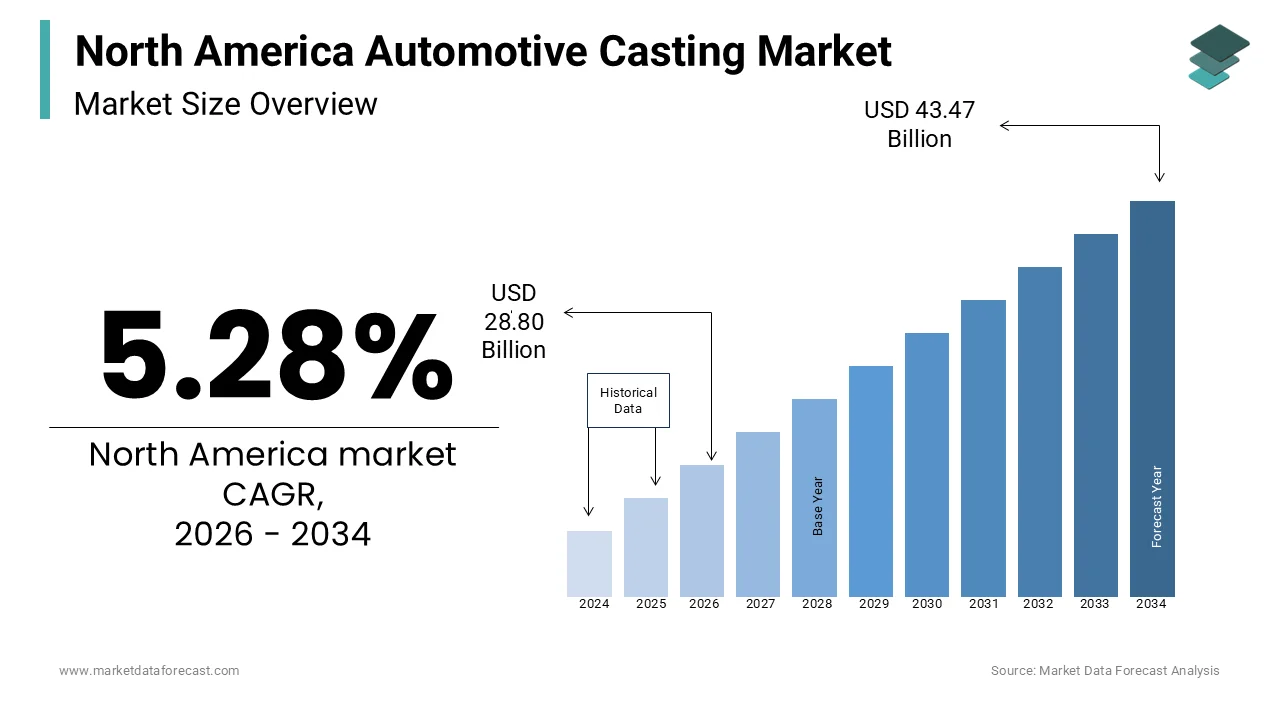
- Market Valuation: Valued at USD 27.36 billion in 2025, estimated at USD 28.80 billion in 2026, and projected to reach USD 43.47 billion by 2034, registering a CAGR of 5.28% from 2026 to 2034.
- Primary Growth Drivers: Rising demand for lightweight automotive components, growing electric vehicle production and demand for specialized cast components, increasing adoption of aluminum castings for fuel efficiency, expanding automotive manufacturing across North America, and advancements in die-casting and precision casting technologies.
Key Market Segment Metrics (2026–2034)
| Category | Leading Segment (Position) | Fastest-Growing / Key Growth Segment |
|---|---|---|
| By Material & Process | Iron (largest material type) & Sand Casting (largest process) | Aluminum (fastest-growing material) & Die Casting (fastest-growing process) |
| By Application & Vehicle Type | Engine Components (largest application) & Passenger Vehicles (largest vehicle type) | Transmission (fastest-growing application) & Commercial Vehicles (fastest-growing vehicle type) |
| By Technology & Innovation | Traditional foundry operations and conventional metal casting infrastructure | Industry 4.0 smart foundries, high-pressure die casting, and automated precision casting systems |
| By Region / Country | United States (leading country with 83.2% market share in 2025) | Mexico (fastest-growing country market) |
Major Market Players & Market Structure
Market Structure: Highly competitive North American automotive casting landscape characterized by lightweight aluminum capability expansions, Industry 4.0 automation and smart foundry investments, vertical integration, and strategic OEM partnerships.
Key Companies: Bedford Machine & Tool Inc., Cast Products, Inc., Casteks Metal Science Co., Ltd., Dynacast International Inc. (Form Technologies), Endurance Technologies Limited, Georg Fischer Ltd., Gibbs Die Casting Group, Impro Precision Industries Limited, Kinetic Die Casting Company, Inc., Kopf Holding GmbH, Lakeside Casting Solutions, LLC, Minda Corporation Limited, Mino Industry USA, Inc., Ningbo Parison Die Casting Co., Ltd., and Ryobi Limited.
 Download Free Sample Report
North America Automotive Casting Market Size
The North American automotive casting market size was valued at USD 27.36 billion in 2025 and is anticipated to reach a valuation of USD 28.80 billion in 2026 and USD 43.47 billion by 2034, growing at a CAGR of 5.28%, from 2026 to 2034.
Casting processes such as die-casting, sand casting, and investment casting are integral to producing lightweight, durable, and complex geometries essential for modern vehicle designs. As per the American Foundry Society, foundries across the United States and Canada contribute significantly to the region’s manufacturing output, with over 1,800 active foundries operating in the U.S. alone. These facilities serve both original equipment manufacturers (OEMs) and aftermarket suppliers. The industry has evolved in response to regulatory standards aimed at reducing emissions and improving fuel efficiency, leading to increased adoption of aluminum and ductile iron castings.
MARKET DRIVERS
Rising Demand for Lightweight Automotive Components
The automotive industry’s shift toward lightweighting to meet stringent fuel efficiency and emission standards is propelling the growth of the North American automotive casting market. As per the International Aluminum Institute, the average aluminum content in North American passenger vehicles increased to approximately 390 kg per vehicle in 2023, up from 270 kg in 2015. This trend is largely driven by automakers seeking to reduce curb weight without compromising structural integrity. According to the Aluminum Association, North American automotive aluminum demand reached 3.7 million tons in 2023, with casting alloys accounting for nearly 45% of this volume. Furthermore, the Canadian Light Steel Automotive Initiative reports that every 10% reduction in vehicle weight can lead to a 6–8% improvement in fuel economy, which reinforces the strategic importance of casting technologies in achieving sustainability targets.
Growth in Electric Vehicle Production and Component Demand
The expanding demand in the production of electric motor housings, battery enclosures, and inverter casings is an additional attribute fuelling the growth of the North American automotive casting market. As per the Edison Electric Institute, EV sales in the U.S. surpassed 1.4 million units in 2023, representing a 40% year-over-year increase. This growth is supported by federal incentives under the Inflation Reduction Act, which allocates $7,500 tax credits for qualifying EVs, boosting consumer adoption. EVs require specialized cast components that differ from traditional internal combustion engine (ICE) vehicles, particularly in terms of thermal management and electromagnetic compatibility. The North American Die Casting Association states that EV motor housings often utilize high-pressure die-cast aluminum to achieve precise tolerances and enhanced thermal conductivity. Tesla, General Motors, and Ford collectively sourced over 230,000 metric tons of aluminum castings for EV applications in 2023. Additionally, the U.S. Department of Energy’s Vehicle Technologies Office emphasizes that lightweight casting materials are pivotal for extending EV range and improving battery efficiency, making them a strategic focus for future automotive development.
MARKET RESTRAINTS
Volatility in Raw Material Prices
The highly susceptible to fluctuations in raw material costs, such as aluminum, iron, and steel, is slowing the growth of the North American automotive casting market. According to the London Metal Exchange, aluminum prices surged by 22% between 2021 and 2022, driven by supply chain disruptions and energy shortages in key producing regions. These price swings directly impact casting foundries, many of which operate on thin margins and struggle to pass increased costs to OEMs due to long-term contractual obligations. The Canadian Metal Casting Federation notes that energy costs account for up to 18% of total production expenses in Canadian foundries. In 2023, industrial natural gas prices in the U.S. Midwest increased by 35% compared to the previous year, as per the U.S. Energy Information Administration.
Stringent Environmental and Emission Regulations
The environmental regulations in terms of air emissions, waste generation, and energy consumption are hindering the growth of the North American automotive casting market. The U.S. Environmental Protection Agency enforces strict standards under the Clean Air Act, requiring foundries to adopt cleaner technologies and reduce particulate matter emissions. As per the National Pollutant Release Inventory, Canadian foundries reported a 12% increase in environmental compliance costs between 2021 and 2023. These regulations necessitate capital-intensive upgrades to filtration systems, melting equipment, and waste recycling infrastructure. According to the American Foundry Society, nearly 60% of North American foundries have invested over $1 million since 2020 to comply with updated environmental norms. The implementation of carbon pricing mechanisms in regions like Quebec and California has further elevated operational costs.
MARKET OPPORTUNITIES
Technological Advancements in Precision Casting
Technological innovations in casting methodologies, in computer-aided design (CAD), simulation software, and automation are creating new opportunities for the growth of the North American automotive casting market. Investment in high-pressure die-casting (HPDC) and vacuum-assisted casting has enabled the production of components with tighter tolerances and reduced porosity, aligning with the demands of next-generation automotive systems. As per the North American Die Casting Association, over 70% of surveyed foundries have adopted real-time process monitoring systems by 2023, leading to a 15% improvement in yield rates. The integration of Industry 4.0 technologies such as IoT-enabled sensors and predictive analytics is enhancing production efficiency and reducing downtime. A 2023 report by the Canadian Advanced Manufacturing Coalition states that smart casting facilities in Ontario have achieved a 22% reduction in energy consumption through automated melt optimization.
Expansion of Domestic EV Supply Chains
The U.S. government’s push for domestic EV supply chain localization under the Inflation Reduction Act is also expected to propel the growth of the North American automotive casting market in the coming years. The legislation prioritizes sourcing of components from within North America, incentivizing automakers to collaborate with regional suppliers. As per the U.S. Department of Commerce, over $120 billion in EV-related investments have been announced since 2022, including battery gigafactories and EV assembly plants. These developments are expected to drive demand for specialized castings used in electric drivetrains and battery enclosures. Ford’s BlueOval City facility in Tennessee and GM’s Ultium Cells plant in Ohio are projected to source 60% of their componentry from U.S. suppliers by 2027.
MARKET CHALLENGES
Skilled Labor Shortage in Foundry Operations
The persistent shortage of skilled labor in roles involving mold making, metallurgy, and machine operation is restraining the growth of the North American automotive casting market. As per the Manufacturing Institute, the U.S. faces a shortfall of over 400,000 manufacturing workers, with foundries among the hardest-hit sectors. The aging workforce exacerbates the issue, with the American Foundry Society reporting that 45% of foundry employees are over the age of 45, and nearly 25% are eligible for retirement by 2027. Younger generations show limited interest in manufacturing careers, leading to a knowledge gap in traditional casting techniques. The Canadian Federation of Industrial Trade Unions notes that over 30% of Canadian foundries have reported production delays due to staffing shortages. Training programs for advanced casting technologies remain underdeveloped, with only 12% of technical colleges in the U.S. offering specialized foundry courses as of 2023. This labor deficit not only hampers productivity but also limits the industry’s ability to adopt new technologies.
High Capital Requirements for Advanced Casting Equipment
The transition to advanced casting technologies, including automation, high-pressure die-casting machines, and digital monitoring systems, demands substantial capital investment, which is posing a barrier for small- and medium-sized foundries in North America. According to the Equipment Leasing and Finance Association, the average cost of a modern HPDC machine ranges between $2 million and $5 million, with additional expenses for auxiliary systems such as cooling and trimming units. Many regional foundries lack the financial resources to modernize their facilities, putting them at a competitive disadvantage. The National Association of Manufacturers reports that 58% of small foundries in the U.S. operate equipment that is over 15 years old, resulting in lower efficiency and higher maintenance costs. Furthermore, the integration of Industry 4.0 technologies such as IoT sensors and AI-driven process control systems requires additional investment in software platforms and workforce training. A 2023 survey by the Canadian Metal Casting Federation revealed that 42% of Canadian foundries delayed automation initiatives due to funding constraints.
REPORT COVERAGE
| REPORT METRIC | DETAILS |
| Market Size Available | 2025 to 2034 |
| Base Year | 2025 |
| Forecast Period | 2026 to 2034 |
| CAGR | 5.28% |
| Segments Covered | By Material Type, Process, Application, Vehicle Type, And By Country |
| Various Analyses Covered | Global, Regional & Country Level Analysis; Segment-Level Analysis, DROC, PESTLE Analysis, Porter’s Five Forces Analysis, Competitive Landscape, Analyst Overview of Investment Opportunities |
| Regions Covered | The United States, Canada, Mexico, Rest of North America |
| Market Leaders Profiled | Bedford Machine & Tool Inc., Cast Products, Inc., Casteks Metal Science Co., Ltd., Dynacast International Inc. by Form Technologies, Inc., Endurance Technologies Limited, Georg Fischer Ltd., Gibbs Die-casting Group, Impro Precision Industries Limited, Kinetic Die Casting Company, Inc., Kopf Holding GmbH, Lakeside Casting Solutions, LLC, Minda Corporation Limited, Mino Industry USA, Inc., Ningbo Parison Die Casting Co., Ltd., Ningbo Yinzhou Ke Ming Machinery Manufacturing Co., Ltd., Production Castings, Inc., Regensburger Druckgusswerk Wolf GmbH Rockman Industries Limited, Ryobi Limited, Sandhar, Sipra Engineers Pvt. Ltd., Sunbeam Lightweighting Solutions Pvt. Ltd |
SEGMENT ANALYSIS
By Material Insights
The Iron casting segment held a dominant share of the North American automotive casting market in 2025 due to its exceptional cost competitiveness compared to alternative materials. Iron ore remains one of the most abundant ferrous materials globally, with the United States Geological Survey reporting that North America holds approximately 25% of global iron ore reserves. This abundance translates to stable pricing, with iron casting costs typically 30-40% lower than aluminum casting for equivalent components. The American Foundry Association's 2023 industry report indicates that gray iron castings average $1.85 per pound compared to aluminum's $2.95 per pound, which makes iron economically attractive for high-volume automotive parts like engine blocks and brake components.
The aluminum casting segment is projected to grow with an expected CAGR of 4.8% throughout the forecast period. The automotive industry's intensified focus on vehicle weight reduction to meet stringent Corporate Average Fuel Economy standards is enhancing the growth of the segment. The National Highway Traffic Safety Administration mandates that new passenger vehicles achieve an average fleet fuel economy of 54.5 miles per gallon by 2025, requiring manufacturers to reduce vehicle weight by 15-20%. Aluminum castings offer 60% weight reduction compared to equivalent iron components, making them essential for achieving these targets.
By Process Insights
The sand casting segment was the largest by capturing a significant share of North America's automotive casting market in 2025. Sand casting's inherent flexibility makes it the preferred choice for manufacturing diverse automotive components ranging from small, intricate parts to large structural elements. The process accommodates virtually any casting size, from tiny valve components weighing less than one pound to massive engine blocks exceeding 200 pounds. The American Foundry Society emphasizes that sand casting can produce parts with complex internal geometries that would be impossible or economically unfeasible using alternative methods. This capability is particularly valuable for automotive applications requiring internal cooling passages, such as cylinder heads and exhaust manifolds, where intricate core work enables optimal thermal management. The process's ability to handle various alloy systems, including iron, steel, and aluminium that further enhances its automotive industry appeal.
The die casting segment is expected to grow at a CAGR of 5.2% throughout the forecast period, with the rapid market expansion due ton is its exceptional production efficiency for high-volume automotive manufacturing requirements. Die casting processes can achieve cycle times as fast as 10-30 seconds per part, enabling production rates exceeding 1,200 pieces per hour for small components. This throughput advantage becomes economically compelling for automotive manufacturers producing hundreds of thousands or millions of identical parts annually. The International Die Casting Association reports that North American die casting facilities average 95% uptime efficiency, significantly higher than sand casting operations that typically achieve 85% utilization rates. The automotive industry's shift toward platform consolidation, where single designs serve multiple vehicle models, creates ideal conditions for die casting's economies of scale.
By Application Insights
The engine components segment was the largest by occupying 43.2% of the North American automotive casting market share in 2025, with the rising inherent complexity and volume requirements of modern automotive engines, which rely extensively on cast components for both structural and functional purposes. Internal combustion engines contain 15-20 major cast components, including cylinder blocks, cylinder heads, intake manifolds, and crankcases, each requiring precise metallurgical properties and dimensional accuracy. The Engine Manufacturers Association reports that North American facilities produced over 9.2 million engines in 2022, with each engine requiring an average of 180 pounds of cast components. This volume requirement, combined with the technical challenges of producing components with complex internal cooling passages and precise bore alignments that makes casting the only economically viable manufacturing method for high-volume engine production.
The transmission segment is lucratively growing with an estimated CAGR of 5.8% during the forecast period. The expanding demand for electric vehicles creates unprecedented demand for specialized transmission castings designed for electric motor integration and battery-powered propulsion systems. Electric vehicle transmissions typically feature single-speed or two-speed designs requiring lightweight aluminum castings with integrated cooling systems and motor mounting interfaces. Bloomberg New Energy Finance projects that North American electric vehicle production will reach 4.2 million units annually by 2030, representing 28% of total vehicle manufacturing. Each electric vehicle requires specialized transmission castings weighing 25-40 pounds, compared to 80-120 pounds for traditional automatic transmissions, but with significantly higher aluminum content and precision requirements.
COUNTRY LEVEL ANALYSIS
North America United States Automotive Casting Market Insights
The United States was the top performer in the North American automotive casting market by holding 83.2% of the share in 2025. The United States automotive casting market is expected to grow with the presence of manufacturing infrastructure and concentration of original equipment manufacturers. Michigan, Ohio, and Indiana form the core of America's automotive heartland, hosting major OEM facilities including General Motors' Arlington Assembly, Ford's Dearborn Truck Plant, and Stellantis' Jefferson North Assembly. The Bureau of Economic Analysis reports that the U.S. automotive industry directly employs over 750,000 workers and supports an additional 3.5 million indirect jobs through supplier networks. This industrial concentration creates demand for over 12 million cast automotive components annually, encompassing engine blocks, transmission cases, and structural parts that require specialized casting capabilities. The United States leads North America in the adoption of advanced casting technologies, including semi-solid metal casting, vacuum die casting, and computer-controlled processes that produce components with enhanced mechanical properties and reduced porosity. These innovations position American foundries at the forefront of producing complex components for electric vehicles and autonomous driving systems, where precision requirements exceed traditional automotive standards.
North America Canada Automotive Casting Market Insights
Canada's automotive casting market held 13.2% of the share in 2025, with the growing prominence of lightweight aluminum and magnesium castings that align with global automotive trends toward fuel efficiency and emission reduction. Ontario's automotive cluster, centered in Windsor and Bramalea, focuses heavily on aluminum high-pressure die casting for components like transmission housings, structural brackets, and electric vehicle battery enclosures. The Canadian Automotive Parts Manufacturers' Association reports that Canadian foundries produce over 400,000 tons of aluminum castings annually, representing 70% of North America's total aluminum automotive casting output. This specialization stems from Canada's abundant hydroelectric power resources that provide low-cost electricity for energy-intensive aluminum smelting and casting operations.
KEY MARKET PLAYERS
Bedford Machine & Tool Inc., Cast Products, Inc., Casteks Metal Science Co., Ltd., Dynacast International Inc. by Form Technologies, Inc., Endurance Technologies Limited, Georg Fischer Ltd., Gibbs Die-casting Group, Impro Precision Industries Limited, Kinetic Die Casting Company, Inc., Kopf Holding GmbH, Lakeside Casting Solutions, LLC, Minda Corporation Limited, Mino Industry USA, Inc., Ningbo Parison Die Casting Co., Ltd., Ningbo Yinzhou Ke Ming Machinery Manufacturing Co., Ltd., Production Castings, Inc., Regensburger Druckgusswerk Wolf GmbH Rockman Industries Limited, Ryobi Limited, Sandhar, Sipra Engineers Pvt. Ltd., Sunbeam Lightweighting Solutions Pvt. Ltd. are the market players that are dominating the North America automotive casting market.
Top Players in the Market
The General Motors Company
General Motors maintains a significant presence in the North American automotive casting sector through its extensive network of manufacturing facilities and vertically integrated operations. The company's casting divisions produce engine components, transmission housings, and structural parts for both internal combustion and electric vehicles. GM's commitment to lightweighting technologies has driven substantial investments in aluminum die-casting capabilities. Their foundry operations serve not only their internal vehicle production needs but also supply components to external automotive manufacturers. The company's strategic focus on electrification has positioned its casting operations to support the growing demand for electric vehicle components, including motor housings and battery enclosures.
Ford Motor Company Ford's casting operations represent prominent manufacturing infrastructure, with specialized facilities dedicated to producing high-quality automotive components. The company operates advanced die-casting and sand casting facilities that manufacture engine blocks, cylinder heads, and transmission cases. Ford's investment in sustainable casting technologies aligns with their environmental commitments and regulatory compliance requirements. Their Dearborn Foundry and other regional facilities have been modernized to support both traditional automotive production and emerging electric vehicle architectures. The company's vertical integration strategy ensures quality control and supply chain stability while reducing dependency on external suppliers for casting components.
Nemak S.A.B. de C.V. Nemak stands as one of North America's leading independent automotive casting manufacturers, specializing in aluminum and magnesium casting solutions. The Mexican-based company operates multiple facilities across the United States and Canada, serving major automotive OEMs with lightweight casting components. Nemak's expertise in high-pressure die-casting and gravity casting technologies has made it a preferred supplier for complex automotive applications. Their focus on innovation and sustainability has driven the development of advanced casting alloys and manufacturing processes. The company's strategic expansion in North America has strengthened its position as a key supplier to both traditional automakers and emerging electric vehicle manufacturers.
Top Strategies Used By Key Market Participants
Technological Innovation and Process Automation Leading automotive casting manufacturers are heavily investing in advanced manufacturing technologies, including Industry 4.0 integration, artificial intelligence-driven quality control systems, and automated production lines. These companies are implementing smart sensors, real-time monitoring systems, and predictive maintenance technologies to enhance production efficiency and reduce operational costs. The adoption of computer-aided engineering tools and simulation software enables precise control over casting parameters, resulting in improved product quality and reduced material waste. This technological advancement also facilitates faster prototyping and customization capabilities, allowing manufacturers to respond quickly to changing customer demands and complex design requirements.
Strategic Partnerships and Vertical Integration.n Major players in the automotive casting market are pursuing strategic alliances with raw material suppliers, technology providers, and automotive OEMs to secure supply chains and enhance competitive advantages. These partnerships often involve long-term supply agreements, joint development initiatives, and collaborative research programs focused on material innovation. Companies are also expanding their vertical integration capabilities by acquiring or establishing subsidiaries in areas such as alloy development, tooling manufacturing, and finishing operations. This approach provides greater control over quality standards, cost management, and delivery timelines while reducing dependency on external vendors and mitigating supply chain disruptions.
Sustainability and Environmental Compliance Focus Automotive casting manufacturers are prioritizing environmental sustainability through the implementation of cleaner production technologies, energy-efficient equipment, and waste reduction initiatives. Companies are investing in renewable energy sources, water recycling systems, and emission control technologies to meet increasingly stringent environmental regulations. The development of lightweight casting materials and recyclable alloys supports automotive manufacturers' fuel efficiency goals and circular economy principles. Additionally, manufacturers are pursuing certifications such as ISO 14001 and implementing comprehensive environmental management systems to demonstrate their commitment to sustainable operations and attract environmentally conscious customers.
COMPETITION OVERVIEW
The North American automotive casting market exhibits intense competitive dynamics characterized by the presence of established multinational corporations, regional specialists, and emerging technology-focused companies. Competition is primarily driven by technological capabilities, quality standards, cost efficiency, and geographic proximity to major automotive manufacturing hubs. Large integrated automotive manufacturers maintain significant market share through their vertically integrated casting operations, while independent casting companies compete by offering specialized expertise, flexible production capabilities, and innovative solutions. The market landscape is influenced by ongoing consolidation activities, strategic acquisitions, and partnerships aimed at expanding production capacities and technological competencies. Customer relationships play a crucial role, with long-term supply agreements and collaborative development programs creating barriers to entry for new competitors. Price competition remains significant, particularly for commodity casting components, while value-added services and technical expertise drive differentiation in specialized applications.
RECENT HAPPENINGS IN THE MARKET
- In March 2025, Ford Motor Company announced the expansion of its Cleveland Engine Plant with a $200 million investment to upgrade casting production capabilities for hybrid and electric vehicle powertrain components by enhancing its North American manufacturing footprint.
- In January 2025, Nemak S.A.B. de C.V. completed the acquisition of Wisconsin-based Grainger & Worrall's automotive casting division, which is strengthening its presence in the premium automotive casting market and expanding its customer base in the Midwest region.
- In November 2023, General Motors partnered with HP Inc. to implement advanced 3D printing technology for rapid prototyping of casting molds by reducing development time and enabling faster iteration of complex automotive components.
- In August 2023, Canadian automotive casting specialist Martinrea International Inc. opened a new aluminum die-casting facility in Tennessee, which represents a $45 million investment to support growing demand from southern U.S. automotive manufacturers.
- In June 2023, Toyota Motor North America announced a $185 million expansion of its Huntsville, Alabama, casting facility to increase production capacity for hybrid system components by supporting its electrification strategy in North America.
MARKET SEGMENTATION
This research report on the North American automotive casting market is segmented and sub-segmented into the following categories.
By Material Type
- Iron
- Steel
- Aluminum
By Process
- Sand Casting
- Die Casting
- Investment Casting
By Application
- Engine
- Transmission
- Suspension
By Vehicle Type
- Commercial vehicles
- Passenger vehicles
By Country
- The United States
- Canada
- Mexico
- Rest of North America