- Product Description Description
- Table of Contents TOC
- List of Table & Figure LOT
- Get Free Sample PDF Sample PDF
North America Cooking Robot Market Size
The cooking robot market size in North America was valued at USD 742.68 million in 2025 and is predicted to reach USD 2,388.61 million by 2034 from USD 845.62 million in 2026, growing at a CAGR of 13.86% from 2026 to 2034.
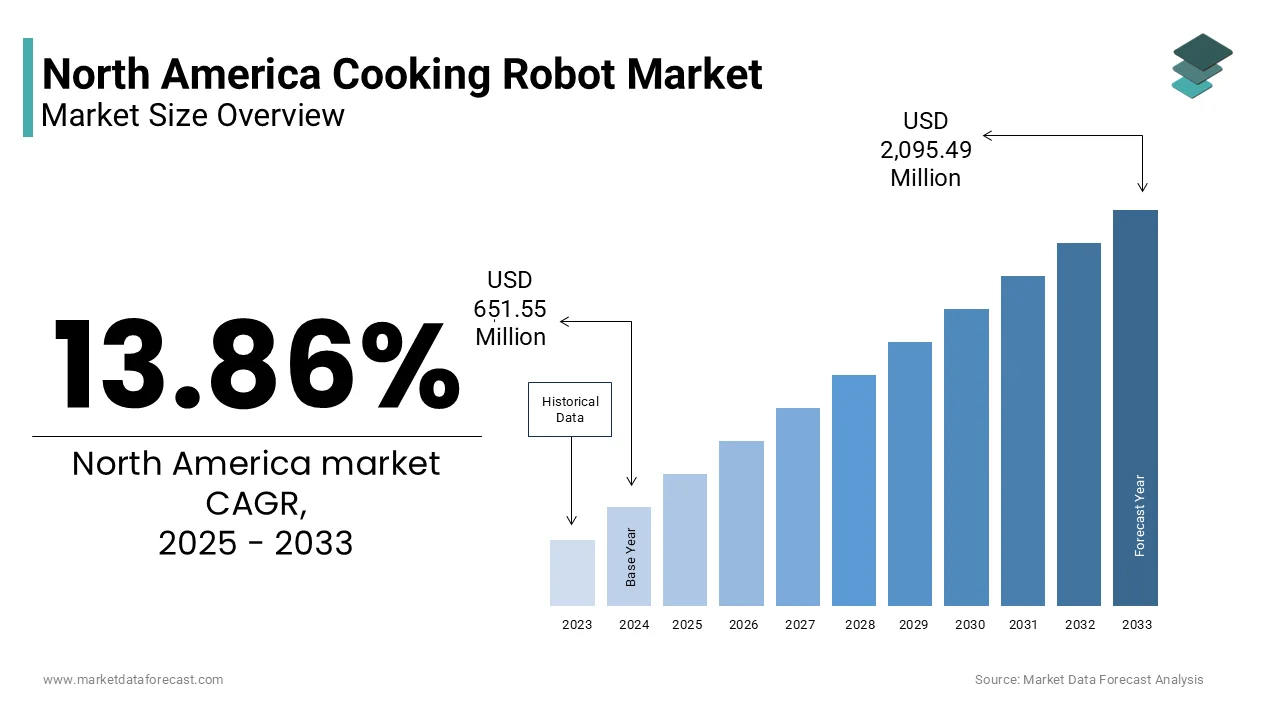
The cooking robot is the ecosystem of automated, electromechanical systems designed to perform culinary tasks such as chopping, stirring, heating, seasoning, and plating with minimal human intervention. These machines integrate robotics, artificial intelligence, and thermal control systems to replicate complex cooking techniques across domestic, commercial, and institutional environments. As per the Association for Advancing Automation, North America witnessed a 34% increase in non-industrial robotic deployments in service sectors between 2020 and 2023, with food preparation emerging as a high-growth application.
MARKET DRIVERS
Labor Shortages in the Food Service Industry
The persistent and deepening labor crisis in the food service and hospitality sectors is propelling the growth of the North America cooking robot market. Restaurants, fast-casual chains, and catering operations face unprecedented difficulties in recruiting and retaining skilled kitchen staff, a trend that has intensified since 2020. As per the National Restaurant Association, the U.S. restaurant industry operated with 480,000 fewer employees in 2023 than in February 2020, despite rising consumer demand. In commercial kitchens, robotic systems can operate continuously without fatigue, ensuring consistent output during peak hours. Miso Robotics, a developer of kitchen automation solutions, reported that its Flippy robot reduced fry station labor requirements by up to 50% in pilot deployments at White Castle and CaliBurger locations. Furthermore, training new employees on robotic interfaces is significantly faster than teaching culinary techniques from scratch, enabling quicker onboarding. The U.S. Department of Agriculture also noted that labor costs now account for nearly 35% of total operating expenses in full-service restaurants, up from 28% in 2019, making automation an attractive cost-mitigation strategy.
Urbanization and Changing Consumer Lifestyles
The transformation of urban living patterns and evolving consumer behaviors are significantly leveraging the growth of the North America cooking robot market. According to the U.S. Census Bureau, the average American spent just 37 minutes per day on meal preparation in 2023, a 15% decline from 2015, reflecting growing time scarcity among working professionals and dual-income families. Devices such as June Oven and Thermomix enable users to execute complex recipes with minimal effort, combining weighing, heating, stirring, and timing functions in a single appliance. The appeal is particularly strong among millennials and Gen Z consumers, 62% of whom, as per a 2023 Pew Research Center survey, expressed interest in smart kitchen technologies that reduce cooking time. Additionally, the rise of micro-kitchens and compact urban housing where 44% of new residential units in major U.S. cities are under 800 square feet, according to the Urban Land Institute limits space for traditional appliances, favoring multifunctional robotic units.
MARKET RESTRAINTS
High Initial Investment and Cost Sensitivity
The high upfront cost associated with acquisition and integration is solely limiting the growth of the North America cooking robot market. Commercial-grade robotic systems, such as those developed by Miso Robotics or Rotimatic for flatbread preparation, often carry price tags exceeding $30,000, placing them beyond the financial reach of many small and mid-sized restaurants. Even consumer models, like the $1,000+ Thermomix or $600 June Oven, represent a substantial investment for average households, particularly when competing with lower-cost alternatives such as air fryers or smart ovens. According to the U.S. Bureau of Economic Analysis, median disposable personal income in the U.S. was $58,000 in 2023, with many consumers prioritizing essential expenditures over premium kitchen automation. A 2022 study by Cornell University’s School of Hotel Administration revealed that 41% of restaurants that piloted kitchen robots discontinued use within a year due to unanticipated maintenance and compatibility issues. In Canada, where small businesses account for 98% of all food service establishments as reported by Innovation, Science and Economic Development Canada, affordability remains a critical barrier.
Limited Culinary Flexibility and Consumer Skepticism
The perceived limitations in culinary adaptability and widespread consumer skepticism about machine-prepared food is to hamper the growth of the North America cooking robot market. Many existing systems are optimized for specific tasks such as frying, grilling, or blending rather than the nuanced, improvisational nature of traditional cooking. As per a 2023 consumer sentiment analysis by the Food Marketing Institute, 57% of U.S. adults believe that robotic cooking lacks the "human touch" necessary for flavor development and emotional satisfaction in culturally significant dishes. Additionally, maintenance and cleaning protocols for robotic units are often more labor-intensive than anticipated, undermining efficiency claims. The absence of standardized safety certifications for autonomous kitchen robots also fuels hesitation; Underwriters Laboratories has yet to establish a dedicated category for fully automated cooking systems, leaving liability concerns unresolved.
MARKET OPPORTUNITIES
Integration with Smart Home and IoT Ecosystems
The smart home and Internet of Things (IoT) platforms integrated with the seamless interoperability with other connected devices is solely creating new opportunities for the growth of the North America cooking robot market. Consumers increasingly expect kitchen appliances to integrate with voice assistants, mobile apps, and home automation systems such as Apple HomeKit, Google Home, and Amazon Alexa. Cooking robots that offer API access and cloud-based recipe management are well-positioned to become central nodes in the digital household. According to the Consumer Technology Association, 72% of U.S. homes had at least one smart home device in 2023, creating a ready infrastructure for robotic kitchen adoption. Companies like June Life Inc. have already capitalized on this trend by allowing users to monitor cooking progress remotely via smartphone and receive AI-generated recommendations based on dietary preferences. In institutional settings, IoT-enabled cooking systems allow facility managers to monitor energy use, track equipment performance, and schedule maintenance in real time. The U.S. Department of Energy has identified smart kitchens as a key component of future energy-efficient buildings, with potential reductions in electricity consumption through optimized cooking cycles.
Expansion into Non-Residential and Institutional Applications
The expansion of cooking robots into non-residential domains such as healthcare facilities, corporate cafeterias, university campuses, and senior living communities is also to expand the growth of the North America cooking robot market. These institutions face unique challenges, including standardized meal delivery, dietary compliance, and staffing constraints, all of which robotic systems are uniquely suited to address. In healthcare, for example, precise portion control and allergen management are critical; a 2023 report by the Agency for Healthcare Research and Quality found that 12% of hospital food service errors were related to incorrect dietary assignments, a risk that automated cooking can mitigate. Companies like Pryon Foods and FoodChainer are deploying robotic kitchens in senior care centers across Florida and Ontario, where consistent, nutritionally balanced meals are essential for resident well-being. The U.S. Department of Education reported that over 1,200 colleges and universities operate on-campus dining services, representing a vast, underpenetrated market. In corporate environments, companies such as Google and Salesforce have experimented with robotic cafés to enhance employee experience and reduce operational overhead.
MARKET CHALLENGES
Technological Complexity and Maintenance Requirements
The operational complexity of cooking robots presents a significant challenge in environments where technical expertise is also to hamper the growth of the North America cooking robot market. These systems rely on intricate combinations of mechanical actuators, thermal sensors, AI algorithms, and software interfaces, all of which require regular calibration and troubleshooting. A 2023 field study by the Massachusetts Institute of Technology’s Mechanical Engineering Department found that robotic kitchen units experienced an average of 2.3 software glitches per month, including misaligned utensil movements, incorrect temperature readings, and failed recipe executions. Maintenance is further complicated by the lack of standardized repair protocols; most manufacturers provide proprietary diagnostic tools, limiting third-party servicing options. The U.S. Bureau of Labor Statistics notes that only 12% of HVAC and appliance technicians have formal training in robotics, creating a skills gap in after-sales support. The National Sanitation Foundation has not yet established a certification standard for robotic kitchen sanitation, leaving food safety concerns unaddressed.
Regulatory and Food Safety Compliance Uncertainty
The absence of clear regulatory frameworks governing autonomous food preparation poses a major challenge for the North America cooking robot market. Unlike traditional kitchen equipment, fully automated systems that handle raw ingredients, apply heat, and serve meals operate in a legal gray area with respect to health codes and liability. The U.S. Food and Drug Administration does not currently classify cooking robots as either food equipment or robotics, resulting in inconsistent oversight across jurisdictions. The National Sanitation Foundation International, a leading standards developer, confirmed in 2023 that no consensus standard exists for evaluating the food contact safety, cross-contamination risks, or pathogen elimination efficacy of robotic cooking units. This ambiguity affects insurance coverage, municipal permitting, and health department approvals. For example, in 2022, the Los Angeles County Department of Public Health delayed the deployment of a robotic café due to unresolved questions about handwashing equivalency and temperature monitoring. Similarly, in Canada, the Canadian Food Inspection Agency has not issued guidelines for AI-driven food handling, creating uncertainty for operators.
REPORT COVERAGE
| REPORT METRIC | DETAILS |
| Market Size Available | 2025 to 2034 |
| Base Year | 2025 |
| Forecast Period | 2026 to 2034 |
| CAGR | 13.86% |
| Segments Covered | By Robot Type, Application, End User, and Region |
| Various Analyses Covered | Regional & Country Level Analysis, Segment-Level Analysis, DROC, PESTLE Analysis, Porter’s Five Forces Analysis, Competitive Landscape, Analyst Overview on Investment Opportunities |
| Regions Covered | The United States, Canada, Mexico, and Rest of North America |
| Market Leaders Profiled | Cafe X Technologies, Inc., Chowbotics, Inc., Creator, Miso Robotics, Inc. (Cali Group, Inc), Picnic and Wilkinson Baking Company, and others |
SEGMENTAL ANALYSIS
By Robot Type Insights
The 6-axis robot segment was accounted in holding a dominant share of the North America cooking robot market in 2025 with the superior dexterity and adaptability in multi-step food preparation. These robots are capable of executing intricate cooking sequences, including sautéing, deglazing, and plating, with high repeatability. According to a 2023 technical assessment by the Robotics Industries Association, 6-axis arms demonstrated a 94% success rate in transferring food items between pans without spillage, significantly outperforming Cartesian and SCARA systems in fluid motion tasks. Additionally, advancements in AI-powered motion planning have enhanced their ability to handle variable inputs; a study by MIT’s Computer Science and Artificial Intelligence Laboratory found that machine learning algorithms improved the precision of 6-axis robotic spatula movements by 38% over six months of iterative training.
The delta robot segment is likely to grow with an expected CAGR of 18.3% from 2026 to 2034 with the Delta robots’ unmatched performance in high-speed ingredient dispensing and pick-and-place operations. With parallel kinematic structures enabling accelerations exceeding 20 G, these robots can portion sauces, place toppings, or transfer prepped ingredients at rates surpassing 200 cycles per minute. As per a 2022 performance benchmark by the National Institute of Standards and Technology, Delta robots achieved 99.2% accuracy in dispensing 5-gram portions of condiments across 10,000 trials, a level of consistency unattainable by human workers. This precision is particularly valuable in fast-food chains and automated kiosks where uniformity impacts brand integrity and cost control. For example, Miso Robotics has integrated Delta-style mechanisms into its "Sally" salad robot to dispense fresh ingredients with minimal cross-contamination. Additionally, their compact design and ceiling-mounted configuration save valuable floor space in commercial kitchens, a critical consideration in urban locations where real estate costs are high.
By Application Insights
The multi-cuisine making segment was the largest and held 38.2% of the North America cooking robot market share in 2025 with the growing demand for versatile robotic systems capable of preparing diverse dishes across culinary traditions from stir-fries and curries to pasta and stews within a single unit. The rising consumer and commercial demand for culinary variety and menu flexibility is also to enhance the growth of the segment. In a 2023 survey conducted by the National Restaurant Association, 71% of diners expressed a preference for restaurants offering globally inspired dishes, with Asian, Mediterranean, and Latin cuisines ranking highest in popularity. Companies like Thermoplan and Rotimatic have demonstrated success in automating culturally specific dishes, with Rotimatic selling over 50,000 units in North America by 2023 for automated flatbread preparation, a foundational element in Indian and Middle Eastern meals. The integration of cloud-based recipe libraries further enhances versatility, with platforms like June Oven offering access to over 1,000 chef-curated dishes.
The salad making segment is lucratively to grow with a projected CAGR of 19.7% during the forecast period owing to the increasing demand for fresh, ready-to-eat meals with minimal human handling. As consumers become more aware of food safety and hygiene, automated salad dispensers offer a contactless, contamination-controlled alternative to traditional salad bars. Companies like Chowbotics (now part of DoorDash) have deployed "Sally" robots in hospitals, airports, and universities, where they dispense fresh ingredients into bowls with precision and consistency. A 2023 study by the University of California, Davis found that robotic salad dispensers reduced cross-contamination incidents by 64% compared to manual preparation. Additionally, customization is a major appeal; Sally allows users to select from 32 ingredients via touchscreen, catering to dietary restrictions and personal taste.
By End User Insights
The commercial segment was accounted in holding a prominent share of North America cooking robot market share in 2025 owing to the rising need to reduce labor dependency in high-turnover environments. For example, White Castle implemented Miso Robotics’ Flippy to manage fry stations, reducing labor requirements by up to 50% during peak hours. The National Restaurant Association reports that labor and food costs now constitute 62% of total operating expenses, up from 54% in 2019, making automation a strategic necessity. Furthermore, chain operators require brand consistency across locations, which robotic systems ensure by executing recipes with exact precision.
The residential segment is expected to grow with a CAGR of 16.8% from 2026 to 2034 with the growing consumer appetite for convenience and intelligent kitchen ecosystems. Devices like the June Oven and Ninja Foodi Smart Cooker combine AI, cameras, and automated cooking programs to guide users through recipes with minimal effort. Additionally, the rise of single-person households 36% of all U.S. households in 2023, according to the U.S. Census Bureau has increased demand for small-batch, efficient cooking solutions. Integration with voice assistants and mobile apps further enhances usability, allowing remote monitoring and control.
REGIONAL ANALYSIS
United States
The United States was the largest contributor of the North America cooking robot market by capturing 74.3% of the share in 2025 with a confluence of technological innovation, venture capital investment, and a vast commercial food service sector eager to adopt automation. The country hosts the majority of leading cooking robot developers, including Miso Robotics, Chowbotics, and June Life, all of which have secured multimillion-dollar funding from Silicon Valley investors. The U.S. Bureau of Labor Statistics reports that the accommodation and food services sector faced a labor deficit of over 700,000 workers in 2023, creating a compelling economic case for automation. Cities like San Francisco, New York, and Chicago have become testbeds for robotic kitchens in fast-casual chains and delivery-only concepts. Additionally, federal initiatives such as the National AI Initiative have supported R&D in autonomous systems, while private-sector partnerships with universities have accelerated prototyping.
Canada
Canada cooking robot market held 18.2% of the share in 2025. While smaller in scale, Canada has emerged as a strategic adopter of cooking automation in urban centers and institutional settings. In response, hospitals and universities in Toronto, Vancouver, and Montreal have piloted robotic salad and meal prep stations to improve efficiency and hygiene. Canadian consumers are also increasingly receptive to smart appliances; a 2023 survey by the Canadian Home Builders’ Association found that 52% of new homeowners prioritized smart kitchen features. Moreover, the federal government has funded AI research through the Pan-Canadian Artificial Intelligence Strategy, indirectly supporting culinary robotics development.
COMPETITIVE LANDSCAPE
The competitive dynamics of the North America cooking robot market are shaped by a blend of technological innovation, niche specialization, and strategic positioning across commercial and residential domains. Established players and agile startups alike are vying to define the future of automated culinary experiences, with differentiation emerging through design sophistication, AI integration, and application specificity. Incumbents leverage deep industry knowledge and partnerships with food chains to embed their systems into high-traffic environments, while newer entrants focus on user-centric interfaces and smart home compatibility to capture consumer interest. The absence of dominant standardization allows for diverse technological approaches, from articulated robotic arms to modular dispensing units, fostering a fragmented yet vibrant innovation landscape. Brand trust, ease of maintenance, and perceived culinary authenticity play pivotal roles in customer adoption, particularly in settings where food quality and safety are paramount. Companies are increasingly investing in aesthetic design and silent operation to align with both commercial efficiency and domestic lifestyle expectations.
KEY MARKET PLAYERS
Key players in the North America cooking robot market are
- Cafe X Technologies, Inc.
- Chowbotics, Inc.
- Creator
- Miso Robotics, Inc. (Cali Group, Inc.)
- Picnic
- Wilkinson Baking Company
TOP PLAYERS IN THE MARKET
- Miso Robotics has emerged as a pioneering force in autonomous kitchen technology, specializing in AI-driven robotic systems designed for commercial food service environments. The company’s flagship product, Flippy, integrates computer vision, deep learning, and robotic manipulation to automate frying, grilling, and food assembly tasks in fast-casual restaurants. By focusing on high-precision, repetitive operations, Miso Robotics enhances kitchen efficiency, consistency, and safety while reducing reliance on manual labor. Its technology is engineered to adapt to dynamic kitchen workflows, learning from real-time data to improve performance over time. Miso Robotics has positioned itself at the forefront of culinary automation by influencing global perceptions of how robotics can transform food preparation in high-volume settings.
- June Life Inc. has redefined the residential cooking robot landscape by blending precision engineering with intuitive user experience. The company’s June Oven combines a multi-function smart oven with AI-powered food recognition, enabling users to cook a wide range of dishes with minimal input. Through embedded cameras, temperature sensors, and cloud-based recipe intelligence, the device autonomously adjusts cooking parameters for optimal results. June Life emphasizes seamless integration into modern smart homes, offering app-based control and voice compatibility.
- Chowbotics gained prominence with Sally, an automated fresh food dispenser capable of assembling customized salads and grain bowls with minimal human intervention. Designed for institutional and commercial use, Sally prioritizes hygiene, speed, and dietary customization, making it ideal for hospitals, universities, and corporate cafeterias. The company’s emphasis on contactless food service aligns with evolving health and safety expectations in post-pandemic environments. After its acquisition by DoorDash, Sally’s technology was integrated into broader food automation and delivery logistics, expanding its operational scope beyond standalone units. Chowbotics’ innovation lies in its modular ingredient system and intuitive interface, which empower users to build meals based on personal preferences and dietary needs. Its presence has catalyzed interest in robotic nutrition solutions by influencing how automated systems are deployed in non-traditional dining environments globally.
TOP STRATEGIES USED BY KEY PLAYERS
The strategic partnerships with established food service operators and retail chains to validate and scale their technology in real-world environments. Companies demonstrate operational reliability and gather critical user feedback by accelerating product refinement and market acceptance. These alliances also serve as powerful endorsements, enhancing credibility among risk-averse buyers.
The integration of AI and machine learning capabilities into robotic platforms by enabling adaptive cooking, real-time error correction, and personalized recipe optimization. Firms are investing heavily in proprietary software stacks that allow robots to recognize food states, adjust cooking parameters, and learn from repeated tasks, thereby improving performance over time and reducing dependency on manual programming.
RECENT HAPPENINGS IN THE MARKET
- In January 2022, Miso Robotics partnered with White Castle to deploy Flippy 2 in multiple locations across the Midwest, enhancing kitchen automation in frying and grilling operations. This collaboration marked a significant step in scaling robotic integration within established fast-food chains.
- In March 2023, June Life Inc. launched an updated version of the June Oven with expanded AI recipe capabilities and enhanced voice command functionality with its position in the premium smart kitchen appliance segment.
- In August 2021, DoorDash completed the acquisition of Chowbotics, integrating Sally the salad robot into its broader food automation and delivery infrastructure to explore new models of contactless meal service.
MARKET SEGMENTATION
This research report on the North America cooking robot market has been segmented and sub-segmented based on the following categories.
By Robot Type
- Cartesian
- Selective Compliance Assembly Robot Arm (SCARA)
- 6-Axis
- Cylindrical
- Delta
- Others
By Application
- Pizza Making
- Cocktail and Coffee
- Salad Making
- Burger and Sandwich Making
- Multi-Cuisine Making
By End User
- Residential
- Commercial
- Fast Food Restaurants
- Fine Dining Restaurants
- Cafe
- Contracted Food Services
- Ghost Kitchens
- Food Trucks
- Others
By Country
- The United States
- Canada
- Rest of North America