- Product Description Description
- Table of Contents TOC
- List of Table & Figure LOT
- Get Free Sample PDF Sample PDF
Market Size, 2025
$1.24 BnMarket Estimate, 2026
$1.36 BnMarket Forecast, 2034
$2.86 BnCAGR, 2026–2034
9.75%North America Direct-to-Consumer Laboratory Testing Market Summary
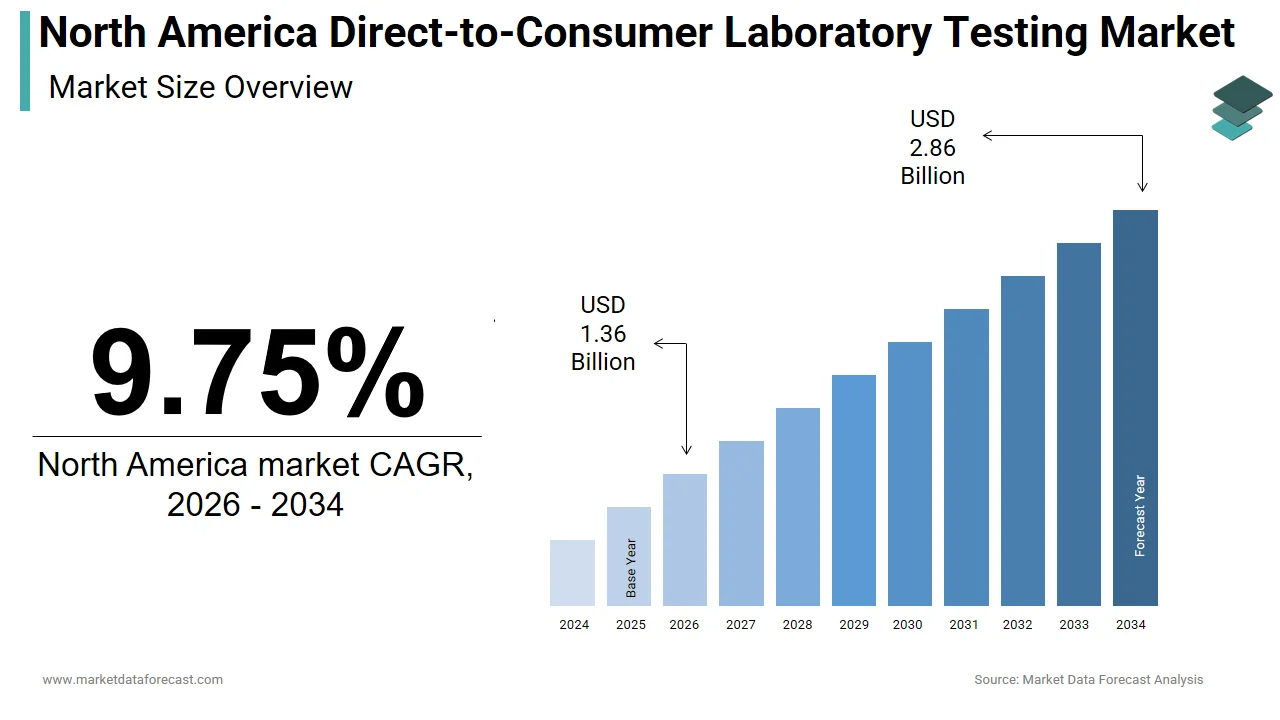
The North America direct-to-consumer laboratory testing market was valued at USD 1.24 billion in 2025, is estimated to reach USD 1.36 billion in 2026, and is projected to reach USD 2.86 billion by 2034, growing at a CAGR of 9.75% from 2026 to 2034. Direct-to-consumer laboratory testing refers to diagnostic services that empower individuals to independently access and manage their health testing needs without traditional healthcare provider involvement, driven by rising healthcare consumerism and digital health innovations.
Key Market Trends & Insights
- United States held the dominant share of the North American market in 2025.
- Canada is expected to witness steady growth throughout the forecast period.
- Based on test type, the genetic testing was the leading segment in 2025.
- Based on sample type, the saliva-based testing segment accounted for the largest share in 2025.
- Based on distribution channel, the online direct sales remained the top segment in 2025.
Market Size & Forecast
- 2025 Market Size: USD 1.24 Billion
- 2026 Estimated Market Size: USD 1.36 Billion
- 2034 Projected Market Size: USD 2.86 Billion
- CAGR (2026 to 2034): 9.75%
- United States: Largest market in 2025
- Canada: Steady growth region
North America Direct-to-Consumer Laboratory Testing Market Size
The North America direct-to-consumer laboratory testing market was valued at USD 1.24 billion in 2025, is estimated to reach USD 1.36 billion in 2026, and is projected to reach USD 2.86 billion by 2034, growing at a CAGR of 9.75% from 2026 to 2034.
Direct-to-consumer laboratory testing refers to the medical diagnostic services that enable individuals to access laboratory testing without requiring traditional physician ordering or healthcare provider intermediation. This innovative healthcare delivery model allows consumers to independently purchase and utilize various diagnostic tests, including blood work, genetic analysis, infectious disease screening, and wellness monitoring services, through online platforms, retail outlets, and specialized testing centers. The market operates through sophisticated logistics networks that facilitate sample collection, transportation to certified laboratories, and secure result delivery directly to consumers via digital platforms and mobile applications. The market's operational framework involves comprehensive quality assurance protocols, certified laboratory operations, and secure data management systems that ensure test accuracy and consumer privacy protection. The convergence of telemedicine technologies, digital health platforms, and consumer-driven healthcare preferences has fundamentally transformed how individuals access diagnostic services and manage their health information.
MARKET DRIVERS
Healthcare Consumerism and Patient Empowerment
The increase in healthcare consumerism and patient empowerment initiatives has emerged as the primary catalyst driving demand for direct-to-consumer laboratory testing services throughout North America, as individuals seek greater control over their health information and diagnostic decision-making processes. The evolution toward patient-centered healthcare models and increased consumer involvement in medical decision-making has created unprecedented demand for accessible, convenient diagnostic services that provide immediate health insights without traditional healthcare system intermediation. A notable portion of American consumers now actively research their health conditions and treatment options online before consulting healthcare providers, creating substantial demand for independent diagnostic capabilities that support informed decision-making and health management. The trend toward high-deductible health plans and consumer-directed healthcare accounts has increased financial responsibility for healthcare expenses, prompting consumers to seek cost-effective diagnostic alternatives that eliminate physician visit costs and provide transparent pricing for laboratory services. Besides, the increasing prevalence of chronic conditions and the critical importance of regular health monitoring have created sustained demand for convenient, accessible testing services that enable ongoing health tracking and early intervention opportunities. Furthermore, the aging population and increased life expectancy have created a growing demand for preventive health screening and wellness monitoring services that provide early detection capabilities and support healthy aging initiatives.
Technological Innovation and Digital Health Integration
The advancement in laboratory technology and digital health integration has created unprecedented opportunities within North America's direct-to-consumer laboratory testing market, as innovative platforms and sophisticated diagnostic capabilities enable convenient, accurate, and comprehensive health monitoring services that meet evolving consumer expectations and healthcare requirements. Modern direct-to-consumer laboratory testing platforms incorporate advanced sample collection systems, automated processing technologies, and sophisticated data analytics that deliver laboratory-quality results with exceptional accuracy and reliability while maintaining consumer-friendly interfaces and convenient access methods. The development of at-home sample collection kits, mobile phlebotomy services, and digital result delivery platforms has transformed the laboratory testing experience, enabling consumers to access comprehensive diagnostic services without visiting healthcare facilities or traditional laboratory locations. Additionally, the integration of artificial intelligence and machine learning algorithms within laboratory platforms enables sophisticated result interpretation, trend analysis, and personalized health recommendations that enhance consumer understanding and health management capabilities. The emergence of genetic testing capabilities and personalized medicine applications has created new service categories and revenue opportunities for direct-to-consumer laboratory testing companies that can provide comprehensive genomic analysis and personalized health insights. These technological advancements have established direct-to-consumer laboratory testing as a mainstream healthcare service that meets contemporary consumer preferences and healthcare delivery requirements.
MARKET RESTRAINTS
Regulatory Complexity and Medical Oversight Requirements
The regulatory complexity and medical oversight requirements associated with direct-to-consumer laboratory testing services have emerged as significant constraints within North America's market, creating compliance costs and operational challenges that limit market expansion and service innovation. The intersection of laboratory regulations, medical device requirements, and healthcare privacy laws creates extensive compliance obligations that require substantial investment in regulatory affairs, quality assurance, and legal expertise to ensure proper market authorization and ongoing operational compliance. In North America, direct-to-consumer laboratory testing companies must navigate many different regulatory frameworks spanning federal, state, and local jurisdictions, creating substantial administrative burden and compliance costs that impact market accessibility and service development. The requirement for certified laboratory operations, qualified personnel, and comprehensive quality management systems creates operational complexity and infrastructure requirements that increase service delivery costs and create barriers to market entry for smaller companies. Additionally, the requirement for medical oversight and result interpretation services creates operational challenges and liability exposure that necessitate comprehensive insurance coverage and risk management protocols. Furthermore, the trend toward increasingly restrictive regulations and enhanced oversight requirements has created additional compliance obligations and service limitations that constrain market growth and innovation potential.
Insurance Coverage Limitations and Reimbursement Challenges
The limitations in insurance coverage and reimbursement challenges for direct-to-consumer laboratory testing services have created significant financial barriers that constrain market adoption and limit accessibility for price-sensitive consumers throughout North America. Traditional health insurance models and reimbursement frameworks have not adapted to accommodate direct-to-consumer laboratory testing services, creating substantial out-of-pocket expenses and financial burden for consumers seeking independent diagnostic capabilities. The complexity of insurance reimbursement processes and the lack of standardized billing codes for direct-to-consumer laboratory services create administrative challenges and financial uncertainty that limit market growth and consumer adoption. Additionally, the requirement for separate physician consultation and result interpretation services to achieve insurance coverage creates additional costs and procedural complexity that reduce the convenience and cost-effectiveness advantages of direct-to-consumer laboratory testing. These insurance and reimbursement challenges create significant market limitations and constrain adoption rates among potential consumers who recognize the value of independent diagnostic services but cannot justify the substantial out-of-pocket expenses.
MARKET OPPORTUNITIES
Preventive Health and Wellness Monitoring Applications
The growth in preventive health awareness and wellness monitoring applications has created unprecedented opportunities within North America's direct-to-consumer laboratory testing market, as consumers increasingly seek proactive health management solutions that provide early detection capabilities and support healthy lifestyle choices. The convergence of wellness culture, preventive medicine initiatives, and consumer-driven health management has created substantial demand for accessible diagnostic services that enable ongoing health monitoring and early intervention opportunities without traditional healthcare system involvement. The increasing prevalence of lifestyle-related chronic conditions and the critical importance of early detection have created sustained demand for convenient, accessible testing services that enable ongoing health tracking and intervention opportunities. Additionally, the integration of wellness monitoring with fitness tracking, nutrition planning, and lifestyle coaching services has created opportunities for comprehensive health management platforms that utilize laboratory testing as foundational diagnostic capabilities. Furthermore, the trend toward personalized wellness programs and individualized health optimization has created demand for comprehensive laboratory testing services that provide detailed biomarker analysis and personalized health insights that support customized wellness strategies and lifestyle modifications.
Corporate Wellness and Employer-Sponsored Health Programs
The expansion of corporate wellness initiatives and employer-sponsored health programs has created unprecedented growth opportunities within North America's direct-to-consumer laboratory testing market, as organizations seek cost-effective health monitoring solutions that support employee wellness, productivity, and healthcare cost management. The increasing recognition of workplace wellness as a critical component of employee retention, productivity, and healthcare cost control has driven substantial investment in accessible health monitoring services that can be easily integrated into corporate wellness programs and employee benefits packages. The trend toward self-insured employer health plans and consumer-directed healthcare benefits has increased organizational responsibility for healthcare cost management and employee health outcomes, creating demand for accessible diagnostic services that support preventive care and early intervention strategies. Additionally, the integration of laboratory testing with employee wellness platforms, health risk assessments, and personalized wellness recommendations has enabled comprehensive corporate wellness solutions that provide measurable health outcomes and return on investment for participating organizations. These corporate wellness opportunities have established sustainable growth trajectories and premium service categories that address evolving employer needs and employee health management requirements.
MARKET CHALLENGES
Result Interpretation and Clinical Guidance Limitations
The complexity of medical result interpretation and limited clinical guidance capabilities represents a significant challenge within North America's direct-to-consumer laboratory testing market, creating consumer confusion, potential health risks, and liability exposure that impact market credibility and service effectiveness. The absence of traditional physician involvement and clinical oversight in direct-to-consumer laboratory testing creates substantial challenges in result interpretation, clinical significance assessment, and appropriate follow-up care recommendations that can lead to consumer anxiety, misinterpretation, and inappropriate healthcare decisions. The complexity of medical terminology, reference ranges, and clinical correlations requires specialized knowledge and training that many consumers lack, creating potential for misinterpretation and inappropriate self-diagnosis or treatment decisions. Additionally, the requirement for proper result communication, risk assessment, and follow-up care recommendations creates operational challenges and liability exposure that necessitate comprehensive service protocols and risk management strategies. Furthermore, the trend toward increasingly complex testing panels and comprehensive health assessments has increased the need for sophisticated result interpretation and personalized clinical recommendations that require advanced medical expertise and comprehensive service capabilities.
Data Privacy and Security Concerns
The data privacy and security concerns associated with direct-to-consumer laboratory testing services have emerged as a critical challenge within North America's market, creating consumer hesitancy, regulatory scrutiny, and operational complexity that impact market adoption and service delivery capabilities. The collection, storage, and transmission of sensitive health information and genetic data create substantial privacy risks and security vulnerabilities that require comprehensive protection measures and regulatory compliance that increase operational costs and complexity. The complexity of healthcare privacy regulations, including HIPAA, GDPR, and state-specific privacy laws, creates extensive compliance requirements and operational challenges that necessitate substantial investment in security infrastructure and privacy management systems. Additionally, the requirement for secure data transmission, encrypted storage, and comprehensive access controls creates operational complexity and technical requirements that increase service delivery costs and create barriers to market entry for smaller companies. These privacy and security challenges create operational difficulties and financial risks that constrain market growth and consumer adoption while increasing regulatory scrutiny and compliance requirements.
REPORT COVERAGE
| REPORT METRIC | DETAILS |
| Market Size Available | 2025 to 2034 |
| Base Year | 2025 |
| Forecast Period | 2026 to 2034 |
| Segments Covered | By Test Type, Sample Type, Distribution Channel, and Region. |
| Various Analyses Covered | Global, Regional and Country-Level Analysis, Segment-Level Analysis, Drivers, Restraints, Opportunities, Challenges; PESTLE Analysis; Porter’s Five Forces Analysis, Competitive Landscape, Analyst Overview of Investment Opportunities |
| Countries Covered | United States, Canada, Mexico, Rest of North America |
| Market Leaders Profiled | Any Lab Test Now Inc., DirectLabs, LLC, 23andMe Inc., Quest Diagnostics Inc., EasyDNA, Everlywell, Inc., LabCorp Inc., Genesis Healthcare Co., and Others. |
SEGMENT ANALYSIS
By Test Type Insights
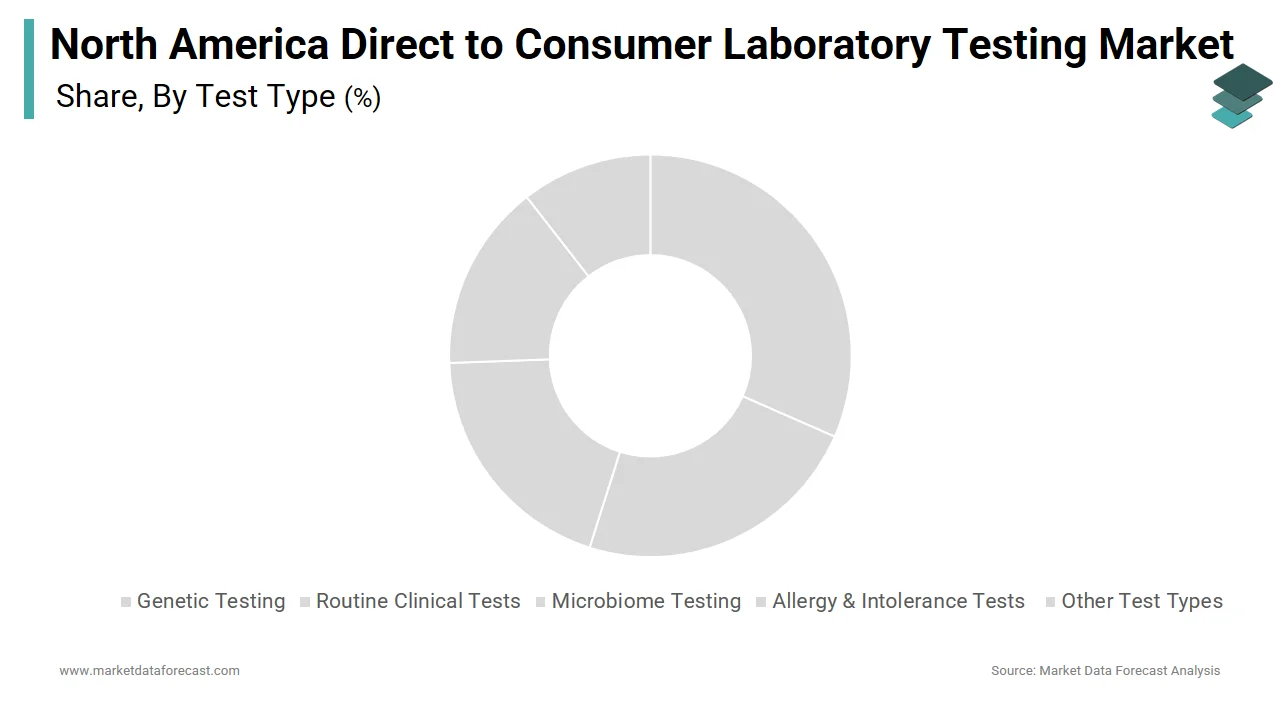
The genetic testing segment was the dominant part within the North America direct-to-consumer laboratory testing market by commanding a 45.7% of the total share in 2024. This segment's lead position is due to the substantial consumer interest in ancestry information, health predisposition insights, and personalized wellness recommendations that genetic testing services provide through accessible, comprehensive genomic analysis platforms.
The exceptional consumer interest in ancestry information and genealogical discovery has created sustained demand for direct-to-consumer genetic testing services throughout North America, as individuals seek to understand their heritage, connect with distant relatives, and explore family history through sophisticated DNA analysis capabilities. The proliferation of genealogy websites, family tree building platforms, and historical record databases has created unprecedented consumer awareness and engagement with genetic testing services that provide detailed ancestry information and relative matching capabilities. The integration of genetic testing with social networking platforms and family connection services has enhanced user engagement and created viral marketing opportunities that drive continued consumer adoption and market expansion. Additionally, the development of advanced ethnicity estimation algorithms and regional ancestry mapping has enhanced the accuracy and detail of ancestry information provided to consumers, creating strong satisfaction rates and repeat usage for comprehensive genetic testing services. Furthermore, the trend toward family reunions, heritage tourism, and cultural identity exploration has increased the social and emotional value of genetic ancestry testing, making these services essential for genealogy enthusiasts and family history researchers.
The substantial consumer interest in health predisposition information and personalized medicine applications has created unprecedented demand for genetic testing services that provide insights into disease risk, medication response, and personalized health recommendations that support preventive care and wellness management. The evolution toward personalized healthcare and precision medicine has increased consumer awareness of genetic factors in health outcomes and created demand for accessible genetic testing services that provide actionable health information without traditional healthcare system involvement. The integration of genetic testing with digital health platforms and wellness management systems has enabled sophisticated health insights and personalized recommendations that enhance consumer understanding and support proactive health management strategies. Additionally, the development of pharmacogenomic testing capabilities that provide medication response information has created new service categories and revenue opportunities for genetic testing companies that can offer personalized treatment recommendations and drug interaction insights. These health applications have established genetic testing as a mainstream healthcare service that meets contemporary consumer preferences for personalized health information and preventive care capabilities.
The microbiome testing segment represents the fastest-growing segment within the North America direct-to-consumer laboratory testing market and is projected to expand at a CAGR of 15.4% from 2026 to 2034. This remarkable growth is because of increasing consumer interest in gut health, personalized nutrition, and the human microbiome's role in overall wellness and disease prevention.
The substantial increase in consumer awareness regarding gut health and digestive wellness has created unprecedented demand for microbiome testing services throughout North America, as individuals seek to understand their intestinal bacterial composition and optimize digestive health through personalized dietary and lifestyle recommendations. The convergence of scientific research highlighting the microbiome's role in immune function, mental health, and chronic disease prevention has created substantial consumer interest in comprehensive gut health analysis and personalized wellness recommendations. The integration of microbiome testing with nutrition planning, probiotic supplementation, and lifestyle coaching services has created comprehensive wellness solutions that provide measurable health outcomes and sustained consumer engagement. Additionally, the development of advanced sequencing technologies and bioinformatics analysis has enabled sophisticated microbiome profiling and actionable health insights that enhance consumer understanding and support targeted wellness interventions. These gut health applications have established microbiome testing as an essential component of comprehensive wellness management and preventive healthcare strategies.
The substantial growth in personalized nutrition and wellness applications has created unprecedented opportunities for microbiome testing services throughout North America, as consumers seek evidence-based dietary recommendations and lifestyle modifications that optimize their unique biological profiles and support long-term health outcomes. The evolution toward individualized wellness approaches and precision nutrition has increased consumer demand for scientific insights that guide personalized dietary choices and supplement recommendations based on individual microbiome composition and metabolic characteristics. The integration of microbiome testing with meal planning services, supplement recommendations, and fitness tracking platforms has enabled sophisticated wellness solutions that provide measurable health outcomes and sustained consumer engagement. Additionally, the development of longitudinal microbiome tracking and progress monitoring has enhanced service value and consumer retention by providing ongoing health insights and personalized adjustments to wellness recommendations. These nutrition and wellness applications have established microbiome testing as a premium service category that addresses contemporary consumer preferences for evidence-based, personalized health management and optimization strategies.
By Sample Type Insights
The saliva-based testing segment commanded within the North America direct-to-consumer laboratory testing market by commanding a 53.5% of total share in 2024. This segment's prominence is due to the exceptional convenience, non-invasiveness, and accessibility of saliva collection methods that enable widespread consumer adoption and simplified testing processes without specialized collection procedures or medical supervision.
The exceptional convenience and non-invasive nature of saliva collection has created sustained demand for saliva-based direct-to-consumer laboratory testing services throughout North America, as consumers prefer simple, painless testing methods that can be easily performed at home without specialized equipment or medical assistance. The ease of saliva collection eliminates the need for needle sticks, blood draws, or specialized phlebotomy services that create barriers to testing adoption and increase service delivery costs for consumers and providers. The development of advanced saliva collection devices and stabilization technologies has enabled reliable sample preservation and transportation without refrigeration requirements, creating substantial logistical advantages and reduced service costs compared to blood-based testing approaches. Additionally, the suitability of saliva collection for pediatric testing, elderly populations, and individuals with needle phobia has expanded market reach and created opportunities for family-based testing services and comprehensive health monitoring programs. Furthermore, the trend toward at-home health monitoring and self-service healthcare options has increased consumer preference for convenient, accessible testing methods that eliminate the need for clinical visits and medical supervision.
The exceptional breadth of analytical capabilities and diverse test applications available through saliva-based testing has created substantial demand for saliva collection methods throughout North America's direct-to-consumer laboratory testing market, enabling comprehensive health assessments and genetic analysis through non-invasive sample collection approaches. Modern saliva testing platforms can analyze DNA, RNA, proteins, hormones, and metabolites that provide comprehensive health insights across multiple biological systems and disease categories without requiring invasive blood collection procedures. The development of advanced extraction techniques and analytical platforms has enabled sophisticated genetic testing, hormone analysis, and disease marker detection through saliva samples that provide accuracy comparable to blood-based testing approaches. Additionally, the stability of saliva samples during transportation and storage has enabled expanded testing applications and reduced logistical complexity compared to blood-based testing that requires specialized handling and cold chain transportation. These broad analytical capabilities have established saliva-based testing as a comprehensive solution for diverse health monitoring and diagnostic applications that meet contemporary consumer preferences for convenient, accessible healthcare services.
The blood-based testing segment is the fastest-growing within the North America direct-to-consumer laboratory testing market and is projected to expand at a CAGR of 12.8% from 2026 to 2034. This remarkable growth trajectory reflects increasing consumer demand for comprehensive health monitoring, advanced biomarker analysis, and clinical-grade testing capabilities that require blood sample collection for accurate diagnostic assessment.
The substantial consumer demand for comprehensive health monitoring and advanced biomarker analysis has created unprecedented growth opportunities for blood-based direct-to-consumer laboratory testing services throughout North America, as individuals seek detailed health insights and clinical-grade diagnostic information that require blood sample analysis for accurate assessment and reliable results. The evolution toward preventive healthcare and wellness monitoring has increased consumer interest in comprehensive metabolic panels, cardiovascular risk assessment, and chronic disease screening that provide detailed health status information and early detection capabilities for serious medical conditions. A notable share of American adults express interest in comprehensive cardiovascular health screening that requires blood-based biomarker analysis, creating substantial market demand for clinical-grade testing services that provide actionable health insights and risk assessment capabilities. The integration of blood-based testing with digital health platforms and wellness management systems has enabled sophisticated health monitoring and trend analysis that support proactive health management and preventive care strategies. Additionally, the development of at-home blood collection systems and mobile phlebotomy services has reduced barriers to blood-based testing adoption while maintaining clinical accuracy and comprehensive analytical capabilities. These comprehensive monitoring applications have established blood-based testing as an essential component of modern preventive healthcare and wellness management strategies.
The substantial emphasis on clinical validation and healthcare provider acceptance has created unprecedented growth opportunities for blood-based direct-to-consumer laboratory testing services throughout North America, as consumers and medical professionals increasingly recognize the clinical value and diagnostic accuracy of properly conducted blood-based testing that meets traditional laboratory standards and regulatory requirements. The requirement for clinical-grade testing accuracy and regulatory compliance has increased consumer preference for blood-based testing services that demonstrate proven analytical validity and clinical utility compared to alternative sample types that may have limited analytical capabilities or reduced accuracy. The trend toward integrated healthcare management and coordinated care has increased demand for testing services that provide results acceptable for clinical decision-making and medical record integration without requiring redundant testing or physician-ordered alternatives. Additionally, the development of certified laboratory operations and quality management systems has enabled direct-to-consumer testing companies to achieve clinical validation and regulatory compliance that meets healthcare provider standards and insurance reimbursement requirements. These clinical validation advantages have established blood-based testing as the preferred choice for consumers seeking clinically meaningful health information and healthcare provider acceptance of direct-to-consumer laboratory testing results.
By Distribution Channel Insights
The online direct sales segment was the leading distribution channel within the North America direct-to-consumer laboratory testing market by commanding a substantial portion of the total share in 2025. This segment's position reflects the exceptional convenience, accessibility, and comprehensive product selection available through digital platforms that enable consumers to research, purchase, and manage laboratory testing services without traditional retail intermediaries or healthcare provider involvement.
The exceptional convenience and round-the-clock accessibility of online direct sales channels have created sustained demand for digital purchasing platforms throughout North America's direct-to-consumer laboratory testing market, as consumers prefer flexible shopping experiences that accommodate their schedules and provide immediate access to comprehensive health testing services without geographic limitations or retail operating hours. The ability to research testing options, compare services, and purchase laboratory tests at any time from any location has transformed the consumer experience and eliminated traditional barriers to testing adoption, including retail availability, geographic constraints, and scheduling conflicts. Many of direct-to-consumer laboratory testing purchases now occur through online channels, reflecting strong consumer preference for digital purchasing platforms that provide comprehensive product information and flexible ordering options. The integration of online sales with mobile applications and social media marketing has enhanced consumer engagement and created opportunities for personalized product recommendations and targeted marketing campaigns that drive continued adoption and market expansion. A notable share of consumers prefer online purchasing for healthcare services due to convenience, privacy, and comprehensive product selection compared to traditional retail channels. Besides, the ability to access detailed product information, customer reviews, and educational content through online platforms has enhanced consumer confidence and informed decision-making for complex health testing services. Furthermore, the trend toward e-commerce adoption and digital-first purchasing behavior has increased consumer comfort with online healthcare service purchases and reduced reliance on traditional retail intermediaries.
The exceptional breadth of product selection and price transparency available through online direct sales channels has created substantial demand for digital purchasing platforms throughout North America's direct-to-consumer laboratory testing market, enabling consumers to access comprehensive testing portfolios, compare pricing options, and make informed purchasing decisions based on detailed product information and value propositions. The ability to offer extensive testing catalogs, bundle services, and provide transparent pricing without traditional retail markup has created competitive advantages and consumer value that drive sustained market growth and customer loyalty. The integration of advanced search capabilities, personalized recommendations, and educational content has enhanced consumer understanding and enabled sophisticated product selection based on individual health needs and testing requirements. Additionally, the ability to provide detailed test descriptions, result interpretation guidance, and customer support through digital platforms has enhanced consumer confidence and reduced purchase anxiety for complex health testing services. These selection and transparency advantages have established online direct sales as the preferred distribution channel for modern consumers seeking convenient, affordable, and comprehensive healthcare testing services.
The retail pharmacies and drug stores segment is the fastest-growing distribution channel within the North America direct-to-consumer laboratory testing market and is projected to expand at a CAGR of 14.2% from 2026 to 2034. This growth of the segment is because of increasing consumer preference for convenient, accessible testing services available at familiar retail locations with immediate product availability and professional guidance from pharmacy staff.
The exceptional physical accessibility and immediate product availability offered by retail pharmacy and drug store distribution channels have created unprecedented growth opportunities for direct-to-consumer laboratory testing services throughout North America, as consumers seek convenient access to testing products without waiting for shipping or online order processing while benefiting from familiar retail environments and professional guidance. The extensive geographic presence of pharmacy chains and drug stores creates convenient access points for testing services in communities across diverse geographic regions, eliminating shipping delays and providing immediate product availability for consumers requiring urgent testing or preferring in-person purchasing experiences. The integration of testing services with existing pharmacy operations and trained staff has enabled comprehensive consumer education and product guidance that enhances customer confidence and informed decision-making for complex health testing services. Additionally, the ability to combine testing services with other health and wellness products, prescription medications, and over-the-counter supplements has created opportunities for comprehensive health management and cross-selling that enhance customer value and retail profitability.
The substantial availability of professional guidance and consumer education through retail pharmacy and drug store distribution channels has created unprecedented growth opportunities for direct-to-consumer laboratory testing services throughout North America, as consumers seek informed product selection assistance and comprehensive health information from trained pharmacy staff in familiar retail environments. The presence of licensed pharmacists and trained healthcare professionals in retail settings provides consumers with access to expert guidance, product recommendations, and health information that enhance consumer confidence and informed decision-making for complex testing services. The integration of testing services with existing pharmacy operations has enabled comprehensive health consultations, medication interaction screening, and personalized health recommendations that enhance service value and consumer engagement. Additionally, the ability to provide immediate result interpretation guidance, follow-up care recommendations, and health management support has enhanced the clinical value and consumer satisfaction of pharmacy-based testing services. These professional guidance advantages have established retail pharmacies as premium distribution channels that address contemporary consumer preferences for accessible, expert-supported healthcare services.
COUNTRY-LEVEL ANALYSIS
United States Direct-to-Consumer Laboratory Testing Market Insights
The United States remained the dominant force within the North America direct-to-consumer laboratory testing market by commanding 94.6% of total regional share in 2024. This overwhelming market position reflects the country's massive consumer base, advanced healthcare infrastructure, and progressive regulatory environment that creates substantial demand for innovative healthcare delivery models and accessible diagnostic services.
The United States maintains its position as the premier market within North America due to its enormous consumer population, sophisticated healthcare system, and progressive approach to healthcare innovation that creates sustained demand for direct-to-consumer laboratory testing services and accessible diagnostic solutions. The country's diverse demographic composition and varied healthcare needs create opportunities for specialized testing services and comprehensive health monitoring solutions that address specific population requirements and regional health concerns. The Food and Drug Administration's progressive regulatory framework has enabled rapid market innovation and service expansion while maintaining appropriate safety and quality standards that support consumer confidence and market growth. Additionally, the United States' advanced telecommunications infrastructure and widespread internet connectivity enable sophisticated digital health platforms and online service delivery that enhance consumer accessibility and convenience. The country's robust venture capital investment environment and entrepreneurial ecosystem support innovation in direct-to-consumer laboratory testing technologies and business models that drive market expansion and competitive differentiation. Furthermore, the United States' comprehensive healthcare data infrastructure and research capabilities enable sophisticated testing, analytics, and personalized health insights that attract consumer interest and justify premium pricing for advanced diagnostic services.
Canada Direct-to-Consumer Laboratory Testing Market Insights
Canada represents a major market within North America's direct-to-consumer laboratory testing landscape. This significant market position reflects Canada's universal healthcare system, health-conscious population, and progressive approach to healthcare innovation that creates substantial demand for accessible diagnostic services and preventive health monitoring solutions.
Canada maintains a prominent position within the regional market due to its universal healthcare system, health-conscious population, and progressive regulatory approach that creates unique opportunities for direct-to-consumer laboratory testing services and accessible health monitoring solutions. The country's universal healthcare system creates a unique demand for accessible diagnostic services that complement traditional healthcare delivery and provide additional health monitoring capabilities for individuals seeking comprehensive health information and preventive care services. Health Canada's progressive regulatory framework has enabled market innovation while maintaining appropriate safety and quality standards that support consumer confidence and service accessibility. Additionally, Canada's multicultural population and diverse demographic composition create opportunities for specialized testing services and culturally sensitive health monitoring solutions that address specific population requirements and regional health concerns. Provincial healthcare initiatives and public health programs have promoted preventive care and health monitoring, creating favourable market conditions and consumer awareness for direct-to-consumer laboratory testing services. Furthermore, Canada's strong digital infrastructure and widespread internet connectivity enable sophisticated online health platforms and digital service delivery that enhance consumer accessibility and convenience. The country's emphasis on health equity and accessible healthcare services creates opportunities for affordable, convenient testing solutions that address underserved populations and remote community healthcare needs.
COMPETITIVE LANDSCAPE
The North America direct-to-consumer laboratory testing market exhibits highly competitive dynamics characterized by the presence of major healthcare corporations alongside numerous specialized biotechnology companies and emerging digital health platforms. The competitive landscape is dominated by large established companies that leverage extensive laboratory networks, comprehensive service portfolios, and sophisticated technology platforms to capture significant market share across multiple customer segments and geographic regions. However, specialized genetic testing companies and innovative health technology startups maintain competitive positions through unique testing capabilities, novel service approaches, and differentiated value propositions that address specific consumer requirements and emerging market trends. The market's competitive intensity is further amplified by the convergence of traditional diagnostic companies with technology innovators and digital health platforms, creating hybrid business models that combine laboratory expertise with digital innovation and personalized health solutions. Pricing competition remains intense, particularly for commodity testing services, while advanced genetic analysis and specialized health assessments command premium pricing and create differentiation opportunities for companies with advanced capabilities and proven performance records. Customer relationships and brand trust have become critical competitive factors as consumers increasingly prioritize accuracy, privacy protection, and personalized health insights over single-price considerations. Market participants compete across multiple dimensions, including technological capabilities, service quality, data security, and healthcare integration, while strategic partnerships and acquisitions continue to reshape competitive positioning and market share distribution.
KEY MARKET PLAYERS
Noteworthy Companies dominating the North America direct-to-consumer laboratory testing market profiled in the report are
- Any Lab Test Now Inc.
- DirectLabs, LLC
- 23andMe Inc.
- Quest Diagnostics Inc.
- EasyDNA
- Everlywell, Inc.
- LabCorp Inc.
- Genesis Healthcare Co.
TOP LEADING PLAYERS IN THE MARKET
- 23andMe stands as the pioneering leader in North America's direct-to-consumer laboratory testing market through their comprehensive genetic testing services that provide ancestry information, health predisposition insights, and personalized wellness recommendations to millions of consumers worldwide. The company's innovative approach to genetic analysis and user-friendly platform has established industry standards for accessible genetic testing and transformed how individuals understand their heritage and health risks. Their commitment to research collaboration and data science has enabled sophisticated genetic insights while maintaining strong consumer privacy protections and ethical data management practices. 23andMe's extensive database and research partnerships have contributed to numerous scientific discoveries and pharmaceutical development initiatives that advance personalized medicine and genetic research globally. The company's focus on consumer education and health empowerment has established strong brand loyalty and market leadership that extends beyond North America to international markets. Their comprehensive service ecosystem includes genetic counseling, health monitoring, and wellness recommendations that provide ongoing value to consumers and support long-term customer relationships. 23andMe's influence on regulatory frameworks and industry standards has shaped the direct-to-consumer genetic testing landscape and established best practices for responsible genetic data management and consumer protection.
- Quest Diagnostics maintains a strong presence in North America's direct-to-consumer laboratory testing market through their comprehensive diagnostic services and certified laboratory operations that deliver clinical-grade testing accuracy and regulatory compliance for consumer health monitoring applications. The company's extensive laboratory network and sophisticated testing capabilities enable comprehensive health assessments, disease screening, and wellness monitoring services that meet traditional clinical standards while providing accessible consumer options. Their commitment to quality assurance and regulatory compliance has established strong healthcare provider acceptance and clinical validation that differentiates their services from less regulated competitors. Quest's integration of direct-to-consumer testing with existing healthcare systems and physician networks creates seamless service delivery and comprehensive health management solutions. The company's emphasis on data security and patient privacy protection ensures regulatory compliance and consumer confidence in their testing services. Their comprehensive test menu and specialized diagnostic capabilities address diverse consumer health needs while maintaining clinical accuracy and professional oversight. Quest's focus on innovation and technology integration has enabled sophisticated testing platforms and digital health solutions that enhance consumer experience and service accessibility.
- LabCorp represents a major force in North America's direct-to-consumer laboratory testing market through their comprehensive laboratory services and integrated healthcare solutions that provide accessible, accurate diagnostic testing for consumer health monitoring and wellness management applications. The company's extensive laboratory network and sophisticated testing capabilities enable comprehensive health assessments, genetic analysis, and disease screening services that combine clinical accuracy with consumer accessibility. Their commitment to innovation and technology advancement has enabled sophisticated testing platforms and digital health solutions that enhance consumer experience and service delivery efficiency. LabCorp's integration of direct-to-consumer testing with existing healthcare infrastructure and physician networks creates comprehensive health management solutions and seamless service delivery. The company's emphasis on quality assurance and regulatory compliance ensures clinical validation and healthcare provider acceptance that supports integrated care and coordinated health management. Their comprehensive service portfolio includes specialized testing capabilities, genetic analysis, and wellness monitoring services that address diverse consumer health needs. LabCorp's focus on research collaboration and scientific advancement has contributed to numerous medical discoveries and diagnostic innovations that advance healthcare delivery and patient outcomes globally.
TOP STRATEGIES USED BY KEY MARKET PARTICIPANTS
Technology Platform Development and Digital Integration Leading players in the North America direct-to-consumer laboratory testing market extensively invest in sophisticated technology platform development and digital integration capabilities that enhance service delivery, consumer experience, and competitive differentiation. These companies develop comprehensive digital ecosystems including mobile applications, online portals, and data analytics platforms that enable seamless test ordering, sample tracking, and result delivery while providing personalized health insights and wellness recommendations. Through advanced software development and user interface design, market leaders can create intuitive consumer experiences that simplify complex health information and support informed decision-making. The integration of artificial intelligence and machine learning algorithms enables sophisticated result interpretation, trend analysis, and personalized health recommendations that enhance consumer understanding and engagement. Additionally, these companies invest in secure data management systems, privacy protection technologies, and regulatory compliance frameworks that ensure consumer data security and regulatory adherence. The development of integrated health platforms that connect with wearable devices, fitness trackers, and other health monitoring systems creates comprehensive wellness solutions that provide measurable health outcomes and sustained consumer engagement. These technology investments create competitive advantages through enhanced service quality, reduced operational costs, and improved customer satisfaction that drive market share growth and brand loyalty.
Strategic Partnerships and Healthcare Integration Market leaders consistently pursue strategic partnerships and healthcare integration initiatives that enhance service credibility, expand market reach, and strengthen competitive positioning across diverse healthcare ecosystems. These companies establish partnerships with healthcare providers, pharmaceutical companies, research institutions, and technology platforms that provide access to specialized expertise, expanded distribution channels, and enhanced service capabilities. Through carefully orchestrated collaborations, established players can rapidly integrate advanced technologies, access new customer segments, and expand geographic reach while maintaining operational efficiency and service quality standards. The development of integrated healthcare solutions that connect with electronic health records, physician networks, and insurance systems enables comprehensive health management and coordinated care delivery that supports consumer health outcomes. Additionally, strategic partnerships with wellness platforms, fitness companies, and lifestyle brands create opportunities for comprehensive health solutions and cross-selling opportunities that enhance customer value and revenue generation. Market leaders also focus on establishing research collaborations and data sharing agreements that advance scientific understanding and support product development while maintaining appropriate privacy protections and ethical standards. These partnership strategies create competitive advantages through enhanced service capabilities, reduced customer acquisition costs, and improved market penetration that drive sustained growth and competitive positioning.
Product Innovation and Service Diversification Successful market participants actively pursue product innovation and service diversification strategies that address emerging consumer needs, expand market coverage, and create new revenue opportunities across diverse health and wellness applications. These companies develop comprehensive product portfolios including genetic testing, health monitoring, disease screening, and wellness assessment services that address specific consumer requirements and market segments. Through continuous research and development investments, market leaders can introduce innovative testing capabilities, enhanced analytical methods, and personalized health insights that differentiate their services and justify premium pricing. The development of specialized testing panels, comprehensive health assessments, and integrated wellness solutions enables sophisticated market segmentation and targeted customer acquisition strategies. Additionally, market leaders invest in customized solutions for specific health conditions, demographic groups, and lifestyle applications that require specialized features and personalized recommendations. The establishment of distinct service categories and value propositions enables companies to address diverse customer needs while maintaining competitive pricing and comprehensive health insights. The development of subscription-based services, wellness programs, and ongoing health monitoring solutions enhances customer value and creates opportunities for recurring revenue and long-term relationship development. These innovation strategies create comprehensive market coverage, reduce customer acquisition costs, and provide multiple revenue streams that ensure sustainable growth and competitive positioning.
RECENT MARKET DEVELOPMENTS
- In March 2024, 23andMe Inc. acquired Lemonaid Health, a telehealth and digital therapeutics company, to expand its healthcare service offerings and strengthen its integrated health platform capabilities.
- In January 2024, Quest Diagnostics Inc. launched its comprehensive at-home blood collection service, MyQuest, to provide consumers with convenient, professional blood draw services and enhanced testing accessibility.
- In November 2023, LabCorp Inc. partnered with Apple Inc. to integrate laboratory testing services with the Apple Health platform, enabling consumers to access comprehensive health data and testing services through their mobile devices.
- In September 2023, 23andMe Inc. received FDA approval for its Parkinson's disease genetic health risk report, expanding its health predisposition testing capabilities and strengthening its regulatory compliance position.
- In June 2023, Quest Diagnostics Inc. acquired CareEvolution Inc., a health information technology company, to enhance its digital health platform capabilities and expand its population health management services.
MARKET SEGMENTATION
This North America direct-to-consumer laboratory testing market research report is segmented and sub-segmented into the following categories.
By Test Type
- Genetic Testing
- Routine Clinical Tests
- Microbiome Testing
- Allergy & Intolerance Tests
- Other Test Types
By Sample Type
- Saliva
- Blood
- Other Sample Types
By Distribution Channel
- Online Direct Sales
- Retail Pharmacies & Drug Stores
- Other Channels
By Country
- United States
- Canada
- Mexico
- Rest of North America