- Product Description Description
- Table of Contents TOC
- List of Table & Figure LOT
- Get Free Sample PDF Sample PDF
Market Size, 2025
$5.76 BnMarket Estimate, 2026
$5.85 BnMarket Forecast, 2034
$6.61 BnCAGR, 2026–2034
1.54%Executive Summary: North America Test Strips Market
- Market Scope: Comprehensive regional analysis of the North American test strips sector, detailing diagnostic product types, clinical and homecare applications, end-user settings, and country-level evaluations.
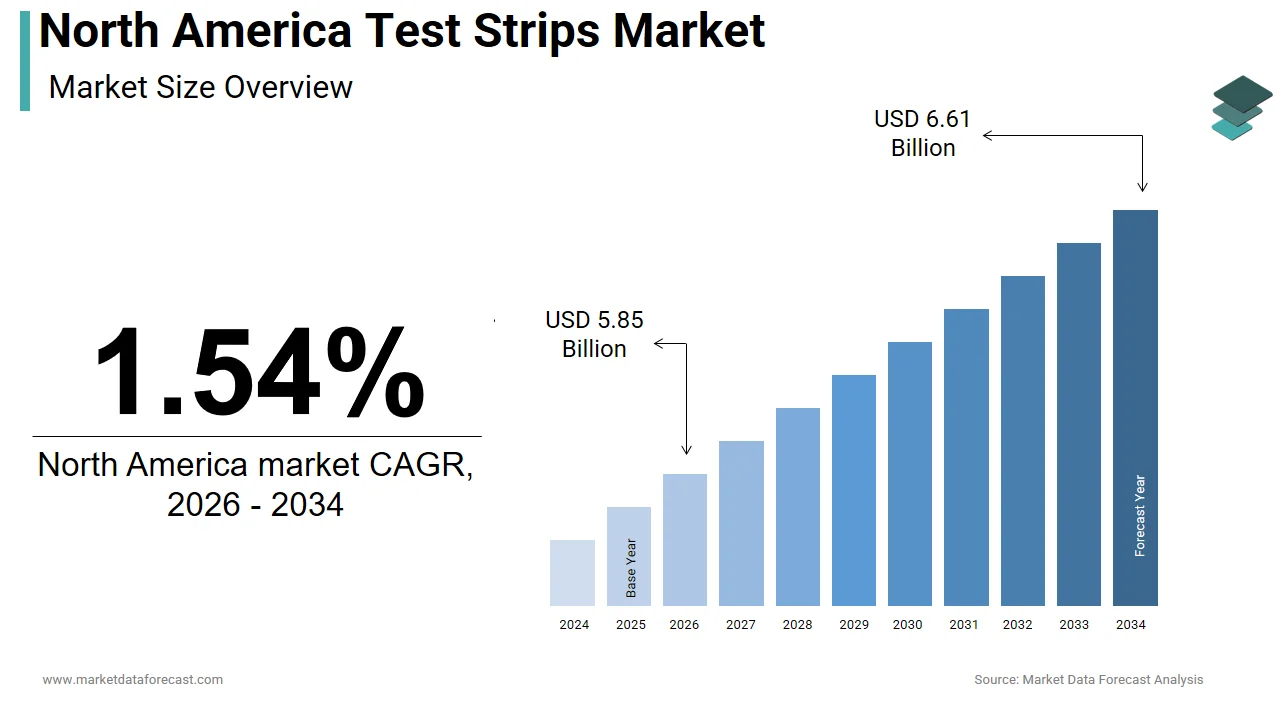
- Market Valuation: Valued at USD 5.76 billion in 2025, reaching USD 5.85 billion in 2026, and projected to expand to USD 6.61 billion by 2034, growing at a CAGR of 1.54% from 2026 to 2034.
- Primary Growth Drivers: Rising prevalence of chronic conditions like diabetes and kidney disorders, expansion of point-of-care (POC) diagnostics, and increasing adoption of home-based health monitoring.
Key Market Segment Metrics
| Category | Leading Segment (Base Position) | Fastest-Growing / High-Growth Segment |
|---|---|---|
| By Product Type | Blood Test Strips (held 58.4% share, anchored by widespread glucose monitoring for diabetes management) | Urine Test Strips (projected at an 8.2% CAGR, driven by kidney function assessments, UTI detection, and prenatal care) |
| By Application | Diabetes (held 45.3% share, backed by millions of Americans managing daily blood glucose levels) | Infectious Disease Testing (projected at a 9.1% CAGR, fueled by STI screening initiatives and rapid point-of-care diagnostics) |
| By End User | Diagnostic Laboratories (held 42.3% share, supported by high volumes of centralized routine and specialized testing workflows) | Homecare (projected at an 8.9% CAGR, driven by consumer preference for self-monitoring and OTC diagnostic expansion) |
| By Country | United States (market leader with an 80.3% share, backed by high chronic disease prevalence and extensive POC adoption) | Canada (steady growth driven by government-led screening programs and telehealth integration in remote regions) |
Major Market Players & Industry Landscape
Market Structure: Highly competitive landscape featuring established global diagnostics leaders and emerging regional brands competing on product innovation, digital health integration, and accuracy.
Key Companies: Abbott Laboratories, F. Hoffmann-La Roche Ltd., Becton, Dickinson and Company (BD), Siemens Healthineers, Quidel Corporation, Danaher Corporation, LifeScan, Taidoc, B. Braun, and Hologic.
 Download Free Sample Report
North America Test Strips Market Size
The North America test strips market was valued at USD 5.76 billion in 2025, is estimated to reach USD 5.85 billion in 2026, and is projected to reach USD 6.61 billion by 2034, growing at a CAGR of 1.54% from 2026 to 2034.
The test strips are widely used in home healthcare, clinical laboratories, and hospitals for monitoring glucose levels, kidney function, urinary tract infections, pregnancy, and drug use. The market has seen consistent growth due to the rising prevalence of chronic diseases and the increasing emphasis on early diagnosis. According to the Centers for Disease Control and Prevention (CDC), more than 37 million Americans have diabetes by making glucose test strips a dominant product category within the market. Additionally, the expansion of point-of-care testing and the growing preference for self-monitoring of health parameters have further boosted demand.
MARKET DRIVERS
Rising Prevalence of Chronic Diseases
The increasing prevalence of chronic diseases such as diabetes, hypertension, and kidney disorders is driving the growth of the North America test strips market. According to the Centers for Disease Control and Prevention (CDC), diabetes affects over 37 million Americans, with approximately 96 million adults classified as prediabetic. This growing patient pool necessitates frequent monitoring of blood glucose levels, which is primarily achieved through the use of glucose test strips. In addition to diabetes, chronic kidney disease (CKD) affects around 37 million U.S. adults, as reported by the National Kidney Foundation, further driving demand for urine test strips that detect protein, glucose, and ketones. These strips are essential for early diagnosis and ongoing management of kidney-related conditions. The increasing burden of chronic illnesses, coupled with an aging population, has significantly expanded the use of test strips in both clinical and home settings.
Expansion of Point-of-Care and Home-Based Testing
The growth of point-of-care (POC) diagnostics and the rising adoption of home-based health monitoring are significantly contributing to the expansion of the North America test strips market. According to the Association for Diagnostics & Laboratory Medicine, over 60% of diagnostic tests in the U.S. are now conducted outside traditional laboratory settings, with test strips playing a crucial role in this shift. The convenience, affordability, and ease of use associated with test strips make them ideal for POC applications in clinics, pharmacies, and long-term care facilities. Additionally, the U.S. Food and Drug Administration (FDA) has approved numerous over-the-counter (OTC) test strip kits for conditions such as diabetes, pregnancy, and infectious diseases, enabling consumers to perform diagnostic tests at home. As per the American Association for Clinical Chemistry, the global home diagnostics market is expected to grow at a double-digit rate, with North America leading in adoption due to high health awareness and digital health integration. Telemedicine platforms have also started incorporating home test kits into their service offerings, which is further boosting demand. In Canada, provincial health systems are promoting home testing for chronic conditions to reduce hospital visits and improve patient outcomes.
MARKET RESTRAINTS
Regulatory Compliance and Stringent Approval Processes
The rigorous regulatory environment governing diagnostic products is restraining the growth of the North America test strips market. The U.S. Food and Drug Administration (FDA) requires extensive clinical validation and quality control assessments before test strips can be marketed, especially for medical-grade diagnostics. According to the FDA’s Center for Devices and Radiological Health, over 25% of diagnostic test strip applications face delays due to insufficient data or non-compliance with quality standards. This extended approval timeline increases development costs and delays product launches, particularly for smaller manufacturers. Additionally, the need for continuous compliance with evolving standards, such as ISO 13485 for medical device manufacturing, adds to the operational burden for manufacturers.
Accuracy Concerns and User Handling Errors
The issue of accuracy variability and user-related errors in home-based testing scenarios is also hindering the growth of the North America test strips market. According to the American Association for Clinical Chemistry, improper handling, storage conditions, and incorrect interpretation of results can lead to false positives or negatives in up to 15% of home diagnostic tests. Urine and blood glucose test strips, which are among the most commonly used, are particularly sensitive to environmental factors such as temperature, humidity, and exposure to light. A study published in the Journal of Diabetes Science and Technology found that nearly 20% of home glucose test strip users reported inconsistencies in readings due to expired strips or improper calibration. Additionally, the lack of standardized training for lay users increases the risk of misdiagnosis, especially for complex tests such as pregnancy or infectious disease detection. As per the U.S. Centers for Disease Control and Prevention (CDC), inaccuracies in self-administered tests have led to unnecessary medical consultations and treatment delays.
MARKET OPPORTUNITIES
Integration of Smart Technologies with Test Strips
The integration of smart technologies, such as mobile connectivity and artificial intelligence, into diagnostic test platforms is certainly to create new opportunities for the North America test strips market. According to the American Medical Informatics Association, over 70% of U.S. consumers now use health apps for monitoring personal health metrics, creating a growing demand for digital integration with traditional diagnostic tools like test strips. Companies are increasingly developing smartphone-compatible test strip readers that automatically analyze results, store data, and provide trend analysis. For instance, the FDA has approved several AI-enabled urinalysis and glucose monitoring apps that work in conjunction with compatible test strips. As per the U.S. Department of Health and Human Services, the adoption of digital health tools has increased by 40% since 2020, driven by telehealth expansion and remote patient monitoring initiatives.
Expansion of Infectious Disease Screening Programs
The increasing focus on infectious disease screening and early detection will additionally propel the growth of the North America test strips market. According to the Centers for Disease Control and Prevention (CDC), sexually transmitted infections (STIs) such as chlamydia, gonorrhea, and syphilis have seen a consistent rise over the past decade, prompting public health agencies to expand screening initiatives. Rapid diagnostic test strips for STIs, HIV, and hepatitis are being widely adopted in community health centers, emergency departments, and outreach programs due to their ease of use and quick results. Additionally, the emergence of new viral threats, including monkeypox and respiratory infections, has reinforced the need for rapid, accessible testing solutions. In Canada, provinces like Ontario and British Columbia have launched mobile testing units equipped with rapid antigen and antibody test strips to improve access in remote and underserved communities.
MARKET CHALLENGES
Competition from Alternative Diagnostic Technologies
The growing adoption of alternative diagnostic technologies that offer enhanced accuracy and real-time monitoring capabilities is a challenging factor for the growth of the North America test strips market. According to the American Association for Clinical Chemistry, non-invasive glucose monitoring devices, such as continuous glucose monitors (CGMs), have gained significant traction among diabetes patients, reducing reliance on traditional test strips. Companies like Dexcom and Abbott have reported a 30% annual increase in CGM adoption in the U.S., as per data from the Endocrine Society. Additionally, lab-on-a-chip and microfluidic diagnostic platforms are emerging as more sophisticated alternatives for multi-parameter testing, offering integrated analysis without the need for separate test strips. As per the U.S. Food and Drug Administration (FDA), over 40 new advanced diagnostic devices were approved in 2023, many of which are designed to replace conventional strip-based testing in clinical settings. In Canada, the adoption of digital diagnostics in hospitals and long-term care facilities is further shifting demand away from traditional test strips.
Supply Chain Disruptions and Raw Material Constraints
The ongoing challenges related to supply chain disruptions and raw material shortages, which impact production timelines and cost structures is to hamper the growth of the North America test strips market. According to the U.S. Department of Commerce, global supply chain bottlenecks in 2023 affected over 60% of medical device manufacturers, including those producing diagnostic test strips. Key raw materials such as nitrocellulose membranes, enzymes, and chemical reagents are often sourced from limited global suppliers, which is making the industry vulnerable to geopolitical tensions and logistics delays. As per the Association for the Advancement of Medical Instrumentation (AAMI), nearly 30% of test strip manufacturers reported production slowdowns due to shortages of critical components during the past two years. Additionally, rising input costs have led to increased pricing for end consumers, potentially limiting adoption in price-sensitive segments.
REPORT COVERAGE
| REPORT METRIC | DETAILS |
| Market Size Available | 2025 to 2034 |
| Base Year | 2025 |
| Forecast Period | 2026 to 2034 |
| Segments Covered | By Product Type, Application, End-use, and Region. |
| Various Analyses Covered | Global, Regional and Country-Level Analysis, Segment-Level Analysis, Drivers, Restraints, Opportunities, Challenges; PESTLE Analysis; Porter’s Five Forces Analysis, Competitive Landscape, Analyst Overview of Investment Opportunities |
| Countries Covered | United States, Canada, Mexico, Rest of North America |
| Market Leaders Profiled | Abbott Laboratories (US), F. Hoffmann-La Roche Ltd. (Switzerland), Quidel Corporation (US), Danaher Corporation (US), Siemens AG (Germany), Life Scan (US), Taidoc (Taiwan), B Braun (Germany), Hologic (US), and others. |
SEGMENTAL ANALYSIS
By Product Type Insights
The blood test strips segment accounted in holding 58.4% of the North America test strips market share in 2024, with the widespread use of glucose test strips for diabetes management. According to the Centers for Disease Control and Prevention (CDC), over 37 million Americans have diabetes, with nearly 96 million adults classified as prediabetic. This high disease burden necessitates regular blood glucose monitoring, which relies heavily on disposable test strips. Additionally, advancements in blood-based diagnostics for cholesterol, ketones, and lactate levels have expanded the application scope of blood test strips beyond diabetes.
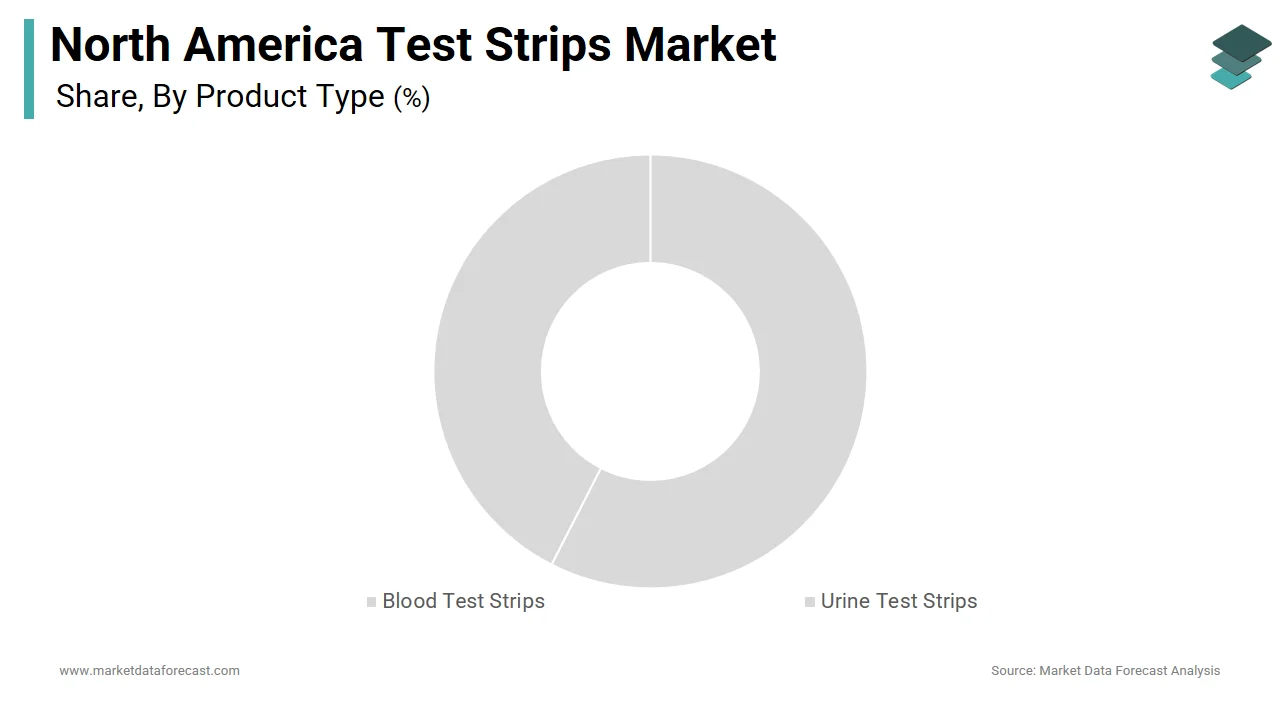
The urine test strips segment is lucratively growing with a CAGR of 8.2% from 2026 to 2034, with the increasing applications in kidney function assessment, urinary tract infection (UTI) detection, and pregnancy testing. The National Kidney Foundation estimates that 37 million U.S. adults suffer from chronic kidney disease, making urine dipstick tests a crucial tool in early diagnosis and monitoring. As per the American Urological Association, one in two women will experience a UTI in their lifetime, driving the adoption of point-of-care diagnostic solutions. In Canada, provincial health systems are incorporating urine test strips into community health screening programs, particularly in remote and underserved areas.
By Application Insights
The diabetes segment held 45.3% of the North America test strips market share in 2024, with the high prevalence of diabetes across the region and the critical role of blood glucose monitoring in disease management. According to the Centers for Disease Control and Prevention (CDC), more than 37 million Americans have diabetes, and approximately 1.4 million new cases are diagnosed annually. According to the American Diabetes Association, nearly 7 million Americans rely on daily blood glucose testing, generating consistent demand for test strips. Government initiatives such as the Canadian Chronic Disease Surveillance System have further integrated test strip usage into national health monitoring frameworks.
The infectious disease testing segment is lucratively to grow with a CAGR of 9.1% from 2026 to 2034, which is rising awareness of sexually transmitted infections (STIs), increased screening initiatives, and the demand for rapid, point-of-care diagnostics. According to the Centers for Disease Control and Prevention (CDC), over 2.5 million cases of chlamydia, gonorrhea, and syphilis were reported in the U.S. in 2023, marking a significant increase from previous years. This surge has prompted public health agencies to expand access to rapid diagnostic test kits, particularly in community health centers and mobile clinics. Additionally, the adoption of home-based STI test kits has grown, with companies like LetsGetChecked and Everlywell offering FDA-approved test strip-based solutions. In Canada, the Public Health Agency of Canada has launched national screening campaigns for HIV and hepatitis, integrating rapid test strips into outreach programs. The expansion of telehealth services and the integration of test results with digital health records are further enhancing accessibility and adoption.
By End-Use Insights
The diagnostic laboratories was accounted in holding 42.3% of the North America test strips market share in 2024 with the high volume of routine and specialized diagnostic testing conducted in centralized labs, including urinalysis, blood chemistry, and infectious disease screening. According to the Association for Diagnostics & Laboratory Medicine (ADLM), over 70% of clinical decisions in the U.S. are informed by laboratory test results, making test strips an essential component of diagnostic workflows. The Centers for Disease Control and Prevention (CDC) notes that more than 15 million laboratory-based diagnostic tests using test strips were performed in the U.S. in 2023 alone. In Canada, provincial health authorities rely heavily on centralized labs for population-wide screening programs, particularly for diabetes, kidney disease, and infectious conditions. The integration of automated strip readers and digital reporting systems has further enhanced efficiency and accuracy in lab settings.
The home care segment is projected to grow with a CAGR of 8.9% from 2026 to 2034, with the increasing consumer preference for self-monitoring, rising chronic disease prevalence, and the expansion of over-the-counter diagnostic test kits. Blood glucose test strips remain the most widely used product in this segment, with millions of Americans managing diabetes through daily self-testing. Additionally, the availability of FDA-approved home test kits for pregnancy, urinary tract infections, and sexually transmitted infections has significantly expanded market reach. As per the Canadian Medical Association, home diagnostic testing adoption in Canada has increased by 35% since 2020, supported by digital health integration and telemedicine services. The rise of direct-to-consumer health brands and e-commerce platforms offering rapid diagnostic solutions is further fueling growth.
COUNTRY-LEVEL ANALYSIS
United States Test Strips Market Insights
The United States was the top performer in the North America test strips market with 80.3% of share in 2024 with the high prevalence of chronic diseases, particularly diabetes and kidney disorders, which drive continuous demand for diagnostic test strips. According to the Centers for Disease Control and Prevention (CDC), more than 37 million Americans have diabetes, and 37 million suffer from chronic kidney disease, making the U.S. the largest consumer of glucose and urine test strips globally. Additionally, the expansion of home healthcare, increasing use of point-of-care diagnostics, and a well-established regulatory framework contribute to market growth. The American Association of Clinical Chemistry (AACC) notes that over 70% of diagnostic tests in the U.S. are now conducted outside traditional laboratories, reinforcing the widespread use of test strips.
Canada Test Strips Market Insights
Canada test strips market is experiencing steady growth owing to the government-led health screening programs and increasing adoption of home-based diagnostics. The Public Health Agency of Canada has emphasized early disease detection through expanded testing initiatives, particularly for diabetes, kidney disease, and infectious conditions. According to Statistics Canada, the number of diabetes cases has increased by 20% over the past five years, necessitating greater use of glucose test strips. Additionally, provincial health authorities are integrating rapid diagnostic test strips into primary care and telehealth services, especially in remote and Indigenous communities.
COMPETITIVE LANDSCAPE
The North America test strips market is characterized by a competitive and evolving landscape, driven by the presence of well-established global players and emerging regional brands. Major companies compete on product innovation, ease of use, accuracy, and integration with digital health platforms. The market is also witnessing increased competition from startups and tech-driven firms that are introducing smart diagnostic solutions. Established players leverage their strong distribution networks, regulatory expertise, and brand recognition to maintain a dominant position. At the same time, smaller companies are gaining traction by focusing on niche applications and cost-effective alternatives. The demand for rapid, accurate, and accessible diagnostic tools is pushing manufacturers to invest heavily in R&D, which is aiming to develop more advanced, multipurpose, and user-friendly test strip solutions. Additionally, regulatory compliance and the ability to meet public health needs are key differentiators in this highly scrutinized market.
KEY MARKET PLAYERS
Noteworthy Companies dominating the North America test strips market are
- Abbott Laboratories
- F. Hoffmann-La Roche Ltd.
- Becton, Dickinson and Company
- Quidel Corporation
- Danaher Corporation
- Siemens AG
- LifeScan
- Taidoc
- B. Braun
- Hologic
TOP LEADING PLAYERS IN THE MARKET
- Abbott is a global leader in diagnostic solutions and holds a strong position in the North America test strips market. The company is widely recognized for its glucose monitoring systems, particularly the Precision Xtra and FreeStyle series, which integrate seamlessly with test strip technology. Abbott’s commitment to innovation has led to the development of advanced, easy-to-use test strips for diabetes and infectious disease diagnostics. Its strong distribution network and strategic partnerships with healthcare providers and pharmacies ensure widespread availability of its products.
- Roche Diagnostics is a major player in the North America test strips market, known for its high-quality, lab-accurate diagnostic strips used in both clinical and home settings. The company’s Accu-Chek line of glucose test strips remains a benchmark for reliability and precision. Roche’s focus on integrating digital health technologies with traditional test strips has enhanced patient monitoring and data management capabilities. Its strong presence in hospital and laboratory settings, combined with continuous R&D investment, ensures sustained market relevance. Roche also collaborates with healthcare systems to support chronic disease management and expand point-of-care testing, making it a key contributor to the evolution of the test strips industry.
- BD is a leading provider of diagnostic solutions and plays a crucial role in the North America test strips market, particularly in urinalysis and infectious disease testing. The company offers a comprehensive portfolio of urine test strips used in both clinical and home-based diagnostics. BD’s focus on automation and integration with digital diagnostic platforms has enhanced efficiency in laboratory settings. The company also supports large-scale public health programs with rapid diagnostic tools, contributing to improved disease surveillance and early detection.
TOP STRATEGIES USED BY KEY MARKET PARTICIPANTS
Integration of Digital Health Technologies Leading companies are embedding smart features into test strips by integrating them with mobile apps and cloud-based platforms. This allows for real-time tracking, data analysis, and remote monitoring, enhancing user experience and clinical decision-making.
Expansion of Point-of-Care and Home Testing Solutions. Major players are focusing on developing user-friendly test strips for home use and point-of-care settings. This strategy aligns with the growing consumer preference for self-monitoring and the expansion of telehealth services across North America.
Strategic Collaborations and Public Health Partnerships Companies are forming alliances with healthcare providers, government agencies, and research institutions to support large-scale screening initiatives. These partnerships help expand market reach, improve accessibility, and align with public health goals related to early diagnosis and disease prevention.
RECENT MARKET DEVELOPMENTS
- In February 2024, Abbott launched a new line of glucose test strips integrated with Bluetooth connectivity, allowing seamless data synchronization with mobile health apps and improving diabetes management for users.
- In April 2024, Roche Diagnostics introduced a next-generation urine test strip system designed for enhanced sensitivity and broader parameter detection by catering to both clinical and home healthcare settings.
- In June 2024, BD announced a strategic partnership with a leading telehealth provider to distribute rapid diagnostic test kits directly to consumers, which is expanding access to at-home infectious disease testing across North America.
- In August 2024, Siemens Healthineers launched an AI-powered test strip reader for home use, designed to interpret results with higher accuracy and integrate with digital health records for better patient monitoring.
- In October 2024, Nova Biomedical expanded its point-of-care test strip offerings by introducing a multi-parameter strip capable of measuring glucose, ketones, and lactate levels simultaneously, enhancing emergency and critical care diagnostics.
MARKET SEGMENTATION
This North America test strips market research report is segmented and sub-segmented into the following categories.
By Product Type
- Blood Test Strips
- Urine Test Strips
- Others (Covid-19 & Other Test Strips)
By Application
- Diabetes
- Infectious Disease
- Cardiac Marker Testing
- Pregnancy & Fertility Testing
- Others (Drug Of Abuse, Veterinary Testing, Lipid Testing, And Drug Development And Quality Testing)
By End User
- Hospitals & Clinics
- Homecare
- Diagnostic Labs
- Other End Users
By Country
- United States
- Canada
- Mexico
- Rest of North America