- Product Description Description
- Table of Contents TOC
- List of Table & Figure LOT
- Get Free Sample PDF Sample PDF
Market Size, 2025
$14.52 BnMarket Estimate, 2026
$16.74 BnMarket Forecast, 2034
$52.25 BnCAGR, 2026–2034
15.29%North America Energy Management System Market Size
The North America energy management system market size was valued at USD 14.52 billion in 2025 and is anticipated to reach USD 16.74 billion in 2026 from USD 52.25 billion by 2034, growing at a CAGR of 15.29% during the forecast period from 2026 to 2034.

Energy management system (EMS) includes digital and hardware-based solutions designed to monitor, control, and optimize energy consumption across residential, commercial, and industrial sectors. These systems integrate advanced analytics, automation, and real-time data monitoring to enhance energy efficiency, reduce operational costs, and support sustainability goals. With rising concerns over energy security, carbon emissions, and grid stability, EMS technologies are increasingly being adopted by utilities, large enterprises, and government bodies to manage power distribution and consumption intelligently.
North America has emerged as a key region for EMS deployment due to the presence of mature infrastructure, strong regulatory frameworks, and high investments in smart grid technologies. The U.S. and Canada are leading contributors, with robust initiatives from agencies such as the Department of Energy (DOE) and Natural Resources Canada promoting intelligent energy use. Apart from these, the increasing integration of renewable energy sources into the grid further amplifies the demand for sophisticated energy management platforms capable of balancing supply and demand dynamically.
MARKET DRIVERS
Rising Demand for Grid Modernization and Smart Infrastructure
The accelerating pace of grid modernization and the development of smart infrastructure is one of the primary drivers fueling the growth of the North America energy management system market. Aging electrical grids, coupled with increasing energy demands and environmental regulations, have prompted significant investments in upgrading transmission and distribution networks. According to the Edison Electric Institute (EEI), U.S. investor-owned utilities invested more than $100 billion between 2014 and 2020 in grid modernization projects, including smart meters, sensors, and intelligent energy management systems.
These upgrades are essential to accommodate decentralized energy generation, improve reliability, and enable real-time monitoring and control of energy flows. In particular, the integration of distributed energy resources (DERs) such as solar panels, wind turbines, and battery storage systems necessitates advanced EMS platforms that can balance fluctuating supply and demand. For instance, as per the U.S. Department of Energy (DOE), over 25% of utility-scale electricity generation in the U.S. came from renewable sources in 2023, up from just 10% a decade earlier. This shift mandates smarter grid operations and robust energy management tools to ensure seamless coordination.
Moreover, cities across North America are embracing smart city initiatives that rely heavily on EMS technologies to optimize street lighting, traffic signals, public buildings, and electric vehicle charging stations. Cities like Toronto, New York, and San Diego have already deployed large-scale EMS systems to enhance urban sustainability and resilience. These developments show the growing importance of energy management systems in enabling next-generation infrastructure.
Increasing Adoption of Industrial Automation and IoT-Enabled Devices
The widespread adoption of industrial automation and Internet of Things (IoT)-enabled devices is another critical driver behind the expansion of the North America energy management system market. Industries are increasingly leveraging connected technologies to monitor and optimize energy usage in real time, thereby reducing operational costs and improving sustainability performance.
Industrial energy management systems (IEMS) are playing a pivotal role in this transformation by providing granular insights into energy consumption patterns, identifying inefficiencies, and enabling predictive maintenance. Such outcomes are driving broader adoption across sectors such as automotive, chemicals, and food processing, where energy-intensive operations dominate.
Besides, regulatory pressures are pushing industries toward greater energy transparency. The Environmental Protection Agency’s (EPA) mandatory reporting rule requires large industrial facilities to report annual greenhouse gas emissions, incentivizing companies to deploy EMS solutions for compliance and performance tracking. Furthermore, industry 4.0 initiatives, supported by organizations like the National Institute of Standards and Technology (NIST), are fostering deeper integration of energy management into overall operational strategies. These factors contribute to a robust growth trajectory for the EMS market in North America.
MARKET RESTRAINTS
High Implementation and Integration Costs
The high initial investment required for implementation and integration is a significant restraint impeding the widespread adoption of energy management systems in North America. While EMS solutions offer long-term cost savings through improved energy efficiency, the upfront expenses associated with software licensing, hardware procurement, system customization, and workforce training often deter small and medium-sized enterprises (SMEs).
In addition to direct costs, integrating EMS with existing building management or industrial control systems can be technically complex and financially burdensome. Legacy infrastructure in many older commercial and industrial facilities is not readily compatible with modern EMS platforms, necessitating additional retrofitting and middleware development. As per a study conducted by the American Council for an Energy-Efficient Economy (ACEEE), retrofitting legacy systems to support smart energy management could add between 15% and 30% to the total project cost.
Moreover, the return on investment (ROI) timeline for EMS deployments can extend beyond five years, depending on the scale and complexity of implementation. This extended payback period makes it difficult for budget-constrained organizations to justify immediate investment, particularly in regions with relatively low energy prices. These financial and technical hurdles continue to limit the penetration of energy management systems across various sectors in North America.
Lack of Standardization and Interoperability Issues
The lack of standardization and interoperability among different EMS platforms and technologies is another major challenge hindering the growth of the North America energy management system market. The absence of universally accepted protocols and communication standards leads to fragmented systems that struggle to integrate seamlessly with each other, limiting the effectiveness of energy management strategies. According to the National Institute of Standards and Technology (NIST), as of 2023, there were over 20 distinct communication protocols used across smart energy devices, making cross-platform compatibility a persistent issue.
This fragmentation creates inefficiencies for both vendors and end-users. Companies deploying EMS solutions often face difficulties when attempting to connect systems from different manufacturers, resulting in increased operational complexity and higher maintenance costs. As per a 2023 survey by the Building Owners and Managers Association (BOMA), 45% of commercial building operators encountered challenges in integrating new energy management tools with existing building automation systems.
Furthermore, the lack of standardized cybersecurity measures across EMS platforms raises concerns about data integrity and system vulnerabilities. Utilities and enterprises are hesitant to adopt new systems without assurance of secure and reliable operation.
MARKET OPPORTUNITIES
Expansion of Renewable Energy Integration and Decentralized Power Systems
The rapid expansion of renewable energy integration and the rise of decentralized power systems is one of the most promising opportunities for the North America energy management system market. As governments and private entities accelerate their commitments to decarbonization, the share of distributed energy resources (DERs) such as rooftop solar, microgrids, and battery storage systems continues to grow. According to the U.S. Department of Energy (DOE), installed solar capacity in the United States surpassed 160 gigawatts (GW) in 2023, supporting over 3% of total electricity generation, with projections indicating a doubling of that capacity by 2030.
This transition toward decentralized generation models necessitates advanced energy management systems capable of handling bidirectional power flows, real-time load balancing, and dynamic pricing mechanisms. Traditional centralized grid infrastructure is ill-suited for managing the variability inherent in renewable sources, prompting utilities and independent power producers to invest in EMS platforms that provide intelligent control and forecasting capabilities. For example, California’s Self-Generation Incentive Program (SGIP) has driven a 30% increase in residential and commercial battery installations since 2021, all of which require sophisticated EMS integration to function efficiently.
Moreover, microgrid deployments—especially in remote communities, campuses, and industrial complexes—are expanding rapidly. These developments present a substantial opportunity for EMS vendors to offer tailored solutions.
Growth of Electrification and EV Charging Infrastructure
The accelerating electrification of transportation and the corresponding expansion of electric vehicle (EV) charging infrastructure represent a significant opportunity for the North America energy management system market. Governments across the U.S. and Canada have set ambitious targets to phase out internal combustion engine vehicles, with President Biden's administration aiming for 50% of new vehicle sales to be electric by 2030. According to the International Energy Agency (IEA), the number of electric cars on North American roads surpassed 4 million in 2023, up from less than 1 million in 2020.
This rapid adoption of EVs necessitates intelligent energy management systems to handle the surge in electricity demand, particularly during peak hours. Unmanaged EV charging can strain local distribution networks, leading to voltage fluctuations and grid instability. To address this, utilities and charging station operators are increasingly deploying EMS platforms that enable smart charging, load balancing, and vehicle-to-grid (V2G) capabilities. For instance, ChargePoint, one of North America’s largest EV charging networks, pointed out in 2023 that its cloud-based energy management system reduced peak load impacts by up to 25% at commercial sites.
Moreover, federal initiatives such as the National Electric Vehicle Infrastructure (NEVI) Formula Program. This convergence of mobility and energy management is creating a fertile ground for innovation and investment in EMS technologies across North America.
MARKET CHALLENGES
Cybersecurity Vulnerabilities in Connected Energy Systems
The increasing vulnerability of connected energy systems to cyberattacks is one of the most pressing challenges facing the North America energy management system market. As EMS platforms become more integrated with internet-connected devices, cloud computing, and AI-driven analytics, they also become attractive targets for malicious actors seeking to disrupt critical infrastructure. According to the U.S. Department of Homeland Security (DHS), the energy sector was the second most targeted industry for cyber incidents in 2023, accounting for nearly 18% of all reported attacks.
Modern energy management systems often operate on open networks and use proprietary software that may not be rigorously tested against evolving cyber threats. As per a 2023 report by the North American Electric Reliability Corporation (NERC), multiple instances of ransomware and phishing attacks disrupting EMS operations at utility providers, leading to temporary service interruptions and data breaches. In one case, a mid-sized utility firm in the Midwest experienced a 72-hour outage due to a malware attack on its energy management information system, underscoring the fragility of current cybersecurity measures.
Furthermore, the proliferation of edge computing and IoT-based EMS deployments introduces additional entry points for attackers. Many EMS vendors lack standardized encryption protocols and real-time threat detection mechanisms, leaving systems exposed.
Regulatory Complexity and Policy Uncertainty
Regulatory complexity and policy uncertainty pose a significant challenge to the growth of the North America energy management system market. The energy sector in North America is highly fragmented, with varying federal, state, and provincial regulations governing grid operations, data privacy, emissions, and consumer participation in energy markets. This inconsistency complicates the deployment and scaling of energy management systems, particularly for vendors operating across multiple jurisdictions.
In the U.S., for example, energy policies are largely determined at the state level, leading to disparities in incentives, compliance requirements, and market structures. Similarly, in Canada, provinces such as Ontario and British Columbia have implemented aggressive smart grid and demand-side management programs, whereas others lag behind in regulatory support.
Policy uncertainty also arises from frequent changes in federal directives. For instance, the rollback of several Obama-era climate regulations under the previous administration created confusion among investors and slowed down the momentum of EMS-related projects. Although recent administrations have reinstated clean energy incentives, the long-term stability of such policies remains uncertain, affecting strategic planning for EMS developers and service providers.
Further, the lack of uniformity in data ownership and access rights complicates the integration of third-party EMS platforms with utility networks.
SEGMENTAL ANALYSIS
By System Type Insights
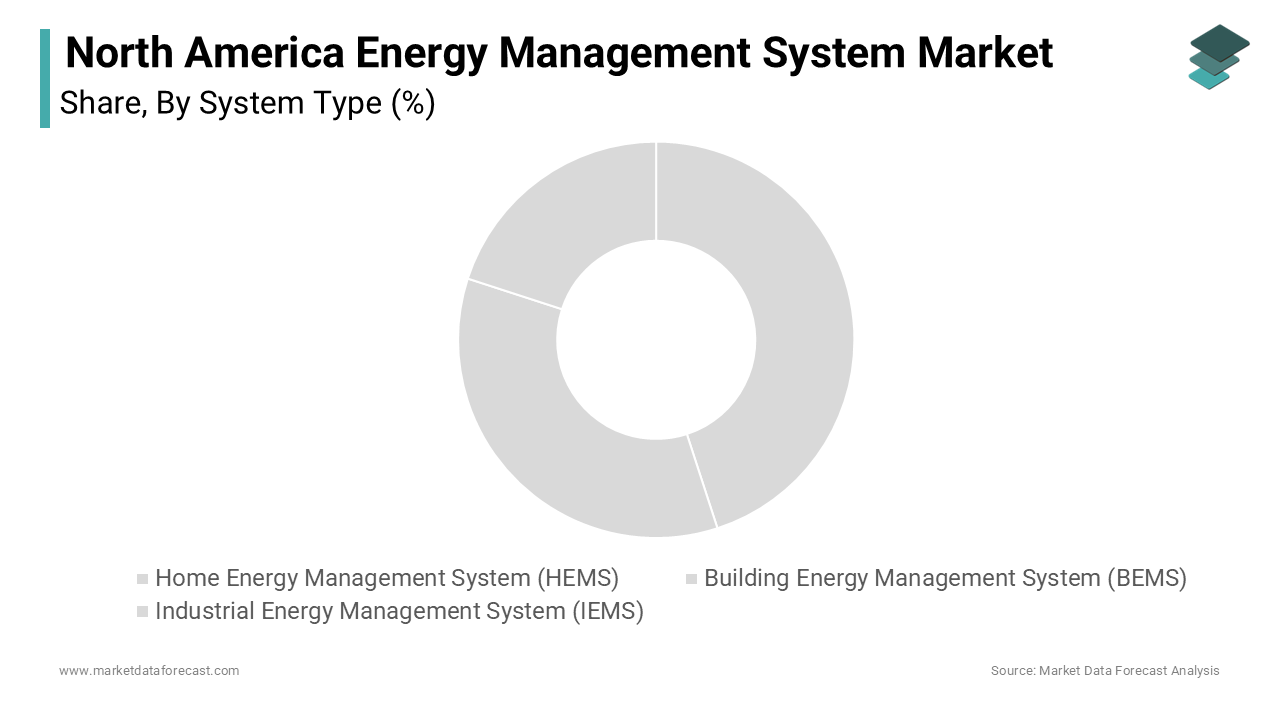
The Building Energy Management Systems (BEMS) led the North America energy management system market in 2024 by capturing 42.5% of total revenue. Increasing demand for energy efficiency in commercial buildings, where HVAC, lighting, and security is driving the dominance of BEMS segment.
According to the U.S. Department of Energy (DOE), commercial buildings in the United States consumed about 18.3 quads of energy in 2023, making them a critical focus area for energy conservation efforts.
Regulatory mandates such as ASHRAE Standard 90.1 and the Leadership in Energy and Environmental Design (LEED) certification further encourage the integration of BEMS in new and retrofit building projects. Apart from these, smart city initiatives across major urban centers like Toronto, Chicago, and New York are accelerating the deployment of intelligent building control systems.
The Home Energy Management Systems (HEMS) segment is projected to grow at the fastest rate in the North America EMS market, with a CAGR of 12.4% from 2025 to 2033. This rapid expansion is driven by Rising consumer awareness about energy savings, growing smart home adoption, and supportive government incentives aimed at residential energy efficiency is propelling the rapid growth of Home Energy Management Systems (HEMS) segment.
Smart meters and IoT-enabled appliances are increasingly being integrated into homes, enabling consumers to track and manage their energy usage through mobile applications. Besides, utility companies like Pacific Gas & Electric (PG&E) offer rebates of up to $100 for homeowners who install qualifying energy management devices, encouraging broader participation.
The surge in rooftop solar installations also plays a pivotal role in driving HEMS growth. As per the Solar Energy Industries Association (SEIA), U.S. residential solar capacity reached 15 gigawatts (GW) in 2023, necessitating advanced monitoring tools to manage generation and consumption effectively. Companies such as Tesla and Google Nest have introduced sophisticated HEMS platforms that allow homeowners to optimize self-consumption, store excess energy, and even sell surplus power back to the grid.
By Application Insights
The Energy Distribution emerged segment commanded the North America energy management system market by accounting for 38.6% of total revenue in 2024. The urgent need to modernize aging grid infrastructure and enhance reliability amid increasing electricity demand and renewable energy integration is driving the growth of Energy Distribution emerged segment.
The U.S. grid, much of which was built in the 1960s and 1970s, faces frequent outages due to extreme weather events and equipment failures. According to the U.S. Department of Energy (DOE), power outages cost the U.S. economy an estimated $150 billion annually, prompting significant investments in intelligent energy distribution systems. In response, utilities have been deploying advanced EMS solutions to improve grid resilience, reduce transmission losses, and integrate distributed energy resources more efficiently.
Moreover, the Federal Energy Regulatory Commission (FERC) has mandated enhanced grid visibility and responsiveness, pushing regional transmission organizations (RTOs) to adopt EMS-driven solutions for better coordination between generation, transmission, and distribution. These factors collectively reinforce Energy Distribution as the most substantial application segment in the North America EMS market.
The e-Mobility segment is projected to be the fastest-growing application segment in the North America energy management system market, with a CAGR of 14.2% in the future. The accelerated adoption of electric vehicles (EVs) and the corresponding need for intelligent charging infrastructure that can manage peak loads and integrate with renewable energy sources is fuelling the rapid growth of e-Mobility segment.
According to the International Energy Agency (IEA), EV sales in North America exceeded 1.2 million units in 2023, marking a 50% increase compared to the previous year. As this trend continues, managing the impact of EV charging on local grids becomes increasingly critical. Energy management systems are now essential for implementing smart charging strategies, vehicle-to-grid (V2G) capabilities, and load balancing techniques.
Major players such as ChargePoint, A Better Routeplanner, and Schneider Electric are integrating EMS platforms into EV charging stations to optimize power usage and prevent grid overload during peak hours. For instance, ChargePoint’s cloud-based energy management solution helped reduce peak load impacts by up to 25% at commercial sites, as per its 2023 annual report.
Furthermore, federal initiatives like the National Electric Vehicle Infrastructure (NEVI) Formula Program under the Bipartisan Infrastructure Law have allocated $7.5 billion to develop a nationwide EV charging network. This convergence of transportation electrification and grid intelligence positions e-Mobility as the fastest-growing application in the EMS sector.
By Industry Insights
The Energy and Utilities industry dominated the North America energy management system market by contributing 35.5% of total revenue in 2025. The superiority of this segment is driven by the sector's ongoing transformation toward digitalization, decarbonization, and grid modernization.
Electric utilities are among the earliest adopters of EMS technologies, using them to enhance grid reliability, integrate renewable energy sources, and respond to fluctuating demand patterns.
The increasing penetration of variable renewable energy sources—such as wind and solar further necessitates robust EMS systems capable of balancing supply and demand dynamically. Managing this influx requires advanced forecasting, storage optimization, and dispatching capabilities, all of which are facilitated by EMS platforms.
Moreover, regulatory mandates such as FERC Order 2222, which enables distributed energy resources to participate in wholesale markets, are pushing utilities to deploy EMS solutions for seamless integration and compliance.
The Automotive industry is emerging as the fastest-growing segment in the North America energy management system market, with a projected CAGR of 13.8% in the future. The growth of this segment is primarily driven by the rapid electrification of vehicle production and the associated rise in energy-intensive manufacturing processes.
Automotive manufacturers are increasingly adopting EMS solutions to manage energy consumption in factories producing electric vehicles (EVs), battery packs, and related components. According to the Alliance for Automotive Innovation, EV production lines consume up to 50% more energy than traditional internal combustion engine facilities, necessitating intelligent energy monitoring and optimization tools.
Leading automakers such as Ford, General Motors, and Tesla have set aggressive sustainability targets, including net-zero carbon emissions by 2035–2040. To achieve these goals, they are investing in EMS platforms that provide granular insights into energy usage, facilitate waste reduction, and enable renewable energy integration. For instance, Ford Motor Company pointed out that in 2023 that its energy management initiatives had reduced factory energy intensity by 18% since 2020, saving millions in operational costs.
In addition, the expansion of EV battery manufacturing plants—commonly referred to as "gigafactories" is intensifying the demand for industrial energy management systems. This makes the Automotive industry one of the most dynamic sectors fueling EMS growth in the region.
REGIONAL ANALYSIS
United states Energy Management System Market Insights
The United States held the dominant position in the North America energy management system market by commanding a 75.6% of total market revenue in 2024. Its position is underpinned by a combination of mature infrastructure, strong regulatory frameworks, and aggressive investments in grid modernization and smart technologies.
The country’s vast commercial and industrial sectors drive significant demand for EMS solutions, particularly in energy-intensive industries such as manufacturing, automotive, and data centers.
Federal programs such as the Department of Energy’s (DOE) Grid Modernization Initiative and the Bipartisan Infrastructure Law, which allocates substantial amount for energy infrastructure upgrades, further stimulate EMS adoption. Further, states like California and Texas have implemented aggressive clean energy policies, mandating the integration of distributed energy resources and smart grid technologies.
Canada Energy Management System Market Insights
Canada demonstrates strong growth potential due to proactive climate policies, increasing smart city development, and a growing emphasis on renewable energy integration. Cities such as Toronto, Vancouver, and Montreal have launched ambitious smart city initiatives, incorporating EMS platforms to optimize municipal energy use and reduce environmental impact.
In the industrial sector, provinces like Ontario and Quebec are prioritizing energy management systems to support sustainable manufacturing practices and meet emission reduction targets under the Pan-Canadian Framework on Clean Growth and Climate Change. Moreover, Canada’s expanding wind and solar capacity requires intelligent grid management tools, further boosting EMS demand.
With federal funding programs like the Smart Renewables and Efficient ElecTricity (SRET) Program supporting clean technology deployments, Canada is well-positioned to maintain steady growth in the EMS market over the coming decade.
Rest of North America Energy Management System Market Insights
The Rest of North America, comprising Mexico and select Caribbean territories, accounts for a notable share of the regional EMS market share in 2023. Though relatively small, this segment is gaining traction due to increasing industrialization, rising energy demand, and supportive policy reforms.
Mexico, in particular, has made notable strides in grid modernization, with the Comisión Federal de Electricidad (CFE) investing heavily in smart metering and energy efficiency programs. This trajectory necessitates greater reliance on EMS technologies to ensure grid stability and optimize energy distribution.
Apart from these, the Mexican government has introduced incentives for renewable energy integration, spurring interest in EMS solutions that support solar and wind farm operations. Meanwhile, Caribbean nations such as Jamaica and the Bahamas are exploring microgrid-based EMS systems to enhance energy resilience against hurricanes and other natural disasters.
Despite challenges such as economic volatility and limited infrastructure investment, the Rest of North America presents a promising frontier for EMS vendors seeking untapped opportunities in the region.
Top Players in the North America Energy Management System Market
One of the leading players in the North America energy management system market is Siemens AG. The company plays a pivotal role in shaping the EMS landscape through its comprehensive digital solutions that integrate automation, analytics, and real-time monitoring across residential, commercial, and industrial applications. Siemens' robust portfolio includes building automation systems, grid optimization tools, and predictive maintenance platforms that support intelligent energy use. Its emphasis on innovation and strategic partnerships has enabled it to maintain a strong foothold in the region’s EMS ecosystem.
Another key player is Schneider Electric, which has established itself as a global leader in energy management and automation technologies. In North America, Schneider Electric offers a wide range of EMS solutions tailored for smart buildings, data centers, and industrial facilities. The company's EcoStruxure platform enables seamless integration of IoT-enabled devices, allowing users to optimize energy consumption and reduce carbon footprints. With a strong focus on sustainability and digital transformation, Schneider continues to drive adoption across various end-user sectors.
Honeywell International Inc. is also a major contributor to the North America energy management system market. Honeywell delivers advanced EMS solutions through its Building Technologies division, offering smart control systems that enhance energy efficiency, comfort, and security in commercial and residential environments. The company leverages its deep expertise in automation and connected technologies to provide scalable energy management offerings. Honeywell’s continuous R&D efforts and customer-centric approach have made it a preferred partner for enterprises seeking smarter, more sustainable infrastructure solutions.
Top Strategies Used by Key Market Participants
Key players in the North America energy management system market are leveraging strategic acquisitions to expand their technological capabilities and broaden their solution portfolios. By acquiring specialized firms, companies can quickly integrate new functionalities such as AI-driven analytics, cloud-based monitoring, and cybersecurity enhancements into their existing EMS offerings.
Another major strategy involves investing heavily in research and development to introduce innovative products tailored to evolving customer needs. Companies are focusing on developing interoperable, scalable, and secure EMS platforms that can seamlessly integrate with renewable energy sources, electric vehicle charging stations, and smart grid infrastructures.
Collaboration and partnership initiatives are also playing a crucial role in strengthening market positions. Industry leaders are forming alliances with utilities, software developers, and government agencies to co-develop integrated energy management ecosystems. These partnerships help in aligning product development with regulatory trends and accelerating deployment across key industry verticals.
COMPETITVE LANDSCAPE
The competitive landscape of the North America energy management system market is characterized by the presence of established global players and emerging regional firms striving to differentiate themselves through innovation and service excellence. The market is highly fragmented, with major vendors focusing on expanding their solution portfolios, enhancing digital capabilities, and forming strategic alliances to gain a stronger foothold. As organizations across industries increasingly prioritize energy efficiency and sustainability, competition is intensifying not only in terms of product offerings but also in customer engagement and after-sales support. Vendors are emphasizing the development of user-friendly interfaces, predictive analytics, and integration with Internet of Things (IoT) platforms to cater to diverse customer demands. Further, customization of energy management solutions to meet specific sectoral requirements is becoming a key differentiator. The growing convergence of energy management with smart infrastructure and decentralized power systems is further driving companies to innovate rapidly and establish themselves as comprehensive solution providers in this dynamic market.
KEY MARKET DRIVERS
Some of the key market players in the North America Energy Management System Market include
- Schneider Electric SE
- Honeywell International Inc.
- Siemens AG
- Johnson Controls International PLC
- General Electric
- ABB Ltd.
- IBM Corporation
- Cisco Systems, Inc.
- C3.ai, Inc.
- GridPoint Inc.
- Oracle Corporation
- Rockwell Automation, Inc.
- Itron Inc.
- Eaton Corporation PLC
- Enel X North America
- Uplight Inc.
RECENT MARKET DEVELOPMENTS
- In February 2024, Siemens AG launched a new version of its Spectrum Power EMS platform tailored for North American grid operators. This update introduced enhanced forecasting capabilities and improved integration with renewable energy assets, supporting better grid reliability and resilience.
- In June 2023, Schneider Electric announced a strategic collaboration with Microsoft Azure to deploy cloud-based energy analytics for large-scale commercial clients. This initiative aimed at enabling real-time energy insights and predictive maintenance for optimized consumption patterns.
- In October 2023, Honeywell International expanded its Building Solutions portfolio with the introduction of a next-generation energy dashboard designed to offer facility managers greater visibility into energy usage and carbon footprint tracking across multiple locations.
- In March 2024, General Electric Digital partnered with a leading U.S. utility provider to implement an advanced distribution management system aimed at improving outage response times and integrating distributed energy resources more effectively into the grid.
- In August 2023, Emerson Electric acquired a niche EMS software startup specializing in industrial process optimization. This move was intended to strengthen Emerson’s position in the industrial energy management segment by enhancing its ability to deliver precision energy control solutions.
MARKET SEGMENTATION
This research report on the North America Energy Management System Market has been segmented and sub-segmented into the following categories.
By System Type
- Home Energy Management System (HEMS)
- Building Energy Management System (BEMS)
- Industrial Energy Management System (IEMS)
By End User
- Residential/Smart homes
- Commercial Building/Complex
By Application
- Property Safety
- Automation
- Energy Distribution
- Design
- e-Mobility
- Others
By Industry
- Oil and Gas
- Manufacturing
- Energy and Utilities
- Automotive
- Healthcare
- Others
By Country
- The United States
- Canada
- Rest of North America