North America Facilities Management Market Size, Share, Trends & Growth Forecast Report By Service Type (Hard Services, Soft Services), Offering Type (In-house, Outsourced [Single FM, Bundled FM, Integrated FM]), End-user Industry (Commercial, Hospitality, Institutional and Public Infrastructure, Healthcare, Industrial and Process), and Country (United States, Canada, Rest of North America) – Industry Analysis, 2025 to 2033
North America Facilities Management Market Summary
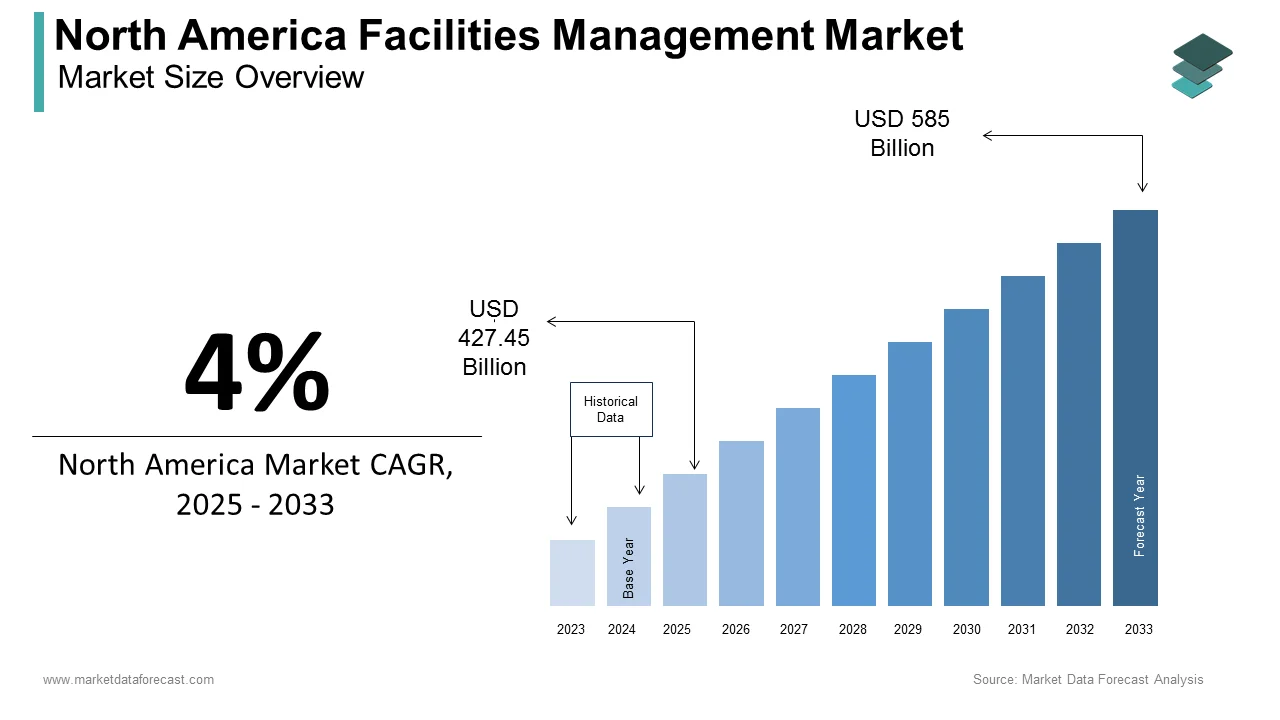
The facilities management market size in North America was valued at USD 411.01 billion in 2024 and is projected to reach USD 585.00 billion by 2033, from USD 427.45 billion in 2025, growing at a CAGR of 4% from 2025 to 2033. The market growth is driven by increasing focus on workplace experience enhancement, regulatory compliance, sustainability requirements, and integration of smart building technologies.
Key Market Trends & Insights
- United States was the largest market in 2024.
- Canada held the second-largest market share in 2024.
- Based on service type, the hard services dominated the market in 2024.
- Based on offering type, the outsourced services held the largest share in 2024.
- Based on end-user industry, the commercial facilities were the top segment in 2024.
Market Size & Forecast
- 2024 Market Size: USD 411.01 Billion
- 2033 Projected Market Size: USD 585.00 Billion
- CAGR (2025–2033): 4%
- United States: Largest market in 2024
- Canada: Second-largest market in 2024
North America Facilities Management Market Size
The facilities management market size in North America was valued at USD 411.01 billion in 2024. The North American market is estimated to be worth USD 585 billion by 2033 from USD 427.45 billion in 2025, growing at a CAGR of 4% from 2025 to 2033.
North American facilities management is an integration of various disciplines, including maintenance, operations, and project management, to ensure that facilities meet the needs of their occupants while adhering to regulatory standards. Facilities management is increasingly recognized as a strategic function that contributes to organizational performance, employee satisfaction, and sustainability initiatives.
In recent years, the importance of facilities management has been underscored by the growing emphasis on workplace wellness and environmental stewardship. For instance, a study by the Global Wellness Institute indicates that the wellness economy in North America is projected to reach $1.2 trillion by 2024, with the increasing focus on creating healthier work environments. Furthermore, according to the U.S. Green Building Council, buildings that prioritize sustainability can reduce energy consumption by up to 30%, thereby not only lowering operational costs but also enhancing the overall quality of life for occupants.
The market is also influenced by technological advancements, with the integration of smart building technologies and Internet of Things (IoT) solutions becoming more prevalent. A report from the International Facility Management Association reveals that 70% of facility managers are now utilizing technology to improve operational efficiency. The North American facilities management market is poised for significant growth and transformation as organizations continue to adapt to changing workforce dynamics and environmental challenges.
MARKET DRIVERS
Workplace Experience Enhancement and Occupant Satisfaction
The increasing recognition of workplace environment impacts on employee productivity, retention, and organizational performance is amplifying the growth of the North American facilities management market. According to the International Workplace Group, 78% of employees consider workplace quality a factor in job satisfaction, which is creating pressure on organizations to invest in premium facilities management services that create attractive, functional, and comfortable work environments. Corporate real estate executives are increasingly viewing facilities management as strategic business functions rather than operational costs, allocating substantial budgets to services that enhance workplace attractiveness and support talent acquisition and retention objectives. The CoreNet Global survey indicates that 65% of corporate real estate leaders have increased facilities management budgets specifically for workplace experience enhancement initiatives, reflecting organizational recognition of environmental factors' impact on business performance. Technology integration, including mobile applications, smart building systems, and predictive maintenance capabilities, enables facilities managers to deliver personalized services and responsive support that meet evolving occupant expectations. Furthermore, hybrid work models and flexible workspace arrangements create new demands for facilities management services that support diverse work patterns and space utilization requirements.
Regulatory Compliance and Environmental Sustainability Requirements
The stringent regulatory compliance requirements and environmental sustainability mandates are additionally fuelling the growth of the North American facilities management market. The Environmental Protection Agency's Energy Star program requires commercial buildings to meet specific energy efficiency standards, necessitating comprehensive energy management services that monitor, optimize, and report on building performance metrics. Healthcare and educational facilities face particularly complex regulatory environments that require specialized facilities management expertise to maintain compliance with safety, environmental, and operational standards. The Joint Commission mandates that healthcare facilities maintain specific environmental conditions and safety protocols, requiring continuous monitoring and documentation services that only professional facilities management providers can effectively deliver. Additionally, corporate sustainability commitments and carbon reduction targets create secondary demand for facilities management services that support environmental objectives through waste reduction, energy optimization, and sustainable procurement practices.
MARKET RESTRAINTS
Skilled Labor Shortages and Workforce Development Challenges
The shortages that constrain operational capacity and service quality also limit the growth of the North American facilities management market. The Building Owners and Managers Institute reports that over 40% of facilities management positions remain unfilled due to insufficient qualified candidates and inadequate training programs that fail to develop necessary technical and managerial competencies. This workforce shortage particularly affects specialized roles, including building automation technicians, energy management specialists, and sustainability coordinators, required for advanced facilities management technologies and regulatory compliance requirements.
Training and certification requirements for facilities management professionals create additional workforce constraints that limit service provider capacity and increase labor costs throughout the industry. The International Facility Management Association mandates extensive certification programs for facilities managers, requiring significant investment in training programs and ongoing professional development that smaller service providers may struggle to support. Furthermore, demographic shifts within the existing workforce create succession planning challenges that threaten long-term operational continuity and knowledge transfer. The Associated General Contractors of America reports that 35% of facilities management workers are eligible for retirement within the next seven years, creating potential knowledge gaps and operational disruptions that require substantial investment in training programs and recruitment initiatives. Recruitment challenges in rural and suburban markets where facilities management services are typically required further constrain workforce development efforts, which is requiring substantial investment in compensation packages and professional development opportunities to attract qualified personnel.
Economic Volatility and Budgetary Constraints
Economic uncertainty and budgetary pressures are additionally limiting the growth of the North American facilities management market. The National Association of Corporate Directors reports that 58% of corporate boards have implemented budget reductions for non-essential services, including facilities management, creating pressure on service providers to reduce costs while maintaining service quality and regulatory compliance. These budgetary constraints particularly impact smaller facilities management companies that lack economies of scale and operational efficiency advantages that larger providers can leverage to maintain profitability during economic downturns.
Capital investment requirements for modernizing facilities management systems create financial barriers that limit market expansion and technological adoption, particularly for smaller operators lacking access to substantial funding sources. Building automation system upgrades, energy management technology implementation, and sustainability program development require significant upfront investments that many organizations cannot justify during periods of economic uncertainty.
MARKET OPPORTUNITIES
Smart Building Technology Integration and Digital Transformation
The digital transformation initiatives are likely to create new opportunities for the growth of the North American facilities management market. Internet of Things sensors, artificial intelligence algorithms, and predictive analytics enable operators to optimize building performance, reduce energy consumption, and provide real-time visibility into facility conditions and service delivery performance. Mobile applications and client portals create opportunities for enhanced customer engagement and service customization that differentiate providers in competitive markets. Real-time reporting systems, automated work order processing, and digital communication platforms improve client satisfaction while reducing administrative costs and operational inefficiencies. Furthermore, data analytics capabilities create opportunities for facilities management companies to develop consulting services and strategic insights that support client business objectives and sustainability initiatives. Building performance analysis, energy optimization recommendations, and occupancy pattern insights provide valuable information to property owners and corporate clients seeking to improve operational efficiency and reduce environmental impact.
Sustainability and Green Building Certification Services
The transition toward environmental sustainability and green building practices is also creating new opportunities for the growth of the North American facilities management market. Leadership in Energy and Environmental Design certification programs, carbon reduction initiatives, and renewable energy integration projects require sophisticated management approaches that transform traditional facilities management services into comprehensive sustainability consulting and implementation capabilities. Energy management and renewable energy integration services represent particularly promising opportunity segments as organizations seek to reduce operational costs and environmental impact through sophisticated energy optimization strategies. Additionally, waste reduction and circular economy initiatives create opportunities for facilities management companies to develop comprehensive sustainability programs that address client environmental objectives while generating additional revenue streams.
MARKET CHALLENGES
Cybersecurity Risks and Technology Vulnerabilities
The increasing integration of digital technologies and building automation systems is significantly hampering the growth of the North American facilities management market. The Department of Homeland Security reports that building automation systems represent 35% of all industrial control system cyber incidents, creating substantial liability exposure and operational risks for facilities management companies that operate these systems on behalf of clients. These cybersecurity vulnerabilities require substantial investment in security infrastructure, staff training, and ongoing monitoring capabilities that smaller providers may struggle to implement effectively. Furthermore, emerging technology vulnerabilities and evolving threat landscapes create ongoing security challenges that require continuous adaptation and investment in new security measures and procedures.
Client Expectation Management and Service Standardization
Evolving client expectations and demand for customized service delivery are anticipated to restrict the growth of the North American facilities management market. The International Facility Management Association reports that client satisfaction scores have declined by 15% over the past five years due to increasing service expectations and inconsistent delivery quality across different providers and service categories. Additionally, performance measurement and accountability requirements create ongoing challenges for facilities management companies seeking to demonstrate value and justify premium pricing for specialized services. Clients increasingly require detailed performance metrics, benchmarking data, and outcome-based reporting that may be difficult to collect and analyze effectively across diverse service portfolios and client requirements.
REPORT COVERAGE
| REPORT METRIC | DETAILS |
| Market Size Available | 2024 to 2033 |
| Base Year | 2024 |
| Forecast Period | 2025 to 2033 |
| Segments Covered | By Service Type, Offering Type, End-User Industry, and Region. |
| Various Analysis Covered | Global, Regional & Country Level Analysis, Segment-Level Analysis; DROC, PESTLE Analysis, Porter's Five Forces Analysis, Competitive Landscape, Analyst Overview of Investment Opportunities |
| Countries Covered | The United States, Canada, and the Rest of North America. |
| Market Leader Profiled | CBRE Group, Inc. (U.S.), Bouygues Energies & Services (Canada), Aramark (U.S.), Jones Lang LaSalle Incorporated (U.S.), Royalty General Construction (Canada), ABM Industries (U.S.), EMCOR Facilities Services (U.S.), GDI Integrated Facilities Services (Canada), Emeric Facility Services (U.S), SMI Facility Services (U.S.), Edon Properties Inc. (Canada), AHI Facility Services, Inc. (U.S.) MRI Software LLC (U.S.), Sodexo (France) |
SEGMENT ANALYSIS
By Service Type Insights
The hard services segment was accounted in holding a dominant share of the North American facilities management market in 2024, with the advanced infrastructure maintenance requirements that necessitate continuous investment in specialized technical services, including HVAC system maintenance, elevator operations, electrical system management, and plumbing services that directly impact building safety and operational continuity. These fundamental requirements create sustained demand for hard services that maintain building functionality and regulatory compliance while supporting occupant safety and comfort throughout diverse facility types. Additionally, capital investment protection and asset preservation requirements drive organizational investment in comprehensive hard services that maintain building value and extend asset lifespans through preventive maintenance and systematic equipment replacement programs. These economic benefits create sustained demand for comprehensive hard services that protect organizational investments in real estate assets while ensuring regulatory compliance and operational efficiency throughout building lifecycles.
The soft services segment is projected to expand with a CAGR of 6.2% from 2025 to 2033, with the evolving workplace experience expectations that require sophisticated soft services, including cleaning protocols, security services, landscaping, waste management, and visitor coordination that directly impact occupant satisfaction and organizational reputation. The International Workplace Group reports that 82% of corporate executives consider workplace experience a competitive advantage that directly influences talent acquisition, retention, and client relationship management, creating sustained demand for premium soft services that enhance organizational performance and stakeholder satisfaction. These evolving expectations particularly impact commercial office environments where first impressions and daily operational experiences significantly influence business relationships and employee engagement outcomes. Furthermore, outsourcing trends and operational efficiency requirements create opportunities for specialized soft service providers to deliver comprehensive solutions that optimize organizational resources while maintaining service quality and regulatory compliance. The Institute for Market Transformation reports that organizations outsourcing soft services achieve 20-25% cost reductions compared to in-house delivery approaches while improving service quality and operational consistency through specialized expertise and economies of scale. These efficiency advantages create sustained demand for professional soft service providers who can deliver comprehensive solutions that optimize organizational resources while maintaining service quality and regulatory compliance.
By Offering Type Insights
The outsourced facilities management services segment accounted in holding a prominent share of the North American facilities management market withthe operational efficiency and cost optimization advantages that outsourced facilities management services provide through economies of scale, specialized expertise, and optimized resource allocation that internal departments may struggle to achieve effectively. The Building Owners and Managers Institute indicates that outsourced providers invest 3-4 times more in technology infrastructure compared to individual organizations, providing access to sophisticated building automation systems, predictive maintenance capabilities, and performance analytics that enhance operational efficiency and service quality. This access to advanced capabilities creates sustained demand for professional services that can deliver measurable value and performance optimization. Additionally, risk management and regulatory compliance advantages favor outsourced facilities management services that provide comprehensive liability coverage, regulatory expertise, and compliance monitoring capabilities that protect organizations from operational risks and regulatory violations.
The in-house segment is expected to grow with a CAGR of 4.8% from 2025 to 2033, with the strategic facility management recognition that positions facilities management as core organizational competencies rather than peripheral operational functions, compelling organizations to retain internal capabilities for decision-making and strategic planning activities. As per the Cybersecurity and Infrastructure Security Agency, 45% of building automation system breaches involve unauthorized external access to operational systems by creating organizational concerns about data security and operational integrity that favor internal management approaches for sensitive facility functions and infrastructure operations. Furthermore, customization and responsiveness requirements create opportunities for in-house facilities management teams to develop specialized capabilities and responsive service delivery approaches that address unique organizational needs and operational requirements more effectively than standardized external services.
By End-User Industry Insights
The commercial facilities management segment was the largest and held 45.3% of the North America facilities management market share in 2024 due to the extensive commercial real estate portfolio and diverse property management requirements that necessitate sophisticated facilities management approaches to coordinate multiple tenants, varied service requirements, and complex operational demands across diverse property types and lease structures. These extensive portfolios create sustained demand for sophisticated facilities management services that can scale effectively across diverse property types and operational requirements. Additionally, regulatory compliance and safety requirements in commercial facilities create substantial demand for professional facilities management services that ensure regulatory adherence, maintain safety standards, and protect organizational liability through comprehensive compliance monitoring and documentation systems. The Occupational Safety and Health Administration reports that commercial facilities face over 200 separate regulatory requirements affecting operations, safety, and environmental compliance that require specialized expertise and continuous monitoring to maintain compliance effectively.
The healthcare facilities management segment in the North America facilities management market is likely to grow with a CAGR of 7.4% from 2025 to 2033 with the complex regulatory compliance and safety requirements that characterize healthcare environments and necessitate specialized facilities management expertise to maintain compliance with Joint Commission standards, infection control protocols, and environmental safety regulations. The American Hospital Association reports that healthcare facilities require 40% more specialized facilities management services compared to commercial properties due to complex regulatory requirements, system dependencies, and safety considerations that demand specialized expertise and continuous monitoring capabilities. The Healthcare Facilities Management Association indicates that healthcare facilities invest 35% more in facilities management services compared to other property types due to infrastructure requirements and 24/7 operational demands that necessitate comprehensive service capabilities and specialized technical expertise. Furthermore, technology integration and digital transformation requirements in healthcare environments create opportunities for facilities management providers to develop sophisticated service capabilities that support electronic health record systems, medical equipment integration, and patient monitoring technologies that require specialized expertise and comprehensive service approaches.
COUNTRY-WISE ANALYSIS
United States Facilities Management Market Insights
The United States was the largest contributor of the North American facilities management market with 85.3% of the share in 2024 with the extensive commercial real estate portfolio and diverse property management requirements that necessitate sophisticated facilities management approaches across office buildings, retail centers, industrial facilities, and mixed-use developments throughout diverse geographic markets. According to the Building Owners and Managers Association, U.S. commercial real estate portfolios exceed 96 billion square feet, which is requiring comprehensive management approaches that coordinate multiple service providers, technology systems, and tenant requirements while maintaining operational efficiency and regulatory compliance. This extensive portfolio creates sustained demand for sophisticated facilities management services that can scale effectively across diverse property types and operational requirements. Additionally, regulatory complexity and compliance requirements across multiple federal, state, and local jurisdictions create substantial demand for professional facilities management services that ensure regulatory adherence, maintain safety standards, and protect organizational liability through comprehensive compliance monitoring and documentation systems. As per the Environmental Protection Agency, commercial facilities face over 300 separate federal regulatory requirements affecting operations, safety, and environmental compliance that require specialized expertise and continuous monitoring to maintain compliance effectively. These regulatory complexities create sustained demand for professional services that can navigate complex compliance requirements while maintaining operational efficiency and cost effectiveness.
Canada Facilities Management Market Insights
Canada was positioned second with 12.3% of the North America facilities management market share in 2024, with the comprehensive workplace safety and environmental regulations that require sophisticated facilities management approaches to ensure compliance with provincial and federal requirements affecting building operations, occupant safety, and environmental protection. Health Canada and provincial regulatory bodies maintain stringent requirements for building safety, air quality, and environmental compliance that necessitate specialized facilities management expertise and continuous monitoring capabilities. According to the Canada Green Building Council, over 60% of new commercial developments pursue LEED certification by requiring comprehensive facilities management services that support ongoing sustainability operations and performance optimization. These sustainability requirements create opportunities for specialized providers who can deliver comprehensive solutions that support environmental objectives and regulatory compliance.
KEY MARKET PLAYERS
CBRE Group, Inc. (U.S.), Bouygues Energies & Services (Canada), Aramark (U.S.), Jones Lang LaSalle Incorporated (U.S.), Royalty General Construction (Canada), ABM Industries (U.S.), EMCOR Facilities Services (U.S.), GDI Integrated Facilities Services (Canada), Emeric Facility Services (U.S), SMI Facility Services (U.S.), Edon Properties Inc. (Canada), AHI Facility Services, Inc. (U.S.) MRI Software LLC (U.S.), Sodexo (France), and Others.
TOP LEADING PLAYERS IN THE MARKET
Royal Barksdale Company
Royal Barksdale Company has established itself as a leading supplier in the Middle East and Africa tragacanth market through decades of specialized trading experience and extensive regional distribution networks. The company's commitment to quality assurance and sustainable sourcing practices has enabled them to serve diverse industries, including pharmaceuticals, food processing, and cosmetics across multiple countries. Their strategic partnerships with Iranian suppliers ensure consistent supply chain reliability while maintaining competitive pricing structures. The company's investment in processing facilities and quality control systems has enhanced product purity and customization capabilities by allowing them to meet specific customer requirements across different industrial applications and geographic markets.
Golnar Tragacanth Company
Golnar Tragacanth Company has gained significant market presence in the African tragacanth sector through innovative processing techniques and comprehensive regional coverage. The company specializes in producing pharmaceutical-grade tragacanth with enhanced solubility properties that cater to the growing healthcare manufacturing demand across the continent. Their integrated approach from raw material procurement to final product development ensures consistent quality control throughout the supply chain. Golnar's research and development initiatives have led to the creation of specialized formulations for specific industrial applications, which is positioning them as a preferred supplier among cosmetic and food processing companies seeking reliable and high-quality tragacanth solutions.
Persian Tragacanth Industries
Persian Tragacanth Industries represents a significant force in the regional market through its comprehensive product portfolio and strategic market expansion initiatives. The company has successfully penetrated both traditional and emerging markets by offering customized tragacanth solutions tailored to specific customer requirements and regional preferences. Their vertically integrated operations, from raw material harvesting to finished product manufacturing, ensure quality standards while maintaining competitive pricing. The company's focus on sustainable harvesting practices and community engagement programs has strengthened its reputation among environmentally conscious buyers, enabling it to capture substantial market share across diverse geographical territories and industrial sectors.
TOP STRATEGIES USED BY THE KEY MARKET PARTICIPANTS
Technology Integration and Digital Transformation
Leading companies in the North American facilities management market are investing heavily in advanced technology platforms and digital transformation initiatives to enhance operational efficiency and service delivery capabilities. These technology investments include building automation systems, Internet of Things sensors, artificial intelligence algorithms, and comprehensive data analytics platforms that enable predictive maintenance, real-time monitoring, and performance optimization across diverse facility types. Companies are also implementing mobile applications, client portals, and communication systems that facilitate real-time service coordination, automated work order processing, and transparent reporting mechanisms that improve client satisfaction and operational transparency.
Strategic Acquisitions and Service Portfolio Expansion
Market participants are pursuing aggressive acquisition strategies and service portfolio expansion initiatives to broaden their capabilities, expand geographic reach, and capture market share from competitors. These consolidation efforts enable larger operators to develop comprehensive service offerings that span multiple facility types, service categories, and geographic markets while achieving operational synergies and economies of scale. Companies are particularly focused on acquiring specialized service providers that offer unique capabilities in areas including building automation, energy management, security systems, and sustainability consulting that complement their existing service portfolios and enhance competitive positioning.
Sustainability and Green Building Services Development
Major players are developing comprehensive sustainability and green building service capabilities to meet evolving client requirements for environmental compliance, energy optimization, and corporate sustainability objectives. These initiatives include investment in LEED certification expertise, energy management technologies, renewable energy integration services, and comprehensive sustainability consulting capabilities that help clients achieve environmental objectives while reducing operational costs. Companies are also developing specialized services for waste reduction, water conservation, indoor air quality optimization, and carbon footprint reduction that support broader corporate sustainability initiatives and regulatory compliance requirements.
COMPETITIVE LANDSCAPE
The North American facilities management market presents a highly concentrated competitive landscape dominated by several large multinational corporations alongside numerous regional and specialized service providers. Major players compete primarily on service quality, technological capabilities, and comprehensive solution offerings rather than price alone, as clients increasingly prioritize value delivery, operational excellence, and specialized expertise over basic cost considerations.
Competition intensifies across different market segments, with commercial real estate dominating the largest share while healthcare, industrial, and institutional sectors present specialized opportunities for providers with specific expertise and capabilities. The industry also witnesses increasing consolidation as larger firms acquire smaller competitors to expand geographic reach and enhance service capabilities.
RECENT MARKET DEVELOPMENTS
- In February 2024, CBRE acquired Critical Facilities Management Group to expand its data center facilities management capabilities and strengthen its position in the infrastructure services market.
- In May 2024, JLL partnered with Microsoft to implement advanced building automation and IoT sensor networks across their managed properties by enhancing operational efficiency and sustainability performance monitoring capabilities.
- In August 2024, Sodexo acquired Smart Building Solutions Inc. to enhance its smart building technology integration capabilities and expand their digital facilities management service offerings.
- In November 2024, ISS A/S expanded its North American healthcare facilities management services through the acquisition of MedTech Facility Services, which is strengthening its position in the specialized healthcare market segment.
- In March 2024, Facility Management Services Inc. launched its comprehensive sustainability consulting division to support corporate clients' carbon reduction initiatives and green building certification requirements.
MARKET SEGMENTATION
This North America facilities management market research report is segmented and sub-segmented into the following categories.
By Service Type
- Hard Services
- Asset Management
- MEP and HVAC Services
- Fire Systems and Safety
- Other Hard FM Services
- Soft Services
- Office Support and Security
- Cleaning Services
- Catering Services
- Other Soft FM Services
By Offering Type
- In-house
- Outsourced
- Single FM
- Bundled FM
- Integrated FM
By End-user Industry
- Commercial (IT and Telecom, Retail and Warehouses)
- Hospitality (Hotels, Eateries, Large-scale Restaurants)
- Institutional and Public Infrastructure (Govt, Education, Transportation)
- Healthcare (Public and Private Facilities)
- Industrial and Process (Manufacturing, Energy, Mining)
- Other End-user Industries (Multi-housing, Entertainment, Sports and Leisure)
By Country
- The United States
- Canada
- Rest of North America
Frequently Asked Questions
1. What is the market size of the North America facilities management market?
The North America facilities management market was valued at USD 411.01 billion in 2024 and is projected to reach USD 585 billion by 2033, growing at a CAGR of 4% from 2025 to 2033.
2. What factors are driving the growth of the North America facilities management market?
The North America facilities management market is driven by the increasing demand for outsourced facility management services, rising emphasis on sustainability and energy efficiency, and the integration of smart building technologies.
3. What are the key challenges in the North America facilities management market?
The North America facilities management market faces challenges such as high operational costs, workforce shortages, regulatory compliance complexities, and cybersecurity threats due to digital transformation.
4. How does sustainability impact the North America facilities management market?
Sustainability is a major factor in the North America facilities management market, with energy-efficient buildings reducing costs by up to 30%. Green building practices and smart technologies are increasingly adopted to enhance sustainability.
5. Which industries contribute the most to the North America facilities management market?
The North America facilities management market serves industries such as healthcare, government, education, military & defense, and real estate, with each sector demanding specialized facility management services.
Related Reports
Access the study in MULTIPLE FORMATS
Purchase options starting from
$ 2000
Didn’t find what you’re looking for?
TALK TO OUR ANALYST TEAM
Need something within your budget?
NO WORRIES! WE GOT YOU COVERED!
Call us on: +1 888 702 9696 (U.S Toll Free)
Write to us: sales@marketdataforecast.com