- Product Description Description
- Table of Contents TOC
- List of Table & Figure LOT
- Get Free Sample PDF Sample PDF
Market Size, 2025
$55.12 BnMarket Estimate, 2026
$74.19 BnMarket Forecast, 2034
$799.31 BnCAGR, 2026–2034
34.6%Global Healthcare Asset Management Market Size
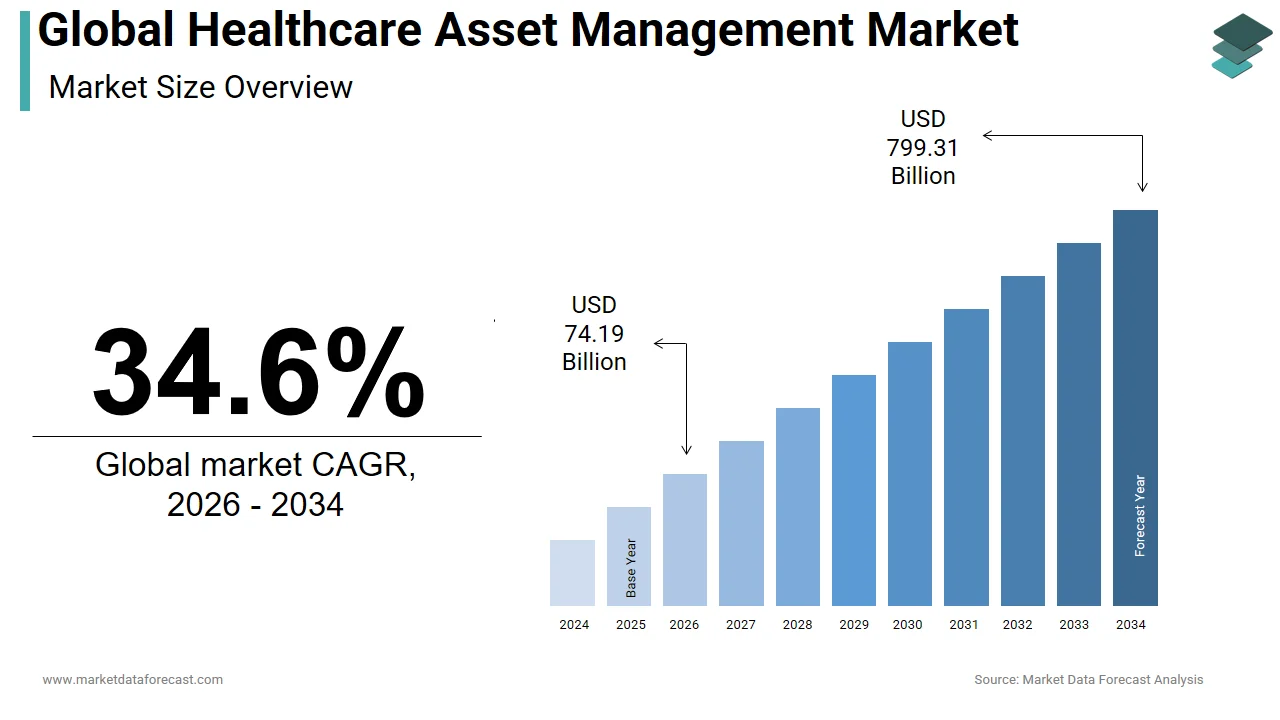
The global healthcare asset management market was valued at USD 55.12 billion in 2025. The global market is anticipated to grow at a CAGR of 34.6% from 2026 to 2034, reaching USD 799.31 billion by 2034, up from USD 74.19 billion in 2026.
Healthcare asset management refers to the maintenance, operation, planning, and acquisition of medical equipment, medical devices, and all physical property/assets of the hospital. The purpose of using a healthcare asset management system is to assure that all the medical equipment is on standards and maintains functionality along with proper, timely disposal and installment of equipment. This management system helps save time by reducing technical errors and providing better patient service. In addition, it helps maintain the efficiency of the machinery.
MARKET DRIVERS
Continuous developments in the healthcare IT sector and the increasing number of initiatives from the governments of several countries in favor of healthcare IT drive the healthcare asset management market growth. In addition, the growth of the healthcare asset management market is further driven by the rising need for proper patient records, maintenance records, and equipment tracking to avoid losing equipment and facing losses as a consequence. In addition, the management helps find the equipment fast in a time of need, reducing the time taken to assist a patient. Furthermore, healthcare departments invest vast amounts into tracking devices because they cost a lot and must be optimally used. Therefore, healthcare asset management helps improve the operational stability of healthcare systems, supporting them in providing better patient care.
Technological advancements in healthcare asset management systems further promote the healthcare asset management market growth.
The shift from traditional management systems to adopting IT in healthcare asset management is fueling the market's growth. In addition, introducing wireless healthcare asset management systems is helping boost market progress. Wireless systems have numerous advantages like flexibility, remote monitoring, portability, scalability, and others, making them a very beneficial addition to the healthcare department. Pharmaceuticals and laboratories are also increasingly interested in adopting healthcare asset management systems, further propelling the market's growth. In addition, radiofrequency identification (RFID) has also grown in pharmaceuticals, along with the need for proper supply chain management, encouraging the use of healthcare asset management systems.
REPORT COVERAGE
| REPORT METRIC | DETAILS |
| Market Size Available | 2025 to 2034 |
| Base Year | 2025 |
| Forecast Period | 2026 to 2034 |
| Segments Covered | By Product, Application & Region. |
| Various Analyses Covered | Global, Regional, and Country-Level Analysis, Segment-Level Analysis, Drivers, Restraints, Opportunities, Challenges; PESTLE Analysis; Porter’s Five Forces Analysis, Competitive Landscape, Analyst Overview of Investment Opportunities |
| Regions Covered | North America, Europe, Asia Pacific, Latin America, Middle East & Africa |
| Market Leaders Profiled | GE Healthcare, IBM Corporation, AiRISTA Flow, Elpas, CenTrak, Inc., ThingMagic, Sonitor, Stanley Healthcare, Versus Technology, Inc., and Zebra Technologies
|
SEGMENTAL ANALYSIS
By Product Insights
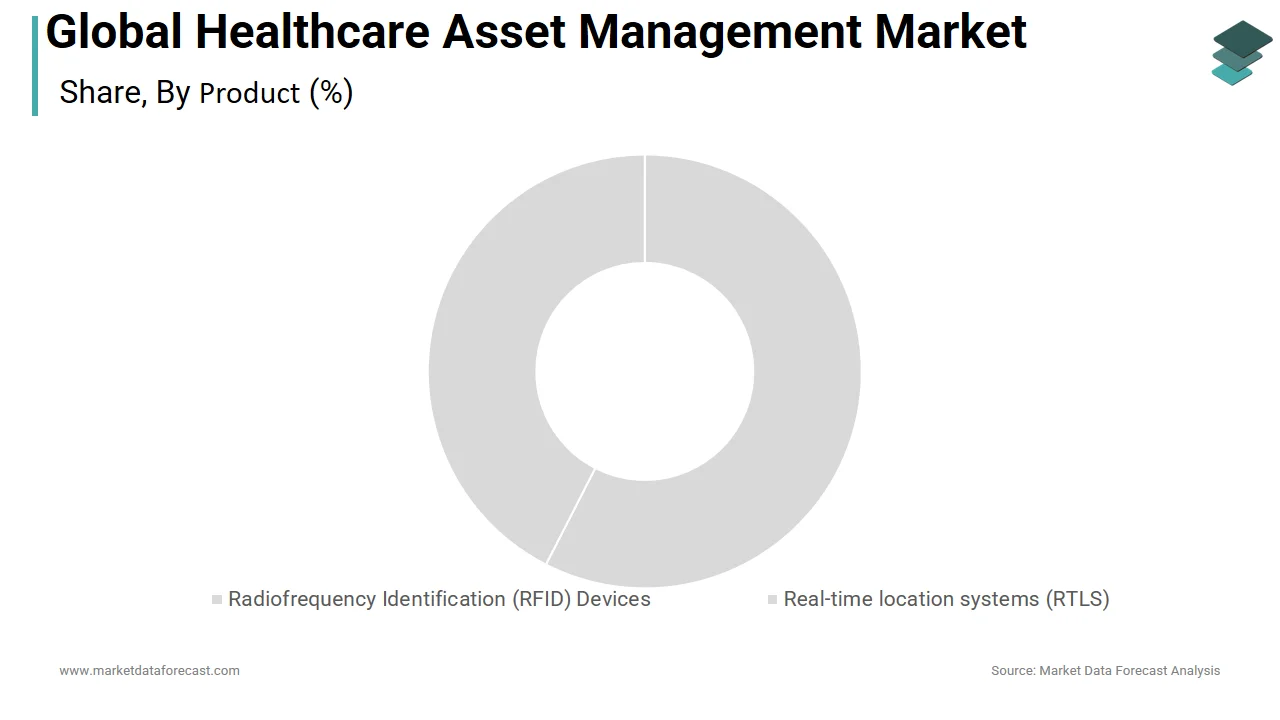
The radiofrequency identification (RFID) segment is expected to hold the largest share of the global healthcare asset management market during the forecast period. The segment's growth can be attributed to its increasing adoption due to its lowered costs and high efficiency. In addition, RFID tags are very low priced and provide good results, thus increasing their popularity. Furthermore, due to its pharmaceutical applications, this electronic identification technology is expected to grow during the forecast period.
The real-time location systems (RTLS) segment is also expected to grow lucratively during the forecast period due to the innovation of wireless systems.
By Application Insights
Based on the application, the equipment tracking segment is expected to grow significantly throughout the forecast period. The dominance of this segment is due to the need for equipment tracking for healthcare professionals to focus entirely on the patient's care and not panic looking for equipment. Additionally, it saves time and prevents the theft of equipment. Therefore, it is the dominating segment.
However, the patient tracking segment is also expected to grow lucratively during the forecast period due to the benefits like reduced patient accidents and keeping track of a patient's condition.
By End-User Insights
During the forecast period, the hospital segment is anticipated to occupy the most significant share of the market among the other end-user types. The hospitals' increasing patient populations, the public's trust in them, and the presence of top-notch medical equipment in hospitals all contribute to their domination. Hospitals are also the most lucrative industry since they provide patients with excellent treatment and security. Additionally, the increasing government investment in hospitals propels the segment's growth.
REGIONAL ANALYSIS
North America was the largest regional segment in the global market in 2024.
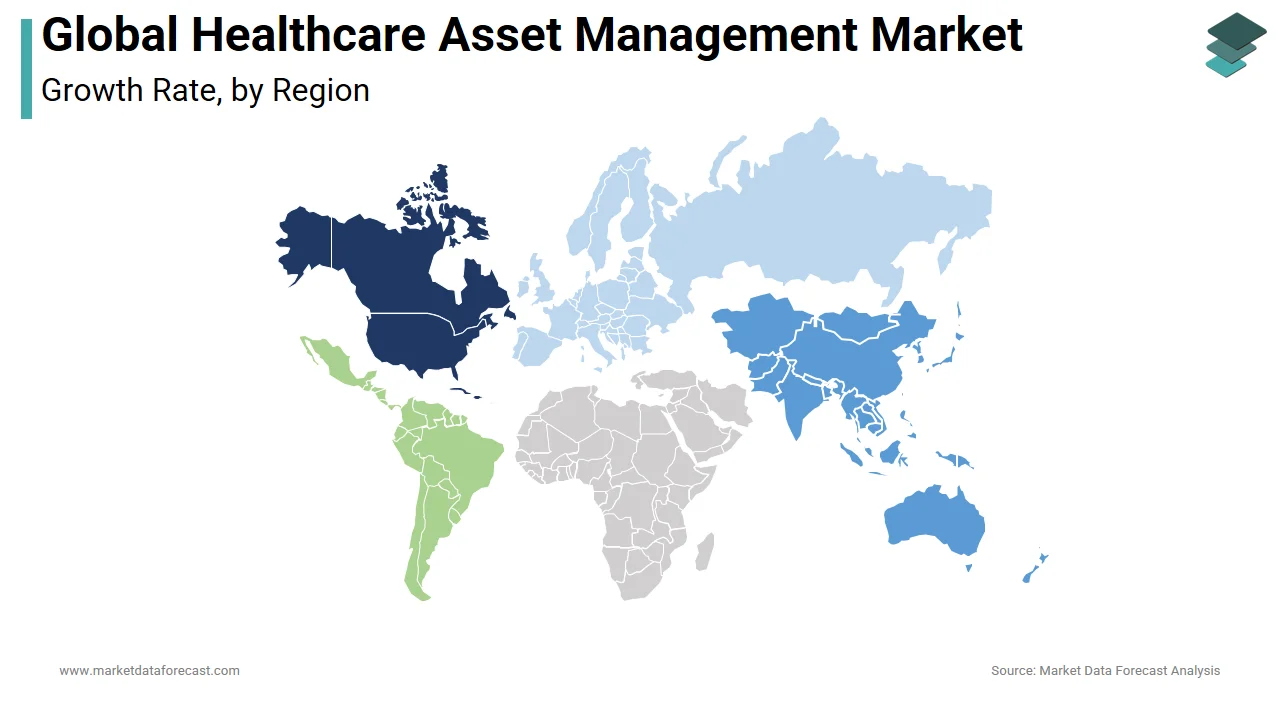
The dominance of North America is further anticipated to continue throughout the forecast period. North America has a high-quality clinical and laboratory research infrastructure. Additionally, the market's growth rate in this region would be boosted by the increasing use of low-cost medical systems in clinical diagnostic laboratories. The need for hospital asset management systems has increased due to the accessibility of reliable healthcare infrastructure, allowing quick installation. In addition, the area was among the first to implement the IT infrastructure. The penetration rate currently stands at 89.4% of the population, increasing the use of asset management solutions in the healthcare industry. Furthermore, more than 40% of the world's pharmaceutical market is in North America. Additionally, as the advantages of using asset management systems in healthcare become more well-known, there may be a rise in demand for the market.
Asia-Pacific is likely to register the highest CAGR in the global market during the forecast period.
Due to the technological advancement of developing nations and the rising number of middle-aged people living in this region, within countries like China, India, Japan, South Korea and others. Asia-Pacific is predicted to rise during the projection period. In addition, this region's market would expand faster due to increasing healthcare infrastructure spending and the emergence of unmet demand.
KEY MARKET PLAYERS
Some of the companies that are playing a dominating role in the global healthcare asset management market include
- GE Healthcare
- IBM Corporation
- AiRISTA Flow
- Elpas
- CenTrak, Inc.
- ThingMagic
- Sonitor
- Stanley Healthcare
- Versus Technology, Inc.
- Zebra Technologies
MARKET SEGMENTATION
This research report on the global healthcare asset management market has been segmented and sub-segmented based on product, application & region.
By Product
- Radiofrequency Identification (RFID) Devices
- Hardware
- Tags
- Passive Tags
- Low frequency
- High frequency
- Ultra-high frequency
- Active Tags
- Passive Tags
- Readers/Interrogators
- Antennas
- Accessories
- Tags
- Software
- Services
- Hardware
- Real-time location systems (RTLS)
- Hardware
- Tags/Badges
- Readers/Interrogators
- Software
- Services
- Hardware
By Application
- Hospital Asset Management
- Equipment Tracking and Management
- Patient Management
- Temperature and Humidity Control
- Staff Management
- Infection Control and Hand Hygiene Compliance
- Pharmaceutical Asset Management
- Drug Anti-counterfeiting
- Supply Chain Management
By End-User
- Laboratories
- Hospitals
- Others
By Region
- North America
- Europe
- Asia-Pacific
- Latin America
- Middle East and Africa