- Product Description Description
- Table of Contents TOC
- List of Table & Figure LOT
- Get Free Sample PDF Sample PDF
Market Size, 2025
$1.38 BnMarket Estimate, 2026
$1.44 BnMarket Forecast, 2034
$2.02 BnCAGR, 2026–2034
4.35%North America Gas Meter Market Size, Growth, Trends & Forecast (2026–2034)
The North American gas meter market size was calculated to be USD 1.38 billion in 2025, is anticipated to be worth USD 1.44 billion in 2026, and is expected to reach USD 2.02 billion by 2034, growing at a compound annual growth rate (CAGR) of 4.35% during the forecast period from 2026 to 2034. Growth is primarily propelled by infrastructure modernization, smart grid implementations, and stringent regulatory compliance and safety requirements.
Key Executive Metrics (At-a-Glance)
- 2025 Base Valuation: USD 1.38 billion
- 2026 Current Valuation: USD 1.44 billion
- 2034 Forecast Valuation: USD 2.02 billion
- Compound Annual Growth Rate (CAGR): 4.35% (2026–2034)
- Dominant Type Segment: Basic gas meters segment (capturing a substantial share in 2025)
- Fastest-Growing Type Segment: Smart gas meters segment (expanding at a CAGR of 14.2% from 2026 to 2034)
- Dominant Application Segment: Residential application segment (holding a significant share in 2025)
- Fastest-Growing Application Segment: Industrial application segment (expanding at a CAGR of 8.7% during the forecast period)
- Dominant Region: United States (holding a 92.1% share in 2025)
Core Market Drivers
- Infrastructure Modernization: Systemic replacement of aging mechanical meters with intelligent measurement systems supporting smart grid functionalities, real-time monitoring, and leak detection.
- Regulatory Compliance and Safety: Stringent frameworks and environmental standards (such as EPA methane monitoring rules) mandating high accuracy and continuous flow measurement.
Primary Market Restraints & Challenges
- High Initial Capital Outlay: Substantial costs associated with advanced meter deployment, installation labor, and integration, posing challenges particularly for smaller municipal utilities.
- Cybersecurity and Data Privacy: Risks related to connected metering infrastructure, potential cyber-attack entry points, and strict data protection regulations.
North America Gas Meter Market Segmentation Breakdown
| Segment Category | Leading Sub-Segment | Fastest-Growing Sub-Segment |
|---|---|---|
| By Type | Basic Gas Meters Segment (Dominant in 2025) | Smart Gas Meters Segment (CAGR of 14.2%) |
| By Application | Residential Application (Dominant share in 2025) | Industrial Application (CAGR of 8.7%) |
| By Region | United States (92.1% share in 2025) | Canada & Rest of North America |
Major Industry Players Profiled
Key market leaders shaping the North American gas meter landscape include Itron, Sensus (Xylem), Honeywell, Badger Meter, Landis+Gyr, Aclara Technologies, Diehl Metering, Elster Group, Neptune Technology Group, Census Instruments, Mueller Systems, Metrix Instrument Company, Romet Limited, and Schneider Electric.
North America Gas Meter Market Size
The North American gas meter market size was calculated to be USD 1.38 billion in 2025 and is anticipated to be worth USD 2.02 billion by 2034, growing from USD 1.44 billion in 2026 at a CAGR of 4.35% during the forecast period.
A gas meter refers to the measurement devices designed to accurately quantify natural gas consumption across residential, commercial, and industrial sectors. These precision instruments serve as critical infrastructure components within the continent's extensive natural gas distribution network, facilitating accurate billing, consumption monitoring, and regulatory compliance. Modern gas meters incorporate advanced technologies, including ultrasonic sensing, magnetic flow measurement, and digital communication protocols that enable real-time data transmission and remote monitoring capabilities. According to sources, the United States maintains an extensive and integrated network of natural gas pipelines, which continues to expand to meet consumer demand and enhance energy distribution efficiency and safety. The number of natural gas residential customers has shown a steady upward trend in the U.S. over the last decade, indicating its continued popularity as a primary energy source for homes. Natural gas consistently represents a significant and primary portion of Canada's total energy consumption, necessitating comprehensive systems for accurate measurement and tracking of distribution and usage patterns. The integration of smart grid technologies has transformed traditional mechanical meters into intelligent measurement systems capable of two-way communication, enabling utilities to optimize distribution networks while providing consumers with detailed consumption insights. Regular testing and calibration of gas meters are critical practices within the industry, with frequencies determined by various regulatory bodies and manufacturer guidelines to ensure ongoing measurement accuracy and safety standards. The market's evolution reflects broader energy sector trends toward digitization, sustainability, and enhanced operational efficiency that characterize modern utility infrastructure development.
MARKET DRIVERS
Infrastructure Modernization and Smart Grid Implementation
The comprehensive modernization of the regional gas distribution infrastructure acts as a key growth enabler of the North American gas meter market. Utilities across the continent are systematically replacing aging mechanical meters with intelligent measurement systems that support smart grid functionalities and enhanced operational capabilities. Gas utility infrastructure modernization is a pervasive trend, with a substantial number of utilities across North America moving forward with advanced technologies, including smart meters, to improve efficiency and reliability. These programs typically involve the installation of advanced metering infrastructure that enables real-time consumption monitoring, leak detection, and automated billing processes. The U.S. government, through the Infrastructure Investment and Jobs Act, is making significant investments in modernizing the nation's energy infrastructure, with a focus on enhancing electric grid resilience and integrating advanced technologies. Regional utilities have reported that smart meter installations reduce operational costs throughthe elimination of manual meter reading requirements and improved maintenance scheduling. The integration of Internet of Things connectivity in modern gas meters enables predictive maintenance capabilities that can identify potential equipment failures before they result in service disruptions. Utilities that deploy smart metering systems and enhanced grid monitoring technologies generally observe an improvement in grid management, including faster detection and restoration of power outages. The modernization trend extends beyond residential applications to commercial and industrial sectors, where advanced metering solutions provide detailed consumption analytics that support energy efficiency optimization and regulatory compliance requirements.
Regulatory Compliance and Safety Requirements
Stringent regulatory frameworks governing gas meter accuracy, safety standards, and environmental monitoring have fuelled the expansion of the North American gas meter market. These frameworks have created substantial demand for advanced metering solutions throughout North America. Regulatory bodies. Regulatory bodies across various states generally establish requirements for gas utility companies to periodically test meters or follow manufacturer recommendations, moving toward risk-based reassessment intervals for pipeline integrity management rather than a fixed universal timeline for meter calibration. State utility commissions have implemented additional requirements for leak detection capabilities. Industry standards organizations, such as the American National Standards Institute and the International Organization of Legal Metrology, establish consensus-based performance and accuracy criteria for various types of gas meters to ensure consistent and reliable measurement in commercial and residential applications. Environmental protection agencies have introduced methane emission monitoring requirements that mandate continuous gas flow measurement at distribution points to track fugitive emissions. The Environmental Protection Agency's Natural Gas STAR program encourages utilities to implement advanced metering technologies that can detect and quantify methane leaks. Insurance providers have also influenced market demand by offering premium discounts to utilities that implement certified safety-compliant metering systems, creating additional financial incentives for equipment upgrades.
MARKET RESTRAINTS
High Initial Investment and Installation Costs
The substantial capital requirements associated with advanced gas meter deployment restrict the growth of the North American gas meter market. These barriers are particularly challenging for smaller utilities and municipal gas distribution systems with limited financial resources. Modern smart gas meters typically cost more than traditional mechanical meters. The total cost of ownership extends beyond initial equipment purchases to include installation labor, system integration, communication infrastructure, and ongoing maintenance expenses that can increase project costs compared to basic meter replacement programs. Small municipal utilities servinga smallerr number of customers often lack the financial capacity to undertake comprehensive meter modernization projects without external funding support. Federal and state grant programs provide partial funding assistance, but application processes are complex and competitive. The integration of new metering systems with existing utility infrastructure often requires costly software upgrades and staff training programs that add to overall project budgets. In addition, the disruption to customer service during meter replacement activities creates indirect costs related to customer complaints, service restoration, and potential revenue loss during installation periods. Rural gas distribution systems face particular challenges due to dispersed customer locations that increase per-unit installation costs and extend project timelines.
Cybersecurity Vulnerabilities and Data Privacy Concerns
The increasing connectivity and data transmission capabilities of modern gas meters have introduced cybersecurity risks that ultimately impede the expansion of the North American gas meter market. These risks create hesitancy among utilities and regulators regarding widespread deployment. Advanced metering infrastructure creates potential entry points for cyber-attacks that could compromise utility operations, customer data, or gas distribution system integrity. Customer privacy concerns have emerged as utilities collect increasingly detailed consumption data that can reveal household occupancy patterns, lifestyle behaviors, and energy usage habits. The Federal Trade Commission has issued guidelines requiring utilities to implement comprehensive data protection measures for smart meter systems, including encryption protocols, access controls, and regular security audits, which adds to system implementation costs. The interconnected nature of smart meter networks means that a single security breach could potentially affect thousands of customers and compromise entire distribution segments. Insurance companies have responded by increasing cybersecurity liability premiums for utilities operating connected metering systems. These security concerns have led some utilities to delay or scale back smart meter deployment programs until robust security frameworks can be established.
MARKET OPPORTUNITIES
Internet of Things Integration and Connected Infrastructure
The convergence of gas metering technology with Internet of Things ecosystems paves the way for fresh opportunities for trade participants, which is expected to drive the growth of the North American gas meter market. These participants can develop interoperable solutions that integrate seamlessly with broader smart city and utility infrastructure initiatives. Major metropolitan areas are initiating smart city programs that include utility infrastructure modernization. These initiatives create demand for gas meters equipped with internet-of-interconnectivity capabilities to communicate with municipal systems. Connected gas meters provide real-time data to utility management platforms. This data integration supports predictive maintenance, demand forecasting, and network optimization. These technological advancements are intended to improve overall operational efficiency. The integration of artificial intelligence and machine learning algorithms with metering data allows utilities to identify consumption patterns, detect anomalies, and optimize distribution pressure settings that reduce energy waste and infrastructure wear. Industrial Internet of Things platforms are increasingly incorporating gas metering data to provide comprehensive energy management solutions for commercial and industrial customers seeking to optimize their energy consumption profiles. The emergence of 5G wireless networks provides enhanced connectivity options for gas meters in previously underserved areas, expanding market reach and enabling new deployment scenarios. Edge computing capabilities integrated into modern gas meters enable local data processing and decision-making that reduces latency and bandwidth requirements while improving system reliability. The standardization of communication protocols such as MQTT and CoAP facilitates interoperability between different vendor systems, creating opportunities for specialized meter manufacturers to participate in larger smart infrastructure projects.
Renewable Natural Gas and Biogas Measurement Applications
The expanding renewable natural gas and biogas sectors are emerging potential opportunities for specialized gas metering solutions, which are anticipated to propel the expansion of the North American gas meter market. These solutions are designed to handle variable gas compositions and unique measurement challenges associated with sustainable fuel sources. Unlike conventional natural gas, renewable gas sources exhibit variable compositions that require specialized metering technologies capable of maintaining accuracy across changing gas properties, es including moisture content, hydrogen sulfide concentrations, and calorific value variations. The California Air Resources Board's Low Carbon Fuel Standard program creates demand for certified measurement systems that can accurately quantify renewable gas credits and verify compliance with environmental regulations. Agricultural biogas projects, landfill gas recovery systems, and wastewater treatment facilities represent growing market segments that require specialized metering solutions adapted to their unique operational environments. The integration of gas quality measurement capabilities with flow measurement systems enables comprehensive tracking of renewable gas characteristics that support carbon credit verification and trading programs. Pipeline operators are investing in advanced metering infrastructure to accommodate increasing renewable gas injection volumes, with a portion of new meter installations specifically designed for renewable gas applications. The development of portable and modular metering solutions creates opportunities for temporary measurement applications during biogas project commissioning and system optimization phases.
MARKET CHALLENGES
Technical Complexity and Integration Difficulties
The increasing sophistication of modern gas metering technology has created technical challenges related to system integration, interoperability, and operational complexity, which in turn inhibit the growth of the North American gas meter market. Overcoming these issues requires specialized expertise and resources. Advanced metering systems incorporate multiple technologies, including ultrasonic sensors, pressure transmitters, temperature compensation systems, and communication modules that must function cohesively to provide accurate measurements. Smart meter deployment projects often encounter technical integration challenges. These issues can lead to delays in implementation timelines. Furthermore, such complications typically result in increased project costs. Legacy utility infrastructure often lacks the communication protocols and data management capabilities required to support modern metering systems, necessitating extensive system upgrades and staff retraining programs. The complexity of configuring advanced metering systems to meet specific utility requirements can extend installation times compared to traditional meter replacements, according to a study. Integration with existing customer information systems, billing platforms, and outage management systems requires careful coordination and testing to ensure seamless operation and data accuracy. The diversity of metering technologies and vendor solutions creates interoperability challenges when utilities attempt to standardize equipment across different service territories or integrate acquisitions. Technical support requirements for advanced metering systems are significantly higher than traditional meters, with utilities reporting more service calls and longer resolution times for complex metering equipment malfunctions.
Regulatory Harmonization and Standardization Issues
The fragmented regulatory landscape across the regional jurisdictions continues to be an issue for gas meter manufacturers and utilities, which further obstructs the expansion of the North American gas meter market. They are seeking to deploy standardized solutions across multiple service territories. Each state and provincial regulatory authority maintains distinct approval processes, technical specifications, and compliance requirements for gas metering equipment, resulting in market fragmentation and increased development costs. Gas meter approval processes vary between different jurisdictions, requiring manufacturers to obtain separate certifications for each market they wish to serve, as per research. International standards organizations, such as the International Organization for Standardization,n have developed metering specifications that are not uniformly adopted across North American regulatory bodies, creating additional compliance complexities for global manufacturers. The timing of regulatory changes and approval processes can extend product development cycles by several months, delaying market entry and reducing competitive advantage for innovative metering solutions. Cross-border trade complications arise when Canadian and U.S. regulatory requirements differ, preventing seamless equipment deployment across international utility systems. The rapid pace of technological advancement in metering systems often outpaces regulatory framework updates, creating uncertainty for manufacturers investing in next-generation metering technologies. Utility procurement processes must navigate multiple regulatory approval requirements, extending purchasing cycles and increasing administrative burden for both buyers and suppliers.
REPORT COVERAGE
| REPORT METRIC | DETAILS |
| Market Size Available | 2025 to 2034 |
| Base Year | 2025 |
| Forecast Period | 2026 to 2034 |
| CAGR | 4.35% |
| Segments Covered | By Type, Application, And Region |
| Various Analyses Covered | Global, Regional & Country Level Analysis; Segment-Level Analysis; DROC, PESTLE Analysis; Porter’s Five Forces Analysis; Competitive Landscape; Analyst Overview of Investment Opportunities |
| Regions Covered | US, Canada, and the rest of North America |
| Market Leaders Profiled | Itron, Sensus (Xylem), Honeywell, Badger Meter, Landis+Gyr, Aclara Technologies, Diehl Metering, Elster Group, Neptune Technology Group, Census Instruments, Mueller Systems, Metrix Instrument Company, Romet Limited, Schneider Electric |
SEGMENTAL ANALYSIS
By Type Insights
In 2025, the basic gas meters segment remained the prominent segment in the North America gas meter market by capturing a substantial share. The prominence of the basic gas meter segment is attributed to cost considerations, established reliability records, and the absence of immediate regulatory mandates requiring replacement in many jurisdictions. This substantial market share reflects the continued prevalence of traditional mechanical metering systems across established residential and commercial installations where replacement cycles have not yet necessitated technology upgrades. Basic meters continue to serve millions of existing connections where utility modernization programs have not yet been implemented or where economic constraints prevent immediate technology transitions. The fundamental cost advantage of basic gas meters continues to drive their widespread adoption and retention across North American utility systems, particularly in price-sensitive market segments and regions with limited modernization funding. Basic mechanical gas meters have a lower upfront cost compared to smart alternatives. However, smart meters offer significant long-term operational savings by eliminating manual readings and improving accuracy. Municipal utilities serving smaller communities often operate under strict budget constraints that prioritize essential maintenance over technology upgrades. As per a study, a portion of rural utilities cite capital expenditure limitations as primary barriers to smart meter deployment. The total cost of ownership for basic meters remains significantly lower over their operational lifespan, as they require minimal electronic infrastructure, reduced maintenance protocols, and no ongoing communication network support. Utility ratepayer advocacy groups have successfully lobbied against rate increases necessary for smart meter programs in several states. The absence of mandatory replacement requirements in many jurisdictions allows utilities to defer modernization investments. The established reliability and straightforward operational characteristics of basic gas meters provide compelling advantages that support their continued market dominance, particularly in applications where complex functionality is unnecessary. Mechanical gas meters have demonstrated longer operational lifespans under normal conditions, with lower failure rates. The simplicity of basic meter designs reduces maintenance complexity and technician training requirements, allowing utilities to maintain service levels with minimal specialized expertise. Rural and remote installations particularly benefit from basic meter reliability, as these systems function independently of electronic infrastructure that may be vulnerable to power outages or communication failures. Emergency response scenarios favor basic meters due to their independence from external power sources and communication networks, ensuring continued operation during natural disasters or system failures. The absence of cybersecurity vulnerabilities in mechanical systems eliminates potential attack vectors that could compromise utility operations or customer data, providing additional operational security benefits that large utilities increasingly value.
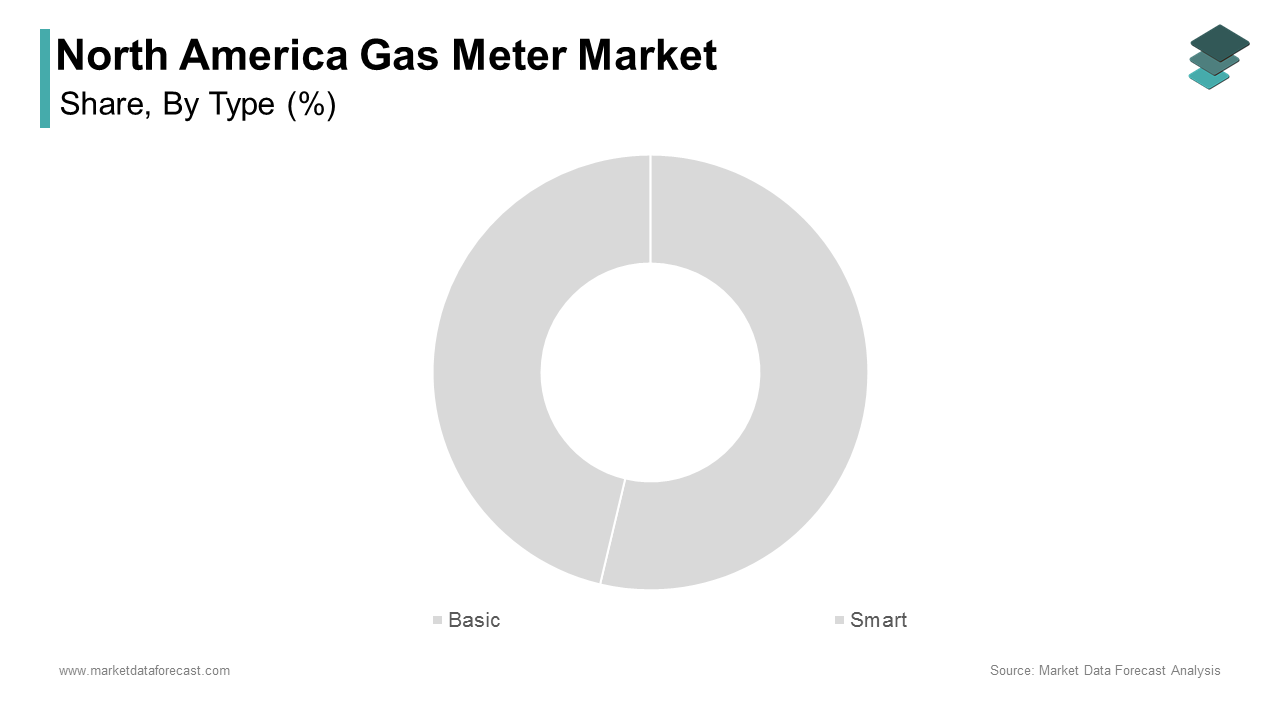
The smart gas meters segment is likely to experience the fastest CAGR of 14.2% from 2026 to 2034. The swift growth of the smart gas meters segment is propelled by declining technology costs, improved performance capabilities, and increasing regulatory mandates that require enhanced measurement accuracy and data collection capabilities. This rapid expansion reflects the accelerating adoption of advanced metering infrastructure as utilities recognize the operational benefits and regulatory compliance advantages of intelligent metering systems. Governmental regulatory initiatives across North American jurisdictions have emerged as primary catalysts driving the rapid adoption of smart gas metering technologies, with utilities responding to mandatory modernization requirements and enhanced measurement standards. State utility commissions have introduced comprehensive smart meter deployment mandates. The Environmental Protection Agency's methane emission reduction programs incentivize utilities to implement smart metering systems that can detect and quantify fugitive gas leaks, with participating utilities eligible for federal grant funding covering a portion of equipment costs. Regional air quality management districts have established leak detection requirements that specifically mandate smart meter installation in high-risk areas, creating immediate deployment opportunities for advanced metering solutions. The North American Electric Reliability Corporation's grid modernization standards have influenced gas utility infrastructure investments, with compliance requirements extending to gas distribution systems serving critical infrastructure facilities. Insurance providers have introduced premium discounts for utilities operating smart metering systems. The substantial operational efficiency improvements and long-term cost savings achievable through smart gas meter deployment have created compelling economic incentives that accelerate market adoption across diverse utility segments. Smart metering systems eliminate the need for manual meter reading activities, which reduces labor costs. Automated data collection capabilities enable utilities to implement time-of-use pricing structures and demand response programs that can increase revenue while improving load management efficiency. Predictive maintenance capabilities integrated into smart metering systems reduce equipment failure rates and extend meter lifespan. Leak detection and pressure monitoring functions prevent revenue loss from undetected gas leaks. The integration of smart meter data with utility management systems enables more accurate demand forecasting and infrastructure planning, reducing capital expenditure requirements for distribution system upgrades based on utility capital planning analysis reports. Customer service improvements through real-time consumption data and faster outage detection have reduced customer complaint volumes and improved customer satisfaction scores.
By Application Insights
The residential application segment dominated the North American gas meter market by accounting for a significant share in 2025. The supremacy of the residential application segment is credited to continuous residential construction activity, population growth in gas-served areas, and the replacement cycle of existing residential meters that require periodic calibration and upgrade. This overwhelming market share shows the extensive residential natural gas infrastructure across North America and the fundamental requirement for individual metering at each residential connection point. Residential gas meter installations represent the largest volume component of the overall market due to the sheer number of individual connections served. New residential construction activity serves as the primary driver sustaining residential gas meter demand across North America, with each new housing unit requiring dedicated metering infrastructure as part of utility service connections. Natural gas availability influences residential development patterns. Multi-family housing developments, whicomprisesed a portion of total new residential construction, represent particularly strong demand drivers due to bulk metering requirements for individual units and common area services. Suburban expansion trends have concentrated residential gas meter demand in developing metropolitan areas. Regional variations in residential construction activity create geographic demand concentrations, with Texas, California, and Florida accounting for a portion of total U.S. residential gas meter installations according to utility installation tracking data. The trend toward larger residential units and luxury home construction has increased demand for premium metering solutions that can accommodate higher flow rates and enhanced measurement accuracy requirements. Regular meter replacement and mandatory calibration schedules create sustained demand for residential gas meters across North American utility service territories, ensuring consistent market activity regardless of new construction levels. The average operational lifespan of residential gas meters ranges from 5 to 20 years, depending on environmental conditions and usage patterns, creating predictable replacement demand that utilities plan into their capital expenditure budgets. Aging meter populations in established residential neighborhoods generate concentrated replacement opportunities. Utility modernization programs often prioritize residential meter upgrades to improve customer service capabilities and regulatory compliance, with residential segments typically comprising a notable share of total smart meter deployment initiatives. The integration of advanced metering infrastructure in residential applications enables utilities to implement new rate structures and customer engagement programs that improve revenue collection and customer satisfaction metrics. Regional climate variations affect meter replacement timing, with northern states experiencing higher replacement rates due to freeze-thaw cycles that accelerate meter component wear and reduce operational lifespan.
By Industrial Application Insights
The industrial application segment is on the rise and is expected to be the fastest-growing segment in the market by witnessing a CAGR of 8.7% during the forecast period due to increasing industrial gas consumption, enhanced measurement accuracy requirements, and the implementation of sophisticated energy management systems that demand advanced metering capabilities. Industrial facilities require specialized metering solutions that can accommodate high flow rates, varying gas compositions, and continuous operation under demanding environmental conditions. The resurgence of industrial manufacturing activity across North America has created substantial demand for advanced gas metering solutions that can support increased production capacity and enhanced energy management requirements. Energy-intensive industries such as chemicals, metals, and food processing account for a portion of total industrial natural gas consumption. The reshoring of manufacturing operations from overseas locations has created new industrial gas meter demand. Industrial facilities require specialized high-capacity gas meters that can accommodate flow rates ranging from 1,000 to 50,000 cubic feet per hour, creating demand for premium metering solutions that command higher average selling prices. The implementation of industrial energy management systems has increased the importance of accurate gas measurement for cost allocation, efficiency optimization, and regulatory compliance purposes. Regional manufacturing hubs such as the Gulf Coast, Great Lakes, and Pacific Northwest have experienced particularly strong industrial gas meter demand. Industrial facilities increasingly rely on advanced gas metering systems to optimize production processes, reduce energy consumption, and meet corporate sustainability objectives that require detailed energy tracking and reporting capabilities. Advanced industrial gas meters provide real-time flow data that enables process control systems to optimize combustion efficiency, reduce waste heat, and minimize energy consumption across manufacturing operations. Corporate sustainability initiatives have created demand for comprehensive energy monitoring systems that track gas consumption by production line, shift, or product batch to support carbon footprint reduction goals. The implementation of ISO 50001 energy management standards requires industrial facilities to maintain detailed energy consumption records, with gas metering systems providing essential data for compliance reporting and certification processes. Industrial facilities implementing combined heat and power systems require specialized metering solutions that can track both fuel consumption and energy production to optimize system performance and maximize economic returns. The integration of industrial gas metering data with enterprise resource planning systems enables comprehensive cost accounting and operational efficiency analysis that supports strategic decision-making and continuous improvement initiatives.
REGIONAL ANALYSIS
United States Gas Meter Market Analysis
The United States led the North American gas meter market and held a 92.1% share in 2025. The leading position of the US market is attributed to the country's extensive natural gas infrastructure, large consumer base, and robust industrial sector that creates substantial demand for diverse metering solutions across residential, commercial, and industrial applications. The U.S. market's size and complexity support innovation in metering technologies while providing opportunities for both domestic and international manufacturers to participate in various market segments. The scale of the U.S. natural gas distribution system creates unparalleled demand for gas metering solutions, with millions of residential customers requiring individual metering infrastructure. Each residential connection typically requires a dedicated gas meter, creating a massive installed base that drives replacement demand through regular calibration cycles and technology upgrades. As per sources, natural gas accounts for a notable share of total U.S. energy consumption, with residential and commercial sectors comprising a portion of total natural gas demand. Industrial gas consumption, which requires specialized high-capacity metering solutions, represents a considerable share of total U.S. natural gas usage and commands premium pricing due to the complexity of measurement requirements. Regional variations in gas meter demand reflect population distribution and industrial concentration patterns. The diversity of climate conditions across the country creates varied metering requirements, from freeze-resistant designs needed in northern states to high-temperature-tolerant solutions required in southwestern markets.
Canada Gas Meter Market Analysis
Canada is the next prominent country in the North American gas meter market hierarchy because of its significant natural gas resources, extensive distribution infrastructure, and regulatory environment that supports advanced metering technology adoption. The Canadian market's characteristics align closely with U.S. demand patterns while incorporating unique regional factors related to climate conditions and regulatory frameworks. Canada's position as a major natural gas producer and exporter creates strong domestic demand for sophisticated metering solutions that can accommodate varying gas compositions and quality specifications required for pipeline transportation and international trade. Natural gas accounts for a portion of the country's total energy consumption, with residential heating representing the largest end-use application requiring accurate metering infrastructure. Provincial regulatory authorities have implemented progressive metering standards that encourage smart meter adoption. The cold climate conditions prevalent across much of Canada necessitate specialized metering solutions designed to operate reliably in extreme temperatures ranging from -40°C to +40°C, creating demand for premium metering products that command higher average selling prices. Cross-border trade relationships with the U.S. provide additional market opportunities. The concentration of gas meter manufacturing in provinces such as Ontario and Alberta has created regional supply chain efficiencies that benefit both domestic consumption and international export markets.
COMPETITION OVERVIEW
The North American gas meter market exhibits highly competitive dynamics characterized by the presence of established multinational corporations, specialized metering technology providers, and emerging innovative startups vying for market share across diverse application segments. The competitive landscape is shaped by factors including technological capabilities, product quality, pricing strategies, customer service excellence, and regulatory compliance expertise. Large multinational companies leverage their extensive resources, global manufacturing capabilities, and comprehensive product portfolios to maintain dominant market positions through economies of scale and broad market coverage. However, specialized metering companies compete effectively by focusing on niche applications, superior technical expertise, and personalized customer service that larger competitors may struggle to replicate efficiently. The market's fragmentation creates opportunities for regional players to capture specialized segments while established companies pursue market consolidation through strategic acquisitions and partnerships. Competition intensity varies across application segments, with residential markets experiencing price-based competition while industrial segments focus on differentiation through advanced features, measurement accuracy, and customized solutions. The increasing importance of digital technologies and smart grid integration has created new competitive dimensions where companies must balance traditional competitive factors with emerging requirements related to connectivity, data management, and cybersecurity protection. Market participants must continuously adapt to evolving regulatory requirements, technological advancements, and changing customer preferences to maintain competitive positioning and sustainable growth trajectories.
KEY MARKET PLAYERS
A few major players of the North American gas meter market include
- Itron
- Sensus (Xylem)
- Honeywell
- Badger Meter
- Landis+Gyr
- Aclara Technologies
- Diehl Metering
- Elster Group
- Neptune Technology Group
- Census Instruments
- Mueller Systems
- Metrix Instrument Company
- Romet Limited
- Schneider Electric
Top Strategies Used by Key Market Participants
Leading North American gas meter manufacturers have increasingly focused on forming strategic partnerships with technology providers, utility companies, and system integrators to enhance their market reach and technological capabilities. These collaborative arrangements enable meter manufacturers to access specialized expertise in areas such as communication technologies, data analytics, and cybersecurity that are essential for modern metering solutions. Partnership strategies often involve joint development initiatives that combine complementary strengths to create innovative metering products that address specific market needs. Companies are also establishing alliances with utility operators to participate in pilot programs and field trials that demonstrate new metering technologies and validate performance claims. These strategic relationships provide valuable market intelligence and customer feedback that inform product development decisions and market positioning strategies. Additionally, partnerships with academic institutions and research organizations support long-term innovation initiatives and emerging technology development. The collaborative approach enables smaller, specialized meter manufacturers to compete effectively against larger, diversified companies by leveraging partner resources and market access capabilities.
Product Innovation and Technology Development
Market leaders have prioritized continuous product innovation and advanced technology development to differentiate their offerings and maintain competitive advantages in the evolving gas meter market. This strategy involves substantial investment in research and development activities focused on improving measurement accuracy, enhancing communication capabilities, and integrating advanced sensor technologies. Companies are developing next-generation metering solutions that incorporate artificial intelligence, machine learning, and predictive analytics to provide utilities with enhanced operational insights and automated decision-making capabilities. Innovation efforts also focus on addressing emerging regulatory requirements and environmental standards that influence meter design and performance specifications. The development of modular metering platforms enables manufacturers to offer customizable solutions that can be adapted to specific customer requirements and application needs. Companies are also investing in sustainable manufacturing processes and eco-friendly materials that align with growing environmental consciousness among utilities and consumers. Product innovation strategies include the development of portable metering solutions, temporary measurement systems, and specialized meters for renewable gas applications that address emerging market opportunities.
Geographic Expansion and Market Penetration
North American gas meter manufacturers have pursued aggressive geographic expansion strategies to increase market coverage and capture opportunities in emerging markets throughout the continent. This approach involves establishing local manufacturing facilities, distribution networks, and service centers that provide enhanced customer support and reduced delivery times. Companies are targeting regional markets with high growth potential, including developing urban areas, industrial corridors, and regions undergoing infrastructure modernization initiatives. Market penetration strategies include developing product portfolios specifically designed for regional climate conditions, regulatory requirements, and customer preferences that vary across different geographic areas. Manufacturers are also establishing partnerships with local distributors and system integrators to gain market insights and establish strong customer relationships in new territories. The geographic expansion strategy extends to cross-border opportunities, with companies developing solutions that meet regulatory standards and technical requirements in multiple jurisdictions. Additionally, manufacturers are investing in regional training programs and technical support capabilities that ensure successful product deployment and customer satisfaction in diverse market environments.
Leading Players in the North America Gas Meter Market
- Honeywell International stands as a leading provider of advanced gas metering solutions in North America, leveraging its extensive industrial automation expertise to deliver sophisticated measurement technologies. The company's gas meter portfolio encompasses both residential and commercial applications, featuring smart metering systems with integrated communication capabilities and enhanced accuracy standards. Honeywell's strength lies in its ability to combine traditional metering expertise with cutting-edge digital technologies, creating solutions that support utility modernization initiatives and smart grid integration. Their metering products incorporate advanced sensor technologies, wireless communication protocols, and data analytics capabilities that enable utilities to optimize operations and improve customer service. The company's global research and development network ensures continuous innovation in metering technologies while maintaining compliance with evolving regulatory standards. Honeywell's comprehensive service offerings include system integration, installation support, and ongoing maintenance programs that provide utilities with end-to-end metering solutions. Their strategic partnerships with major utilities and technology providers have established strong market presence across diverse geographic regions and customer segments.
- Siemens AG maintains a prominent position in the North American gas meter market through its comprehensive portfolio of intelligent metering solutions designed for residential, commercial, and industrial applications. The company's gas metering technologies integrate seamlessly with broader smart infrastructure initiatives, providing utilities with advanced measurement capabilities that support digital transformation objectives. Siemens' metering solutions feature state-of-the-art sensor technologies, secure communication protocols, and sophisticated data management capabilities that enable real-time monitoring and analytics. Their commitment to innovation is demonstrated through continuous investment in research and development activities that focus on improving measurement accuracy, reducing maintenance requirements, and enhancing cybersecurity protection. The company's global manufacturing footprint ensures reliable supply chain capabilities while maintaining quality standards across diverse product lines. Siemens' extensive service network provides comprehensive support, including installation, calibration, and technical assistance that ensures optimal meter performance throughout operational lifecycles. Strategic acquisitions and partnerships have strengthened Siemens' market position while expanding technological capabilities and geographic reach across North American utility markets.
- Badger Meter represents a specialized focus on precision flow measurement solutions, establishing strong market recognition for innovative gas metering technologies that serve diverse industrial and municipal applications. The company's expertise in ultrasonic and magnetic flow measurement technologies has enabled the development of advanced gas metering solutions that provide superior accuracy and reliability compared to traditional mechanical systems. Badger Meter's product portfolio emphasizes industrial applications where high-precision measurement is critical for process optimization and cost management. Their metering solutions incorporate advanced materials and manufacturing techniques that ensure long-term performance in demanding operating environments. The company's commitment to customer service is demonstrated through comprehensive technical support programs, calibration services, and training initiatives that help customers maximize meter performance and lifespan. Badger Meter's research and development efforts focus on emerging measurement challenges and regulatory requirements that influence utility operations and compliance needs. Strategic market positioning has enabled the company to capture significant market share in specialized applications while maintaining strong relationships with key industrial customers and municipal utilities throughout North America.
MARKET SEGMENTATION
This research report on the North American gas meter market has been segmented and sub-segmented based on type, application, and region.
By Type
- Basic
- Smart
By Application
- Residential
- Commercial
- Industrial
By Region
- US
- Canada
- Mexico
- Rest of North America